F O R U M O B J E C T I V E
To provide a strong
foundation of
interface among
multidisciplinary
teams capable to
talk in language of
science without
confusion
To provide opportunity of
discussion and transfer of
knowledge among
pharmaceutical professionals
of multidisciplinary
educational background
A platform for
engineers to
exchange
knowledge and
learn expanding
regulatory
expectations
Thanks All of you &
Team
Almas, Noman, Zainab and Esther
Ref: USFDA, ISPE, WHO
1
Discussion Forum on
Pharmaceutical Engineering
(Designing & Maintenance of Pharmaceutical Manufacturing Facilities)
Forum’s Opening talk
Roohi B. Obaid, Deputy Director,
Drug Regulatory Authority of Pakistan
Not the view of
DRAP
Current
judgment of
speaker
No obligation
on DRAP
Regulatory
experience
It has nothing to do
with any specific
commercial
product
It is just a
knowledge sharing
exercise nothing
more than that
D
I
S
C
L
A
I
M
E
R
Science Regulation Quality
Pharmaceutical Engineering
Designing & Maintenance of Pharmaceutical Manufacturing Facilities
What, Why & How
What will happen if design is not
part of GMP standards???
Discuss and enlist
Confusion
in
Flow & Holding
Prevent
Contamination & mix up
D
I
F
F
I
C
U
L
T
I
E
S
What will happen if Cleaning & Maintenance
is not part of GMP standards???
Discuss and enlist
Lets think
In a working room air supply and exit both are on the
ceiling at two different terminals
How can we make it efficient and compliant
Insanitary Condition & Contamination
Microorganisms, dust, dirt, chemicals
Can we design/outline a Raw Material Store?
Please indicate Men Flow & Material Flow
Can we design/outline a sampling facility in
Raw Material Store?
Please indicate Men Flow & Material Flow
2
Discussion Forum on
Pharmaceutical Engineering
(Designing & Maintenance of Pharmaceutical Manufacturing Facilities)
Obaid Ali, R. Ph., Ph. D.
28 Jan 2017
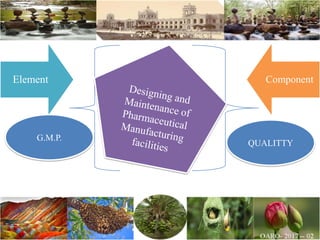
Element Component
QUALITTY
G.M.P.
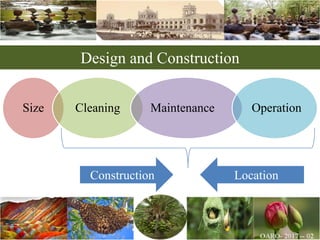
Design and Construction
Size Cleaning Maintenance Operation
Construction Location
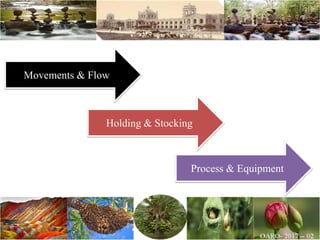
Movements & Flow
Holding & Stocking
Process & Equipment
Mix up
Confusion
Contamination
Mix up
Confusion
Contamination
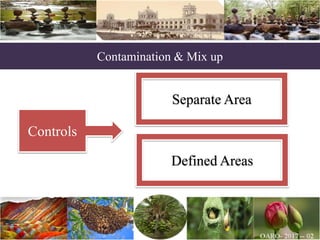
Contamination & Mix up
Controls
Separate Area
Defined Areas
Contamination & Mix up
Receipt, ID, Storage and withholding from use
of components, drug product containers,
closures & labeling pending QC sampling,
testing or examination
Contamination & Mix up
Holding rejected components, drug product
containers, closures & labeling before
disposition
Contamination & Mix up
Storage of released components, drug product
containers, closures & labeling
Contamination & Mix up
Storage of in-process materials
Contamination & Mix up
Manufacturing & processing operations
Contamination & Mix up
Packaging & labeling operations
Contamination & Mix up
Quarantine storage before release of drug
products
Contamination & Mix up
Storage of drug products after release
Contamination & Mix up
Control and laboratory operations
Contamination
Aseptic Processing
Easily cleanable floors, walls, ceiling of smooth hard surfaces
Temperature & humidity controls
An air supply filtered through HEPA under +ve pressure,
irrespective off whether flow is laminar or non-laminar
HEPA & Pressure Differential Control
Avoiding Contamination/Cross-contamination
HEPA
Filter
Efficiency
testing
Integrity
testing
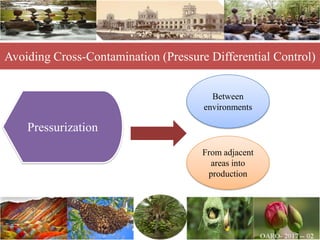
Avoiding Cross-Contamination (Pressure Differential Control)
Pressurization
Between
environments
From adjacent
areas into
production
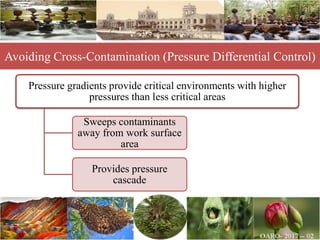
Avoiding Cross-Contamination (Pressure Differential Control)
Pressure gradients provide critical environments with higher
pressures than less critical areas
Sweeps contaminants
away from work surface
area
Provides pressure
cascade
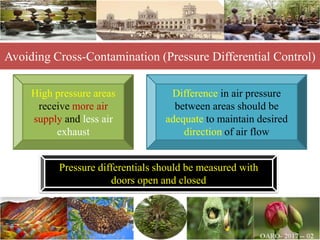
High pressure areas
receive more air
supply and less air
exhaust
Difference in air pressure
between areas should be
adequate to maintain desired
direction of air flow
Avoiding Cross-Contamination (Pressure Differential Control)
Pressure differentials should be measured with
doors open and closed
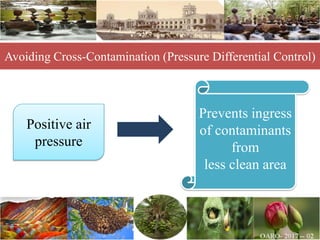
Avoiding Cross-Contamination (Pressure Differential Control)
Positive air
pressure
Prevents ingress
of contaminants
from
less clean area
Avoiding Cross-Contamination (Pressure Differential Control)
Negative air
pressure
Containment or
prevention of
dispersion of
sensitive or highly
toxic materials
Avoiding Cross-Contamination
(Unidirectional or Laminar air flow)
An air flow moving in a single direction, in a robust &
uniform manner, and at sufficient speed to reproducibly
sweep particles away from the critical processing or
testing area
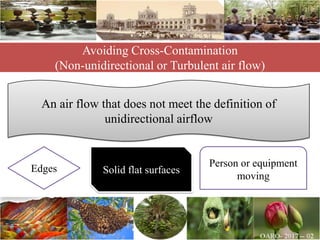
Avoiding Cross-Contamination
(Non-unidirectional or Turbulent air flow)
An air flow that does not meet the definition of
unidirectional airflow
Edges Solid flat surfaces
Person or equipment
moving
Contamination
Aseptic Processing
A system for monitoring environmental conditions
As
Built
At Rest At Operation (Dynamic)
Clean Room
Controlled with respect to
Air borne particles
Viable Non-viable
Controlled with respect to
Temperature
Humidity
Controlled with respect to
Air Pressure
Air Flow
Controlled with respect to
Air Motion
Lighting
A
S
B
U
I
L
T
Complete and ready for operation, with all
services connected and functional
But without equipment & operating personnel
A
S
B
U
I
L
T
With very low particle counts
Reflects quality of supply air & removal efficiency
of the HVAC system
A
T
R
E
S
T
Complete and with all services functional,
with equipment installed and operable
But without operating personnel
Smoke testing should demonstrate unidirectional air
flow over critical equipment surfaces
In case of air disturbance, ADJUST;
A
T
R
E
S
T Equipment Placement Air Velocities
With all services functioning & with
equipment and personnel performing
normal work functions
A
T
O
P
E
R
A
T
I
O
N
Validation studies should demonstrate
that Class 100 is maintained in critical
zones during routine operations
A
T
O
P
E
R
A
T
I
O
N
Contamination
Aseptic Processing
A system for cleaning & disinfecting
Room Equipments
To provide aseptic
conditions
Contamination
Aseptic Processing
A system for maintaining any equipment used to control the
aseptic conditions
Ventilation Air filtration Heating Cooling
Contamination
Aseptic Processing
A system for maintaining any equipment used to control the
aseptic conditions
Sewage/ Refuses Washing/ Toilet Sanitation
Contamination
Aseptic Processing
A system for maintaining any equipment used to control the
aseptic conditions
Plumbing MaintenanceLighting
Plumbing, Sewage & Refuses, Washing & Toilets
Contamination
Aseptic Processing
A system for maintaining any equipment used to control the aseptic conditions
Potable water supplied under continuous positive
pressure in Plumbing System (free of defects that could
contribute to product contamination)
Contamination
Aseptic Processing
A system for maintaining any equipment used to control the aseptic conditions
Adequately sized & designed drains (air break or
mechanical device) to prevent back siphoning
Contamination
Aseptic Processing
A system for maintaining any equipment used to control the aseptic conditions
Safe/ sanitary disposal of sewage, trash & other refuses
Sanitation & Maintenance
Contamination
Aseptic Processing
A system for maintaining any equipment used to control the aseptic conditions
Building maintained in clean/sanitary condition
Free of infestation by rodents, birds, insects etc.
Contamination
Aseptic Processing
A system for maintaining any equipment used to control the aseptic conditions
Trash & organic waste held and disposed off in a
timely & sanitary manner
Building maintained in clean/sanitary condition
Contamination
Aseptic Processing
A system for maintaining any equipment used to control the aseptic conditions
Sanitation Procedure & Program
(schedule, method, equipment materials for
cleaning of building & facilities)
Contamination
Aseptic Processing
A system for maintaining any equipment used to control the aseptic conditions
Formal Procedure for
(use of suitable rodenticides, insecticides, fuungicides,
fumigation agents & cleaning and sanitization agents to
prevent contamination)
Contamination
Aseptic Processing
A system for maintaining any equipment used to control the aseptic conditions
Sanitation Procedure for
(contractors & temporary employees as well as full
time employees during the operations)
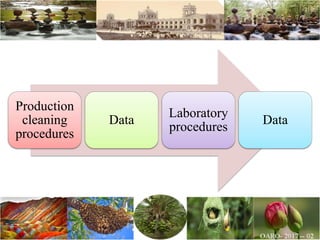
Cleaning Validation
Production
cleaning
procedures
Data
Laboratory
procedures
Data
How clean is clean?
Test until clean
It is not considered Cleaning Validation
Potential Observations
The plant is not constructed in such a manner as to allow
floor or walls or ceiling to be adequately cleaned and kept
clean or kept in a good state of repair
Floor, Walls & Ceiling
Failure to maintain building, fixtures or other physical
facilities in a sanitary condition
Building/ Sanitary
Failure to provide hand washing or hand sanitizing
facilities at each location in the plant where needed
Suitable Location
Lack of drainage in area that may contribute to
contamination
Drainage
Plumbing is not of adequate size and design or adequately
installed & maintained to provide adequate drainage
Drainage
Plumbing is not of adequate size and design or adequately
installed & maintained to properly convey sewage & liquid
disposal waste
Conveying of Sewage
Not adequate or convenient to furnish running water at a
suitable temperature
Hand Washing Facility
Did not maintain plant in repair sufficient to prevent
components or contact surfaces from becoming
contaminated
Physical Plant
Working space between equipment and walls are
obstructed or inadequate
Spacing of Equipment
Some examples from FDA Warning letters
Adequate unidirectional airflow studies (smoke
studies) under dynamic conditions are not
performed to determine
how the movement of air & personnel
during aseptic operations could pose risks to
product sterility e.g.
Failure to perform appropriate smoke studies
Sun Pharmaceuticals, India Dec 2015
Failure to perform appropriate smoke studies
Significant airflow turbulence, including air moving in a
direction in the laminar air flow unit in which aseptic & tubing
connections are made
No dynamic smoke studies to demonstrate unidirectional air flow
during the manual aseptic transfer of xxx units into the xxx used
for transport to the xxx
Failure to perform appropriate smoke studies
Inadequate evaluation of airflow patterns in stopper xxx area,
and turbulence around the stopper xxx.
Lack of smoke studies during aseptic filling line setup activities
Lesson
learned
Without smoke study data to
demonstrate unidirectional
airflows over all aseptic
operations and processing steps,
you cannot show that your
processes are designed to prevent
microbiological contamination or
provide adequate assurance of
product sterility
The floors, walls, and ceilings were not maintained as smooth, hard
surfaces that were easily cleaned. The leaks were present in the form of
water stains and ceiling damage in the Parenteral manufacturing area
personnel corridor.
Buckets with water collected from ceiling leaks and other leaks in the
manufacturing area were observed.
Failure to maintain Aseptic processing Area
Sun Pharmaceuticals, India Dec 2015
Lesson learned
Failure to address environmental control
Leaks in the area could compromise the quality of
aseptically filled products
Inadequate disinfection of RABS e.g. surface xxx
not routinely disinfected, and the the bottom of
the RABS xxx incompletely disinfected
Failure to qualify Disinfectant
CP Pharmaceuticals, UK, Nov 2016
The efficacy of disinfectants used in aseptic processing
cleanrooms have not been sufficiently established. The
disinfectant study only challenged xxx & xxx manufacturing
surfaces. An adequate scientific rationale for not challenging
other representative surfaces, such as glass windowsor other
interior RABS surfaces is not provided
Failure to qualify Disinfectant
CP Pharmaceuticals, UK, Nov 2016
Qualification of disinfectant xxx failed to demonstrate that it is
suitable and effective to remove microorganisms from
different surfaces. Specifically, the disinfectant failed to meet
qualification criteria when challenged with multiple
organisms
Failure to qualify Disinfectant
SmithKline Beecham, UK, Oct 2011
Failure to qualify Disinfectant
However, the procedures for routine cleaning of the aseptic manufacturing area continue to require the
use of unqualified disinfectants during days xxx through xxx of your disinfectant program.
After disinfection, Micrococcus luteus on vinyl, stainless steel, glass, and wall laminate and
Enterobacter cloacae, Rhodococcus sp, Burkholderia cepacia, Pseudomonas aeruginosa,
Methylobacterium mesophilicum and, Acinetobacter lwoffi on glass were recovered.
Disinfectant qualification for xxx and xxx bi-spore disinfectants documented that the log reduction
criteria (Bacteria ≥ 4, Fungi ≥ 3) was not met when challenged with multiple organisms in a variety of
surfaces.
3
Hands-on exercise: HVAC systems –
assessment of facility layout
98
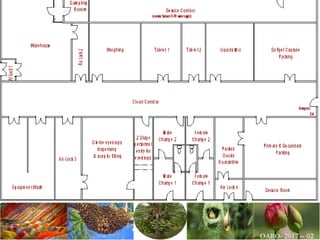
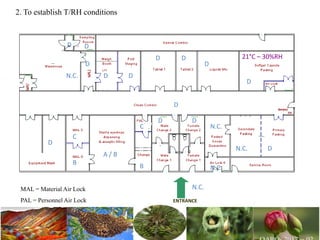
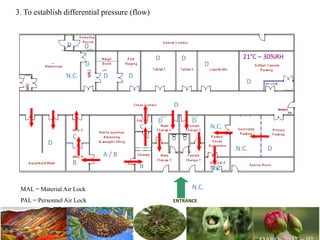
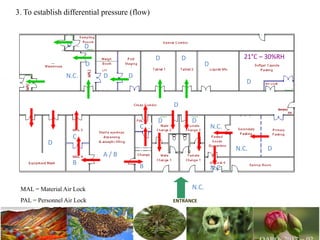
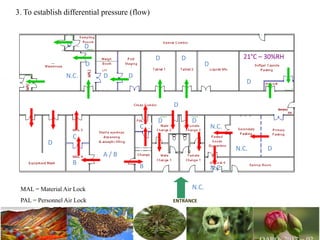
WHAT DO YOU HAVE TO DO?:
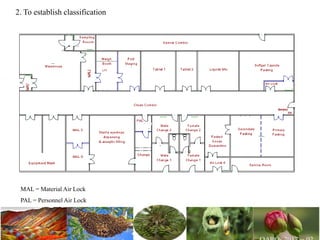
•  to modify layout
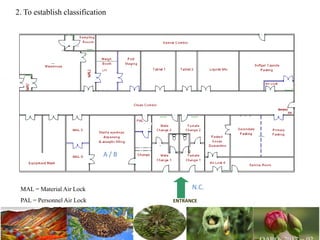
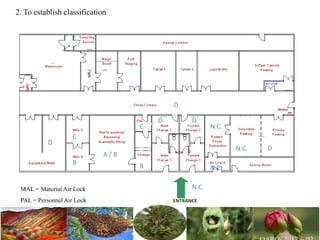
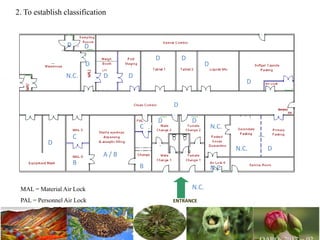
•  to establish classification and/or T/RH conditions
•  to establish differential pressure (flow)
•  to establish differential pressure (D or values)
HOW DO YOU HAVE TO DO?
•  to discuss in team work (brainstorming)
•  to elect a “speaker”
•  to show groups feedback
SOME TIPS:
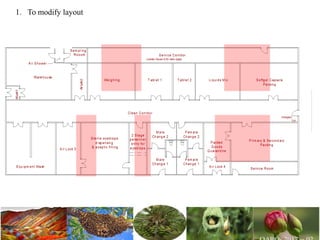
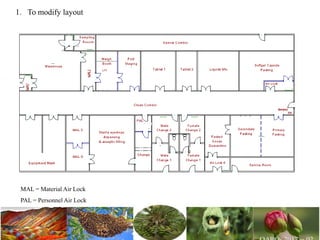
 layout: 5 rooms have to be modified
 classification: starting classification from class A/B
 T/RH conditions: 1 room needs RH monitoring
 differential pressure: establishing the pressure direction from A/B
class
 values of differential pressure: considering 10 Pa difference for
different classes A-B / C / D / N.C.
1. To modify layout
MAL = Material Air Lock
PAL = Personnel Air Lock
1. To modify layout
LAF
2. To establish classification
MAL = Material Air Lock
PAL = Personnel Air Lock
LAF
2. To establish classification
N.C.
A / B
MAL = Material Air Lock
PAL = Personnel Air Lock
LAF
ENTRANCE
2. To establish classification
N.C.
A / B
B
C
D
D D
C
B
D
MAL = Material Air Lock
PAL = Personnel Air Lock
DN.C.
N.C.
N.C.
LAF
ENTRANCE
2. To establish classification
N.C.
A / B
B
C
D
D D
C
B
D
MAL = Material Air Lock
PAL = Personnel Air Lock
DN.C.
N.C.
N.C.
D
D
DD
DD
D
D
N.C.
D
LAF
ENTRANCE
2. To establish T/RH conditions
N.C.
A / B
B
C
D
D D
C
B
D
MAL = Material Air Lock
PAL = Personnel Air Lock
DN.C.
N.C.
N.C.
D
D
DD
DD
D
D
N.C.
D
21°C – 30%RH
LAF
ENTRANCE
3. To establish differential pressure (flow)
N.C.
A / B
B
C
D
D D
C
B
D
MAL = Material Air Lock
PAL = Personnel Air Lock
DN.C.
N.C.
N.C.
D
D
DD
DD
D
D
N.C.
D
21°C – 30%RH
LAF
ENTRANCE
109
3. To establish differential pressure (flow)
N.C.
A / B
B
C
D
D D
C
B
D
MAL = Material Air Lock
PAL = Personnel Air Lock
DN.C.
N.C.
N.C.
D
D
DD
DD
D
D
N.C.
D
21°C – 30%RH
LAF
ENTRANCE
110
3. To establish differential pressure (flow)
N.C.
A / B
B
C
D
D D
C
B
D
MAL = Material Air Lock
PAL = Personnel Air Lock
DN.C.
N.C.
N.C.
D
D
DD
DD
D
D
N.C.
D
21°C – 30%RH
LAF
ENTRANCE
MAL = Material Air Lock
PAL = Personnel Air Lock
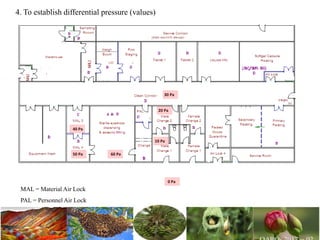
0 Pa
10 Pa
20 Pa
30 Pa
40 Pa
50 Pa 60 Pa
4. To establish differential pressure (values)
LAF
MAL = Material Air Lock
PAL = Personnel Air Lock
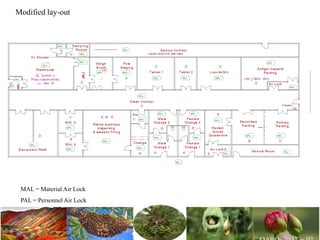
Modified lay-out
LAF
4
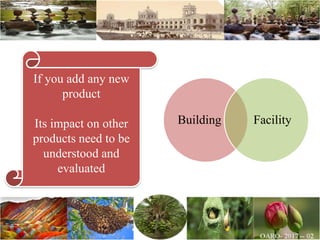
If you add any new
product
Its impact on other
products need to be
understood and
evaluated
Building Facility
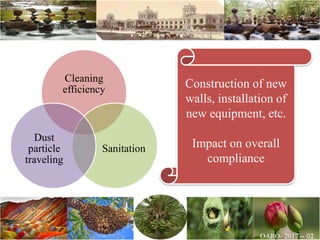
Construction of new
walls, installation of
new equipment, etc.
Impact on overall
compliance
Cleaning
efficiency
Sanitation
Dust
particle
traveling
If earthquake shock of 5 RS occurs, ….
what we have to do???
Lets think
Reviews
Design Review
Pre-construction
Review
Construction
Review
Equipment
Qualification Review
Pre-Production
Review
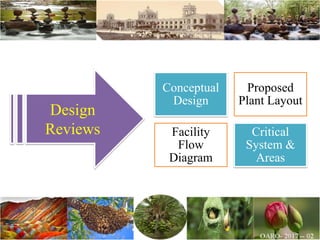
Design
Reviews
Conceptual
Design
Proposed
Plant Layout
Facility
Flow
Diagram
Critical
System &
Areas
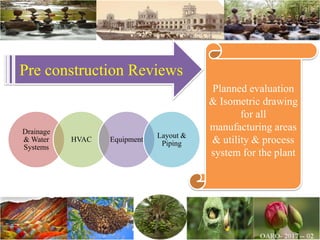
Pre construction Reviews
Planned evaluation
& Isometric drawing
for all
manufacturing areas
& utility & process
system for the plant
Drainage
& Water
Systems
HVAC Equipment
Layout &
Piping
Construction & Qualification Reviews
On-site review of
specific portion of
plant while
constrcution is in
progress
Piping
System
Method of
Construction
Reviewed
before they
are
concealed
Etc.
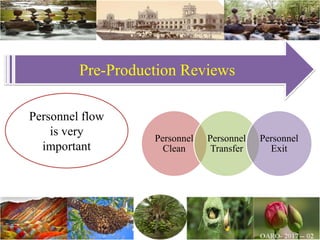
Pre-Production Reviews
Personnel flow
is very
important
Personnel
Clean
Personnel
Transfer
Personnel
Exit
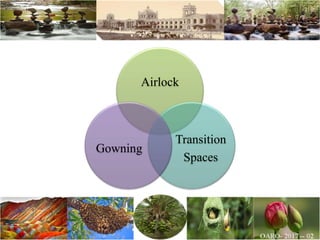
Lets Resolve & Understand
Airlock
Transition
Spaces
Gowning
Airlock
Provides
segregation of
cleanliness
levels
Airlock
Achieved by maintaining
room pressurization by
direction of air flow
through doors and isolating
the levels from each other
Airlock
Provides
segregation of
cleanliness
levels
Airlock
Achieved by maintaining
room pressurization by
direction of air flow
through doors and isolating
the levels from each other
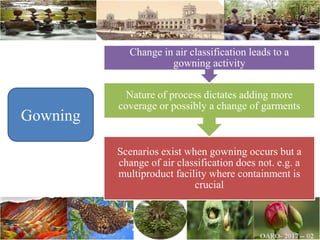
Scenarios exist when gowning occurs but a
change of air classification does not. e.g. a
multiproduct facility where containment is
crucial
Nature of process dictates adding more
coverage or possibly a change of garments
Change in air classification leads to a
gowning activity
Gowning
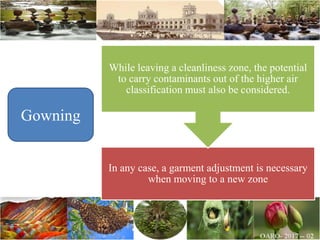
In any case, a garment adjustment is necessary
when moving to a new zone
While leaving a cleanliness zone, the potential
to carry contaminants out of the higher air
classification must also be considered.
Gowning
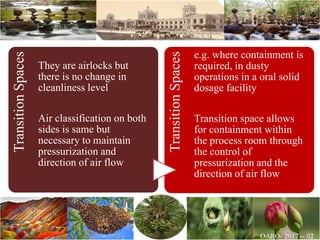
TransitionSpaces
They are airlocks but
there is no change in
cleanliness level
Air classification on both
sides is same but
necessary to maintain
pressurization and
direction of air flow
TransitionSpaces
e.g. where containment is
required, in dusty
operations in a oral solid
dosage facility
Transition space allows
for containment within
the process room through
the control of
pressurization and the
direction of air flow
TransitionSpaces
They are airlocks but
there is no change in
cleanliness level
Air classification on both
sides is same but
necessary to maintain
pressurization and
direction of air flow
TransitionSpaces
e.g. where containment is
required, in dusty
operations in a oral solid
dosage facility
Transition space allows
for containment within
the process room through
the control of
pressurization and the
direction of air flow
TransitionSpaces
They are airlocks but
there is no change in
cleanliness level
Air classification on both
sides is same but
necessary to maintain
pressurization and
direction of air flow
TransitionSpaces
e.g. where containment is
required, in dusty
operations in a oral solid
dosage facility
Transition space allows
for containment within
the process room through
the control of
pressurization and the
direction of air flow
TransitionSpaces
They are airlocks but
there is no change in
cleanliness level
Air classification on both
sides is same but
necessary to maintain
pressurization and
direction of air flow
TransitionSpaces
e.g. where containment is
required, in dusty
operations in a oral solid
dosage facility
Transition space allows
for containment within
the process room through
the control of
pressurization and the
direction of air flow
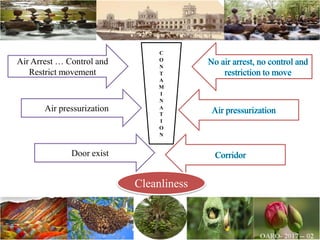
Air Arrest … Control and
Restrict movement
Air pressurization
Door exist
Cleanliness
C
O
N
T
A
M
I
N
A
T
I
O
N
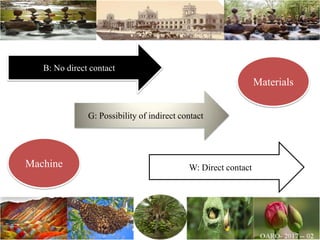
B: No direct contact
G: Possibility of indirect contact
W: Direct contact
Materials
Machine
oarohama@gmail.com

Pharmaceutical Engineering Forum 28 Jan 2017 (135 Slides)

  • 3.
    F O RU M O B J E C T I V E To provide a strong foundation of interface among multidisciplinary teams capable to talk in language of science without confusion To provide opportunity of discussion and transfer of knowledge among pharmaceutical professionals of multidisciplinary educational background A platform for engineers to exchange knowledge and learn expanding regulatory expectations
  • 4.
    Thanks All ofyou & Team Almas, Noman, Zainab and Esther Ref: USFDA, ISPE, WHO
  • 5.
  • 6.
    Discussion Forum on PharmaceuticalEngineering (Designing & Maintenance of Pharmaceutical Manufacturing Facilities) Forum’s Opening talk Roohi B. Obaid, Deputy Director, Drug Regulatory Authority of Pakistan
  • 7.
    Not the viewof DRAP Current judgment of speaker No obligation on DRAP Regulatory experience It has nothing to do with any specific commercial product It is just a knowledge sharing exercise nothing more than that D I S C L A I M E R
  • 8.
    Science Regulation Quality PharmaceuticalEngineering Designing & Maintenance of Pharmaceutical Manufacturing Facilities What, Why & How
  • 10.
    What will happenif design is not part of GMP standards??? Discuss and enlist
  • 11.
  • 12.
  • 13.
  • 14.
    What will happenif Cleaning & Maintenance is not part of GMP standards??? Discuss and enlist
  • 15.
    Lets think In aworking room air supply and exit both are on the ceiling at two different terminals How can we make it efficient and compliant
  • 16.
    Insanitary Condition &Contamination Microorganisms, dust, dirt, chemicals
  • 17.
    Can we design/outlinea Raw Material Store? Please indicate Men Flow & Material Flow
  • 18.
    Can we design/outlinea sampling facility in Raw Material Store? Please indicate Men Flow & Material Flow
  • 19.
  • 20.
    Discussion Forum on PharmaceuticalEngineering (Designing & Maintenance of Pharmaceutical Manufacturing Facilities) Obaid Ali, R. Ph., Ph. D. 28 Jan 2017
  • 21.
  • 22.
    Design and Construction SizeCleaning Maintenance Operation Construction Location
  • 23.
    Movements & Flow Holding& Stocking Process & Equipment
  • 24.
  • 25.
  • 26.
    Contamination & Mixup Controls Separate Area Defined Areas
  • 27.
    Contamination & Mixup Receipt, ID, Storage and withholding from use of components, drug product containers, closures & labeling pending QC sampling, testing or examination
  • 28.
    Contamination & Mixup Holding rejected components, drug product containers, closures & labeling before disposition
  • 29.
    Contamination & Mixup Storage of released components, drug product containers, closures & labeling
  • 30.
    Contamination & Mixup Storage of in-process materials
  • 31.
    Contamination & Mixup Manufacturing & processing operations
  • 32.
    Contamination & Mixup Packaging & labeling operations
  • 33.
    Contamination & Mixup Quarantine storage before release of drug products
  • 34.
    Contamination & Mixup Storage of drug products after release
  • 35.
    Contamination & Mixup Control and laboratory operations
  • 36.
    Contamination Aseptic Processing Easily cleanablefloors, walls, ceiling of smooth hard surfaces Temperature & humidity controls An air supply filtered through HEPA under +ve pressure, irrespective off whether flow is laminar or non-laminar
  • 37.
    HEPA & PressureDifferential Control
  • 38.
  • 39.
    Avoiding Cross-Contamination (PressureDifferential Control) Pressurization Between environments From adjacent areas into production
  • 40.
    Avoiding Cross-Contamination (PressureDifferential Control) Pressure gradients provide critical environments with higher pressures than less critical areas Sweeps contaminants away from work surface area Provides pressure cascade
  • 41.
    High pressure areas receivemore air supply and less air exhaust Difference in air pressure between areas should be adequate to maintain desired direction of air flow Avoiding Cross-Contamination (Pressure Differential Control) Pressure differentials should be measured with doors open and closed
  • 42.
    Avoiding Cross-Contamination (PressureDifferential Control) Positive air pressure Prevents ingress of contaminants from less clean area
  • 43.
    Avoiding Cross-Contamination (PressureDifferential Control) Negative air pressure Containment or prevention of dispersion of sensitive or highly toxic materials
  • 44.
    Avoiding Cross-Contamination (Unidirectional orLaminar air flow) An air flow moving in a single direction, in a robust & uniform manner, and at sufficient speed to reproducibly sweep particles away from the critical processing or testing area
  • 45.
    Avoiding Cross-Contamination (Non-unidirectional orTurbulent air flow) An air flow that does not meet the definition of unidirectional airflow Edges Solid flat surfaces Person or equipment moving
  • 46.
    Contamination Aseptic Processing A systemfor monitoring environmental conditions As Built At Rest At Operation (Dynamic)
  • 47.
  • 48.
    Controlled with respectto Air borne particles Viable Non-viable
  • 49.
    Controlled with respectto Temperature Humidity
  • 50.
    Controlled with respectto Air Pressure Air Flow
  • 51.
    Controlled with respectto Air Motion Lighting
  • 52.
    A S B U I L T Complete and readyfor operation, with all services connected and functional But without equipment & operating personnel
  • 53.
    A S B U I L T With very lowparticle counts Reflects quality of supply air & removal efficiency of the HVAC system
  • 54.
    A T R E S T Complete and withall services functional, with equipment installed and operable But without operating personnel
  • 55.
    Smoke testing shoulddemonstrate unidirectional air flow over critical equipment surfaces In case of air disturbance, ADJUST; A T R E S T Equipment Placement Air Velocities
  • 56.
    With all servicesfunctioning & with equipment and personnel performing normal work functions A T O P E R A T I O N
  • 57.
    Validation studies shoulddemonstrate that Class 100 is maintained in critical zones during routine operations A T O P E R A T I O N
  • 58.
    Contamination Aseptic Processing A systemfor cleaning & disinfecting Room Equipments To provide aseptic conditions
  • 59.
    Contamination Aseptic Processing A systemfor maintaining any equipment used to control the aseptic conditions Ventilation Air filtration Heating Cooling
  • 60.
    Contamination Aseptic Processing A systemfor maintaining any equipment used to control the aseptic conditions Sewage/ Refuses Washing/ Toilet Sanitation
  • 61.
    Contamination Aseptic Processing A systemfor maintaining any equipment used to control the aseptic conditions Plumbing MaintenanceLighting
  • 62.
    Plumbing, Sewage &Refuses, Washing & Toilets
  • 63.
    Contamination Aseptic Processing A systemfor maintaining any equipment used to control the aseptic conditions Potable water supplied under continuous positive pressure in Plumbing System (free of defects that could contribute to product contamination)
  • 64.
    Contamination Aseptic Processing A systemfor maintaining any equipment used to control the aseptic conditions Adequately sized & designed drains (air break or mechanical device) to prevent back siphoning
  • 65.
    Contamination Aseptic Processing A systemfor maintaining any equipment used to control the aseptic conditions Safe/ sanitary disposal of sewage, trash & other refuses
  • 66.
  • 67.
    Contamination Aseptic Processing A systemfor maintaining any equipment used to control the aseptic conditions Building maintained in clean/sanitary condition Free of infestation by rodents, birds, insects etc.
  • 68.
    Contamination Aseptic Processing A systemfor maintaining any equipment used to control the aseptic conditions Trash & organic waste held and disposed off in a timely & sanitary manner Building maintained in clean/sanitary condition
  • 69.
    Contamination Aseptic Processing A systemfor maintaining any equipment used to control the aseptic conditions Sanitation Procedure & Program (schedule, method, equipment materials for cleaning of building & facilities)
  • 70.
    Contamination Aseptic Processing A systemfor maintaining any equipment used to control the aseptic conditions Formal Procedure for (use of suitable rodenticides, insecticides, fuungicides, fumigation agents & cleaning and sanitization agents to prevent contamination)
  • 71.
    Contamination Aseptic Processing A systemfor maintaining any equipment used to control the aseptic conditions Sanitation Procedure for (contractors & temporary employees as well as full time employees during the operations)
  • 72.
  • 73.
  • 74.
    How clean isclean? Test until clean It is not considered Cleaning Validation
  • 75.
  • 76.
    The plant isnot constructed in such a manner as to allow floor or walls or ceiling to be adequately cleaned and kept clean or kept in a good state of repair Floor, Walls & Ceiling
  • 77.
    Failure to maintainbuilding, fixtures or other physical facilities in a sanitary condition Building/ Sanitary
  • 78.
    Failure to providehand washing or hand sanitizing facilities at each location in the plant where needed Suitable Location
  • 79.
    Lack of drainagein area that may contribute to contamination Drainage
  • 80.
    Plumbing is notof adequate size and design or adequately installed & maintained to provide adequate drainage Drainage
  • 81.
    Plumbing is notof adequate size and design or adequately installed & maintained to properly convey sewage & liquid disposal waste Conveying of Sewage
  • 82.
    Not adequate orconvenient to furnish running water at a suitable temperature Hand Washing Facility
  • 83.
    Did not maintainplant in repair sufficient to prevent components or contact surfaces from becoming contaminated Physical Plant
  • 84.
    Working space betweenequipment and walls are obstructed or inadequate Spacing of Equipment
  • 85.
    Some examples fromFDA Warning letters
  • 86.
    Adequate unidirectional airflowstudies (smoke studies) under dynamic conditions are not performed to determine how the movement of air & personnel during aseptic operations could pose risks to product sterility e.g. Failure to perform appropriate smoke studies Sun Pharmaceuticals, India Dec 2015
  • 87.
    Failure to performappropriate smoke studies Significant airflow turbulence, including air moving in a direction in the laminar air flow unit in which aseptic & tubing connections are made No dynamic smoke studies to demonstrate unidirectional air flow during the manual aseptic transfer of xxx units into the xxx used for transport to the xxx
  • 88.
    Failure to performappropriate smoke studies Inadequate evaluation of airflow patterns in stopper xxx area, and turbulence around the stopper xxx. Lack of smoke studies during aseptic filling line setup activities
  • 89.
    Lesson learned Without smoke studydata to demonstrate unidirectional airflows over all aseptic operations and processing steps, you cannot show that your processes are designed to prevent microbiological contamination or provide adequate assurance of product sterility
  • 90.
    The floors, walls,and ceilings were not maintained as smooth, hard surfaces that were easily cleaned. The leaks were present in the form of water stains and ceiling damage in the Parenteral manufacturing area personnel corridor. Buckets with water collected from ceiling leaks and other leaks in the manufacturing area were observed. Failure to maintain Aseptic processing Area Sun Pharmaceuticals, India Dec 2015
  • 91.
    Lesson learned Failure toaddress environmental control Leaks in the area could compromise the quality of aseptically filled products
  • 92.
    Inadequate disinfection ofRABS e.g. surface xxx not routinely disinfected, and the the bottom of the RABS xxx incompletely disinfected Failure to qualify Disinfectant CP Pharmaceuticals, UK, Nov 2016
  • 93.
    The efficacy ofdisinfectants used in aseptic processing cleanrooms have not been sufficiently established. The disinfectant study only challenged xxx & xxx manufacturing surfaces. An adequate scientific rationale for not challenging other representative surfaces, such as glass windowsor other interior RABS surfaces is not provided Failure to qualify Disinfectant CP Pharmaceuticals, UK, Nov 2016
  • 94.
    Qualification of disinfectantxxx failed to demonstrate that it is suitable and effective to remove microorganisms from different surfaces. Specifically, the disinfectant failed to meet qualification criteria when challenged with multiple organisms Failure to qualify Disinfectant SmithKline Beecham, UK, Oct 2011
  • 95.
    Failure to qualifyDisinfectant However, the procedures for routine cleaning of the aseptic manufacturing area continue to require the use of unqualified disinfectants during days xxx through xxx of your disinfectant program. After disinfection, Micrococcus luteus on vinyl, stainless steel, glass, and wall laminate and Enterobacter cloacae, Rhodococcus sp, Burkholderia cepacia, Pseudomonas aeruginosa, Methylobacterium mesophilicum and, Acinetobacter lwoffi on glass were recovered. Disinfectant qualification for xxx and xxx bi-spore disinfectants documented that the log reduction criteria (Bacteria ≥ 4, Fungi ≥ 3) was not met when challenged with multiple organisms in a variety of surfaces.
  • 96.
  • 97.
    Hands-on exercise: HVACsystems – assessment of facility layout
  • 98.
  • 99.
    WHAT DO YOUHAVE TO DO?: •  to modify layout •  to establish classification and/or T/RH conditions •  to establish differential pressure (flow) •  to establish differential pressure (D or values) HOW DO YOU HAVE TO DO? •  to discuss in team work (brainstorming) •  to elect a “speaker” •  to show groups feedback
  • 100.
    SOME TIPS:  layout:5 rooms have to be modified  classification: starting classification from class A/B  T/RH conditions: 1 room needs RH monitoring  differential pressure: establishing the pressure direction from A/B class  values of differential pressure: considering 10 Pa difference for different classes A-B / C / D / N.C.
  • 101.
  • 102.
    MAL = MaterialAir Lock PAL = Personnel Air Lock 1. To modify layout LAF
  • 103.
    2. To establishclassification MAL = Material Air Lock PAL = Personnel Air Lock LAF
  • 104.
    2. To establishclassification N.C. A / B MAL = Material Air Lock PAL = Personnel Air Lock LAF ENTRANCE
  • 105.
    2. To establishclassification N.C. A / B B C D D D C B D MAL = Material Air Lock PAL = Personnel Air Lock DN.C. N.C. N.C. LAF ENTRANCE
  • 106.
    2. To establishclassification N.C. A / B B C D D D C B D MAL = Material Air Lock PAL = Personnel Air Lock DN.C. N.C. N.C. D D DD DD D D N.C. D LAF ENTRANCE
  • 107.
    2. To establishT/RH conditions N.C. A / B B C D D D C B D MAL = Material Air Lock PAL = Personnel Air Lock DN.C. N.C. N.C. D D DD DD D D N.C. D 21°C – 30%RH LAF ENTRANCE
  • 108.
    3. To establishdifferential pressure (flow) N.C. A / B B C D D D C B D MAL = Material Air Lock PAL = Personnel Air Lock DN.C. N.C. N.C. D D DD DD D D N.C. D 21°C – 30%RH LAF ENTRANCE
  • 109.
    109 3. To establishdifferential pressure (flow) N.C. A / B B C D D D C B D MAL = Material Air Lock PAL = Personnel Air Lock DN.C. N.C. N.C. D D DD DD D D N.C. D 21°C – 30%RH LAF ENTRANCE
  • 110.
    110 3. To establishdifferential pressure (flow) N.C. A / B B C D D D C B D MAL = Material Air Lock PAL = Personnel Air Lock DN.C. N.C. N.C. D D DD DD D D N.C. D 21°C – 30%RH LAF ENTRANCE
  • 111.
    MAL = MaterialAir Lock PAL = Personnel Air Lock 0 Pa 10 Pa 20 Pa 30 Pa 40 Pa 50 Pa 60 Pa 4. To establish differential pressure (values) LAF
  • 112.
    MAL = MaterialAir Lock PAL = Personnel Air Lock Modified lay-out LAF
  • 113.
  • 114.
    If you addany new product Its impact on other products need to be understood and evaluated Building Facility
  • 115.
    Construction of new walls,installation of new equipment, etc. Impact on overall compliance Cleaning efficiency Sanitation Dust particle traveling
  • 116.
    If earthquake shockof 5 RS occurs, …. what we have to do??? Lets think
  • 117.
  • 118.
  • 119.
  • 120.
    Pre construction Reviews Plannedevaluation & Isometric drawing for all manufacturing areas & utility & process system for the plant Drainage & Water Systems HVAC Equipment Layout & Piping
  • 121.
    Construction & QualificationReviews On-site review of specific portion of plant while constrcution is in progress Piping System Method of Construction Reviewed before they are concealed Etc.
  • 122.
    Pre-Production Reviews Personnel flow isvery important Personnel Clean Personnel Transfer Personnel Exit
  • 123.
    Lets Resolve &Understand
  • 124.
  • 125.
    Airlock Provides segregation of cleanliness levels Airlock Achieved bymaintaining room pressurization by direction of air flow through doors and isolating the levels from each other
  • 126.
    Airlock Provides segregation of cleanliness levels Airlock Achieved bymaintaining room pressurization by direction of air flow through doors and isolating the levels from each other
  • 127.
    Scenarios exist whengowning occurs but a change of air classification does not. e.g. a multiproduct facility where containment is crucial Nature of process dictates adding more coverage or possibly a change of garments Change in air classification leads to a gowning activity Gowning
  • 128.
    In any case,a garment adjustment is necessary when moving to a new zone While leaving a cleanliness zone, the potential to carry contaminants out of the higher air classification must also be considered. Gowning
  • 129.
    TransitionSpaces They are airlocksbut there is no change in cleanliness level Air classification on both sides is same but necessary to maintain pressurization and direction of air flow TransitionSpaces e.g. where containment is required, in dusty operations in a oral solid dosage facility Transition space allows for containment within the process room through the control of pressurization and the direction of air flow
  • 130.
    TransitionSpaces They are airlocksbut there is no change in cleanliness level Air classification on both sides is same but necessary to maintain pressurization and direction of air flow TransitionSpaces e.g. where containment is required, in dusty operations in a oral solid dosage facility Transition space allows for containment within the process room through the control of pressurization and the direction of air flow
  • 131.
    TransitionSpaces They are airlocksbut there is no change in cleanliness level Air classification on both sides is same but necessary to maintain pressurization and direction of air flow TransitionSpaces e.g. where containment is required, in dusty operations in a oral solid dosage facility Transition space allows for containment within the process room through the control of pressurization and the direction of air flow
  • 132.
    TransitionSpaces They are airlocksbut there is no change in cleanliness level Air classification on both sides is same but necessary to maintain pressurization and direction of air flow TransitionSpaces e.g. where containment is required, in dusty operations in a oral solid dosage facility Transition space allows for containment within the process room through the control of pressurization and the direction of air flow
  • 133.
    Air Arrest …Control and Restrict movement Air pressurization Door exist Cleanliness C O N T A M I N A T I O N
  • 134.
    B: No directcontact G: Possibility of indirect contact W: Direct contact Materials Machine
  • 135.