Training Programme
on
Safe Handling of Chemicals
& Their Hazards
http://healthsafetyupdates.blogspot.in/
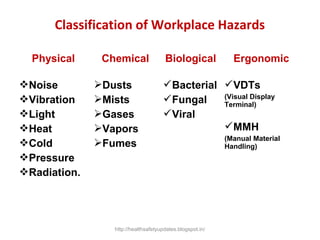
Classification of Workplace Hazards
Physical Chemical Biological Ergonomic
Noise
Vibration
Light
Heat
Cold
Pressure
Radiation.
Dusts
Mists
Gases
Vapors
Fumes
Bacterial
Fungal
Viral
VDTs
(Visual Display
Terminal)
MMH
(Manual Material
Handling)
http://healthsafetyupdates.blogspot.in/
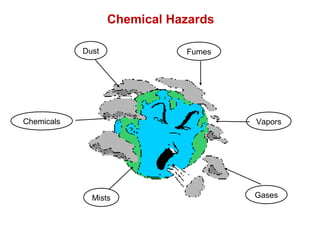
Chemical Hazards
Dust
Mists
Chemicals
Fumes
Gases
Vapors
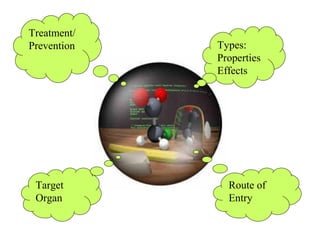
Types:
Properties
Effects
Route of
Entry
Target
Organ
Treatment/
Prevention
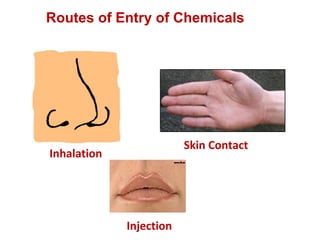
Routes of Entry of Chemicals
Inhalation
Skin Contact
Injection
Routes of Entry
1. Inhalation –
 through the lungs
2. Absorption :
 through the skin
 through the epidermal cells of skin
 sweat and sebaceous (oil) glands
 hair follicles and eyes .
3. Ingestion :
 through eating and drinking
http://healthsafetyupdates.blogspot.in/
Definitions
FLASH POINT
Minimum temperature at which a liquid gives off vapor in sufficient
concentration to form an ignitable mixture with air near the surface of the
liquid.
Methanol : 16.10
C Naphtha: -6.670
C
AUTO IGNITION TEMPERATURE
Minimum temperature at which a flammable gas or vapor mixture will ignite
from its own heat source or a contacted heated surface with out necessity
of spark or flame.
Methanol: 3850
C Naphtha : 2320
C
http://healthsafetyupdates.blogspot.in/
T.L.V (Threshold Limit value)
TLV-TWA (Time Weighted Average):
The concentration of air contaminants in the working environment to which it is
believed nearly all persons may be exposed repeatedly, day after day, without
adverse effect. It refers for normal 8 hour work week.
Chlorine: 1 PPM Ammonia- 25 PPM
Hydrogen Sulfide: 10 PPM
TLV - S.T.E.L (Short Term Exposure Limit):
The maximum concentration to which person can be exposed for a period up to 15
minutes continuously, provided that no more than four excursions per day are
permitted, with at least 60 minutes between exposure periods.
Chlorine: 3 PPM Ammonia: 35 PPM
Hydrogen Sulfide: 15 PPM
Definitions
http://healthsafetyupdates.blogspot.in/
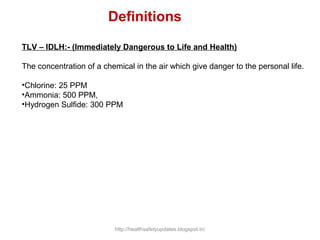
TLV – IDLH:- (Immediately Dangerous to Life and Health)
The concentration of a chemical in the air which give danger to the personal life.
•Chlorine: 25 PPM
•Ammonia: 500 PPM,
•Hydrogen Sulfide: 300 PPM
Definitions
http://healthsafetyupdates.blogspot.in/
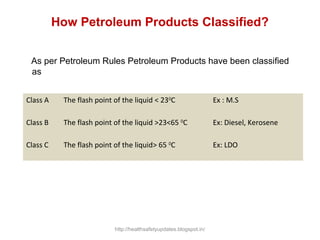
How Petroleum Products Classified?
As per Petroleum Rules Petroleum Products have been classified
as
Class A The flash point of the liquid < 230
C Ex : M.S
Class B The flash point of the liquid >23<65 0
C Ex: Diesel, Kerosene
Class C The flash point of the liquid> 65 0
C Ex: LDO
http://healthsafetyupdates.blogspot.in/
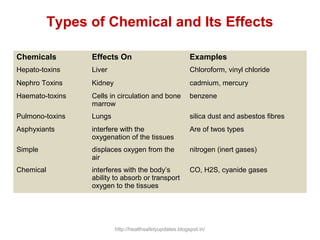
Types of Chemical and Its Effects
Chemicals Effects On Examples
Hepato-toxins Liver Chloroform, vinyl chloride
Nephro Toxins Kidney cadmium, mercury
Haemato-toxins Cells in circulation and bone
marrow
benzene
Pulmono-toxins Lungs silica dust and asbestos fibres
Asphyxiants interfere with the
oxygenation of the tissues
Are of twos types
Simple displaces oxygen from the
air
nitrogen (inert gases)
Chemical interferes with the body’s
ability to absorb or transport
oxygen to the tissues
CO, H2S, cyanide gases
http://healthsafetyupdates.blogspot.in/
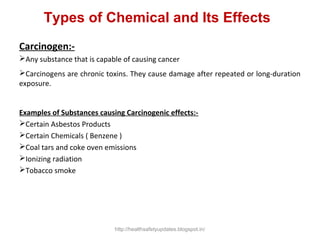
Types of Chemical and Its Effects
Carcinogen:-
Any substance that is capable of causing cancer
Carcinogens are chronic toxins. They cause damage after repeated or long-duration
exposure.
Examples of Substances causing Carcinogenic effects:-
Certain Asbestos Products
Certain Chemicals ( Benzene )
Coal tars and coke oven emissions
Ionizing radiation
Tobacco smoke
http://healthsafetyupdates.blogspot.in/
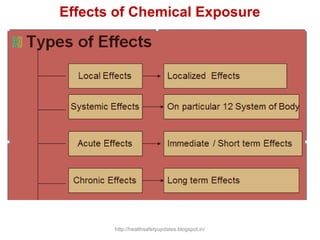
Effects of Chemical Exposure
http://healthsafetyupdates.blogspot.in/
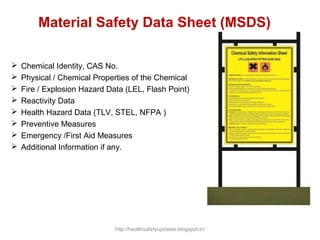
Material Safety Data Sheet (MSDS)
 Chemical Identity, CAS No.
 Physical / Chemical Properties of the Chemical
 Fire / Explosion Hazard Data (LEL, Flash Point)
 Reactivity Data
 Health Hazard Data (TLV, STEL, NFPA )
 Preventive Measures
 Emergency /First Aid Measures
 Additional Information if any.
http://healthsafetyupdates.blogspot.in/
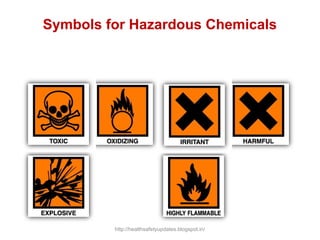
Symbols for Hazardous Chemicals
http://healthsafetyupdates.blogspot.in/
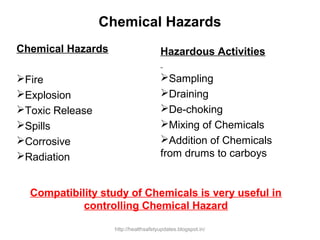
Chemical Hazards
Chemical Hazards
Fire
Explosion
Toxic Release
Spills
Corrosive
Radiation
Hazardous Activities
Sampling
Draining
De-choking
Mixing of Chemicals
Addition of Chemicals
from drums to carboys
Compatibility study of Chemicals is very useful in
controlling Chemical Hazard
http://healthsafetyupdates.blogspot.in/
Risk in Hazardous Activities
Splashing of hot and /or corrosive chemicals resulting into injury on
body parts.
Splashing of flammable chemicals
Inhalation of toxic gas if it released through a sample point
Static charge generation with hydrocarbon sampling.
Safe Handling of Chemicals in Work place
 Samples shall be taken only by authorized trained personnel.
Follow SOP.
Avoid inhaling vapors during sampling.
Use approved type of sample bottles.
Identify the sample points with tag nos.
Chemical Hazards
http://healthsafetyupdates.blogspot.in/
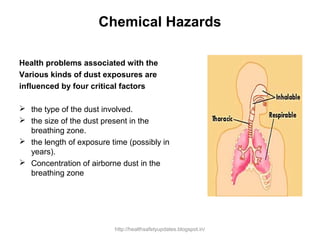
Health problems associated with the
Various kinds of dust exposures are
influenced by four critical factors
 the type of the dust involved.
 the size of the dust present in the
breathing zone.
 the length of exposure time (possibly in
years).
 Concentration of airborne dust in the
breathing zone
Chemical Hazards
http://healthsafetyupdates.blogspot.in/
Control of Chemical exposure
 Precautions to be taken that the chemicals are not entered into body
through Skin absorption, Ingestion or inhalation.
 Engineering controls-exhaust ventilation and equipment
 Personal protective equipment
 Personal hygiene
 Labeling and storage of containers.
 Housekeeping and maintenance.
 Regulated areas.
 Decontamination and emergency Procedure.
 Monitoring.
http://healthsafetyupdates.blogspot.in/
Use appropriate PPEs for different chemicals
 PVC Aprons
PVC Gloves, Nitrile gloves,
 PVC Suit
 FACE Shield with visor
 Heat Retardant suit.
Chemical Splash Goggles for eyes.
Safety shoes with Chemical retardant sole.
Control of Chemical exposure
http://healthsafetyupdates.blogspot.in/
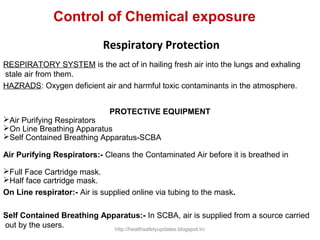
Respiratory Protection
RESPIRATORY SYSTEM is the act of in hailing fresh air into the lungs and exhaling
stale air from them.
HAZRADS: Oxygen deficient air and harmful toxic contaminants in the atmosphere.
PROTECTIVE EQUIPMENT
Air Purifying Respirators
On Line Breathing Apparatus
Self Contained Breathing Apparatus-SCBA
Air Purifying Respirators:- Cleans the Contaminated Air before it is breathed in
Full Face Cartridge mask.
Half face cartridge mask.
On Line respirator:- Air is supplied online via tubing to the mask.
Self Contained Breathing Apparatus:- In SCBA, air is supplied from a source carried
out by the users.
Control of Chemical exposure
http://healthsafetyupdates.blogspot.in/
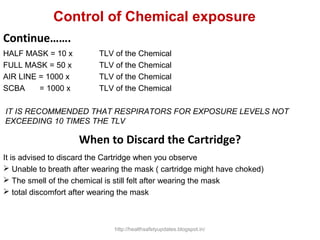
HALF MASK = 10 x TLV of the Chemical
FULL MASK = 50 x TLV of the Chemical
AIR LINE = 1000 x TLV of the Chemical
SCBA = 1000 x TLV of the Chemical
IT IS RECOMMENDED THAT RESPIRATORS FOR EXPOSURE LEVELS NOT
EXCEEDING 10 TIMES THE TLV
Continue…….
When to Discard the Cartridge?
It is advised to discard the Cartridge when you observe
 Unable to breath after wearing the mask ( cartridge might have choked)
 The smell of the chemical is still felt after wearing the mask
 total discomfort after wearing the mask
Control of Chemical exposure
http://healthsafetyupdates.blogspot.in/
Care and Maintenance Of Respirators
 Place it back after use in its storage position
 Avoid dust, heat, sun exposure
 Regular check for workability
 Wash/clean/dry after use
 Keep records
Control of Chemical exposure
http://healthsafetyupdates.blogspot.in/
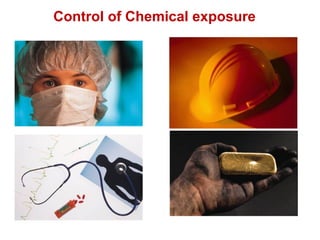
Control of Chemical exposure
Thank You
For Kind Attention
Any ?????? Please
Comment on my blog
http://healthsafetyupdates.blogspot.in/

Chemcial handling

  • 1.
    Training Programme on Safe Handlingof Chemicals & Their Hazards http://healthsafetyupdates.blogspot.in/
  • 2.
    Classification of WorkplaceHazards Physical Chemical Biological Ergonomic Noise Vibration Light Heat Cold Pressure Radiation. Dusts Mists Gases Vapors Fumes Bacterial Fungal Viral VDTs (Visual Display Terminal) MMH (Manual Material Handling) http://healthsafetyupdates.blogspot.in/
  • 3.
  • 4.
  • 5.
    Routes of Entryof Chemicals Inhalation Skin Contact Injection
  • 6.
    Routes of Entry 1.Inhalation –  through the lungs 2. Absorption :  through the skin  through the epidermal cells of skin  sweat and sebaceous (oil) glands  hair follicles and eyes . 3. Ingestion :  through eating and drinking http://healthsafetyupdates.blogspot.in/
  • 7.
    Definitions FLASH POINT Minimum temperatureat which a liquid gives off vapor in sufficient concentration to form an ignitable mixture with air near the surface of the liquid. Methanol : 16.10 C Naphtha: -6.670 C AUTO IGNITION TEMPERATURE Minimum temperature at which a flammable gas or vapor mixture will ignite from its own heat source or a contacted heated surface with out necessity of spark or flame. Methanol: 3850 C Naphtha : 2320 C http://healthsafetyupdates.blogspot.in/
  • 8.
    T.L.V (Threshold Limitvalue) TLV-TWA (Time Weighted Average): The concentration of air contaminants in the working environment to which it is believed nearly all persons may be exposed repeatedly, day after day, without adverse effect. It refers for normal 8 hour work week. Chlorine: 1 PPM Ammonia- 25 PPM Hydrogen Sulfide: 10 PPM TLV - S.T.E.L (Short Term Exposure Limit): The maximum concentration to which person can be exposed for a period up to 15 minutes continuously, provided that no more than four excursions per day are permitted, with at least 60 minutes between exposure periods. Chlorine: 3 PPM Ammonia: 35 PPM Hydrogen Sulfide: 15 PPM Definitions http://healthsafetyupdates.blogspot.in/
  • 9.
    TLV – IDLH:-(Immediately Dangerous to Life and Health) The concentration of a chemical in the air which give danger to the personal life. •Chlorine: 25 PPM •Ammonia: 500 PPM, •Hydrogen Sulfide: 300 PPM Definitions http://healthsafetyupdates.blogspot.in/
  • 10.
    How Petroleum ProductsClassified? As per Petroleum Rules Petroleum Products have been classified as Class A The flash point of the liquid < 230 C Ex : M.S Class B The flash point of the liquid >23<65 0 C Ex: Diesel, Kerosene Class C The flash point of the liquid> 65 0 C Ex: LDO http://healthsafetyupdates.blogspot.in/
  • 11.
    Types of Chemicaland Its Effects Chemicals Effects On Examples Hepato-toxins Liver Chloroform, vinyl chloride Nephro Toxins Kidney cadmium, mercury Haemato-toxins Cells in circulation and bone marrow benzene Pulmono-toxins Lungs silica dust and asbestos fibres Asphyxiants interfere with the oxygenation of the tissues Are of twos types Simple displaces oxygen from the air nitrogen (inert gases) Chemical interferes with the body’s ability to absorb or transport oxygen to the tissues CO, H2S, cyanide gases http://healthsafetyupdates.blogspot.in/
  • 12.
    Types of Chemicaland Its Effects Carcinogen:- Any substance that is capable of causing cancer Carcinogens are chronic toxins. They cause damage after repeated or long-duration exposure. Examples of Substances causing Carcinogenic effects:- Certain Asbestos Products Certain Chemicals ( Benzene ) Coal tars and coke oven emissions Ionizing radiation Tobacco smoke http://healthsafetyupdates.blogspot.in/
  • 13.
    Effects of ChemicalExposure http://healthsafetyupdates.blogspot.in/
  • 14.
    Material Safety DataSheet (MSDS)  Chemical Identity, CAS No.  Physical / Chemical Properties of the Chemical  Fire / Explosion Hazard Data (LEL, Flash Point)  Reactivity Data  Health Hazard Data (TLV, STEL, NFPA )  Preventive Measures  Emergency /First Aid Measures  Additional Information if any. http://healthsafetyupdates.blogspot.in/
  • 15.
    Symbols for HazardousChemicals http://healthsafetyupdates.blogspot.in/
  • 16.
    Chemical Hazards Chemical Hazards Fire Explosion ToxicRelease Spills Corrosive Radiation Hazardous Activities Sampling Draining De-choking Mixing of Chemicals Addition of Chemicals from drums to carboys Compatibility study of Chemicals is very useful in controlling Chemical Hazard http://healthsafetyupdates.blogspot.in/
  • 17.
    Risk in HazardousActivities Splashing of hot and /or corrosive chemicals resulting into injury on body parts. Splashing of flammable chemicals Inhalation of toxic gas if it released through a sample point Static charge generation with hydrocarbon sampling. Safe Handling of Chemicals in Work place  Samples shall be taken only by authorized trained personnel. Follow SOP. Avoid inhaling vapors during sampling. Use approved type of sample bottles. Identify the sample points with tag nos. Chemical Hazards http://healthsafetyupdates.blogspot.in/
  • 18.
    Health problems associatedwith the Various kinds of dust exposures are influenced by four critical factors  the type of the dust involved.  the size of the dust present in the breathing zone.  the length of exposure time (possibly in years).  Concentration of airborne dust in the breathing zone Chemical Hazards http://healthsafetyupdates.blogspot.in/
  • 19.
    Control of Chemicalexposure  Precautions to be taken that the chemicals are not entered into body through Skin absorption, Ingestion or inhalation.  Engineering controls-exhaust ventilation and equipment  Personal protective equipment  Personal hygiene  Labeling and storage of containers.  Housekeeping and maintenance.  Regulated areas.  Decontamination and emergency Procedure.  Monitoring. http://healthsafetyupdates.blogspot.in/
  • 20.
    Use appropriate PPEsfor different chemicals  PVC Aprons PVC Gloves, Nitrile gloves,  PVC Suit  FACE Shield with visor  Heat Retardant suit. Chemical Splash Goggles for eyes. Safety shoes with Chemical retardant sole. Control of Chemical exposure http://healthsafetyupdates.blogspot.in/
  • 21.
    Respiratory Protection RESPIRATORY SYSTEMis the act of in hailing fresh air into the lungs and exhaling stale air from them. HAZRADS: Oxygen deficient air and harmful toxic contaminants in the atmosphere. PROTECTIVE EQUIPMENT Air Purifying Respirators On Line Breathing Apparatus Self Contained Breathing Apparatus-SCBA Air Purifying Respirators:- Cleans the Contaminated Air before it is breathed in Full Face Cartridge mask. Half face cartridge mask. On Line respirator:- Air is supplied online via tubing to the mask. Self Contained Breathing Apparatus:- In SCBA, air is supplied from a source carried out by the users. Control of Chemical exposure http://healthsafetyupdates.blogspot.in/
  • 22.
    HALF MASK =10 x TLV of the Chemical FULL MASK = 50 x TLV of the Chemical AIR LINE = 1000 x TLV of the Chemical SCBA = 1000 x TLV of the Chemical IT IS RECOMMENDED THAT RESPIRATORS FOR EXPOSURE LEVELS NOT EXCEEDING 10 TIMES THE TLV Continue……. When to Discard the Cartridge? It is advised to discard the Cartridge when you observe  Unable to breath after wearing the mask ( cartridge might have choked)  The smell of the chemical is still felt after wearing the mask  total discomfort after wearing the mask Control of Chemical exposure http://healthsafetyupdates.blogspot.in/
  • 23.
    Care and MaintenanceOf Respirators  Place it back after use in its storage position  Avoid dust, heat, sun exposure  Regular check for workability  Wash/clean/dry after use  Keep records Control of Chemical exposure http://healthsafetyupdates.blogspot.in/
  • 24.
  • 25.
    Thank You For KindAttention Any ?????? Please Comment on my blog http://healthsafetyupdates.blogspot.in/ http://healthsafetyupdates.blogspot.in/