Spill Prevention,  Control and Countermeasure (SPCC)  Training
Goals of SPCC Training Overview of the SPCC Requirements Summary of Harvard’s SPCC Plan Spill Prevention and Response Procedures Inspection Requirements Roles and Responsibilities Information Resources
SPCC Requirements Required by EPA if a facility can “reasonably be expected to discharge harmful amounts of oil into navigable waters of the United States or adjoining shorelines”, and stores above certain threshold Required at Harvard due to oil storage volume throughout the University and at off-site locations and because oil can reasonably be expected to enter navigable waters
Oil Regulated Under SPCC All petroleum based oils  Fuel oil, motor oil, distillate oil, gasoline, hydraulic fluid Oil mixed with wastes Animal fats and oils Fish and marine mammal oils Vegetable oils  Oils from seeds, fruits, nuts and kernels
Containers Regulated Under SPCC Any current oil storage container 55 gallons or greater Bulk Storage - drums, tanks and containers  Operational equipment - transformers, elevator tanks, electrical switches Any empty container 55 gallons or greater capable of storing oil and not rendered unusable
Harvard’s SPCC Plans Harvard has five (5) SPCC Plans: Cambridge/Allston Campuses Longwood Medical Campus Southborough Campus Concord Field Station Harvard Forest Copies of the Plans are Maintained at: EH&S offices at 46 Blackstone Street in Cambridge University Operations Center  Security stations at off-site locations
Contents of SPCC Plans Identify oil storage and use locations Tanks (above and underground) Hydraulic elevator systems Emergency Generators Electrical transformers and substations Electrical switches Pumps, gear boxes, bearings Waste Oil Satellite Accumulation Areas Waste cooking oil containers Designate responsibilities for implementation Establish spill prevention and response procedures
Roles and Responsibilities Maintain signed copy of Fuel Delivery notice Conduct follow-up Ensure contractors are aware of SPCC Reporting requirements Maintain facility-specific oil storage/use information and provide updates to EH&S Determine need for regulatory reporting Assign and monitor monthly inspections Maintain training records Assess human health and environmental hazards and impacts Cleanup spills  Ensure personnel are familiar with locations of spill equipment Coordinate with EH&S on SPCC Requirements Support spill incident report and follow-up Notify the Operations Center of any spills (617-495-5560) Ensure spill equipment is stocked Conduct and document inspections Monitor SPCC regulatory changes Provide spill response equipment Ensure personnel are trained Training for Staff Provides SPCC Training and Guidance  Be familiar with SPCC requirements Update inventory for accuracy Ensure resource allocation Develop SPCC Plan Contractors/ Vendors Facility Managers Environmental Safety Compliance Officers EH&S
SPCC Device Inventory Harvard facilities are required to keep an accurate and up-to-date inventory of all SPCC devices Facilities must review the devices and inventory annually EH&S maintains a web-based Facility Equipment Inventory Management System (FEIMS)  http:// www.uos.harvard.edu/redir/feims.html
SPCC Training Required for any Harvard employee involved in: Oil handling Transfer Storage Spill response Maintenance of oil equipment Managers or supervisors who have direct reports involved in the activities listed above Fuel oil delivery company employees
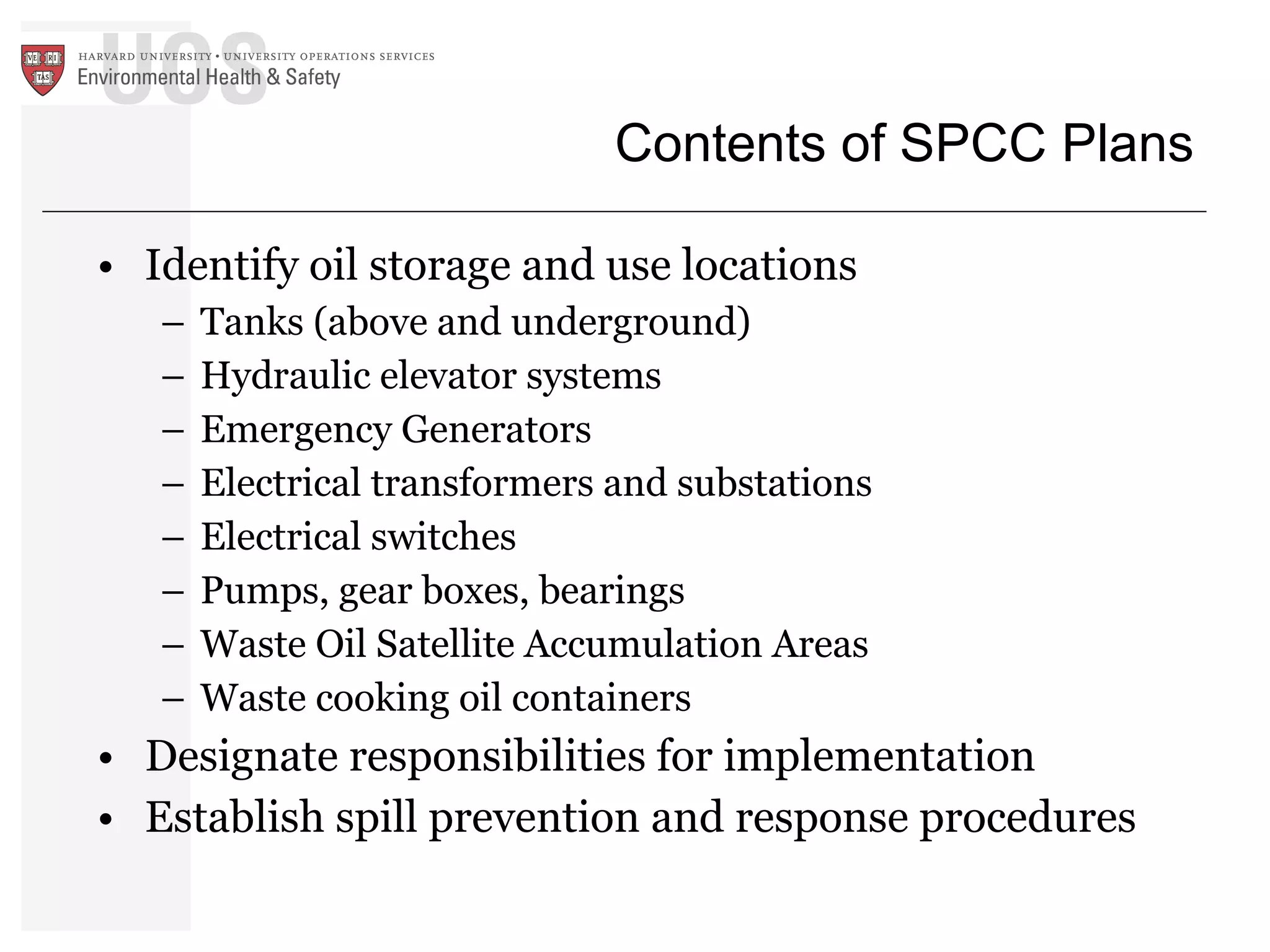
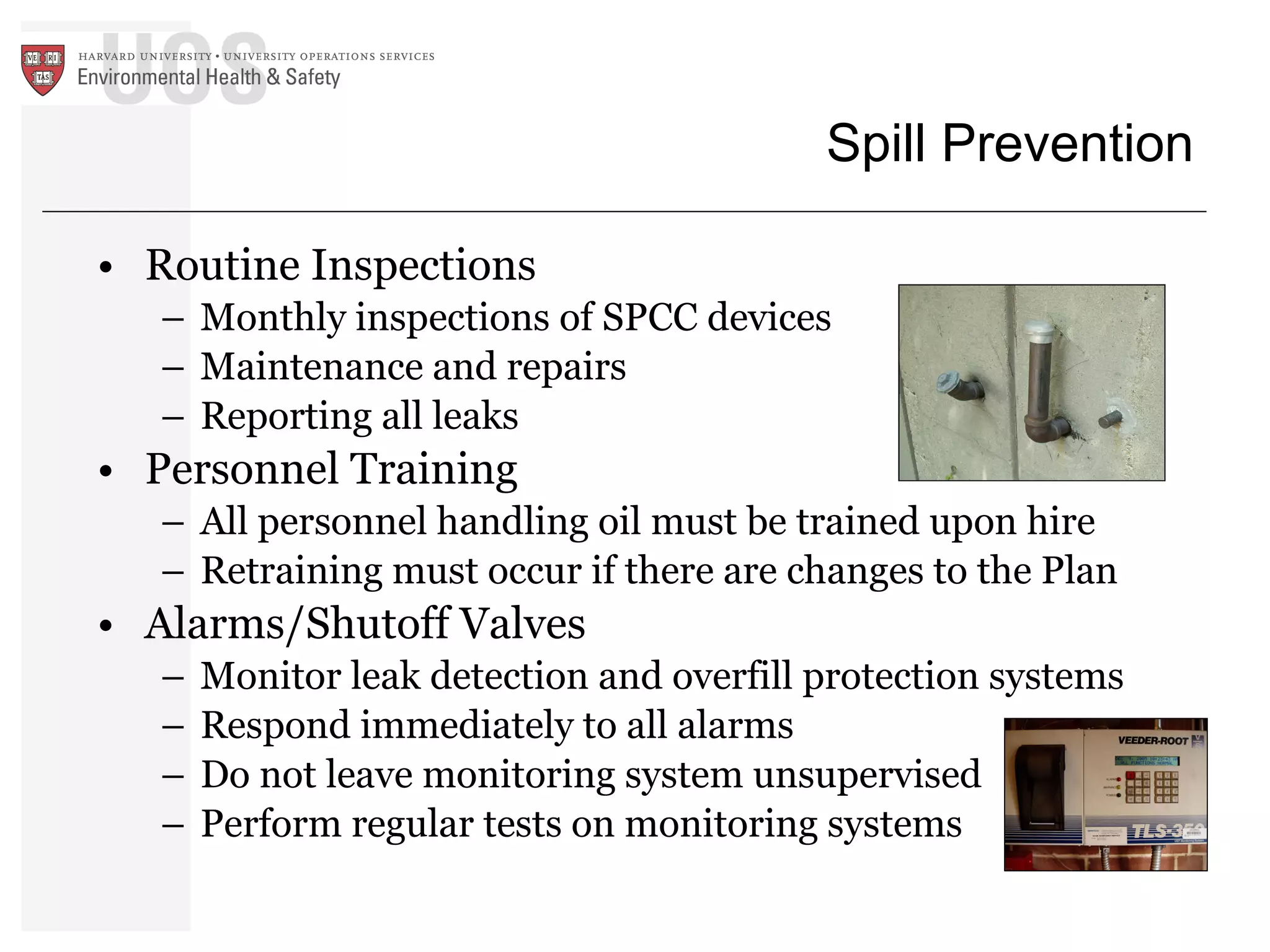
Spill Prevention Routine Inspections Monthly inspections of SPCC devices Maintenance and repairs Reporting all leaks Personnel Training All personnel handling oil must be trained upon hire Retraining must occur if there are changes to the Plan Alarms/Shutoff Valves Monitor leak detection and overfill protection systems  Respond immediately to all alarms Do not leave monitoring system unsupervised Perform regular tests on monitoring systems
Spill Prevention Continued Fuel Deliveries Facility managers should ensure that all fuel delivery vendors receive the “Notice to Fuel Delivery Vendor” Maintain signed “Notice to Fuel Delivery Vendor” Must follow Tank Truck Delivery Procedures  Harvard University personnel should be present and monitor fuel deliveries Immediately report any leakage or spillage to Harvard University’s Operations Center at (617) 495-5560
Spill Prevention Continued Secondary Containment Must be an impervious material and contain a means of discharge (pipe with valve) that is able to be locked Required for oil containing devices by Harvard EH&S Transformers, electrical switches and elevator tanks are exempt from this requirement of SPCC
Spill Scenarios Potential spills at Harvard include: Damage to or release from oil delivery equipment during the loading/unloading of oil at fill stations Aboveground or underground tank failure Leaking or failure of drums or containers Overfill at a fill port Spillage during transfer from drums or tanks Leaking and/or failure of piping and pumps Leaking transformer
Incidental Spills Definition: Spills of known materials that do not pose potential safety or health hazards (fire, explosion or chemical exposure) Spills that can be controlled and cleaned up at the time of release by employees in the immediate area or by maintenance personnel Spills that do NOT impact the environment Management Do not endanger yourself or others Use proper personal protective equipment (gloves, goggles, etc.) while cleaning up the spill Dispose of the waste properly and in accordance with Harvard’s Hazardous Waste procedures
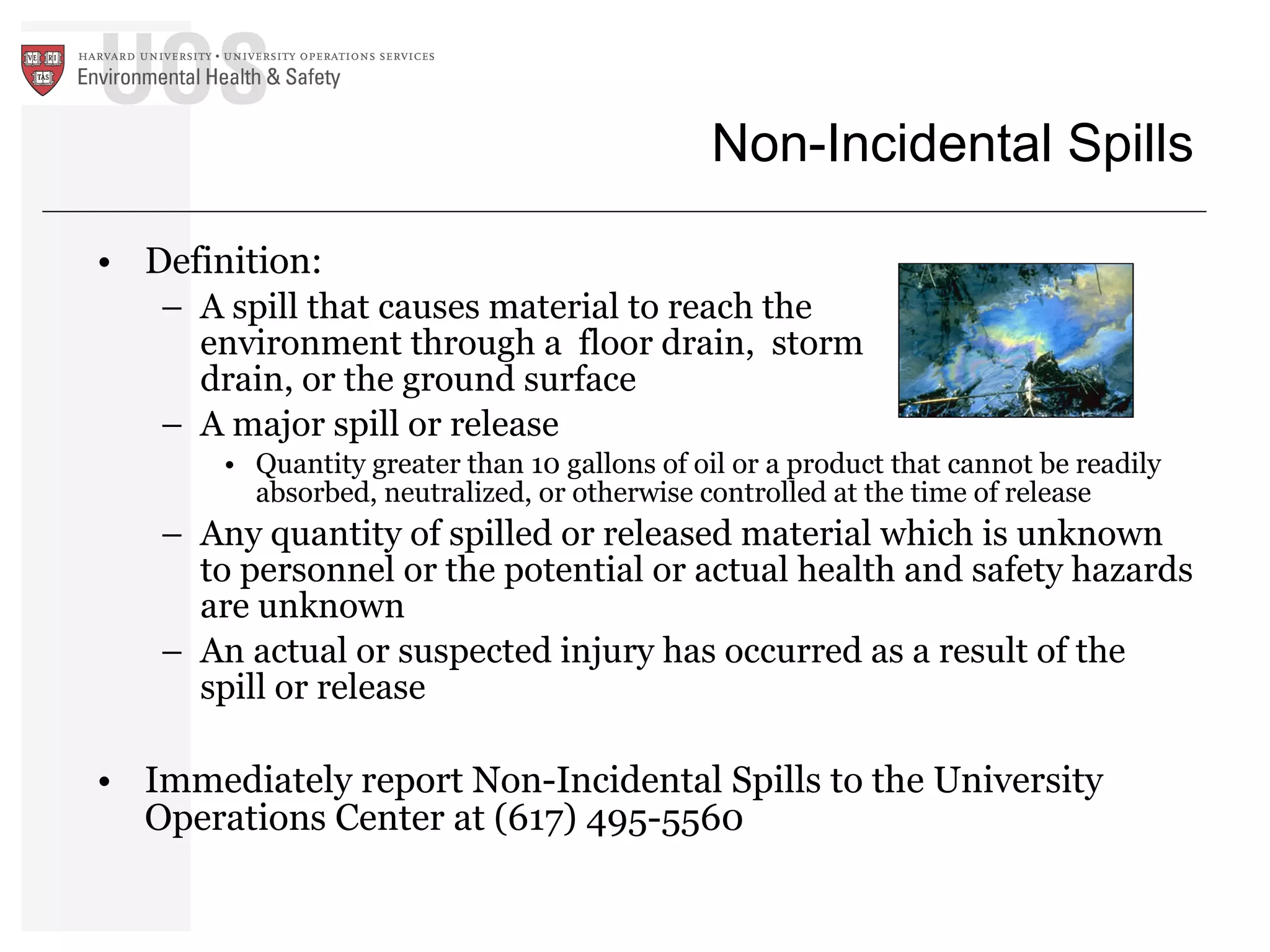
Non-Incidental Spills Definition: A spill that causes material to reach the  environment through a  floor drain,  storm  drain, or the ground surface A major spill or release  Quantity greater than 10 gallons of oil or a product that cannot be readily absorbed, neutralized, or otherwise controlled at the time of release Any quantity of spilled or released material which is unknown to personnel or the potential or actual health and safety hazards are unknown  An actual or suspected injury has occurred as a result of the spill or release Immediately report Non-Incidental Spills to the University Operations Center at (617) 495-5560
Response Procedures In the event of a spill: Isolate area to protect people Identify the source of the spill Note the material and quantity spilled Identify potential hazards Protect potential receptors (storm drains, sumps, floor drains and soil) Clean up incidental spills Ask facility operations for location of nearest spill kit Call for help if you are unable to clean the spill
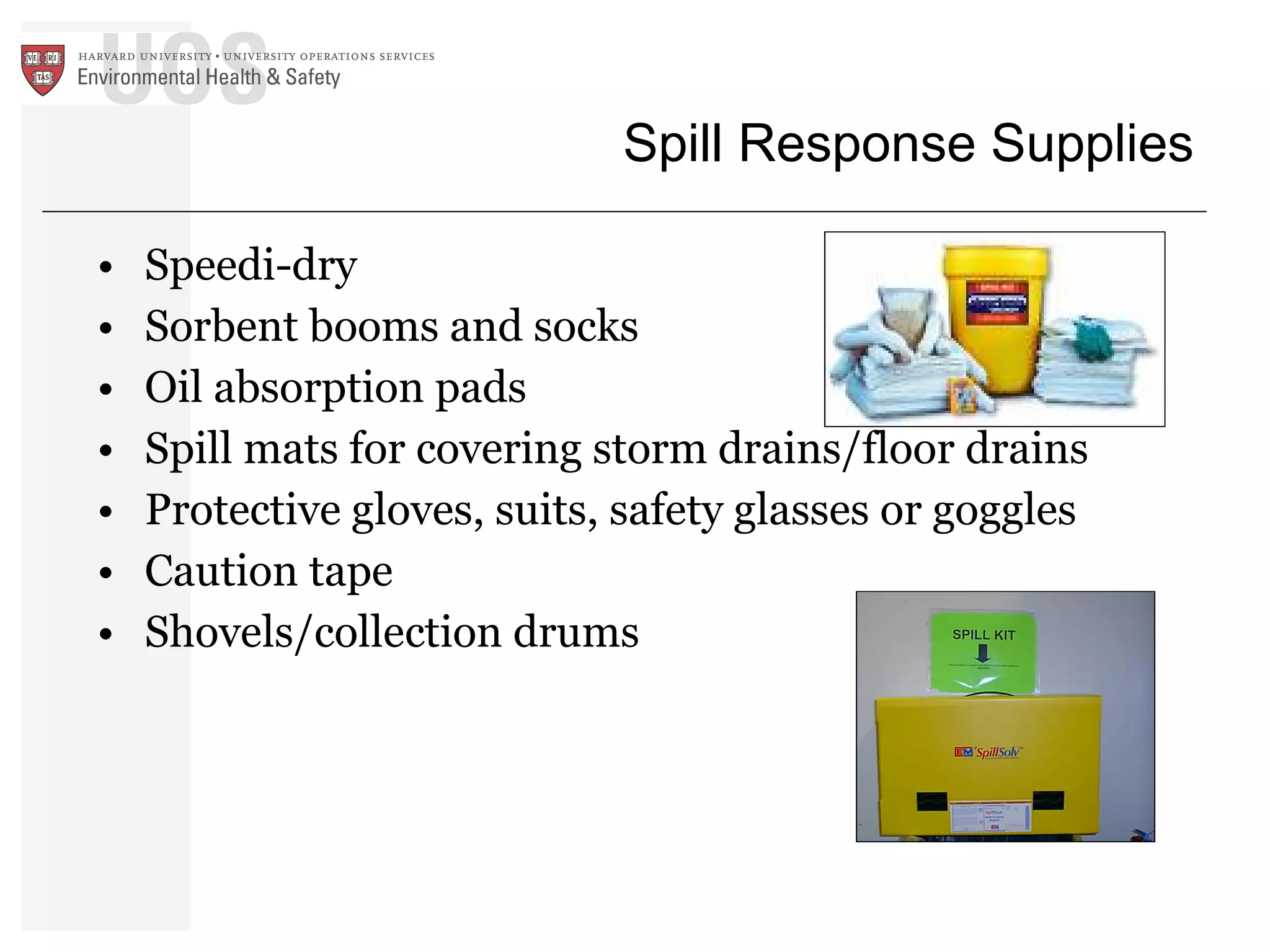
Spill Response Supplies Speedi-dry Sorbent booms and socks Oil absorption pads Spill mats for covering storm drains/floor drains Protective gloves, suits, safety glasses or goggles Caution tape Shovels/collection drums
Inspections Monthly documented inspections are required for: Aboveground Storage Tanks Bulk Storage Containers Drums – 55 gallons or greater, including kitchen grease drums. Underground Storage Tanks which are used for heating on site Conduct Best Management Practice inspections on: Transformers  Hydraulic Elevator Systems and Lifts Electrical Switches Grease traps  Oil/Water separators Records must be kept on site for 3 years
Tank Testing Formal inspections by qualified inspectors and leak testing are required every 10 years for tanks greater than 1,100 gallons Integrity testing must be conducted under the following conditions: Regular schedule or when repairs are made to a tank On an interval not greater than 10 years Testing will be in accordance with general industry guidelines and by a qualified tank inspector Records of all testing must be maintained by the tank owner
Security Containers must be located in areas that are accessible only to authorized personnel Lighting must be sufficient to enable the discovery of spills during hours of darkness and to prevent spills occurring through acts of vandalism
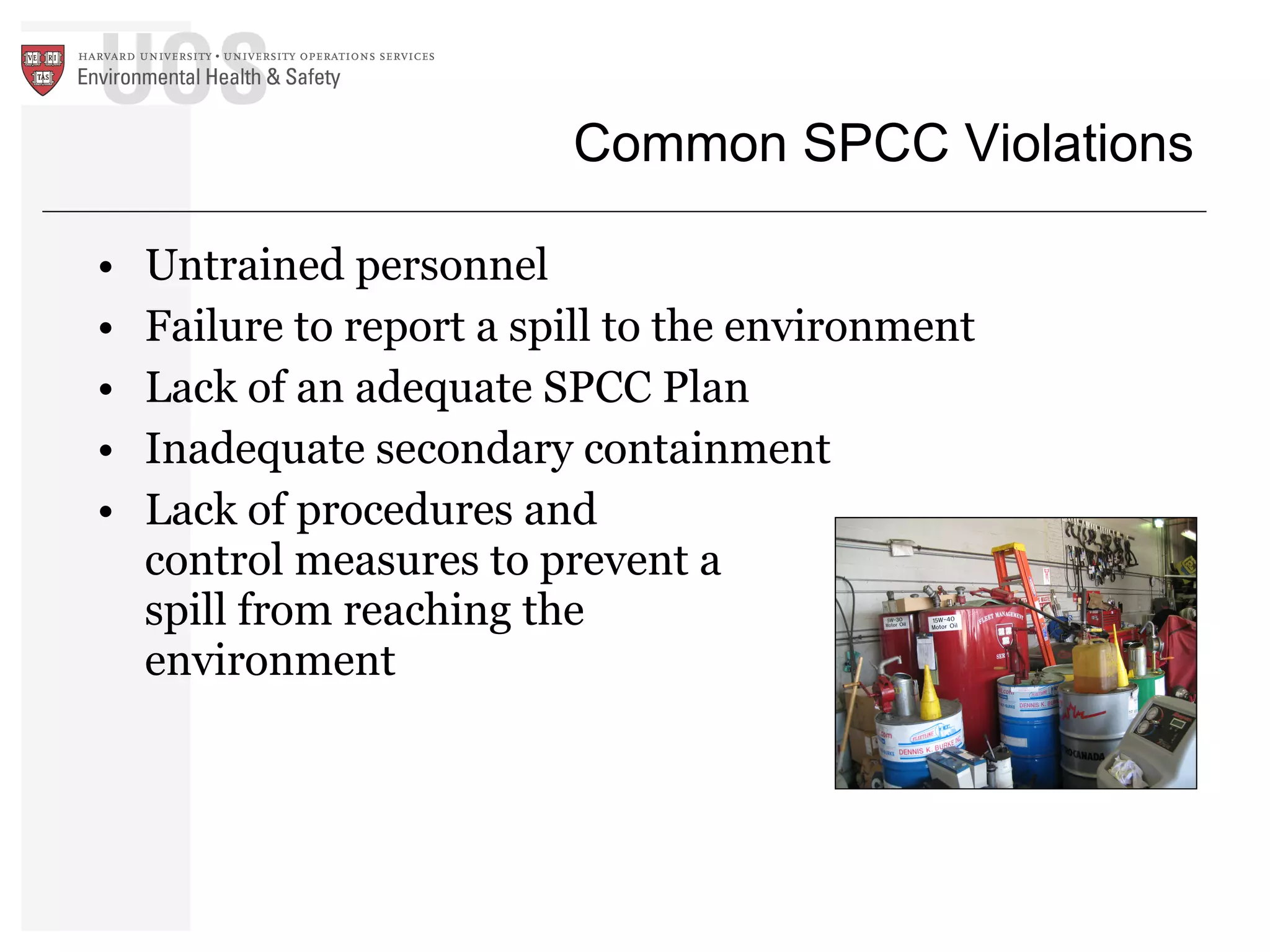
Common SPCC Violations Untrained personnel Failure to report a spill to the environment Lack of an adequate SPCC Plan Inadequate secondary containment Lack of procedures and  control measures to prevent a  spill from reaching the  environment
Communications Internal: EH&S will communicate regulatory changes through the SPCC Management Coordinators Emergencies: Immediately contact the University Operations Center  (617) 495-5560  Go to the next slide for more SPCC resources
Information Resources EH&S web-based Facility Equipment Inventory Management System (FEIMS) http:// www.uos.harvard.edu/redir/feims.html   Technical Assistance on SPCC Plan http:// www.uos.harvard.edu/ehs/environmental/spcc.shtml   Hazardous Waste Procedures http://www.uos.harvard.edu/ehs/environmental/hazardous_waste.shtml   Harvard Environmental Health and Safety Department Cambridge (617) 495-2060,  Longwood (617) 432-1720
Congratulations You have now completed the presentation portion of the SPCC Training In order to finish the training take the course quiz Then print out your certificate of completion

SPCC Training

  • 1.
    Spill Prevention, Control and Countermeasure (SPCC) Training
  • 2.
    Goals of SPCCTraining Overview of the SPCC Requirements Summary of Harvard’s SPCC Plan Spill Prevention and Response Procedures Inspection Requirements Roles and Responsibilities Information Resources
  • 3.
    SPCC Requirements Requiredby EPA if a facility can “reasonably be expected to discharge harmful amounts of oil into navigable waters of the United States or adjoining shorelines”, and stores above certain threshold Required at Harvard due to oil storage volume throughout the University and at off-site locations and because oil can reasonably be expected to enter navigable waters
  • 4.
    Oil Regulated UnderSPCC All petroleum based oils Fuel oil, motor oil, distillate oil, gasoline, hydraulic fluid Oil mixed with wastes Animal fats and oils Fish and marine mammal oils Vegetable oils Oils from seeds, fruits, nuts and kernels
  • 5.
    Containers Regulated UnderSPCC Any current oil storage container 55 gallons or greater Bulk Storage - drums, tanks and containers Operational equipment - transformers, elevator tanks, electrical switches Any empty container 55 gallons or greater capable of storing oil and not rendered unusable
  • 6.
    Harvard’s SPCC PlansHarvard has five (5) SPCC Plans: Cambridge/Allston Campuses Longwood Medical Campus Southborough Campus Concord Field Station Harvard Forest Copies of the Plans are Maintained at: EH&S offices at 46 Blackstone Street in Cambridge University Operations Center Security stations at off-site locations
  • 7.
    Contents of SPCCPlans Identify oil storage and use locations Tanks (above and underground) Hydraulic elevator systems Emergency Generators Electrical transformers and substations Electrical switches Pumps, gear boxes, bearings Waste Oil Satellite Accumulation Areas Waste cooking oil containers Designate responsibilities for implementation Establish spill prevention and response procedures
  • 8.
    Roles and ResponsibilitiesMaintain signed copy of Fuel Delivery notice Conduct follow-up Ensure contractors are aware of SPCC Reporting requirements Maintain facility-specific oil storage/use information and provide updates to EH&S Determine need for regulatory reporting Assign and monitor monthly inspections Maintain training records Assess human health and environmental hazards and impacts Cleanup spills Ensure personnel are familiar with locations of spill equipment Coordinate with EH&S on SPCC Requirements Support spill incident report and follow-up Notify the Operations Center of any spills (617-495-5560) Ensure spill equipment is stocked Conduct and document inspections Monitor SPCC regulatory changes Provide spill response equipment Ensure personnel are trained Training for Staff Provides SPCC Training and Guidance Be familiar with SPCC requirements Update inventory for accuracy Ensure resource allocation Develop SPCC Plan Contractors/ Vendors Facility Managers Environmental Safety Compliance Officers EH&S
  • 9.
    SPCC Device InventoryHarvard facilities are required to keep an accurate and up-to-date inventory of all SPCC devices Facilities must review the devices and inventory annually EH&S maintains a web-based Facility Equipment Inventory Management System (FEIMS) http:// www.uos.harvard.edu/redir/feims.html
  • 10.
    SPCC Training Requiredfor any Harvard employee involved in: Oil handling Transfer Storage Spill response Maintenance of oil equipment Managers or supervisors who have direct reports involved in the activities listed above Fuel oil delivery company employees
  • 11.
    Spill Prevention RoutineInspections Monthly inspections of SPCC devices Maintenance and repairs Reporting all leaks Personnel Training All personnel handling oil must be trained upon hire Retraining must occur if there are changes to the Plan Alarms/Shutoff Valves Monitor leak detection and overfill protection systems Respond immediately to all alarms Do not leave monitoring system unsupervised Perform regular tests on monitoring systems
  • 12.
    Spill Prevention ContinuedFuel Deliveries Facility managers should ensure that all fuel delivery vendors receive the “Notice to Fuel Delivery Vendor” Maintain signed “Notice to Fuel Delivery Vendor” Must follow Tank Truck Delivery Procedures Harvard University personnel should be present and monitor fuel deliveries Immediately report any leakage or spillage to Harvard University’s Operations Center at (617) 495-5560
  • 13.
    Spill Prevention ContinuedSecondary Containment Must be an impervious material and contain a means of discharge (pipe with valve) that is able to be locked Required for oil containing devices by Harvard EH&S Transformers, electrical switches and elevator tanks are exempt from this requirement of SPCC
  • 14.
    Spill Scenarios Potentialspills at Harvard include: Damage to or release from oil delivery equipment during the loading/unloading of oil at fill stations Aboveground or underground tank failure Leaking or failure of drums or containers Overfill at a fill port Spillage during transfer from drums or tanks Leaking and/or failure of piping and pumps Leaking transformer
  • 15.
    Incidental Spills Definition:Spills of known materials that do not pose potential safety or health hazards (fire, explosion or chemical exposure) Spills that can be controlled and cleaned up at the time of release by employees in the immediate area or by maintenance personnel Spills that do NOT impact the environment Management Do not endanger yourself or others Use proper personal protective equipment (gloves, goggles, etc.) while cleaning up the spill Dispose of the waste properly and in accordance with Harvard’s Hazardous Waste procedures
  • 16.
    Non-Incidental Spills Definition:A spill that causes material to reach the environment through a floor drain, storm drain, or the ground surface A major spill or release Quantity greater than 10 gallons of oil or a product that cannot be readily absorbed, neutralized, or otherwise controlled at the time of release Any quantity of spilled or released material which is unknown to personnel or the potential or actual health and safety hazards are unknown An actual or suspected injury has occurred as a result of the spill or release Immediately report Non-Incidental Spills to the University Operations Center at (617) 495-5560
  • 17.
    Response Procedures Inthe event of a spill: Isolate area to protect people Identify the source of the spill Note the material and quantity spilled Identify potential hazards Protect potential receptors (storm drains, sumps, floor drains and soil) Clean up incidental spills Ask facility operations for location of nearest spill kit Call for help if you are unable to clean the spill
  • 18.
    Spill Response SuppliesSpeedi-dry Sorbent booms and socks Oil absorption pads Spill mats for covering storm drains/floor drains Protective gloves, suits, safety glasses or goggles Caution tape Shovels/collection drums
  • 19.
    Inspections Monthly documentedinspections are required for: Aboveground Storage Tanks Bulk Storage Containers Drums – 55 gallons or greater, including kitchen grease drums. Underground Storage Tanks which are used for heating on site Conduct Best Management Practice inspections on: Transformers Hydraulic Elevator Systems and Lifts Electrical Switches Grease traps Oil/Water separators Records must be kept on site for 3 years
  • 20.
    Tank Testing Formalinspections by qualified inspectors and leak testing are required every 10 years for tanks greater than 1,100 gallons Integrity testing must be conducted under the following conditions: Regular schedule or when repairs are made to a tank On an interval not greater than 10 years Testing will be in accordance with general industry guidelines and by a qualified tank inspector Records of all testing must be maintained by the tank owner
  • 21.
    Security Containers mustbe located in areas that are accessible only to authorized personnel Lighting must be sufficient to enable the discovery of spills during hours of darkness and to prevent spills occurring through acts of vandalism
  • 22.
    Common SPCC ViolationsUntrained personnel Failure to report a spill to the environment Lack of an adequate SPCC Plan Inadequate secondary containment Lack of procedures and control measures to prevent a spill from reaching the environment
  • 23.
    Communications Internal: EH&Swill communicate regulatory changes through the SPCC Management Coordinators Emergencies: Immediately contact the University Operations Center (617) 495-5560 Go to the next slide for more SPCC resources
  • 24.
    Information Resources EH&Sweb-based Facility Equipment Inventory Management System (FEIMS) http:// www.uos.harvard.edu/redir/feims.html Technical Assistance on SPCC Plan http:// www.uos.harvard.edu/ehs/environmental/spcc.shtml Hazardous Waste Procedures http://www.uos.harvard.edu/ehs/environmental/hazardous_waste.shtml Harvard Environmental Health and Safety Department Cambridge (617) 495-2060, Longwood (617) 432-1720
  • 25.
    Congratulations You havenow completed the presentation portion of the SPCC Training In order to finish the training take the course quiz Then print out your certificate of completion