BANYU URIP PROJECT
EPC1 - Production Processing Facilities
Contract No. C-3207067
Module 1 – Hazardous Materials
CONSTRUCTION SAFETY
TRAINING
Right-to-Know
 All employees have the Right-to-Know the
identity and potential hazards that are
associated with the chemicals that they work
with.
Hazards of Chemicals
 Physical Hazards
– Combustible Liquid
– Compressed Gas
– Flammable
– Explosive
– Oxidizer
 Health Hazards
– Toxic
– Corrosive
– Carcinogen
– Irritant
– Sensitizer
• Acute Health Hazard
– Occurs after a short period of exposure and can cause harm very
quickly.
• Chronic Health Hazard
– Occurs gradually over time.
Chemical Exposures
Chemicals can enter your body in one of three ways:
1. Inhalation
• Breathing hazardous chemicals could cause nausea, headaches, or
dizziness. It could also damage the lungs, throat, respiratory
system, and even cause asphyxiation or death.
2. Ingestion
• Eating or smoking after handling a hazardous chemical could cause
poisoning or damage of internal organs.
3. Absorption
• Chemicals can cause burns, rashes, allergies, and vision problems.
It’s even possible for some chemicals to pass through the skin into
the bloodstream.
Requirements of the Standard
 Chemical manufacturers are required to:
–Identify all physical and health hazards of any
chemical or material they produce.
–Report these hazards by:
• Attaching a warning label to each chemical
container.
• Sending an accurate MSDS to every company to
whom the chemical or material is shipped.
Requirements of the Standard
• The Haz-Com Standard requires each
employer that uses hazardous chemicals or
material to:
–Develop written Haz-Com Program
–List all hazardous chemicals/material on site
–Ensure MSDS available and accessible
–Provide required PPE
–Ensure thorough training
Warning Labels
• Warning labels are designed to alert you that a
chemical or material may be hazardous.
• The labels will include the following information:
– The identity of the chemical
– The appropriate hazard warnings
• Flammable
• Explosive
• Proper Handling & Storage
• PPE required
– The name and address of the chemical manufacturer,
importer, or other responsible party.
Warning Labels
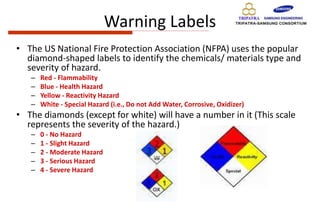
• The US National Fire Protection Association (NFPA) uses the popular
diamond-shaped labels to identify the chemicals/ materials type and
severity of hazard.
– Red - Flammability
– Blue - Health Hazard
– Yellow - Reactivity Hazard
– White - Special Hazard (i.e., Do not Add Water, Corrosive, Oxidizer)
• The diamonds (except for white) will have a number in it (This scale
represents the severity of the hazard.)
– 0 - No Hazard
– 1 - Slight Hazard
– 2 - Moderate Hazard
– 3 - Serious Hazard
– 4 - Severe Hazard
Material Safety Data Sheets
(MSDS)
 The MSDS gives employers detailed information
about the hazards of specific chemicals and
material, as well as how to control them.
 MSDS must be made available to all employees.
 Must be posted at both storage and usage
locations
 Must be communicated to the users
Four Main Categories
1. Product Information
2. Exposure Situations
3. Hazard Prevention and Protection
4. Other Specific Safety Information
Product Information
• Basic information about the material is found in
the beginning of the MSDS
– Name of the chemical (the chemical name will be the
same as the one on the label, although other names
may also be listed
– The manufacturer’s name, address, and telephone
number
– The preparation date, or date of last revision
– Emergency telephone numbers
Product Information
• Specific Exposure Limits:
– Permissible exposure limit (PEL)
– Threshold limit value (TVL)
– Short-term exposure limit (STEL)
• The PEL and TVL are maximum concentrations of
the substance that you can safely be exposed to
averaged over an 8-hour workday.
• The STEL is the acceptable amount of a substance
that you can be exposed to over a fifteen minute
period.
Product Information
• Potential Physical and Health Hazards
– Is the material flammable, corrosive, or
toxic?
– Can the hazards enter your body and
affect your health?
Exposure Situations
• This section of the MSDS explains what
to do in the event of an accidental
exposure:
–First-aid measures
–Response procedures for spills or leaks
–Fire-fighting measures
Hazard Prevention and Protection
• The MSDS provides instruction on how to safely
handle and store materials.
• The following will allow you to:
– Minimize your contact with hazardous materials
– Reduce fire hazards
– Prevent release of hazardous materials
– Learn the conditions
• Heat
• Direct sunlight
• Vibration
Hazard Prevention and
Protection
• Additional Safety Issues:
– PPE
– Engineering controls
– Physical and chemical properties:
• Appearance
• Evaporation rate
• Melting and boiling points
– Stability
– Reactivity
Other Specific Safety
Information
• Other information on the MSDS sheet
– Toxicological
– Ecological
– Disposal
– Transportation
– Regulatory information
• Can be very beneficial and is typically utilized by specialists
– Emergency responders
– Physicians
– Toxicologists
FIRST AIDER MUST BE FAMILIAR WITH THE MSDS AND KNOW WHAT IMMEDIATE
FIRST AID IS REQUIRED
Usage
 MSDS at both the storage and usage areas.
 Decanted substances clearly labeled.
 Hazards and controls clearly communicated to
worker and understood.
 PPE requirements available and understood
 Emergency processes identified on the MSDS are
in place and understood.
Hazardous Materials must be included in JSA
19
Hazard Communication
 Know what you are working with
 Know the risks and the precautions you must take
 If you are unsure, always ask
 Take responsibility for the safety of yourself and
your colleagues
The worker must be trained in the use of Hazardous Materials.
The hazards and controls must be communicated to the worker.
Summary
• The Haz-Com Standard is in place to ensure that
anyone who works around hazardous chemicals or
material:
– Understands their specific hazards
– Has the information, knowledge, and personal
protective equipment to be proactive in the prevention
of safety & health incidents
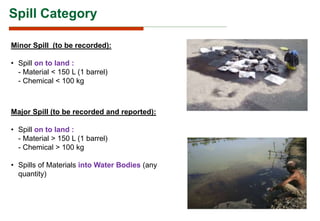
Spill Category
Minor Spill (to be recorded):
• Spill on to land :
- Material < 150 L (1 barrel)
- Chemical < 100 kg
Major Spill (to be recorded and reported):
• Spill on to land :
- Material > 150 L (1 barrel)
- Chemical > 100 kg
• Spills of Materials into Water Bodies (any
quantity)
SPILL PREVENTION STRATEGIES
Activities / Areas Strategy
Storage and Disposal All areas where hazardous wastes, diesel fuel, vehicle fluids, and other liquid materials
that pose a potential threat to human health and/ or the environment (e.g., solvents,
acidic/ caustic solutions, herbicides/ pesticides) are stored and dispensed will be
inspected on a minimum weekly basis by Environmental Engineer in order to identify
drips, small leakages, and situations that could give rise to a spill.
Hazardous wastes will be stored in sealed drums or other suitable sealed
containers placed in hazardous waste collection facilities/ areas at TS site.
Hazardous waste collection facilities/areas will possess secondary containment
capabilities
Liquid materials that pose a potential threat to human health and/ or the environment
will be stored in sealed containers or small tanks placed within designated areas/
facilities that possess secondary containment capabilities or within temporary earthen
beamed areas underlain by an impervious liner.
Diesel fuel will be stored at TS maintenance facility in aboveground storage tanks
placed within a lined containment pad.
Material Transportation Liquid hazardous wastes and material will be transported in a manner that provides
the waste with secondary containment (i.e., via the use of Over Packs or other similar
devices).
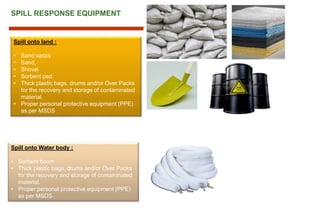
SPILL RESPONSE EQUIPMENT
Spill onto land :
• Sand sacks
• Sand,
• Shovel
• Sorbent pad
• Thick plastic bags, drums and/or Over Packs
for the recovery and storage of contaminated
material.
• Proper personal protective equipment (PPE)
as per MSDS
Spill onto Water body :
• Sorbent boom
• Thick plastic bags, drums and/or Over Packs
for the recovery and storage of contaminated
material.
• Proper personal protective equipment (PPE)
as per MSDS
End of Module
THANK YOU
“FOLLOW THE SAFETY RULE
AND BE SAFE”
“NOBODY GETS HURT”

Hazardus material handel how to cek andd

  • 1.
    BANYU URIP PROJECT EPC1- Production Processing Facilities Contract No. C-3207067 Module 1 – Hazardous Materials CONSTRUCTION SAFETY TRAINING
  • 2.
    Right-to-Know  All employeeshave the Right-to-Know the identity and potential hazards that are associated with the chemicals that they work with.
  • 3.
    Hazards of Chemicals Physical Hazards – Combustible Liquid – Compressed Gas – Flammable – Explosive – Oxidizer  Health Hazards – Toxic – Corrosive – Carcinogen – Irritant – Sensitizer • Acute Health Hazard – Occurs after a short period of exposure and can cause harm very quickly. • Chronic Health Hazard – Occurs gradually over time.
  • 4.
    Chemical Exposures Chemicals canenter your body in one of three ways: 1. Inhalation • Breathing hazardous chemicals could cause nausea, headaches, or dizziness. It could also damage the lungs, throat, respiratory system, and even cause asphyxiation or death. 2. Ingestion • Eating or smoking after handling a hazardous chemical could cause poisoning or damage of internal organs. 3. Absorption • Chemicals can cause burns, rashes, allergies, and vision problems. It’s even possible for some chemicals to pass through the skin into the bloodstream.
  • 5.
    Requirements of theStandard  Chemical manufacturers are required to: –Identify all physical and health hazards of any chemical or material they produce. –Report these hazards by: • Attaching a warning label to each chemical container. • Sending an accurate MSDS to every company to whom the chemical or material is shipped.
  • 6.
    Requirements of theStandard • The Haz-Com Standard requires each employer that uses hazardous chemicals or material to: –Develop written Haz-Com Program –List all hazardous chemicals/material on site –Ensure MSDS available and accessible –Provide required PPE –Ensure thorough training
  • 7.
    Warning Labels • Warninglabels are designed to alert you that a chemical or material may be hazardous. • The labels will include the following information: – The identity of the chemical – The appropriate hazard warnings • Flammable • Explosive • Proper Handling & Storage • PPE required – The name and address of the chemical manufacturer, importer, or other responsible party.
  • 8.
    Warning Labels • TheUS National Fire Protection Association (NFPA) uses the popular diamond-shaped labels to identify the chemicals/ materials type and severity of hazard. – Red - Flammability – Blue - Health Hazard – Yellow - Reactivity Hazard – White - Special Hazard (i.e., Do not Add Water, Corrosive, Oxidizer) • The diamonds (except for white) will have a number in it (This scale represents the severity of the hazard.) – 0 - No Hazard – 1 - Slight Hazard – 2 - Moderate Hazard – 3 - Serious Hazard – 4 - Severe Hazard
  • 9.
    Material Safety DataSheets (MSDS)  The MSDS gives employers detailed information about the hazards of specific chemicals and material, as well as how to control them.  MSDS must be made available to all employees.  Must be posted at both storage and usage locations  Must be communicated to the users
  • 10.
    Four Main Categories 1.Product Information 2. Exposure Situations 3. Hazard Prevention and Protection 4. Other Specific Safety Information
  • 11.
    Product Information • Basicinformation about the material is found in the beginning of the MSDS – Name of the chemical (the chemical name will be the same as the one on the label, although other names may also be listed – The manufacturer’s name, address, and telephone number – The preparation date, or date of last revision – Emergency telephone numbers
  • 12.
    Product Information • SpecificExposure Limits: – Permissible exposure limit (PEL) – Threshold limit value (TVL) – Short-term exposure limit (STEL) • The PEL and TVL are maximum concentrations of the substance that you can safely be exposed to averaged over an 8-hour workday. • The STEL is the acceptable amount of a substance that you can be exposed to over a fifteen minute period.
  • 13.
    Product Information • PotentialPhysical and Health Hazards – Is the material flammable, corrosive, or toxic? – Can the hazards enter your body and affect your health?
  • 14.
    Exposure Situations • Thissection of the MSDS explains what to do in the event of an accidental exposure: –First-aid measures –Response procedures for spills or leaks –Fire-fighting measures
  • 15.
    Hazard Prevention andProtection • The MSDS provides instruction on how to safely handle and store materials. • The following will allow you to: – Minimize your contact with hazardous materials – Reduce fire hazards – Prevent release of hazardous materials – Learn the conditions • Heat • Direct sunlight • Vibration
  • 16.
    Hazard Prevention and Protection •Additional Safety Issues: – PPE – Engineering controls – Physical and chemical properties: • Appearance • Evaporation rate • Melting and boiling points – Stability – Reactivity
  • 17.
    Other Specific Safety Information •Other information on the MSDS sheet – Toxicological – Ecological – Disposal – Transportation – Regulatory information • Can be very beneficial and is typically utilized by specialists – Emergency responders – Physicians – Toxicologists FIRST AIDER MUST BE FAMILIAR WITH THE MSDS AND KNOW WHAT IMMEDIATE FIRST AID IS REQUIRED
  • 18.
    Usage  MSDS atboth the storage and usage areas.  Decanted substances clearly labeled.  Hazards and controls clearly communicated to worker and understood.  PPE requirements available and understood  Emergency processes identified on the MSDS are in place and understood. Hazardous Materials must be included in JSA
  • 19.
    19 Hazard Communication  Knowwhat you are working with  Know the risks and the precautions you must take  If you are unsure, always ask  Take responsibility for the safety of yourself and your colleagues The worker must be trained in the use of Hazardous Materials. The hazards and controls must be communicated to the worker.
  • 20.
    Summary • The Haz-ComStandard is in place to ensure that anyone who works around hazardous chemicals or material: – Understands their specific hazards – Has the information, knowledge, and personal protective equipment to be proactive in the prevention of safety & health incidents
  • 21.
    Spill Category Minor Spill(to be recorded): • Spill on to land : - Material < 150 L (1 barrel) - Chemical < 100 kg Major Spill (to be recorded and reported): • Spill on to land : - Material > 150 L (1 barrel) - Chemical > 100 kg • Spills of Materials into Water Bodies (any quantity)
  • 22.
    SPILL PREVENTION STRATEGIES Activities/ Areas Strategy Storage and Disposal All areas where hazardous wastes, diesel fuel, vehicle fluids, and other liquid materials that pose a potential threat to human health and/ or the environment (e.g., solvents, acidic/ caustic solutions, herbicides/ pesticides) are stored and dispensed will be inspected on a minimum weekly basis by Environmental Engineer in order to identify drips, small leakages, and situations that could give rise to a spill. Hazardous wastes will be stored in sealed drums or other suitable sealed containers placed in hazardous waste collection facilities/ areas at TS site. Hazardous waste collection facilities/areas will possess secondary containment capabilities Liquid materials that pose a potential threat to human health and/ or the environment will be stored in sealed containers or small tanks placed within designated areas/ facilities that possess secondary containment capabilities or within temporary earthen beamed areas underlain by an impervious liner. Diesel fuel will be stored at TS maintenance facility in aboveground storage tanks placed within a lined containment pad. Material Transportation Liquid hazardous wastes and material will be transported in a manner that provides the waste with secondary containment (i.e., via the use of Over Packs or other similar devices).
  • 23.
    SPILL RESPONSE EQUIPMENT Spillonto land : • Sand sacks • Sand, • Shovel • Sorbent pad • Thick plastic bags, drums and/or Over Packs for the recovery and storage of contaminated material. • Proper personal protective equipment (PPE) as per MSDS Spill onto Water body : • Sorbent boom • Thick plastic bags, drums and/or Over Packs for the recovery and storage of contaminated material. • Proper personal protective equipment (PPE) as per MSDS
  • 24.
    End of Module THANKYOU “FOLLOW THE SAFETY RULE AND BE SAFE” “NOBODY GETS HURT”