General Laboratory Safety
Training
Presented by : Asif Nawaz
M.phil 4th Microbiology
Aust
Staying safe means that you…
• Read labels on containers of chemicals
• Read Material Safety Data Sheets (MSDS)
• Handle chemicals with care
• Use correct protective clothing and equipment
• Remember emergency procedures
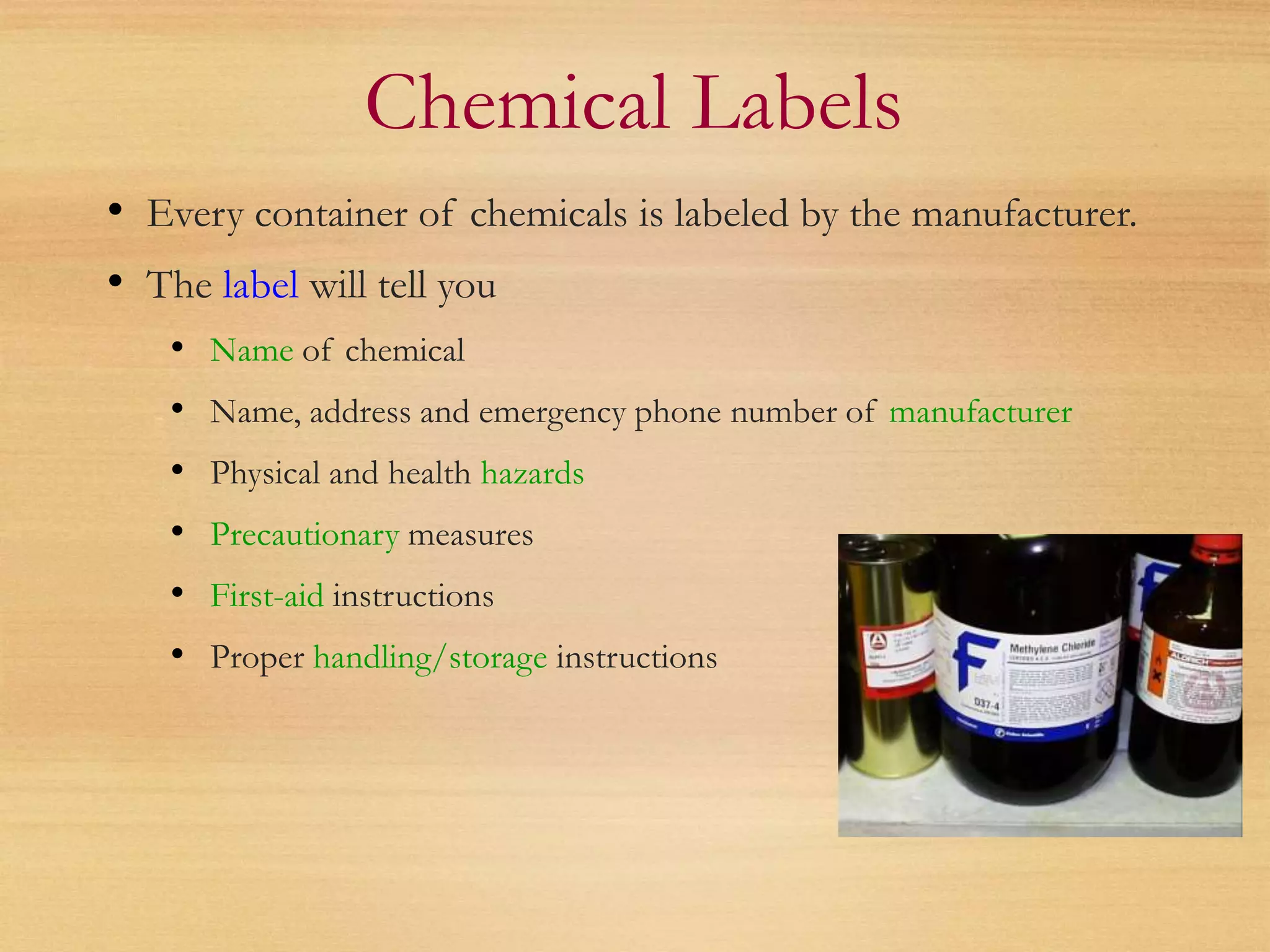
Chemical Labels
• Every container of chemicals is labeled by the manufacturer.
• The label will tell you
• Name of chemical
• Name, address and emergency phone number of manufacturer
• Physical and health hazards
• Precautionary measures
• First-aid instructions
• Proper handling/storage instructions
Health Hazards on a
Chemical Label
• Carcinogen
• Highly toxic agent
• Toxic agent
• Reproductive hazard
• Irritant
• Corrosive
• Sensitizer
• Hepatotoxin
• Nephrotoxin
• Neurotoxin
Typical Precautionary Measures
on a Label
• Do not breathe vapors
• Use in well-ventilated areas
• Keep container closed when not in use
• Avoid contact with skin
• Wash thoroughly with soap and water after handling
• Keep away from sparks, heat, and flame
• Do not store near combustible materials
• Store in tightly closed container
• Remove and wash contaminated clothing promptly
• Keep from contact with clothing and other combustible
materials
Common Signal Words
on Labels
• Danger – Can cause immediate serious injury or death
• Warning – Can cause potentially serious injury or death
• Caution – Can cause potentially moderate injury
Special Symbols Used on Labels
Helps you recognize kind of hazard a chemical could
present if you are not careful
• Toxicity
• Corrosivity (acids and bases)
• Ignitability (flammable solvents and
certain solids)
• Reactivity (sodium and various water-reactive reagents)
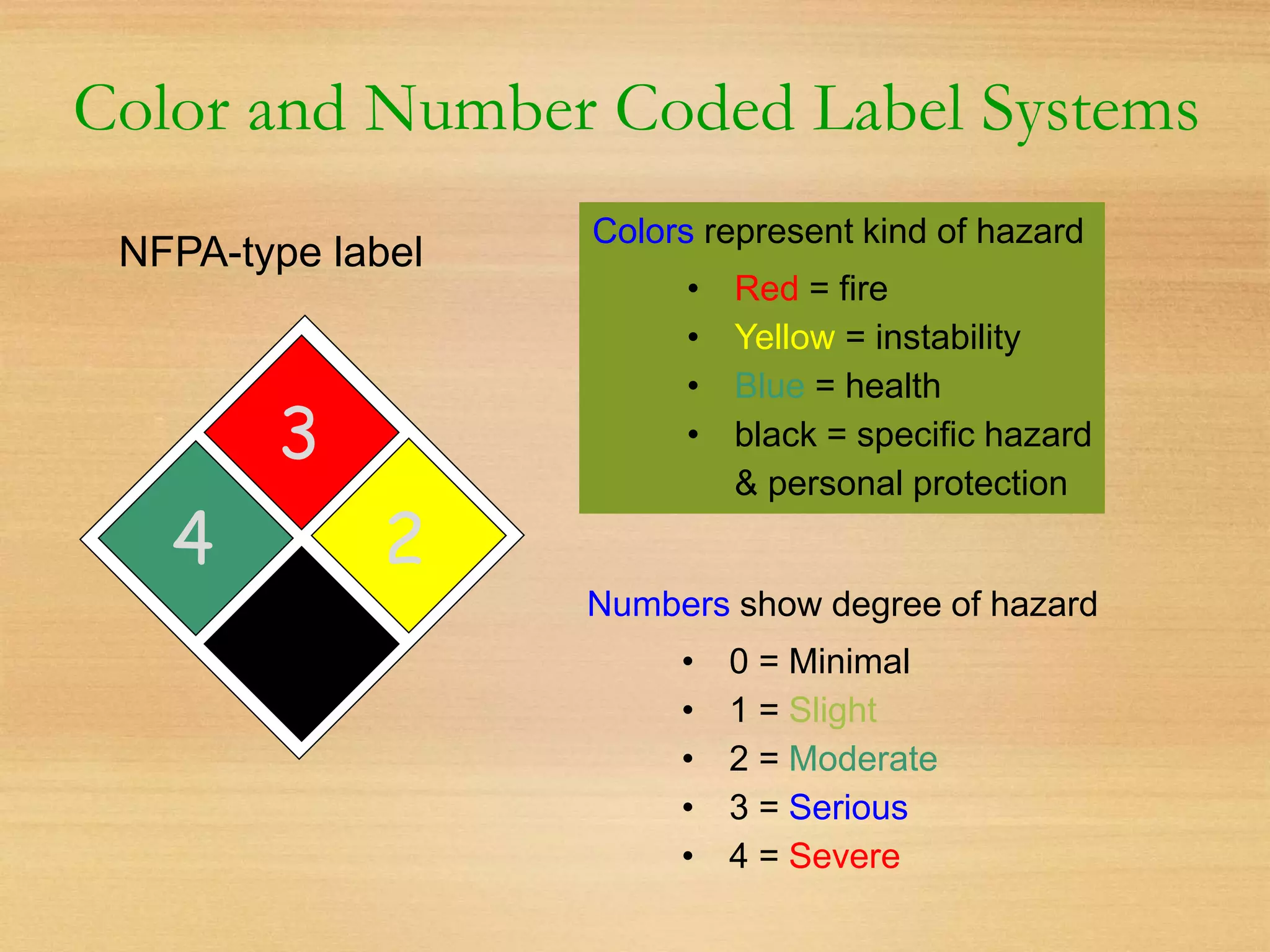
Color and Number Coded Label Systems
3
2
4
Colors represent kind of hazard
• Red = fire
• Yellow = instability
• Blue = health
• black = specific hazard
& personal protection
Numbers show degree of hazard
• 0 = Minimal
• 1 = Slight
• 2 = Moderate
• 3 = Serious
• 4 = Severe
NFPA-type label
Color and Number Coded
Label Systems
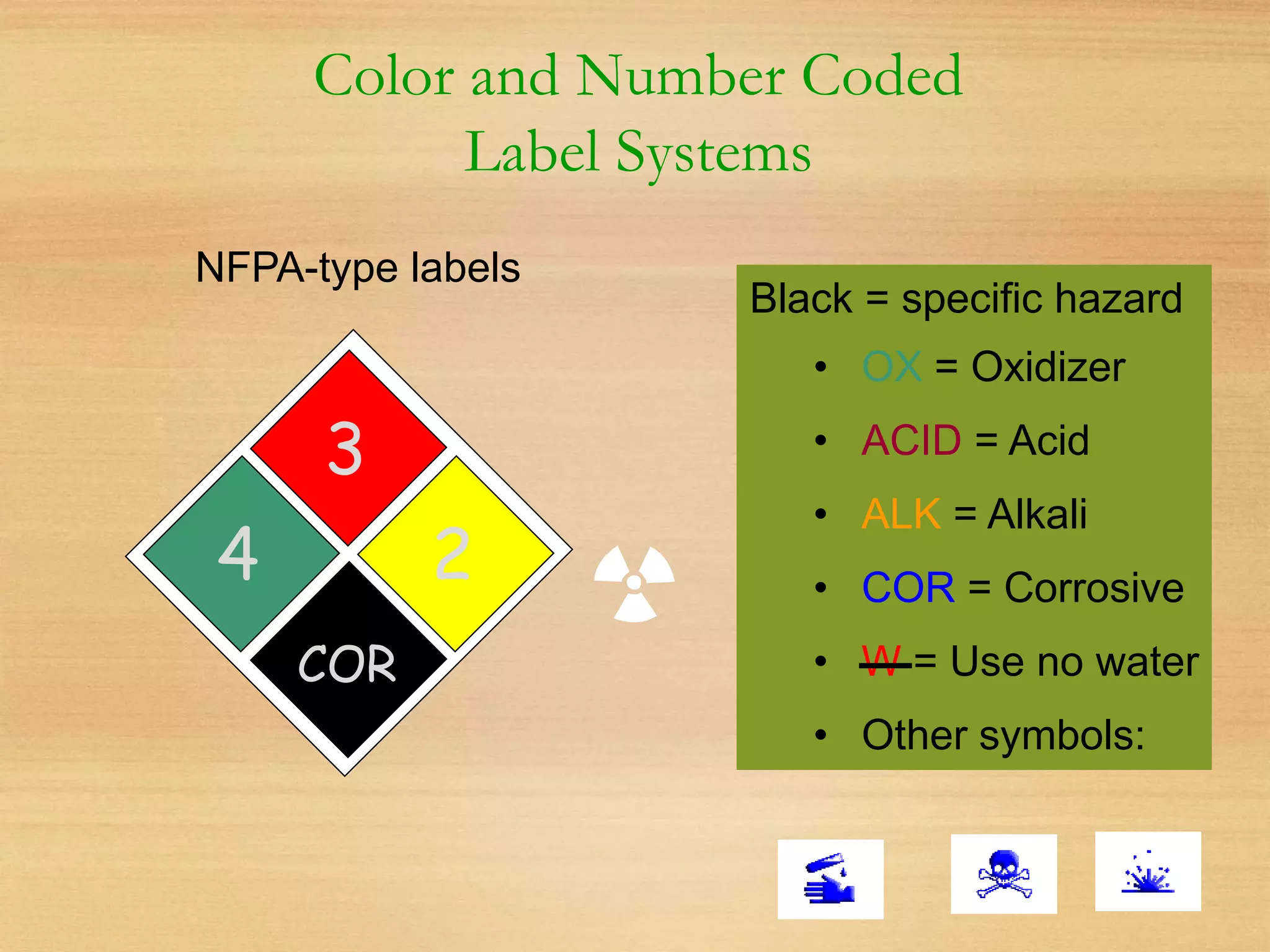
NFPA-type labels
3
2
4
COR
Black = specific hazard
• OX = Oxidizer
• ACID = Acid
• ALK = Alkali
• COR = Corrosive
• W = Use no water
• Other symbols:
Material Safety Data Sheets (MSDS)
Provides more detailed information about a chemical, including
• Composition, information on ingredients (Section 2)
• Hazards identification (Section 3)
• First aid measures (Section 4)
• Accidental Release measures (Section 6)
• Handling and Storage (Section 7)
• Exposure controls, personal protection (Section 8)
• Stability and reactivity (Section 10)
• Toxicological information (Section 11)
MSDS (cont’d)
Hazards Identification
• Inhalation: Respiratory tract (lungs) through inhalation
• Ingestion: Digestive tract through eating or smoking with
contaminated hands or in contaminated work areas
• Absorption through the skin or eyes: Dermatitis or damage to the
liver, kidney, or other organ systems
• Injection: Percutaneous injection of a toxic substance through the
skin
MSDS (cont’d)
Specific possible health hazards:
• Acute poisoning (rapid assimilation of substance, i.e., carbon
monoxide)
• Chronic poisoning (prolonged exposure, i.e., lead poisoning)
• Cumulative poisons (numerous chronic exposures, i.e., heavy
metals)
• Substances in combination (synergistic effect, i.e., exposure
to alcohol and chlorinated solvents)
MSDS (cont’d)
Potential Health Effects
• Eye irritation
• Nausea
• Dizziness
• Skin rashes
• Headache
• Existing medical conditions possibly aggravated by exposure
MSDS (cont’d)
• Emergency/first-aid procedures to follow
• Accidental Release Measures
 What to do if substance spills and leaks
 How to correctly dispose of substance
 Equipment/procedures for cleaning up
spills and leaks
MSDS (cont’d)
Handling and Storage
• How to handle and store substance safely
• Any other precautions (i.e., grounding containers during transfer of
flammables)
MSDS (cont’d)
• Exposure Controls, Personal Protection
 Respirator
 Gloves
 Eye protection
 Protective clothing
 Ventilation
• Special work and hygiene practices that should be followed
MSDS (cont’d)
• Toxicological Information
 LC50: median lethal concentration by inhalation in a
single exposure over a specified time period
 LCLO: lowest reported LC50
 LD50: median lethal concentration by a route other than
inhalation
So, what is “highly toxic”?
• “Highly Toxic” is indicated by
• LD50  50 mg/kg body wt by ingestion to albino rats each
weighing between 200 to 300 gms
OR
• LD50  200 mg/kg by continuous contact for 24 hrs with skin
of albino rabbits each weighing between 2 and 3 kg
OR
• LC50  200 ppm of gas or vapor inhalation (or 2 mg/L of
mist, dust, or fumes) for one hour by albino rats each weighing
between 200 to 300 gms
Handle Chemicals with Care
• Dispose of chemicals, broken glass, and other waste in approved
containers
• Clean up broken glass and spills immediately
• Keep the lab clean and neat
• Store incompatible chemicals in separate storage areas
Chemical Storage
• Labs have established separate storage areas for
 Flammable and combustible organic liquids and solvents
 Acids
 Dry poisons, salts, and oxidizers
 Bases
• Chemicals are stored in
 Chemical storage cabinets
 Flammable storage refrigerators (No food)
 Chemical storage refrigerators/freezers (No food)
 On shelves with retaining barriers
Storage Fundamentals
• Identify incompatible chemicals – check the Material
Safety Data Sheet
• Isolate and separate incompatible materials
• Isolate by storing in another area or room
• Degree of isolation depends on quantities,
chemical properties and packaging
• Separate by storing in same area or room, but
apart from each other
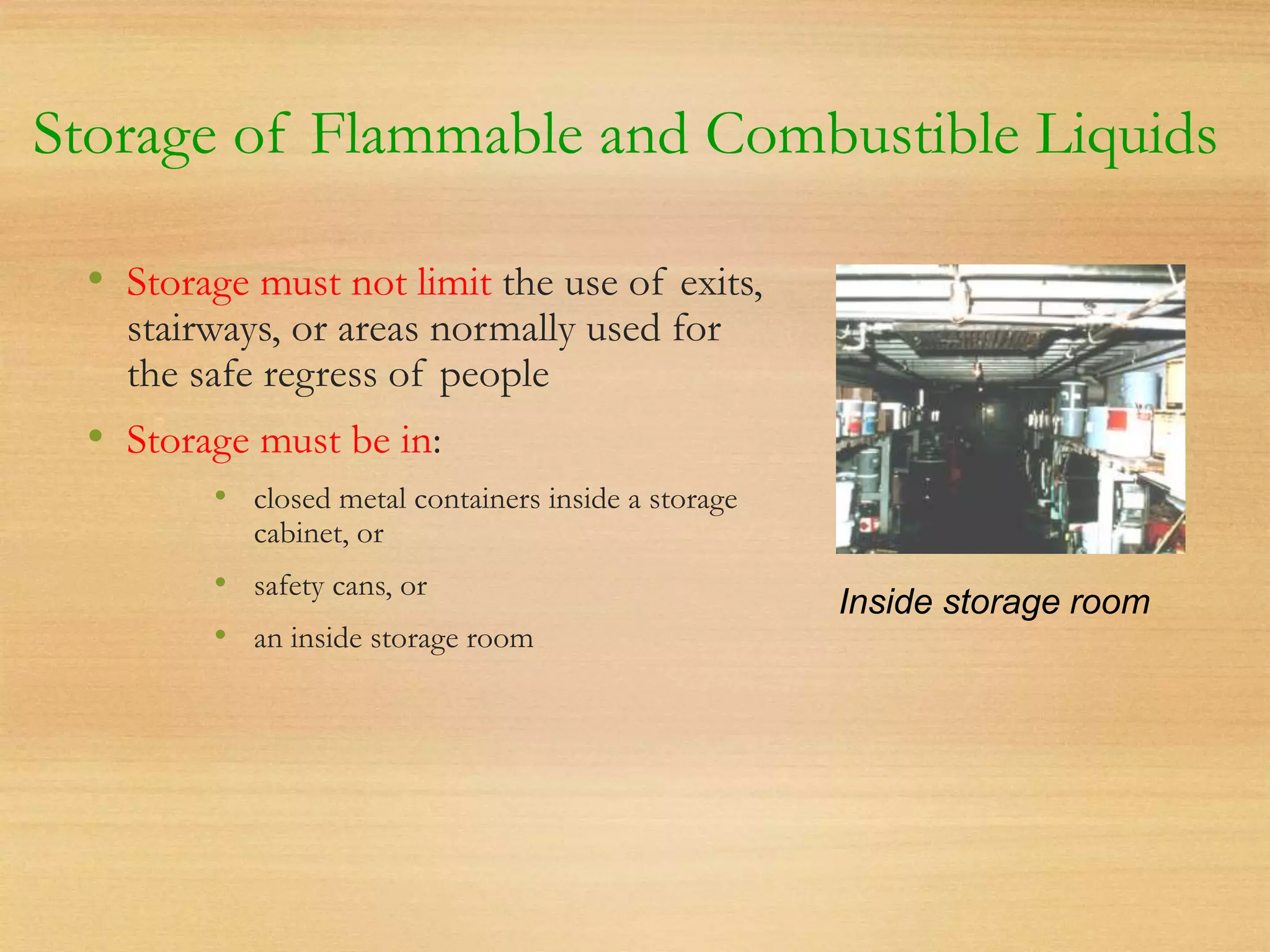
Storage of Flammable and Combustible Liquids
• Storage must not limit the use of exits,
stairways, or areas normally used for
the safe regress of people
• Storage must be in:
• closed metal containers inside a storage
cabinet, or
• safety cans, or
• an inside storage room
Inside storage room
Storage Cabinets
• Not more than 60 gal of Class I and/or
Class II liquids, or not more than 120
gal of Class III liquids permitted in a
cabinet
• Must be conspicuously labeled,
“Flammable - Keep Fire Away”
• Doors on metal cabinets must have a
three-point lock (top, side, and
bottom), and the door sill must be
raised at least 2 inches above the
bottom of the cabinet
Use correct protective clothing and equipment
• Eye Protection
 Safety glasses – flying particles, chemical splashes, dust
 Splash goggles – corrosive liquids, solvents, powders
 Face Shields – high pressure systems
• Respiratory Protection – normally not needed at LUC
• Skin and Body Protection
 Gloves – see the MSDS
 Aprons and lab coats – strong acids and bases
 Shoes – always worn in lab, closed toe and closed heel
• Hearing Protection – normally not needed at LUC
Do not
• Use damaged glassware
• Store chemicals near heat, sunlight, or other substances with
which they might react
• Store materials on floors or other places where people could
trip over them
• Leave equipment unattended when its operating (unless it is
designed to do so or you have an SOP)
• Put custodians and fellow workers in danger
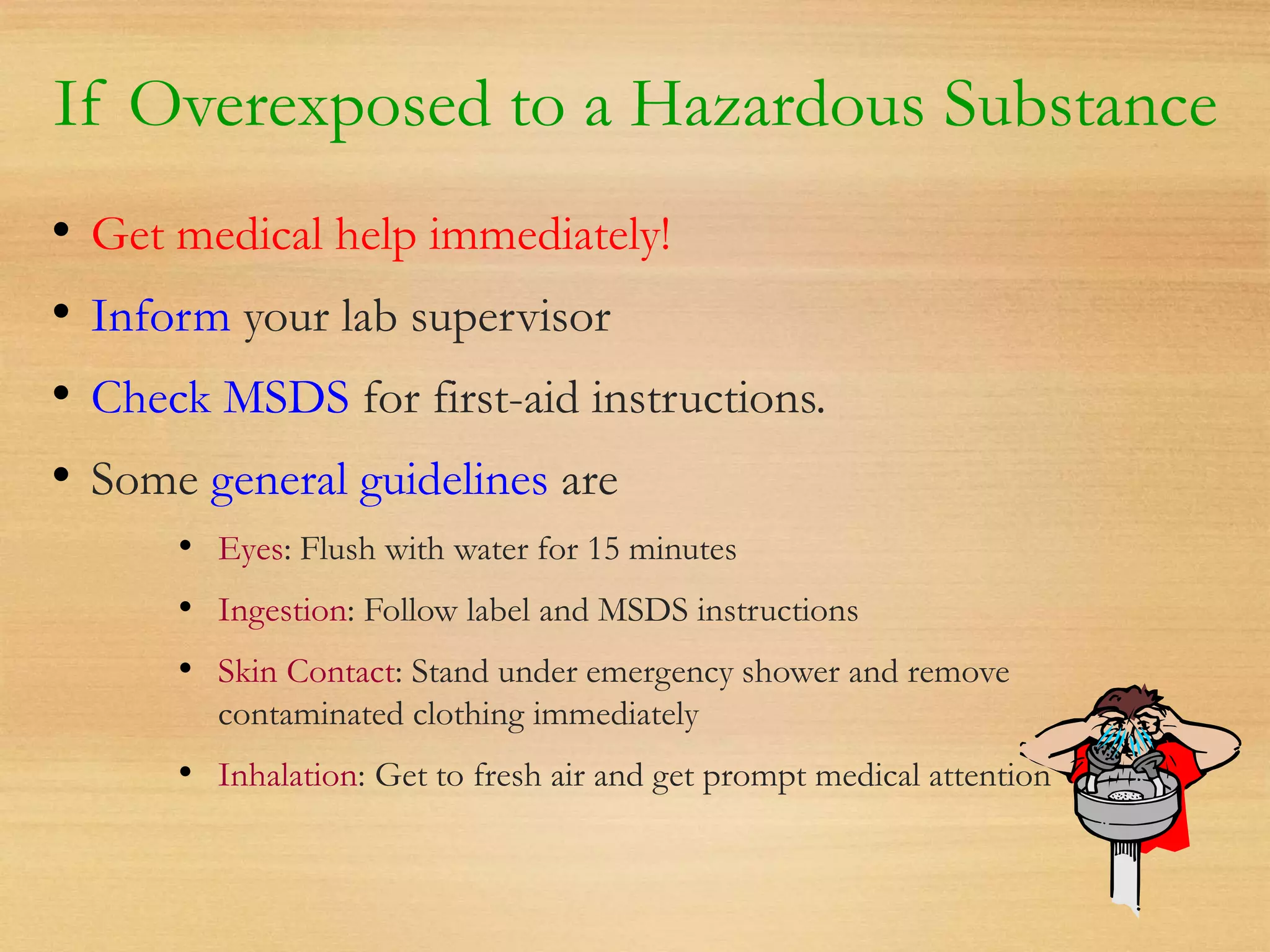
If Overexposed to a Hazardous Substance
• Get medical help immediately!
• Inform your lab supervisor
• Check MSDS for first-aid instructions.
• Some general guidelines are
• Eyes: Flush with water for 15 minutes
• Ingestion: Follow label and MSDS instructions
• Skin Contact: Stand under emergency shower and remove
contaminated clothing immediately
• Inhalation: Get to fresh air and get prompt medical attention
Emergencies can happen, so
• Avoid working alone in the lab
• Know where emergency phone numbers are posted
• Review MSDS
• Know where to go and what to do in an emergency
• Know the location of the closest safety showers,
eyewashes, and fire extinguishers
Chemical Hygiene Plan (CHP)
Outlines specific work practices for all work
involving hazardous substances in the lab
• Gives procedures to follow when working
with hazardous chemicals
• Provides details on how your chemical exposure
will be monitored and limited
• Assures that you have the right personal protective
equipment (PPE)
• Specifies that some hazardous tasks to be
approved in advance by the PI
JLF 9/05 30
30

General Laboratory Safety Training

  • 1.
    General Laboratory Safety Training Presentedby : Asif Nawaz M.phil 4th Microbiology Aust
  • 2.
    Staying safe meansthat you… • Read labels on containers of chemicals • Read Material Safety Data Sheets (MSDS) • Handle chemicals with care • Use correct protective clothing and equipment • Remember emergency procedures
  • 3.
    Chemical Labels • Everycontainer of chemicals is labeled by the manufacturer. • The label will tell you • Name of chemical • Name, address and emergency phone number of manufacturer • Physical and health hazards • Precautionary measures • First-aid instructions • Proper handling/storage instructions
  • 4.
    Health Hazards ona Chemical Label • Carcinogen • Highly toxic agent • Toxic agent • Reproductive hazard • Irritant • Corrosive • Sensitizer • Hepatotoxin • Nephrotoxin • Neurotoxin
  • 5.
    Typical Precautionary Measures ona Label • Do not breathe vapors • Use in well-ventilated areas • Keep container closed when not in use • Avoid contact with skin • Wash thoroughly with soap and water after handling
  • 6.
    • Keep awayfrom sparks, heat, and flame • Do not store near combustible materials • Store in tightly closed container • Remove and wash contaminated clothing promptly • Keep from contact with clothing and other combustible materials
  • 7.
    Common Signal Words onLabels • Danger – Can cause immediate serious injury or death • Warning – Can cause potentially serious injury or death • Caution – Can cause potentially moderate injury
  • 8.
    Special Symbols Usedon Labels Helps you recognize kind of hazard a chemical could present if you are not careful • Toxicity • Corrosivity (acids and bases) • Ignitability (flammable solvents and certain solids) • Reactivity (sodium and various water-reactive reagents)
  • 9.
    Color and NumberCoded Label Systems 3 2 4 Colors represent kind of hazard • Red = fire • Yellow = instability • Blue = health • black = specific hazard & personal protection Numbers show degree of hazard • 0 = Minimal • 1 = Slight • 2 = Moderate • 3 = Serious • 4 = Severe NFPA-type label
  • 10.
    Color and NumberCoded Label Systems NFPA-type labels 3 2 4 COR Black = specific hazard • OX = Oxidizer • ACID = Acid • ALK = Alkali • COR = Corrosive • W = Use no water • Other symbols:
  • 11.
    Material Safety DataSheets (MSDS) Provides more detailed information about a chemical, including • Composition, information on ingredients (Section 2) • Hazards identification (Section 3) • First aid measures (Section 4) • Accidental Release measures (Section 6) • Handling and Storage (Section 7) • Exposure controls, personal protection (Section 8) • Stability and reactivity (Section 10) • Toxicological information (Section 11)
  • 12.
    MSDS (cont’d) Hazards Identification •Inhalation: Respiratory tract (lungs) through inhalation • Ingestion: Digestive tract through eating or smoking with contaminated hands or in contaminated work areas • Absorption through the skin or eyes: Dermatitis or damage to the liver, kidney, or other organ systems • Injection: Percutaneous injection of a toxic substance through the skin
  • 13.
    MSDS (cont’d) Specific possiblehealth hazards: • Acute poisoning (rapid assimilation of substance, i.e., carbon monoxide) • Chronic poisoning (prolonged exposure, i.e., lead poisoning) • Cumulative poisons (numerous chronic exposures, i.e., heavy metals) • Substances in combination (synergistic effect, i.e., exposure to alcohol and chlorinated solvents)
  • 14.
    MSDS (cont’d) Potential HealthEffects • Eye irritation • Nausea • Dizziness • Skin rashes • Headache • Existing medical conditions possibly aggravated by exposure
  • 15.
    MSDS (cont’d) • Emergency/first-aidprocedures to follow • Accidental Release Measures  What to do if substance spills and leaks  How to correctly dispose of substance  Equipment/procedures for cleaning up spills and leaks
  • 16.
    MSDS (cont’d) Handling andStorage • How to handle and store substance safely • Any other precautions (i.e., grounding containers during transfer of flammables)
  • 17.
    MSDS (cont’d) • ExposureControls, Personal Protection  Respirator  Gloves  Eye protection  Protective clothing  Ventilation • Special work and hygiene practices that should be followed
  • 18.
    MSDS (cont’d) • ToxicologicalInformation  LC50: median lethal concentration by inhalation in a single exposure over a specified time period  LCLO: lowest reported LC50  LD50: median lethal concentration by a route other than inhalation
  • 19.
    So, what is“highly toxic”? • “Highly Toxic” is indicated by • LD50  50 mg/kg body wt by ingestion to albino rats each weighing between 200 to 300 gms OR • LD50  200 mg/kg by continuous contact for 24 hrs with skin of albino rabbits each weighing between 2 and 3 kg OR • LC50  200 ppm of gas or vapor inhalation (or 2 mg/L of mist, dust, or fumes) for one hour by albino rats each weighing between 200 to 300 gms
  • 20.
    Handle Chemicals withCare • Dispose of chemicals, broken glass, and other waste in approved containers • Clean up broken glass and spills immediately • Keep the lab clean and neat • Store incompatible chemicals in separate storage areas
  • 21.
    Chemical Storage • Labshave established separate storage areas for  Flammable and combustible organic liquids and solvents  Acids  Dry poisons, salts, and oxidizers  Bases • Chemicals are stored in  Chemical storage cabinets  Flammable storage refrigerators (No food)  Chemical storage refrigerators/freezers (No food)  On shelves with retaining barriers
  • 22.
    Storage Fundamentals • Identifyincompatible chemicals – check the Material Safety Data Sheet • Isolate and separate incompatible materials • Isolate by storing in another area or room • Degree of isolation depends on quantities, chemical properties and packaging • Separate by storing in same area or room, but apart from each other
  • 23.
    Storage of Flammableand Combustible Liquids • Storage must not limit the use of exits, stairways, or areas normally used for the safe regress of people • Storage must be in: • closed metal containers inside a storage cabinet, or • safety cans, or • an inside storage room Inside storage room
  • 24.
    Storage Cabinets • Notmore than 60 gal of Class I and/or Class II liquids, or not more than 120 gal of Class III liquids permitted in a cabinet • Must be conspicuously labeled, “Flammable - Keep Fire Away” • Doors on metal cabinets must have a three-point lock (top, side, and bottom), and the door sill must be raised at least 2 inches above the bottom of the cabinet
  • 25.
    Use correct protectiveclothing and equipment • Eye Protection  Safety glasses – flying particles, chemical splashes, dust  Splash goggles – corrosive liquids, solvents, powders  Face Shields – high pressure systems • Respiratory Protection – normally not needed at LUC • Skin and Body Protection  Gloves – see the MSDS  Aprons and lab coats – strong acids and bases  Shoes – always worn in lab, closed toe and closed heel • Hearing Protection – normally not needed at LUC
  • 26.
    Do not • Usedamaged glassware • Store chemicals near heat, sunlight, or other substances with which they might react • Store materials on floors or other places where people could trip over them • Leave equipment unattended when its operating (unless it is designed to do so or you have an SOP) • Put custodians and fellow workers in danger
  • 27.
    If Overexposed toa Hazardous Substance • Get medical help immediately! • Inform your lab supervisor • Check MSDS for first-aid instructions. • Some general guidelines are • Eyes: Flush with water for 15 minutes • Ingestion: Follow label and MSDS instructions • Skin Contact: Stand under emergency shower and remove contaminated clothing immediately • Inhalation: Get to fresh air and get prompt medical attention
  • 28.
    Emergencies can happen,so • Avoid working alone in the lab • Know where emergency phone numbers are posted • Review MSDS • Know where to go and what to do in an emergency • Know the location of the closest safety showers, eyewashes, and fire extinguishers
  • 29.
    Chemical Hygiene Plan(CHP) Outlines specific work practices for all work involving hazardous substances in the lab • Gives procedures to follow when working with hazardous chemicals • Provides details on how your chemical exposure will be monitored and limited • Assures that you have the right personal protective equipment (PPE) • Specifies that some hazardous tasks to be approved in advance by the PI
  • 30.