GHS Labels
Presented by: Lorraine Davison, M.Sc. M.Eng.
        Manager, Chemical Services
                   2012


        www.ccohs.ca
What is GHS?

Globally Harmonized System of
Classification and Labelling of
Chemicals

 An international system for
  All chemical substances, mixtures.
  Allows “continuous improvement” for
   chemical hazard communication.

Goal is a common & effective
classification & communication system
world-wide.


 Canadian Centre for Occupational Health and Safety   www.ccohs.ca
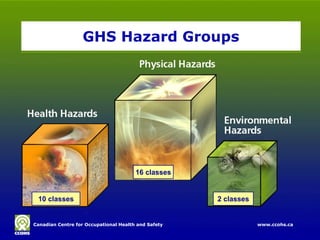
GHS Hazard Groups


                                       16 classes


 10 classes                                          2 classes


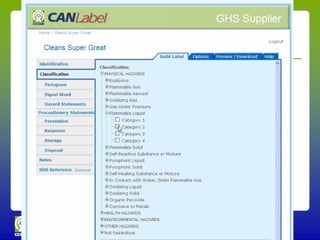
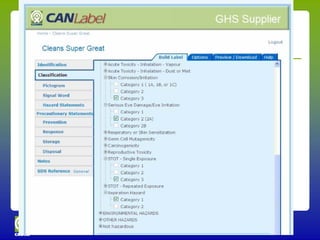
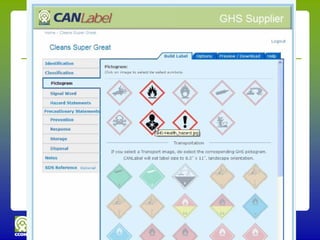
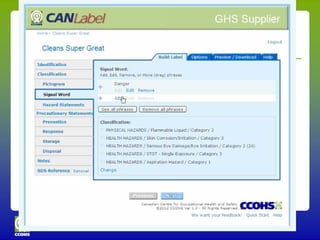
Canadian Centre for Occupational Health and Safety
Canadian Centre for Occupational Health and Safety               www.ccohs.ca
                                                                 www.ccohs.ca
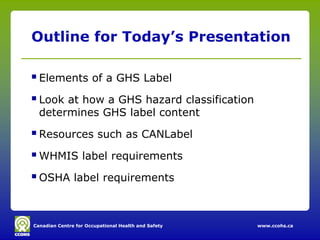
Outline for Today’s Presentation

 Elements of a GHS Label
 Look at how a GHS hazard classification
  determines GHS label content

 Resources such as CANLabel
 WHMIS label requirements
 OSHA label requirements


Canadian Centre for Occupational Health and Safety   www.ccohs.ca
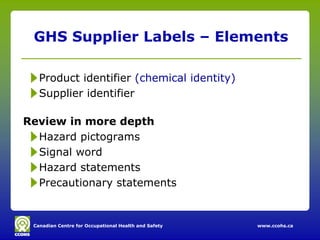
GHS Supplier Labels – Elements

   Product identifier (chemical identity)
   Supplier identifier

Review in more depth
  Hazard pictograms
  Signal word
  Hazard statements
  Precautionary statements


 Canadian Centre for Occupational Health and Safety   www.ccohs.ca
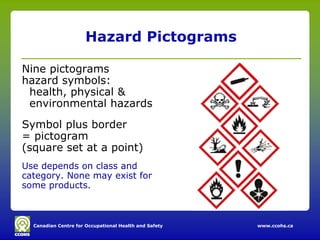
Hazard Pictograms

Nine pictograms
hazard symbols:
 health, physical &
 environmental hazards
Symbol plus border
= pictogram
(square set at a point)
Use depends on class and
category. None may exist for
some products.


  Canadian Centre for Occupational Health and Safety   www.ccohs.ca
Signal Words

Signal words warn users about the level or degree
 of hazard. There are two signal words:
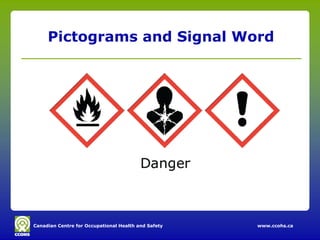
   Danger
   Warning

 Use depends on class and category.
 No signal word may be required.


 Canadian Centre for Occupational Health and Safety   www.ccohs.ca
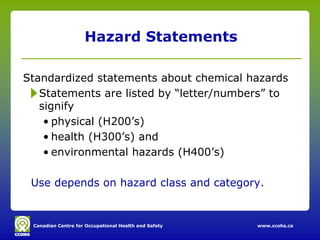
Hazard Statements

Standardized statements about chemical hazards
   Statements are listed by “letter/numbers” to
   signify
    • physical (H200’s)
    • health (H300’s) and
    • environmental hazards (H400’s)

 Use depends on hazard class and category.


 Canadian Centre for Occupational Health and Safety   www.ccohs.ca
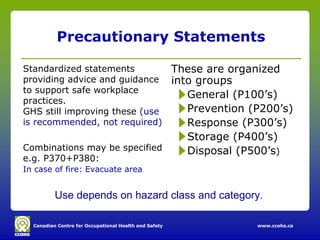
Precautionary Statements

Standardized statements       These are organized
providing advice and guidance into groups
to support safe workplace
                                 General (P100’s)
practices.
GHS still improving these (use   Prevention (P200’s)
is recommended, not required)    Response (P300’s)
                                 Storage (P400’s)
Combinations may be specified    Disposal (P500’s)
e.g. P370+P380:
In case of fire: Evacuate area


          Use depends on hazard class and category.

  Canadian Centre for Occupational Health and Safety   www.ccohs.ca
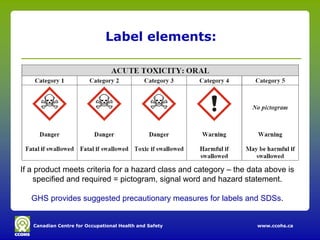
Label elements:


If a product meets criteria for a hazard class and category – the data above is
    specified and required = pictogram, signal word and hazard statement.

   GHS provides suggested precautionary measures for labels and SDSs.


   Canadian Centre for Occupational Health and Safety               www.ccohs.ca
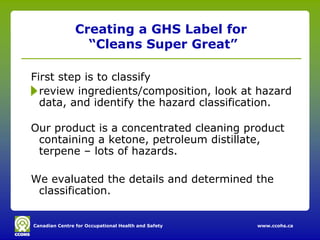
Creating a GHS Label for
                  “Cleans Super Great”

First step is to classify
  review ingredients/composition, look at hazard
  data, and identify the hazard classification.

Our product is a concentrated cleaning product
 containing a ketone, petroleum distillate,
 terpene – lots of hazards.

We evaluated the details and determined the
 classification.


Canadian Centre for Occupational Health and Safety   www.ccohs.ca
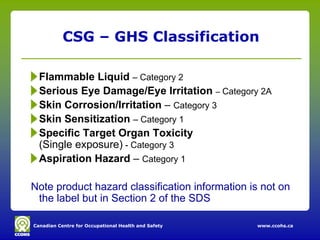
CSG – GHS Classification

  Flammable Liquid – Category 2
  Serious Eye Damage/Eye Irritation – Category 2A
  Skin Corrosion/Irritation – Category 3
  Skin Sensitization – Category 1
  Specific Target Organ Toxicity
  (Single exposure) - Category 3
  Aspiration Hazard – Category 1

Note product hazard classification information is not on
 the label but in Section 2 of the SDS

Canadian Centre for Occupational Health and Safety   www.ccohs.ca
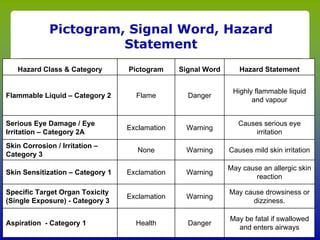
Pictogram, Signal Word, Hazard
                          Statement
    Hazard Class & Category                  Pictogram       Signal Word      Hazard Statement


                                                                            Highly flammable liquid
Flammable Liquid – Category 2                   Flame          Danger
                                                                                  and vapour


Serious Eye Damage / Eye                                                      Causes serious eye
                                            Exclamation       Warning
Irritation – Category 2A                                                          irritation
Skin Corrosion / Irritation –
                                                None          Warning      Causes mild skin irritation
Category 3
                                                                           May cause an allergic skin
Skin Sensitization – Category 1             Exclamation       Warning
                                                                                   reaction

Specific Target Organ Toxicity                                             May cause drowsiness or
                                            Exclamation       Warning
(Single Exposure) - Category 3                                                   dizziness.

                                                                           May be fatal if swallowed
Aspiration - Category 1
        Canadian Centre for Occupational Health Health
                                                and Safety     Danger              www.ccohs.ca
                                                                             and enters airways
Pictograms and Signal Word


Canadian Centre for Occupational Health and Safety   www.ccohs.ca
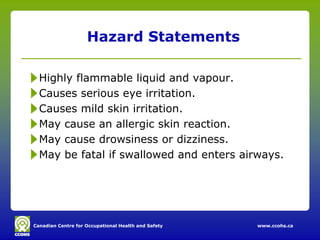
Hazard Statements

  Highly flammable liquid and vapour.
  Causes serious eye irritation.
  Causes mild skin irritation.
  May cause an allergic skin reaction.
  May cause drowsiness or dizziness.
  May be fatal if swallowed and enters airways.


Canadian Centre for Occupational Health and Safety   www.ccohs.ca
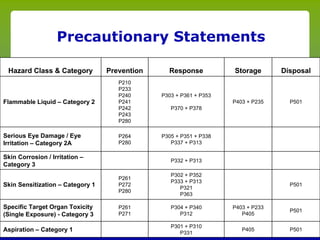
Precautionary Statements

 Hazard Class & Category              Prevention               Response         Storage          Disposal
                                          P210
                                          P233
                                          P240             P303 + P361 + P353
Flammable Liquid – Category 2             P241                                  P403 + P235         P501
                                          P242                 P370 + P378
                                          P243
                                          P280

Serious Eye Damage / Eye                  P264             P305 + P351 + P338
Irritation – Category 2A                  P280                P337 + P313

Skin Corrosion / Irritation –
                                                               P332 + P313
Category 3
                                                               P302 + P352
                                          P261
                                                               P333 + P313
Skin Sensitization – Category 1           P272
                                                                  P321
                                                                                                    P501
                                          P280
                                                                  P363

Specific Target Organ Toxicity            P261                 P304 + P340      P403 + P233
                                                                                                    P501
(Single Exposure) - Category 3            P271                    P312             P405

          Canadian Centre for Occupational Health and Safety   P301 + P310                www.ccohs.ca
Aspiration – Category 1                                           P331
                                                                                   P405             P501
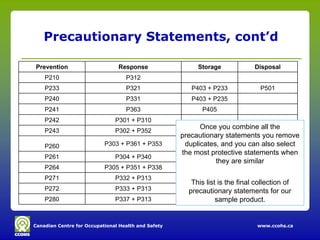
Precautionary Statements, cont’d

Prevention                      Response                  Storage             Disposal
    P210                           P312
    P233                           P321                 P403 + P233             P501
    P240                           P331                 P403 + P235
    P241                           P363                    P405
    P242                       P301 + P310
                                                           Once you combine all the
    P243                       P302 + P352
                                                     precautionary statements you remove
    P260                   P303 + P361 + P353         duplicates, and you can also select
                                                     the most protective statements when
    P261                       P304 + P340
                                                                they are similar
    P264                   P305 + P351 + P338
    P271                       P332 + P313
                                                        This list is the final collection of
    P272                       P333 + P313             precautionary statements for our
    P280                       P337 + P313                       sample product.


Canadian Centre for Occupational Health and Safety                             www.ccohs.ca
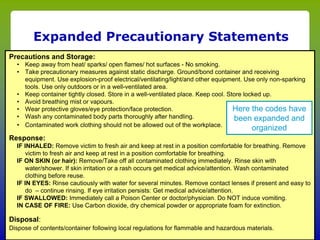
Expanded Precautionary Statements
Precautions and Storage:
  • Keep away from heat/ sparks/ open flames/ hot surfaces - No smoking.
  • Take precautionary measures against static discharge. Ground/bond container and receiving
    equipment. Use explosion-proof electrical/ventilating/light/and other equipment. Use only non-sparking
    tools. Use only outdoors or in a well-ventilated area.
  • Keep container tightly closed. Store in a well-ventilated place. Keep cool. Store locked up.
  • Avoid breathing mist or vapours.
  • Wear protective gloves/eye protection/face protection.                        Here the codes have
  • Wash any contaminated body parts thoroughly after handling.                   been expanded and
  • Contaminated work clothing should not be allowed out of the workplace.
                                                                                      organized
Response:
  IF INHALED: Remove victim to fresh air and keep at rest in a position comfortable for breathing. Remove
      victim to fresh air and keep at rest in a position comfortable for breathing.
  IF ON SKIN (or hair): Remove/Take off all contaminated clothing immediately. Rinse skin with
      water/shower. If skin irritation or a rash occurs get medical advice/attention. Wash contaminated
      clothing before reuse.
  IF IN EYES: Rinse cautiously with water for several minutes. Remove contact lenses if present and easy to
      do – continue rinsing. If eye irritation persists: Get medical advice/attention.
  IF SWALLOWED: Immediately call a Poison Center or doctor/physician. Do NOT induce vomiting.
  IN CASE OF FIRE: Use Carbon dioxide, dry chemical powder or appropriate foam for extinction.

Disposal:
Dispose of contents/container following Health and Safety for flammable and hazardous materials.
        Canadian Centre for Occupational
                                         local regulations                               www.ccohs.ca
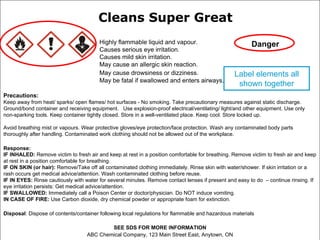
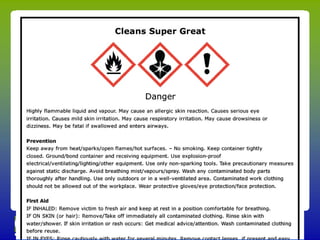
Cleans Super Great
                                        Highly flammable liquid and vapour.                             Danger
                                        Causes serious eye irritation.
                                        Causes mild skin irritation.
                                        May cause an allergic skin reaction.
                                        May cause drowsiness or dizziness.                       Label elements all
                                        May be fatal if swallowed and enters airways.
                                                                                                  shown together
Precautions:
Keep away from heat/ sparks/ open flames/ hot surfaces - No smoking. Take precautionary measures against static discharge.
Ground/bond container and receiving equipment. Use explosion-proof electrical/ventilating/ light/and other equipment. Use only
non-sparking tools. Keep container tightly closed. Store in a well-ventilated place. Keep cool. Store locked up.

Avoid breathing mist or vapours. Wear protective gloves/eye protection/face protection. Wash any contaminated body parts
thoroughly after handling. Contaminated work clothing should not be allowed out of the workplace.

Response:
IF INHALED: Remove victim to fresh air and keep at rest in a position comfortable for breathing. Remove victim to fresh air and keep
at rest in a position comfortable for breathing.
IF ON SKIN (or hair): Remove/Take off all contaminated clothing immediately. Rinse skin with water/shower. If skin irritation or a
rash occurs get medical advice/attention. Wash contaminated clothing before reuse.
IF IN EYES: Rinse cautiously with water for several minutes. Remove contact lenses if present and easy to do – continue rinsing. If
eye irritation persists: Get medical advice/attention.
IF SWALLOWED: Immediately call a Poison Center or doctor/physician. Do NOT induce vomiting.
IN CASE OF FIRE: Use Carbon dioxide, dry chemical powder or appropriate foam for extinction.

Disposal: Dispose of contents/container following local regulations for flammable and hazardous materials

                                           SEE SDS FOR MORE INFORMATION
                                   ABC Chemical Company, 123 Main Street East, Anytown, ON
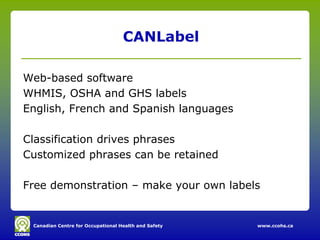
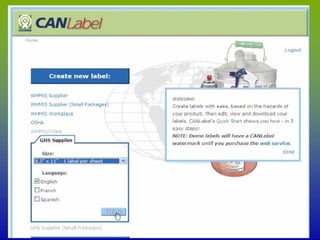
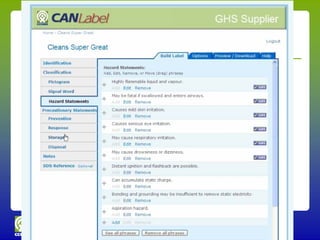
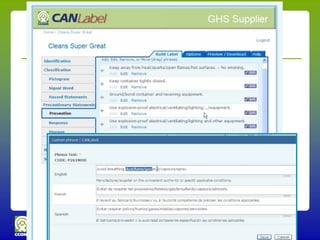
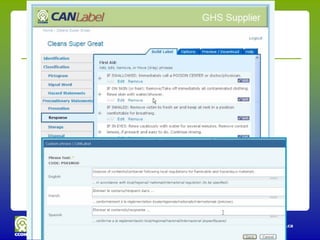
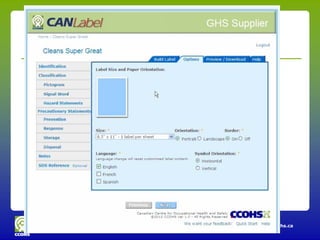
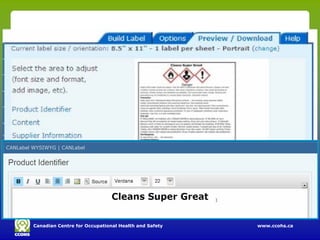
CANLabel

Web-based software
WHMIS, OSHA and GHS labels
English, French and Spanish languages

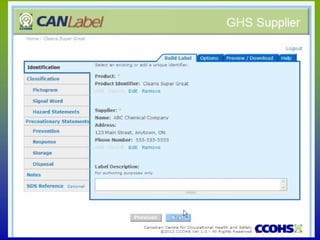
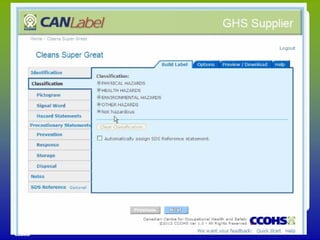
Classification drives phrases
Customized phrases can be retained

Free demonstration – make your own labels


 Canadian Centre for Occupational Health and Safety   www.ccohs.ca
Canadian Centre for Occupational Health and Safety   www.ccohs.ca
Canadian Centre for Occupational Health and Safety                                                                        www.ccohs.ca

   <file:Nws_ccohs2dataGLOBALWorking_groupsChemical_Safety_ToolsCANLabelGHS_product_launchCleans_super_great_GHS_label.pdf>
Next Steps and….


                          Resources
Canadian Centre for Occupational Health and Safety
Canadian Centre for Occupational Health and Safety   www.ccohs.ca
                                                     www.ccohs.ca
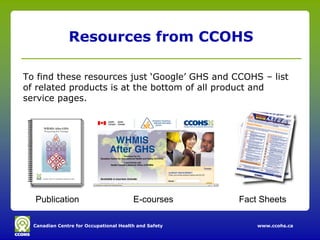
Resources from CCOHS

To find these resources just ‘Google’ GHS and CCOHS – list
of related products is at the bottom of all product and
service pages.


  Publication                           E-courses      Fact Sheets

  Canadian Centre for Occupational Health and Safety       www.ccohs.ca
Resources from CCOHS

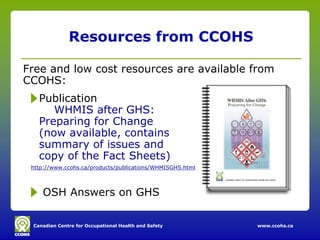
Free and low cost resources are available from
CCOHS:
   Publication
      WHMIS after GHS:
   Preparing for Change
   (now available, contains
   summary of issues and
   copy of the Fact Sheets)
 http://www.ccohs.ca/products/publications/WHMISGHS.html


    OSH Answers on GHS

 Canadian Centre for Occupational Health and Safety        www.ccohs.ca
E-courses from CCOHS

Two free e-courses are available through CCOHS
and funded with the support of Health Canada’s
National Office of WHMIS (requires registration)
http://www.ccohs.ca/products/courses/whmis_ghs_intro/

WHMIS After GHS: An Introduction
     • 20-minute awareness course
    WHMIS After GHS: How Suppliers Can Prepare
     • 60-minute awareness course


  Canadian Centre for Occupational Health and Safety    www.ccohs.ca
WHMIS after GHS
                  Fact Sheets from CCOHS

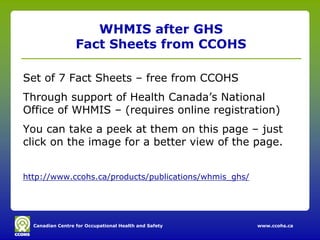
Set of 7 Fact Sheets – free from CCOHS
Through support of Health Canada’s National
Office of WHMIS – (requires online registration)
You can take a peek at them on this page – just
click on the image for a better view of the page.


http://www.ccohs.ca/products/publications/whmis_ghs/


  Canadian Centre for Occupational Health and Safety   www.ccohs.ca
More Information...

CCOHS
Google – CCOHS and GHS

Health Canada - WHMIS Official National Site
Google – WHMIS Canada
 Or Google – Health Canada and GHS

GHS Home (includes the “Purple book”)
Google – UNECE and GHS – look for 3rd edition


  Canadian Centre for Occupational Health and Safety   www.ccohs.ca
Thank You


                           Questions?

                 Free, confidential Inquiries Service:
                            1-800-668-4284
                        clientservices@ccohs.ca


Canadian Centre for Occupational Health and Safety       www.ccohs.ca

GHS Labels

  • 1.
    GHS Labels Presented by:Lorraine Davison, M.Sc. M.Eng. Manager, Chemical Services 2012 www.ccohs.ca
  • 2.
    What is GHS? GloballyHarmonized System of Classification and Labelling of Chemicals An international system for  All chemical substances, mixtures.  Allows “continuous improvement” for chemical hazard communication. Goal is a common & effective classification & communication system world-wide. Canadian Centre for Occupational Health and Safety www.ccohs.ca
  • 3.
    GHS Hazard Groups 16 classes 10 classes 2 classes Canadian Centre for Occupational Health and Safety Canadian Centre for Occupational Health and Safety www.ccohs.ca www.ccohs.ca
  • 4.
    Outline for Today’sPresentation  Elements of a GHS Label  Look at how a GHS hazard classification determines GHS label content  Resources such as CANLabel  WHMIS label requirements  OSHA label requirements Canadian Centre for Occupational Health and Safety www.ccohs.ca
  • 5.
    GHS Supplier Labels– Elements Product identifier (chemical identity) Supplier identifier Review in more depth Hazard pictograms Signal word Hazard statements Precautionary statements Canadian Centre for Occupational Health and Safety www.ccohs.ca
  • 6.
    Hazard Pictograms Nine pictograms hazardsymbols: health, physical & environmental hazards Symbol plus border = pictogram (square set at a point) Use depends on class and category. None may exist for some products. Canadian Centre for Occupational Health and Safety www.ccohs.ca
  • 7.
    Signal Words Signal wordswarn users about the level or degree of hazard. There are two signal words: Danger Warning Use depends on class and category. No signal word may be required. Canadian Centre for Occupational Health and Safety www.ccohs.ca
  • 8.
    Hazard Statements Standardized statementsabout chemical hazards Statements are listed by “letter/numbers” to signify • physical (H200’s) • health (H300’s) and • environmental hazards (H400’s) Use depends on hazard class and category. Canadian Centre for Occupational Health and Safety www.ccohs.ca
  • 9.
    Precautionary Statements Standardized statements These are organized providing advice and guidance into groups to support safe workplace General (P100’s) practices. GHS still improving these (use Prevention (P200’s) is recommended, not required) Response (P300’s) Storage (P400’s) Combinations may be specified Disposal (P500’s) e.g. P370+P380: In case of fire: Evacuate area Use depends on hazard class and category. Canadian Centre for Occupational Health and Safety www.ccohs.ca
  • 10.
    Label elements: If aproduct meets criteria for a hazard class and category – the data above is specified and required = pictogram, signal word and hazard statement. GHS provides suggested precautionary measures for labels and SDSs. Canadian Centre for Occupational Health and Safety www.ccohs.ca
  • 11.
    Creating a GHSLabel for “Cleans Super Great” First step is to classify review ingredients/composition, look at hazard data, and identify the hazard classification. Our product is a concentrated cleaning product containing a ketone, petroleum distillate, terpene – lots of hazards. We evaluated the details and determined the classification. Canadian Centre for Occupational Health and Safety www.ccohs.ca
  • 12.
    CSG – GHSClassification Flammable Liquid – Category 2 Serious Eye Damage/Eye Irritation – Category 2A Skin Corrosion/Irritation – Category 3 Skin Sensitization – Category 1 Specific Target Organ Toxicity (Single exposure) - Category 3 Aspiration Hazard – Category 1 Note product hazard classification information is not on the label but in Section 2 of the SDS Canadian Centre for Occupational Health and Safety www.ccohs.ca
  • 13.
    Pictogram, Signal Word,Hazard Statement Hazard Class & Category Pictogram Signal Word Hazard Statement Highly flammable liquid Flammable Liquid – Category 2 Flame Danger and vapour Serious Eye Damage / Eye Causes serious eye Exclamation Warning Irritation – Category 2A irritation Skin Corrosion / Irritation – None Warning Causes mild skin irritation Category 3 May cause an allergic skin Skin Sensitization – Category 1 Exclamation Warning reaction Specific Target Organ Toxicity May cause drowsiness or Exclamation Warning (Single Exposure) - Category 3 dizziness. May be fatal if swallowed Aspiration - Category 1 Canadian Centre for Occupational Health Health and Safety Danger www.ccohs.ca and enters airways
  • 14.
    Pictograms and SignalWord Canadian Centre for Occupational Health and Safety www.ccohs.ca
  • 15.
    Hazard Statements Highly flammable liquid and vapour. Causes serious eye irritation. Causes mild skin irritation. May cause an allergic skin reaction. May cause drowsiness or dizziness. May be fatal if swallowed and enters airways. Canadian Centre for Occupational Health and Safety www.ccohs.ca
  • 16.
    Precautionary Statements HazardClass & Category Prevention Response Storage Disposal P210 P233 P240 P303 + P361 + P353 Flammable Liquid – Category 2 P241 P403 + P235 P501 P242 P370 + P378 P243 P280 Serious Eye Damage / Eye P264 P305 + P351 + P338 Irritation – Category 2A P280 P337 + P313 Skin Corrosion / Irritation – P332 + P313 Category 3 P302 + P352 P261 P333 + P313 Skin Sensitization – Category 1 P272 P321 P501 P280 P363 Specific Target Organ Toxicity P261 P304 + P340 P403 + P233 P501 (Single Exposure) - Category 3 P271 P312 P405 Canadian Centre for Occupational Health and Safety P301 + P310 www.ccohs.ca Aspiration – Category 1 P331 P405 P501
  • 17.
    Precautionary Statements, cont’d Prevention Response Storage Disposal P210 P312 P233 P321 P403 + P233 P501 P240 P331 P403 + P235 P241 P363 P405 P242 P301 + P310 Once you combine all the P243 P302 + P352 precautionary statements you remove P260 P303 + P361 + P353 duplicates, and you can also select the most protective statements when P261 P304 + P340 they are similar P264 P305 + P351 + P338 P271 P332 + P313 This list is the final collection of P272 P333 + P313 precautionary statements for our P280 P337 + P313 sample product. Canadian Centre for Occupational Health and Safety www.ccohs.ca
  • 18.
    Expanded Precautionary Statements Precautionsand Storage: • Keep away from heat/ sparks/ open flames/ hot surfaces - No smoking. • Take precautionary measures against static discharge. Ground/bond container and receiving equipment. Use explosion-proof electrical/ventilating/light/and other equipment. Use only non-sparking tools. Use only outdoors or in a well-ventilated area. • Keep container tightly closed. Store in a well-ventilated place. Keep cool. Store locked up. • Avoid breathing mist or vapours. • Wear protective gloves/eye protection/face protection. Here the codes have • Wash any contaminated body parts thoroughly after handling. been expanded and • Contaminated work clothing should not be allowed out of the workplace. organized Response: IF INHALED: Remove victim to fresh air and keep at rest in a position comfortable for breathing. Remove victim to fresh air and keep at rest in a position comfortable for breathing. IF ON SKIN (or hair): Remove/Take off all contaminated clothing immediately. Rinse skin with water/shower. If skin irritation or a rash occurs get medical advice/attention. Wash contaminated clothing before reuse. IF IN EYES: Rinse cautiously with water for several minutes. Remove contact lenses if present and easy to do – continue rinsing. If eye irritation persists: Get medical advice/attention. IF SWALLOWED: Immediately call a Poison Center or doctor/physician. Do NOT induce vomiting. IN CASE OF FIRE: Use Carbon dioxide, dry chemical powder or appropriate foam for extinction. Disposal: Dispose of contents/container following Health and Safety for flammable and hazardous materials. Canadian Centre for Occupational local regulations www.ccohs.ca
  • 19.
    Cleans Super Great Highly flammable liquid and vapour. Danger Causes serious eye irritation. Causes mild skin irritation. May cause an allergic skin reaction. May cause drowsiness or dizziness. Label elements all May be fatal if swallowed and enters airways. shown together Precautions: Keep away from heat/ sparks/ open flames/ hot surfaces - No smoking. Take precautionary measures against static discharge. Ground/bond container and receiving equipment. Use explosion-proof electrical/ventilating/ light/and other equipment. Use only non-sparking tools. Keep container tightly closed. Store in a well-ventilated place. Keep cool. Store locked up. Avoid breathing mist or vapours. Wear protective gloves/eye protection/face protection. Wash any contaminated body parts thoroughly after handling. Contaminated work clothing should not be allowed out of the workplace. Response: IF INHALED: Remove victim to fresh air and keep at rest in a position comfortable for breathing. Remove victim to fresh air and keep at rest in a position comfortable for breathing. IF ON SKIN (or hair): Remove/Take off all contaminated clothing immediately. Rinse skin with water/shower. If skin irritation or a rash occurs get medical advice/attention. Wash contaminated clothing before reuse. IF IN EYES: Rinse cautiously with water for several minutes. Remove contact lenses if present and easy to do – continue rinsing. If eye irritation persists: Get medical advice/attention. IF SWALLOWED: Immediately call a Poison Center or doctor/physician. Do NOT induce vomiting. IN CASE OF FIRE: Use Carbon dioxide, dry chemical powder or appropriate foam for extinction. Disposal: Dispose of contents/container following local regulations for flammable and hazardous materials SEE SDS FOR MORE INFORMATION ABC Chemical Company, 123 Main Street East, Anytown, ON
  • 20.
    CANLabel Web-based software WHMIS, OSHAand GHS labels English, French and Spanish languages Classification drives phrases Customized phrases can be retained Free demonstration – make your own labels Canadian Centre for Occupational Health and Safety www.ccohs.ca
  • 21.
    Canadian Centre forOccupational Health and Safety www.ccohs.ca
  • 22.
    Canadian Centre forOccupational Health and Safety www.ccohs.ca
  • 23.
    Canadian Centre forOccupational Health and Safety www.ccohs.ca
  • 24.
    Canadian Centre forOccupational Health and Safety www.ccohs.ca
  • 25.
    Canadian Centre forOccupational Health and Safety www.ccohs.ca
  • 26.
    Canadian Centre forOccupational Health and Safety www.ccohs.ca
  • 27.
    Canadian Centre forOccupational Health and Safety www.ccohs.ca
  • 28.
    Canadian Centre forOccupational Health and Safety www.ccohs.ca
  • 29.
    Canadian Centre forOccupational Health and Safety www.ccohs.ca
  • 30.
    Canadian Centre forOccupational Health and Safety www.ccohs.ca
  • 31.
    Canadian Centre forOccupational Health and Safety www.ccohs.ca
  • 32.
    Canadian Centre forOccupational Health and Safety www.ccohs.ca
  • 33.
    Canadian Centre forOccupational Health and Safety www.ccohs.ca <file:Nws_ccohs2dataGLOBALWorking_groupsChemical_Safety_ToolsCANLabelGHS_product_launchCleans_super_great_GHS_label.pdf>
  • 34.
    Next Steps and…. Resources Canadian Centre for Occupational Health and Safety Canadian Centre for Occupational Health and Safety www.ccohs.ca www.ccohs.ca
  • 35.
    Resources from CCOHS Tofind these resources just ‘Google’ GHS and CCOHS – list of related products is at the bottom of all product and service pages. Publication E-courses Fact Sheets Canadian Centre for Occupational Health and Safety www.ccohs.ca
  • 36.
    Resources from CCOHS Freeand low cost resources are available from CCOHS: Publication WHMIS after GHS: Preparing for Change (now available, contains summary of issues and copy of the Fact Sheets) http://www.ccohs.ca/products/publications/WHMISGHS.html OSH Answers on GHS Canadian Centre for Occupational Health and Safety www.ccohs.ca
  • 37.
    E-courses from CCOHS Twofree e-courses are available through CCOHS and funded with the support of Health Canada’s National Office of WHMIS (requires registration) http://www.ccohs.ca/products/courses/whmis_ghs_intro/ WHMIS After GHS: An Introduction • 20-minute awareness course WHMIS After GHS: How Suppliers Can Prepare • 60-minute awareness course Canadian Centre for Occupational Health and Safety www.ccohs.ca
  • 38.
    WHMIS after GHS Fact Sheets from CCOHS Set of 7 Fact Sheets – free from CCOHS Through support of Health Canada’s National Office of WHMIS – (requires online registration) You can take a peek at them on this page – just click on the image for a better view of the page. http://www.ccohs.ca/products/publications/whmis_ghs/ Canadian Centre for Occupational Health and Safety www.ccohs.ca
  • 39.
    More Information... CCOHS Google –CCOHS and GHS Health Canada - WHMIS Official National Site Google – WHMIS Canada Or Google – Health Canada and GHS GHS Home (includes the “Purple book”) Google – UNECE and GHS – look for 3rd edition Canadian Centre for Occupational Health and Safety www.ccohs.ca
  • 40.
    Thank You Questions? Free, confidential Inquiries Service: 1-800-668-4284 clientservices@ccohs.ca Canadian Centre for Occupational Health and Safety www.ccohs.ca