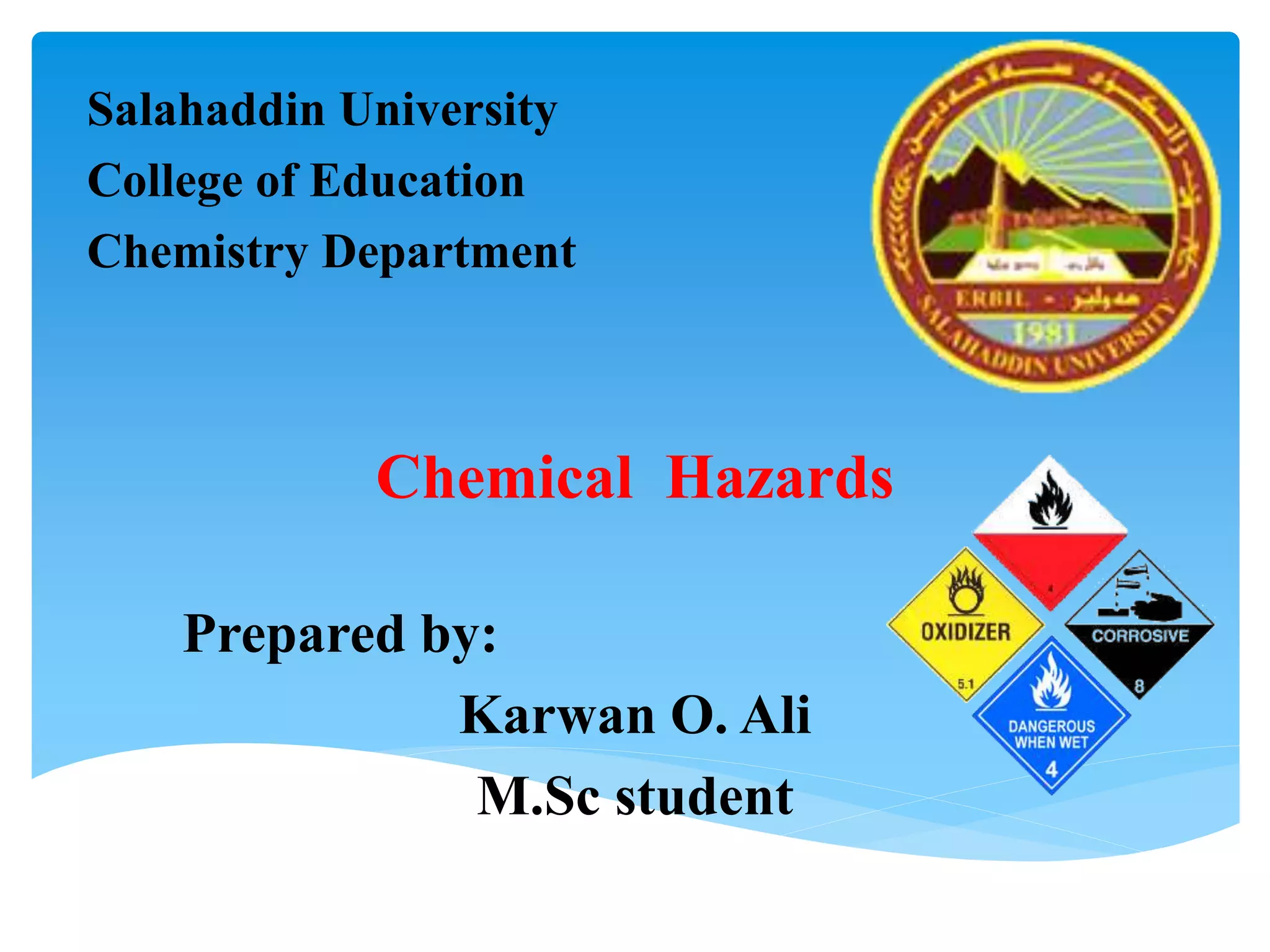
Salahaddin University
College of Education
Chemistry Department
Chemical Hazards
Prepared by:
Karwan O. Ali
M.Sc student
 Objectives
1- what is the chemical hazards
2- Classification of chemical hazards
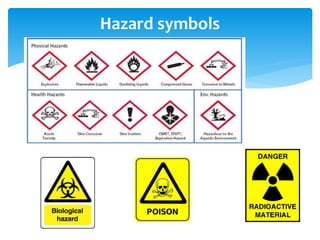
3- Hazard symbols
4- Routes of Chemical Entry
5- types of personal protective
equipment
GOAL
The goal of this presentation is to
identify chemical hazards and is to
reduce or eliminate risk of injury or
illness from potential hazards.
what is the chemical hazards
chemical hazards are substances
that are dangerous to people,
wildlife and the environment at any
stage of their life cycle, from
production to use to disposal.
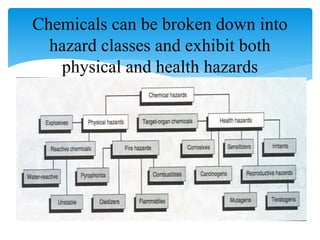
Chemicals can be broken down into
hazard classes and exhibit both
physical and health hazards
Several factors can influence the severity of chemical
hazard
1- Concentration of the chemical.
2- Physical state of the chemical (solid, liquid, gas).
3- Physical processes involved in using the chemical
(cutting, grinding, heating, cooling).
4- Chemical processes involved in using the chemical
(mixing with other chemicals, purification, distillation).
5- Other processes(improper storage , addition of
moisture, storage in sunlight, refrigeration).
Classification of chemical hazards
1- Explosives
The OSHA Laboratory Standard defines
an explosive as a chemical that causes a sudden,
almost instantaneous release of pressure, gas,
and heat when subjected to sudden shock,
pressure, or high temperature. Under the
Department of Transportation (DOT) hazard
class system, explosives are listed as hazard
class 1.
Examples of explosive and potentially explosive
chemicals include:
1- Compounds containing the functional groups
azide, acetylide, diazo, nitroso, haloamine,
peroxide, and ozonide
2- Nitrocellulose
3- Di- and Tri-nitro compounds
4- Peroxide forming compounds
5- Picric acid (dry)
6- 2,4-Dinitrophenylhydrazine (dry)
7- Benzoyl peroxide (dry)
2-flammable and combustible liquids
The OSHA Laboratory Standard defines a
flammable liquid as any liquid having a
flashpoint below 100 degrees F (37.8 degrees C).
Examples : diethyl ether, pentane, petroleum ether
,acetone, benzene .
Flashpoint is defined as the minimum
temperature at which a liquid gives off enough
vapor to ignite in the presence of an ignition
source.
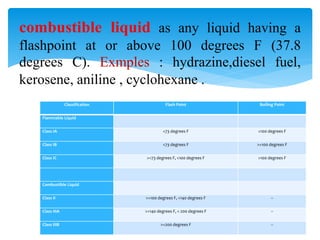
combustible liquid as any liquid having a
flashpoint at or above 100 degrees F (37.8
degrees C). Exmples : hydrazine,diesel fuel,
kerosene, aniline , cyclohexane .
Classification Flash Point Boiling Point
Flammable Liquid
Class IA <73 degrees F <100 degrees F
Class IB <73 degrees F >=100 degrees F
Class IC >=73 degrees F, <100 degrees F >100 degrees F
Combustible Liquid
Class II >=100 degrees F, <140 degrees F --
Class IIIA >=140 degrees F, < 200 degrees F --
Class IIIB >=200 degrees F --
3- Flammable Solids
The OSHA Laboratory Standard defines
a flammable solid that is liable to cause fire
through friction, absorption of moisture,
spontaneous chemical change, or retained heat
from manufacturing or processing, or which can
be ignited readily and when ignited, burn so
vigorously and persistently to create a serious
hazard .example: Phosphorus which burns by itself
when exposed to air and sodium, zinc particles contact
with water emit flammable gases
4- spontaneously combustible
spontaneously combustible materials are also
known as pyrophorics; these chemicals can
spontaneously ignite in the presence of air, some
are reactive with water vapor, and most are
reactive with oxygen. Two common examples
are tert-Butyllithium under Hexanes and White
Phosphorus. Another example is Lithium alkyls
spontaneously ignites when exposed to air .
5- oxidizers and organic peroxids
The OSHA Laboratory Standard defines an
oxidizer as “a chemical other than a blasting
agent or explosive that initiates or promotes
combustion in other materials, there by causing
fire either of itself or through the release of
oxygen or other gases. Example: concentrated
nitric acid, sodium hypochlorite , perchloric acid,
concentrated sulfuric acid .
The OSHA Laboratory Standard defines an organic
peroxide as “an organic compound that contains the
bivalent –O-O- structure and which may be considered
to be a structural derivative of hydrogen peroxide where
one or both of the hydrogen atoms have been replaced
by an organic radical.”examples:benzoyl
peroxide, ketone peroxides, diacyl peroxides, dialkyl
peroxides, Oxidizers and organic peroxides are a
concern for laboratory safety due to their ability to
promote and enhance the potential for fires in labs. As a
reminder of the fire triangle , in order to have a fire, you
need
1- A fuel source.
2- An oxygen source.
3- An ignition source.
Oxidizers can supply the oxygen needed for the fire,
whereas organic peroxides supply both the oxygen and
the fuel source. Both oxidizers and organic peroxides
may become shock sensitive when they dry out, are
stored in sunlight, or due to contamination with other
materials, particularly when contaminated with heavy
metals. Most organic peroxides are also temperature
sensitive
6- poison
Poisons are substances that cause harm to
organisms when sufficient quantities are
absorbed, inhaled or ingested. Some poisons
make an organism sick, others may cause it to
die and yet others may lead to subtle changes in
health that may not be noticed for years .
Examples: Ammonia , bleach, mecury, arsenic .
7- corrosive
Corrosive chemicals are substances that cause
visible destruction or permanent changes in human
skin tissue at the site of contact .Corrosive
chemicals can be liquids, solids, or gases and can
affect the eyes, skin, and respiratory
tract. examples: Strong Acids: hydrochloric,
sulfuric, phosphoric.
Strong Bases: hydroxides of sodium, potassium,
ammonia.
Hazard symbols
Routes of Chemical Entry
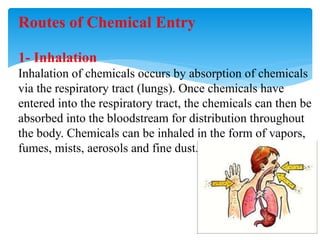
1- Inhalation
Inhalation of chemicals occurs by absorption of chemicals
via the respiratory tract (lungs). Once chemicals have
entered into the respiratory tract, the chemicals can then be
absorbed into the bloodstream for distribution throughout
the body. Chemicals can be inhaled in the form of vapors,
fumes, mists, aerosols and fine dust.
2- Ingestion
Chemical exposure through ingestion occurs by absorption
of chemicals through the digestive tract. Ingestion of
chemicals can occur directly and indirectly. Direct ingestion
can occur by accidently eating or drinking a chemical; with
proper housekeeping and labeling, this is less likely to
occur. A higher probability of receiving a chemical
exposure can occur by way of indirect ingestionThis can
occur when food or drink is brought into a chemical
laboratory. The food or drink can then absorb chemical
contaminants (vapors or dusts) in the air and result in a
chemical exposure when the food or drink is consumed.
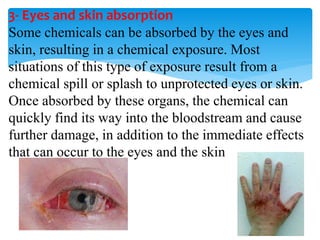
3- Eyes and skin absorption
Some chemicals can be absorbed by the eyes and
skin, resulting in a chemical exposure. Most
situations of this type of exposure result from a
chemical spill or splash to unprotected eyes or skin.
Once absorbed by these organs, the chemical can
quickly find its way into the bloodstream and cause
further damage, in addition to the immediate effects
that can occur to the eyes and the skin
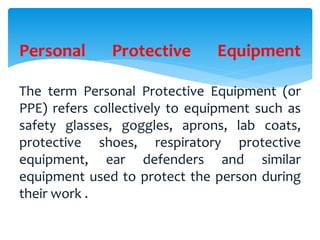
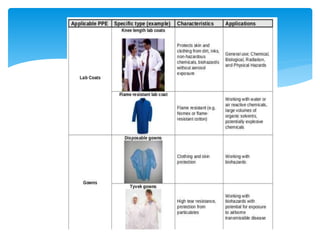
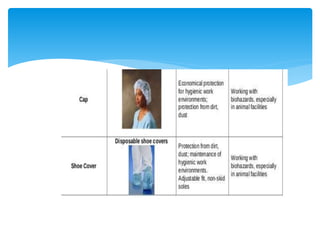
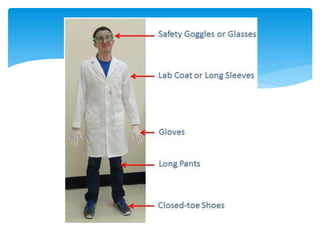
Personal Protective Equipment
The term Personal Protective Equipment (or
PPE) refers collectively to equipment such as
safety glasses, goggles, aprons, lab coats,
protective shoes, respiratory protective
equipment, ear defenders and similar
equipment used to protect the person during
their work .
Thanks for your
attention
Chemical hazards by Karwan Omer Ali, Greza

Chemical hazards by Karwan Omer Ali, Greza

  • 1.
    Salahaddin University College ofEducation Chemistry Department Chemical Hazards Prepared by: Karwan O. Ali M.Sc student
  • 2.
     Objectives 1- whatis the chemical hazards 2- Classification of chemical hazards 3- Hazard symbols 4- Routes of Chemical Entry 5- types of personal protective equipment
  • 3.
    GOAL The goal ofthis presentation is to identify chemical hazards and is to reduce or eliminate risk of injury or illness from potential hazards.
  • 4.
    what is thechemical hazards chemical hazards are substances that are dangerous to people, wildlife and the environment at any stage of their life cycle, from production to use to disposal.
  • 5.
    Chemicals can bebroken down into hazard classes and exhibit both physical and health hazards
  • 6.
    Several factors caninfluence the severity of chemical hazard 1- Concentration of the chemical. 2- Physical state of the chemical (solid, liquid, gas). 3- Physical processes involved in using the chemical (cutting, grinding, heating, cooling). 4- Chemical processes involved in using the chemical (mixing with other chemicals, purification, distillation). 5- Other processes(improper storage , addition of moisture, storage in sunlight, refrigeration).
  • 7.
    Classification of chemicalhazards 1- Explosives The OSHA Laboratory Standard defines an explosive as a chemical that causes a sudden, almost instantaneous release of pressure, gas, and heat when subjected to sudden shock, pressure, or high temperature. Under the Department of Transportation (DOT) hazard class system, explosives are listed as hazard class 1.
  • 8.
    Examples of explosiveand potentially explosive chemicals include: 1- Compounds containing the functional groups azide, acetylide, diazo, nitroso, haloamine, peroxide, and ozonide 2- Nitrocellulose 3- Di- and Tri-nitro compounds 4- Peroxide forming compounds 5- Picric acid (dry) 6- 2,4-Dinitrophenylhydrazine (dry) 7- Benzoyl peroxide (dry)
  • 9.
    2-flammable and combustibleliquids The OSHA Laboratory Standard defines a flammable liquid as any liquid having a flashpoint below 100 degrees F (37.8 degrees C). Examples : diethyl ether, pentane, petroleum ether ,acetone, benzene . Flashpoint is defined as the minimum temperature at which a liquid gives off enough vapor to ignite in the presence of an ignition source.
  • 10.
    combustible liquid asany liquid having a flashpoint at or above 100 degrees F (37.8 degrees C). Exmples : hydrazine,diesel fuel, kerosene, aniline , cyclohexane . Classification Flash Point Boiling Point Flammable Liquid Class IA <73 degrees F <100 degrees F Class IB <73 degrees F >=100 degrees F Class IC >=73 degrees F, <100 degrees F >100 degrees F Combustible Liquid Class II >=100 degrees F, <140 degrees F -- Class IIIA >=140 degrees F, < 200 degrees F -- Class IIIB >=200 degrees F --
  • 11.
    3- Flammable Solids TheOSHA Laboratory Standard defines a flammable solid that is liable to cause fire through friction, absorption of moisture, spontaneous chemical change, or retained heat from manufacturing or processing, or which can be ignited readily and when ignited, burn so vigorously and persistently to create a serious hazard .example: Phosphorus which burns by itself when exposed to air and sodium, zinc particles contact with water emit flammable gases
  • 12.
    4- spontaneously combustible spontaneouslycombustible materials are also known as pyrophorics; these chemicals can spontaneously ignite in the presence of air, some are reactive with water vapor, and most are reactive with oxygen. Two common examples are tert-Butyllithium under Hexanes and White Phosphorus. Another example is Lithium alkyls spontaneously ignites when exposed to air .
  • 13.
    5- oxidizers andorganic peroxids The OSHA Laboratory Standard defines an oxidizer as “a chemical other than a blasting agent or explosive that initiates or promotes combustion in other materials, there by causing fire either of itself or through the release of oxygen or other gases. Example: concentrated nitric acid, sodium hypochlorite , perchloric acid, concentrated sulfuric acid .
  • 14.
    The OSHA LaboratoryStandard defines an organic peroxide as “an organic compound that contains the bivalent –O-O- structure and which may be considered to be a structural derivative of hydrogen peroxide where one or both of the hydrogen atoms have been replaced by an organic radical.”examples:benzoyl peroxide, ketone peroxides, diacyl peroxides, dialkyl peroxides, Oxidizers and organic peroxides are a concern for laboratory safety due to their ability to promote and enhance the potential for fires in labs. As a reminder of the fire triangle , in order to have a fire, you need
  • 15.
    1- A fuelsource. 2- An oxygen source. 3- An ignition source. Oxidizers can supply the oxygen needed for the fire, whereas organic peroxides supply both the oxygen and the fuel source. Both oxidizers and organic peroxides may become shock sensitive when they dry out, are stored in sunlight, or due to contamination with other materials, particularly when contaminated with heavy metals. Most organic peroxides are also temperature sensitive
  • 16.
    6- poison Poisons aresubstances that cause harm to organisms when sufficient quantities are absorbed, inhaled or ingested. Some poisons make an organism sick, others may cause it to die and yet others may lead to subtle changes in health that may not be noticed for years . Examples: Ammonia , bleach, mecury, arsenic .
  • 17.
    7- corrosive Corrosive chemicalsare substances that cause visible destruction or permanent changes in human skin tissue at the site of contact .Corrosive chemicals can be liquids, solids, or gases and can affect the eyes, skin, and respiratory tract. examples: Strong Acids: hydrochloric, sulfuric, phosphoric. Strong Bases: hydroxides of sodium, potassium, ammonia.
  • 18.
  • 19.
    Routes of ChemicalEntry 1- Inhalation Inhalation of chemicals occurs by absorption of chemicals via the respiratory tract (lungs). Once chemicals have entered into the respiratory tract, the chemicals can then be absorbed into the bloodstream for distribution throughout the body. Chemicals can be inhaled in the form of vapors, fumes, mists, aerosols and fine dust.
  • 20.
    2- Ingestion Chemical exposurethrough ingestion occurs by absorption of chemicals through the digestive tract. Ingestion of chemicals can occur directly and indirectly. Direct ingestion can occur by accidently eating or drinking a chemical; with proper housekeeping and labeling, this is less likely to occur. A higher probability of receiving a chemical exposure can occur by way of indirect ingestionThis can occur when food or drink is brought into a chemical laboratory. The food or drink can then absorb chemical contaminants (vapors or dusts) in the air and result in a chemical exposure when the food or drink is consumed.
  • 22.
    3- Eyes andskin absorption Some chemicals can be absorbed by the eyes and skin, resulting in a chemical exposure. Most situations of this type of exposure result from a chemical spill or splash to unprotected eyes or skin. Once absorbed by these organs, the chemical can quickly find its way into the bloodstream and cause further damage, in addition to the immediate effects that can occur to the eyes and the skin
  • 23.
    Personal Protective Equipment Theterm Personal Protective Equipment (or PPE) refers collectively to equipment such as safety glasses, goggles, aprons, lab coats, protective shoes, respiratory protective equipment, ear defenders and similar equipment used to protect the person during their work .
  • 27.