CLINICAL & NON-CLINICAL TRAINING
James Chapple
Aims & Objectives
At the end of this training session you will
know:
• What types of wastes are produced.
• Why segregation is necessary.
• How to correctly handle each waste stream.
• Implications of non-compliance.
What a Load of Rubbish!
We class it as business waste and it must be
treated in accordance with the requirements of
many pieces of legislation.
Although it is not your waste, you are still
legally responsible for it!
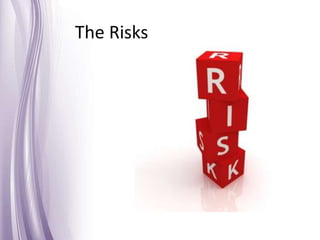
The Risks
Risk 1 - Cost
• Disposal of clinical waste costs 5 times
as much as domestic waste!
• Correct segregation can save lots of money.
• Fines can be imposed on the spot or through the
courts and there is no limit on the amount.
Risk 2 –
Legal Penalties
The Environment Agency can impose;
• Civil sanctions including financial
penalties.
• Criminal sanctions including
prosecution.
• The risk of prosecution is to the
individual as well as the organisation.
Risk 3 -
Reputation
• Unsafe disposal of waste risks public
health.
• Public organisations cannot be seen to
break the law or waste taxpayers money
on avoidable fines.
• Commissioners could seek alternative
providers.
Risk 4 -
Environmental
• Carbon emissions created in
manufacturing, packaging,
marketing, use and end of life
disposal of products.
• Businesses pay the whole life costs of
a product.
• Waste not just the cost of disposal,
but the value of the wasted products.
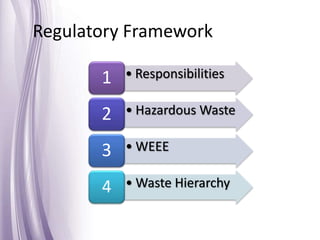
• Responsibilities1
• Hazardous Waste2
• WEEE3
• Waste Hierarchy4
Regulatory Framework
RESPONSIBILITIES
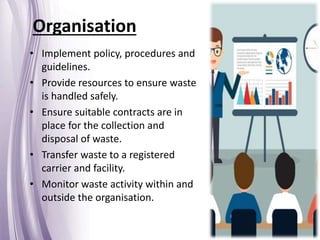
Organisation
• Implement policy, procedures and
guidelines.
• Provide resources to ensure waste
is handled safely.
• Ensure suitable contracts are in
place for the collection and
disposal of waste.
• Transfer waste to a registered
carrier and facility.
• Monitor waste activity within and
outside the organisation.
Individual
• Follow policy, procedures
and guidelines.
• Pack waste securely.
• Describe and label waste
accurately.
• Store waste safely on site.
• Complete and sign
collection paperwork.
• Report any concerns.
HAZARDOUS WASTE
Defining Hazardous Waste
Hazardous waste is classed as anything which
causes harm to humans or the environment.
Common items include;
Hazardous wastes must not be mixed with
any other wastes or with each other!
• Batteries
• Fridges
• TVs & Computer Monitors
• Paints & Chemicals
• Fluorescent Tubes
• Ink & Toner Cartridges
• Some Alcohol Gels
What is WEEE Waste?
• WEEE (Waste Electrical and Electronic
Equipment) is anything with a plug, battery or
item that can carry an electrical current.
• Some WEEE items are also classed as
hazardous waste.
• WEEE must be stored securely and under
cover to await collection.
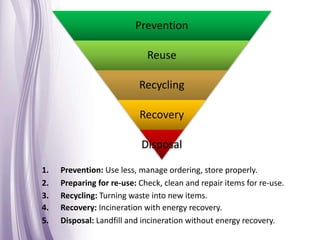
WASTE HIERARCHY
Prevention
Reuse
Recycling
Recovery
Disposal
1. Prevention: Use less, manage ordering, store properly.
2. Preparing for re-use: Check, clean and repair items for re-use.
3. Recycling: Turning waste into new items.
4. Recovery: Incineration with energy recovery.
5. Disposal: Landfill and incineration without energy recovery.
DON’T WASTE YOUR WASTE
Länsstyrelsen Östergötland (2012) Don´t waste your waste. Available at
https://www.youtube.com/watch?v=Ptp6JGAF3o0 (Accessed: 12 July 2016)
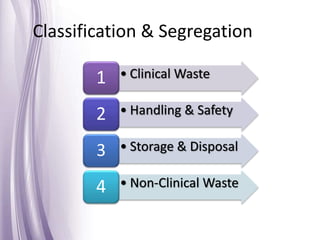
• Clinical Waste1
• Handling & Safety2
• Storage & Disposal3
• Non-Clinical Waste4
Classification & Segregation
CLINICAL WASTE
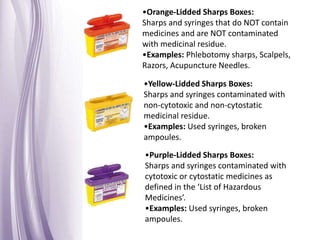
•Orange-Lidded Sharps Boxes:
Sharps and syringes that do NOT contain
medicines and are NOT contaminated
with medicinal residue.
•Examples: Phlebotomy sharps, Scalpels,
Razors, Acupuncture Needles.
•Yellow-Lidded Sharps Boxes:
Sharps and syringes contaminated with
non-cytotoxic and non-cytostatic
medicinal residue.
•Examples: Used syringes, broken
ampoules.
•Purple-Lidded Sharps Boxes:
Sharps and syringes contaminated with
cytotoxic or cytostatic medicines as
defined in the ‘List of Hazardous
Medicines’.
•Examples: Used syringes, broken
ampoules.
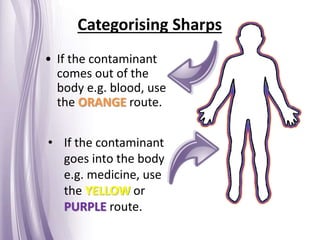
• If the contaminant
comes out of the
body e.g. blood, use
the ORANGE route.
Categorising Sharps
• If the contaminant
goes into the body
e.g. medicine, use
the YELLOW or
PURPLE route.
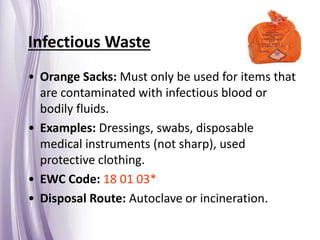
Infectious Waste
• Orange Sacks: Must only be used for items that
are contaminated with infectious blood or
bodily fluids.
• Examples: Dressings, swabs, disposable
medical instruments (not sharp), used
protective clothing.
• EWC Code: 18 01 03*
• Disposal Route: Autoclave or incineration.
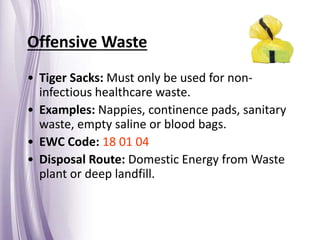
Offensive Waste
• Tiger Sacks: Must only be used for non-
infectious healthcare waste.
• Examples: Nappies, continence pads, sanitary
waste, empty saline or blood bags.
• EWC Code: 18 01 04
• Disposal Route: Domestic Energy from Waste
plant or deep landfill.
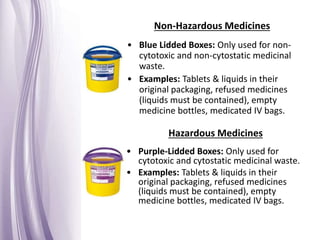
Non-Hazardous Medicines
• Blue Lidded Boxes: Only used for non-
cytotoxic and non-cytostatic medicinal
waste.
• Examples: Tablets & liquids in their
original packaging, refused medicines
(liquids must be contained), empty
medicine bottles, medicated IV bags.
• Purple-Lidded Boxes: Only used for
cytotoxic and cytostatic medicinal waste.
• Examples: Tablets & liquids in their
original packaging, refused medicines
(liquids must be contained), empty
medicine bottles, medicated IV bags.
Hazardous Medicines
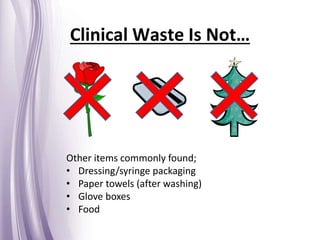
Clinical Waste Is Not…
Other items commonly found;
• Dressing/syringe packaging
• Paper towels (after washing)
• Glove boxes
• Food
HANDLING & SAFETY
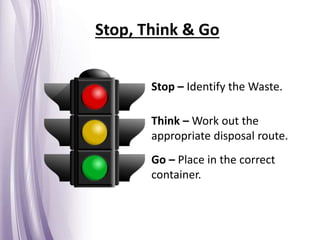
Stop, Think & Go
Stop – Identify the Waste.
Think – Work out the
appropriate disposal route.
Go – Place in the correct
container.
Safety & Hygiene
•Wear Personal Protective
Equipment (PPE).
•Keep your Tetanus and
Hepatitis B vaccinations up
to date.
•Wash your hands
thoroughly after handling
waste.
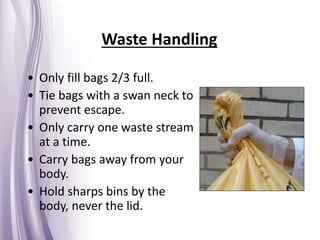
Waste Handling
• Only fill bags 2/3 full.
• Tie bags with a swan neck to
prevent escape.
• Only carry one waste stream
at a time.
• Carry bags away from your
body.
• Hold sharps bins by the
body, never the lid.
Spillages & Accidents
• All spillages must be cleared without delay.
• Always wear appropriate PPE.
• Use a spillage kit, if available.
• Spilled waste should be picked up with an
extension grab or tweezers, NOT bare hands.
• Clean the affected area thoroughly.
• Report all accidents, incidents and near misses
on an H&S Incident form.
STORAGE & DISPOSAL
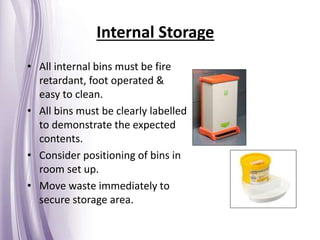
Internal Storage
• All internal bins must be fire
retardant, foot operated &
easy to clean.
• All bins must be clearly labelled
to demonstrate the expected
contents.
• Consider positioning of bins in
room set up.
• Move waste immediately to
secure storage area.
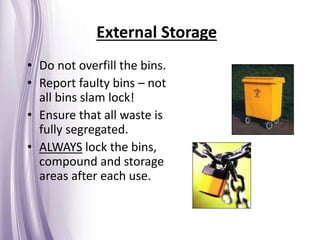
• Do not overfill the bins.
• Report faulty bins – not
all bins slam lock!
• Ensure that all waste is
fully segregated.
• ALWAYS lock the bins,
compound and storage
areas after each use.
External Storage
• Controlled Waste Transfer Note - Annual
season ticket for domestic and recycling
collections. Individual notes for ad hoc
collections.
• Hazardous Waste Consignment Note –
Individual notes for every clinical and
hazardous collection.
• Hazardous Waste Producer Returns – received
quarterly from the Contractors.
• Certificate of Destruction – Individual notes
for confidential waste collections.
Waste Collection Paperwork
CharlieVav (2010) How an EfW plant works. Available at
https://www.youtube.com/watch?v=Sg-ov4FKbaI (Accessed: 12 July 2016)
THE INCINERATION PROCESS
NOW IT’S YOUR TURN!
WASTE IN THE
COMMUNITY
• Clinical Waste1
• Sharps2
• Carriage of Waste3
Community nursing
• Regardless of who owns or supplies the items,
the healthcare professional who uses or
removes them is the Waste Producer.
• The Waste Producer is legally responsible for
the safe removal of the waste.
• Local councils are only responsible for
removing waste from self administering
patients e.g. collection of diabetic sharps.
• Waste can only be left behind if it meets
certain criteria and with patient consent.
Clinical Waste in the Community
• For reasons of practicality it is acceptable for
Community Staff to take only one sharps box
out with them.
• The box should be of the highest category to
meet the disposal requirements of the most
Hazardous contents.
• Purple lidded sharps boxes are usually taken as
they cover all possible contents.
• Only the Patient’s own sharps boxes should be
left in their homes.
Sharps in the Community
• Clinical waste sacks and sharps boxes (in
temporary closure mode) must be transported
in UN approved, rigid containers.
• All directly employed staff are covered under
the Practice’s Waste Carriers Licence.
• Containers should be transported in the boot
of the vehicle and kept out of sight.
• All waste must be returned to base and not
left in the vehicle overnight.
• Clean transport boxes with detergent wipes
every time they are emptied.
Carriage of Clinical Waste
NON-CLINICAL WASTE
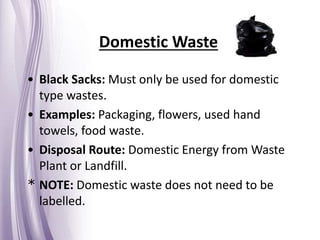
Domestic Waste
• Black Sacks: Must only be used for domestic
type wastes.
• Examples: Packaging, flowers, used hand
towels, food waste.
• Disposal Route: Domestic Energy from Waste
Plant or Landfill.
* NOTE: Domestic waste does not need to be
labelled.
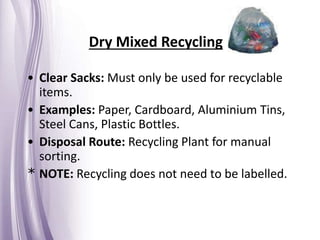
Dry Mixed Recycling
• Clear Sacks: Must only be used for recyclable
items.
• Examples: Paper, Cardboard, Aluminium Tins,
Steel Cans, Plastic Bottles.
• Disposal Route: Recycling Plant for manual
sorting.
* NOTE: Recycling does not need to be labelled.
Confidential Waste
• Any information, or combination of
information, containing details about a person
that may identify them, e.g. name, address,
telephone number.
• Commercially sensitive information such as
budgets, invoices & contracts.
• Confidential waste should be shredded and
placed in recycling OR put into confidential
waste bins if supplied on your site.
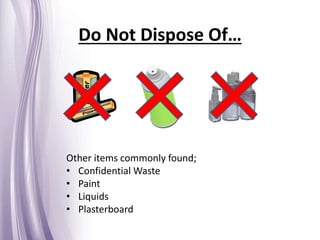
Do Not Dispose Of…
Other items commonly found;
• Confidential Waste
• Paint
• Liquids
• Plasterboard
OVERVIEW
Waste Management
Good waste management is important:
• To protect the environment.
• To reduce waste disposal costs.
• To ensure that you and your employer
comply with legislation.
Good waste management also prevents health
& safety risks to staff, patients and visitors and
promotes good infection prevention & control.
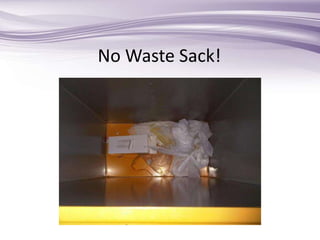
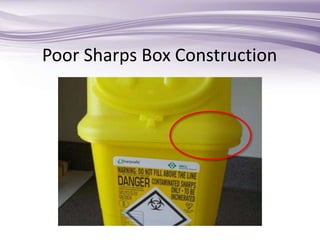
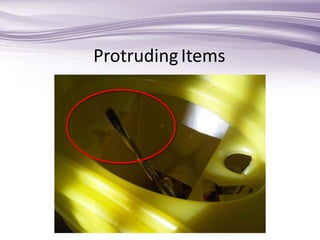
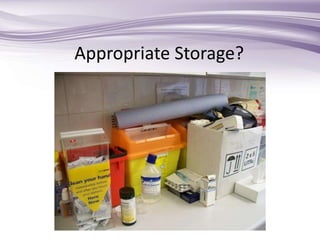
WHAT’S WRONG HERE?
No Waste Sack!
Poor Sharps Box Construction
ProtrudingItems
Appropriate Storage?
Resources
• Waste & Environment Team
• Waste Management Policy
• Waste Management Procedures & Guidelines
• HTM 07-01: Safe Management of Healthcare
Waste
QUESTIONS?
JAMES CHAPPLE
SUPPORT OFFICER

Waste Management Training

  • 1.
    CLINICAL & NON-CLINICALTRAINING James Chapple
  • 2.
    Aims & Objectives Atthe end of this training session you will know: • What types of wastes are produced. • Why segregation is necessary. • How to correctly handle each waste stream. • Implications of non-compliance.
  • 3.
    What a Loadof Rubbish! We class it as business waste and it must be treated in accordance with the requirements of many pieces of legislation. Although it is not your waste, you are still legally responsible for it!
  • 4.
  • 5.
    Risk 1 -Cost • Disposal of clinical waste costs 5 times as much as domestic waste! • Correct segregation can save lots of money. • Fines can be imposed on the spot or through the courts and there is no limit on the amount.
  • 6.
    Risk 2 – LegalPenalties The Environment Agency can impose; • Civil sanctions including financial penalties. • Criminal sanctions including prosecution. • The risk of prosecution is to the individual as well as the organisation.
  • 7.
    Risk 3 - Reputation •Unsafe disposal of waste risks public health. • Public organisations cannot be seen to break the law or waste taxpayers money on avoidable fines. • Commissioners could seek alternative providers.
  • 8.
    Risk 4 - Environmental •Carbon emissions created in manufacturing, packaging, marketing, use and end of life disposal of products. • Businesses pay the whole life costs of a product. • Waste not just the cost of disposal, but the value of the wasted products.
  • 9.
    • Responsibilities1 • HazardousWaste2 • WEEE3 • Waste Hierarchy4 Regulatory Framework
  • 10.
  • 11.
    Organisation • Implement policy,procedures and guidelines. • Provide resources to ensure waste is handled safely. • Ensure suitable contracts are in place for the collection and disposal of waste. • Transfer waste to a registered carrier and facility. • Monitor waste activity within and outside the organisation.
  • 12.
    Individual • Follow policy,procedures and guidelines. • Pack waste securely. • Describe and label waste accurately. • Store waste safely on site. • Complete and sign collection paperwork. • Report any concerns.
  • 13.
  • 14.
    Defining Hazardous Waste Hazardouswaste is classed as anything which causes harm to humans or the environment. Common items include; Hazardous wastes must not be mixed with any other wastes or with each other! • Batteries • Fridges • TVs & Computer Monitors • Paints & Chemicals • Fluorescent Tubes • Ink & Toner Cartridges • Some Alcohol Gels
  • 15.
    What is WEEEWaste? • WEEE (Waste Electrical and Electronic Equipment) is anything with a plug, battery or item that can carry an electrical current. • Some WEEE items are also classed as hazardous waste. • WEEE must be stored securely and under cover to await collection.
  • 16.
  • 17.
    Prevention Reuse Recycling Recovery Disposal 1. Prevention: Useless, manage ordering, store properly. 2. Preparing for re-use: Check, clean and repair items for re-use. 3. Recycling: Turning waste into new items. 4. Recovery: Incineration with energy recovery. 5. Disposal: Landfill and incineration without energy recovery.
  • 18.
    DON’T WASTE YOURWASTE Länsstyrelsen Östergötland (2012) Don´t waste your waste. Available at https://www.youtube.com/watch?v=Ptp6JGAF3o0 (Accessed: 12 July 2016)
  • 19.
    • Clinical Waste1 •Handling & Safety2 • Storage & Disposal3 • Non-Clinical Waste4 Classification & Segregation
  • 20.
  • 21.
    •Orange-Lidded Sharps Boxes: Sharpsand syringes that do NOT contain medicines and are NOT contaminated with medicinal residue. •Examples: Phlebotomy sharps, Scalpels, Razors, Acupuncture Needles. •Yellow-Lidded Sharps Boxes: Sharps and syringes contaminated with non-cytotoxic and non-cytostatic medicinal residue. •Examples: Used syringes, broken ampoules. •Purple-Lidded Sharps Boxes: Sharps and syringes contaminated with cytotoxic or cytostatic medicines as defined in the ‘List of Hazardous Medicines’. •Examples: Used syringes, broken ampoules.
  • 22.
    • If thecontaminant comes out of the body e.g. blood, use the ORANGE route. Categorising Sharps • If the contaminant goes into the body e.g. medicine, use the YELLOW or PURPLE route.
  • 23.
    Infectious Waste • OrangeSacks: Must only be used for items that are contaminated with infectious blood or bodily fluids. • Examples: Dressings, swabs, disposable medical instruments (not sharp), used protective clothing. • EWC Code: 18 01 03* • Disposal Route: Autoclave or incineration.
  • 24.
    Offensive Waste • TigerSacks: Must only be used for non- infectious healthcare waste. • Examples: Nappies, continence pads, sanitary waste, empty saline or blood bags. • EWC Code: 18 01 04 • Disposal Route: Domestic Energy from Waste plant or deep landfill.
  • 25.
    Non-Hazardous Medicines • BlueLidded Boxes: Only used for non- cytotoxic and non-cytostatic medicinal waste. • Examples: Tablets & liquids in their original packaging, refused medicines (liquids must be contained), empty medicine bottles, medicated IV bags. • Purple-Lidded Boxes: Only used for cytotoxic and cytostatic medicinal waste. • Examples: Tablets & liquids in their original packaging, refused medicines (liquids must be contained), empty medicine bottles, medicated IV bags. Hazardous Medicines
  • 26.
    Clinical Waste IsNot… Other items commonly found; • Dressing/syringe packaging • Paper towels (after washing) • Glove boxes • Food
  • 27.
  • 28.
    Stop, Think &Go Stop – Identify the Waste. Think – Work out the appropriate disposal route. Go – Place in the correct container.
  • 29.
    Safety & Hygiene •WearPersonal Protective Equipment (PPE). •Keep your Tetanus and Hepatitis B vaccinations up to date. •Wash your hands thoroughly after handling waste.
  • 30.
    Waste Handling • Onlyfill bags 2/3 full. • Tie bags with a swan neck to prevent escape. • Only carry one waste stream at a time. • Carry bags away from your body. • Hold sharps bins by the body, never the lid.
  • 31.
    Spillages & Accidents •All spillages must be cleared without delay. • Always wear appropriate PPE. • Use a spillage kit, if available. • Spilled waste should be picked up with an extension grab or tweezers, NOT bare hands. • Clean the affected area thoroughly. • Report all accidents, incidents and near misses on an H&S Incident form.
  • 32.
  • 33.
    Internal Storage • Allinternal bins must be fire retardant, foot operated & easy to clean. • All bins must be clearly labelled to demonstrate the expected contents. • Consider positioning of bins in room set up. • Move waste immediately to secure storage area.
  • 34.
    • Do notoverfill the bins. • Report faulty bins – not all bins slam lock! • Ensure that all waste is fully segregated. • ALWAYS lock the bins, compound and storage areas after each use. External Storage
  • 35.
    • Controlled WasteTransfer Note - Annual season ticket for domestic and recycling collections. Individual notes for ad hoc collections. • Hazardous Waste Consignment Note – Individual notes for every clinical and hazardous collection. • Hazardous Waste Producer Returns – received quarterly from the Contractors. • Certificate of Destruction – Individual notes for confidential waste collections. Waste Collection Paperwork
  • 36.
    CharlieVav (2010) Howan EfW plant works. Available at https://www.youtube.com/watch?v=Sg-ov4FKbaI (Accessed: 12 July 2016) THE INCINERATION PROCESS
  • 37.
  • 38.
  • 39.
    • Clinical Waste1 •Sharps2 • Carriage of Waste3 Community nursing
  • 40.
    • Regardless ofwho owns or supplies the items, the healthcare professional who uses or removes them is the Waste Producer. • The Waste Producer is legally responsible for the safe removal of the waste. • Local councils are only responsible for removing waste from self administering patients e.g. collection of diabetic sharps. • Waste can only be left behind if it meets certain criteria and with patient consent. Clinical Waste in the Community
  • 41.
    • For reasonsof practicality it is acceptable for Community Staff to take only one sharps box out with them. • The box should be of the highest category to meet the disposal requirements of the most Hazardous contents. • Purple lidded sharps boxes are usually taken as they cover all possible contents. • Only the Patient’s own sharps boxes should be left in their homes. Sharps in the Community
  • 42.
    • Clinical wastesacks and sharps boxes (in temporary closure mode) must be transported in UN approved, rigid containers. • All directly employed staff are covered under the Practice’s Waste Carriers Licence. • Containers should be transported in the boot of the vehicle and kept out of sight. • All waste must be returned to base and not left in the vehicle overnight. • Clean transport boxes with detergent wipes every time they are emptied. Carriage of Clinical Waste
  • 43.
  • 44.
    Domestic Waste • BlackSacks: Must only be used for domestic type wastes. • Examples: Packaging, flowers, used hand towels, food waste. • Disposal Route: Domestic Energy from Waste Plant or Landfill. * NOTE: Domestic waste does not need to be labelled.
  • 45.
    Dry Mixed Recycling •Clear Sacks: Must only be used for recyclable items. • Examples: Paper, Cardboard, Aluminium Tins, Steel Cans, Plastic Bottles. • Disposal Route: Recycling Plant for manual sorting. * NOTE: Recycling does not need to be labelled.
  • 46.
    Confidential Waste • Anyinformation, or combination of information, containing details about a person that may identify them, e.g. name, address, telephone number. • Commercially sensitive information such as budgets, invoices & contracts. • Confidential waste should be shredded and placed in recycling OR put into confidential waste bins if supplied on your site.
  • 47.
    Do Not DisposeOf… Other items commonly found; • Confidential Waste • Paint • Liquids • Plasterboard
  • 48.
  • 49.
    Waste Management Good wastemanagement is important: • To protect the environment. • To reduce waste disposal costs. • To ensure that you and your employer comply with legislation. Good waste management also prevents health & safety risks to staff, patients and visitors and promotes good infection prevention & control.
  • 50.
  • 51.
  • 52.
    Poor Sharps BoxConstruction
  • 53.
  • 54.
  • 55.
    Resources • Waste &Environment Team • Waste Management Policy • Waste Management Procedures & Guidelines • HTM 07-01: Safe Management of Healthcare Waste
  • 56.
  • 57.