Improving the
maize productivity
in India: Progress,
challenges and
opportunities

   R. Sai Kumar
   DMR, INDIA
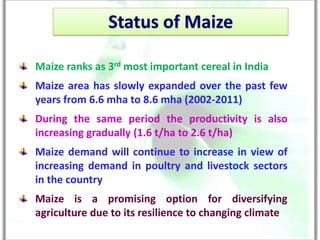
Status of Maize

Maize ranks as 3rd most important cereal in India
Maize area has slowly expanded over the past few
years from 6.6 mha to 8.6 mha (2002-2011)
During the same period the productivity is also
increasing gradually (1.6 t/ha to 2.6 t/ha)
Maize demand will continue to increase in view of
increasing demand in poultry and livestock sectors
in the country
Maize is a promising option for diversifying
agriculture due to its resilience to changing climate
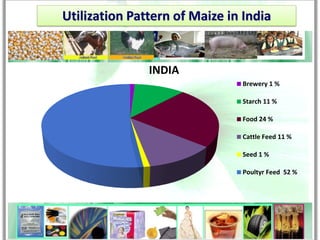
Utilization Pattern of Maize in India


               INDIA
                               Brewery 1 %

                               Starch 11 %

                               Food 24 %

                               Cattle Feed 11 %

                               Seed 1 %

                               Poultyr Feed 52 %
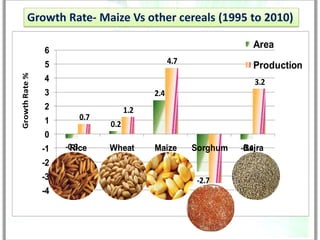
Growth Rate- Maize Vs other cereals (1995 to 2010)

                                                                     Area
                6
                5                               4.7
                                                                     Production
Growth Rate %


                4                                                    3.2
                3                         2.4
                2                   1.2
                1       0.7
                              0.2
                0
                -1   -0.3
                      Rice    Wheat       Maize       Sorghum     -0.4
                                                                   Bajra
                -2
                -3                                     -2.7
                -4                                         -3.5
Adoption of Single Cross Hybrid Technology
Factors for Increased Maize Production

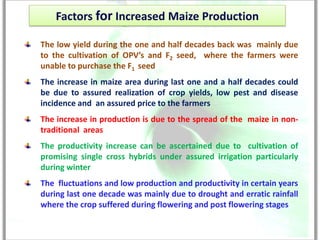
The low yield during the one and half decades back was mainly due
to the cultivation of OPV’s and F2 seed, where the farmers were
unable to purchase the F1 seed
The increase in maize area during last one and a half decades could
be due to assured realization of crop yields, low pest and disease
incidence and an assured price to the farmers
The increase in production is due to the spread of the maize in non-
traditional areas
The productivity increase can be ascertained due to cultivation of
promising single cross hybrids under assured irrigation particularly
during winter
The fluctuations and low production and productivity in certain years
during last one decade was mainly due to drought and erratic rainfall
where the crop suffered during flowering and post flowering stages
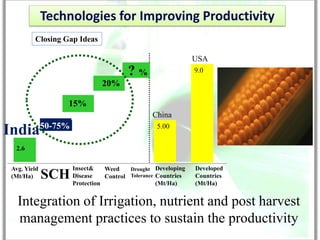
Technologies for Improving Productivity
         Closing Gap Ideas

                                                             USA
                                      ?%                     9.0
                             20%

                  15%
                                               China

India50-75%                                     5.00


  2.6


 Avg. Yield         Insect&    Weed    Drought Developing    Developed
 (Mt/Ha)      SCH   Disease
                    Protection
                               Control Tolerance Countries
                                                 (Mt/Ha)
                                                             Countries
                                                             (Mt/Ha)


   Integration of Irrigation, nutrient and post harvest
   management practices to sustain the productivity
                                                                         7
Strategies to Further Increase Maize
     Production and Productivity
Development of long, medium and short duration
single cross hybrids
Development of high yielding QPM single cross
hybrids
Development of super sweet corn (sh-2) single cross
hybrids
Development of popcorn single cross hybrids with
high popping quality
Development of single cross hybrids with high oil
content (>6.0%)
Development of single cross baby corn hybrids
Short Term Strategy
Facilitate immediate disposal of SCH to target
environments
Screening of available elite germplasms for different
traits
Testing in high density planting
Classifying male and female parents
Making cross combination
Developing Single Cross Hybrid suitable to particular
region
Grouping them based on Extra early, Early, Medium
and Late duration
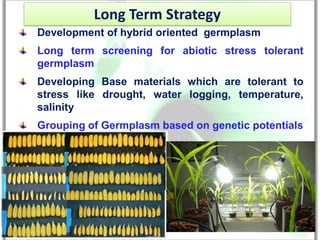
Long Term Strategy
Development of hybrid oriented germplasm
Long term screening for abiotic stress tolerant
germplasm
Developing Base materials which are tolerant to
stress like drought, water logging, temperature,
salinity
Grouping of Germplasm based on genetic potentials
Broadening Genetic Bases of source materials in
long term vision
Identification of suitable material   subject to
particular location specific stress
Making cross combinations and production of
ideal hybrids
Target sustainable production and productivity of
maize
Biotechnological tools for Maize Improvements
Marker Aided Selection (MAS)
   Screening for Disease resistance
   Drought tolerance, High Yield
   Conversion of normal maize to QPM, β Carotene
Transgenic technology
   Pest and Disease resistance
   Improved drought tolerance
   Herbicide Tolerance
   Low Phytase maize
Doubled Haploid Production through Haploid Inducers
   Rapid production of inbred lines
   High success rate of Induction
   Development of Inbreds as vigor as Hybrids
Potential for Crop Diversification


Andhra Pradesh         Winter Rice


  Karnataka             Cotton, Rice


Maharashtra           Sorghum, Cotton
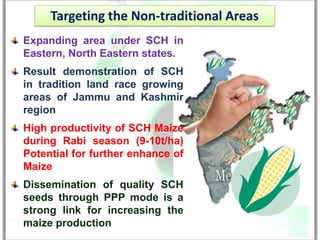
Targeting the Non-traditional Areas
Expanding area under SCH in
Eastern, North Eastern states.
Result demonstration of SCH
in tradition land race growing
areas of Jammu and Kashmir
region
High productivity of SCH Maize
during Rabi season (9-10t/ha)
Potential for further enhance of
Maize
Dissemination of quality SCH
seeds through PPP mode is a
strong link for increasing the
maize production
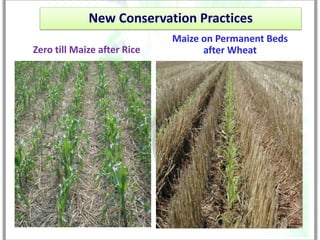
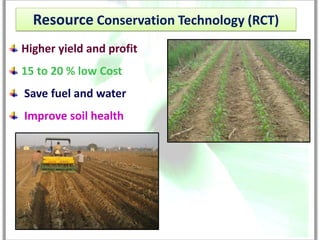
New Conservation Practices
                             Maize on Permanent Beds
Zero till Maize after Rice         after Wheat
Resource Conservation Technology (RCT)
Higher yield and profit
15 to 20 % low Cost
Save fuel and water
Improve soil health
Promotion of Mechanization
Seed Village Concept
Andhra Pradesh & West Bengal farmers get benefited in different
ways:
1. Exposure to modern agronomic practices
2. It imparts safety consciousness to seed farmers
3. Agriculture is weaned away from traditional to streamlined
   enterprise
4. Guaranteed buy back of produce by seed companies
5. Ancillary enterprise development like transport operators,
   godown and container facility services etc
6. Good infrastructure development like road, transportation,
   power availability etc
7. Employment Opportunity
8. Improve social facilities like school, Hospitals etc
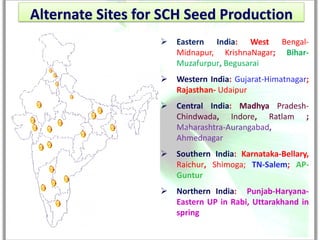
Alternate Sites for SCH Seed Production
                      Eastern India: West Bengal-
                       Midnapur, KrishnaNagar; Bihar-
                       Muzafurpur, Begusarai
                      Western India: Gujarat-Himatnagar;
                       Rajasthan- Udaipur
                      Central India: Madhya Pradesh-
                       Chindwada, Indore, Ratlam ;
                       Maharashtra-Aurangabad,
                       Ahmednagar
                      Southern India: Karnataka-Bellary,
                       Raichur, Shimoga; TN-Salem; AP-
                       Guntur
                      Northern India: Punjab-Haryana-
                       Eastern UP in Rabi, Uttarakhand in
                       spring
Production and Distribution of Quality Seeds
Area under SCH is keep on Increasing, there is a need to produce
quality seeds of SCH
   Involvement of KVKs for Parental Seed Production by
   Imparting training to KVKs for SCH seed Production
   Public Private Partnership(PPP) - Public sector hybrids are
   easily disseminated by entering Memorandum Of
   Understanding(MOU) with Private seed industries
Example:
   Green Gold Seed Ltd. of Aurangabad signed MoU with CCS
   HAU for seed production of HQPM 1 and HM 4
   Vikky Agro. Tech., Sampurna Seeds & AB Seeds Ltd, Hyderabad
   entered MoU with ANGRAU for seed production and
   marketing of DHM 117
Maize in Poultry Industries
India is 3rd largest egg producer and 5th largest poultry
meat producer in the world
Maize accounts for most of the energy in the feed and
poultry feed provides the link between maize and
poultry sectors
8-10mt of maize is required for poultry feed every year
and it is over 50% of total annual production
Poultry industry have buy back mechanism with
maize farmers
Maize farmers have assured market and reasonably
reliable income
Poultry industry is more concentrated in Peninsular
India and employs about two million people
Private sector controls roughly 80% of total poultry
production in the country
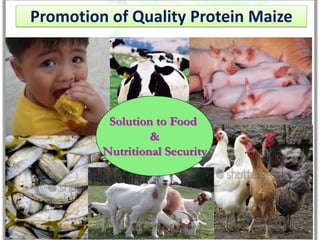
Promotion of Quality Protein Maize


          Solution to Food
                  &
         Nutritional Security
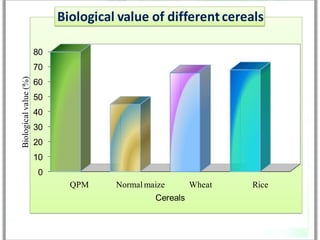
Biological value of different cereals

                       80
                       70
Biological value (%)


                       60
                       50
                       40
                       30
                       20
                       10
                       0
                              QPM     Normal maize       Wheat   Rice
                                               Cereals
Impact of QPM on Human Being

Low cost quality protein compared to milk

Meet the energy and protein needs of infants
and children

Improve growth rates in young children

Protein requirements of adults
Prevent and cure protein deficiency diseases,
Kwashierkor, in young children
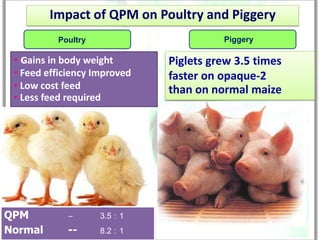
Impact of QPM on Poultry and Piggery
          Poultry                       Piggery

 • Gains in body weight       Piglets grew 3.5 times
 • Feed efficiency Improved   faster on opaque-2
 • Low cost feed              than on normal maize
 • Less feed required


QPM          --     3.5 : 1
Normal       --     8.2 : 1
Role of maize in furthering farmer’s livelihood

  High yielding hybrids of specialty corn increase output and
  thereby Income levels
  Increased income levels provide economic surplus for
  increased standard of living
  Economic sufficiency paves the way for appreciating and
  implementing newer farm technologies/ agronomic
  practices hereby starting a profitable corn cropping trend
  This trend has a multiplicative effect in that other
  neighboring farmers too follow suit
  All in all it ends up in a win-win situation for farmers and
  seed industry
Specialty Corn – for Livelihood Security
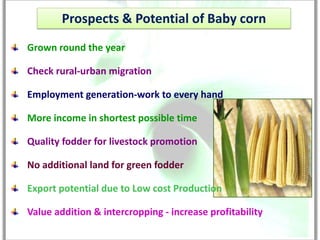
Prospects & Potential of Baby corn
Grown round the year

Check rural-urban migration

Employment generation-work to every hand

More income in shortest possible time

Quality fodder for livestock promotion

No additional land for green fodder

Export potential due to Low cost Production

Value addition & intercropping - increase profitability
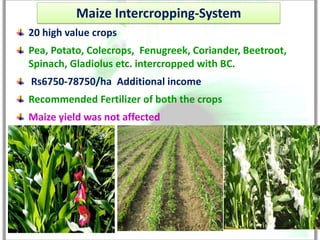
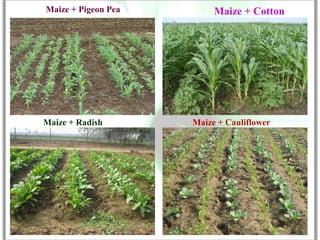
Maize Intercropping-System
20 high value crops
Pea, Potato, Colecrops, Fenugreek, Coriander, Beetroot,
Spinach, Gladiolus etc. intercropped with BC.
Rs6750-78750/ha Additional income
Recommended Fertilizer of both the crops
Maize yield was not affected
Maize + Pigeon Pea        Maize + Cotton


Maize + Radish       Maize + Cauliflower
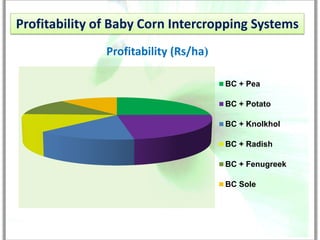
Profitability of Baby Corn Intercropping Systems
               Profitability (Rs/ha)

                                       BC + Pea

                                       BC + Potato

                                       BC + Knolkhol

                                       BC + Radish

                                       BC + Fenugreek

                                       BC Sole
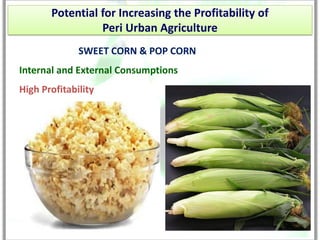
Potential for Increasing the Profitability of
                 Peri Urban Agriculture
              SWEET CORN & POP CORN
Internal and External Consumptions
High Profitability
Transfer of Technology
Imparting trainings to KVKs for Parental Seed
Production
Training To Farmers for Single Cross Hybrids Seed
Production
Front Line Demonstrations (FLDs)
Result Demonstration of SCH in non traditional areas
like J&K, Tribal belts of Gujarat, MP,CG
Adoption of Model Villages e.g. Baby corn Village of
Atterna, Haryana
Promotion of Value added Products of QPM
Promotion of Sweet corn, Pop corn cultivation for
high income
Development of Community Village for Seed
marketing and Buy back arrangements
Creation of Self Help Groups (SHG’s)
For marketing and Procurement of maize seed
Generation of income by procuring maize
Ensuring minimum support price
The women got kudos from the World Bank for their
bold endeavor in agri-marketing
Procured 8.62 lakh Quintal (Rs 46.5 crores) through
90 Procurement centre in Three months
Earned Rs 45 Lakhs Commission by selling maize to
Andhra Pradesh Market Federation in Telangana
Region (Deccan Chronicle, dt: 13-3-06)
Success Story of Women Self Help Group (SHG)


                           (Deccan Chronicle, dt: 13-3-06)
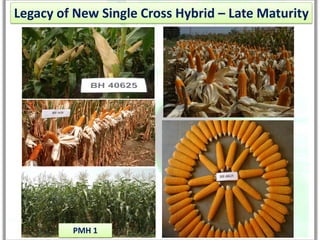
Legacy of New Single Cross Hybrid – Late Maturity


         PMH 1
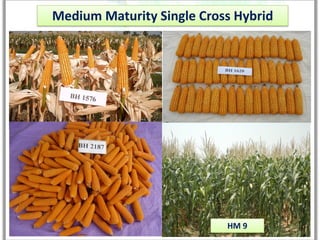
Medium Maturity Single Cross Hybrid


                           HM 9
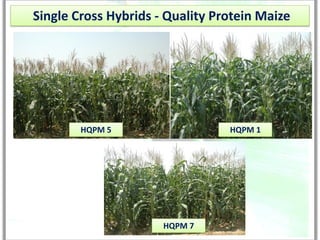
Single Cross Hybrids - Quality Protein Maize


        HQPM 5                   HQPM 1


                      HQPM 7
Conclusion
To realize genetic potential yield of maize the single cross
hybrid technology is the solution
It is an appropriate technology for sustainable agriculture
and deserves to be promoted on large scale by both public
and private sector
Identification of productive seed parent as female to
minimize cost of seed production
Identification of suitable male parent with dense tassel with
longevity of pollen shedding
Development of stress tolerant germplsam
Early maturing single cross hybrids for drought/ excess water
Seed technology research for new products

Agronomic packages for rain fed situations

Strengthen research on hybrid technology for unfavorable
environments

More emphasis for seed production under marginal areas

Total yield increased resulting from genetic and non genetic
causes
S3.3 Improving the maize productivity in India: Progress,

S3.3 Improving the maize productivity in India: Progress,

  • 1.
    Improving the maize productivity inIndia: Progress, challenges and opportunities R. Sai Kumar DMR, INDIA
  • 2.
    Status of Maize Maizeranks as 3rd most important cereal in India Maize area has slowly expanded over the past few years from 6.6 mha to 8.6 mha (2002-2011) During the same period the productivity is also increasing gradually (1.6 t/ha to 2.6 t/ha) Maize demand will continue to increase in view of increasing demand in poultry and livestock sectors in the country Maize is a promising option for diversifying agriculture due to its resilience to changing climate
  • 3.
    Utilization Pattern ofMaize in India INDIA Brewery 1 % Starch 11 % Food 24 % Cattle Feed 11 % Seed 1 % Poultyr Feed 52 %
  • 4.
    Growth Rate- MaizeVs other cereals (1995 to 2010) Area 6 5 4.7 Production Growth Rate % 4 3.2 3 2.4 2 1.2 1 0.7 0.2 0 -1 -0.3 Rice Wheat Maize Sorghum -0.4 Bajra -2 -3 -2.7 -4 -3.5
  • 5.
    Adoption of SingleCross Hybrid Technology
  • 6.
    Factors for IncreasedMaize Production The low yield during the one and half decades back was mainly due to the cultivation of OPV’s and F2 seed, where the farmers were unable to purchase the F1 seed The increase in maize area during last one and a half decades could be due to assured realization of crop yields, low pest and disease incidence and an assured price to the farmers The increase in production is due to the spread of the maize in non- traditional areas The productivity increase can be ascertained due to cultivation of promising single cross hybrids under assured irrigation particularly during winter The fluctuations and low production and productivity in certain years during last one decade was mainly due to drought and erratic rainfall where the crop suffered during flowering and post flowering stages
  • 7.
    Technologies for ImprovingProductivity Closing Gap Ideas USA ?% 9.0 20% 15% China India50-75% 5.00 2.6 Avg. Yield Insect& Weed Drought Developing Developed (Mt/Ha) SCH Disease Protection Control Tolerance Countries (Mt/Ha) Countries (Mt/Ha) Integration of Irrigation, nutrient and post harvest management practices to sustain the productivity 7
  • 8.
    Strategies to FurtherIncrease Maize Production and Productivity Development of long, medium and short duration single cross hybrids Development of high yielding QPM single cross hybrids Development of super sweet corn (sh-2) single cross hybrids Development of popcorn single cross hybrids with high popping quality Development of single cross hybrids with high oil content (>6.0%) Development of single cross baby corn hybrids
  • 9.
    Short Term Strategy Facilitateimmediate disposal of SCH to target environments Screening of available elite germplasms for different traits Testing in high density planting Classifying male and female parents Making cross combination Developing Single Cross Hybrid suitable to particular region Grouping them based on Extra early, Early, Medium and Late duration
  • 10.
    Long Term Strategy Developmentof hybrid oriented germplasm Long term screening for abiotic stress tolerant germplasm Developing Base materials which are tolerant to stress like drought, water logging, temperature, salinity Grouping of Germplasm based on genetic potentials
  • 11.
    Broadening Genetic Basesof source materials in long term vision Identification of suitable material subject to particular location specific stress Making cross combinations and production of ideal hybrids Target sustainable production and productivity of maize
  • 12.
    Biotechnological tools forMaize Improvements Marker Aided Selection (MAS) Screening for Disease resistance Drought tolerance, High Yield Conversion of normal maize to QPM, β Carotene Transgenic technology Pest and Disease resistance Improved drought tolerance Herbicide Tolerance Low Phytase maize Doubled Haploid Production through Haploid Inducers Rapid production of inbred lines High success rate of Induction Development of Inbreds as vigor as Hybrids
  • 13.
    Potential for CropDiversification Andhra Pradesh Winter Rice Karnataka Cotton, Rice Maharashtra Sorghum, Cotton
  • 14.
    Targeting the Non-traditionalAreas Expanding area under SCH in Eastern, North Eastern states. Result demonstration of SCH in tradition land race growing areas of Jammu and Kashmir region High productivity of SCH Maize during Rabi season (9-10t/ha) Potential for further enhance of Maize Dissemination of quality SCH seeds through PPP mode is a strong link for increasing the maize production
  • 15.
    New Conservation Practices Maize on Permanent Beds Zero till Maize after Rice after Wheat
  • 16.
    Resource Conservation Technology(RCT) Higher yield and profit 15 to 20 % low Cost Save fuel and water Improve soil health
  • 17.
  • 18.
    Seed Village Concept AndhraPradesh & West Bengal farmers get benefited in different ways: 1. Exposure to modern agronomic practices 2. It imparts safety consciousness to seed farmers 3. Agriculture is weaned away from traditional to streamlined enterprise 4. Guaranteed buy back of produce by seed companies 5. Ancillary enterprise development like transport operators, godown and container facility services etc 6. Good infrastructure development like road, transportation, power availability etc 7. Employment Opportunity 8. Improve social facilities like school, Hospitals etc
  • 19.
    Alternate Sites forSCH Seed Production  Eastern India: West Bengal- Midnapur, KrishnaNagar; Bihar- Muzafurpur, Begusarai  Western India: Gujarat-Himatnagar; Rajasthan- Udaipur  Central India: Madhya Pradesh- Chindwada, Indore, Ratlam ; Maharashtra-Aurangabad, Ahmednagar  Southern India: Karnataka-Bellary, Raichur, Shimoga; TN-Salem; AP- Guntur  Northern India: Punjab-Haryana- Eastern UP in Rabi, Uttarakhand in spring
  • 20.
    Production and Distributionof Quality Seeds Area under SCH is keep on Increasing, there is a need to produce quality seeds of SCH Involvement of KVKs for Parental Seed Production by Imparting training to KVKs for SCH seed Production Public Private Partnership(PPP) - Public sector hybrids are easily disseminated by entering Memorandum Of Understanding(MOU) with Private seed industries Example: Green Gold Seed Ltd. of Aurangabad signed MoU with CCS HAU for seed production of HQPM 1 and HM 4 Vikky Agro. Tech., Sampurna Seeds & AB Seeds Ltd, Hyderabad entered MoU with ANGRAU for seed production and marketing of DHM 117
  • 21.
    Maize in PoultryIndustries India is 3rd largest egg producer and 5th largest poultry meat producer in the world Maize accounts for most of the energy in the feed and poultry feed provides the link between maize and poultry sectors 8-10mt of maize is required for poultry feed every year and it is over 50% of total annual production Poultry industry have buy back mechanism with maize farmers Maize farmers have assured market and reasonably reliable income Poultry industry is more concentrated in Peninsular India and employs about two million people Private sector controls roughly 80% of total poultry production in the country
  • 22.
    Promotion of QualityProtein Maize Solution to Food & Nutritional Security
  • 23.
    Biological value ofdifferent cereals 80 70 Biological value (%) 60 50 40 30 20 10 0 QPM Normal maize Wheat Rice Cereals
  • 24.
    Impact of QPMon Human Being Low cost quality protein compared to milk Meet the energy and protein needs of infants and children Improve growth rates in young children Protein requirements of adults Prevent and cure protein deficiency diseases, Kwashierkor, in young children
  • 25.
    Impact of QPMon Poultry and Piggery Poultry Piggery • Gains in body weight Piglets grew 3.5 times • Feed efficiency Improved faster on opaque-2 • Low cost feed than on normal maize • Less feed required QPM -- 3.5 : 1 Normal -- 8.2 : 1
  • 26.
    Role of maizein furthering farmer’s livelihood High yielding hybrids of specialty corn increase output and thereby Income levels Increased income levels provide economic surplus for increased standard of living Economic sufficiency paves the way for appreciating and implementing newer farm technologies/ agronomic practices hereby starting a profitable corn cropping trend This trend has a multiplicative effect in that other neighboring farmers too follow suit All in all it ends up in a win-win situation for farmers and seed industry
  • 27.
    Specialty Corn –for Livelihood Security
  • 28.
    Prospects & Potentialof Baby corn Grown round the year Check rural-urban migration Employment generation-work to every hand More income in shortest possible time Quality fodder for livestock promotion No additional land for green fodder Export potential due to Low cost Production Value addition & intercropping - increase profitability
  • 29.
    Maize Intercropping-System 20 highvalue crops Pea, Potato, Colecrops, Fenugreek, Coriander, Beetroot, Spinach, Gladiolus etc. intercropped with BC. Rs6750-78750/ha Additional income Recommended Fertilizer of both the crops Maize yield was not affected
  • 30.
    Maize + PigeonPea Maize + Cotton Maize + Radish Maize + Cauliflower
  • 31.
    Profitability of BabyCorn Intercropping Systems Profitability (Rs/ha) BC + Pea BC + Potato BC + Knolkhol BC + Radish BC + Fenugreek BC Sole
  • 32.
    Potential for Increasingthe Profitability of Peri Urban Agriculture SWEET CORN & POP CORN Internal and External Consumptions High Profitability
  • 33.
    Transfer of Technology Impartingtrainings to KVKs for Parental Seed Production Training To Farmers for Single Cross Hybrids Seed Production Front Line Demonstrations (FLDs) Result Demonstration of SCH in non traditional areas like J&K, Tribal belts of Gujarat, MP,CG Adoption of Model Villages e.g. Baby corn Village of Atterna, Haryana Promotion of Value added Products of QPM Promotion of Sweet corn, Pop corn cultivation for high income Development of Community Village for Seed marketing and Buy back arrangements
  • 34.
    Creation of SelfHelp Groups (SHG’s) For marketing and Procurement of maize seed Generation of income by procuring maize Ensuring minimum support price The women got kudos from the World Bank for their bold endeavor in agri-marketing Procured 8.62 lakh Quintal (Rs 46.5 crores) through 90 Procurement centre in Three months Earned Rs 45 Lakhs Commission by selling maize to Andhra Pradesh Market Federation in Telangana Region (Deccan Chronicle, dt: 13-3-06)
  • 35.
    Success Story ofWomen Self Help Group (SHG) (Deccan Chronicle, dt: 13-3-06)
  • 36.
    Legacy of NewSingle Cross Hybrid – Late Maturity PMH 1
  • 37.
    Medium Maturity SingleCross Hybrid HM 9
  • 38.
    Single Cross Hybrids- Quality Protein Maize HQPM 5 HQPM 1 HQPM 7
  • 39.
    Conclusion To realize geneticpotential yield of maize the single cross hybrid technology is the solution It is an appropriate technology for sustainable agriculture and deserves to be promoted on large scale by both public and private sector Identification of productive seed parent as female to minimize cost of seed production Identification of suitable male parent with dense tassel with longevity of pollen shedding Development of stress tolerant germplsam Early maturing single cross hybrids for drought/ excess water
  • 40.
    Seed technology researchfor new products Agronomic packages for rain fed situations Strengthen research on hybrid technology for unfavorable environments More emphasis for seed production under marginal areas Total yield increased resulting from genetic and non genetic causes