Sunil Bhardwaj
(FIRST BATCH)
What is hybrid rice
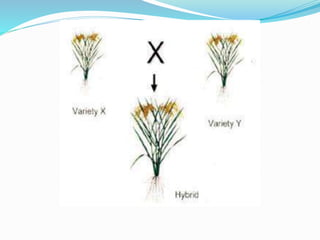
 the first generation progeny (F1) obtained by crossing
two genetically different varieties (parents) of rice is
called ‘Hybrid’.
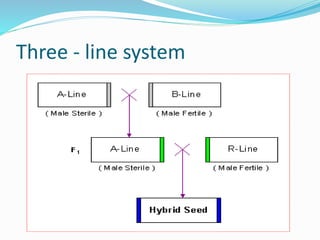
 Since rice is self pollinated, cytoplasmic male sterile
(CMS) parent is used as female parent, which is
normally called ‘A’ line. The fertility restoring line
which is called ‘pollinator’ to the female parent is
known as male parent. It is generally referred to as ‘R’
line, and is used for hybrid seed production. The
hybrid combines the desirable characters from CMS
line and R line.
Three - line system
History of hybrid rice
 The Chinese scientists were the first in the world to
develop commercial hybrids in rice and the first
hybrid was released in 1976.
 Prof. Yuan longping considered as father of hybrid rice
 China covers 53% of its rice area and about 58% of
production under hybrid rice.
 Chinese researchers are now developing single
breeding step lines (known as two line hybrid).
 These are called as super rice hybrid and yield on
average 10% higher than three-line hybrids.
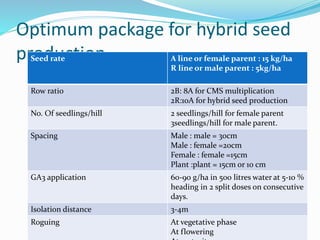
Optimum package for hybrid seed
productionSeed rate A line or female parent : 15 kg/ha
R line or male parent : 5kg/ha
Row ratio 2B: 8A for CMS multiplication
2R:10A for hybrid seed production
No. Of seedlings/hill 2 seedlings/hill for female parent
3seedlings/hill for male parent.
Spacing Male : male = 30cm
Male : female =20cm
Female : female =15cm
Plant :plant = 15cm or 10 cm
GA3 application 60-90 g/ha in 500 litres water at 5-10 %
heading in 2 split doses on consecutive
days.
Isolation distance 3-4m
Roguing At vegetative phase
At flowering
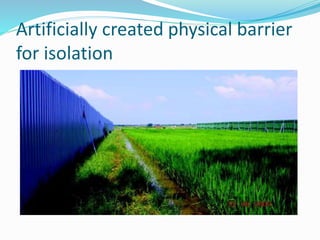
Artificially created physical barrier
for isolation
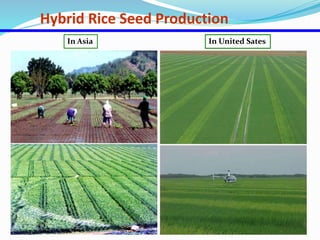
Hybrid Rice Seed Production
In Asia In United Sates
History of hybrid rice in India
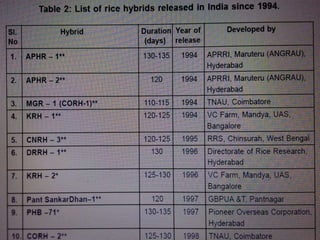
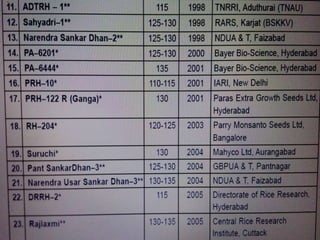
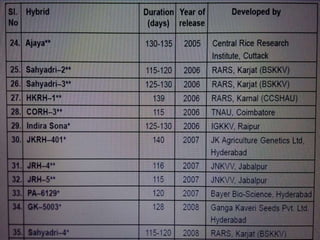
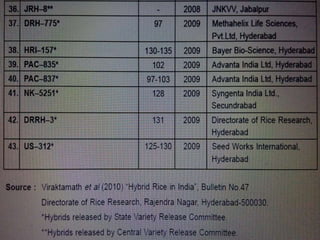
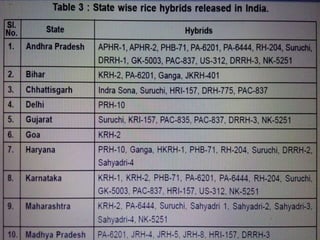
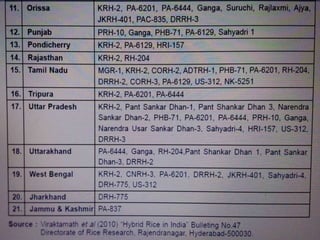
 Hybrid rice in India were initiated in 1989, when Indian
Council of Agricultural Research (ICAR) launched a special
goal oriented and time bound project on ‘Promotion of
Research and Development Efforts on Hybrids in
Selected Crops’. For rice, National Network Project
involving 12 centres was initiated. The technical support
was received from the International Rice Research Institute
(IRRI), Philippines and Food and Agriculture Organization
(FAO), Rome and financial support from United Nations
Development Programme (UNDP), Mahyco Research
Foundation, World Bank funded National Agricultural
Technology Project (NATP) and IRRI/ADB projects on
hybrid rice.
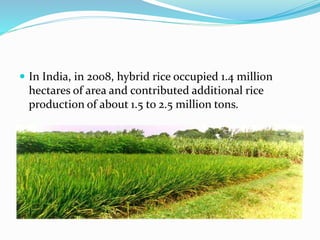
 In India, in 2008, hybrid rice occupied 1.4 million
hectares of area and contributed additional rice
production of about 1.5 to 2.5 million tons.
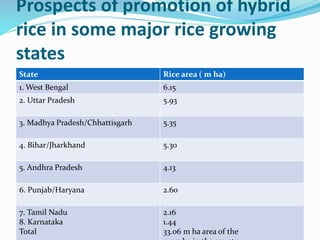
Prospects of promotion of hybrid
rice in some major rice growing
states
State Rice area ( m ha)
1. West Bengal 6.15
2. Uttar Pradesh 5.93
3. Madhya Pradesh/Chhattisgarh 5.35
4. Bihar/Jharkhand 5.30
5. Andhra Pradesh 4.13
6. Punjab/Haryana 2.60
7. Tamil Nadu
8. Karnataka
Total
2.16
1.44
33.06 m ha area of the
Hybrid Rice Cultivation
 Seed rate - 20 kg per hectare
 Nursery should be sown in the first week of June for
kharif crop and in the second week of December for
Rabi crop.
 About 600-1000 sq m are required for raising nursery
to transplant in one hactare field
 Seeding density : sparse sowing @ 15-20g/sq m to
ensure healthy seedling with 2-3 tillers in 20-25 days,
preferably in wet nursery.
 Spacing (cm) : 20 x 10 (50 hills/m2) or 25 x 10 (40
hills/m2) according to soil fertility
 Seedlings/ hill : One (along with tillers if already
produced)
 Fertilizer : 150 – 170 kg N/ha, (in three split doses )
 60 kg P2O5/ha
 60kg K2O/ha/ha (may be given in two split doses)
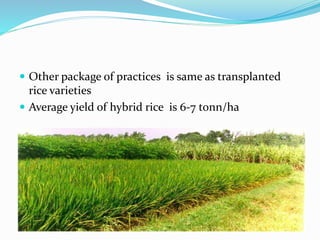
 Other package of practices is same as transplanted
rice varieties
 Average yield of hybrid rice is 6-7 tonn/ha
Basmati
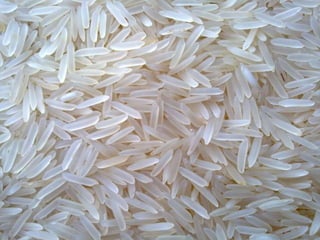
 basmati is a variety of long, slender-grained
aromatic rice which is traditionally from theIndian
subcontinent.
 Basmati rice has a typical flavour caused by the aroma
compound 2-acetyl-1-pyrroline
 Basmati grains contain about 0.09 ppm of this aromatic
chemical compound naturally.
 India exported 65 percent of the overseas basmati rice
market.
 Basmati rice is known as king of rice and is priced for its
characteristic long-grain, subtle aroma and delicious taste.
National scenario
 India is the largest producer and exporter of basmati
rice in the world. The annual production in the
country hovers at around 10-15 lakh tons a year, of
which around two-thirds is exported. The remaining is
consumed, within the country.
 During 2006-07, the country officially exported 10.41
lakh tonnes of basmati rice, valued at Rs 2,778.31 crore,
with the corresponding figures for non-basmati being
37.05 lakh tonnes and Rs 4,257.88 crore.
 Punjab, Haryana and Uttar Pradesh himachal are
traditional basmati rice growing areas .
 Varieties: Basmati 370 and Taraori Basmati are the
widely cultivated varieties of export quality for
decades. Breeding efforts have resulted in
development of the world’s first high yielding, semi
dwarf Basmati variety - Pusa Basmati I,
 And other important varieties are: basmati 217,
ranbir basmati , punjab basmati 1 , pusa sugandh
2 , pusa sugandh 5.
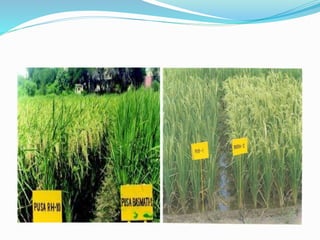
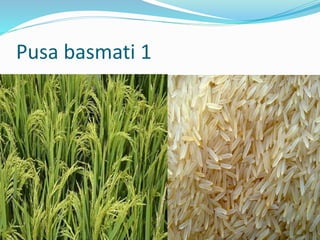
Pusa basmati 1
Golden rice
 Golden rice is a variety of rice (Oryza sativa)
produced through genetic
engineering to biosynthesize beta-carotene, a
precursor ofvitamin A, in the edible parts of rice.[1] It is
intended to produce a fortified food to be grown and
consumed in areas with a shortage of dietary vitamin A
 Golden rice differs from its parental strain by the
addition of three beta-carotene biosynthesis genes.
 In 2005, Golden Rice 2 was announced, which
produces up to 23 times more beta-carotene than the
original golden rice. To receive the
USDA's Recommended Dietary Allowance (RDA), it is
estimated that 144 g of the high-yielding strain would
have to be eaten. Bioavailability of the carotene from
golden rice has been confirmed and found to be an
effective source of vitamin A for humans
Hybrid rice presentation

Hybrid rice presentation

  • 1.
  • 2.
    What is hybridrice  the first generation progeny (F1) obtained by crossing two genetically different varieties (parents) of rice is called ‘Hybrid’.  Since rice is self pollinated, cytoplasmic male sterile (CMS) parent is used as female parent, which is normally called ‘A’ line. The fertility restoring line which is called ‘pollinator’ to the female parent is known as male parent. It is generally referred to as ‘R’ line, and is used for hybrid seed production. The hybrid combines the desirable characters from CMS line and R line.
  • 5.
  • 6.
    History of hybridrice  The Chinese scientists were the first in the world to develop commercial hybrids in rice and the first hybrid was released in 1976.  Prof. Yuan longping considered as father of hybrid rice  China covers 53% of its rice area and about 58% of production under hybrid rice.  Chinese researchers are now developing single breeding step lines (known as two line hybrid).  These are called as super rice hybrid and yield on average 10% higher than three-line hybrids.
  • 7.
    Optimum package forhybrid seed productionSeed rate A line or female parent : 15 kg/ha R line or male parent : 5kg/ha Row ratio 2B: 8A for CMS multiplication 2R:10A for hybrid seed production No. Of seedlings/hill 2 seedlings/hill for female parent 3seedlings/hill for male parent. Spacing Male : male = 30cm Male : female =20cm Female : female =15cm Plant :plant = 15cm or 10 cm GA3 application 60-90 g/ha in 500 litres water at 5-10 % heading in 2 split doses on consecutive days. Isolation distance 3-4m Roguing At vegetative phase At flowering
  • 8.
    Artificially created physicalbarrier for isolation
  • 9.
    Hybrid Rice SeedProduction In Asia In United Sates
  • 10.
    History of hybridrice in India  Hybrid rice in India were initiated in 1989, when Indian Council of Agricultural Research (ICAR) launched a special goal oriented and time bound project on ‘Promotion of Research and Development Efforts on Hybrids in Selected Crops’. For rice, National Network Project involving 12 centres was initiated. The technical support was received from the International Rice Research Institute (IRRI), Philippines and Food and Agriculture Organization (FAO), Rome and financial support from United Nations Development Programme (UNDP), Mahyco Research Foundation, World Bank funded National Agricultural Technology Project (NATP) and IRRI/ADB projects on hybrid rice.
  • 11.
     In India,in 2008, hybrid rice occupied 1.4 million hectares of area and contributed additional rice production of about 1.5 to 2.5 million tons.
  • 12.
    Prospects of promotionof hybrid rice in some major rice growing states State Rice area ( m ha) 1. West Bengal 6.15 2. Uttar Pradesh 5.93 3. Madhya Pradesh/Chhattisgarh 5.35 4. Bihar/Jharkhand 5.30 5. Andhra Pradesh 4.13 6. Punjab/Haryana 2.60 7. Tamil Nadu 8. Karnataka Total 2.16 1.44 33.06 m ha area of the
  • 21.
    Hybrid Rice Cultivation Seed rate - 20 kg per hectare  Nursery should be sown in the first week of June for kharif crop and in the second week of December for Rabi crop.  About 600-1000 sq m are required for raising nursery to transplant in one hactare field  Seeding density : sparse sowing @ 15-20g/sq m to ensure healthy seedling with 2-3 tillers in 20-25 days, preferably in wet nursery.
  • 22.
     Spacing (cm): 20 x 10 (50 hills/m2) or 25 x 10 (40 hills/m2) according to soil fertility  Seedlings/ hill : One (along with tillers if already produced)  Fertilizer : 150 – 170 kg N/ha, (in three split doses )  60 kg P2O5/ha  60kg K2O/ha/ha (may be given in two split doses)
  • 23.
     Other packageof practices is same as transplanted rice varieties  Average yield of hybrid rice is 6-7 tonn/ha
  • 24.
    Basmati  basmati isa variety of long, slender-grained aromatic rice which is traditionally from theIndian subcontinent.  Basmati rice has a typical flavour caused by the aroma compound 2-acetyl-1-pyrroline  Basmati grains contain about 0.09 ppm of this aromatic chemical compound naturally.  India exported 65 percent of the overseas basmati rice market.  Basmati rice is known as king of rice and is priced for its characteristic long-grain, subtle aroma and delicious taste.
  • 27.
    National scenario  Indiais the largest producer and exporter of basmati rice in the world. The annual production in the country hovers at around 10-15 lakh tons a year, of which around two-thirds is exported. The remaining is consumed, within the country.  During 2006-07, the country officially exported 10.41 lakh tonnes of basmati rice, valued at Rs 2,778.31 crore, with the corresponding figures for non-basmati being 37.05 lakh tonnes and Rs 4,257.88 crore.
  • 28.
     Punjab, Haryanaand Uttar Pradesh himachal are traditional basmati rice growing areas .  Varieties: Basmati 370 and Taraori Basmati are the widely cultivated varieties of export quality for decades. Breeding efforts have resulted in development of the world’s first high yielding, semi dwarf Basmati variety - Pusa Basmati I,  And other important varieties are: basmati 217, ranbir basmati , punjab basmati 1 , pusa sugandh 2 , pusa sugandh 5.
  • 29.
  • 30.
    Golden rice  Goldenrice is a variety of rice (Oryza sativa) produced through genetic engineering to biosynthesize beta-carotene, a precursor ofvitamin A, in the edible parts of rice.[1] It is intended to produce a fortified food to be grown and consumed in areas with a shortage of dietary vitamin A  Golden rice differs from its parental strain by the addition of three beta-carotene biosynthesis genes.
  • 31.
     In 2005,Golden Rice 2 was announced, which produces up to 23 times more beta-carotene than the original golden rice. To receive the USDA's Recommended Dietary Allowance (RDA), it is estimated that 144 g of the high-yielding strain would have to be eaten. Bioavailability of the carotene from golden rice has been confirmed and found to be an effective source of vitamin A for humans