Plant Roots Structure and Function Author: Mike Dana Revised by: Geonyzl Alviola Reference:http://www.hort.purdue.edu/hort/courses/HORT101Spring/Roots/index.htm
Objectives of today’s  lecture: Learn about the functions of the root system and its importance to plant growth and development Learn the structures that allow the root to perform these functions Learn some of the modifications that occur in roots
Functions of the Root anchorage to the soil  (or other substrate) absorption of water acquisition of mineral nutrients a tissue for energy (food) storage for propagation and dispersal of some species
Functions of the Root Root morphology is highly variable most dicotyledonous plants (those with 2 seed leaves) have a prominent primary root monocots (with one cotyledon or seed leaf) typically have a more diffuse fibrous root system
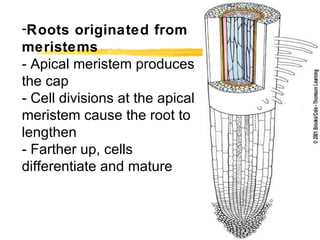
Roots originated from meristems - Apical meristem produces the cap  - Cell divisions at the apical meristem cause the root to lengthen - Farther up, cells differentiate and mature
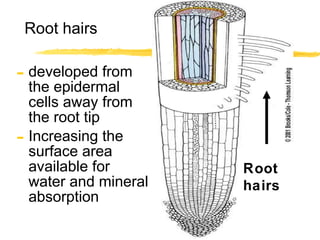
developed from the epidermal cells away from the root tip Increasing the surface area available for  water and mineral absorption Root hairs Root hairs
Root hairs contribute the largest fraction of root surface area In the winter rye example given earlier, more than 4,000 sq. ft. of the 6,500 sq. ft. of root surface area comes from root hairs Epidermis functions in the uptake of water and minerals Large surface area facilitates uptake
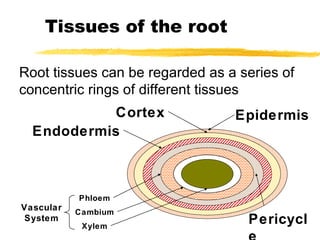
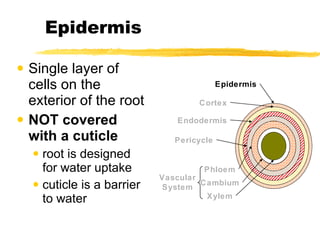
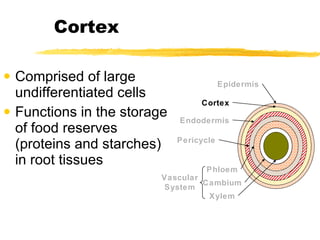
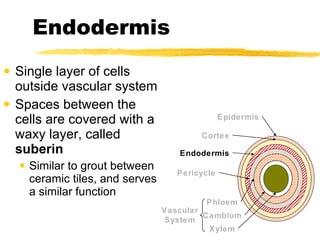
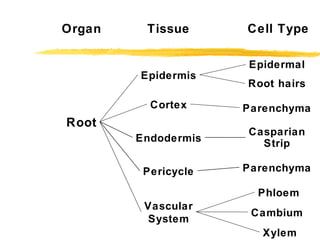
Tissues of the root Epidermis Cortex Endodermis Pericycle Vascular System Phloem Cambium Xylem Root tissues can be regarded as a series of concentric rings of different tissues
Epidermis Single layer of cells on the exterior of the root NOT covered with a cuticle root is designed for water uptake cuticle is a barrier to water Epidermis Cortex Endodermis Pericycle Vascular System Phloem Cambium Xylem
Comprised of large undifferentiated cells Functions in the storage of food reserves (proteins and starches) in root tissues Cortex Epidermis Cortex Endodermis Pericycle Vascular System Phloem Cambium Xylem
Endodermis Single layer of cells outside vascular system Spaces between the cells are covered with a waxy layer, called  suberin Similar to grout between ceramic tiles, and serves a similar function Epidermis Cortex Endodermis Pericycle Vascular System Phloem Cambium Xylem
Endodermis Blocks passage of water and dissolved nutrients into the vascular system Water, nutrients and other solutes must enter a cell, cannot go round the endodermis Endodermis functions to  regulate the uptake of water and nutrients into the plant
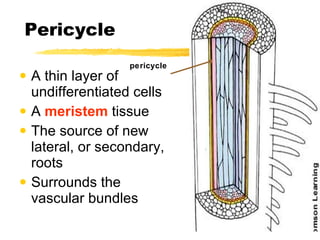
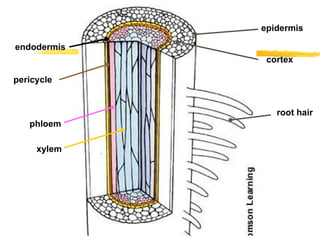
Pericycle A thin layer of undifferentiated cells A  meristem  tissue The source of new lateral, or secondary, roots Surrounds the vascular bundles pericycle
pericycle phloem xylem root hair endodermis epidermis cortex
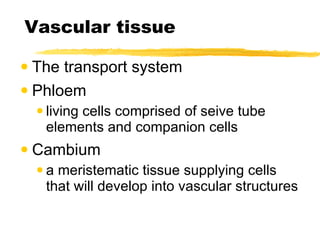
Vascular tissue The transport system Phloem living cells comprised of seive tube elements and companion cells Cambium a meristematic tissue supplying cells that will develop into vascular structures
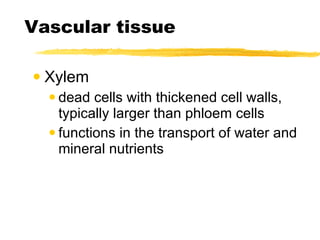
Vascular tissue Xylem dead cells with thickened cell walls, typically larger than phloem cells functions in the transport of water and mineral nutrients
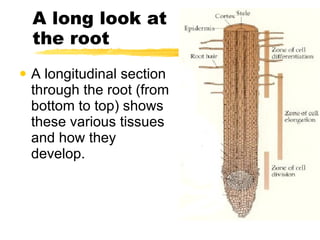
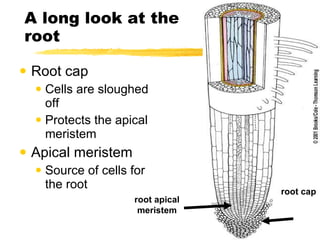
A long look at the root A longitudinal section through the root (from bottom to top) shows these various tissues and how they develop.
A long look at the root Elongation zone Where cells elongate and differentiate Pushes the root tip through the soil Maturation zone Cells develop their final form Root hairs form, xylem cells thicken and die
 
A long look at the root Root cap Cells are sloughed off Protects the apical meristem Apical meristem Source of cells for the root root apical meristem root cap
Organ Tissue Cell Type Root Epidermis Vascular System Cortex Parenchyma Endodermis Pericycle Casparian Strip Parenchyma Epidermal Root hairs Phloem Cambium Xylem
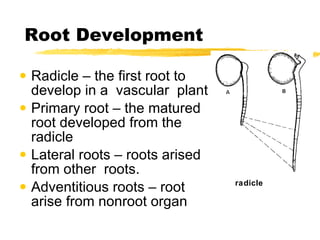
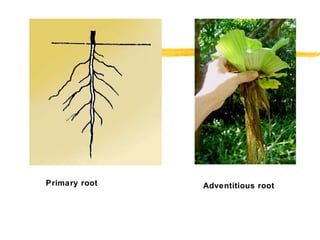
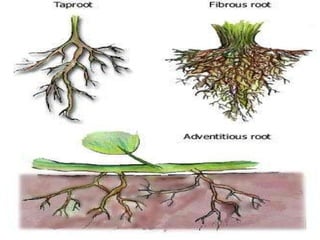
Root Development Radicle – the first root to develop in a  vascular  plant Primary root – the matured root developed from the  radicle Lateral roots – roots arised from other  roots. Adventitious roots – root arise from nonroot organ radicle
Primary root Adventitious root
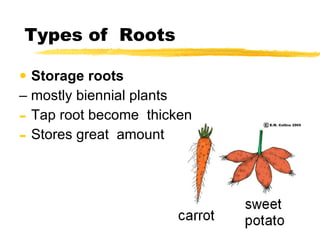
Root modifications The organ that is consumed in many vegetable crops, such as carrot and sweet potato, is a modified root that serves as a storage tissue  Other modifications for support
Modifications of the root Taproot -  if the  primary root is  dominant Fibrous root system – if the  primary root withers and more are adventitous roots.
 
Types of  Roots Storage roots   –  mostly biennial plants Tap root become  thicken  Stores great  amount of  starch
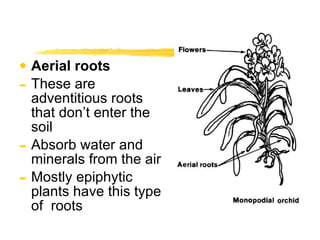
Aerial roots These are  adventitious roots that don’t enter the soil Absorb water and minerals from the air Mostly epiphytic plants have this type of  roots
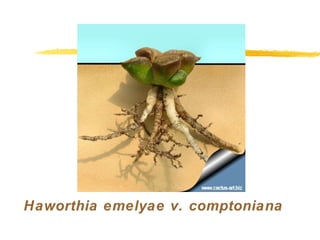
Contractile roots roots  that actually contract  vertically To pull the  stock further into the soil. Contractile roots are usually broad,  fleshy , vertical, tapering, wrinkled looking and very distinct of the rather  cylindrical  fine  absorbent roots  and are capable of incredible effort.
Haworthia   emelyae  v.  comptoniana
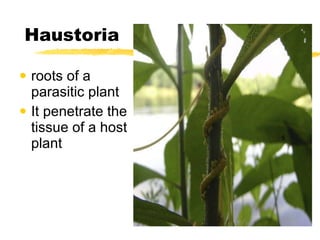
Haustoria roots of a parasitic plant It penetrate the  tissue of a host plant
Prop roots Grow from the base of the stem Serve as to support of the plant with weak stems
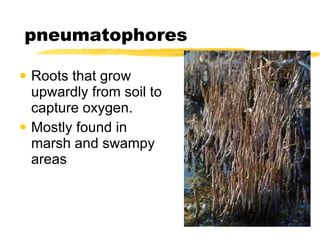
pneumatophores Roots that grow upwardly from soil to capture oxygen. Mostly found in marsh and swampy areas
Buttress roots large  roots  on all sides of a tall or shallowly rooted  tree .  Provide a mechanical support to a tree
The End

Roots

  • 1.
    Plant Roots Structureand Function Author: Mike Dana Revised by: Geonyzl Alviola Reference:http://www.hort.purdue.edu/hort/courses/HORT101Spring/Roots/index.htm
  • 2.
    Objectives of today’s lecture: Learn about the functions of the root system and its importance to plant growth and development Learn the structures that allow the root to perform these functions Learn some of the modifications that occur in roots
  • 3.
    Functions of theRoot anchorage to the soil (or other substrate) absorption of water acquisition of mineral nutrients a tissue for energy (food) storage for propagation and dispersal of some species
  • 4.
    Functions of theRoot Root morphology is highly variable most dicotyledonous plants (those with 2 seed leaves) have a prominent primary root monocots (with one cotyledon or seed leaf) typically have a more diffuse fibrous root system
  • 5.
    Roots originated frommeristems - Apical meristem produces the cap - Cell divisions at the apical meristem cause the root to lengthen - Farther up, cells differentiate and mature
  • 6.
    developed from theepidermal cells away from the root tip Increasing the surface area available for water and mineral absorption Root hairs Root hairs
  • 7.
    Root hairs contributethe largest fraction of root surface area In the winter rye example given earlier, more than 4,000 sq. ft. of the 6,500 sq. ft. of root surface area comes from root hairs Epidermis functions in the uptake of water and minerals Large surface area facilitates uptake
  • 8.
    Tissues of theroot Epidermis Cortex Endodermis Pericycle Vascular System Phloem Cambium Xylem Root tissues can be regarded as a series of concentric rings of different tissues
  • 9.
    Epidermis Single layerof cells on the exterior of the root NOT covered with a cuticle root is designed for water uptake cuticle is a barrier to water Epidermis Cortex Endodermis Pericycle Vascular System Phloem Cambium Xylem
  • 10.
    Comprised of largeundifferentiated cells Functions in the storage of food reserves (proteins and starches) in root tissues Cortex Epidermis Cortex Endodermis Pericycle Vascular System Phloem Cambium Xylem
  • 11.
    Endodermis Single layerof cells outside vascular system Spaces between the cells are covered with a waxy layer, called suberin Similar to grout between ceramic tiles, and serves a similar function Epidermis Cortex Endodermis Pericycle Vascular System Phloem Cambium Xylem
  • 12.
    Endodermis Blocks passageof water and dissolved nutrients into the vascular system Water, nutrients and other solutes must enter a cell, cannot go round the endodermis Endodermis functions to regulate the uptake of water and nutrients into the plant
  • 13.
    Pericycle A thinlayer of undifferentiated cells A meristem tissue The source of new lateral, or secondary, roots Surrounds the vascular bundles pericycle
  • 14.
    pericycle phloem xylemroot hair endodermis epidermis cortex
  • 15.
    Vascular tissue Thetransport system Phloem living cells comprised of seive tube elements and companion cells Cambium a meristematic tissue supplying cells that will develop into vascular structures
  • 16.
    Vascular tissue Xylemdead cells with thickened cell walls, typically larger than phloem cells functions in the transport of water and mineral nutrients
  • 17.
    A long lookat the root A longitudinal section through the root (from bottom to top) shows these various tissues and how they develop.
  • 18.
    A long lookat the root Elongation zone Where cells elongate and differentiate Pushes the root tip through the soil Maturation zone Cells develop their final form Root hairs form, xylem cells thicken and die
  • 19.
  • 20.
    A long lookat the root Root cap Cells are sloughed off Protects the apical meristem Apical meristem Source of cells for the root root apical meristem root cap
  • 21.
    Organ Tissue CellType Root Epidermis Vascular System Cortex Parenchyma Endodermis Pericycle Casparian Strip Parenchyma Epidermal Root hairs Phloem Cambium Xylem
  • 22.
    Root Development Radicle– the first root to develop in a vascular plant Primary root – the matured root developed from the radicle Lateral roots – roots arised from other roots. Adventitious roots – root arise from nonroot organ radicle
  • 23.
  • 24.
    Root modifications Theorgan that is consumed in many vegetable crops, such as carrot and sweet potato, is a modified root that serves as a storage tissue Other modifications for support
  • 25.
    Modifications of theroot Taproot - if the primary root is dominant Fibrous root system – if the primary root withers and more are adventitous roots.
  • 26.
  • 27.
    Types of Roots Storage roots – mostly biennial plants Tap root become thicken Stores great amount of starch
  • 28.
    Aerial roots Theseare adventitious roots that don’t enter the soil Absorb water and minerals from the air Mostly epiphytic plants have this type of roots
  • 29.
    Contractile roots roots that actually contract vertically To pull the stock further into the soil. Contractile roots are usually broad, fleshy , vertical, tapering, wrinkled looking and very distinct of the rather cylindrical fine absorbent roots and are capable of incredible effort.
  • 30.
    Haworthia emelyae v. comptoniana
  • 31.
    Haustoria roots ofa parasitic plant It penetrate the tissue of a host plant
  • 32.
    Prop roots Growfrom the base of the stem Serve as to support of the plant with weak stems
  • 33.
    pneumatophores Roots thatgrow upwardly from soil to capture oxygen. Mostly found in marsh and swampy areas
  • 34.
    Buttress roots large roots on all sides of a tall or shallowly rooted tree . Provide a mechanical support to a tree
  • 35.