97
9.1 Angiosperms :
Our earth has a vast diversity of
plants. The flowering plants dominate the
world of plants as they are well adapted to the
environmental conditions. These plants show
considerable variation in their general external
and internal characters with respect to their
habitat. Such variations help the plant body to
carry out different functions. You have studied
a broad classification of kingdom Plantae.
Angiosperms are one of flowering plants from
phanerogams.
Angiosperms can be classified into
different types on the basis of habitat and it can
be represented as follows :
9. Morphology of Flowering Plants
			
You have learnt the diversity and
structureofAngiospermicplantin6th
standared.
Can you recall? 9.2 Morphology :
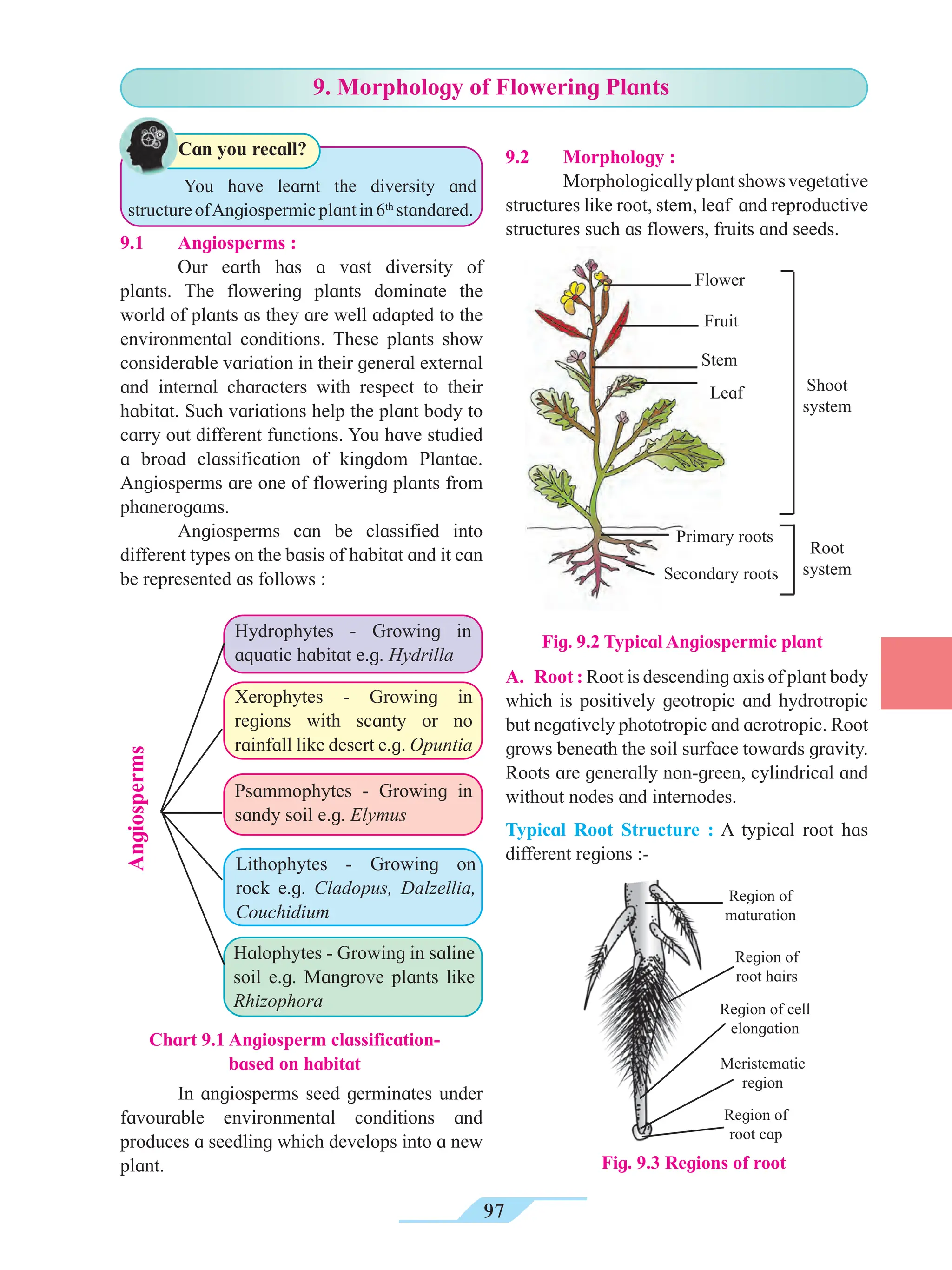
Morphologicallyplantshowsvegetative
structures like root, stem, leaf and reproductive
structures such as flowers, fruits and seeds.
Hydrophytes - Growing in
aquatic habitat e.g. Hydrilla
Xerophytes - Growing in
regions with scanty or no
rainfall like desert e.g. Opuntia
Psammophytes - Growing in
sandy soil e.g. Elymus
Lithophytes - Growing on
rock e.g. Cladopus, Dalzellia,
Couchidium
Halophytes - Growing in saline
soil e.g. Mangrove plants like
Rhizophora
Angiosperms
Chart 9.1 Angiosperm classification-
based on habitat
Fig. 9.2 Typical Angiospermic plant
A. Root : Root is descending axis of plant body
which is positively geotropic and hydrotropic
but negatively phototropic and aerotropic. Root
grows beneath the soil surface towards gravity.
Roots are generally non-green, cylindrical and
without nodes and internodes.
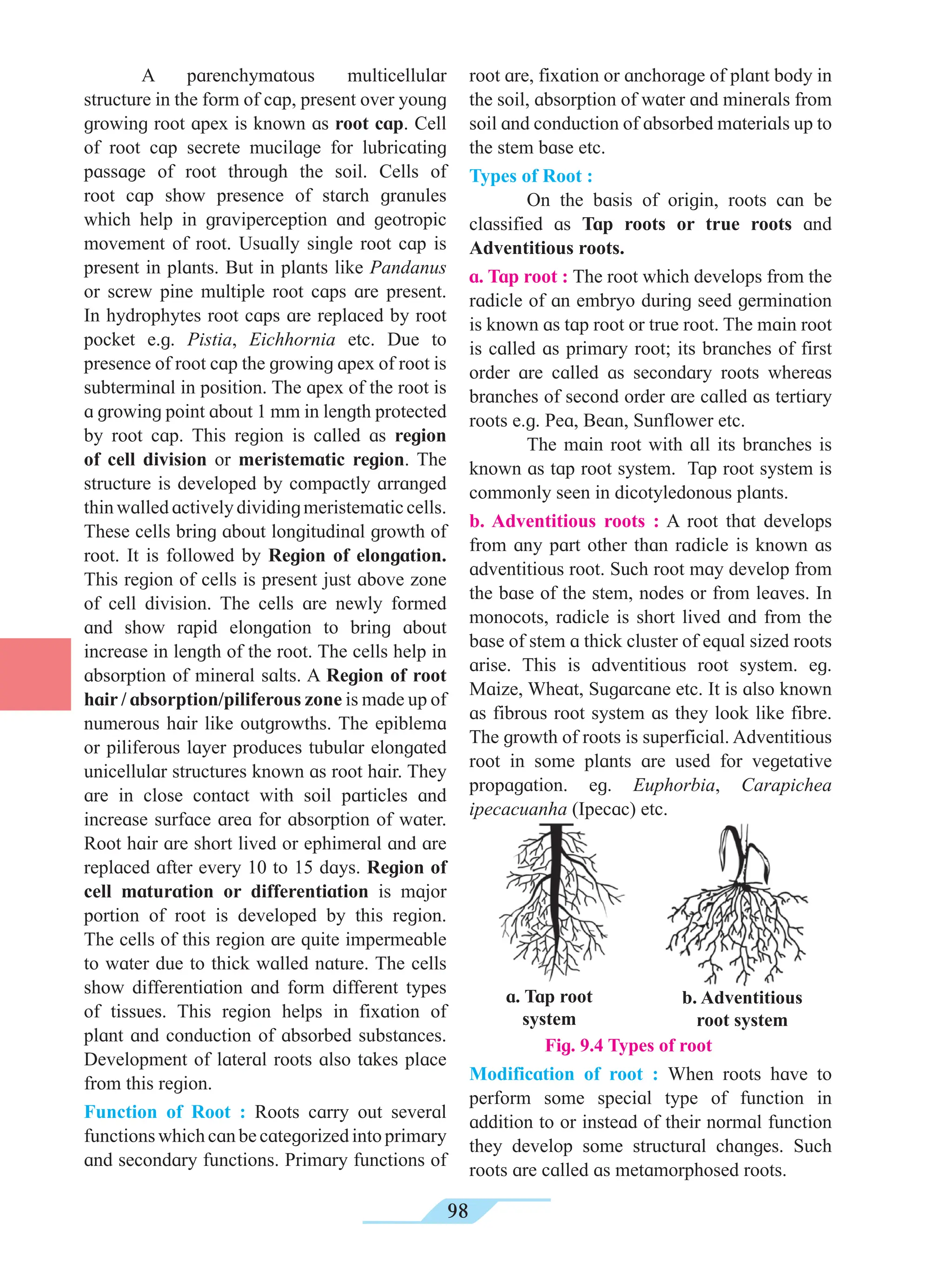
Typical Root Structure : A typical root has
different regions :-
Flower
Fruit
Stem
Leaf
Primary roots
Secondary roots
Shoot
system
Root
system
In angiosperms seed germinates under
favourable environmental conditions and
produces a seedling which develops into a new
plant. Fig. 9.3 Regions of root
Region of
maturation
Region of
root hairs
Region of cell
elongation
Meristematic
region
Region of
root cap
98
root are, fixation or anchorage of plant body in
the soil, absorption of water and minerals from
soil and conduction of absorbed materials up to
the stem base etc.
Types of Root :
On the basis of origin, roots can be
classified as Tap roots or true roots and
Adventitious roots.
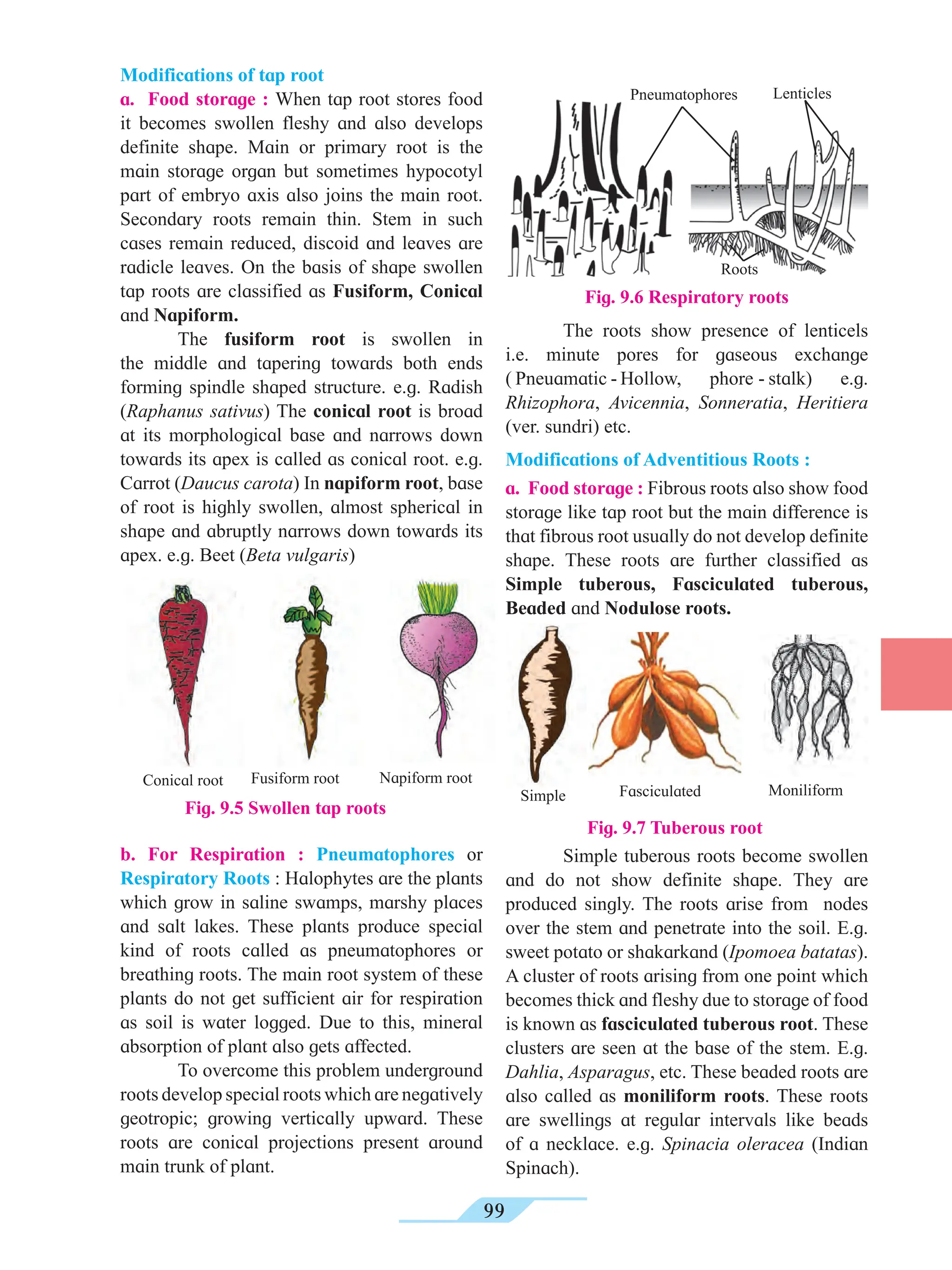
a. Tap root : The root which develops from the
radicle of an embryo during seed germination
is known as tap root or true root. The main root
is called as primary root; its branches of first
order are called as secondary roots whereas
branches of second order are called as tertiary
roots e.g. Pea, Bean, Sunflower etc.
The main root with all its branches is
known as tap root system. Tap root system is
commonly seen in dicotyledonous plants.
b. Adventitious roots : A root that develops
from any part other than radicle is known as
adventitious root. Such root may develop from
the base of the stem, nodes or from leaves. In
monocots, radicle is short lived and from the
base of stem a thick cluster of equal sized roots
arise. This is adventitious root system. eg.
Maize, Wheat, Sugarcane etc. It is also known
as fibrous root system as they look like fibre.
The growth of roots is superficial. Adventitious
root in some plants are used for vegetative
propagation. eg. Euphorbia, Carapichea
ipecacuanha (Ipecac) etc.
A parenchymatous multicellular
structure in the form of cap, present over young
growing root apex is known as root cap. Cell
of root cap secrete mucilage for lubricating
passage of root through the soil. Cells of
root cap show presence of starch granules
which help in graviperception and geotropic
movement of root. Usually single root cap is
present in plants. But in plants like Pandanus
or screw pine multiple root caps are present.
In hydrophytes root caps are replaced by root
pocket e.g. Pistia, Eichhornia etc. Due to
presence of root cap the growing apex of root is
subterminal in position. The apex of the root is
a growing point about 1 mm in length protected
by root cap. This region is called as region
of cell division or meristematic region. The
structure is developed by compactly arranged
thin walled actively dividing meristematic cells.
These cells bring about longitudinal growth of
root. It is followed by Region of elongation.
This region of cells is present just above zone
of cell division. The cells are newly formed
and show rapid elongation to bring about
increase in length of the root. The cells help in
absorption of mineral salts. A Region of root
hair / absorption/piliferous zone is made up of
numerous hair like outgrowths. The epiblema
or piliferous layer produces tubular elongated
unicellular structures known as root hair. They
are in close contact with soil particles and
increase surface area for absorption of water.
Root hair are short lived or ephimeral and are
replaced after every 10 to 15 days. Region of
cell maturation or differentiation is major
portion of root is developed by this region.
The cells of this region are quite impermeable
to water due to thick walled nature. The cells
show differentiation and form different types
of tissues. This region helps in fixation of
plant and conduction of absorbed substances.
Development of lateral roots also takes place
from this region.
Function of Root : Roots carry out several
functions which can be categorizedinto primary
and secondary functions. Primary functions of
Modification of root : When roots have to
perform some special type of function in
addition to or instead of their normal function
they develop some structural changes. Such
roots are called as metamorphosed roots.
Fig. 9.4 Types of root
a. Tap root
system
b. Adventitious
root system
99
Modifications of tap root
a. Food storage : When tap root stores food
it becomes swollen fleshy and also develops
definite shape. Main or primary root is the
main storage organ but sometimes hypocotyl
part of embryo axis also joins the main root.
Secondary roots remain thin. Stem in such
cases remain reduced, discoid and leaves are
radicle leaves. On the basis of shape swollen
tap roots are classified as Fusiform, Conical
and Napiform.
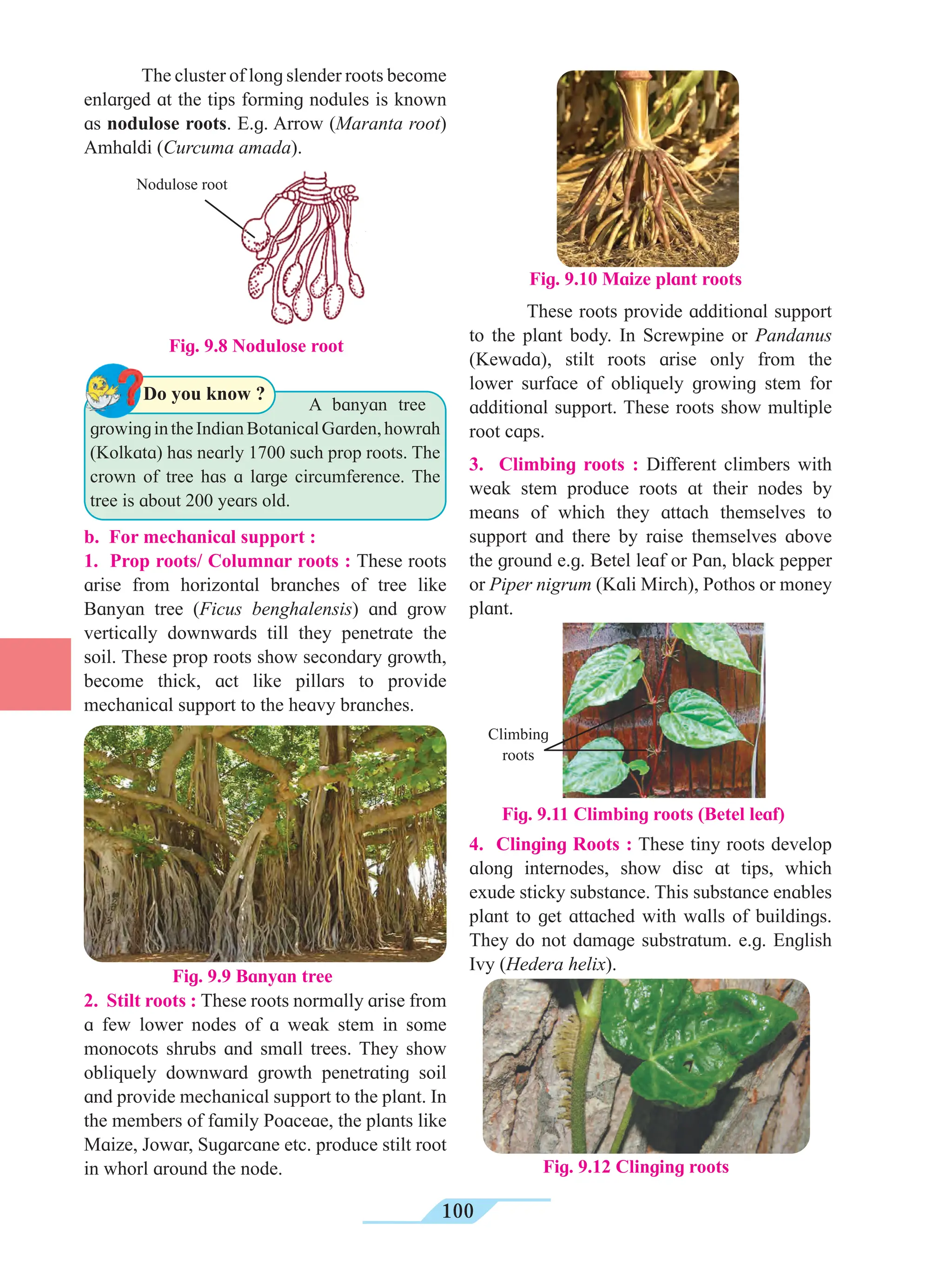
The fusiform root is swollen in
the middle and tapering towards both ends
forming spindle shaped structure. e.g. Radish
(Raphanus sativus) The conical root is broad
at its morphological base and narrows down
towards its apex is called as conical root. e.g.
Carrot (Daucus carota) In napiform root, base
of root is highly swollen, almost spherical in
shape and abruptly narrows down towards its
apex. e.g. Beet (Beta vulgaris)
The roots show presence of lenticels
i.e. minute pores for gaseous exchange
( Pneuamatic - Hollow, phore - stalk) e.g.
Rhizophora, Avicennia, Sonneratia, Heritiera
(ver. sundri) etc.
Modifications of Adventitious Roots :
a. Food storage : Fibrous roots also show food
storage like tap root but the main difference is
that fibrous root usually do not develop definite
shape. These roots are further classified as
Simple tuberous, Fasciculated tuberous,
Beaded and Nodulose roots.
b. For Respiration : Pneumatophores or
Respiratory Roots : Halophytes are the plants
which grow in saline swamps, marshy places
and salt lakes. These plants produce special
kind of roots called as pneumatophores or
breathing roots. The main root system of these
plants do not get sufficient air for respiration
as soil is water logged. Due to this, mineral
absorption of plant also gets affected.
To overcome this problem underground
roots develop special roots which are negatively
geotropic; growing vertically upward. These
roots are conical projections present around
main trunk of plant.
Fig. 9.7 Tuberous root
Simple tuberous roots become swollen
and do not show definite shape. They are
produced singly. The roots arise from nodes
over the stem and penetrate into the soil. E.g.
sweet potato or shakarkand (Ipomoea batatas).
A cluster of roots arising from one point which
becomes thick and fleshy due to storage of food
is known as fasciculated tuberous root. These
clusters are seen at the base of the stem. E.g.
Dahlia, Asparagus, etc. These beaded roots are
also called as moniliform roots. These roots
are swellings at regular intervals like beads
of a necklace. e.g. Spinacia oleracea (Indian
Spinach).
Fig. 9.5 Swollen tap roots
Napiform root
Fusiform root
Conical root
Simple Fasciculated Moniliform
Fig. 9.6 Respiratory roots
Pneumatophores Lenticles
Roots
100
Fig. 9.8 Nodulose root
The cluster of long slender roots become
enlarged at the tips forming nodules is known
as nodulose roots. E.g. Arrow (Maranta root)
Amhaldi (Curcuma amada).
			 A banyan tree
growingintheIndianBotanicalGarden,howrah
(Kolkata) has nearly 1700 such prop roots. The
crown of tree has a large circumference. The
tree is about 200 years old.
Do you know ?
These roots provide additional support
to the plant body. In Screwpine or Pandanus
(Kewada), stilt roots arise only from the
lower surface of obliquely growing stem for
additional support. These roots show multiple
root caps.
3. Climbing roots : Different climbers with
weak stem produce roots at their nodes by
means of which they attach themselves to
support and there by raise themselves above
the ground e.g. Betel leaf or Pan, black pepper
or Piper nigrum (Kali Mirch), Pothos or money
plant.
b. For mechanical support :
1. Prop roots/ Columnar roots : These roots
arise from horizontal branches of tree like
Banyan tree (Ficus benghalensis) and grow
vertically downwards till they penetrate the
soil. These prop roots show secondary growth,
become thick, act like pillars to provide
mechanical support to the heavy branches.
Fig. 9.9 Banyan tree
2. Stilt roots : These roots normally arise from
a few lower nodes of a weak stem in some
monocots shrubs and small trees. They show
obliquely downward growth penetrating soil
and provide mechanical support to the plant. In
the members of family Poaceae, the plants like
Maize, Jowar, Sugarcane etc. produce stilt root
in whorl around the node.
Fig. 9.10 Maize plant roots
Fig. 9.11 Climbing roots (Betel leaf)
4. Clinging Roots : These tiny roots develop
along internodes, show disc at tips, which
exude sticky substance. This substance enables
plant to get attached with walls of buildings.
They do not damage substratum. e.g. English
Ivy (Hedera helix).
Fig. 9.12 Clinging roots
Nodulose root
Climbing
roots
101
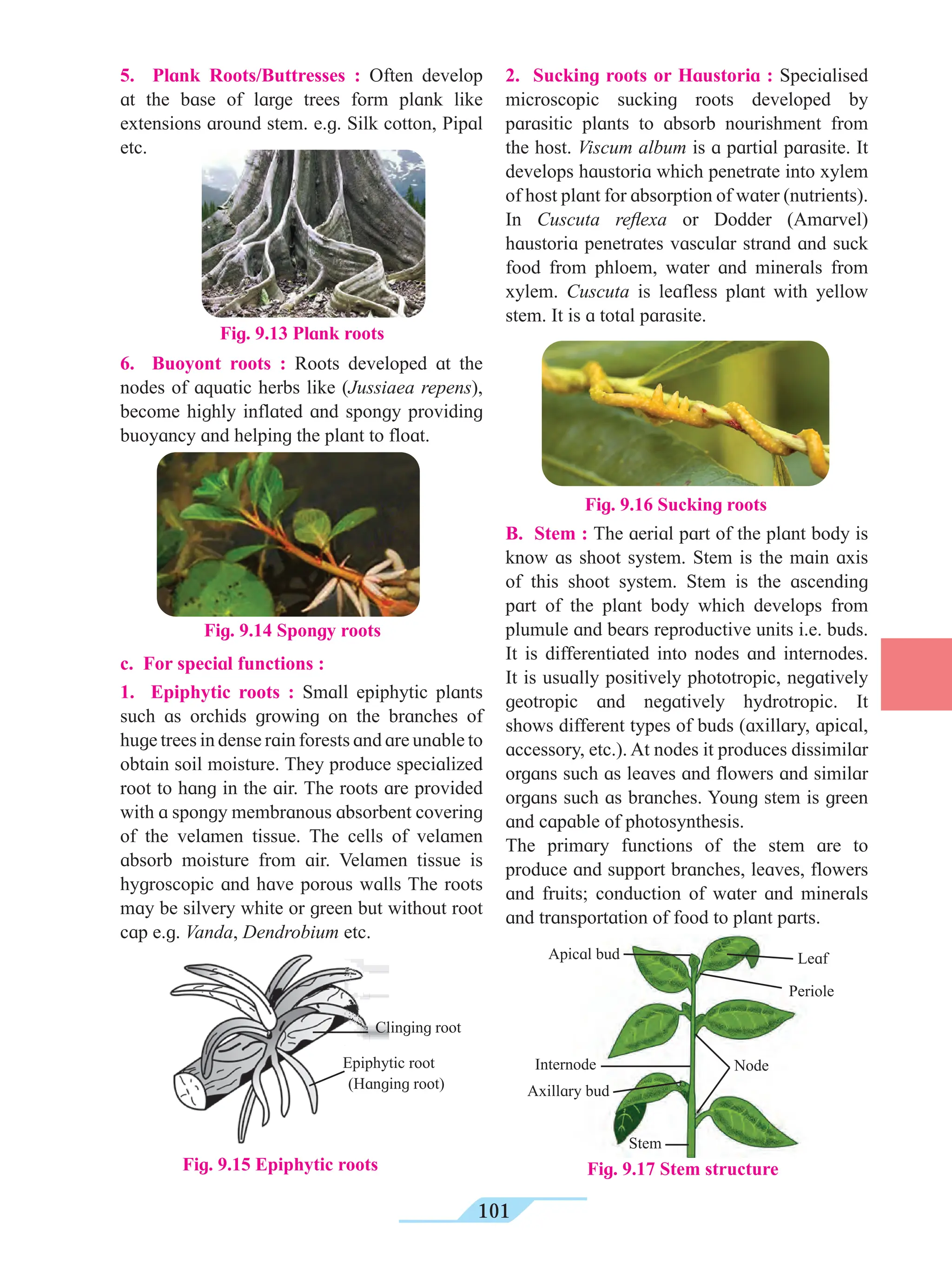
5. Plank Roots/Buttresses : Often develop
at the base of large trees form plank like
extensions around stem. e.g. Silk cotton, Pipal
etc.
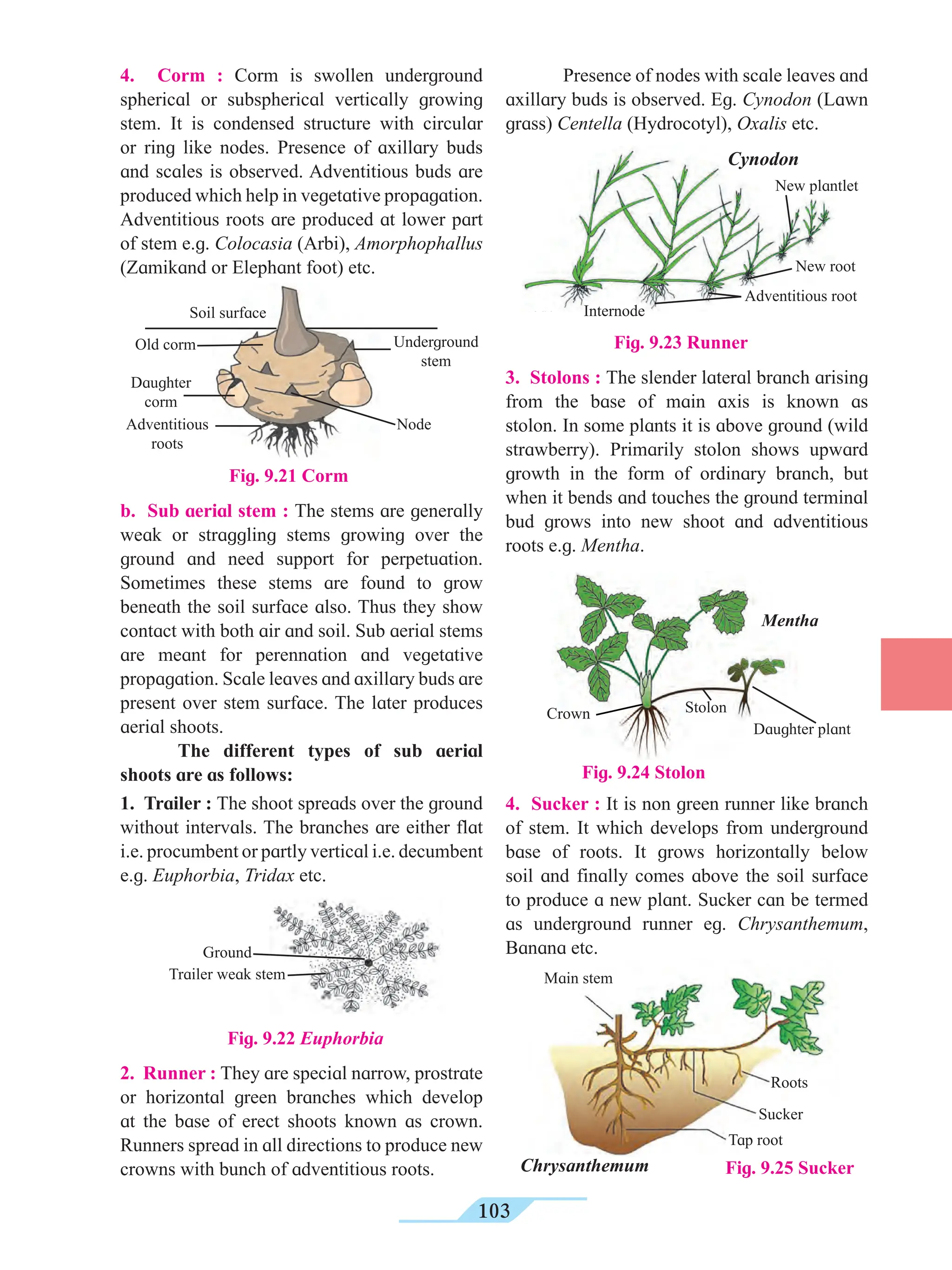
2. Sucking roots or Haustoria : Specialised
microscopic sucking roots developed by
parasitic plants to absorb nourishment from
the host. Viscum album is a partial parasite. It
develops haustoria which penetrate into xylem
of host plant for absorption of water (nutrients).
In Cuscuta reflexa or Dodder (Amarvel)
haustoria penetrates vascular strand and suck
food from phloem, water and minerals from
xylem. Cuscuta is leafless plant with yellow
stem. It is a total parasite.
Fig. 9.13 Plank roots
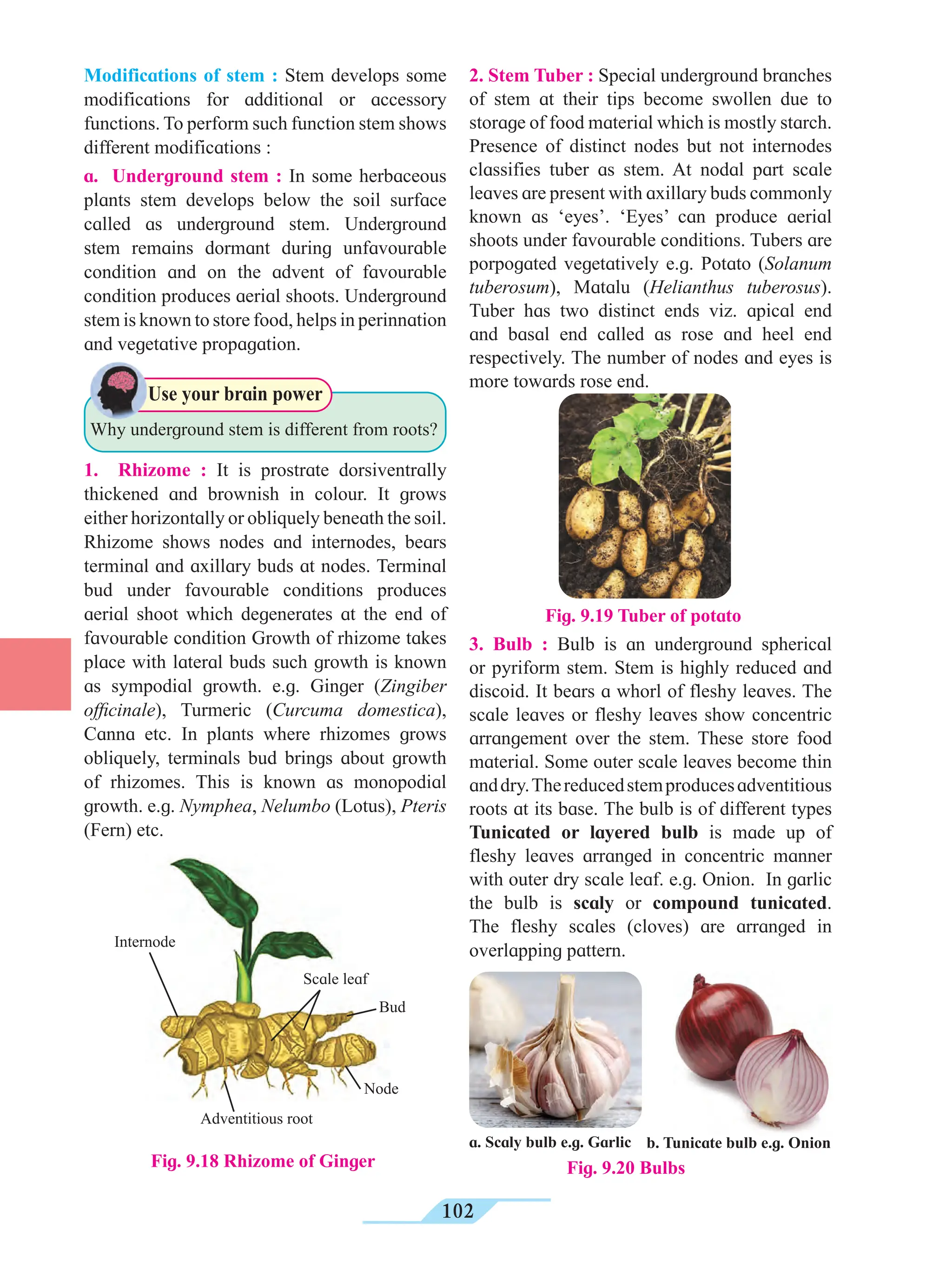
6. Buoyont roots : Roots developed at the
nodes of aquatic herbs like (Jussiaea repens),
become highly inflated and spongy providing
buoyancy and helping the plant to float.
Fig. 9.14 Spongy roots
c. For special functions :
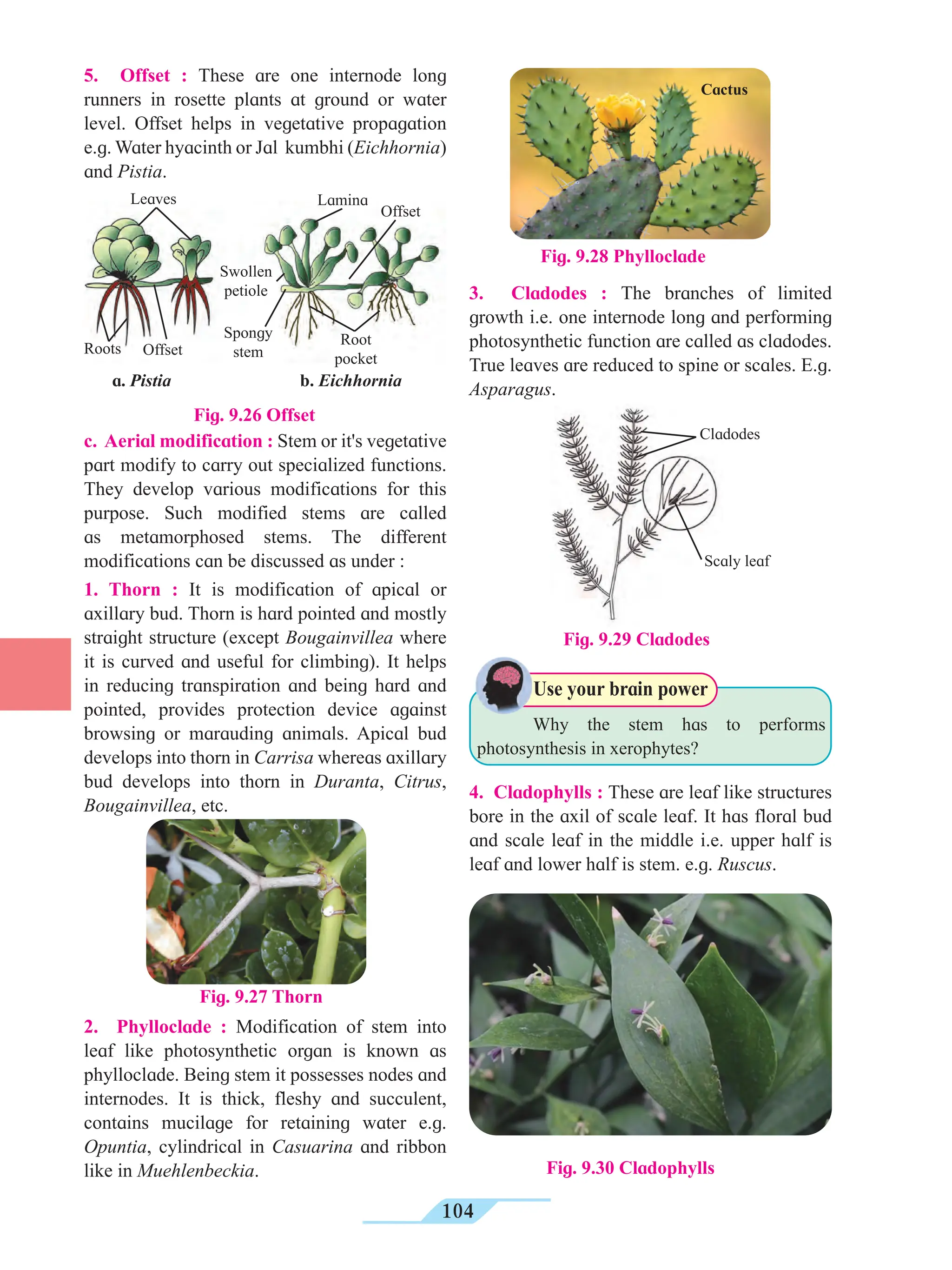
1. Epiphytic roots : Small epiphytic plants
such as orchids growing on the branches of
huge trees in dense rain forests and are unable to
obtain soil moisture. They produce specialized
root to hang in the air. The roots are provided
with a spongy membranous absorbent covering
of the velamen tissue. The cells of velamen
absorb moisture from air. Velamen tissue is
hygroscopic and have porous walls The roots
may be silvery white or green but without root
cap e.g. Vanda, Dendrobium etc.
Fig. 9.16 Sucking roots
B. Stem : The aerial part of the plant body is
know as shoot system. Stem is the main axis
of this shoot system. Stem is the ascending
part of the plant body which develops from
plumule and bears reproductive units i.e. buds.
It is differentiated into nodes and internodes.
It is usually positively phototropic, negatively
geotropic and negatively hydrotropic. It
shows different types of buds (axillary, apical,
accessory, etc.). At nodes it produces dissimilar
organs such as leaves and flowers and similar
organs such as branches. Young stem is green
and capable of photosynthesis.
The primary functions of the stem are to
produce and support branches, leaves, flowers
and fruits; conduction of water and minerals
and transportation of food to plant parts.
Fig. 9.17 Stem structure
Apical bud Leaf
Periole
Node
Internode
Stem
Axillary bud
Fig. 9.15 Epiphytic roots
Epiphytic root
Clinging root
(Hanging root)
102
Modifications of stem : Stem develops some
modifications for additional or accessory
functions. To perform such function stem shows
different modifications :
a. Underground stem : In some herbaceous
plants stem develops below the soil surface
called as underground stem. Underground
stem remains dormant during unfavourable
condition and on the advent of favourable
condition produces aerial shoots. Underground
stem is known to store food, helps in perinnation
and vegetative propagation.
2. Stem Tuber : Special underground branches
of stem at their tips become swollen due to
storage of food material which is mostly starch.
Presence of distinct nodes but not internodes
classifies tuber as stem. At nodal part scale
leaves are present with axillary buds commonly
known as ‘eyes’. ‘Eyes’ can produce aerial
shoots under favourable conditions. Tubers are
porpogated vegetatively e.g. Potato (Solanum
tuberosum), Matalu (Helianthus tuberosus).
Tuber has two distinct ends viz. apical end
and basal end called as rose and heel end
respectively. The number of nodes and eyes is
more towards rose end.
				
Why underground stem is different from roots?
Use your brain power
1. Rhizome : It is prostrate dorsiventrally
thickened and brownish in colour. It grows
either horizontally or obliquely beneath the soil.
Rhizome shows nodes and internodes, bears
terminal and axillary buds at nodes. Terminal
bud under favourable conditions produces
aerial shoot which degenerates at the end of
favourable condition Growth of rhizome takes
place with lateral buds such growth is known
as sympodial growth. e.g. Ginger (Zingiber
officinale), Turmeric (Curcuma domestica),
Canna etc. In plants where rhizomes grows
obliquely, terminals bud brings about growth
of rhizomes. This is known as monopodial
growth. e.g. Nymphea, Nelumbo (Lotus), Pteris
(Fern) etc.
Fig. 9.19 Tuber of potato
3. Bulb : Bulb is an underground spherical
or pyriform stem. Stem is highly reduced and
discoid. It bears a whorl of fleshy leaves. The
scale leaves or fleshy leaves show concentric
arrangement over the stem. These store food
material. Some outer scale leaves become thin
anddry.Thereducedstemproducesadventitious
roots at its base. The bulb is of different types
Tunicated or layered bulb is made up of
fleshy leaves arranged in concentric manner
with outer dry scale leaf. e.g. Onion. In garlic
the bulb is scaly or compound tunicated.
The fleshy scales (cloves) are arranged in
overlapping pattern.
Fig. 9.18 Rhizome of Ginger
Internode
Scale leaf
Bud
Node
Adventitious root
Fig. 9.20 Bulbs
a. Scaly bulb e.g. Garlic b. Tunicate bulb e.g. Onion
103
4. Corm : Corm is swollen underground
spherical or subspherical vertically growing
stem. It is condensed structure with circular
or ring like nodes. Presence of axillary buds
and scales is observed. Adventitious buds are
produced which help in vegetative propagation.
Adventitious roots are produced at lower part
of stem e.g. Colocasia (Arbi), Amorphophallus
(Zamikand or Elephant foot) etc.
Presence of nodes with scale leaves and
axillary buds is observed. Eg. Cynodon (Lawn
grass) Centella (Hydrocotyl), Oxalis etc.
b. Sub aerial stem : The stems are generally
weak or straggling stems growing over the
ground and need support for perpetuation.
Sometimes these stems are found to grow
beneath the soil surface also. Thus they show
contact with both air and soil. Sub aerial stems
are meant for perennation and vegetative
propagation. Scale leaves and axillary buds are
present over stem surface. The later produces
aerial shoots.
The different types of sub aerial
shoots are as follows:
1. Trailer : The shoot spreads over the ground
without intervals. The branches are either flat
i.e. procumbent or partly vertical i.e. decumbent
e.g. Euphorbia, Tridax etc.
Fig. 9.22 Euphorbia
3. Stolons : The slender lateral branch arising
from the base of main axis is known as
stolon. In some plants it is above ground (wild
strawberry). Primarily stolon shows upward
growth in the form of ordinary branch, but
when it bends and touches the ground terminal
bud grows into new shoot and adventitious
roots e.g. Mentha.
4. Sucker : It is non green runner like branch
of stem. It which develops from underground
base of roots. It grows horizontally below
soil and finally comes above the soil surface
to produce a new plant. Sucker can be termed
as underground runner eg. Chrysanthemum,
Banana etc.
Runner
Node
Fig. 9.21 Corm
Soil surface
Old corm
Daughter
corm
Adventitious
roots
Underground
stem
Node
Fig. 9.24 Stolon
Crown Stolon
Daughter plant
Ground
Trailer weak stem
2. Runner : They are special narrow, prostrate
or horizontal green branches which develop
at the base of erect shoots known as crown.
Runners spread in all directions to produce new
crowns with bunch of adventitious roots.
Mentha
Fig. 9.25 Sucker
Chrysanthemum
Tap root
Roots
Sucker
Main stem
Fig. 9.23 Runner
Adventitious root
Internode
New root
New plantlet
Cynodon
104
5. Offset : These are one internode long
runners in rosette plants at ground or water
level. Offset helps in vegetative propagation
e.g. Water hyacinth or Jal kumbhi (Eichhornia)
and Pistia.
3. Cladodes : The branches of limited
growth i.e. one internode long and performing
photosynthetic function are called as cladodes.
True leaves are reduced to spine or scales. E.g.
Asparagus.
c. Aerial modification : Stem or it's vegetative
part modify to carry out specialized functions.
They develop various modifications for this
purpose. Such modified stems are called
as metamorphosed stems. The different
modifications can be discussed as under :
1. Thorn : It is modification of apical or
axillary bud. Thorn is hard pointed and mostly
straight structure (except Bougainvillea where
it is curved and useful for climbing). It helps
in reducing transpiration and being hard and
pointed, provides protection device against
browsing or marauding animals. Apical bud
develops into thorn in Carrisa whereas axillary
bud develops into thorn in Duranta, Citrus,
Bougainvillea, etc.
Fig. 9.27 Thorn
2. Phylloclade : Modification of stem into
leaf like photosynthetic organ is known as
phylloclade. Being stem it possesses nodes and
internodes. It is thick, fleshy and succulent,
contains mucilage for retaining water e.g.
Opuntia, cylindrical in Casuarina and ribbon
like in Muehlenbeckia.
				
Why the stem has to performs
photosynthesis in xerophytes?
Use your brain power
4. Cladophylls : These are leaf like structures
bore in the axil of scale leaf. It has floral bud
and scale leaf in the middle i.e. upper half is
leaf and lower half is stem. e.g. Ruscus.
Fig. 9.30 Cladophylls
Fig. 9.26 Offset
Leaves Lamina
Offset
Root
pocket
Roots Offset
Swollen
petiole
Spongy
stem
a. Pistia b. Eichhornia
Fig. 9.28 Phylloclade
Cactus
Cladodes
Scaly leaf
Fig. 9.29 Cladodes
105
C. Leaf :
Leaves are the most important
appendages as they carry out photosynthesis
and also help to remove excess amount of
water from plant body. Leaf develops from leaf
primordium. Leaf is dorsiventrally flattened
lateral appendage of stem. It is produced at
nodal region. Leaf is thin, expanded and green
due to presence of photosynthetic pigments. It
shows exogenous origin. Axil of leaf shows
presence of axillary bud. Leaf shows limited
growth, does not show apical bud or a growing
point.
1. Typical leaf structure : It shows presence
of three main parts Leaf base or Hypopodium,
Petiole or Mesopodium and Leaf lamina/
blade or epipodium.
Leaf base : The point by which leaf remains
attached to stem is known as leaf base.
Axillary tendril
in Passiflora
axillary bud
gets modified
in tendril
Apical bud in Vitis quadrangularis gets
modified in to tendril. The further growth
is carried out by axillary bud. This
branching pattern is termed dichotomous.
Extra axillary bud is the one
which grows outside the axil.
This bud in cucurbita gets modi-
fied in to tendril.
Normally floral buds are
destined to produced flowers.
But in plants like Antigonon
they produce tendrils.
Stem tendrils : Tendrils are thin, wiry, photosynthetic, leafless coiled structures. They give
additional support to developing plant. Tendrils have adhesive glands for fixation.
The nature of leaf base is varies in
different plants. It may be pulvinus (swollen),
sheathing or ligulate etc.
In some plants leaves possess a pair of
lateral outgrowths called as stipules. The leaf
with stipule is said to be stipulate and without
stipule is exstipulate. Stipules are normally
green protective structure.
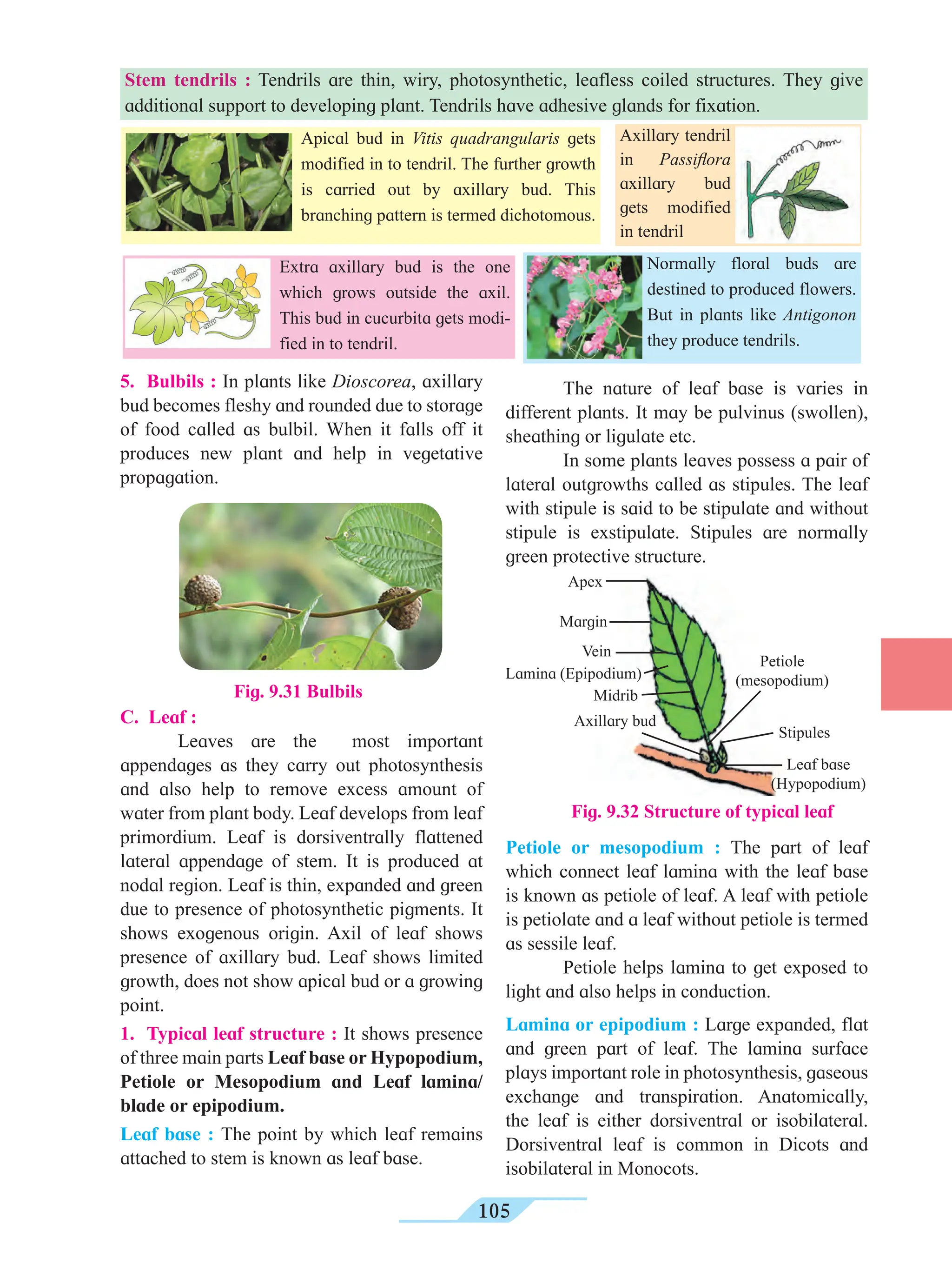
5. Bulbils : In plants like Dioscorea, axillary
bud becomes fleshy and rounded due to storage
of food called as bulbil. When it falls off it
produces new plant and help in vegetative
propagation.
Fig. 9.31 Bulbils
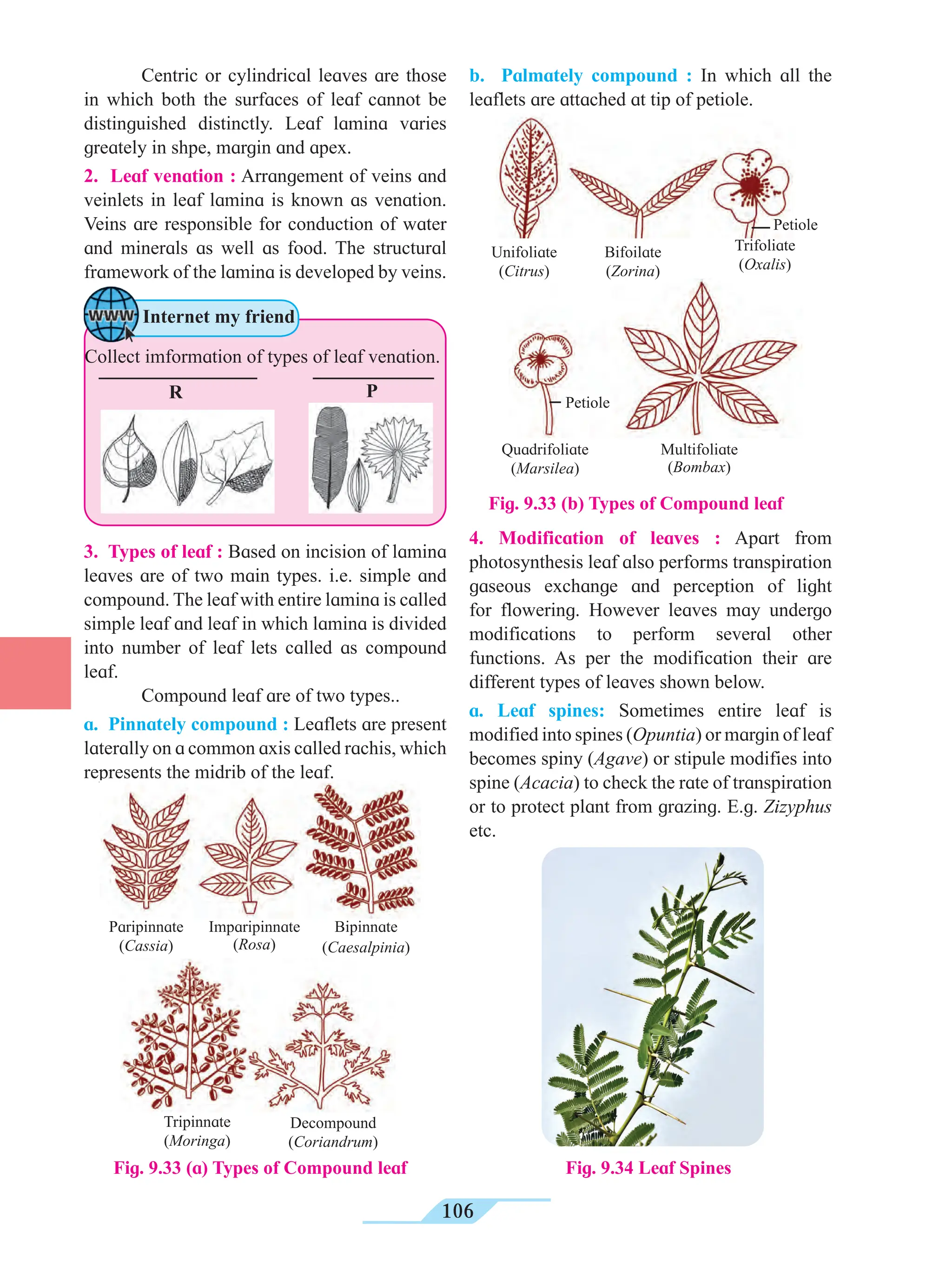
Petiole or mesopodium : The part of leaf
which connect leaf lamina with the leaf base
is known as petiole of leaf. A leaf with petiole
is petiolate and a leaf without petiole is termed
as sessile leaf.
Petiole helps lamina to get exposed to
light and also helps in conduction.
Lamina or epipodium : Large expanded, flat
and green part of leaf. The lamina surface
plays important role in photosynthesis, gaseous
exchange and transpiration. Anatomically,
the leaf is either dorsiventral or isobilateral.
Dorsiventral leaf is common in Dicots and
isobilateral in Monocots.
Fig. 9.32 Structure of typical leaf
Apex
Margin
Vein
Lamina (Epipodium)
Midrib
Axillary bud
Petiole
(mesopodium)
Stipules
Leaf base
(Hypopodium)
106
Centric or cylindrical leaves are those
in which both the surfaces of leaf cannot be
distinguished distinctly. Leaf lamina varies
greately in shpe, margin and apex.
2. Leaf venation : Arrangement of veins and
veinlets in leaf lamina is known as venation.
Veins are responsible for conduction of water
and minerals as well as food. The structural
framework of the lamina is developed by veins.
3. Types of leaf : Based on incision of lamina
leaves are of two main types. i.e. simple and
compound. The leaf with entire lamina is called
simple leaf and leaf in which lamina is divided
into number of leaf lets called as compound
leaf.
Compound leaf are of two types..
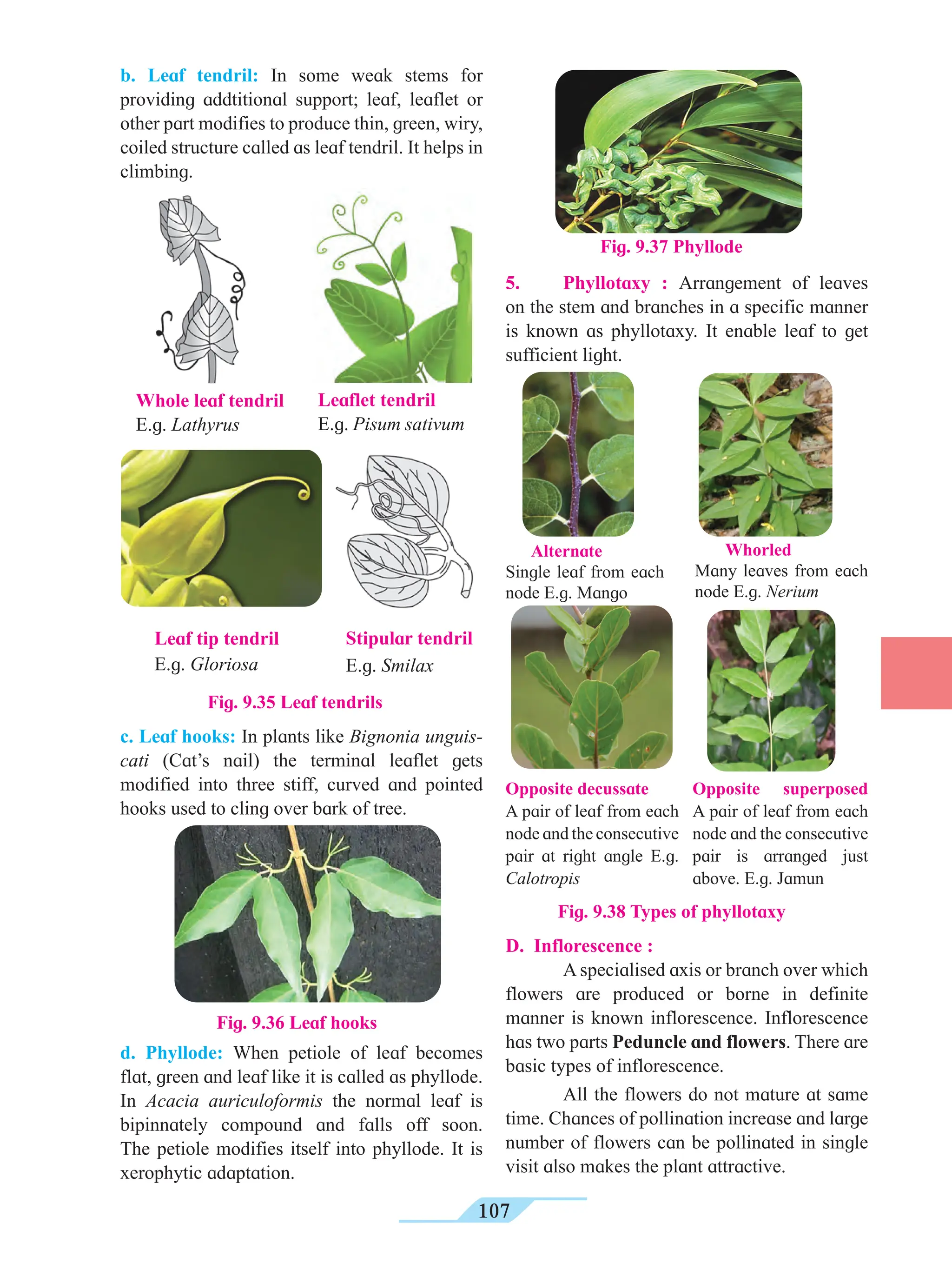
a. Pinnately compound : Leaflets are present
laterally on a common axis called rachis, which
represents the midrib of the leaf.
4. Modification of leaves : Apart from
photosynthesis leaf also performs transpiration
gaseous exchange and perception of light
for flowering. However leaves may undergo
modifications to perform several other
functions. As per the modification their are
different types of leaves shown below.
a. Leaf spines: Sometimes entire leaf is
modified into spines (Opuntia) or margin of leaf
becomes spiny (Agave) or stipule modifies into
spine (Acacia) to check the rate of transpiration
or to protect plant from grazing. E.g. Zizyphus
etc.
Fig. 9.33 (b) Types of Compound leaf
b. Palmately compound : In which all the
leaflets are attached at tip of petiole.
Fig. 9.34 Leaf Spines
R P
Internet my friend
Collect imformation of types of leaf venation.
Bipinnate
(Caesalpinia)
Imparipinnate
(Rosa)
Paripinnate
(Cassia)
Decompound
(Coriandrum)
Tripinnate
(Moringa)
Fig. 9.33 (a) Types of Compound leaf
Trifoliate
(Oxalis)
Bifoilate
(Zorina)
Petiole
Petiole
Unifoliate
(Citrus)
Quadrifoliate
(Marsilea)
Multifoliate
(Bombax)
107
b. Leaf tendril: In some weak stems for
providing addtitional support; leaf, leaflet or
other part modifies to produce thin, green, wiry,
coiled structure called as leaf tendril. It helps in
climbing.
5. Phyllotaxy : Arrangement of leaves
on the stem and branches in a specific manner
is known as phyllotaxy. It enable leaf to get
sufficient light.
Fig. 9.38 Types of phyllotaxy
Leaf tip tendril
E.g. Gloriosa
Stipular tendril
E.g. Smilax
Fig. 9.35 Leaf tendrils
Fig. 9.36 Leaf hooks
Whole leaf tendril
E.g. Lathyrus
Leaflet tendril
E.g. Pisum sativum
c. Leaf hooks: In plants like Bignonia unguis-
cati (Cat’s nail) the terminal leaflet gets
modified into three stiff, curved and pointed
hooks used to cling over bark of tree.
Fig. 9.37 Phyllode
d. Phyllode: When petiole of leaf becomes
flat, green and leaf like it is called as phyllode.
In Acacia auriculoformis the normal leaf is
bipinnately compound and falls off soon.
The petiole modifies itself into phyllode. It is
xerophytic adaptation.
D. Inflorescence :
A specialised axis or branch over which
flowers are produced or borne in definite
manner is known inflorescence. Inflorescence
has two parts Peduncle and flowers. There are
basic types of inflorescence.
All the flowers do not mature at same
time. Chances of pollination increase and large
number of flowers can be pollinated in single
visit also makes the plant attractive.
Opposite decussate
A pair of leaf from each
node and the consecutive
pair at right angle E.g.
Calotropis
Opposite superposed
A pair of leaf from each
node and the consecutive
pair is arranged just
above. E.g. Jamun
Alternate
Single leaf from each
node E.g. Mango
Whorled
Many leaves from each
node E.g. Nerium
108
Types of inflorescence :
a. Racemose : Growth of peduncle is infinite
or unlimited. Apical bud is free for continuous
growth. Older flowers at the base. Flowers are
borne in acropetal succession. Order of opening
is centripetal, when peduncle is disc shaped.
Flower with bilateral symmetry is called
zygomorphic flower e.g. Sweet pea where
there is only one plane along which if flower
is cut, shows mirror images. Flower with radial
symmetry where it can be cut along diameter in
any plane and shows mirror images. It is called
actinomorphic flower e.g. Hibiscus.
Terminologies related to flower :
1. Complete : Presence of all four floral
whorls.
2. Incomplete : Absence of any one of the
floral whorl.
3. Perfect : Both androecium and gynoecium
are present in a flower; also called
monoclinous or bisexual flower.
4. Imperfect : Any one reproductive whorl
is present in a flower; also called as
diclinous flower or unisexual flower.
5. Unisexual : It can be either staminate
(male)/ pistillate (female) flower; also
called dicliny.
6. Neuter : When both reproductive whorls
are absent, it is said to be neuter flower
e.g. Ray florets of Tagetus (marigold).
7. Monoecious plant : Male and female
reproductive flowers are borne on same
plant. E.g. Maize.
8. Dioecious plant : Only one type of
unisexual flowers are present on a plant
e.g. Date palm, papaya.
Always Remember
b. Cymose : Growth of peduncle is finite
limited. Apical meristem terminates into
flower. Oldest flower is the apex. Flowers are
borne in basipetal succession. Order of opening
is centrifugal if peduncle is compressed from
the top.
Fig. 9.39 Racemose
Flower bud
Mature
flower
Peduncle
Fig. 9.40 Cymose
E. Flower : Flower is highly modified and
condensed shoot meant for sexual reproduction.
On the basis of position a flower can
be axillary or terminal. In a typical flower, the
thalamus (Consists of four compactly arranged
nodes and three highly condenseed internodes.
From each node of thalamus, a circle or whorl
of modified leaves is produced.
A flower may or may not show
presence of bract at base of pedicel or over the
pedicel, such a flower is said to be bracteate or
ebracteate respectively. A flower with pedicel
is said to be pedicellate flower and without
pedicel is called as sessile flower.
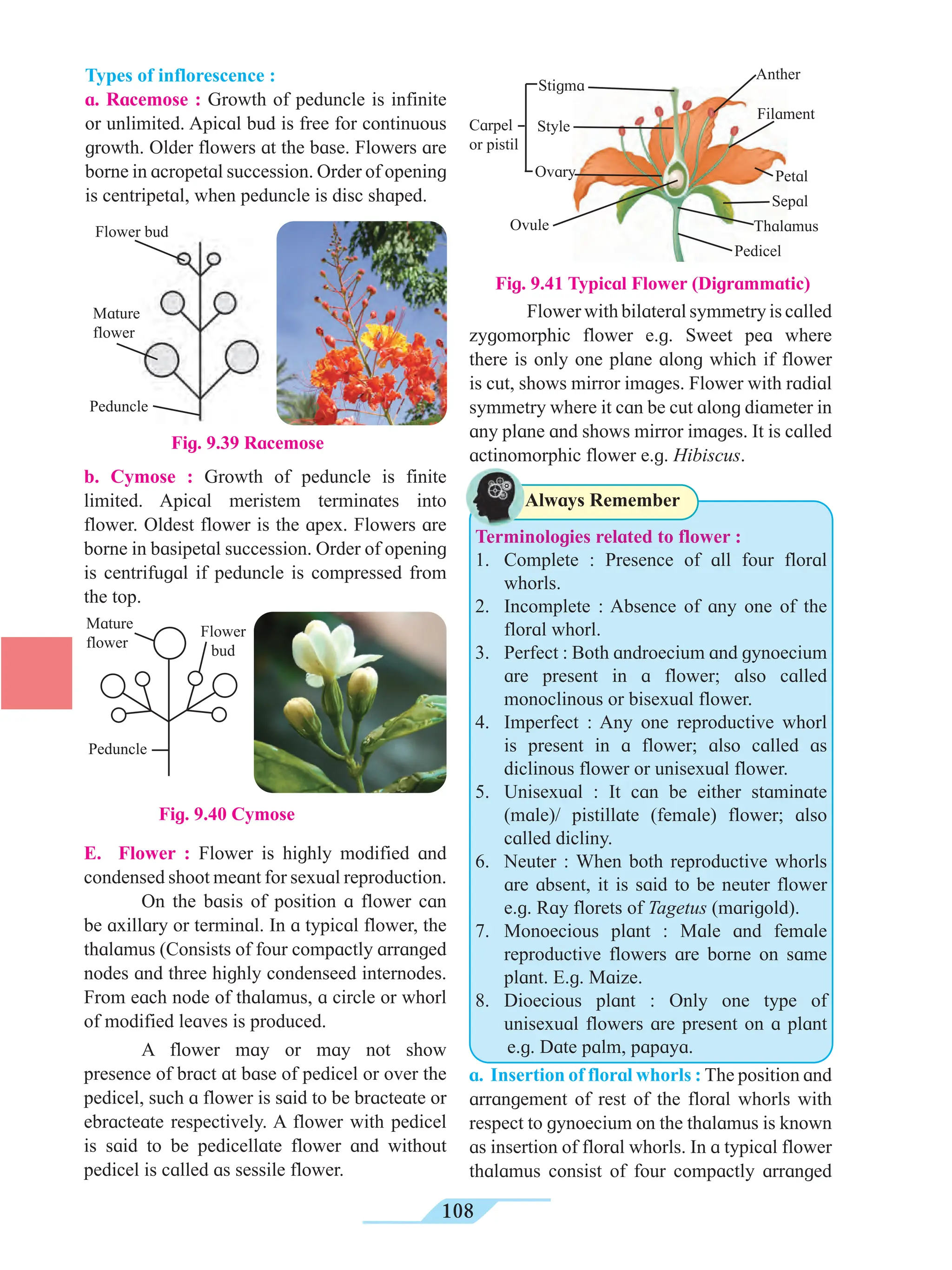
Fig. 9.41 Typical Flower (Digrammatic)
Stigma
Style
Ovary
Carpel
or pistil
Ovule
Anther
Filament
Petal
Sepal
Thalamus
Pedicel
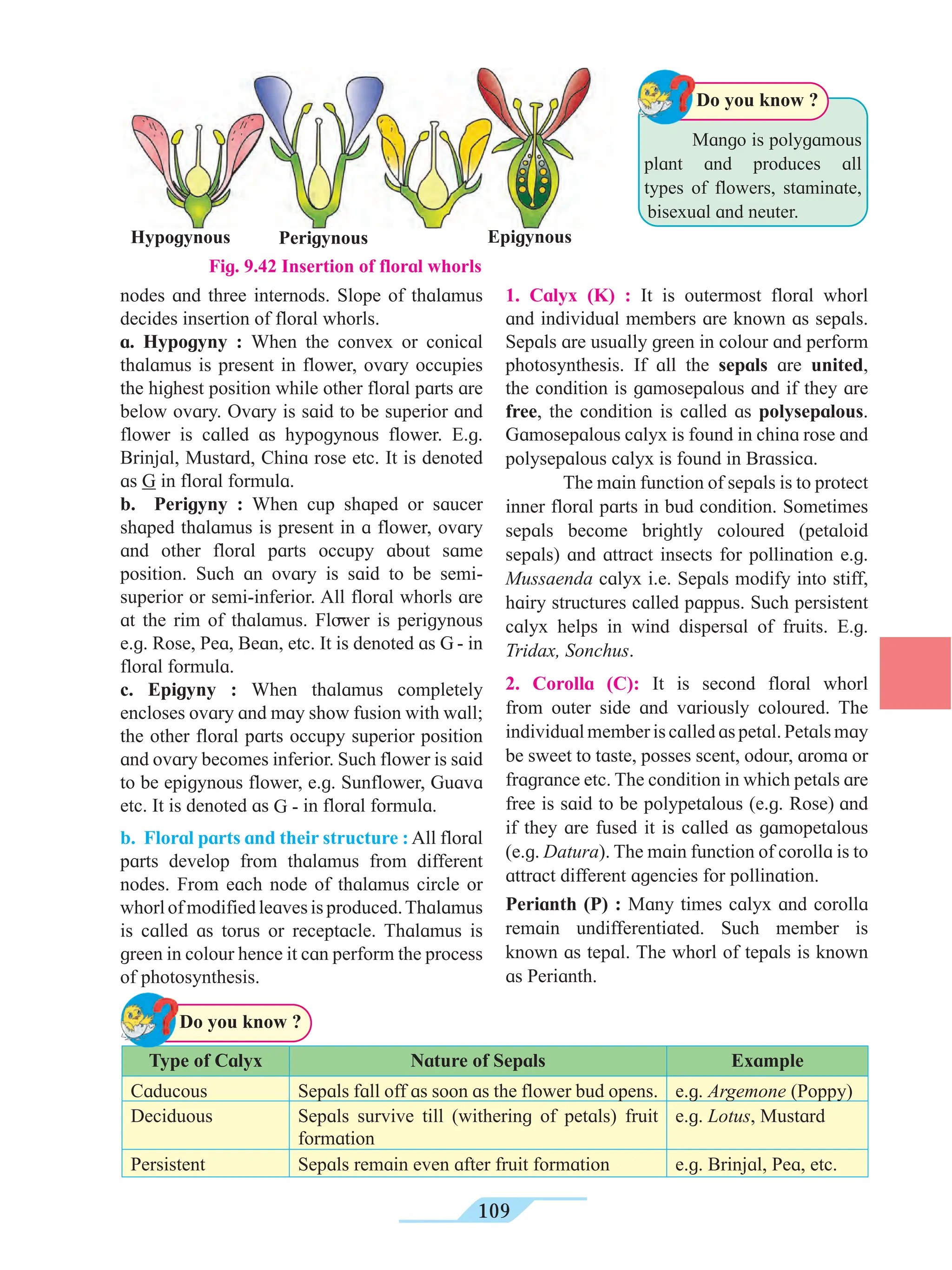
a. Insertion of floral whorls : The position and
arrangement of rest of the floral whorls with
respect to gynoecium on the thalamus is known
as insertion of floral whorls. In a typical flower
thalamus consist of four compactly arranged
Flower
bud
Mature
flower
Peduncle
109
Type of Calyx Nature of Sepals Example
Caducous Sepals fall off as soon as the flower bud opens. e.g. Argemone (Poppy)
Deciduous Sepals survive till (withering of petals) fruit
formation
e.g. Lotus, Mustard
Persistent Sepals remain even after fruit formation e.g. Brinjal, Pea, etc.
Do you know ?
nodes and three internods. Slope of thalamus
decides insertion of floral whorls.
a. Hypogyny : When the convex or conical
thalamus is present in flower, ovary occupies
the highest position while other floral parts are
below ovary. Ovary is said to be superior and
flower is called as hypogynous flower. E.g.
Brinjal, Mustard, China rose etc. It is denoted
as G in floral formula.
b. Perigyny : When cup shaped or saucer
shaped thalamus is present in a flower, ovary
and other floral parts occupy about same
position. Such an ovary is said to be semi-
superior or semi-inferior. All floral whorls are
at the rim of thalamus. Flower is perigynous
e.g. Rose, Pea, Bean, etc. It is denoted as G - in
floral formula.
c. Epigyny : When thalamus completely
encloses ovary and may show fusion with wall;
the other floral parts occupy superior position
and ovary becomes inferior. Such flower is said
to be epigynous flower, e.g. Sunflower, Guava
etc. It is denoted as G - in floral formula.
b. Floral parts and their structure : All floral
parts develop from thalamus from different
nodes. From each node of thalamus circle or
whorlofmodifiedleavesisproduced.Thalamus
is called as torus or receptacle. Thalamus is
green in colour hence it can perform the process
of photosynthesis.
Hypogynous Perigynous Epigynous
Fig. 9.42 Insertion of floral whorls
			
Mango is polygamous
plant and produces all
types of flowers, staminate,
bisexual and neuter.
Do you know ?
1. Calyx (K) : It is outermost floral whorl
and individual members are known as sepals.
Sepals are usually green in colour and perform
photosynthesis. If all the sepals are united,
the condition is gamosepalous and if they are
free, the condition is called as polysepalous.
Gamosepalous calyx is found in china rose and
polysepalous calyx is found in Brassica.
The main function of sepals is to protect
inner floral parts in bud condition. Sometimes
sepals become brightly coloured (petaloid
sepals) and attract insects for pollination e.g.
Mussaenda calyx i.e. Sepals modify into stiff,
hairy structures called pappus. Such persistent
calyx helps in wind dispersal of fruits. E.g.
Tridax, Sonchus.
2. Corolla (C): It is second floral whorl
from outer side and variously coloured. The
individualmemberiscalledaspetal.Petalsmay
be sweet to taste, posses scent, odour, aroma or
fragrance etc. The condition in which petals are
free is said to be polypetalous (e.g. Rose) and
if they are fused it is called as gamopetalous
(e.g. Datura). The main function of corolla is to
attract different agencies for pollination.
Perianth (P) : Many times calyx and corolla
remain undifferentiated. Such member is
known as tepal. The whorl of tepals is known
as Perianth.
110
If all the tepals are free the condition is
called as polyphyllous and if they are fused the
condition is called as gamophyllous. Sepaloid
perianth shows green tepals while petaloid
perianth brightly coloured tepals. E.g. Lily,
Amaranthus, Celosia, etc. It protects other floral
whorls. Petaloid tepal helps in pollination and
sepaloid tepals can perform photosynthesis.
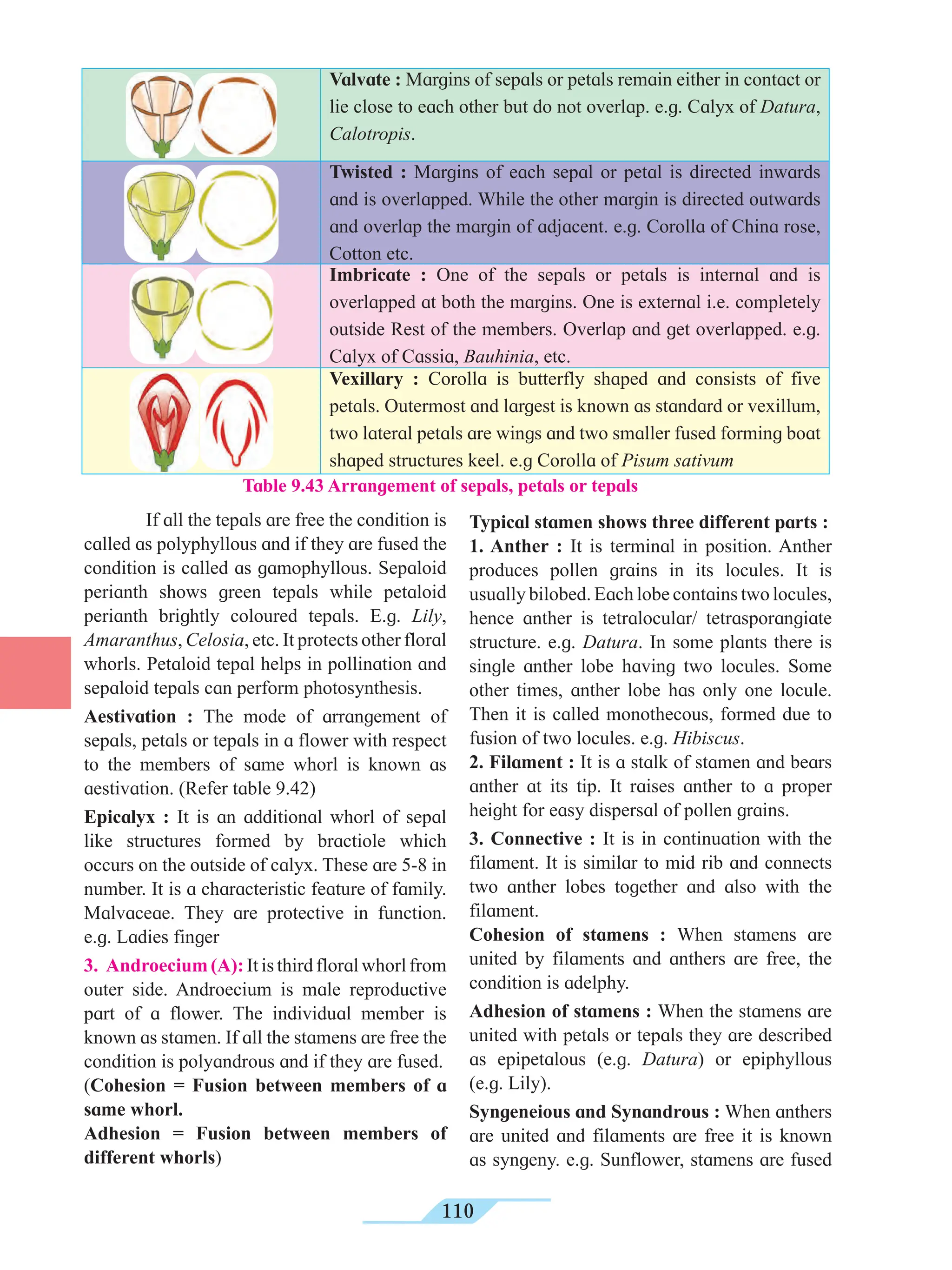
Aestivation : The mode of arrangement of
sepals, petals or tepals in a flower with respect
to the members of same whorl is known as
aestivation. (Refer table 9.42)
Epicalyx : It is an additional whorl of sepal
like structures formed by bractiole which
occurs on the outside of calyx. These are 5-8 in
number. It is a characteristic feature of family.
Malvaceae. They are protective in function.
e.g. Ladies finger
3. Androecium(A): Itisthirdfloralwhorlfrom
outer side. Androecium is male reproductive
part of a flower. The individual member is
known as stamen. If all the stamens are free the
condition is polyandrous and if they are fused.
(Cohesion = Fusion between members of a
same whorl.
Adhesion = Fusion between members of
different whorls)
Typical stamen shows three different parts :
1. Anther : It is terminal in position. Anther
produces pollen grains in its locules. It is
usually bilobed. Each lobe contains two locules,
hence anther is tetralocular/ tetrasporangiate
structure. e.g. Datura. In some plants there is
single anther lobe having two locules. Some
other times, anther lobe has only one locule.
Then it is called monothecous, formed due to
fusion of two locules. e.g. Hibiscus.
2. Filament : It is a stalk of stamen and bears
anther at its tip. It raises anther to a proper
height for easy dispersal of pollen grains.
3. Connective : It is in continuation with the
filament. It is similar to mid rib and connects
two anther lobes together and also with the
filament.
Cohesion of stamens : When stamens are
united by filaments and anthers are free, the
condition is adelphy.
Adhesion of stamens : When the stamens are
united with petals or tepals they are described
as epipetalous (e.g. Datura) or epiphyllous
(e.g. Lily).
Syngeneious and Synandrous : When anthers
are united and filaments are free it is known
as syngeny. e.g. Sunflower, stamens are fused
Valvate : Margins of sepals or petals remain either in contact or
lie close to each other but do not overlap. e.g. Calyx of Datura,
Calotropis.
Twisted : Margins of each sepal or petal is directed inwards
and is overlapped. While the other margin is directed outwards
and overlap the margin of adjacent. e.g. Corolla of China rose,
Cotton etc.
Imbricate : One of the sepals or petals is internal and is
overlapped at both the margins. One is external i.e. completely
outside Rest of the members. Overlap and get overlapped. e.g.
Calyx of Cassia, Bauhinia, etc.
Vexillary : Corolla is butterfly shaped and consists of five
petals. Outermost and largest is known as standard or vexillum,
two lateral petals are wings and two smaller fused forming boat
shaped structures keel. e.g Corolla of Pisum sativum
Table 9.43 Arrangement of sepals, petals or tepals
111
4. Gynoecium(G):Itisthefemalereproductive
part of flower and innermost in position. It is
also known as pistil. The individual member
of gynoecium is known as carpel. The number
of carpels may be one to many. If all the
carpels are fused the condition is described as
syncarpous and if they are free the condition
is described as apocarpous. The polycarpellary
gynoecium can be bicarpellary (two carpels
e.g. Datura) tricarpellary (three carpels e.g.
Cucurbita), pentacarpellery (five carpels e.g.
Hibiscus) and so on.
A typical carpel consists of three
parts viz, stigma, style and ovary. Stigma
is a terminal part of carpel which receives
pollen grains during pollination. It helps in
germination of pollen grain. Stigma shows
variation in structure to suit the pollinating
agent. Style is narrow thread like structure that
connects ovary with stigma. Ovary is basal
swollen fertile part of the carpel. Ovules are
produced in ovary on a soft fertile tissue called
placenta.
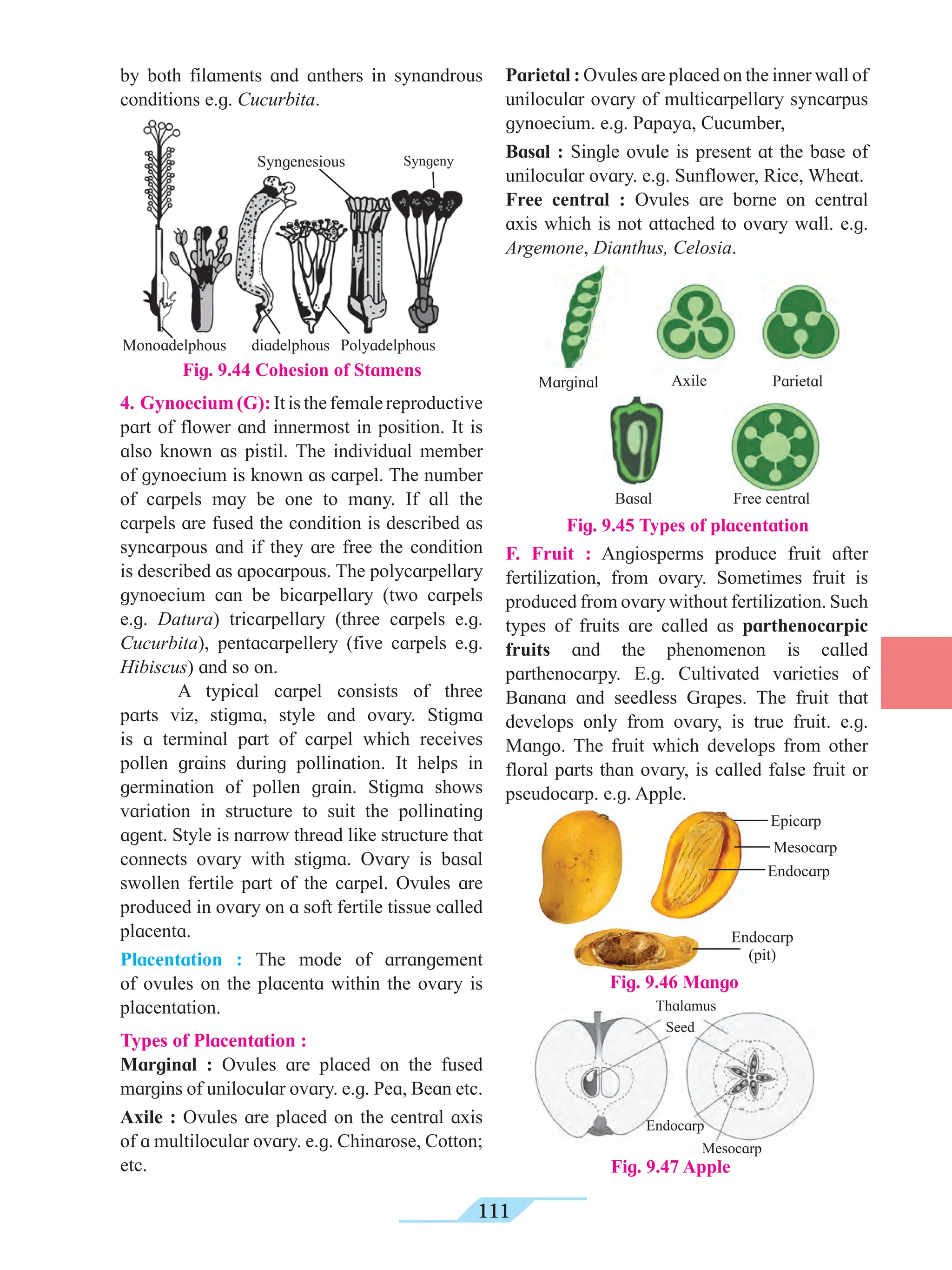
Placentation : The mode of arrangement
of ovules on the placenta within the ovary is
placentation.
Types of Placentation :
Marginal : Ovules are placed on the fused
margins of unilocular ovary. e.g. Pea, Bean etc.
Axile : Ovules are placed on the central axis
of a multilocular ovary. e.g. Chinarose, Cotton;
etc.
Fig. 9.46 Mango
Fig. 9.47 Apple
Epicarp
Mesocarp
Endocarp
Endocarp
(pit)
F. Fruit : Angiosperms produce fruit after
fertilization, from ovary. Sometimes fruit is
produced from ovary without fertilization. Such
types of fruits are called as parthenocarpic
fruits and the phenomenon is called
parthenocarpy. E.g. Cultivated varieties of
Banana and seedless Grapes. The fruit that
develops only from ovary, is true fruit. e.g.
Mango. The fruit which develops from other
floral parts than ovary, is called false fruit or
pseudocarp. e.g. Apple.
Parietal : Ovules are placed on the inner wall of
unilocular ovary of multicarpellary syncarpus
gynoecium. e.g. Papaya, Cucumber,
Basal : Single ovule is present at the base of
unilocular ovary. e.g. Sunflower, Rice, Wheat.
Free central : Ovules are borne on central
axis which is not attached to ovary wall. e.g.
Argemone, Dianthus, Celosia.
by both filaments and anthers in synandrous
conditions e.g. Cucurbita.
Fig. 9.44 Cohesion of Stamens
Monoadelphous diadelphous Polyadelphous
Syngenesious Syngeny
Fig. 9.45 Types of placentation
Marginal Axile Parietal
Basal Free central
Thalamus
Seed
Endocarp
Mesocarp
112
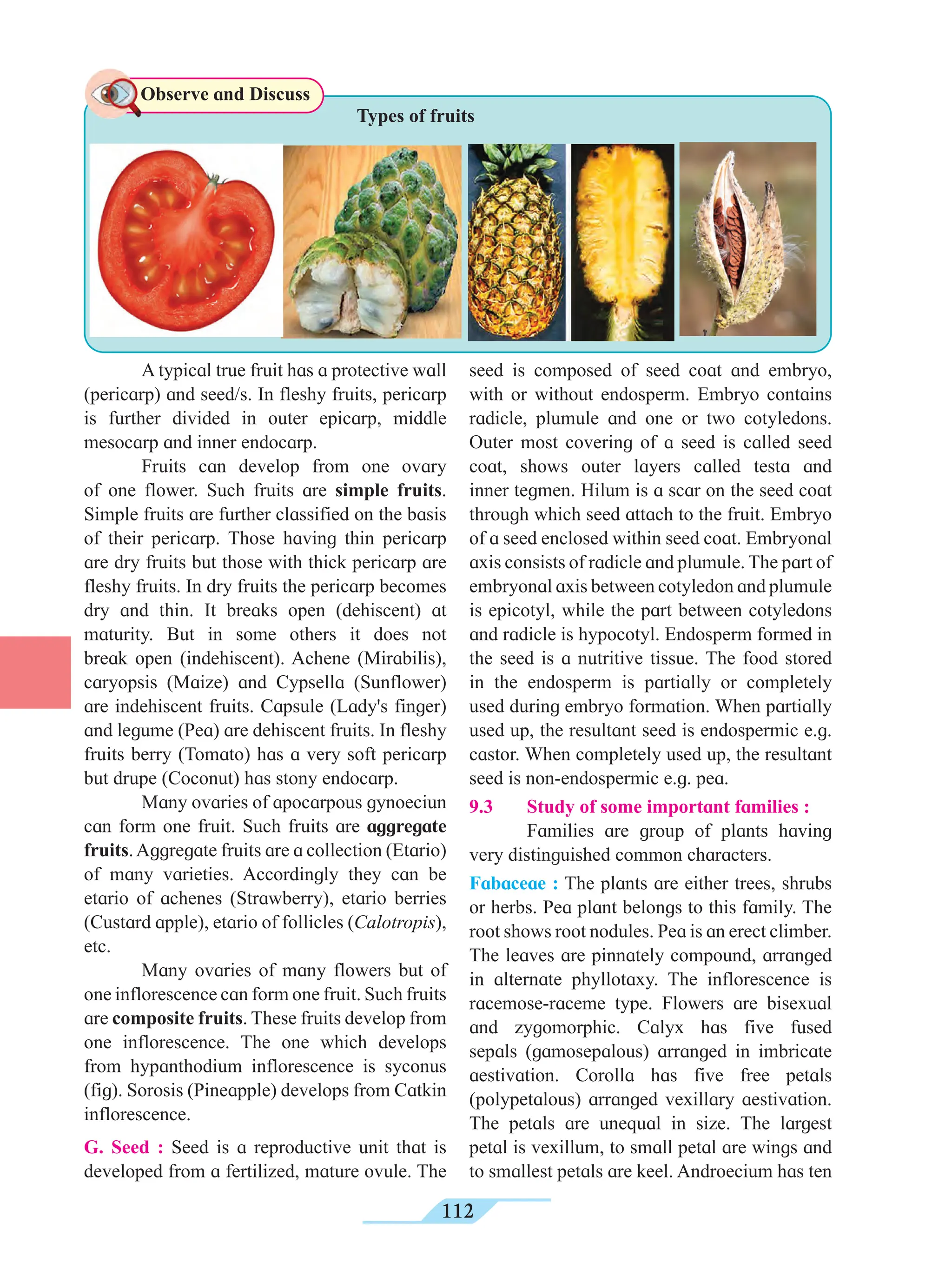
A typical true fruit has a protective wall
(pericarp) and seed/s. In fleshy fruits, pericarp
is further divided in outer epicarp, middle
mesocarp and inner endocarp.
Fruits can develop from one ovary
of one flower. Such fruits are simple fruits.
Simple fruits are further classified on the basis
of their pericarp. Those having thin pericarp
are dry fruits but those with thick pericarp are
fleshy fruits. In dry fruits the pericarp becomes
dry and thin. It breaks open (dehiscent) at
maturity. But in some others it does not
break open (indehiscent). Achene (Mirabilis),
caryopsis (Maize) and Cypsella (Sunflower)
are indehiscent fruits. Capsule (Lady's finger)
and legume (Pea) are dehiscent fruits. In fleshy
fruits berry (Tomato) has a very soft pericarp
but drupe (Coconut) has stony endocarp.
Many ovaries of apocarpous gynoeciun
can form one fruit. Such fruits are aggregate
fruits.Aggregate fruits are a collection (Etario)
of many varieties. Accordingly they can be
etario of achenes (Strawberry), etario berries
(Custard apple), etario of follicles (Calotropis),
etc.
Many ovaries of many flowers but of
one inflorescence can form one fruit. Such fruits
are composite fruits. These fruits develop from
one inflorescence. The one which develops
from hypanthodium inflorescence is syconus
(fig). Sorosis (Pineapple) develops from Catkin
inflorescence.
G. Seed : Seed is a reproductive unit that is
developed from a fertilized, mature ovule. The
seed is composed of seed coat and embryo,
with or without endosperm. Embryo contains
radicle, plumule and one or two cotyledons.
Outer most covering of a seed is called seed
coat, shows outer layers called testa and
inner tegmen. Hilum is a scar on the seed coat
through which seed attach to the fruit. Embryo
of a seed enclosed within seed coat. Embryonal
axis consists of radicle and plumule. The part of
embryonal axis between cotyledon and plumule
is epicotyl, while the part between cotyledons
and radicle is hypocotyl. Endosperm formed in
the seed is a nutritive tissue. The food stored
in the endosperm is partially or completely
used during embryo formation. When partially
used up, the resultant seed is endospermic e.g.
castor. When completely used up, the resultant
seed is non-endospermic e.g. pea.
9.3 Study of some important families :
Families are group of plants having
very distinguished common characters.
Fabaceae : The plants are either trees, shrubs
or herbs. Pea plant belongs to this family. The
root shows root nodules. Pea is an erect climber.
The leaves are pinnately compound, arranged
in alternate phyllotaxy. The inflorescence is
racemose-raceme type. Flowers are bisexual
and zygomorphic. Calyx has five fused
sepals (gamosepalous) arranged in imbricate
aestivation. Corolla has five free petals
(polypetalous) arranged vexillary aestivation.
The petals are unequal in size. The largest
petal is vexillum, to small petal are wings and
to smallest petals are keel. Androecium has ten
Observe and Discuss
Types of fruits
113
stamens arranged in diadelphous condition.
Gynoecium is monocarpellary. Unilocular
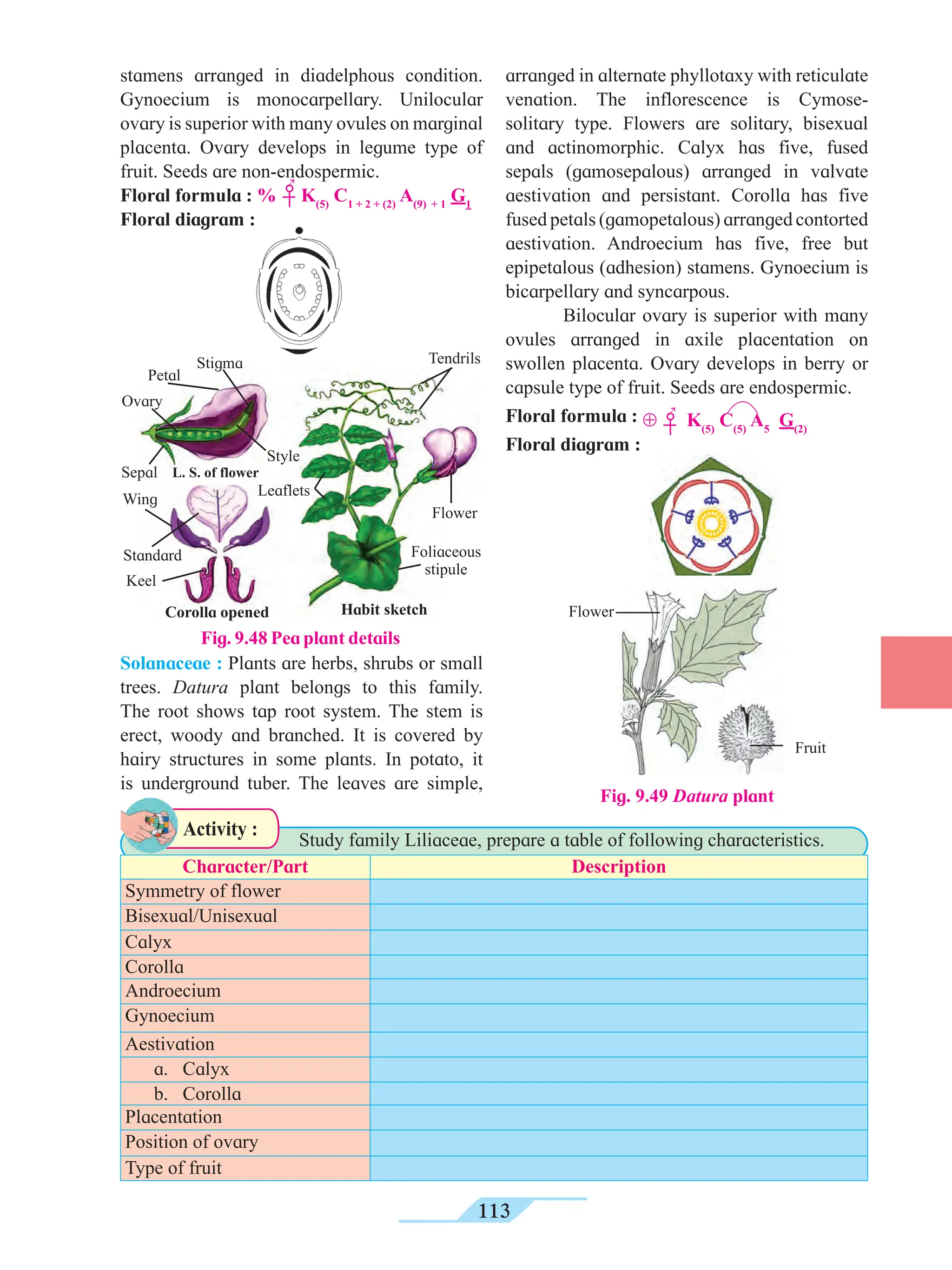
ovary is superior with many ovules on marginal
placenta. Ovary develops in legume type of
fruit. Seeds are non-endospermic.
Floral formula : %
↑
K(5)
C­
1 + 2 + (2)
A(9) + 1
G1
Floral diagram :
arranged in alternate phyllotaxy with reticulate
venation. The inflorescence is Cymose-
solitary type. Flowers are solitary, bisexual
and actinomorphic. Calyx has five, fused
sepals (gamosepalous) arranged in valvate
aestivation and persistant. Corolla has five
fused petals (gamopetalous) arranged contorted
aestivation. Androecium has five, free but
epipetalous (adhesion) stamens. Gynoecium is
bicarpellary and syncarpous.
Bilocular ovary is superior with many
ovules arranged in axile placentation on
swollen placenta. Ovary develops in berry or
capsule type of fruit. Seeds are endospermic.
Floral formula : ⊕
↑
K(5)
C­
(5)
A5
G(2)
Floral diagram :
Fig. 9.49 Datura plant
Flower
Fruit
			 Study family Liliaceae, prepare a table of following characteristics.
Activity :
Character/Part Description
Symmetry of flower
Bisexual/Unisexual
Calyx
Corolla
Androecium
Gynoecium
Aestivation
a. Calyx
b. Corolla
Placentation
Position of ovary
Type of fruit
Fig. 9.48 Pea plant details
Stigma
Petal
Style
Sepal
Ovary
Standard
Wing
Keel
Corolla opened
Flower
Habit sketch
Foliaceous
stipule
Leaflets
Tendrils
L. S. of flower
Solanaceae : Plants are herbs, shrubs or small
trees. Datura plant belongs to this family.
The root shows tap root system. The stem is
erect, woody and branched. It is covered by
hairy structures in some plants. In potato, it
is underground tuber. The leaves are simple,
114
1. Choose correct option
A. Which one of the following will grow
better in moist and shady region?
a. Opuntia
b. Orchid
c. Mangrove
d. Lotus
B. A particular plant had a pair of leaves at
each node arranged in one plane. What is
the arrangement called?
a. Alternate phyllotaxy
b. Decussate phyllotaxy
c. Superposed phyllotaxy
d. Whorled phyllotaxy
C. In a particular flower the insertion of
floral whorls was in such a manner, so
the ovary was below other three whorls,
but its stigma was taller than other three
whorls. What will you call such flower?
a. Hypogynous
b. Perigynous
c. Inferior ovary
d. Half superior - half inferior
D. Beet and Arum both store food for
perennation. Are the examples for two
different types?
a. Beet is a stem but Arum is a root
b. Beet is a root but Arum is a stem
c. Beet is a stem but Arum is a leaf
d. Beet is a stem but Arum is an 		
inflorescence
2. Answer the following questions
A. Two of the vegetables we consume are
nothing but leaf bases. Which are they?
B. Opuntia has spines but Carissa has thorns.
What is the difference?
C. Teacher described Hibiscus as solitary
Cyme. What it means?
3. Write notes on
A. Fusiform root.
B. Racemose inflorescence
C. Fasciculated tuberous roots
D. Region of cell maturation
E. Rhizome
F. Stolon
G. Leaf venation
H. Cymose inflorescence
I. Perianth
J. Vexillary aestivation
K. Axile placentation
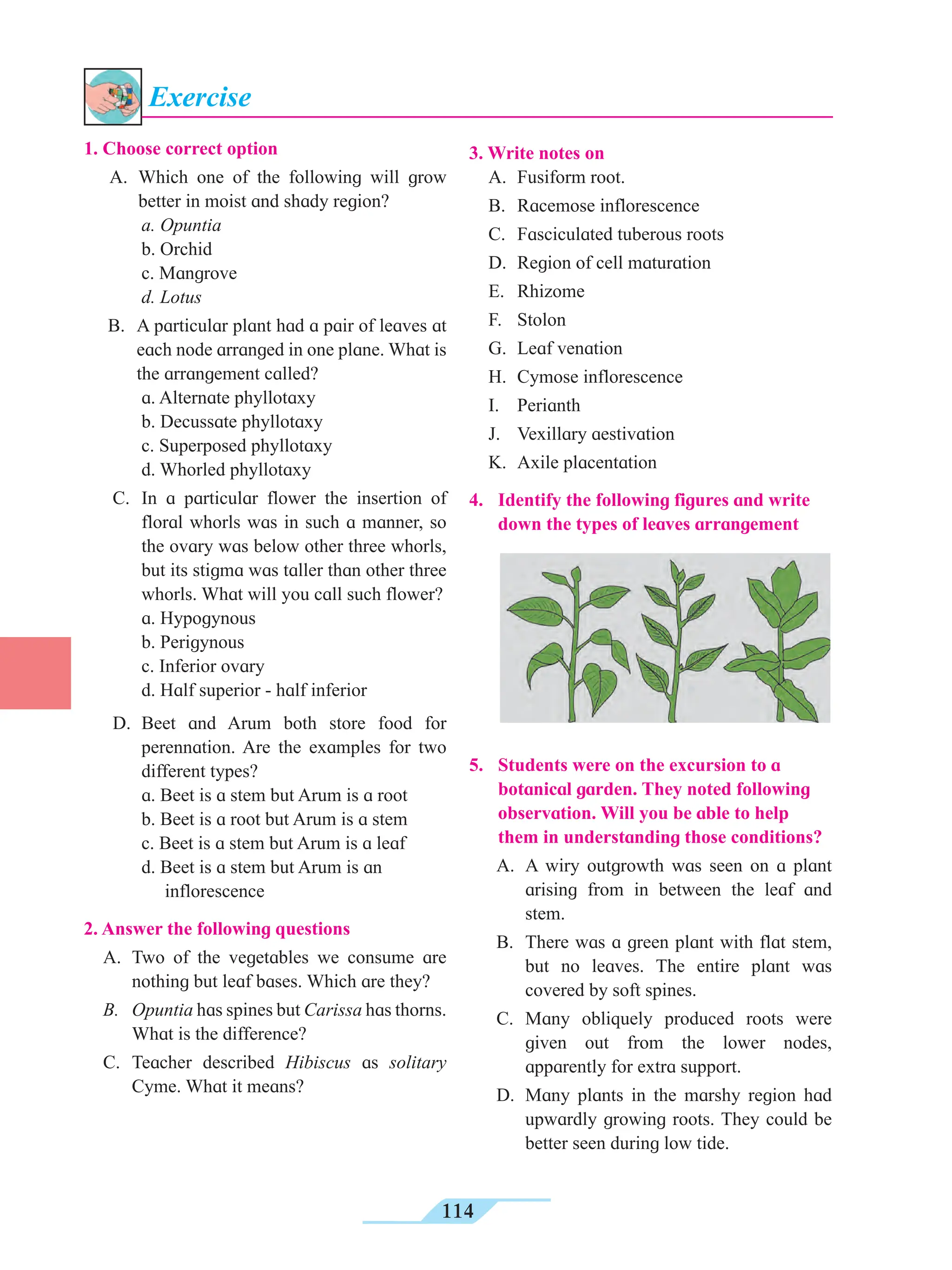
4. Identify the following figures and write
down the types of leaves arrangement
Exercise
5. Students were on the excursion to a
botanical garden. They noted following
observation. Will you be able to help
them in understanding those conditions?
A. A wiry outgrowth was seen on a plant
arising from in between the leaf and
stem.
B. There was a green plant with flat stem,
but no leaves. The entire plant was
covered by soft spines.
C. Many obliquely produced roots were
given out from the lower nodes,
apparently for extra support.
D. Many plants in the marshy region had
upwardly growing roots. They could be
better seen during low tide.
115
E. A plant had leaves with long leaf apex,
which was curling around a support.
F. A plant was found growing on other
plant. Teacher said it is not a parasite. It
exhibited two types of roots.
G. While having lunch onion slices were
served to them. Teacher asked which
part of the plant are you eating?
H. Studentsobservedlargeleavesofcoconut
and small leaves of Mimosa. Teacher
asked it what way they are similar?
I. Teacher showed them Marigold flower
and said it is not one flower. What the
teacher meant?
J. Students cut open a Papaya fruit and
found all the seeds attached to the sides.
Teacher inquired about the possible
placentation of Papaya ovary.
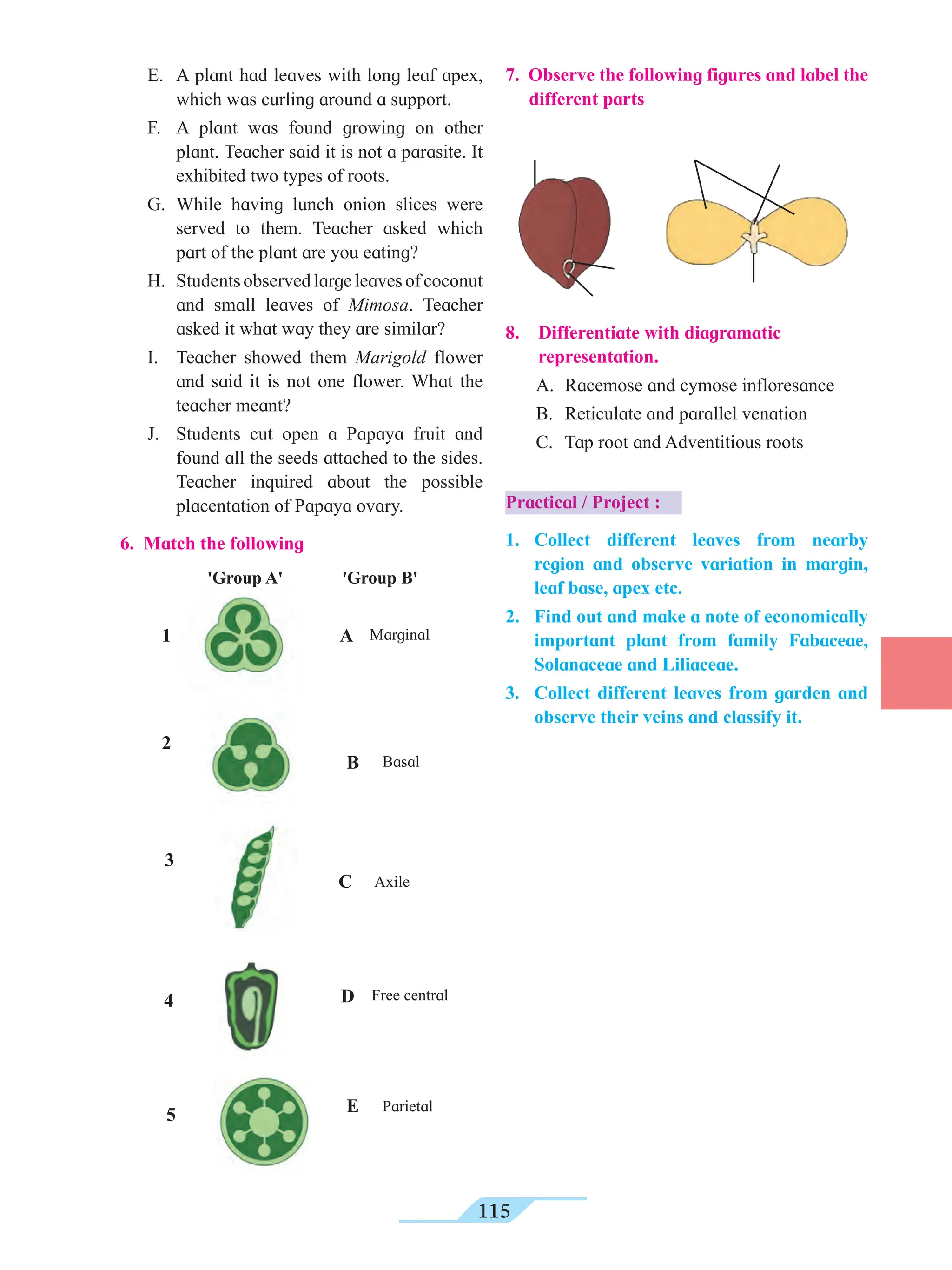
6. Match the following
Practical / Project :
1. Collect different leaves from nearby
region and observe variation in margin,
leaf base, apex etc.
2. Find out and make a note of economically
important plant from family Fabaceae,
Solanaceae and Liliaceae.
3. Collect different leaves from garden and
observe their veins and classify it.
7. Observe the following figures and label the
different parts
Marginal
Axile
Parietal
Basal
Free central
1
2
3
4
5
A
B
C
D
E
'Group A' 'Group B'
8. Differentiate with diagramatic
representation.
A. Racemose and cymose infloresance
B. Reticulate and parallel venation
C. Tap root and Adventitious roots

MSB Class 11 Biology-Ch9.pdf for NEET and State

  • 1.
    97 9.1 Angiosperms : Ourearth has a vast diversity of plants. The flowering plants dominate the world of plants as they are well adapted to the environmental conditions. These plants show considerable variation in their general external and internal characters with respect to their habitat. Such variations help the plant body to carry out different functions. You have studied a broad classification of kingdom Plantae. Angiosperms are one of flowering plants from phanerogams. Angiosperms can be classified into different types on the basis of habitat and it can be represented as follows : 9. Morphology of Flowering Plants You have learnt the diversity and structureofAngiospermicplantin6th standared. Can you recall? 9.2 Morphology : Morphologicallyplantshowsvegetative structures like root, stem, leaf and reproductive structures such as flowers, fruits and seeds. Hydrophytes - Growing in aquatic habitat e.g. Hydrilla Xerophytes - Growing in regions with scanty or no rainfall like desert e.g. Opuntia Psammophytes - Growing in sandy soil e.g. Elymus Lithophytes - Growing on rock e.g. Cladopus, Dalzellia, Couchidium Halophytes - Growing in saline soil e.g. Mangrove plants like Rhizophora Angiosperms Chart 9.1 Angiosperm classification- based on habitat Fig. 9.2 Typical Angiospermic plant A. Root : Root is descending axis of plant body which is positively geotropic and hydrotropic but negatively phototropic and aerotropic. Root grows beneath the soil surface towards gravity. Roots are generally non-green, cylindrical and without nodes and internodes. Typical Root Structure : A typical root has different regions :- Flower Fruit Stem Leaf Primary roots Secondary roots Shoot system Root system In angiosperms seed germinates under favourable environmental conditions and produces a seedling which develops into a new plant. Fig. 9.3 Regions of root Region of maturation Region of root hairs Region of cell elongation Meristematic region Region of root cap
  • 2.
    98 root are, fixationor anchorage of plant body in the soil, absorption of water and minerals from soil and conduction of absorbed materials up to the stem base etc. Types of Root : On the basis of origin, roots can be classified as Tap roots or true roots and Adventitious roots. a. Tap root : The root which develops from the radicle of an embryo during seed germination is known as tap root or true root. The main root is called as primary root; its branches of first order are called as secondary roots whereas branches of second order are called as tertiary roots e.g. Pea, Bean, Sunflower etc. The main root with all its branches is known as tap root system. Tap root system is commonly seen in dicotyledonous plants. b. Adventitious roots : A root that develops from any part other than radicle is known as adventitious root. Such root may develop from the base of the stem, nodes or from leaves. In monocots, radicle is short lived and from the base of stem a thick cluster of equal sized roots arise. This is adventitious root system. eg. Maize, Wheat, Sugarcane etc. It is also known as fibrous root system as they look like fibre. The growth of roots is superficial. Adventitious root in some plants are used for vegetative propagation. eg. Euphorbia, Carapichea ipecacuanha (Ipecac) etc. A parenchymatous multicellular structure in the form of cap, present over young growing root apex is known as root cap. Cell of root cap secrete mucilage for lubricating passage of root through the soil. Cells of root cap show presence of starch granules which help in graviperception and geotropic movement of root. Usually single root cap is present in plants. But in plants like Pandanus or screw pine multiple root caps are present. In hydrophytes root caps are replaced by root pocket e.g. Pistia, Eichhornia etc. Due to presence of root cap the growing apex of root is subterminal in position. The apex of the root is a growing point about 1 mm in length protected by root cap. This region is called as region of cell division or meristematic region. The structure is developed by compactly arranged thin walled actively dividing meristematic cells. These cells bring about longitudinal growth of root. It is followed by Region of elongation. This region of cells is present just above zone of cell division. The cells are newly formed and show rapid elongation to bring about increase in length of the root. The cells help in absorption of mineral salts. A Region of root hair / absorption/piliferous zone is made up of numerous hair like outgrowths. The epiblema or piliferous layer produces tubular elongated unicellular structures known as root hair. They are in close contact with soil particles and increase surface area for absorption of water. Root hair are short lived or ephimeral and are replaced after every 10 to 15 days. Region of cell maturation or differentiation is major portion of root is developed by this region. The cells of this region are quite impermeable to water due to thick walled nature. The cells show differentiation and form different types of tissues. This region helps in fixation of plant and conduction of absorbed substances. Development of lateral roots also takes place from this region. Function of Root : Roots carry out several functions which can be categorizedinto primary and secondary functions. Primary functions of Modification of root : When roots have to perform some special type of function in addition to or instead of their normal function they develop some structural changes. Such roots are called as metamorphosed roots. Fig. 9.4 Types of root a. Tap root system b. Adventitious root system
  • 3.
    99 Modifications of taproot a. Food storage : When tap root stores food it becomes swollen fleshy and also develops definite shape. Main or primary root is the main storage organ but sometimes hypocotyl part of embryo axis also joins the main root. Secondary roots remain thin. Stem in such cases remain reduced, discoid and leaves are radicle leaves. On the basis of shape swollen tap roots are classified as Fusiform, Conical and Napiform. The fusiform root is swollen in the middle and tapering towards both ends forming spindle shaped structure. e.g. Radish (Raphanus sativus) The conical root is broad at its morphological base and narrows down towards its apex is called as conical root. e.g. Carrot (Daucus carota) In napiform root, base of root is highly swollen, almost spherical in shape and abruptly narrows down towards its apex. e.g. Beet (Beta vulgaris) The roots show presence of lenticels i.e. minute pores for gaseous exchange ( Pneuamatic - Hollow, phore - stalk) e.g. Rhizophora, Avicennia, Sonneratia, Heritiera (ver. sundri) etc. Modifications of Adventitious Roots : a. Food storage : Fibrous roots also show food storage like tap root but the main difference is that fibrous root usually do not develop definite shape. These roots are further classified as Simple tuberous, Fasciculated tuberous, Beaded and Nodulose roots. b. For Respiration : Pneumatophores or Respiratory Roots : Halophytes are the plants which grow in saline swamps, marshy places and salt lakes. These plants produce special kind of roots called as pneumatophores or breathing roots. The main root system of these plants do not get sufficient air for respiration as soil is water logged. Due to this, mineral absorption of plant also gets affected. To overcome this problem underground roots develop special roots which are negatively geotropic; growing vertically upward. These roots are conical projections present around main trunk of plant. Fig. 9.7 Tuberous root Simple tuberous roots become swollen and do not show definite shape. They are produced singly. The roots arise from nodes over the stem and penetrate into the soil. E.g. sweet potato or shakarkand (Ipomoea batatas). A cluster of roots arising from one point which becomes thick and fleshy due to storage of food is known as fasciculated tuberous root. These clusters are seen at the base of the stem. E.g. Dahlia, Asparagus, etc. These beaded roots are also called as moniliform roots. These roots are swellings at regular intervals like beads of a necklace. e.g. Spinacia oleracea (Indian Spinach). Fig. 9.5 Swollen tap roots Napiform root Fusiform root Conical root Simple Fasciculated Moniliform Fig. 9.6 Respiratory roots Pneumatophores Lenticles Roots
  • 4.
    100 Fig. 9.8 Noduloseroot The cluster of long slender roots become enlarged at the tips forming nodules is known as nodulose roots. E.g. Arrow (Maranta root) Amhaldi (Curcuma amada). A banyan tree growingintheIndianBotanicalGarden,howrah (Kolkata) has nearly 1700 such prop roots. The crown of tree has a large circumference. The tree is about 200 years old. Do you know ? These roots provide additional support to the plant body. In Screwpine or Pandanus (Kewada), stilt roots arise only from the lower surface of obliquely growing stem for additional support. These roots show multiple root caps. 3. Climbing roots : Different climbers with weak stem produce roots at their nodes by means of which they attach themselves to support and there by raise themselves above the ground e.g. Betel leaf or Pan, black pepper or Piper nigrum (Kali Mirch), Pothos or money plant. b. For mechanical support : 1. Prop roots/ Columnar roots : These roots arise from horizontal branches of tree like Banyan tree (Ficus benghalensis) and grow vertically downwards till they penetrate the soil. These prop roots show secondary growth, become thick, act like pillars to provide mechanical support to the heavy branches. Fig. 9.9 Banyan tree 2. Stilt roots : These roots normally arise from a few lower nodes of a weak stem in some monocots shrubs and small trees. They show obliquely downward growth penetrating soil and provide mechanical support to the plant. In the members of family Poaceae, the plants like Maize, Jowar, Sugarcane etc. produce stilt root in whorl around the node. Fig. 9.10 Maize plant roots Fig. 9.11 Climbing roots (Betel leaf) 4. Clinging Roots : These tiny roots develop along internodes, show disc at tips, which exude sticky substance. This substance enables plant to get attached with walls of buildings. They do not damage substratum. e.g. English Ivy (Hedera helix). Fig. 9.12 Clinging roots Nodulose root Climbing roots
  • 5.
    101 5. Plank Roots/Buttresses: Often develop at the base of large trees form plank like extensions around stem. e.g. Silk cotton, Pipal etc. 2. Sucking roots or Haustoria : Specialised microscopic sucking roots developed by parasitic plants to absorb nourishment from the host. Viscum album is a partial parasite. It develops haustoria which penetrate into xylem of host plant for absorption of water (nutrients). In Cuscuta reflexa or Dodder (Amarvel) haustoria penetrates vascular strand and suck food from phloem, water and minerals from xylem. Cuscuta is leafless plant with yellow stem. It is a total parasite. Fig. 9.13 Plank roots 6. Buoyont roots : Roots developed at the nodes of aquatic herbs like (Jussiaea repens), become highly inflated and spongy providing buoyancy and helping the plant to float. Fig. 9.14 Spongy roots c. For special functions : 1. Epiphytic roots : Small epiphytic plants such as orchids growing on the branches of huge trees in dense rain forests and are unable to obtain soil moisture. They produce specialized root to hang in the air. The roots are provided with a spongy membranous absorbent covering of the velamen tissue. The cells of velamen absorb moisture from air. Velamen tissue is hygroscopic and have porous walls The roots may be silvery white or green but without root cap e.g. Vanda, Dendrobium etc. Fig. 9.16 Sucking roots B. Stem : The aerial part of the plant body is know as shoot system. Stem is the main axis of this shoot system. Stem is the ascending part of the plant body which develops from plumule and bears reproductive units i.e. buds. It is differentiated into nodes and internodes. It is usually positively phototropic, negatively geotropic and negatively hydrotropic. It shows different types of buds (axillary, apical, accessory, etc.). At nodes it produces dissimilar organs such as leaves and flowers and similar organs such as branches. Young stem is green and capable of photosynthesis. The primary functions of the stem are to produce and support branches, leaves, flowers and fruits; conduction of water and minerals and transportation of food to plant parts. Fig. 9.17 Stem structure Apical bud Leaf Periole Node Internode Stem Axillary bud Fig. 9.15 Epiphytic roots Epiphytic root Clinging root (Hanging root)
  • 6.
    102 Modifications of stem: Stem develops some modifications for additional or accessory functions. To perform such function stem shows different modifications : a. Underground stem : In some herbaceous plants stem develops below the soil surface called as underground stem. Underground stem remains dormant during unfavourable condition and on the advent of favourable condition produces aerial shoots. Underground stem is known to store food, helps in perinnation and vegetative propagation. 2. Stem Tuber : Special underground branches of stem at their tips become swollen due to storage of food material which is mostly starch. Presence of distinct nodes but not internodes classifies tuber as stem. At nodal part scale leaves are present with axillary buds commonly known as ‘eyes’. ‘Eyes’ can produce aerial shoots under favourable conditions. Tubers are porpogated vegetatively e.g. Potato (Solanum tuberosum), Matalu (Helianthus tuberosus). Tuber has two distinct ends viz. apical end and basal end called as rose and heel end respectively. The number of nodes and eyes is more towards rose end. Why underground stem is different from roots? Use your brain power 1. Rhizome : It is prostrate dorsiventrally thickened and brownish in colour. It grows either horizontally or obliquely beneath the soil. Rhizome shows nodes and internodes, bears terminal and axillary buds at nodes. Terminal bud under favourable conditions produces aerial shoot which degenerates at the end of favourable condition Growth of rhizome takes place with lateral buds such growth is known as sympodial growth. e.g. Ginger (Zingiber officinale), Turmeric (Curcuma domestica), Canna etc. In plants where rhizomes grows obliquely, terminals bud brings about growth of rhizomes. This is known as monopodial growth. e.g. Nymphea, Nelumbo (Lotus), Pteris (Fern) etc. Fig. 9.19 Tuber of potato 3. Bulb : Bulb is an underground spherical or pyriform stem. Stem is highly reduced and discoid. It bears a whorl of fleshy leaves. The scale leaves or fleshy leaves show concentric arrangement over the stem. These store food material. Some outer scale leaves become thin anddry.Thereducedstemproducesadventitious roots at its base. The bulb is of different types Tunicated or layered bulb is made up of fleshy leaves arranged in concentric manner with outer dry scale leaf. e.g. Onion. In garlic the bulb is scaly or compound tunicated. The fleshy scales (cloves) are arranged in overlapping pattern. Fig. 9.18 Rhizome of Ginger Internode Scale leaf Bud Node Adventitious root Fig. 9.20 Bulbs a. Scaly bulb e.g. Garlic b. Tunicate bulb e.g. Onion
  • 7.
    103 4. Corm :Corm is swollen underground spherical or subspherical vertically growing stem. It is condensed structure with circular or ring like nodes. Presence of axillary buds and scales is observed. Adventitious buds are produced which help in vegetative propagation. Adventitious roots are produced at lower part of stem e.g. Colocasia (Arbi), Amorphophallus (Zamikand or Elephant foot) etc. Presence of nodes with scale leaves and axillary buds is observed. Eg. Cynodon (Lawn grass) Centella (Hydrocotyl), Oxalis etc. b. Sub aerial stem : The stems are generally weak or straggling stems growing over the ground and need support for perpetuation. Sometimes these stems are found to grow beneath the soil surface also. Thus they show contact with both air and soil. Sub aerial stems are meant for perennation and vegetative propagation. Scale leaves and axillary buds are present over stem surface. The later produces aerial shoots. The different types of sub aerial shoots are as follows: 1. Trailer : The shoot spreads over the ground without intervals. The branches are either flat i.e. procumbent or partly vertical i.e. decumbent e.g. Euphorbia, Tridax etc. Fig. 9.22 Euphorbia 3. Stolons : The slender lateral branch arising from the base of main axis is known as stolon. In some plants it is above ground (wild strawberry). Primarily stolon shows upward growth in the form of ordinary branch, but when it bends and touches the ground terminal bud grows into new shoot and adventitious roots e.g. Mentha. 4. Sucker : It is non green runner like branch of stem. It which develops from underground base of roots. It grows horizontally below soil and finally comes above the soil surface to produce a new plant. Sucker can be termed as underground runner eg. Chrysanthemum, Banana etc. Runner Node Fig. 9.21 Corm Soil surface Old corm Daughter corm Adventitious roots Underground stem Node Fig. 9.24 Stolon Crown Stolon Daughter plant Ground Trailer weak stem 2. Runner : They are special narrow, prostrate or horizontal green branches which develop at the base of erect shoots known as crown. Runners spread in all directions to produce new crowns with bunch of adventitious roots. Mentha Fig. 9.25 Sucker Chrysanthemum Tap root Roots Sucker Main stem Fig. 9.23 Runner Adventitious root Internode New root New plantlet Cynodon
  • 8.
    104 5. Offset :These are one internode long runners in rosette plants at ground or water level. Offset helps in vegetative propagation e.g. Water hyacinth or Jal kumbhi (Eichhornia) and Pistia. 3. Cladodes : The branches of limited growth i.e. one internode long and performing photosynthetic function are called as cladodes. True leaves are reduced to spine or scales. E.g. Asparagus. c. Aerial modification : Stem or it's vegetative part modify to carry out specialized functions. They develop various modifications for this purpose. Such modified stems are called as metamorphosed stems. The different modifications can be discussed as under : 1. Thorn : It is modification of apical or axillary bud. Thorn is hard pointed and mostly straight structure (except Bougainvillea where it is curved and useful for climbing). It helps in reducing transpiration and being hard and pointed, provides protection device against browsing or marauding animals. Apical bud develops into thorn in Carrisa whereas axillary bud develops into thorn in Duranta, Citrus, Bougainvillea, etc. Fig. 9.27 Thorn 2. Phylloclade : Modification of stem into leaf like photosynthetic organ is known as phylloclade. Being stem it possesses nodes and internodes. It is thick, fleshy and succulent, contains mucilage for retaining water e.g. Opuntia, cylindrical in Casuarina and ribbon like in Muehlenbeckia. Why the stem has to performs photosynthesis in xerophytes? Use your brain power 4. Cladophylls : These are leaf like structures bore in the axil of scale leaf. It has floral bud and scale leaf in the middle i.e. upper half is leaf and lower half is stem. e.g. Ruscus. Fig. 9.30 Cladophylls Fig. 9.26 Offset Leaves Lamina Offset Root pocket Roots Offset Swollen petiole Spongy stem a. Pistia b. Eichhornia Fig. 9.28 Phylloclade Cactus Cladodes Scaly leaf Fig. 9.29 Cladodes
  • 9.
    105 C. Leaf : Leavesare the most important appendages as they carry out photosynthesis and also help to remove excess amount of water from plant body. Leaf develops from leaf primordium. Leaf is dorsiventrally flattened lateral appendage of stem. It is produced at nodal region. Leaf is thin, expanded and green due to presence of photosynthetic pigments. It shows exogenous origin. Axil of leaf shows presence of axillary bud. Leaf shows limited growth, does not show apical bud or a growing point. 1. Typical leaf structure : It shows presence of three main parts Leaf base or Hypopodium, Petiole or Mesopodium and Leaf lamina/ blade or epipodium. Leaf base : The point by which leaf remains attached to stem is known as leaf base. Axillary tendril in Passiflora axillary bud gets modified in tendril Apical bud in Vitis quadrangularis gets modified in to tendril. The further growth is carried out by axillary bud. This branching pattern is termed dichotomous. Extra axillary bud is the one which grows outside the axil. This bud in cucurbita gets modi- fied in to tendril. Normally floral buds are destined to produced flowers. But in plants like Antigonon they produce tendrils. Stem tendrils : Tendrils are thin, wiry, photosynthetic, leafless coiled structures. They give additional support to developing plant. Tendrils have adhesive glands for fixation. The nature of leaf base is varies in different plants. It may be pulvinus (swollen), sheathing or ligulate etc. In some plants leaves possess a pair of lateral outgrowths called as stipules. The leaf with stipule is said to be stipulate and without stipule is exstipulate. Stipules are normally green protective structure. 5. Bulbils : In plants like Dioscorea, axillary bud becomes fleshy and rounded due to storage of food called as bulbil. When it falls off it produces new plant and help in vegetative propagation. Fig. 9.31 Bulbils Petiole or mesopodium : The part of leaf which connect leaf lamina with the leaf base is known as petiole of leaf. A leaf with petiole is petiolate and a leaf without petiole is termed as sessile leaf. Petiole helps lamina to get exposed to light and also helps in conduction. Lamina or epipodium : Large expanded, flat and green part of leaf. The lamina surface plays important role in photosynthesis, gaseous exchange and transpiration. Anatomically, the leaf is either dorsiventral or isobilateral. Dorsiventral leaf is common in Dicots and isobilateral in Monocots. Fig. 9.32 Structure of typical leaf Apex Margin Vein Lamina (Epipodium) Midrib Axillary bud Petiole (mesopodium) Stipules Leaf base (Hypopodium)
  • 10.
    106 Centric or cylindricalleaves are those in which both the surfaces of leaf cannot be distinguished distinctly. Leaf lamina varies greately in shpe, margin and apex. 2. Leaf venation : Arrangement of veins and veinlets in leaf lamina is known as venation. Veins are responsible for conduction of water and minerals as well as food. The structural framework of the lamina is developed by veins. 3. Types of leaf : Based on incision of lamina leaves are of two main types. i.e. simple and compound. The leaf with entire lamina is called simple leaf and leaf in which lamina is divided into number of leaf lets called as compound leaf. Compound leaf are of two types.. a. Pinnately compound : Leaflets are present laterally on a common axis called rachis, which represents the midrib of the leaf. 4. Modification of leaves : Apart from photosynthesis leaf also performs transpiration gaseous exchange and perception of light for flowering. However leaves may undergo modifications to perform several other functions. As per the modification their are different types of leaves shown below. a. Leaf spines: Sometimes entire leaf is modified into spines (Opuntia) or margin of leaf becomes spiny (Agave) or stipule modifies into spine (Acacia) to check the rate of transpiration or to protect plant from grazing. E.g. Zizyphus etc. Fig. 9.33 (b) Types of Compound leaf b. Palmately compound : In which all the leaflets are attached at tip of petiole. Fig. 9.34 Leaf Spines R P Internet my friend Collect imformation of types of leaf venation. Bipinnate (Caesalpinia) Imparipinnate (Rosa) Paripinnate (Cassia) Decompound (Coriandrum) Tripinnate (Moringa) Fig. 9.33 (a) Types of Compound leaf Trifoliate (Oxalis) Bifoilate (Zorina) Petiole Petiole Unifoliate (Citrus) Quadrifoliate (Marsilea) Multifoliate (Bombax)
  • 11.
    107 b. Leaf tendril:In some weak stems for providing addtitional support; leaf, leaflet or other part modifies to produce thin, green, wiry, coiled structure called as leaf tendril. It helps in climbing. 5. Phyllotaxy : Arrangement of leaves on the stem and branches in a specific manner is known as phyllotaxy. It enable leaf to get sufficient light. Fig. 9.38 Types of phyllotaxy Leaf tip tendril E.g. Gloriosa Stipular tendril E.g. Smilax Fig. 9.35 Leaf tendrils Fig. 9.36 Leaf hooks Whole leaf tendril E.g. Lathyrus Leaflet tendril E.g. Pisum sativum c. Leaf hooks: In plants like Bignonia unguis- cati (Cat’s nail) the terminal leaflet gets modified into three stiff, curved and pointed hooks used to cling over bark of tree. Fig. 9.37 Phyllode d. Phyllode: When petiole of leaf becomes flat, green and leaf like it is called as phyllode. In Acacia auriculoformis the normal leaf is bipinnately compound and falls off soon. The petiole modifies itself into phyllode. It is xerophytic adaptation. D. Inflorescence : A specialised axis or branch over which flowers are produced or borne in definite manner is known inflorescence. Inflorescence has two parts Peduncle and flowers. There are basic types of inflorescence. All the flowers do not mature at same time. Chances of pollination increase and large number of flowers can be pollinated in single visit also makes the plant attractive. Opposite decussate A pair of leaf from each node and the consecutive pair at right angle E.g. Calotropis Opposite superposed A pair of leaf from each node and the consecutive pair is arranged just above. E.g. Jamun Alternate Single leaf from each node E.g. Mango Whorled Many leaves from each node E.g. Nerium
  • 12.
    108 Types of inflorescence: a. Racemose : Growth of peduncle is infinite or unlimited. Apical bud is free for continuous growth. Older flowers at the base. Flowers are borne in acropetal succession. Order of opening is centripetal, when peduncle is disc shaped. Flower with bilateral symmetry is called zygomorphic flower e.g. Sweet pea where there is only one plane along which if flower is cut, shows mirror images. Flower with radial symmetry where it can be cut along diameter in any plane and shows mirror images. It is called actinomorphic flower e.g. Hibiscus. Terminologies related to flower : 1. Complete : Presence of all four floral whorls. 2. Incomplete : Absence of any one of the floral whorl. 3. Perfect : Both androecium and gynoecium are present in a flower; also called monoclinous or bisexual flower. 4. Imperfect : Any one reproductive whorl is present in a flower; also called as diclinous flower or unisexual flower. 5. Unisexual : It can be either staminate (male)/ pistillate (female) flower; also called dicliny. 6. Neuter : When both reproductive whorls are absent, it is said to be neuter flower e.g. Ray florets of Tagetus (marigold). 7. Monoecious plant : Male and female reproductive flowers are borne on same plant. E.g. Maize. 8. Dioecious plant : Only one type of unisexual flowers are present on a plant e.g. Date palm, papaya. Always Remember b. Cymose : Growth of peduncle is finite limited. Apical meristem terminates into flower. Oldest flower is the apex. Flowers are borne in basipetal succession. Order of opening is centrifugal if peduncle is compressed from the top. Fig. 9.39 Racemose Flower bud Mature flower Peduncle Fig. 9.40 Cymose E. Flower : Flower is highly modified and condensed shoot meant for sexual reproduction. On the basis of position a flower can be axillary or terminal. In a typical flower, the thalamus (Consists of four compactly arranged nodes and three highly condenseed internodes. From each node of thalamus, a circle or whorl of modified leaves is produced. A flower may or may not show presence of bract at base of pedicel or over the pedicel, such a flower is said to be bracteate or ebracteate respectively. A flower with pedicel is said to be pedicellate flower and without pedicel is called as sessile flower. Fig. 9.41 Typical Flower (Digrammatic) Stigma Style Ovary Carpel or pistil Ovule Anther Filament Petal Sepal Thalamus Pedicel a. Insertion of floral whorls : The position and arrangement of rest of the floral whorls with respect to gynoecium on the thalamus is known as insertion of floral whorls. In a typical flower thalamus consist of four compactly arranged Flower bud Mature flower Peduncle
  • 13.
    109 Type of CalyxNature of Sepals Example Caducous Sepals fall off as soon as the flower bud opens. e.g. Argemone (Poppy) Deciduous Sepals survive till (withering of petals) fruit formation e.g. Lotus, Mustard Persistent Sepals remain even after fruit formation e.g. Brinjal, Pea, etc. Do you know ? nodes and three internods. Slope of thalamus decides insertion of floral whorls. a. Hypogyny : When the convex or conical thalamus is present in flower, ovary occupies the highest position while other floral parts are below ovary. Ovary is said to be superior and flower is called as hypogynous flower. E.g. Brinjal, Mustard, China rose etc. It is denoted as G in floral formula. b. Perigyny : When cup shaped or saucer shaped thalamus is present in a flower, ovary and other floral parts occupy about same position. Such an ovary is said to be semi- superior or semi-inferior. All floral whorls are at the rim of thalamus. Flower is perigynous e.g. Rose, Pea, Bean, etc. It is denoted as G - in floral formula. c. Epigyny : When thalamus completely encloses ovary and may show fusion with wall; the other floral parts occupy superior position and ovary becomes inferior. Such flower is said to be epigynous flower, e.g. Sunflower, Guava etc. It is denoted as G - in floral formula. b. Floral parts and their structure : All floral parts develop from thalamus from different nodes. From each node of thalamus circle or whorlofmodifiedleavesisproduced.Thalamus is called as torus or receptacle. Thalamus is green in colour hence it can perform the process of photosynthesis. Hypogynous Perigynous Epigynous Fig. 9.42 Insertion of floral whorls Mango is polygamous plant and produces all types of flowers, staminate, bisexual and neuter. Do you know ? 1. Calyx (K) : It is outermost floral whorl and individual members are known as sepals. Sepals are usually green in colour and perform photosynthesis. If all the sepals are united, the condition is gamosepalous and if they are free, the condition is called as polysepalous. Gamosepalous calyx is found in china rose and polysepalous calyx is found in Brassica. The main function of sepals is to protect inner floral parts in bud condition. Sometimes sepals become brightly coloured (petaloid sepals) and attract insects for pollination e.g. Mussaenda calyx i.e. Sepals modify into stiff, hairy structures called pappus. Such persistent calyx helps in wind dispersal of fruits. E.g. Tridax, Sonchus. 2. Corolla (C): It is second floral whorl from outer side and variously coloured. The individualmemberiscalledaspetal.Petalsmay be sweet to taste, posses scent, odour, aroma or fragrance etc. The condition in which petals are free is said to be polypetalous (e.g. Rose) and if they are fused it is called as gamopetalous (e.g. Datura). The main function of corolla is to attract different agencies for pollination. Perianth (P) : Many times calyx and corolla remain undifferentiated. Such member is known as tepal. The whorl of tepals is known as Perianth.
  • 14.
    110 If all thetepals are free the condition is called as polyphyllous and if they are fused the condition is called as gamophyllous. Sepaloid perianth shows green tepals while petaloid perianth brightly coloured tepals. E.g. Lily, Amaranthus, Celosia, etc. It protects other floral whorls. Petaloid tepal helps in pollination and sepaloid tepals can perform photosynthesis. Aestivation : The mode of arrangement of sepals, petals or tepals in a flower with respect to the members of same whorl is known as aestivation. (Refer table 9.42) Epicalyx : It is an additional whorl of sepal like structures formed by bractiole which occurs on the outside of calyx. These are 5-8 in number. It is a characteristic feature of family. Malvaceae. They are protective in function. e.g. Ladies finger 3. Androecium(A): Itisthirdfloralwhorlfrom outer side. Androecium is male reproductive part of a flower. The individual member is known as stamen. If all the stamens are free the condition is polyandrous and if they are fused. (Cohesion = Fusion between members of a same whorl. Adhesion = Fusion between members of different whorls) Typical stamen shows three different parts : 1. Anther : It is terminal in position. Anther produces pollen grains in its locules. It is usually bilobed. Each lobe contains two locules, hence anther is tetralocular/ tetrasporangiate structure. e.g. Datura. In some plants there is single anther lobe having two locules. Some other times, anther lobe has only one locule. Then it is called monothecous, formed due to fusion of two locules. e.g. Hibiscus. 2. Filament : It is a stalk of stamen and bears anther at its tip. It raises anther to a proper height for easy dispersal of pollen grains. 3. Connective : It is in continuation with the filament. It is similar to mid rib and connects two anther lobes together and also with the filament. Cohesion of stamens : When stamens are united by filaments and anthers are free, the condition is adelphy. Adhesion of stamens : When the stamens are united with petals or tepals they are described as epipetalous (e.g. Datura) or epiphyllous (e.g. Lily). Syngeneious and Synandrous : When anthers are united and filaments are free it is known as syngeny. e.g. Sunflower, stamens are fused Valvate : Margins of sepals or petals remain either in contact or lie close to each other but do not overlap. e.g. Calyx of Datura, Calotropis. Twisted : Margins of each sepal or petal is directed inwards and is overlapped. While the other margin is directed outwards and overlap the margin of adjacent. e.g. Corolla of China rose, Cotton etc. Imbricate : One of the sepals or petals is internal and is overlapped at both the margins. One is external i.e. completely outside Rest of the members. Overlap and get overlapped. e.g. Calyx of Cassia, Bauhinia, etc. Vexillary : Corolla is butterfly shaped and consists of five petals. Outermost and largest is known as standard or vexillum, two lateral petals are wings and two smaller fused forming boat shaped structures keel. e.g Corolla of Pisum sativum Table 9.43 Arrangement of sepals, petals or tepals
  • 15.
    111 4. Gynoecium(G):Itisthefemalereproductive part offlower and innermost in position. It is also known as pistil. The individual member of gynoecium is known as carpel. The number of carpels may be one to many. If all the carpels are fused the condition is described as syncarpous and if they are free the condition is described as apocarpous. The polycarpellary gynoecium can be bicarpellary (two carpels e.g. Datura) tricarpellary (three carpels e.g. Cucurbita), pentacarpellery (five carpels e.g. Hibiscus) and so on. A typical carpel consists of three parts viz, stigma, style and ovary. Stigma is a terminal part of carpel which receives pollen grains during pollination. It helps in germination of pollen grain. Stigma shows variation in structure to suit the pollinating agent. Style is narrow thread like structure that connects ovary with stigma. Ovary is basal swollen fertile part of the carpel. Ovules are produced in ovary on a soft fertile tissue called placenta. Placentation : The mode of arrangement of ovules on the placenta within the ovary is placentation. Types of Placentation : Marginal : Ovules are placed on the fused margins of unilocular ovary. e.g. Pea, Bean etc. Axile : Ovules are placed on the central axis of a multilocular ovary. e.g. Chinarose, Cotton; etc. Fig. 9.46 Mango Fig. 9.47 Apple Epicarp Mesocarp Endocarp Endocarp (pit) F. Fruit : Angiosperms produce fruit after fertilization, from ovary. Sometimes fruit is produced from ovary without fertilization. Such types of fruits are called as parthenocarpic fruits and the phenomenon is called parthenocarpy. E.g. Cultivated varieties of Banana and seedless Grapes. The fruit that develops only from ovary, is true fruit. e.g. Mango. The fruit which develops from other floral parts than ovary, is called false fruit or pseudocarp. e.g. Apple. Parietal : Ovules are placed on the inner wall of unilocular ovary of multicarpellary syncarpus gynoecium. e.g. Papaya, Cucumber, Basal : Single ovule is present at the base of unilocular ovary. e.g. Sunflower, Rice, Wheat. Free central : Ovules are borne on central axis which is not attached to ovary wall. e.g. Argemone, Dianthus, Celosia. by both filaments and anthers in synandrous conditions e.g. Cucurbita. Fig. 9.44 Cohesion of Stamens Monoadelphous diadelphous Polyadelphous Syngenesious Syngeny Fig. 9.45 Types of placentation Marginal Axile Parietal Basal Free central Thalamus Seed Endocarp Mesocarp
  • 16.
    112 A typical truefruit has a protective wall (pericarp) and seed/s. In fleshy fruits, pericarp is further divided in outer epicarp, middle mesocarp and inner endocarp. Fruits can develop from one ovary of one flower. Such fruits are simple fruits. Simple fruits are further classified on the basis of their pericarp. Those having thin pericarp are dry fruits but those with thick pericarp are fleshy fruits. In dry fruits the pericarp becomes dry and thin. It breaks open (dehiscent) at maturity. But in some others it does not break open (indehiscent). Achene (Mirabilis), caryopsis (Maize) and Cypsella (Sunflower) are indehiscent fruits. Capsule (Lady's finger) and legume (Pea) are dehiscent fruits. In fleshy fruits berry (Tomato) has a very soft pericarp but drupe (Coconut) has stony endocarp. Many ovaries of apocarpous gynoeciun can form one fruit. Such fruits are aggregate fruits.Aggregate fruits are a collection (Etario) of many varieties. Accordingly they can be etario of achenes (Strawberry), etario berries (Custard apple), etario of follicles (Calotropis), etc. Many ovaries of many flowers but of one inflorescence can form one fruit. Such fruits are composite fruits. These fruits develop from one inflorescence. The one which develops from hypanthodium inflorescence is syconus (fig). Sorosis (Pineapple) develops from Catkin inflorescence. G. Seed : Seed is a reproductive unit that is developed from a fertilized, mature ovule. The seed is composed of seed coat and embryo, with or without endosperm. Embryo contains radicle, plumule and one or two cotyledons. Outer most covering of a seed is called seed coat, shows outer layers called testa and inner tegmen. Hilum is a scar on the seed coat through which seed attach to the fruit. Embryo of a seed enclosed within seed coat. Embryonal axis consists of radicle and plumule. The part of embryonal axis between cotyledon and plumule is epicotyl, while the part between cotyledons and radicle is hypocotyl. Endosperm formed in the seed is a nutritive tissue. The food stored in the endosperm is partially or completely used during embryo formation. When partially used up, the resultant seed is endospermic e.g. castor. When completely used up, the resultant seed is non-endospermic e.g. pea. 9.3 Study of some important families : Families are group of plants having very distinguished common characters. Fabaceae : The plants are either trees, shrubs or herbs. Pea plant belongs to this family. The root shows root nodules. Pea is an erect climber. The leaves are pinnately compound, arranged in alternate phyllotaxy. The inflorescence is racemose-raceme type. Flowers are bisexual and zygomorphic. Calyx has five fused sepals (gamosepalous) arranged in imbricate aestivation. Corolla has five free petals (polypetalous) arranged vexillary aestivation. The petals are unequal in size. The largest petal is vexillum, to small petal are wings and to smallest petals are keel. Androecium has ten Observe and Discuss Types of fruits
  • 17.
    113 stamens arranged indiadelphous condition. Gynoecium is monocarpellary. Unilocular ovary is superior with many ovules on marginal placenta. Ovary develops in legume type of fruit. Seeds are non-endospermic. Floral formula : % ↑ K(5) C­ 1 + 2 + (2) A(9) + 1 G1 Floral diagram : arranged in alternate phyllotaxy with reticulate venation. The inflorescence is Cymose- solitary type. Flowers are solitary, bisexual and actinomorphic. Calyx has five, fused sepals (gamosepalous) arranged in valvate aestivation and persistant. Corolla has five fused petals (gamopetalous) arranged contorted aestivation. Androecium has five, free but epipetalous (adhesion) stamens. Gynoecium is bicarpellary and syncarpous. Bilocular ovary is superior with many ovules arranged in axile placentation on swollen placenta. Ovary develops in berry or capsule type of fruit. Seeds are endospermic. Floral formula : ⊕ ↑ K(5) C­ (5) A5 G(2) Floral diagram : Fig. 9.49 Datura plant Flower Fruit Study family Liliaceae, prepare a table of following characteristics. Activity : Character/Part Description Symmetry of flower Bisexual/Unisexual Calyx Corolla Androecium Gynoecium Aestivation a. Calyx b. Corolla Placentation Position of ovary Type of fruit Fig. 9.48 Pea plant details Stigma Petal Style Sepal Ovary Standard Wing Keel Corolla opened Flower Habit sketch Foliaceous stipule Leaflets Tendrils L. S. of flower Solanaceae : Plants are herbs, shrubs or small trees. Datura plant belongs to this family. The root shows tap root system. The stem is erect, woody and branched. It is covered by hairy structures in some plants. In potato, it is underground tuber. The leaves are simple,
  • 18.
    114 1. Choose correctoption A. Which one of the following will grow better in moist and shady region? a. Opuntia b. Orchid c. Mangrove d. Lotus B. A particular plant had a pair of leaves at each node arranged in one plane. What is the arrangement called? a. Alternate phyllotaxy b. Decussate phyllotaxy c. Superposed phyllotaxy d. Whorled phyllotaxy C. In a particular flower the insertion of floral whorls was in such a manner, so the ovary was below other three whorls, but its stigma was taller than other three whorls. What will you call such flower? a. Hypogynous b. Perigynous c. Inferior ovary d. Half superior - half inferior D. Beet and Arum both store food for perennation. Are the examples for two different types? a. Beet is a stem but Arum is a root b. Beet is a root but Arum is a stem c. Beet is a stem but Arum is a leaf d. Beet is a stem but Arum is an inflorescence 2. Answer the following questions A. Two of the vegetables we consume are nothing but leaf bases. Which are they? B. Opuntia has spines but Carissa has thorns. What is the difference? C. Teacher described Hibiscus as solitary Cyme. What it means? 3. Write notes on A. Fusiform root. B. Racemose inflorescence C. Fasciculated tuberous roots D. Region of cell maturation E. Rhizome F. Stolon G. Leaf venation H. Cymose inflorescence I. Perianth J. Vexillary aestivation K. Axile placentation 4. Identify the following figures and write down the types of leaves arrangement Exercise 5. Students were on the excursion to a botanical garden. They noted following observation. Will you be able to help them in understanding those conditions? A. A wiry outgrowth was seen on a plant arising from in between the leaf and stem. B. There was a green plant with flat stem, but no leaves. The entire plant was covered by soft spines. C. Many obliquely produced roots were given out from the lower nodes, apparently for extra support. D. Many plants in the marshy region had upwardly growing roots. They could be better seen during low tide.
  • 19.
    115 E. A planthad leaves with long leaf apex, which was curling around a support. F. A plant was found growing on other plant. Teacher said it is not a parasite. It exhibited two types of roots. G. While having lunch onion slices were served to them. Teacher asked which part of the plant are you eating? H. Studentsobservedlargeleavesofcoconut and small leaves of Mimosa. Teacher asked it what way they are similar? I. Teacher showed them Marigold flower and said it is not one flower. What the teacher meant? J. Students cut open a Papaya fruit and found all the seeds attached to the sides. Teacher inquired about the possible placentation of Papaya ovary. 6. Match the following Practical / Project : 1. Collect different leaves from nearby region and observe variation in margin, leaf base, apex etc. 2. Find out and make a note of economically important plant from family Fabaceae, Solanaceae and Liliaceae. 3. Collect different leaves from garden and observe their veins and classify it. 7. Observe the following figures and label the different parts Marginal Axile Parietal Basal Free central 1 2 3 4 5 A B C D E 'Group A' 'Group B' 8. Differentiate with diagramatic representation. A. Racemose and cymose infloresance B. Reticulate and parallel venation C. Tap root and Adventitious roots