RHS Level 2 Certificate Year 1 Week 4  Parts of the Plant Roots
Learning objectives 1.2  Parts of the plant – an overview 1.2.1 State the parts of a typical seed bearing plant and their respective purposes. 1.3 Roots.(1)  1.3.1 Describe how the root system develops from the radicle. 1.3.2  Define the meaning of ‘primary’, ‘secondary’, ‘tap’, ‘lateral’, ‘fibrous’, and ‘adventitious’ roots. 1.3.3 Describe the external structure of the root tip and the role of the root cap and root hairs. 1.3.4 Describe how the root is adapted in order to perform specific functions. 1.3.5 Root fungi - symbiosis 1.3.6  Describe transverse sections of the young dicotyledon root; these should include the location of the following: epidermis, cortex, xylem, phloem, pith, cambium, vascular bundles, endodermis, pericycle, cuticle .
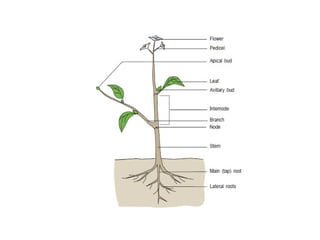
Parts of a seed bearing plant Review the parts of a plant Introduction to their function We will look at each in turn over the next few weeks – to understand how to grow plants effectively it is important to know how they work.
 
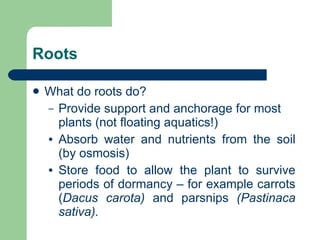
Roots What do roots do? Provide support and anchorage for most plants (not floating aquatics!) Absorb water and nutrients from the soil (by osmosis)  Store food to allow the plant to survive periods of dormancy – for example carrots ( Dacus carota)  and parsnips  (Pastinaca sativa).
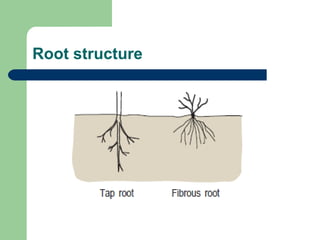
Root structure
Types of Root Primary root Secondary root Tap root Fibrous root Lateral root Adventitious roots
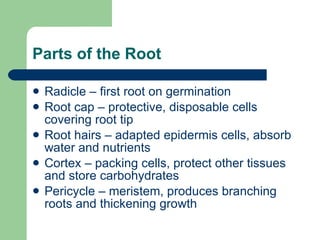
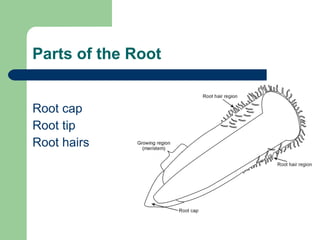
Parts of the Root Radicle – first root on germination Root cap – protective, disposable cells covering root tip Root hairs – adapted epidermis cells, absorb water and nutrients Cortex – packing cells, protect other tissues and store carbohydrates Pericycle – meristem, produces branching roots and thickening growth
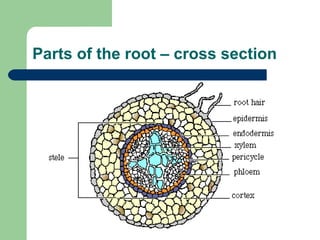
Parts of the root Root tip – root apical meristem  Epidermis – ‘skin’ or bark of the root Endodermis – layer of cells outside the pericycle that control entry and exit of water and dissolved nutrients  Xylem – carries water and dissolved nutrients from the roots to the tip of the shoots Phloem – carries dissolved sugars and carbohydrates etc from the leaves to where they are needed.
Parts of the root – cross section
Parts of the Root Root cap Root tip Root hairs
Root development Radicle (first root produced at germination) – rapid cell division at root apex meristem, production of root hairs and subsequently branching root development from the pericycle (lateral meristem of the root). Root branches in turn grow, produce root hairs and further branches.
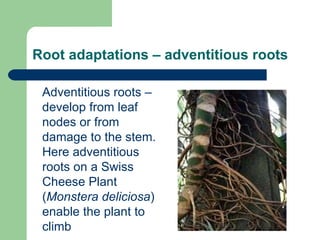
Root adaptations – adventitious roots Adventitious roots – develop from leaf nodes or from damage to the stem.  Here adventitious roots on a Swiss Cheese Plant ( Monstera deliciosa ) enable the plant to climb
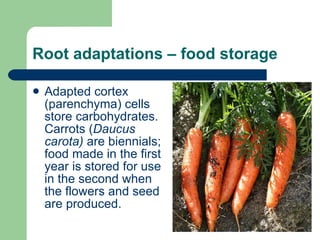
Root adaptations – food storage Adapted cortex (parenchyma) cells store carbohydrates.  Carrots ( Daucus carota)  are biennials; food made in the first year is stored for use in the second when the flowers and seed are produced.
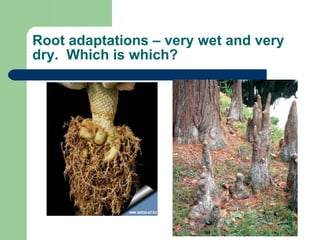
Root adaptations – very wet and very dry.  Which is which?
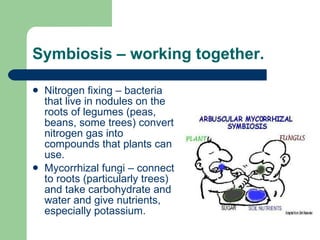
Symbiosis – working together. Nitrogen fixing – bacteria that live in nodules on the roots of legumes (peas, beans, some trees) convert nitrogen gas into compounds that plants can use. Mycorrhizal fungi – connect to roots (particularly trees) and take carbohydrate and water and give nutrients, especially potassium.
Learning outcomes -review 1.2  Parts of the plant – an overview 1.2.1 State the parts of a typical seed bearing plant and their respective purposes. 1.3 Roots.(1)  1.3.1 Describe how the root system develops from the radicle. 1.3.2  Define the meaning of ‘primary’, ‘secondary’, ‘tap’, ‘lateral’, ‘fibrous’, and ‘adventitious’ roots. 1.3.3 Describe the external structure of the root tip and the role of the root cap and root hairs. 1.3.4 Describe how the root is adapted in order to perform specific functions. 1.3.5 Root fungi - symbiosis 1.3.6  Describe transverse sections of the young dicotyledon root; these should include the location of the following: epidermis, cortex, xylem, phloem, pith, cambium, vascular bundles, endodermis, pericycle, cuticle

Rhs year 1 week 4 2011

  • 1.
    RHS Level 2Certificate Year 1 Week 4 Parts of the Plant Roots
  • 2.
    Learning objectives 1.2 Parts of the plant – an overview 1.2.1 State the parts of a typical seed bearing plant and their respective purposes. 1.3 Roots.(1) 1.3.1 Describe how the root system develops from the radicle. 1.3.2 Define the meaning of ‘primary’, ‘secondary’, ‘tap’, ‘lateral’, ‘fibrous’, and ‘adventitious’ roots. 1.3.3 Describe the external structure of the root tip and the role of the root cap and root hairs. 1.3.4 Describe how the root is adapted in order to perform specific functions. 1.3.5 Root fungi - symbiosis 1.3.6 Describe transverse sections of the young dicotyledon root; these should include the location of the following: epidermis, cortex, xylem, phloem, pith, cambium, vascular bundles, endodermis, pericycle, cuticle .
  • 3.
    Parts of aseed bearing plant Review the parts of a plant Introduction to their function We will look at each in turn over the next few weeks – to understand how to grow plants effectively it is important to know how they work.
  • 4.
  • 5.
    Roots What doroots do? Provide support and anchorage for most plants (not floating aquatics!) Absorb water and nutrients from the soil (by osmosis) Store food to allow the plant to survive periods of dormancy – for example carrots ( Dacus carota) and parsnips (Pastinaca sativa).
  • 6.
  • 7.
    Types of RootPrimary root Secondary root Tap root Fibrous root Lateral root Adventitious roots
  • 8.
    Parts of theRoot Radicle – first root on germination Root cap – protective, disposable cells covering root tip Root hairs – adapted epidermis cells, absorb water and nutrients Cortex – packing cells, protect other tissues and store carbohydrates Pericycle – meristem, produces branching roots and thickening growth
  • 9.
    Parts of theroot Root tip – root apical meristem Epidermis – ‘skin’ or bark of the root Endodermis – layer of cells outside the pericycle that control entry and exit of water and dissolved nutrients Xylem – carries water and dissolved nutrients from the roots to the tip of the shoots Phloem – carries dissolved sugars and carbohydrates etc from the leaves to where they are needed.
  • 10.
    Parts of theroot – cross section
  • 11.
    Parts of theRoot Root cap Root tip Root hairs
  • 12.
    Root development Radicle(first root produced at germination) – rapid cell division at root apex meristem, production of root hairs and subsequently branching root development from the pericycle (lateral meristem of the root). Root branches in turn grow, produce root hairs and further branches.
  • 13.
    Root adaptations –adventitious roots Adventitious roots – develop from leaf nodes or from damage to the stem. Here adventitious roots on a Swiss Cheese Plant ( Monstera deliciosa ) enable the plant to climb
  • 14.
    Root adaptations –food storage Adapted cortex (parenchyma) cells store carbohydrates. Carrots ( Daucus carota) are biennials; food made in the first year is stored for use in the second when the flowers and seed are produced.
  • 15.
    Root adaptations –very wet and very dry. Which is which?
  • 16.
    Symbiosis – workingtogether. Nitrogen fixing – bacteria that live in nodules on the roots of legumes (peas, beans, some trees) convert nitrogen gas into compounds that plants can use. Mycorrhizal fungi – connect to roots (particularly trees) and take carbohydrate and water and give nutrients, especially potassium.
  • 17.
    Learning outcomes -review1.2 Parts of the plant – an overview 1.2.1 State the parts of a typical seed bearing plant and their respective purposes. 1.3 Roots.(1) 1.3.1 Describe how the root system develops from the radicle. 1.3.2 Define the meaning of ‘primary’, ‘secondary’, ‘tap’, ‘lateral’, ‘fibrous’, and ‘adventitious’ roots. 1.3.3 Describe the external structure of the root tip and the role of the root cap and root hairs. 1.3.4 Describe how the root is adapted in order to perform specific functions. 1.3.5 Root fungi - symbiosis 1.3.6 Describe transverse sections of the young dicotyledon root; these should include the location of the following: epidermis, cortex, xylem, phloem, pith, cambium, vascular bundles, endodermis, pericycle, cuticle