Lesson Overview
23.2 Roots
Lesson Overview

Roots

THINK ABOUT IT
Can you guess how large a typical plant’s root system is?
A study of a single rye plant showed that the length of all the branches in its root
system was an astonishing 663 kilometers (412 miles). The surface area of these
roots was more than 600 square meters—130 times greater than the combined
areas of its stems and leaves!
Lesson Overview

Roots

Root Structure and Growth
What are the main tissues in a mature root?
Lesson Overview

Roots

Root Structure and Growth
What are the main tissues in a mature root?
A mature root has an outside layer, called the epidermis, and also contains
vascular tissue and a large area of ground tissue.
Lesson Overview

Roots

Root Structure and Growth
As soon as a seed begins to sprout, it puts out its first root to draw water and
nutrients from the soil.
Rapid cell growth pushes the tips of the growing roots into the soil.
The new roots provide raw materials for the developing stems and leaves before
they emerge from the soil.
Lesson Overview

Roots

Types of Root Systems
The two main types of root systems are taproot systems and fibrous
root systems.
Taproot systems are found mainly in dicots. Dandelions have a
taproot system.
Fibrous root systems are found mainly in monocots. Grasses have a fibrous
root system.
Lesson Overview

Roots

Taproot System
In some plants, the primary root grows long and thick and gives rise to
smaller branch roots. The large primary root is called a taproot.
The taproots of oak and hickory trees grow so long that they can reach
water several meters below the surface.
For example, a dandelion has a short, thick taproot that stores sugars
and starches.
Lesson Overview

Roots

Fibrous Root System
In other plants, such as grass, the system begins with one primary
root. But it is soon replaced by many equally sized branch roots that
grow separately from the base of the stem.
The extensive fibrous root systems produced by many plants help
prevent topsoil from being washed away by heavy rain.
Lesson Overview

Roots

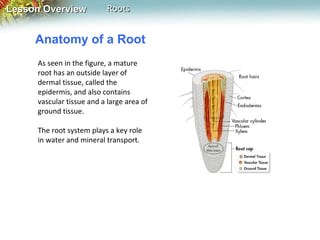
Anatomy of a Root
As seen in the figure, a mature
root has an outside layer of
dermal tissue, called the
epidermis, and also contains
vascular tissue and a large area of
ground tissue.
The root system plays a key role
in water and mineral transport.
Lesson Overview

Roots

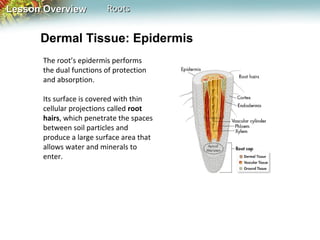
Dermal Tissue: Epidermis
The root’s epidermis performs
the dual functions of protection
and absorption.
Its surface is covered with thin
cellular projections called root
hairs, which penetrate the spaces
between soil particles and
produce a large surface area that
allows water and minerals to
enter.
Lesson Overview

Roots

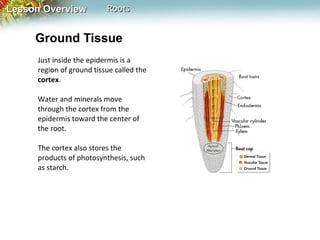
Ground Tissue
Just inside the epidermis is a
region of ground tissue called the
cortex.
Water and minerals move
through the cortex from the
epidermis toward the center of
the root.
The cortex also stores the
products of photosynthesis, such
as starch.
Lesson Overview

Roots

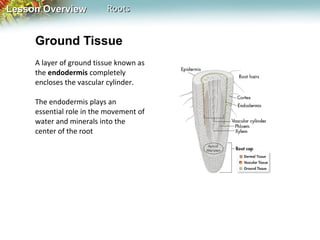
Ground Tissue
A layer of ground tissue known as
the endodermis completely
encloses the vascular cylinder.
The endodermis plays an
essential role in the movement of
water and minerals into the
center of the root
Lesson Overview

Roots

Vascular Tissue
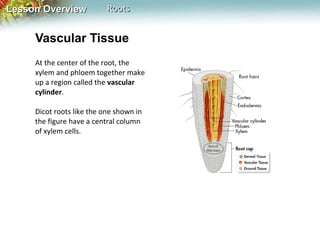
At the center of the root, the
xylem and phloem together make
up a region called the vascular
cylinder.
Dicot roots like the one shown in
the figure have a central column
of xylem cells.
Lesson Overview

Roots

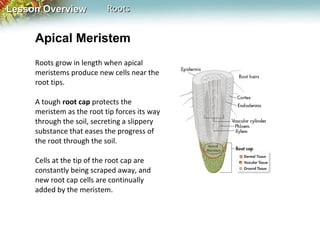
Apical Meristem
Roots grow in length when apical
meristems produce new cells near the
root tips.
A tough root cap protects the
meristem as the root tip forces its way
through the soil, secreting a slippery
substance that eases the progress of
the root through the soil.
Cells at the tip of the root cap are
constantly being scraped away, and
new root cap cells are continually
added by the meristem.
Lesson Overview

Roots

Root Functions
What are the different functions of roots?
Lesson Overview

Roots

Root Functions
What are the different functions of roots?
Roots support a plant, anchor it in the ground, store food, and absorb water and
dissolved nutrients from the soil.
Lesson Overview

Roots

Uptake of Plant Nutrients
Soil is a complex mixture of sand, silt, clay, air, and bits of decaying animal and
plant tissue. Soil in different places contains varying amounts of these ingredients.
The ingredients define the soil and determine, to a large extent, the kinds of
plants that can grow in it.
Lesson Overview

Roots

Uptake of Plant Nutrients
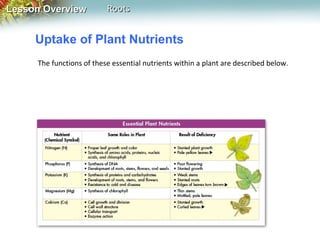
To grow, flower, and produce seeds, plants require a variety of inorganic
nutrients. The nutrients needed in largest amounts are nitrogen, phosphorus,
potassium, magnesium, and calcium.
Lesson Overview

Roots

Uptake of Plant Nutrients
The functions of these essential nutrients within a plant are described below.
Lesson Overview

Roots

Uptake of Plant Nutrients
Small amounts of other nutrients, called trace elements, are also important. These
trace elements include sulfur, iron, zinc, molybdenum, boron, copper, manganese,
and chlorine.
As important as they are, excessive amounts of any of these nutrients in soil can
also be poisonous to plants.
Lesson Overview

Roots

Active Transport of Dissolved Nutrients
The cell membranes of root hairs and other cells in the root epidermis contain
active transport proteins.
Active transport brings the mineral ions of dissolved nutrients from the soil into
the plant.
The high concentration of mineral ions in the plant cells causes water molecules
to move into the plant by osmosis.
Lesson Overview

Roots

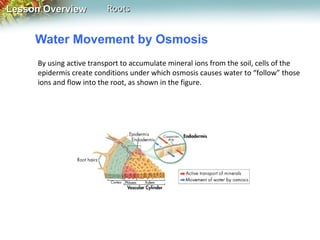
Water Movement by Osmosis
By using active transport to accumulate mineral ions from the soil, cells of the
epidermis create conditions under which osmosis causes water to “follow” those
ions and flow into the root, as shown in the figure.
Lesson Overview

Roots

Movement Into the Vascular Cylinder
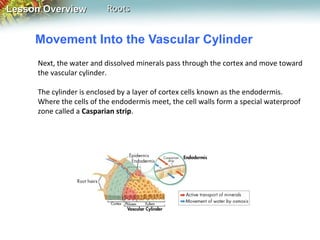
Next, the water and dissolved minerals pass through the cortex and move toward
the vascular cylinder.
The cylinder is enclosed by a layer of cortex cells known as the endodermis.
Where the cells of the endodermis meet, the cell walls form a special waterproof
zone called a Casparian strip.
Lesson Overview

Roots

Movement Into the Vascular Cylinder
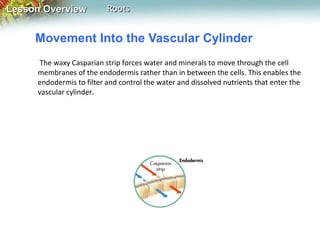
The waxy Casparian strip forces water and minerals to move through the cell
membranes of the endodermis rather than in between the cells. This enables the
endodermis to filter and control the water and dissolved nutrients that enter the
vascular cylinder.
Lesson Overview

Roots

Movement Into the Vascular Cylinder
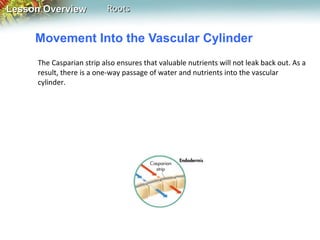
The Casparian strip also ensures that valuable nutrients will not leak back out. As a
result, there is a one-way passage of water and nutrients into the vascular
cylinder.
Lesson Overview

Roots

Root Pressure
As minerals are pumped into the vascular cylinder, more and more water follows
by osmosis, producing a strong pressure.
Contained within the Casparian strip, the water has just one place to go—up. Root
pressure, produced within the cylinder by active transport, forces water through
the vascular cylinder and into the xylem. As more water moves from the cortex
into the vascular cylinder, more water in the xylem is forced upward through the
root into the stem.
Lesson Overview

Roots

Root Pressure Demonstration

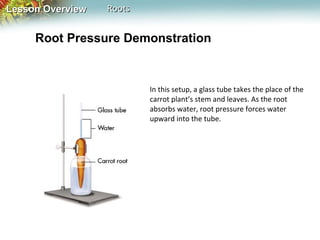
In this setup, a glass tube takes the place of the
carrot plant’s stem and leaves. As the root
absorbs water, root pressure forces water
upward into the tube.

B10vrv6232

  • 1.
  • 2.
    Lesson Overview Roots THINK ABOUTIT Can you guess how large a typical plant’s root system is? A study of a single rye plant showed that the length of all the branches in its root system was an astonishing 663 kilometers (412 miles). The surface area of these roots was more than 600 square meters—130 times greater than the combined areas of its stems and leaves!
  • 3.
    Lesson Overview Roots Root Structureand Growth What are the main tissues in a mature root?
  • 4.
    Lesson Overview Roots Root Structureand Growth What are the main tissues in a mature root? A mature root has an outside layer, called the epidermis, and also contains vascular tissue and a large area of ground tissue.
  • 5.
    Lesson Overview Roots Root Structureand Growth As soon as a seed begins to sprout, it puts out its first root to draw water and nutrients from the soil. Rapid cell growth pushes the tips of the growing roots into the soil. The new roots provide raw materials for the developing stems and leaves before they emerge from the soil.
  • 6.
    Lesson Overview Roots Types ofRoot Systems The two main types of root systems are taproot systems and fibrous root systems. Taproot systems are found mainly in dicots. Dandelions have a taproot system. Fibrous root systems are found mainly in monocots. Grasses have a fibrous root system.
  • 7.
    Lesson Overview Roots Taproot System Insome plants, the primary root grows long and thick and gives rise to smaller branch roots. The large primary root is called a taproot. The taproots of oak and hickory trees grow so long that they can reach water several meters below the surface. For example, a dandelion has a short, thick taproot that stores sugars and starches.
  • 8.
    Lesson Overview Roots Fibrous RootSystem In other plants, such as grass, the system begins with one primary root. But it is soon replaced by many equally sized branch roots that grow separately from the base of the stem. The extensive fibrous root systems produced by many plants help prevent topsoil from being washed away by heavy rain.
  • 9.
    Lesson Overview Roots Anatomy ofa Root As seen in the figure, a mature root has an outside layer of dermal tissue, called the epidermis, and also contains vascular tissue and a large area of ground tissue. The root system plays a key role in water and mineral transport.
  • 10.
    Lesson Overview Roots Dermal Tissue:Epidermis The root’s epidermis performs the dual functions of protection and absorption. Its surface is covered with thin cellular projections called root hairs, which penetrate the spaces between soil particles and produce a large surface area that allows water and minerals to enter.
  • 11.
    Lesson Overview Roots Ground Tissue Justinside the epidermis is a region of ground tissue called the cortex. Water and minerals move through the cortex from the epidermis toward the center of the root. The cortex also stores the products of photosynthesis, such as starch.
  • 12.
    Lesson Overview Roots Ground Tissue Alayer of ground tissue known as the endodermis completely encloses the vascular cylinder. The endodermis plays an essential role in the movement of water and minerals into the center of the root
  • 13.
    Lesson Overview Roots Vascular Tissue Atthe center of the root, the xylem and phloem together make up a region called the vascular cylinder. Dicot roots like the one shown in the figure have a central column of xylem cells.
  • 14.
    Lesson Overview Roots Apical Meristem Rootsgrow in length when apical meristems produce new cells near the root tips. A tough root cap protects the meristem as the root tip forces its way through the soil, secreting a slippery substance that eases the progress of the root through the soil. Cells at the tip of the root cap are constantly being scraped away, and new root cap cells are continually added by the meristem.
  • 15.
    Lesson Overview Roots Root Functions Whatare the different functions of roots?
  • 16.
    Lesson Overview Roots Root Functions Whatare the different functions of roots? Roots support a plant, anchor it in the ground, store food, and absorb water and dissolved nutrients from the soil.
  • 17.
    Lesson Overview Roots Uptake ofPlant Nutrients Soil is a complex mixture of sand, silt, clay, air, and bits of decaying animal and plant tissue. Soil in different places contains varying amounts of these ingredients. The ingredients define the soil and determine, to a large extent, the kinds of plants that can grow in it.
  • 18.
    Lesson Overview Roots Uptake ofPlant Nutrients To grow, flower, and produce seeds, plants require a variety of inorganic nutrients. The nutrients needed in largest amounts are nitrogen, phosphorus, potassium, magnesium, and calcium.
  • 19.
    Lesson Overview Roots Uptake ofPlant Nutrients The functions of these essential nutrients within a plant are described below.
  • 20.
    Lesson Overview Roots Uptake ofPlant Nutrients Small amounts of other nutrients, called trace elements, are also important. These trace elements include sulfur, iron, zinc, molybdenum, boron, copper, manganese, and chlorine. As important as they are, excessive amounts of any of these nutrients in soil can also be poisonous to plants.
  • 21.
    Lesson Overview Roots Active Transportof Dissolved Nutrients The cell membranes of root hairs and other cells in the root epidermis contain active transport proteins. Active transport brings the mineral ions of dissolved nutrients from the soil into the plant. The high concentration of mineral ions in the plant cells causes water molecules to move into the plant by osmosis.
  • 22.
    Lesson Overview Roots Water Movementby Osmosis By using active transport to accumulate mineral ions from the soil, cells of the epidermis create conditions under which osmosis causes water to “follow” those ions and flow into the root, as shown in the figure.
  • 23.
    Lesson Overview Roots Movement Intothe Vascular Cylinder Next, the water and dissolved minerals pass through the cortex and move toward the vascular cylinder. The cylinder is enclosed by a layer of cortex cells known as the endodermis. Where the cells of the endodermis meet, the cell walls form a special waterproof zone called a Casparian strip.
  • 24.
    Lesson Overview Roots Movement Intothe Vascular Cylinder The waxy Casparian strip forces water and minerals to move through the cell membranes of the endodermis rather than in between the cells. This enables the endodermis to filter and control the water and dissolved nutrients that enter the vascular cylinder.
  • 25.
    Lesson Overview Roots Movement Intothe Vascular Cylinder The Casparian strip also ensures that valuable nutrients will not leak back out. As a result, there is a one-way passage of water and nutrients into the vascular cylinder.
  • 26.
    Lesson Overview Roots Root Pressure Asminerals are pumped into the vascular cylinder, more and more water follows by osmosis, producing a strong pressure. Contained within the Casparian strip, the water has just one place to go—up. Root pressure, produced within the cylinder by active transport, forces water through the vascular cylinder and into the xylem. As more water moves from the cortex into the vascular cylinder, more water in the xylem is forced upward through the root into the stem.
  • 27.
    Lesson Overview Roots Root PressureDemonstration In this setup, a glass tube takes the place of the carrot plant’s stem and leaves. As the root absorbs water, root pressure forces water upward into the tube.