


Presented by:-
Bharat Kumar Mewara
M.N. (Prev.)
R.A.K. College of Nursing, New Delhi
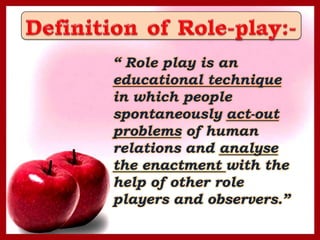
“ Role play is an
educational technique
in which people
spontaneously act-out
problems of human
relations and analyse
the enactment with the
help of other role
players and observers.”
“It is the form of un-rehearsed
drama in which members of
group assume the roles of
principal characters in the
problem under the discussion.


         It makes possible the
      maximum participation of a
       group through acting out
          an example of some
            problem or idea.”
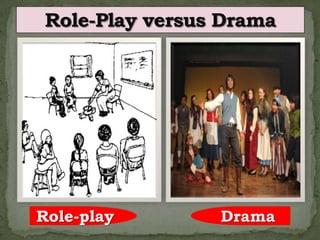
Role-play   Drama
Value of Role-playing

1. The actor really tries to feel the part
   of character.
2. Enjoyed by the people who do it.
3. Doesn’t need equipments.
3. Involves a group through
   participation.
4. Arouses interest in a problem.
5. Makes a problem seem real to a group.
6. Helps to understand the point of view.
Value of Role-playing
8. Trains leadership skill.
9. The student not only hears about a
   problem or tells about it, but he lives
   through it.
10. Helps to develop new skills for dealing
    with problems in human relations.
11. It is the way of presenting human
    relations problems, because the student
    can experiment with behaviour, make
    mistakes and try new skill without
    chancing the hurts that experimentation
    in real- life situation may involve.
Principles as
guides to the use
 of role playing:-
 Careful definition of the goals and
    objectives.
   Selection of the characters according to
    enthusiasm, sincerity and willingness of
    the players.
   Should not be rehearsed.
   Should be stimulant to thinking
   Flexible
   Brief. (15 minutes)
   Analysis and evaluation immediately
    following role-playing
Steps of Role-playing

1. Selection of a problem
2. Construction of role- play
   situation
3. Casting the players
4. Briefing
5. Role-playing action
6. Discussion & analysis of
   action
7. Evaluation
Steps of Role-playing


1. Selection
of a problem
Steps of Role-playing


2. Construction of
role-play situation
Steps of Role-playing


3. Casting the
    players
Steps of Role-playing


4. Briefing
Steps of Role-playing


5. Role-playing
    action
Steps of Role-playing


6. Discussion and
analysis of action
Steps of Role-playing


7. Evaluation
1.Allow students to develop an
             understanding of others
             perspectives.
           2.Encourage students to work
             with others in analysing
             situations and developing
             solutions.
           3.Provide opportunity to apply
             concepts they have learned.
           4.Gives students to effectively
             contrast problem-solving
             methods by role playing a
  For        situation several times.
students
5. Offers a channel through
             which feelings can be
             expressed and feedback
             processed.
           6. Helps to build self-esteem
             and confidence.
           7. Helps to develop real
             communication skills in
             leadership, interviewing and
             social interaction.
           8. Helps to develop ability to
             observe and analyse
  For        situation.
students
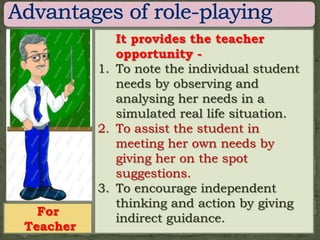
It provides the teacher
             opportunity -
          1. To note the individual student
             needs by observing and
             analysing her needs in a
             simulated real life situation.
          2. To assist the student in
             meeting her own needs by
             giving her on the spot
             suggestions.
          3. To encourage independent
             thinking and action by giving
  For
             indirect guidance.
Teacher
1. It requires expert’s guidance and
   leadership.
2. Sometimes participants may feel
   threatened.
3. Used as an educational technique, not a
   therapeutic one.
4. Strongly dependent on student’s
   imagination.
5. Time consuming in developing group
   readiness. It should not be used when
   there is pressure of time present.
6. Limited by the teacher’s ingenuity and
   realistic use.
 Definition of role-play
 Role-play versus
  drama
 Principles of Role
  play
 Steps of Role-play
 Advantages of Role
  play
 Disadvantages of
  Role-play.
Role playing

Role playing

  • 1.
    Presented by:- Bharat KumarMewara M.N. (Prev.) R.A.K. College of Nursing, New Delhi
  • 3.
    “ Role playis an educational technique in which people spontaneously act-out problems of human relations and analyse the enactment with the help of other role players and observers.”
  • 4.
    “It is theform of un-rehearsed drama in which members of group assume the roles of principal characters in the problem under the discussion. It makes possible the maximum participation of a group through acting out an example of some problem or idea.”
  • 5.
  • 6.
    Value of Role-playing 1.The actor really tries to feel the part of character. 2. Enjoyed by the people who do it. 3. Doesn’t need equipments. 3. Involves a group through participation. 4. Arouses interest in a problem. 5. Makes a problem seem real to a group. 6. Helps to understand the point of view.
  • 7.
    Value of Role-playing 8.Trains leadership skill. 9. The student not only hears about a problem or tells about it, but he lives through it. 10. Helps to develop new skills for dealing with problems in human relations. 11. It is the way of presenting human relations problems, because the student can experiment with behaviour, make mistakes and try new skill without chancing the hurts that experimentation in real- life situation may involve.
  • 8.
    Principles as guides tothe use of role playing:-
  • 9.
     Careful definitionof the goals and objectives.  Selection of the characters according to enthusiasm, sincerity and willingness of the players.  Should not be rehearsed.  Should be stimulant to thinking  Flexible  Brief. (15 minutes)  Analysis and evaluation immediately following role-playing
  • 10.
    Steps of Role-playing 1.Selection of a problem 2. Construction of role- play situation 3. Casting the players 4. Briefing 5. Role-playing action 6. Discussion & analysis of action 7. Evaluation
  • 11.
    Steps of Role-playing 1.Selection of a problem
  • 12.
    Steps of Role-playing 2.Construction of role-play situation
  • 13.
    Steps of Role-playing 3.Casting the players
  • 14.
  • 15.
    Steps of Role-playing 5.Role-playing action
  • 16.
    Steps of Role-playing 6.Discussion and analysis of action
  • 17.
  • 18.
    1.Allow students todevelop an understanding of others perspectives. 2.Encourage students to work with others in analysing situations and developing solutions. 3.Provide opportunity to apply concepts they have learned. 4.Gives students to effectively contrast problem-solving methods by role playing a For situation several times. students
  • 19.
    5. Offers achannel through which feelings can be expressed and feedback processed. 6. Helps to build self-esteem and confidence. 7. Helps to develop real communication skills in leadership, interviewing and social interaction. 8. Helps to develop ability to observe and analyse For situation. students
  • 20.
    It provides theteacher opportunity - 1. To note the individual student needs by observing and analysing her needs in a simulated real life situation. 2. To assist the student in meeting her own needs by giving her on the spot suggestions. 3. To encourage independent thinking and action by giving For indirect guidance. Teacher
  • 21.
    1. It requiresexpert’s guidance and leadership. 2. Sometimes participants may feel threatened. 3. Used as an educational technique, not a therapeutic one. 4. Strongly dependent on student’s imagination. 5. Time consuming in developing group readiness. It should not be used when there is pressure of time present. 6. Limited by the teacher’s ingenuity and realistic use.
  • 22.
     Definition ofrole-play  Role-play versus drama  Principles of Role play  Steps of Role-play  Advantages of Role play  Disadvantages of Role-play.