ROLE PLAY
PREPARED BY
Ms. JASPHIN VENCY
Nursing Tutor
Department of child health nursing
Shri Sathya Sai College of Nursing
Affiliated by Shri Balaji Vidyapeeth University-
PUDUCHERRY
ROLE PLAY
INTRODUCTION:
Role playing is a discussion techniques that
makes it possible to get maximum participation of
a group through acting out an example of some
problem or idea under discussion.
DEFINITION:
Role playing is educational techniques in which
people spontaneously act out a problem of human
relations and analyze the enactment with the help of
the other role players and observers.
- Plato
PURPOSE:
To convey information.
To provide emotional and affective stimulus
for solving problems.
To develop specific skills.
To develop a situation for analysis.
CONTD …
To provide awareness about social and psychological
solving problems.
To prepare for meeting future situation.
To develop understanding of point of view of others.
PRINCIPLES OF ROLE PLAY:
As a teaching techniques role playing is based on the
philosophy that meaning are in people , not in words
or symbols.
It should be based on realistic and life related problem
situation rather than through hearing about such
situation from others.
CONTD…
Role play is flexible.
It should be brief.
Role should be rehearsed to produce an effective
outcome and on the audience to help players interpret
their roles.
CONTD…
Role play should be stimulant to thinking and should
not be escape from discipline of learning.
There is no single method of selecting the character;
the group may do the assigning.
Analysis and evaluation are essential to attain the
maximum learning benefits.
TYPES OF ROLE PLAY:
Multiple Role Play:
In this type of role play, all trainees are in groups, with
each groups acting out the role play simultaneously. After the
role play , each group analyzes the interactions and identifies
the learning points .
SINGLE ROLE PLAY:
One group of participants acts out the role various role
for the rest, providing demonstrations of the situation.
Other participants observe the role play , analyze their
interactions with one another and learn from the play.
ROLE ROTATION:
It start as a single role play .After the interaction of
participants , the trainer will stop the role play and
discuss what happened so far .Then the participants are
asked to exchange characters. This method allows a
variety of ways to approach the situations and carry-out
the roles.
CONTD….
Spontaneous role play:
In this kind of role play, one of the trainees play
herself while the other trainees play people with whom
the first participant interacted before.
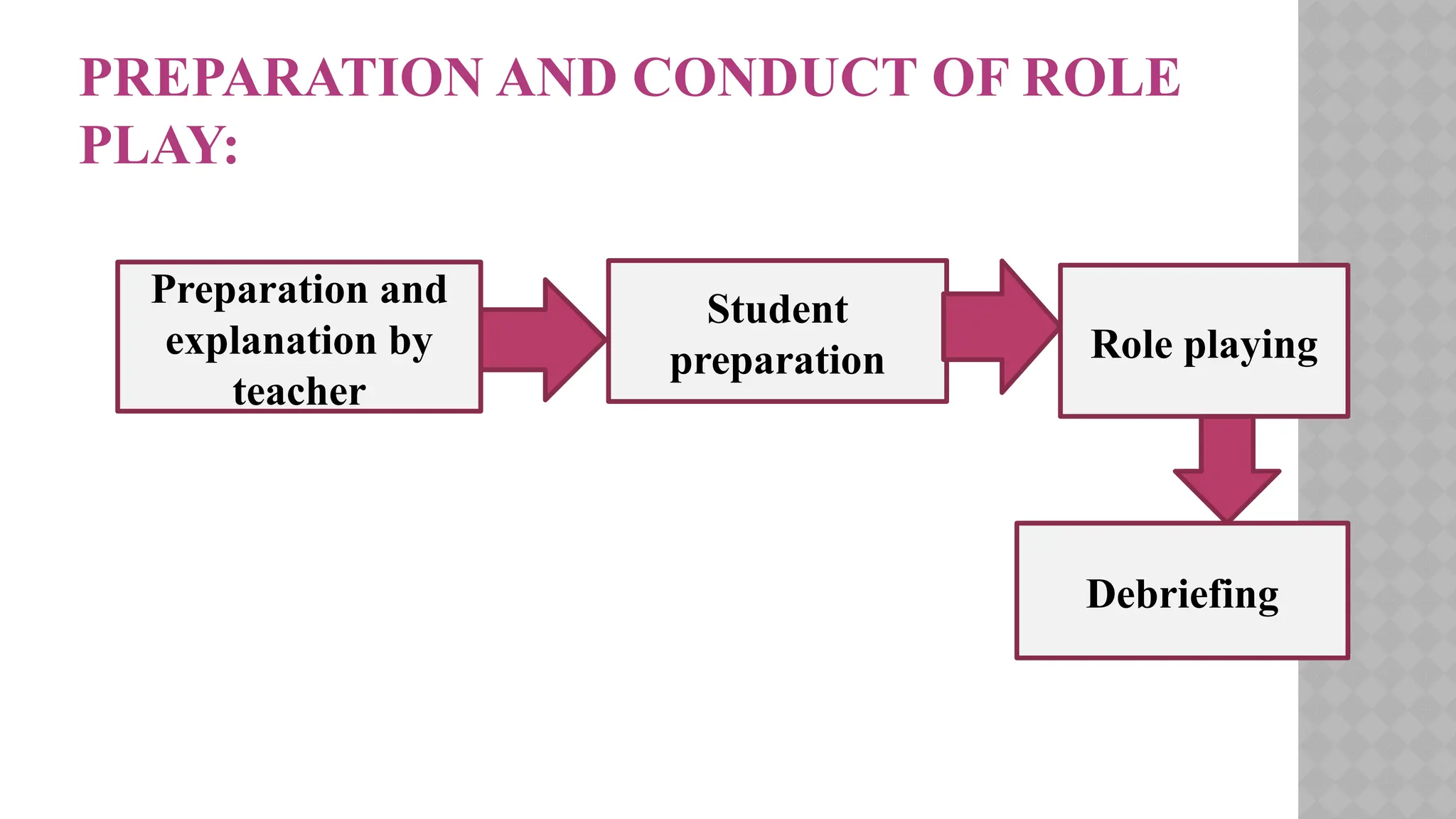
PREPARATION AND CONDUCT OF ROLE
PLAY:
Student
preparation Role playing
Debriefing
Preparation and
explanation by
teacher
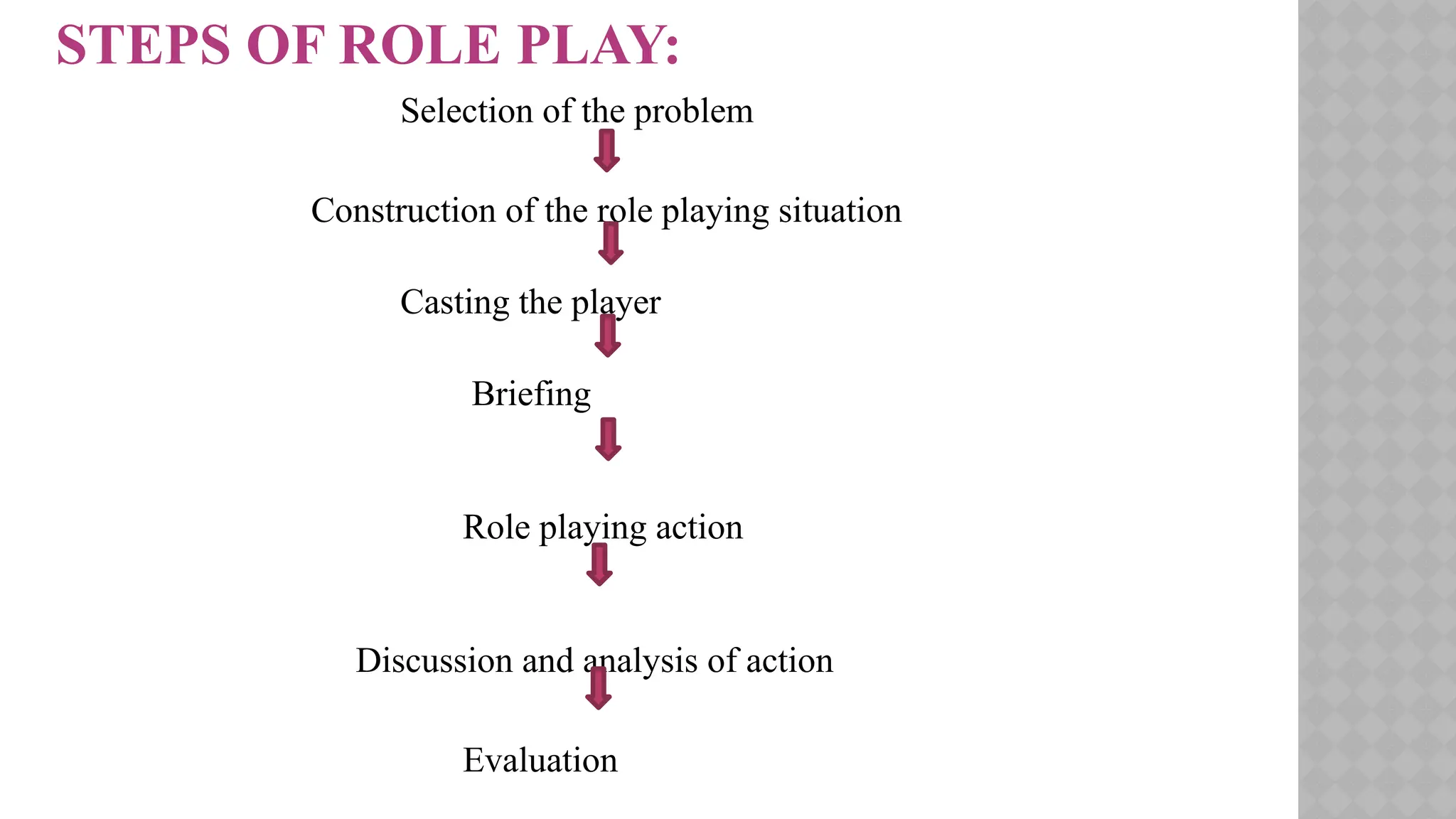
STEPS OF ROLE PLAY:
Selection of the problem
Construction of the role playing situation
Casting the player
Briefing
Role playing action
Discussion and analysis of action
Evaluation
STPES IN ROLE PLAY:
Selection Of The Problem:
The problem must be selected with group content . It
should be clear and related to human relation situation that
serves a useful purpose within the context of the subjective
being studied . Pick a situation that learners might experience
in day-to-day life.
CONSTRUCTION OF THE ROLE PLAYING SITUATION:
The purpose of the role playing session serves as the guide
for preparing content to stimulate reality problem. Situations
can be planned by the total group / by a sub-committee or by
the teacher.
Casting The Players:
Students as players should always be selected among those
willing to act in order to avoid misinterpretation of the role and
to preserve their self esteem. Explain to learners beforehand that
role-play will be one of the activities that will be performed and
will require them to practice.
CONTD …
Discuss the advantages of role play with students and explain
how and why it is helpful for them to learn . Tell them how they
can deal with mistakes. Explain that it could be enjoyable and
even fun.
BRIEFING:
Introduce the basic functions; this stage will normally be
conducted as whole group work. Decide on the number
and type of roles and allocate .
Role Playing Action:
Decide on the task, exercise and prompts that will be
used to get learners into their role. These might include cue or
prompt cards , reading exercises , individual research , briefing
sheets , or information gap exercises . Make sure to pick the
kind of prompt for each person . The scene is played as simply
and concisely as possible . The time to be limited to not more
than 15 minutes.
DISCUSSION AND ANALYSIS OF ACTION:
Discussion should not revolve around the acting abilities
of the students. The focus of discussion should be on the
contributions made toward the understanding of taken up
issue / problem area .
Evaluation:
The teacher should conclude , evaluate and
summaries at the end . Assess whether the purpose has
been achieved or not . Participant’s responses can be
obtained through discussions or on the
checklist /questionnaire.
SPECIFICALLY , ROLE PLAYING CAN BE USED TO
HELP STUDENTS :
Develop real communication skills in leadership, interviewing and
social interaction and obtain constructive feedback from peers.
Develop skill in group problem-solving.
Develop ability to observe and analyze situations.
Practice selected behaviors in a real life situation without the stress
of making a mistake. A person is more apt to permit true feelings
to be expressed when it is safe to do so .
ROLE PLAYING HELPS THE TEACHER :
Note the individual student needs by observing and analyzing
her needs in a stimulated real life situation.
Assist the student in meeting her own needs by either giving or
encouraging group members to give her on spot suggestions.
Encourage independent thinking and action by stepping aside
or giving indirect guidance , for emphasis is on the students
helping themselves.
ADVANTAGES OF ROLE PLAY:
Role-play Encourages hands on training.
Role play adds variety, reality , and specificity to
the learning experience.
It enables brain storming and them building.
It enables to enhances feeling of tolerance and
empathy in student.
It help to develop problem-solving and verbal
expression of skills in students.
CONTD…
Role play provides practice to build skills before
real-world application and when ‘real’ experiences
are not readily available.
It can provide an entirely new perspective of
situation and develop insights about feelings and
relationship.
DISADVANTAGES OF ROLE PLAY:
Role playing is a means, not an end.
It requires export guidance and leadership.
Limited to small groups.
Can be time –consuming.
Sometimes participants may feel threatened.
Effective only when learners have adequate knowledge and
skill to perform what is requested. Can lead to when students
are not sure of expectation.
CONTD…
Used as an education technique , not as a therapeutic one .
Strongly dependent on student’s imagination.
Can be a tendency by some participants to overly exaggerate
their assigned roles.
Time consuming in developing group readiness , should not
be used when pressure of time is present.
CONCLUSION :
Firstly ,role play is not beneficial only for the pre
intermediate students but even students of upper levels as
well as lower levels. Role play proves to be a good way to
motivate English learners to speck out what they want to say.
In fact , students have to experience different situations in
real life .
microteaching on role play.pptx in nursing

microteaching on role play.pptx in nursing

  • 1.
    ROLE PLAY PREPARED BY Ms.JASPHIN VENCY Nursing Tutor Department of child health nursing Shri Sathya Sai College of Nursing Affiliated by Shri Balaji Vidyapeeth University- PUDUCHERRY
  • 3.
  • 4.
    INTRODUCTION: Role playing isa discussion techniques that makes it possible to get maximum participation of a group through acting out an example of some problem or idea under discussion.
  • 5.
    DEFINITION: Role playing iseducational techniques in which people spontaneously act out a problem of human relations and analyze the enactment with the help of the other role players and observers. - Plato
  • 6.
    PURPOSE: To convey information. Toprovide emotional and affective stimulus for solving problems. To develop specific skills. To develop a situation for analysis.
  • 7.
    CONTD … To provideawareness about social and psychological solving problems. To prepare for meeting future situation. To develop understanding of point of view of others.
  • 8.
    PRINCIPLES OF ROLEPLAY: As a teaching techniques role playing is based on the philosophy that meaning are in people , not in words or symbols. It should be based on realistic and life related problem situation rather than through hearing about such situation from others.
  • 9.
    CONTD… Role play isflexible. It should be brief. Role should be rehearsed to produce an effective outcome and on the audience to help players interpret their roles.
  • 10.
    CONTD… Role play shouldbe stimulant to thinking and should not be escape from discipline of learning. There is no single method of selecting the character; the group may do the assigning. Analysis and evaluation are essential to attain the maximum learning benefits.
  • 11.
    TYPES OF ROLEPLAY: Multiple Role Play: In this type of role play, all trainees are in groups, with each groups acting out the role play simultaneously. After the role play , each group analyzes the interactions and identifies the learning points .
  • 12.
    SINGLE ROLE PLAY: Onegroup of participants acts out the role various role for the rest, providing demonstrations of the situation. Other participants observe the role play , analyze their interactions with one another and learn from the play.
  • 13.
    ROLE ROTATION: It startas a single role play .After the interaction of participants , the trainer will stop the role play and discuss what happened so far .Then the participants are asked to exchange characters. This method allows a variety of ways to approach the situations and carry-out the roles.
  • 14.
    CONTD…. Spontaneous role play: Inthis kind of role play, one of the trainees play herself while the other trainees play people with whom the first participant interacted before.
  • 15.
    PREPARATION AND CONDUCTOF ROLE PLAY: Student preparation Role playing Debriefing Preparation and explanation by teacher
  • 16.
    STEPS OF ROLEPLAY: Selection of the problem Construction of the role playing situation Casting the player Briefing Role playing action Discussion and analysis of action Evaluation
  • 17.
    STPES IN ROLEPLAY: Selection Of The Problem: The problem must be selected with group content . It should be clear and related to human relation situation that serves a useful purpose within the context of the subjective being studied . Pick a situation that learners might experience in day-to-day life.
  • 18.
    CONSTRUCTION OF THEROLE PLAYING SITUATION: The purpose of the role playing session serves as the guide for preparing content to stimulate reality problem. Situations can be planned by the total group / by a sub-committee or by the teacher.
  • 19.
    Casting The Players: Studentsas players should always be selected among those willing to act in order to avoid misinterpretation of the role and to preserve their self esteem. Explain to learners beforehand that role-play will be one of the activities that will be performed and will require them to practice.
  • 20.
    CONTD … Discuss theadvantages of role play with students and explain how and why it is helpful for them to learn . Tell them how they can deal with mistakes. Explain that it could be enjoyable and even fun.
  • 21.
    BRIEFING: Introduce the basicfunctions; this stage will normally be conducted as whole group work. Decide on the number and type of roles and allocate .
  • 22.
    Role Playing Action: Decideon the task, exercise and prompts that will be used to get learners into their role. These might include cue or prompt cards , reading exercises , individual research , briefing sheets , or information gap exercises . Make sure to pick the kind of prompt for each person . The scene is played as simply and concisely as possible . The time to be limited to not more than 15 minutes.
  • 23.
    DISCUSSION AND ANALYSISOF ACTION: Discussion should not revolve around the acting abilities of the students. The focus of discussion should be on the contributions made toward the understanding of taken up issue / problem area .
  • 24.
    Evaluation: The teacher shouldconclude , evaluate and summaries at the end . Assess whether the purpose has been achieved or not . Participant’s responses can be obtained through discussions or on the checklist /questionnaire.
  • 25.
    SPECIFICALLY , ROLEPLAYING CAN BE USED TO HELP STUDENTS : Develop real communication skills in leadership, interviewing and social interaction and obtain constructive feedback from peers. Develop skill in group problem-solving. Develop ability to observe and analyze situations. Practice selected behaviors in a real life situation without the stress of making a mistake. A person is more apt to permit true feelings to be expressed when it is safe to do so .
  • 26.
    ROLE PLAYING HELPSTHE TEACHER : Note the individual student needs by observing and analyzing her needs in a stimulated real life situation. Assist the student in meeting her own needs by either giving or encouraging group members to give her on spot suggestions. Encourage independent thinking and action by stepping aside or giving indirect guidance , for emphasis is on the students helping themselves.
  • 27.
    ADVANTAGES OF ROLEPLAY: Role-play Encourages hands on training. Role play adds variety, reality , and specificity to the learning experience. It enables brain storming and them building. It enables to enhances feeling of tolerance and empathy in student. It help to develop problem-solving and verbal expression of skills in students.
  • 28.
    CONTD… Role play providespractice to build skills before real-world application and when ‘real’ experiences are not readily available. It can provide an entirely new perspective of situation and develop insights about feelings and relationship.
  • 29.
    DISADVANTAGES OF ROLEPLAY: Role playing is a means, not an end. It requires export guidance and leadership. Limited to small groups. Can be time –consuming. Sometimes participants may feel threatened. Effective only when learners have adequate knowledge and skill to perform what is requested. Can lead to when students are not sure of expectation.
  • 30.
    CONTD… Used as aneducation technique , not as a therapeutic one . Strongly dependent on student’s imagination. Can be a tendency by some participants to overly exaggerate their assigned roles. Time consuming in developing group readiness , should not be used when pressure of time is present.
  • 31.
    CONCLUSION : Firstly ,roleplay is not beneficial only for the pre intermediate students but even students of upper levels as well as lower levels. Role play proves to be a good way to motivate English learners to speck out what they want to say. In fact , students have to experience different situations in real life .