Introduction Historical details – Monero, 1946 : Definition – planned learning…. 3 aspects  role taking role making role negotiation
Warning Putting on plays is training not education  Role-play is not theatrical rather an active learning medium, ongoing and/or spontaneous Simulation focused on context, and circumstances not roles – difference between role-play/simulation is one of focus not distinction
Value of Role-play in Drama education Encourage experimentation with roles, situations and try out range of behaviour possibilities Inclusive teaching strategy : whole class Roleplay draws on life experiences not acting ability : everybody has experienced a role in life
Value of Role-play in Drama education Participants negotiate social expectations of giving roles and dynamic interpretation Make abstract problems concrete Involve students in direct experiential knowledge/learning Promote life long learning Develop empathic understanding : emotional intelligence
Value of Role-play in Drama education Universal teaching strategies - 360 Active Collaberative Interactive Integrative
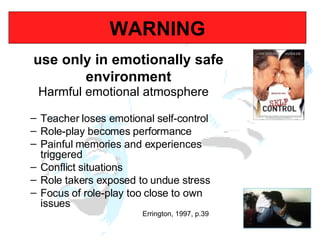
use only in emotionally safe environment Harmful emotional atmosphere Teacher loses emotional self-control Role-play becomes performance  Painful memories and experiences triggered  Conflict situations Role takers exposed to undue stress Focus of role-play too close to own issues Errington, 1997, p.39 WARNING
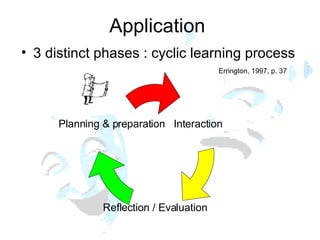
Application  3 distinct phases  Planning & preparation Interaction Reflection / Evaluation Errington, 1997, p. 37
Planning and Preparation Context  Objectives Identify scenario Locate roles Gather resources
Interaction Warm up  Establish ground rules Explicit objectives vs. exploration Reduce fears  Describe scenario
Interaction Allocate roles Explain teacher role in role-play Begin role-play – gradually Stop/ start as necessary Give clear signal show role-play has ended
Reflection & Evaluation Debriefing session Identification, classification, analysis of major issues Purpose is to make connections and provide opportunity to evaluate own learning
6 Steps of reflection Bring out of role Allow expression Consolidate ideas Group analysis Opportunities for peer evaluation Looking beyond
Application  3 distinct phases : cyclic learning process Errington, 1997, p. 37 Interaction Reflection / Evaluation Planning & preparation
How and what do students learn Involving students in direct participatory learning methods achieves deeper learning because students are placed in positions where they have to manipulate knowledge Promotes verbal, physical skills, logical and intuitive thinking, interpersonal skills, spatial, rhythmic and kinaesthetic  awareness
How and what do students learn Attempting to negotiate with other players ensures students engage in rehearsing life long learning skills fundamental to success in both role-play and life : oral communication, empathy, social competence Students become active empowered social actors & learn to cope with a range of human relationships
In closing Neelands pg. 20 involving young people…. Figure 4 We need to remember that kids strutting on stage is not the purpose of school drama. We need to question what learning is occurring and if our list does not include critical thinking, reflective praxis and a range of other skills as articulated in such documents as the curriculum framework

roleplay in the classroom

  • 1.
    Introduction Historical details– Monero, 1946 : Definition – planned learning…. 3 aspects role taking role making role negotiation
  • 2.
    Warning Putting onplays is training not education Role-play is not theatrical rather an active learning medium, ongoing and/or spontaneous Simulation focused on context, and circumstances not roles – difference between role-play/simulation is one of focus not distinction
  • 3.
    Value of Role-playin Drama education Encourage experimentation with roles, situations and try out range of behaviour possibilities Inclusive teaching strategy : whole class Roleplay draws on life experiences not acting ability : everybody has experienced a role in life
  • 4.
    Value of Role-playin Drama education Participants negotiate social expectations of giving roles and dynamic interpretation Make abstract problems concrete Involve students in direct experiential knowledge/learning Promote life long learning Develop empathic understanding : emotional intelligence
  • 5.
    Value of Role-playin Drama education Universal teaching strategies - 360 Active Collaberative Interactive Integrative
  • 6.
    use only inemotionally safe environment Harmful emotional atmosphere Teacher loses emotional self-control Role-play becomes performance Painful memories and experiences triggered Conflict situations Role takers exposed to undue stress Focus of role-play too close to own issues Errington, 1997, p.39 WARNING
  • 7.
    Application 3distinct phases Planning & preparation Interaction Reflection / Evaluation Errington, 1997, p. 37
  • 8.
    Planning and PreparationContext Objectives Identify scenario Locate roles Gather resources
  • 9.
    Interaction Warm up Establish ground rules Explicit objectives vs. exploration Reduce fears Describe scenario
  • 10.
    Interaction Allocate rolesExplain teacher role in role-play Begin role-play – gradually Stop/ start as necessary Give clear signal show role-play has ended
  • 11.
    Reflection & EvaluationDebriefing session Identification, classification, analysis of major issues Purpose is to make connections and provide opportunity to evaluate own learning
  • 12.
    6 Steps ofreflection Bring out of role Allow expression Consolidate ideas Group analysis Opportunities for peer evaluation Looking beyond
  • 13.
    Application 3distinct phases : cyclic learning process Errington, 1997, p. 37 Interaction Reflection / Evaluation Planning & preparation
  • 14.
    How and whatdo students learn Involving students in direct participatory learning methods achieves deeper learning because students are placed in positions where they have to manipulate knowledge Promotes verbal, physical skills, logical and intuitive thinking, interpersonal skills, spatial, rhythmic and kinaesthetic awareness
  • 15.
    How and whatdo students learn Attempting to negotiate with other players ensures students engage in rehearsing life long learning skills fundamental to success in both role-play and life : oral communication, empathy, social competence Students become active empowered social actors & learn to cope with a range of human relationships
  • 16.
    In closing Neelandspg. 20 involving young people…. Figure 4 We need to remember that kids strutting on stage is not the purpose of school drama. We need to question what learning is occurring and if our list does not include critical thinking, reflective praxis and a range of other skills as articulated in such documents as the curriculum framework