•In India the Guru or the
teacher is held in high
esteem.
•Indeed, there is an
understanding that if the
devotee were presented
with the guru and God, first
he would pay respect to
the guru, since the guru
had been instrumental in
leading him to God.
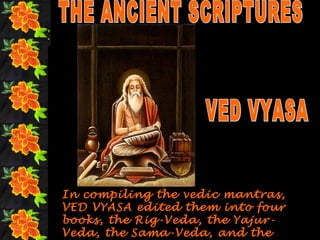
In compiling the vedic mantras,
VED VYASA edited them into four
books, the Rig-Veda, the Yajur-
Veda, the Sama-Veda, and the
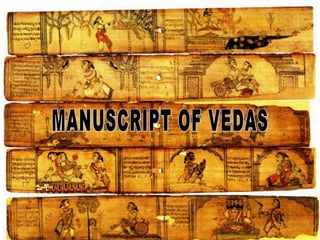
The Vedas are a large body of
texts originating in ancient India.
Composed in Vedic Sanskrit, the
texts constitutes the oldest layer
of Sanskrit literature and the
oldest scriptures of Hinduism.

•Scholars have determined that the
Rig Veda, the oldest of the four
Vedas, was composed about 1500
B.C.
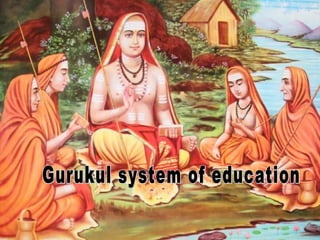
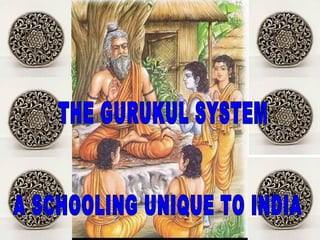
Gurukul was a type of school in India, residential in
nature, with pupils living in proximity to the guru.
 In a gurukul, students resided together as equals,
irrespective of their social standing, learnt from the guru
and helped the guru in his day-to-day life.
At the end of his studies, the pupil offered dakshina (fees)
to the guru. The gurudakshina is a traditional gesture of
acknowledgment, respect and thanks.
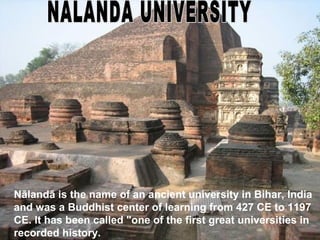
Nālandā is the name of an ancient university in Bihar, India
and was a Buddhist center of learning from 427 CE to 1197
CE. It has been called "one of the first great universities in
recorded history.
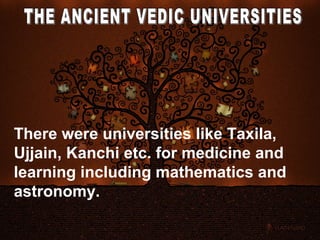
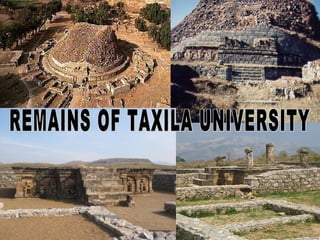
There were universities like Taxila,
Ujjain, Kanchi etc. for medicine and
learning including mathematics and
astronomy.
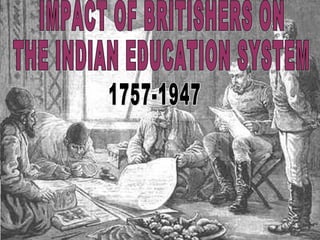
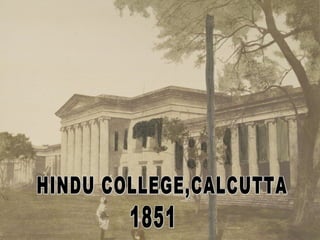
Education of Indians had
 become a topic of     interest
 among East India Company
 officials. The policy’s goal
 was
• to advance knowledge of Indians
  and
• to employ that knowledge in the
  East India Company
• Since English was increasingly being
  employed as the language of
  instruction, during 1852–1853
  petitions were sent to the British
  Parliament in support of both
  establishing and adequately funding
  university education in India which
  resulted in the Education Dispatch of
  July 1854 which helped in shaping the
  education system of India.
•   Established a Department of Public Instruction in
     each province of British India.
 •   Established teacher-training schools for all levels of
     instruction.
 •   Increased the number of Government colleges
     ,vernacular schools and high-schools .
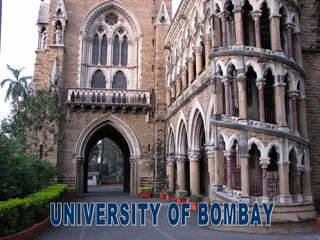
 •   The Department of Public Instruction was in place
     by 1855. By 1857 a number of universities were
     established modeled on the University of London.

Educational reforms in the early 20 th century
 led towards the nationalisation of many
universities.
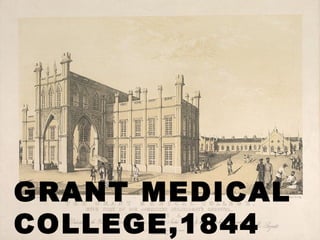
GRANT MEDICAL
COLLEGE,1844
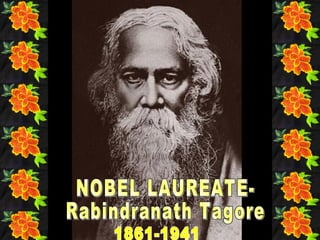
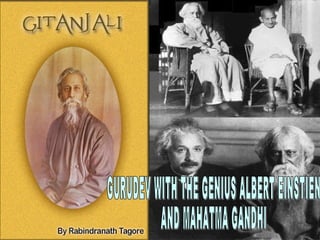
• Rabindranath started an open-air school
  known as the Patha Bhavan at
  Shantiniketan that gradually developed
  into an international university named
  Visva Bharati where the cultures of the
  East and the West met in common
  fellowship and thereby strengthening
  the fundamental condition of world
  peace.
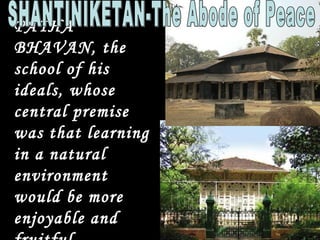
PATHA
BHAVAN, the
school of his
ideals, whose
central premise
was that learning
in a natural
environment
would be more
enjoyable and
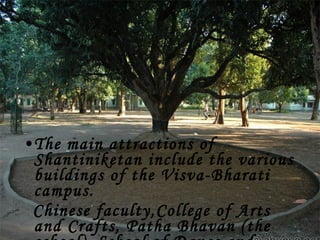
•The main attractions of
 Shantiniketan include the various
 buildings of the Visva-Bharati
 campus.
 Chinese faculty,College of Arts
 and Crafts, Patha Bhavan (the
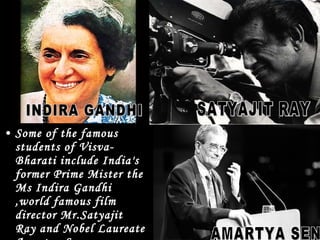
• Some of the famous
  students of Visva-
  Bharati include India's
  former Prime Mister the
  Ms Indira Gandhi
  ,world famous film
  director Mr.Satyajit
  Ray and Nobel Laureate
•Following independence in
 1947, MAULANA AZAD,
 India's first education minister
 recommended strong central
 government control over
 education throughout the
 country, with a uniform
 educational system.
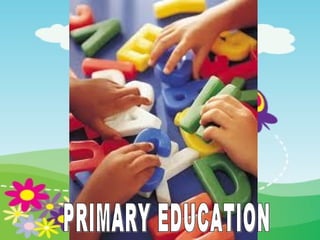
The Indian government lays great
emphasis to primary education up to
the age of fourteen years (referred to
as Elementary Education in India.)
The Indian government has also
banned child labour in order to
ensure that the children do not enter
unsafe working conditions.
Education has also been made free for
 children for six to 16 years of age.

The District Primary Education Programme
(DPEP) was launched in 1994 with an aim to
universalize primary education in India by
reforming and vitalizing the existing primary
education system
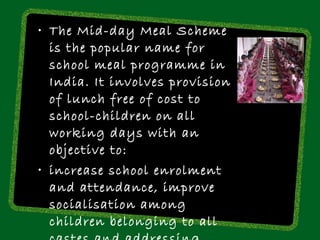
• The Mid-day Meal Scheme
  is the popular name for
  school meal programme in
  India. It involves provision
  of lunch free of cost to
  school-children on all
  working days with an
  objective to:
• increase school enrolment
  and attendance, improve
  socialisation among
  children belonging to all
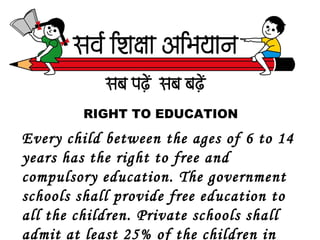
The current scheme for universalization
of Education for All is the SARVA
SHIKSHA ABHIYAN which is one of
the largest education initiatives in the
world.
RIGHT TO EDUCATION
Every child between the ages of 6 to 14
years has the right to free and
compulsory education. The government
schools shall provide free education to
all the children. Private schools shall
admit at least 25% of the children in
2.1

      In our national perception, Education
2.2

       refines sensitivities and perceptions that contribute
      to national cohesion, a scientific temper and
      independence of mind and spirit - thus furthering
      the goals of socialism, secularism and democracy
      enshrined in our Constitution.
2.3


2.4
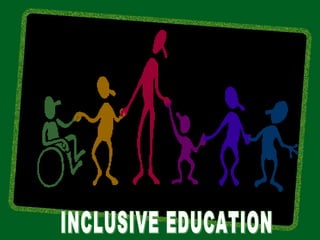
.The government is committed to providing
education through mainstream schools for
children with disabilities.
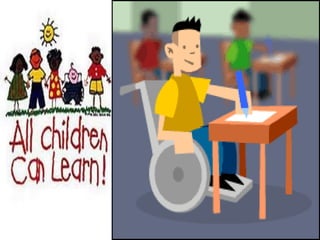
The need for inclusive education arises
precisely because it is now well understood
that most children with disabilities can,
with motivation and effort on the part of
teaching institutions, become an integral
part of those institutions
There is a common educational
structure(10+2+3) followed all
over the country.
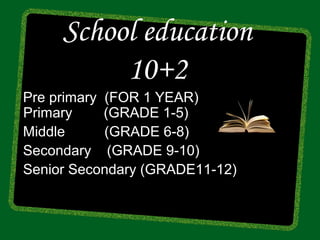
School education
          10+2
Pre primary (FOR 1 YEAR)
Primary     (GRADE 1-5)
Middle      (GRADE 6-8)
Secondary (GRADE 9-10)
Senior Secondary (GRADE11-12)
Significant feature of India's
secondary school system is the
emphasis on inclusion of the
disadvantaged sections of the
society.
 Another feature of India's
secondary school system is its
emphasis on profession based
vocational training to help
students attain skills for finding
a vocation of his/her choosing.
The Secondary education is supported by
 the following organisations under the
 administrative control of the Union
 Department of Education:
 Some of the institutes are:-
•National Council of Educational
Research and Training (NCERT)
•Central Board of               Secondary
Education (CBSE)
•National   Institute           of   Open
Schooling (NIOS)
The National Policy on Education (NPE),
1986, has provided for environment awareness,
science and technology education, and
introduction of traditional elements such as
yoga into the Indian secondary school system
The CBSE was set up by a special resolution of
the Government of India in 1929 at Ajmer 
with a view to play a useful role in the field of
Secondary Education and to raise its standard.
. The Main functions of the board are: to
 conduct Class X and XII examinations and
 grant certificates, to prescribe courses of
 instructions, prescribe conditions for
 examinations, and to affiliate institutions
 for the purpose of examinations. The
 CBSE also conducts all India entrance
 examinations at the under graduate level
 for pre-medical/pre-dental, engineering
 and architecture courses.
The CBSE has constantly
been engaged in process of
curriculum design, in-service
teacher empowerment
programmes and development
of textual material .
CBSE has introduced
CONTINUOUS AND COMPREHENSIVE
    EVALUATION (CCE) at the
secondary level.
 The scheme of CCE discourages mechanical testing. It
envisages employment of variety of tools and techniques
for assessment in informal and formal settings which are
more interesting, relevant and meaningful and involve
learners for greater participation and learning.
It is a system of school based
assessment that covers all aspects of
student’s development. It emphasizes
two fold objectives. Continuity in
evaluation and assessment of broad
based learning. CCE will cover the
scholastic and co scholastic areas of
school education.
NCERT is an autonomous body
fully funded by the Ministry of
Human Resource and Development
(MHRD)
The NCERT was established in 1961. It functions as
a resource centre in the field of school education and
teacher education. Publication of school textbooks
and other educational material like teachers’
guides/manuals etc. are its major functions.
It aims at making environmental education an integral
part of curriculum in school education.
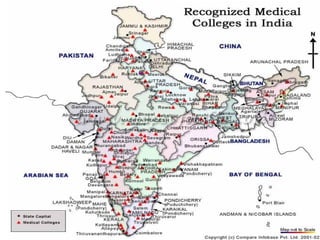
India's higher education
system is the third largest in
the world, after China and the
United States.
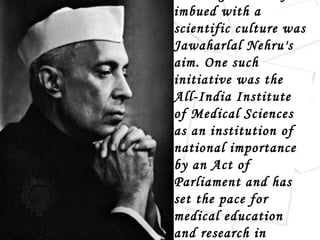
imbued with a
scientific culture was
Jawaharlal Nehru's
aim. One such
initiative was the
All-India Institute
of Medical Sciences
as an institution of
national importance
by an Act of
Parliament and has
set the pace for
medical education
and research in
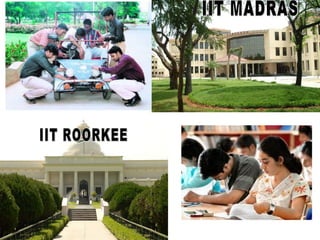
Some institutions of India, such as the
Indian Institutes of Technology (IITs),
have been globally acclaimed for their
standard of education. The IITs enroll
about 8000 students annually and the
alumni have contributed to both the
growth of the private sector and the
public sectors of India.
Higher education in India has evolved in
divergent streams with each stream
monitored by an apex body(UNIVERSITY
GRANTS COMMISION- organisation set up by Union
government in 1956, for the coordination, determination and
maintenance of standards of university education )indirectly
controlled by the Ministry of Human
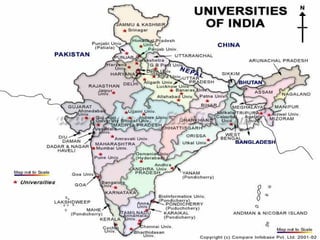
Resource Development. Most universities are
administered by the States, but there are 18
important universities called Central
Universities, which are maintained by the
Union Government.
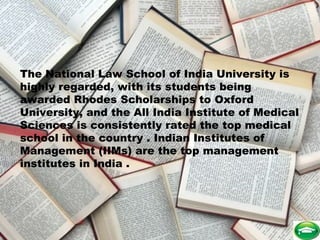
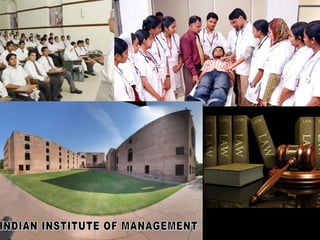
The National Law School of India University is
highly regarded, with its students being
awarded Rhodes Scholarships to Oxford
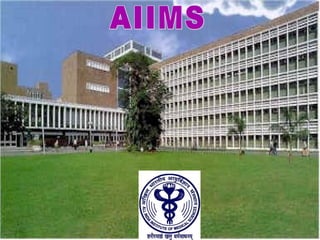
University, and the All India Institute of Medical
Sciences is consistently rated the top medical
school in the country . Indian Institutes of
Management (IIMs) are the top management
institutes in India .
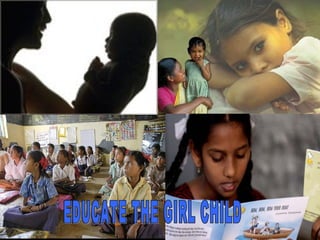
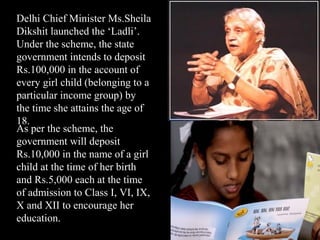
Delhi Chief Minister Ms.Sheila
Dikshit launched the ‘Ladli’.
Under the scheme, the state
government intends to deposit
Rs.100,000 in the account of
every girl child (belonging to a
particular income group) by
the time she attains the age of
18.
As per the scheme, the
government will deposit
Rs.10,000 in the name of a girl
child at the time of her birth
and Rs.5,000 each at the time
of admission to Class I, VI, IX,
X and XII to encourage her
education.
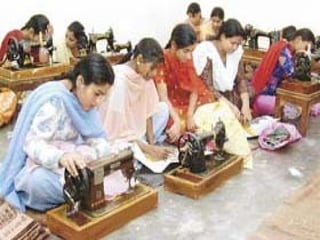
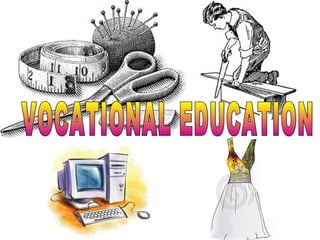
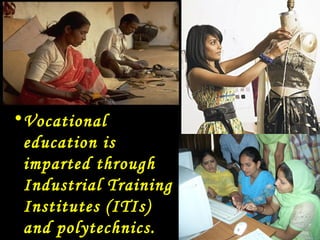
• Vocational
  education is
  imparted through
  Industrial Training
  Institutes (ITIs)
  and polytechnics.
•India which has always
been a centre for the
textile and garment trade.
 Now the fashion industry
has become so specialized
that it encompasses a vast
field of studies in design,
concept management,
design production
management, quality
control, planning, fabric
design, printing, fashion
accessory design, fashion
merchandising, textile
science, colour mixing,
marketing and so on.
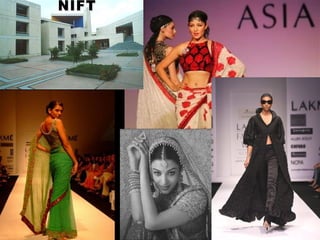
National Institute of Fashion Technology was
set up in 1986 under the aegis of the Ministry
of Textiles, Government of India. It has
emerged as the premier Institute of Design,
Management and Technology, developing
professionals for taking up leadership positions
in fashion business in the emerging global
scenario.
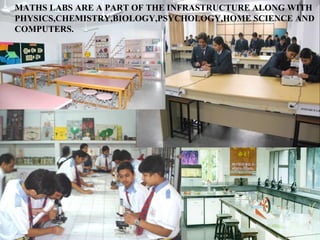
MATHS LABS ARE A PART OF THE INFRASTRUCTURE ALONG WITH
PHYSICS,CHEMISTRY,BIOLOGY,PSYCHOLOGY,HOME SCIENCE AND
COMPUTERS.
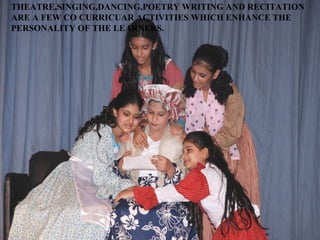
THEATRE,SINGING,DANCING,POETRY WRITING AND RECITATION
ARE A FEW CO CURRICUAR ACTIVITIES WHICH ENHANCE THE
PERSONALITY OF THE LEARNERS.
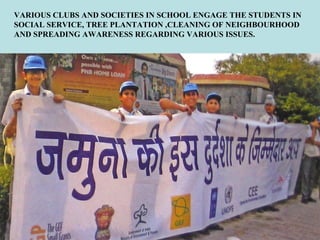
VARIOUS CLUBS AND SOCIETIES IN SCHOOL ENGAGE THE STUDENTS IN
SOCIAL SERVICE, TREE PLANTATION ,CLEANING OF NEIGHBOURHOOD
AND SPREADING AWARENESS REGARDING VARIOUS ISSUES.
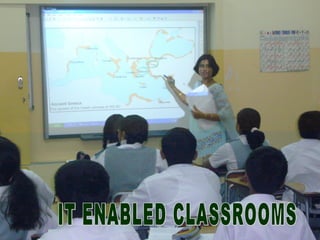
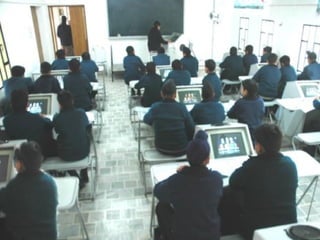
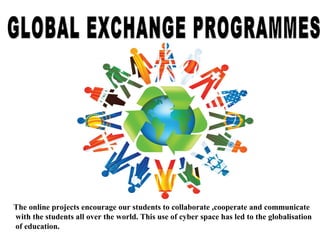
The online projects encourage our students to collaborate ,cooperate and communicate
with the students all over the world. This use of cyber space has led to the globalisation
of education.
We give them roots, we give them
             wings
And great joys from, little things,
  A hope that they will soar ,
   A hope that they will try,
   We are sure that one day ,
 Our children will learn to fly.


PREPARED BY
St.Mark’s Sr. Sec. Public school,
Meera Bagh, New delhi