


TOPIC PRESENTATION ON:-
SIMULATION & ROLE PLAY
BY-
PREETI SHARMA
MSC. NSG. 1ST YR.
INTRODUCTION
• A number of techniques are being used
currently in India as well as in other countries.
The simulated social skill is one of clime.
Simulation-based education should not be an
extra-ordinary activity, but must be grounded
in the ways learner performance is evaluated,
and should be built into learners’ normal
training schedule.
DEFINITION
• The true value of simulation lies in its ability
to offer experiences throughout the educational
process that provides students with
opportunities for repetition, pattern
recognition, and faster decision making.”
-Doyle & Leighton, 2010
PURPOSE
• To helps students practice decision making and
problem solving skills.
• To develop human interaction abilities in a
controlled and safes settings.
• To support innovative teaching strategies
• To overcome faculty and preceptor shortages
and lack of clinical sites
PRINCIPLES
• It Should be driven by the educational
goal/objective
• It Should match the level of the student
• The higher the realism, the more effective it is
in engaging the student
• Strengths and Limitations of Different Types
of Simulation
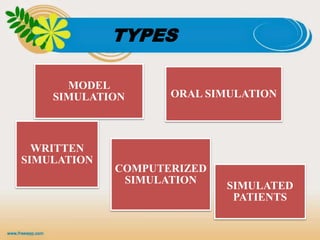
TYPES
MODEL
SIMULATION ORAL SIMULATION
WRITTEN
SIMULATION
COMPUTERIZED
SIMULATION
SIMULATED
PATIENTS
OBJECTIVES
• Modifying student behavior.
• Motivating learners.
• Bringing about changes in attitudes.
• Understanding one’s role properly
• Realizing others role and responsibilities.
• Helping students to assume emerging role.
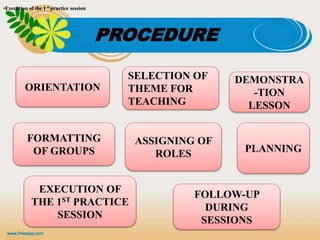
PROCEDURE
ORIENTATION
SELECTION OF
THEME FOR
TEACHING
DEMONSTRA
-TION
LESSON
FORMATTING
OF GROUPS
ASSIGNING OF
ROLES PLANNING
EXECUTION OF
THE 1ST PRACTICE
SESSION
FOLLOW-UP
DURING
SESSIONS
•Execution of the I st practice session
USES
• To acquaint the pupil teachers with the
classroom manners before they actually fare
the classroom situation.
• To enable them to modify their teaching
behavior as a result of suggestions given by the
observer.
• To develop self – confidence in beginners.
• To help in developing social skill of teaching.
ADVANTAGE
• Simulation helps to build confidence in the
student teacher.
• Simulation bridges the gulf between the theory
and practice.
• Simulation enables the learner to learn directly
from experience.
• Simulation promotes a high level of critical
thanking.
• Simulation technique motivates students by
making real-life situations exciting and
interesting.
DISADVANTAGE
• Often expensive and time consuming to
develop
• An invalid model may result with confidence
in wrong results
LIMITATION
• It is quite possible that during an exercise the
observer may record incorrectly.
• The most common error in serious skill
training is the misconception that adults can
play the role of pupils.
• Simulation attempts to portray real situation
in a simple way and which is very different.
INTRODUCTION
• Role play is educational methods in which
people spontaneously act out problems of
human relations and analyze the enactment
with the help of other role players and
observers. Role playing is a learning structure
that allows students to immediately apply
content as they are put in the role of a decision
maker who must make a decision regarding a
policy, resource allocation, or some other
outcome.
DEFINITION
“Role playing is a discussion technique that
makes possible to get maximum participation
of a group through acting out an example of
some problem or idea under discussion.”
Or
Role playing ‘as the changing of one’s
behaviour to fulfil a social role’.
- Oxford English Dictionary
VALUES
• The actor really tries to feel the part of the
character he is portraying and put himself in that
person’s situation.
• Adopting simulation techniques to solve problem.
• It is enjoyed by people who do it.
• It does not need equipment.
• It is a way of presenting human relations
problems, the students can experiment with
behaviour , make mistakes and try new skills.
PURPOSE
1. Role playing helps the students
• Develop skill in group problem solving.
• Develop ability to observe and analyze situations.
2. Role playing helps the teacher
• Note the individual student need by observing an
analyzing her needs in a simulated real life
situation.
PRINCIPLES
• Based on the philosophy.
• Should be flexible.
• Clarify our understanding of each other’s
meanings.
• Should be stimulant to think and should not be an
escape from discipline.
• Require rehearsal
• Should be able to analyse and evaluate.
• Should be done for brief period.
ADVANTAGES
 For students:-
• Develop communication skills, leadership,
interviewing skills&
• Social interaction.
• Develop sensitivity to another’s
 For teacher:-
• Note the individual student’s ability.
• Feeling by having the opportunity to put
oneself in another’s place.
DISADVANTAGES
• Time consuming process
• It requires expert guidance and leadership.
• Sometimes participants may feel threatened.
• It is a failure when the group does not
understand.
• Strongly depended on student’s imagination
• Require willing volunteers who would ready to
act.
TYPES
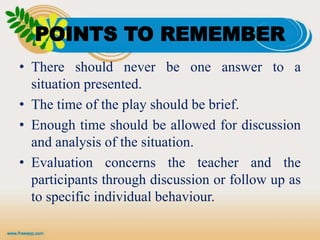
POINTS TO REMEMBER
• There should never be one answer to a
situation presented.
• The time of the play should be brief.
• Enough time should be allowed for discussion
and analysis of the situation.
• Evaluation concerns the teacher and the
participants through discussion or follow up as
to specific individual behaviour.
STEPS
Select a
problem for
role playing
Set up the
role playing
scene
Getting
underway in
role playing
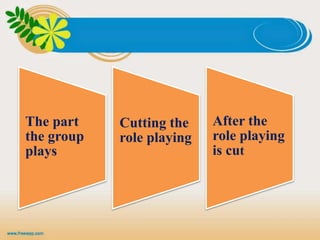
The part
the group
plays
Cutting the
role playing
After the
role playing
is cut
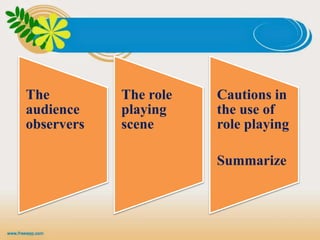
The
audience
observers
The role
playing
scene
Cautions in
the use of
role playing
Summarize
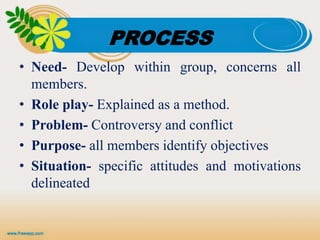
PROCESS
• Need- Develop within group, concerns all
members.
• Role play- Explained as a method.
• Problem- Controversy and conflict
• Purpose- all members identify objectives
• Situation- specific attitudes and motivations
delineated
• Casting role- Ask for volunteers. Provide
atmosphere which allows for volunteering or
choosing actors. Do not use own names.
• Stooping- cut when purpose is achieved.
• Discussion and analysis- Actor discusses own
performance first. Teacher encourages
discussion, but keeps in background.
• Evaluation- Observe whether the purpose is
achieved or not.
CONCLUSION
• Simulation the one of the teaching method it is
used very much is teaching programme. It
helps the student teachers to become a
complete skill feel teacher. It improves the
personal confidence.
• Role playing is a learning structure that allows
students to immediately apply content as they
are put in the role of a decision maker who
must make a decision regarding a policy,
resource allocation, or some other outcome.

Simulation and role play

  • 2.
    TOPIC PRESENTATION ON:- SIMULATION& ROLE PLAY BY- PREETI SHARMA MSC. NSG. 1ST YR.
  • 4.
    INTRODUCTION • A numberof techniques are being used currently in India as well as in other countries. The simulated social skill is one of clime. Simulation-based education should not be an extra-ordinary activity, but must be grounded in the ways learner performance is evaluated, and should be built into learners’ normal training schedule.
  • 5.
    DEFINITION • The truevalue of simulation lies in its ability to offer experiences throughout the educational process that provides students with opportunities for repetition, pattern recognition, and faster decision making.” -Doyle & Leighton, 2010
  • 6.
    PURPOSE • To helpsstudents practice decision making and problem solving skills. • To develop human interaction abilities in a controlled and safes settings. • To support innovative teaching strategies • To overcome faculty and preceptor shortages and lack of clinical sites
  • 7.
    PRINCIPLES • It Shouldbe driven by the educational goal/objective • It Should match the level of the student • The higher the realism, the more effective it is in engaging the student • Strengths and Limitations of Different Types of Simulation
  • 8.
  • 9.
    OBJECTIVES • Modifying studentbehavior. • Motivating learners. • Bringing about changes in attitudes. • Understanding one’s role properly • Realizing others role and responsibilities. • Helping students to assume emerging role.
  • 10.
    PROCEDURE ORIENTATION SELECTION OF THEME FOR TEACHING DEMONSTRA -TION LESSON FORMATTING OFGROUPS ASSIGNING OF ROLES PLANNING EXECUTION OF THE 1ST PRACTICE SESSION FOLLOW-UP DURING SESSIONS •Execution of the I st practice session •Execution of the I st practice session
  • 11.
    USES • To acquaintthe pupil teachers with the classroom manners before they actually fare the classroom situation. • To enable them to modify their teaching behavior as a result of suggestions given by the observer. • To develop self – confidence in beginners. • To help in developing social skill of teaching.
  • 12.
    ADVANTAGE • Simulation helpsto build confidence in the student teacher. • Simulation bridges the gulf between the theory and practice. • Simulation enables the learner to learn directly from experience. • Simulation promotes a high level of critical thanking. • Simulation technique motivates students by making real-life situations exciting and interesting.
  • 13.
    DISADVANTAGE • Often expensiveand time consuming to develop • An invalid model may result with confidence in wrong results
  • 14.
    LIMITATION • It isquite possible that during an exercise the observer may record incorrectly. • The most common error in serious skill training is the misconception that adults can play the role of pupils. • Simulation attempts to portray real situation in a simple way and which is very different.
  • 16.
    INTRODUCTION • Role playis educational methods in which people spontaneously act out problems of human relations and analyze the enactment with the help of other role players and observers. Role playing is a learning structure that allows students to immediately apply content as they are put in the role of a decision maker who must make a decision regarding a policy, resource allocation, or some other outcome.
  • 17.
    DEFINITION “Role playing isa discussion technique that makes possible to get maximum participation of a group through acting out an example of some problem or idea under discussion.” Or Role playing ‘as the changing of one’s behaviour to fulfil a social role’. - Oxford English Dictionary
  • 18.
    VALUES • The actorreally tries to feel the part of the character he is portraying and put himself in that person’s situation. • Adopting simulation techniques to solve problem. • It is enjoyed by people who do it. • It does not need equipment. • It is a way of presenting human relations problems, the students can experiment with behaviour , make mistakes and try new skills.
  • 19.
    PURPOSE 1. Role playinghelps the students • Develop skill in group problem solving. • Develop ability to observe and analyze situations. 2. Role playing helps the teacher • Note the individual student need by observing an analyzing her needs in a simulated real life situation.
  • 20.
    PRINCIPLES • Based onthe philosophy. • Should be flexible. • Clarify our understanding of each other’s meanings. • Should be stimulant to think and should not be an escape from discipline. • Require rehearsal • Should be able to analyse and evaluate. • Should be done for brief period.
  • 21.
    ADVANTAGES  For students:- •Develop communication skills, leadership, interviewing skills& • Social interaction. • Develop sensitivity to another’s  For teacher:- • Note the individual student’s ability. • Feeling by having the opportunity to put oneself in another’s place.
  • 22.
    DISADVANTAGES • Time consumingprocess • It requires expert guidance and leadership. • Sometimes participants may feel threatened. • It is a failure when the group does not understand. • Strongly depended on student’s imagination • Require willing volunteers who would ready to act.
  • 23.
  • 24.
    POINTS TO REMEMBER •There should never be one answer to a situation presented. • The time of the play should be brief. • Enough time should be allowed for discussion and analysis of the situation. • Evaluation concerns the teacher and the participants through discussion or follow up as to specific individual behaviour.
  • 25.
    STEPS Select a problem for roleplaying Set up the role playing scene Getting underway in role playing
  • 26.
    The part the group plays Cuttingthe role playing After the role playing is cut
  • 27.
  • 28.
    PROCESS • Need- Developwithin group, concerns all members. • Role play- Explained as a method. • Problem- Controversy and conflict • Purpose- all members identify objectives • Situation- specific attitudes and motivations delineated
  • 29.
    • Casting role-Ask for volunteers. Provide atmosphere which allows for volunteering or choosing actors. Do not use own names. • Stooping- cut when purpose is achieved. • Discussion and analysis- Actor discusses own performance first. Teacher encourages discussion, but keeps in background. • Evaluation- Observe whether the purpose is achieved or not.
  • 30.
    CONCLUSION • Simulation theone of the teaching method it is used very much is teaching programme. It helps the student teachers to become a complete skill feel teacher. It improves the personal confidence. • Role playing is a learning structure that allows students to immediately apply content as they are put in the role of a decision maker who must make a decision regarding a policy, resource allocation, or some other outcome.