PUPPETS
PRESENTED BY-
Prabhninder Kaur , Mahendra Kumar
INTRODUCTION
• A puppet is a manipulative doll dressed as a
character and the performer is a person termed as
puppeteer.
• It can be used as an effective teaching aid for
language and social sciences.
• In selecting or writing a puppet play, the age,
background and interest of the students should be
taken into consideration
DEFINITION
Puppetry is an education cum entertaining aid in
which puppets manipulated by the performer is a
person termed as characters in a story to be
depicted.
History of Puppetry
• Originated about 4000 years ago in INDIA.
• Used to communicate the ideas and needs of
human societies.
• Historians claim that they are pre date actors in
theatre
• Evidences show use of wooden puppets in Egypt
around 2000 BC.
• African ethnic groups are using puppets in ritual
dramas, in healing and hunting ceremonies till now.
PUPPET SHOW
Dramatic expression
Play integral role in lives of people
Substitute of real experiences
Flexible media
PURPOSES
• To motivate the student.
• To create interest.
• To add sense of humor.
TYPES
OF
PUPPETS
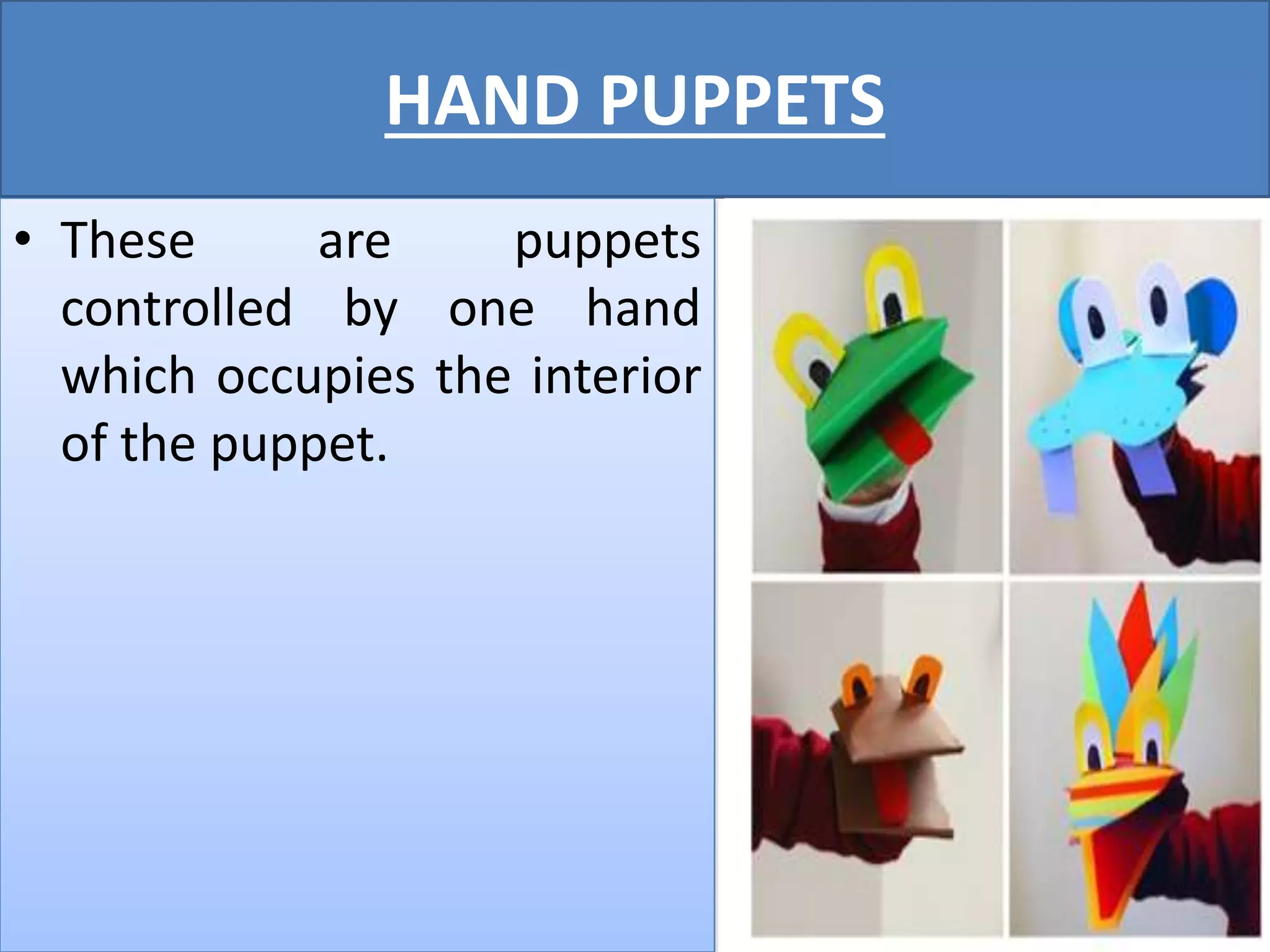
HAND PUPPETS
• These are puppets
controlled by one hand
which occupies the interior
of the puppet.
GLOVE PUPPET
• This is like a fingered glove
which fits on the hand and
are operated from below
by fingers.
ROD PUPPET
• These are operated from below
the stage by a combination of
rods and strings.
FINGER PUPPET
• An extremely simple
puppet variant which fits
onto a single finger. Finger
puppets normally have no
moving parts
STRING/ MARIONETTES PUPPETS
• It consists of puppets with
hinged body parts which are
controlled by nine strings
produces required movements
in the puppet
STICK PUPPETS
• Stick puppets are painted
cardboard/paper cut-outs
attached by sticks.
• These puppets are
manipulated by the teacher
and students by hiding
behind a screen so that only
puppets are visible to the
audience or the class.
SHADOW PUPPETS
• Shadow puppets Shadow
puppets are made of
cardboard which produce
shadows on a white
screen.
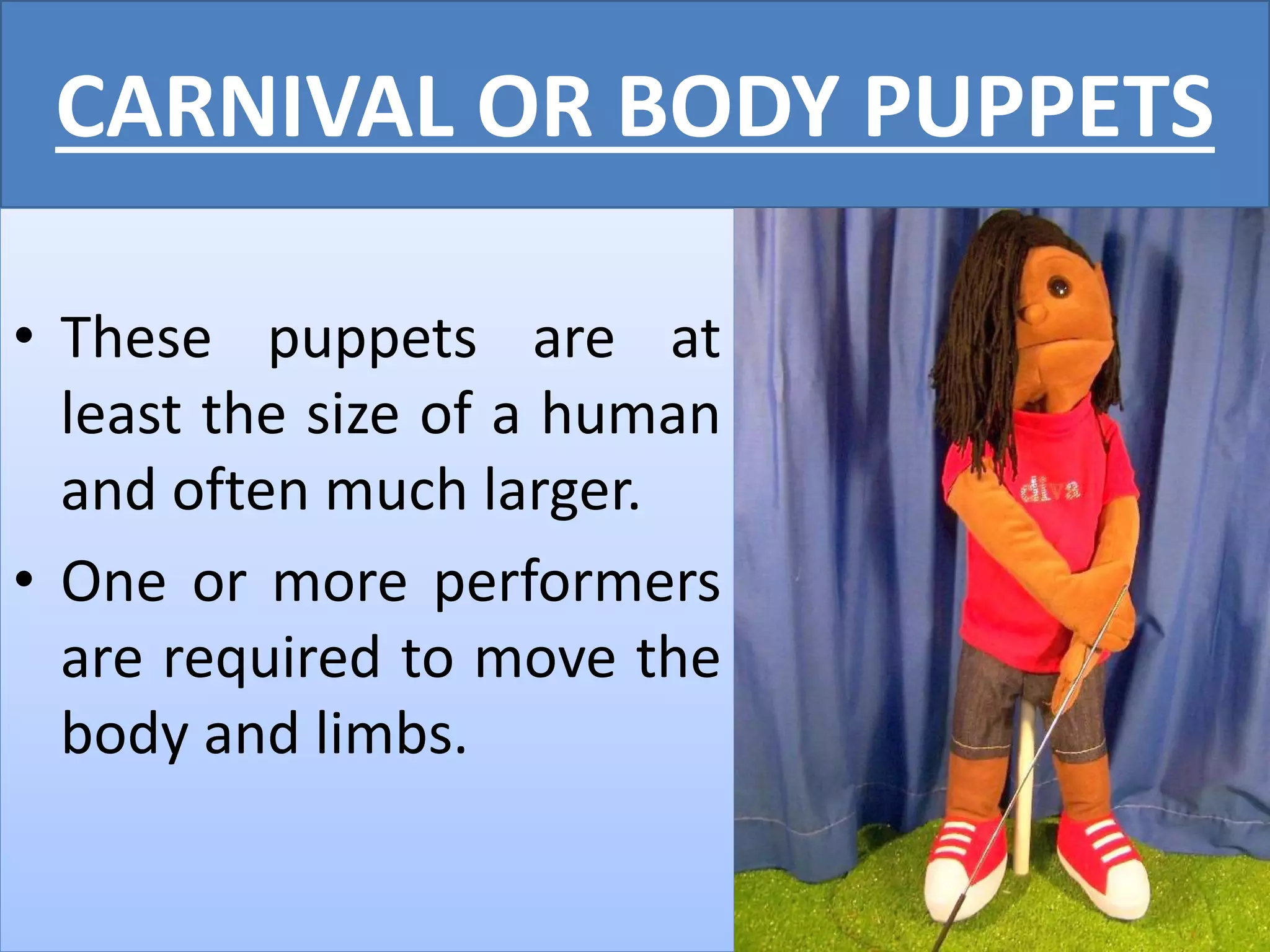
CARNIVAL OR BODY PUPPETS
• These puppets are at
least the size of a human
and often much larger.
• One or more performers
are required to move the
body and limbs.
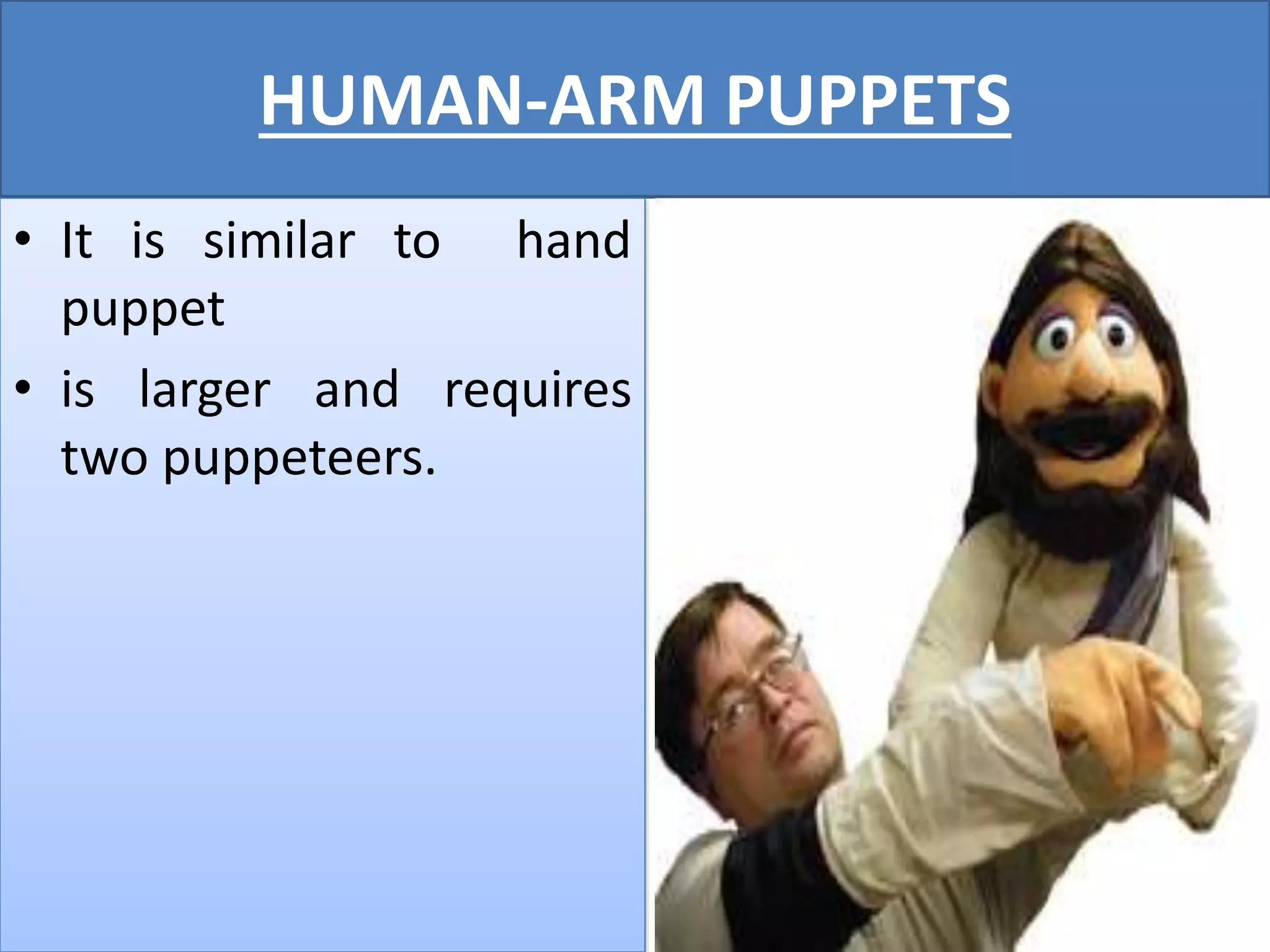
HUMAN-ARM PUPPETS
• It is similar to hand
puppet
• is larger and requires
two puppeteers.
MAROTTE PUPPETS
• A simplified rod puppet that is
just a head or body on a stick
PUSH PUPPET
• A push puppet consists of a
segmented character on a base
which is kept under tension
until the button on the bottom
is pressed.
• The puppet wiggles, slumps and
then collapses, and is usually
used as a novelty toy.
WATER PUPPETS
• Means "puppets that dance
on water".
• The puppets are built out of
wood and the shows are
performed in a waist-deep
pool.
• A large rod supports the
puppet under the water
CHIN FACE PUPPET
• It is a performance,
usually of a
comical nature, involving
someone's chin.
• By drawing or attaching
eyes, it gives the
impression of a distorted
face when viewed upside
down.
PRINCIPLES
• Puppets action should be accompanied by short dialogues.
• A puppet show should not have many characters.
• Put in short duration songs and dances to arouse emotions.
• The main problem should be introduced in the beginning of
the puppet show and answer comes out at the end of it to
keep up interest and suspense.
• Songs or speech from the back or recorded talk are used.
• The actual voices of men, women and children can be limited.
• There should be silent pauses in between the dialogues.
USES OF PUPPETRY
• It develops effective listening and looking skills.
• It develops group co-operation.
• It develops feeling of security and confidence.
• It promotes creative ability.
• It promotes developmental learning in language
and fine arts.
• It promotes self expression.
ADVANTAGES OF PUPPETRY
• Puppets show can heighten the human emotions.
• It captures the attention of participants.
• It creates interest in learner for learning.
• It gives the knowledge in a brief period.
• It motivates the students and stimulate thinking.
• In nursing puppetry used in health education
programs.
• It provides opportunity for team work.
• It provides emotional release.
DISADVANTAGES OF PUPPETRY
• It needs group co-operation and co-ordination.
• It requires skills in preparation and in presentation.
• Preparation is very time consuming.
• Seating arrangement is to be managed carefully.
DEMONSTRATION
SUMMARIZATION
• DEFINITION OF PUPPETS
• PURPOSES
• TYPES
• PRINCIPLES
• USES
• ADVANTAGES
• DISADVANTAGES
REFERENCES
• Neerja KP (2003); “ Textbook of Communication and Educational
Technology for Nurses”; 1st Edition; Jaypee Publishers; Pp- 375
• Bhatnagar & Dahama (2004); “Education and Communication for
Development”; 2nd Edition; Oxford & IBH publishers ;Pp- 455-56
• Basvanthapa BT (2003); “ Nursing Education’’; First Edition; Jaypee
publishers; Pp-446
• Sharma Dinesh Kumar (2008); “ Communication & Educational
Technology”; 1st Edition; Lotus publishers; Pp- 271-72
Puppets show

Puppets show

  • 1.
  • 2.
    INTRODUCTION • A puppetis a manipulative doll dressed as a character and the performer is a person termed as puppeteer. • It can be used as an effective teaching aid for language and social sciences. • In selecting or writing a puppet play, the age, background and interest of the students should be taken into consideration
  • 3.
    DEFINITION Puppetry is aneducation cum entertaining aid in which puppets manipulated by the performer is a person termed as characters in a story to be depicted.
  • 4.
    History of Puppetry •Originated about 4000 years ago in INDIA. • Used to communicate the ideas and needs of human societies. • Historians claim that they are pre date actors in theatre • Evidences show use of wooden puppets in Egypt around 2000 BC. • African ethnic groups are using puppets in ritual dramas, in healing and hunting ceremonies till now.
  • 5.
    PUPPET SHOW Dramatic expression Playintegral role in lives of people Substitute of real experiences Flexible media
  • 6.
    PURPOSES • To motivatethe student. • To create interest. • To add sense of humor.
  • 7.
  • 8.
    HAND PUPPETS • Theseare puppets controlled by one hand which occupies the interior of the puppet.
  • 9.
    GLOVE PUPPET • Thisis like a fingered glove which fits on the hand and are operated from below by fingers.
  • 10.
    ROD PUPPET • Theseare operated from below the stage by a combination of rods and strings.
  • 11.
    FINGER PUPPET • Anextremely simple puppet variant which fits onto a single finger. Finger puppets normally have no moving parts
  • 12.
    STRING/ MARIONETTES PUPPETS •It consists of puppets with hinged body parts which are controlled by nine strings produces required movements in the puppet
  • 13.
    STICK PUPPETS • Stickpuppets are painted cardboard/paper cut-outs attached by sticks. • These puppets are manipulated by the teacher and students by hiding behind a screen so that only puppets are visible to the audience or the class.
  • 14.
    SHADOW PUPPETS • Shadowpuppets Shadow puppets are made of cardboard which produce shadows on a white screen.
  • 15.
    CARNIVAL OR BODYPUPPETS • These puppets are at least the size of a human and often much larger. • One or more performers are required to move the body and limbs.
  • 16.
    HUMAN-ARM PUPPETS • Itis similar to hand puppet • is larger and requires two puppeteers.
  • 17.
    MAROTTE PUPPETS • Asimplified rod puppet that is just a head or body on a stick
  • 18.
    PUSH PUPPET • Apush puppet consists of a segmented character on a base which is kept under tension until the button on the bottom is pressed. • The puppet wiggles, slumps and then collapses, and is usually used as a novelty toy.
  • 19.
    WATER PUPPETS • Means"puppets that dance on water". • The puppets are built out of wood and the shows are performed in a waist-deep pool. • A large rod supports the puppet under the water
  • 20.
    CHIN FACE PUPPET •It is a performance, usually of a comical nature, involving someone's chin. • By drawing or attaching eyes, it gives the impression of a distorted face when viewed upside down.
  • 21.
    PRINCIPLES • Puppets actionshould be accompanied by short dialogues. • A puppet show should not have many characters. • Put in short duration songs and dances to arouse emotions. • The main problem should be introduced in the beginning of the puppet show and answer comes out at the end of it to keep up interest and suspense. • Songs or speech from the back or recorded talk are used. • The actual voices of men, women and children can be limited. • There should be silent pauses in between the dialogues.
  • 22.
    USES OF PUPPETRY •It develops effective listening and looking skills. • It develops group co-operation. • It develops feeling of security and confidence. • It promotes creative ability. • It promotes developmental learning in language and fine arts. • It promotes self expression.
  • 23.
    ADVANTAGES OF PUPPETRY •Puppets show can heighten the human emotions. • It captures the attention of participants. • It creates interest in learner for learning. • It gives the knowledge in a brief period. • It motivates the students and stimulate thinking. • In nursing puppetry used in health education programs. • It provides opportunity for team work. • It provides emotional release.
  • 24.
    DISADVANTAGES OF PUPPETRY •It needs group co-operation and co-ordination. • It requires skills in preparation and in presentation. • Preparation is very time consuming. • Seating arrangement is to be managed carefully.
  • 25.
  • 26.
    SUMMARIZATION • DEFINITION OFPUPPETS • PURPOSES • TYPES • PRINCIPLES • USES • ADVANTAGES • DISADVANTAGES
  • 27.
    REFERENCES • Neerja KP(2003); “ Textbook of Communication and Educational Technology for Nurses”; 1st Edition; Jaypee Publishers; Pp- 375 • Bhatnagar & Dahama (2004); “Education and Communication for Development”; 2nd Edition; Oxford & IBH publishers ;Pp- 455-56 • Basvanthapa BT (2003); “ Nursing Education’’; First Edition; Jaypee publishers; Pp-446 • Sharma Dinesh Kumar (2008); “ Communication & Educational Technology”; 1st Edition; Lotus publishers; Pp- 271-72