
‘Translational mechanisms in
Prokaryotic and Eukaryotic
systems’
Presented by:
Masoom Raza
PhD 1st year(Life Sciences)
Shiv Nadar University 1
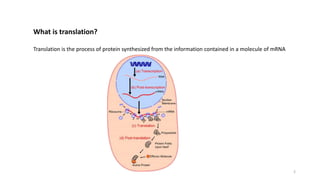
What is translation?
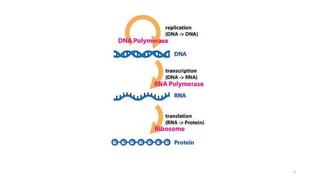
Translation is the process of protein synthesized from the information contained in a molecule of mRNA
2
3
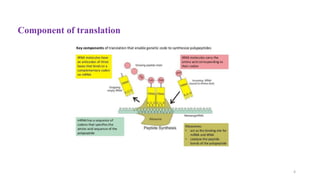
Component of translation
4
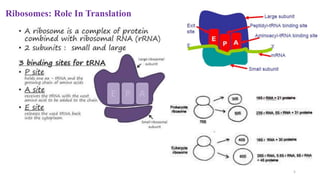
Ribosomes: Role In Translation
5
6
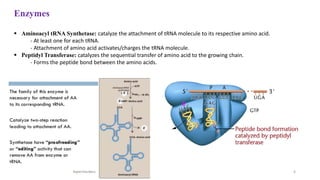
Enzymes
 Aminoacyl tRNA Synthetase: catalyze the attachment of tRNA molecule to its respective amino acid.
- At least one for each tRNA.
- Attachment of amino acid activates/charges the tRNA molecule.
 Peptidyl Transferase: catalyzes the sequential transfer of amino acid to the growing chain.
- Forms the peptide bond between the amino acids.
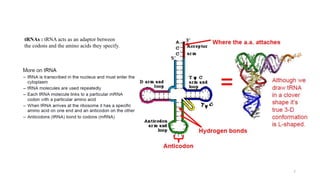
tRNAs : tRNA acts as an adaptor between
the codons and the amino acids they specify.
7
8
Mechanism Of Translation
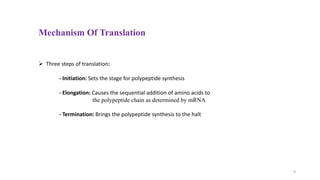
 Three steps of translation:
- Initiation: Sets the stage for polypeptide synthesis
- Elongation: Causes the sequential addition of amino acids to
the polypeptide chain as determined by mRNA
- Termination: Brings the polypeptide synthesis to the halt
9
10
Translation in Prokaryotic system
Shine-Dalgarno Sequences
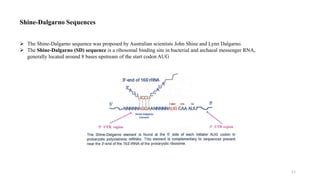
 The Shine-Dalgarno sequence was proposed by Australian scientists John Shine and Lynn Dalgarno.
 The Shine-Dalgarno (SD) sequence is a ribosomal binding site in bacterial and archaeal messenger RNA,
generally located around 8 bases upstream of the start codon AUG
11
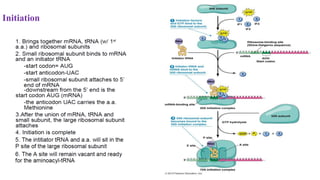
Initiation
12
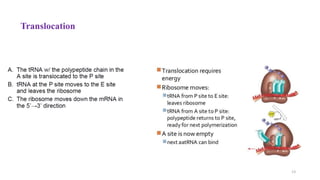
Translocation
13
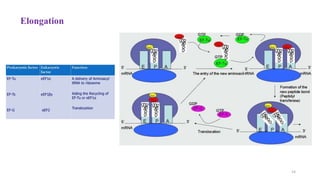
Elongation
14
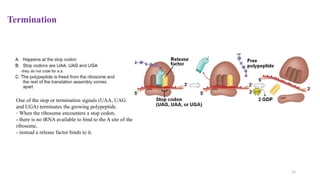
Termination
One of the stop or termination signals (UAA, UAG
and UGA) terminates the growing polypeptide.
• When the ribosome encounters a stop codon,
- there is no tRNA available to bind to the A site of the
ribosome,
- instead a release factor binds to it.
15
16
Translation in Eukaryotic System
Kozak sequence
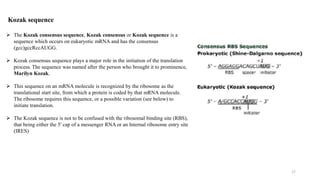
 The Kozak consensus sequence, Kozak consensus or Kozak sequence is a
sequence which occurs on eukaryotic mRNA and has the consensus
(gcc)gccRccAUGG.
 Kozak consensus sequence plays a major role in the initiation of the translation
process. The sequence was named after the person who brought it to prominence,
Marilyn Kozak.
 This sequence on an mRNA molecule is recognized by the ribosome as the
translational start site, from which a protein is coded by that mRNA molecule.
The ribosome requires this sequence, or a possible variation (see below) to
initiate translation.
 The Kozak sequence is not to be confused with the ribosomal binding site (RBS),
that being either the 5' cap of a messenger RNA or an Internal ribosome entry site
(IRES)
17
Scanning model of Initiation
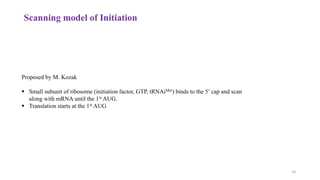
Proposed by M. Kozak
 Small subunit of ribosome (initiation factor, GTP, tRNAiMet) binds to the 5’ cap and scan
along with mRNA until the 1st AUG.
 Translation starts at the 1st AUG
18
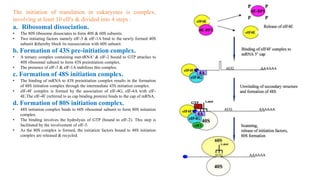
The initiation of translation in eukaryotes is complex,
involving at least 10 eIFs & divided into 4 steps :
a. Ribosomal dissociation.
• The 80S ribosome dissociates to form 40S & 60S subunits.
• Two initiating factors namely elF-3 & elF-1A bind to the newly formed 40S
subunit &thereby block its reassociation with 60S subunit.
b. Formation of 43S pre-initiation complex.
• A ternary complex containing met-tRNA′ & elF-2 bound to GTP attaches to
40S ribosomal subunit to form 43S preinitiation complex.
• The presence of elF-3 & elF-1A stabilizes this complex.
c. Formation of 48S initiation complex.
• The binding of mRNA to 43S preinitiation complex results in the formation
of 48S initiation complex through the intermediate 43S initiation complex.
• elF-4F complex is formed by the association of elF-4G, elF-4A with elF-
4E.The elF-4F (referred to as cap binding protein) binds to the cap of mRNA.
d. Formation of 80S initiation complex.
• 48S initiation complex binds to 60S ribosomal subunit to form 80S initiation
complex.
• The binding involves the hydrolysis of GTP (bound to elF-2). This step is
facilitated by the involvement of elF-5.
• As the 80S complex is formed, the initiation factors bound to 48S initiation
complex are released & recycled.
19
Elongation
20
Termination
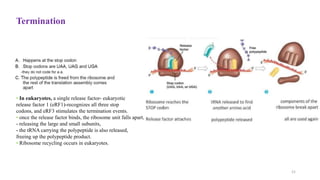
• In eukaryotes, a single release factor- eukaryotic
release factor 1 (eRF1)-recognizes all three stop
codons, and eRF3 stimulates the termination events.
• once the release factor binds, the ribosome unit falls apart,
- releasing the large and small subunits,
- the tRNA carrying the polypeptide is also released,
freeing up the polypeptide product.
• Ribosome recycling occurs in eukaryotes.
21
Ribosome Recycling
 After the release of polypeptide and the release factors the ribosome is still
bound to the mRNA and is left with two deacylated tRNA (in the P and E sites)
 To participate in a new round of polypeptide synthesis, these mRNA and the
tRNA must be released and the ribosome must dissociate into small subunit
and large subunit
 Collectively these events are termed as ribosome recycling
22
23
Thank You
24

Translation in Prokaryotes and Eukaryotes

  • 1.
    ‘Translational mechanisms in Prokaryoticand Eukaryotic systems’ Presented by: Masoom Raza PhD 1st year(Life Sciences) Shiv Nadar University 1
  • 2.
    What is translation? Translationis the process of protein synthesized from the information contained in a molecule of mRNA 2
  • 3.
  • 4.
  • 5.
    Ribosomes: Role InTranslation 5
  • 6.
    6 Enzymes  Aminoacyl tRNASynthetase: catalyze the attachment of tRNA molecule to its respective amino acid. - At least one for each tRNA. - Attachment of amino acid activates/charges the tRNA molecule.  Peptidyl Transferase: catalyzes the sequential transfer of amino acid to the growing chain. - Forms the peptide bond between the amino acids.
  • 7.
    tRNAs : tRNAacts as an adaptor between the codons and the amino acids they specify. 7
  • 8.
  • 9.
    Mechanism Of Translation Three steps of translation: - Initiation: Sets the stage for polypeptide synthesis - Elongation: Causes the sequential addition of amino acids to the polypeptide chain as determined by mRNA - Termination: Brings the polypeptide synthesis to the halt 9
  • 10.
  • 11.
    Shine-Dalgarno Sequences  TheShine-Dalgarno sequence was proposed by Australian scientists John Shine and Lynn Dalgarno.  The Shine-Dalgarno (SD) sequence is a ribosomal binding site in bacterial and archaeal messenger RNA, generally located around 8 bases upstream of the start codon AUG 11
  • 12.
  • 13.
  • 14.
  • 15.
    Termination One of thestop or termination signals (UAA, UAG and UGA) terminates the growing polypeptide. • When the ribosome encounters a stop codon, - there is no tRNA available to bind to the A site of the ribosome, - instead a release factor binds to it. 15
  • 16.
  • 17.
    Kozak sequence  TheKozak consensus sequence, Kozak consensus or Kozak sequence is a sequence which occurs on eukaryotic mRNA and has the consensus (gcc)gccRccAUGG.  Kozak consensus sequence plays a major role in the initiation of the translation process. The sequence was named after the person who brought it to prominence, Marilyn Kozak.  This sequence on an mRNA molecule is recognized by the ribosome as the translational start site, from which a protein is coded by that mRNA molecule. The ribosome requires this sequence, or a possible variation (see below) to initiate translation.  The Kozak sequence is not to be confused with the ribosomal binding site (RBS), that being either the 5' cap of a messenger RNA or an Internal ribosome entry site (IRES) 17
  • 18.
    Scanning model ofInitiation Proposed by M. Kozak  Small subunit of ribosome (initiation factor, GTP, tRNAiMet) binds to the 5’ cap and scan along with mRNA until the 1st AUG.  Translation starts at the 1st AUG 18
  • 19.
    The initiation oftranslation in eukaryotes is complex, involving at least 10 eIFs & divided into 4 steps : a. Ribosomal dissociation. • The 80S ribosome dissociates to form 40S & 60S subunits. • Two initiating factors namely elF-3 & elF-1A bind to the newly formed 40S subunit &thereby block its reassociation with 60S subunit. b. Formation of 43S pre-initiation complex. • A ternary complex containing met-tRNA′ & elF-2 bound to GTP attaches to 40S ribosomal subunit to form 43S preinitiation complex. • The presence of elF-3 & elF-1A stabilizes this complex. c. Formation of 48S initiation complex. • The binding of mRNA to 43S preinitiation complex results in the formation of 48S initiation complex through the intermediate 43S initiation complex. • elF-4F complex is formed by the association of elF-4G, elF-4A with elF- 4E.The elF-4F (referred to as cap binding protein) binds to the cap of mRNA. d. Formation of 80S initiation complex. • 48S initiation complex binds to 60S ribosomal subunit to form 80S initiation complex. • The binding involves the hydrolysis of GTP (bound to elF-2). This step is facilitated by the involvement of elF-5. • As the 80S complex is formed, the initiation factors bound to 48S initiation complex are released & recycled. 19
  • 20.
  • 21.
    Termination • In eukaryotes,a single release factor- eukaryotic release factor 1 (eRF1)-recognizes all three stop codons, and eRF3 stimulates the termination events. • once the release factor binds, the ribosome unit falls apart, - releasing the large and small subunits, - the tRNA carrying the polypeptide is also released, freeing up the polypeptide product. • Ribosome recycling occurs in eukaryotes. 21
  • 22.
    Ribosome Recycling  Afterthe release of polypeptide and the release factors the ribosome is still bound to the mRNA and is left with two deacylated tRNA (in the P and E sites)  To participate in a new round of polypeptide synthesis, these mRNA and the tRNA must be released and the ribosome must dissociate into small subunit and large subunit  Collectively these events are termed as ribosome recycling 22
  • 23.
  • 24.