Regulation
of
Gene Expression
R.C. Gupta
Professor and Head
Dept. of Biochemistry
National Institute of Medical Sciences
Jaipur, India
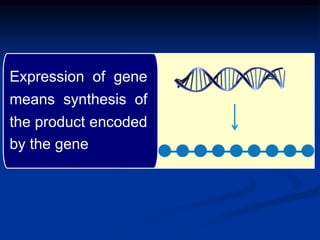
Expression of gene
means synthesis of
the product encoded
by the gene
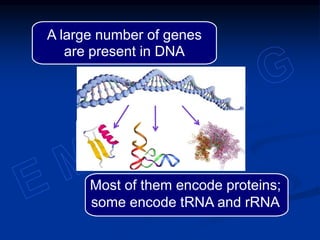
A large number of genes
are present in DNA
Most of them encode proteins;
some encode tRNA and rRNA
Proteins encoded by different genes are
not required all the time
A gene should be expressed only when
the protein encoded by it is required
This is possible only if gene expression
is regulated
Living organisms employ a number of
strategies to regulate gene expression
Regulation increases viability and
adaptability of the organism
Regulation can occur at different stages
of gene expression
Gene expression can be
regulated at the level of:
• Transcription
• Post-transcriptional modification
• Translation
• RNA degradation
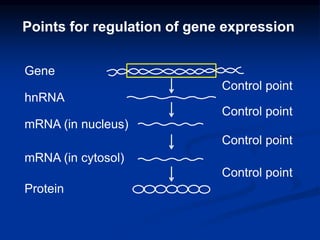
Gene
hnRNA
mRNA (in nucleus)
mRNA (in cytosol)
Protein
Control point
Control point
Control point
Control point
Points for regulation of gene expression
Gene expression is regulated in pro-
karyotes as well as eukaryotes
Regulation is different in prokaryotes
and eukaryotes
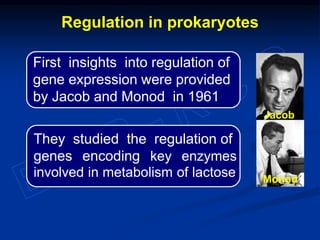
First insights into regulation of
gene expression were provided
by Jacob and Monod in 1961
Jacob
Monod
Regulation in prokaryotes
They studied the regulation of
genes encoding key enzymes
involved in metabolism of lactose
Jacob and Monod conducted their study in
E.coli
b-Galactosidase
The enzymes required to metabolize
lactose in E.coli are:
Galactoside transacetylase
Galactoside permease
b-Galactosidase is encoded by z gene
Galactoside permease is encoded by
y gene
Galactoside transacetylase is encoded
by a gene
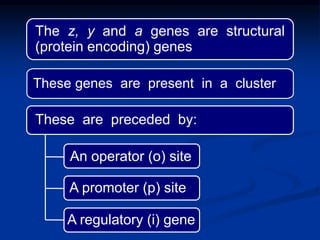
The z, y and a genes are structural
(protein encoding) genes
A regulatory (i) gene
A promoter (p) site
An operator (o) site
These are preceded by:
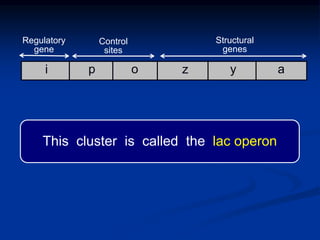
These genes are present in a cluster
Regulatory
gene
Control
sites
Structural
genes
i p o z y a
This cluster is called the lac operon
Operon
In bacteria, related genes are often
present in a cluster on the chromosome
They are trans-
cribed together
They are preceded by
a common promoter
The cluster of related genes is known as
an operon
E.coli can use lactose as well as other
sources of energy
Enzymes that metabolize lactose are not
required, and hence not synthesized, in
the absence of lactose
Entry of lactose in the cell induces
the synthesis of these enzymes
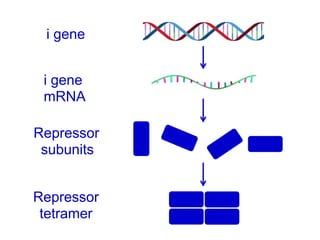
The i gene encodes a repressor subunit
Its expression is constitutive
The repressor subunits are synthesized
continuously
Four subunits combine to form the
repressor tetramer
i gene
i gene
mRNA
Repressor
subunits
Repressor
tetramer
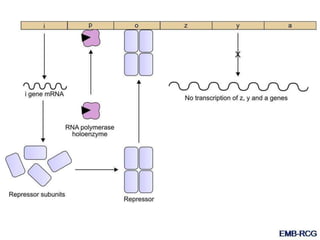
Repressor tetramer attaches to the
operator site
This prevents the transcription of z, y
and a genes by RNA polymerase
The enzymes encoded by these genes
are not synthesized
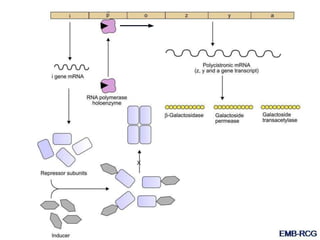
When lactose enters the cell, it is
converted into the inducer, allo-lactose
One allo-lactose molecule binds to each
repressor subunit
This prevents the formation of repressor
tetramer
The operator site remains free
RNA polymerase can move down-
stream
RNA polymerase transcribes z, y and a
genes
The polycystronic mRNA is translated
b-Galactosidase, galactoside permease
and galactoside transacetylase are
synthesized
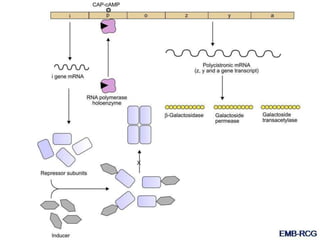
Lac operon has a positive regulator
also
When the bacterial cell is starved of
energy, concentration of cAMP rises
cAMP forms a complex with catabolite
gene activator protein (CAP)
CAP-cAMP complex binds to promoter
site
This facilitates the binding of RNA
polymerase holoenzyme to promoter site
When energy is abundant, cAMP
concentration falls, and CAP-cAMP
complex is not formed
In eukaryotes, gene expression is far
more complex
Regulation can occur at several stages
Regulation in eukaryotes
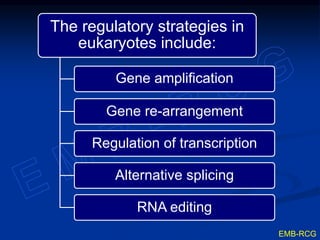
The regulatory strategies in
eukaryotes include:
Gene amplification
Gene re-arrangement
Regulation of transcription
Alternative splicing
RNA editing
EMB-RCG
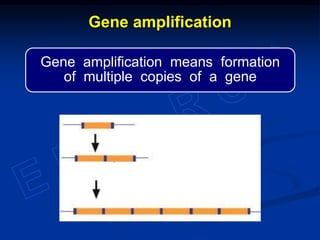
Gene amplification means formation
of multiple copies of a gene
Gene amplification
Synthesis of proteins can be increased
by amplifying the genes encoding them
Amplification may be spontaneous or
secondary to exogenous signals e.g.
drugs
Amplification of genes encoding tissue
proteins has been seen in Drosophilia
This occurs during growing age to
permit rapid formation of tissues
Amplification of dihydrofolate reductase
gene has been seen in cancer cells on
administration of amethopterin
Amethopterin is a competitive inhibitor of
dihydrofolate reductase
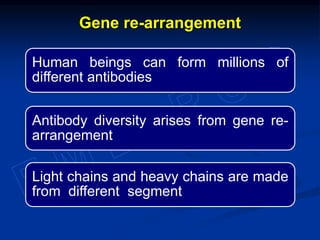
Human beings can form millions of
different antibodies
Antibody diversity arises from gene re-
arrangement
Light chains and heavy chains are made
from different segment
Gene re-arrangement
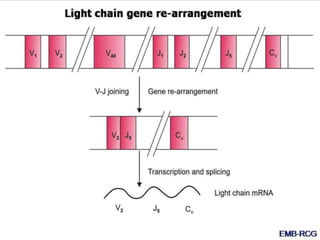
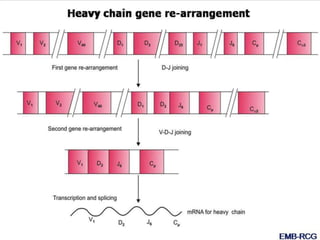
Genes for different segments are
located at different sites on the DNA
These genes are present in small
clusters
Each cluster contains a small number
of genes
The gene segments are joined in different
combinations in different B cells
This creates a huge diversity of antibodies
having different antigen specificities
Regulation of transcription
Transcription is the major control point in
eukaryotes
Control of transcription can control the
overall process of protein synthesis
The regulatory mechanisms
determine:
When a gene should
be transcribed


How often it should
be transcribed
In which tissues it
should be transcribed
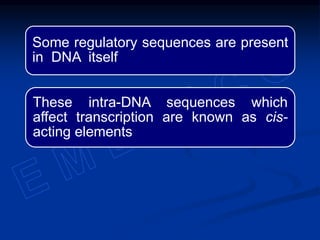
Some regulatory sequences are present
in DNA itself
These intra-DNA sequences which
affect transcription are known as cis-
acting elements
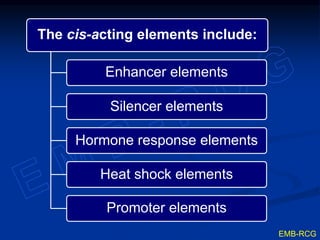
The cis-acting elements include:
Enhancer elements
Silencer elements
Hormone response elements
Heat shock elements
Promoter elements
EMB-RCG
Some extra-DNA factors influence the
cis-acting elements
The extra-DNA factors that act on the
cis-acting elements are called trans-
acting factors
These include inducers, repressors and
a number of protein factors
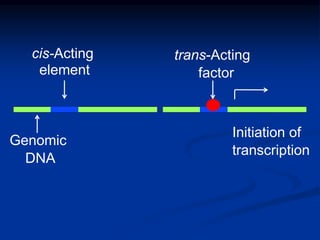
cis-Acting element
trans-Acting factor
Genomic DNA
Initiation of transcription
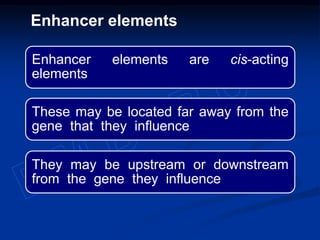
Enhancer elements are cis-acting
elements
These may be located far away from the
gene that they influence
They may be upstream or downstream
from the gene they influence
Enhancer elements
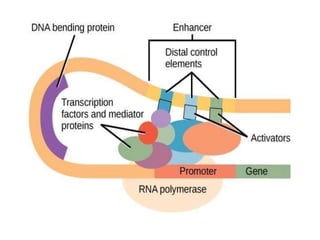
Binding of trans-acting factors to the
enhancer element increases the
transcription of the gene
By looping of DNA, enhancer element
and the trans-acting factors are brought
close to the gene
Enhancer element and the trans-acting
factor facilitate binding of basal trans-
cription apparatus to the TATA box
This increases the transcription of the
gene
Enhancer elements are poor in
specificity
Silencer elements are also located at a
distance from the gene they influence
They may be upstream or downstream
of the gene they influence
Silencer elements
Silencer elements suppress transcription
of the genes that they influence
Tissue-specific expression of genes may
be a function of enhancer elements and
silencer elements
Some hormones produce their actions
by acting on DNA
Examples are steroid hormones, thyroid
hormones, calcitriol, retinoic acid etc
They bind to their receptors forming
hormone-receptor complexes
Hormone response elements
The gene influenced by the hormone is
preceded by a hormone-response
element
The receptor-hormone complex binds to
the hormone-response element
This increases the transcription of the
downstream structural gene
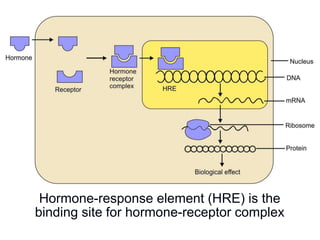
Hormone-response element (HRE) is the
binding site for hormone-receptor complex
Heat shock elements also increase the
expression of some genes
They act in response to heat stress and
other types of stress
Heat shock elements
Promoters respond to inducers and
repressors
Inducers increase genes expression
Repressors decrease gene expression
Promoters
Stability of mRNA also affects the rate of
gene expression
Long-lived mRNAs can be translated
many times over
This increases the rate of protein
synthesis
mRNA stability
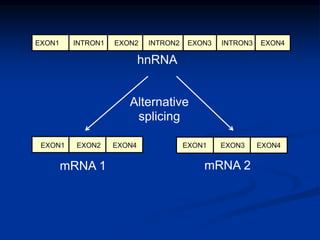
The primary transcript (hnRNA) can be
spliced in different ways
By joining different exons, different
proteins can be formed
Alternative splicing
hnRNA
mRNA 1 mRNA 2
Alternative
splicing
EXON1 INTRON1 EXON2 INTRON2 EXON3 INTRON3 EXON4
EXON1 EXON3 EXON4EXON1 EXON2 EXON4
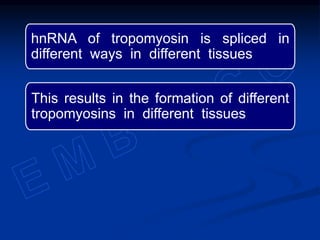
hnRNA of tropomyosin is spliced in
different ways in different tissues
This results in the formation of different
tropomyosins in different tissues
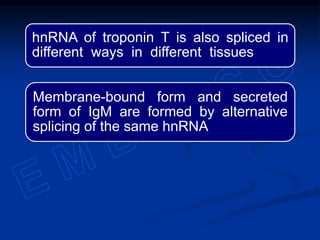
hnRNA of troponin T is also spliced in
different ways in different tissues
Membrane-bound form and secreted
form of IgM are formed by alternative
splicing of the same hnRNA
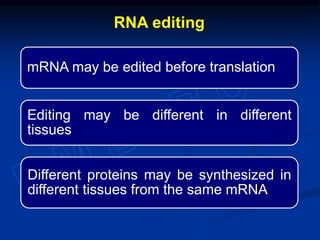
mRNA may be edited before translation
Editing may be different in different
tissues
Different proteins may be synthesized in
different tissues from the same mRNA
RNA editing
An example is synthesis of apo B in liver
and in intestine from the same gene
The gene is transcribed to form identical
mRNAs in liver and intestine
The mRNA is translated as such in liver
but is edited before translation in
intestine
The product of apo B gene in liver is
apo B-100, made up of 4536 amino acid
residues
The product of apo B gene in intestine is
apo B-48, made up of 2152 amino acid
residues
Amino acid sequence of apo B-48 is
identical with the first 2152 amino acid
residues of apo B-100
In the intestinal cells, the mRNA for apo
B is deaminated at position 6666
The base at position 6666 is cytosine
Deamination converts it into uracil
The codon CAA (glutamine) is changed
to UAA (stop signal)
Premature termination of translation
yields a protein 48% in size as
compared to apo B-100
Proteins affecting transcription by inter-
acting with DNA possess some distinct
structural motifs
These motifs help them to bind to
specific DNA sequences with high affinity
Protein-DNA interaction
Helix-turn-helix motif
Zinc finger motif
Leucine zipper motif
Structural motifs of DNA-
interacting proteins include:
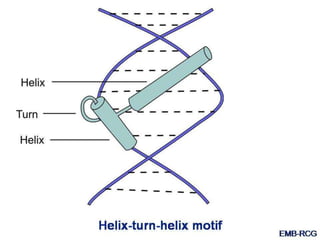
Proteins having helix-turn-helix motif
consist of two identical monomers
The DNA recognition domain of each
monomer binds to five base pairs of
DNA in a major groove
An example is catabolite gene activator
protein (CAP) of E.coli
Helix-turn-helix motif
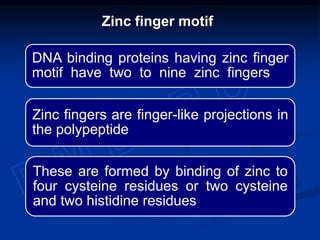
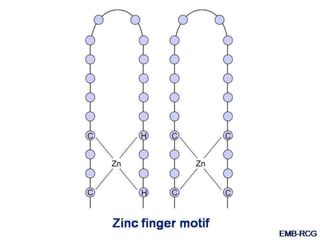
DNA binding proteins having zinc finger
motif have two to nine zinc fingers
Zinc fingers are finger-like projections in
the polypeptide
These are formed by binding of zinc to
four cysteine residues or two cysteine
and two histidine residues
Zinc finger motif
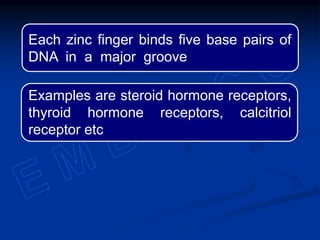
Each zinc finger binds five base pairs of
DNA in a major groove
Examples are steroid hormone receptors,
thyroid hormone receptors, calcitriol
receptor etc
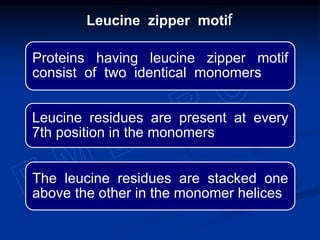
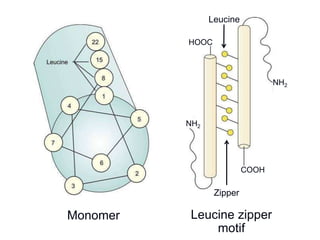
Proteins having leucine zipper motif
consist of two identical monomers
Leucine residues are present at every
7th position in the monomers
The leucine residues are stacked one
above the other in the monomer helices
Leucine zipper motif
Leucine residues are hydrophobic
Leucine residues of two monomers
attract each other to form a zipper-like
structure
An example is cAMP response element
binding protein (CREB)
HOOC
COOH
NH2
NH2
Leucine
Zipper
Leucine zipper
motif
Monomer

Regulation of gene expression

  • 1.
    Regulation of Gene Expression R.C. Gupta Professorand Head Dept. of Biochemistry National Institute of Medical Sciences Jaipur, India
  • 2.
    Expression of gene meanssynthesis of the product encoded by the gene
  • 3.
    A large numberof genes are present in DNA Most of them encode proteins; some encode tRNA and rRNA
  • 4.
    Proteins encoded bydifferent genes are not required all the time A gene should be expressed only when the protein encoded by it is required This is possible only if gene expression is regulated
  • 5.
    Living organisms employa number of strategies to regulate gene expression Regulation increases viability and adaptability of the organism Regulation can occur at different stages of gene expression
  • 6.
    Gene expression canbe regulated at the level of: • Transcription • Post-transcriptional modification • Translation • RNA degradation
  • 7.
    Gene hnRNA mRNA (in nucleus) mRNA(in cytosol) Protein Control point Control point Control point Control point Points for regulation of gene expression
  • 8.
    Gene expression isregulated in pro- karyotes as well as eukaryotes Regulation is different in prokaryotes and eukaryotes
  • 9.
    First insights intoregulation of gene expression were provided by Jacob and Monod in 1961 Jacob Monod Regulation in prokaryotes They studied the regulation of genes encoding key enzymes involved in metabolism of lactose
  • 10.
    Jacob and Monodconducted their study in E.coli b-Galactosidase The enzymes required to metabolize lactose in E.coli are: Galactoside transacetylase Galactoside permease
  • 11.
    b-Galactosidase is encodedby z gene Galactoside permease is encoded by y gene Galactoside transacetylase is encoded by a gene
  • 12.
    The z, yand a genes are structural (protein encoding) genes A regulatory (i) gene A promoter (p) site An operator (o) site These are preceded by: These genes are present in a cluster
  • 13.
    Regulatory gene Control sites Structural genes i p oz y a This cluster is called the lac operon
  • 14.
    Operon In bacteria, relatedgenes are often present in a cluster on the chromosome They are trans- cribed together They are preceded by a common promoter The cluster of related genes is known as an operon
  • 15.
    E.coli can uselactose as well as other sources of energy Enzymes that metabolize lactose are not required, and hence not synthesized, in the absence of lactose Entry of lactose in the cell induces the synthesis of these enzymes
  • 16.
    The i geneencodes a repressor subunit Its expression is constitutive The repressor subunits are synthesized continuously Four subunits combine to form the repressor tetramer
  • 17.
  • 18.
    Repressor tetramer attachesto the operator site This prevents the transcription of z, y and a genes by RNA polymerase The enzymes encoded by these genes are not synthesized
  • 20.
    When lactose entersthe cell, it is converted into the inducer, allo-lactose One allo-lactose molecule binds to each repressor subunit This prevents the formation of repressor tetramer
  • 21.
    The operator siteremains free RNA polymerase can move down- stream RNA polymerase transcribes z, y and a genes
  • 22.
    The polycystronic mRNAis translated b-Galactosidase, galactoside permease and galactoside transacetylase are synthesized
  • 24.
    Lac operon hasa positive regulator also When the bacterial cell is starved of energy, concentration of cAMP rises cAMP forms a complex with catabolite gene activator protein (CAP)
  • 25.
    CAP-cAMP complex bindsto promoter site This facilitates the binding of RNA polymerase holoenzyme to promoter site When energy is abundant, cAMP concentration falls, and CAP-cAMP complex is not formed
  • 27.
    In eukaryotes, geneexpression is far more complex Regulation can occur at several stages Regulation in eukaryotes
  • 28.
    The regulatory strategiesin eukaryotes include: Gene amplification Gene re-arrangement Regulation of transcription Alternative splicing RNA editing EMB-RCG
  • 29.
    Gene amplification meansformation of multiple copies of a gene Gene amplification
  • 30.
    Synthesis of proteinscan be increased by amplifying the genes encoding them Amplification may be spontaneous or secondary to exogenous signals e.g. drugs
  • 31.
    Amplification of genesencoding tissue proteins has been seen in Drosophilia This occurs during growing age to permit rapid formation of tissues
  • 32.
    Amplification of dihydrofolatereductase gene has been seen in cancer cells on administration of amethopterin Amethopterin is a competitive inhibitor of dihydrofolate reductase
  • 33.
    Human beings canform millions of different antibodies Antibody diversity arises from gene re- arrangement Light chains and heavy chains are made from different segment Gene re-arrangement
  • 34.
    Genes for differentsegments are located at different sites on the DNA These genes are present in small clusters Each cluster contains a small number of genes
  • 35.
    The gene segmentsare joined in different combinations in different B cells This creates a huge diversity of antibodies having different antigen specificities
  • 38.
    Regulation of transcription Transcriptionis the major control point in eukaryotes Control of transcription can control the overall process of protein synthesis
  • 39.
    The regulatory mechanisms determine: Whena gene should be transcribed   How often it should be transcribed In which tissues it should be transcribed
  • 40.
    Some regulatory sequencesare present in DNA itself These intra-DNA sequences which affect transcription are known as cis- acting elements
  • 41.
    The cis-acting elementsinclude: Enhancer elements Silencer elements Hormone response elements Heat shock elements Promoter elements EMB-RCG
  • 42.
    Some extra-DNA factorsinfluence the cis-acting elements The extra-DNA factors that act on the cis-acting elements are called trans- acting factors These include inducers, repressors and a number of protein factors
  • 43.
    cis-Acting element trans-Acting factor GenomicDNA Initiation of transcription
  • 44.
    Enhancer elements arecis-acting elements These may be located far away from the gene that they influence They may be upstream or downstream from the gene they influence Enhancer elements
  • 45.
    Binding of trans-actingfactors to the enhancer element increases the transcription of the gene By looping of DNA, enhancer element and the trans-acting factors are brought close to the gene
  • 47.
    Enhancer element andthe trans-acting factor facilitate binding of basal trans- cription apparatus to the TATA box This increases the transcription of the gene Enhancer elements are poor in specificity
  • 48.
    Silencer elements arealso located at a distance from the gene they influence They may be upstream or downstream of the gene they influence Silencer elements
  • 49.
    Silencer elements suppresstranscription of the genes that they influence Tissue-specific expression of genes may be a function of enhancer elements and silencer elements
  • 50.
    Some hormones producetheir actions by acting on DNA Examples are steroid hormones, thyroid hormones, calcitriol, retinoic acid etc They bind to their receptors forming hormone-receptor complexes Hormone response elements
  • 51.
    The gene influencedby the hormone is preceded by a hormone-response element The receptor-hormone complex binds to the hormone-response element This increases the transcription of the downstream structural gene
  • 52.
    Hormone-response element (HRE)is the binding site for hormone-receptor complex
  • 53.
    Heat shock elementsalso increase the expression of some genes They act in response to heat stress and other types of stress Heat shock elements
  • 54.
    Promoters respond toinducers and repressors Inducers increase genes expression Repressors decrease gene expression Promoters
  • 55.
    Stability of mRNAalso affects the rate of gene expression Long-lived mRNAs can be translated many times over This increases the rate of protein synthesis mRNA stability
  • 56.
    The primary transcript(hnRNA) can be spliced in different ways By joining different exons, different proteins can be formed Alternative splicing
  • 57.
    hnRNA mRNA 1 mRNA2 Alternative splicing EXON1 INTRON1 EXON2 INTRON2 EXON3 INTRON3 EXON4 EXON1 EXON3 EXON4EXON1 EXON2 EXON4
  • 58.
    hnRNA of tropomyosinis spliced in different ways in different tissues This results in the formation of different tropomyosins in different tissues
  • 59.
    hnRNA of troponinT is also spliced in different ways in different tissues Membrane-bound form and secreted form of IgM are formed by alternative splicing of the same hnRNA
  • 60.
    mRNA may beedited before translation Editing may be different in different tissues Different proteins may be synthesized in different tissues from the same mRNA RNA editing
  • 61.
    An example issynthesis of apo B in liver and in intestine from the same gene The gene is transcribed to form identical mRNAs in liver and intestine The mRNA is translated as such in liver but is edited before translation in intestine
  • 62.
    The product ofapo B gene in liver is apo B-100, made up of 4536 amino acid residues The product of apo B gene in intestine is apo B-48, made up of 2152 amino acid residues
  • 63.
    Amino acid sequenceof apo B-48 is identical with the first 2152 amino acid residues of apo B-100 In the intestinal cells, the mRNA for apo B is deaminated at position 6666
  • 64.
    The base atposition 6666 is cytosine Deamination converts it into uracil The codon CAA (glutamine) is changed to UAA (stop signal) Premature termination of translation yields a protein 48% in size as compared to apo B-100
  • 65.
    Proteins affecting transcriptionby inter- acting with DNA possess some distinct structural motifs These motifs help them to bind to specific DNA sequences with high affinity Protein-DNA interaction
  • 66.
    Helix-turn-helix motif Zinc fingermotif Leucine zipper motif Structural motifs of DNA- interacting proteins include:
  • 67.
    Proteins having helix-turn-helixmotif consist of two identical monomers The DNA recognition domain of each monomer binds to five base pairs of DNA in a major groove An example is catabolite gene activator protein (CAP) of E.coli Helix-turn-helix motif
  • 69.
    DNA binding proteinshaving zinc finger motif have two to nine zinc fingers Zinc fingers are finger-like projections in the polypeptide These are formed by binding of zinc to four cysteine residues or two cysteine and two histidine residues Zinc finger motif
  • 71.
    Each zinc fingerbinds five base pairs of DNA in a major groove Examples are steroid hormone receptors, thyroid hormone receptors, calcitriol receptor etc
  • 72.
    Proteins having leucinezipper motif consist of two identical monomers Leucine residues are present at every 7th position in the monomers The leucine residues are stacked one above the other in the monomer helices Leucine zipper motif
  • 73.
    Leucine residues arehydrophobic Leucine residues of two monomers attract each other to form a zipper-like structure An example is cAMP response element binding protein (CREB)
  • 74.