River Landforms River Processes
Waterfall
A waterfall is a vertical drop along the course of a river over which the river
flows the usually found in the upper course
Waterfall
Waterfalls are found in the upper course
of a river. They usually occur where a
band of hard rock lies next to the soft
rock
As the river passes over the hard
rock the soft rock below is eroded
quicker than the harder rock
Waterfall
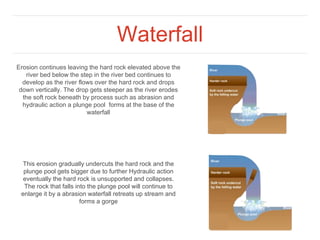
This erosion gradually undercuts the hard rock and the
plunge pool gets bigger due to further Hydraulic action
eventually the hard rock is unsupported and collapses.
The rock that falls into the plunge pool will continue to
enlarge it by a abrasion waterfall retreats up stream and
forms a gorge
Erosion continues leaving the hard rock elevated above the
river bed below the step in the river bed continues to
develop as the river flows over the hard rock and drops
down vertically. The drop gets steeper as the river erodes
the soft rock beneath by process such as abrasion and
hydraulic action a plunge pool forms at the base of the
waterfall
Meander
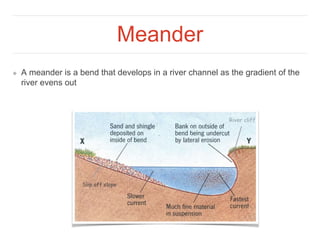
❖ A meander is a bend that develops in a river channel as the gradient of the
river evens out
Meander
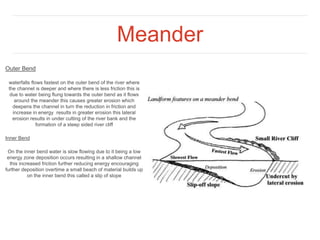
Outer Bend
waterfalls flows fastest on the outer bend of the river where
the channel is deeper and where there is less friction this is
due to water being flung towards the outer bend as it flows
around the meander this causes greater erosion which
deepens the channel in turn the reduction in friction and
increase in energy results in greater erosion this lateral
erosion results in under cutting of the river bank and the
formation of a steep sided river cliff
Inner Bend
On the inner bend water is slow flowing due to it being a low
energy zone deposition occurs resulting in a shallow channel
this increased friction further reducing energy encouraging
further deposition overtime a small beach of material builds up
on the inner bend this called a slip of slope
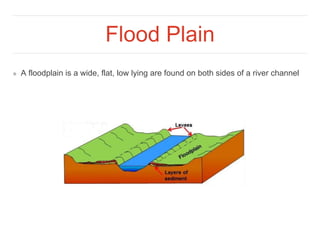
Flood Plain
❖ A floodplain is a wide, flat, low lying are found on both sides of a river channel
Flood Plain
Rivers carry a large load the load is carried
mainly by solution and suspension though also
by saltation and traction. Flooding is most likely
to occur after heavy rain fall or melting snow.
When the water level of the river reaches the
level of its banks it’s known as bankfull
discharge the river will then overflow and flood.
River deposition will now occur the depth of the
flooded water will be shallow leading to friction
with the ground surface. This will reduce the
speed and energy of the river as the floodwater
loses energy the rivers ability to carry its load is
reduced leading to deposition the heaviest
coarsest material will be deposited first and
nearest to the channel while the finest of the
load is deposited furthest away. Ridges of
deposition will from beside the river these are
know as levees

River landforms

  • 1.
  • 2.
    Waterfall A waterfall isa vertical drop along the course of a river over which the river flows the usually found in the upper course
  • 3.
    Waterfall Waterfalls are foundin the upper course of a river. They usually occur where a band of hard rock lies next to the soft rock As the river passes over the hard rock the soft rock below is eroded quicker than the harder rock
  • 4.
    Waterfall This erosion graduallyundercuts the hard rock and the plunge pool gets bigger due to further Hydraulic action eventually the hard rock is unsupported and collapses. The rock that falls into the plunge pool will continue to enlarge it by a abrasion waterfall retreats up stream and forms a gorge Erosion continues leaving the hard rock elevated above the river bed below the step in the river bed continues to develop as the river flows over the hard rock and drops down vertically. The drop gets steeper as the river erodes the soft rock beneath by process such as abrasion and hydraulic action a plunge pool forms at the base of the waterfall
  • 5.
    Meander ❖ A meanderis a bend that develops in a river channel as the gradient of the river evens out
  • 6.
    Meander Outer Bend waterfalls flowsfastest on the outer bend of the river where the channel is deeper and where there is less friction this is due to water being flung towards the outer bend as it flows around the meander this causes greater erosion which deepens the channel in turn the reduction in friction and increase in energy results in greater erosion this lateral erosion results in under cutting of the river bank and the formation of a steep sided river cliff Inner Bend On the inner bend water is slow flowing due to it being a low energy zone deposition occurs resulting in a shallow channel this increased friction further reducing energy encouraging further deposition overtime a small beach of material builds up on the inner bend this called a slip of slope
  • 7.
    Flood Plain ❖ Afloodplain is a wide, flat, low lying are found on both sides of a river channel
  • 8.
    Flood Plain Rivers carrya large load the load is carried mainly by solution and suspension though also by saltation and traction. Flooding is most likely to occur after heavy rain fall or melting snow. When the water level of the river reaches the level of its banks it’s known as bankfull discharge the river will then overflow and flood. River deposition will now occur the depth of the flooded water will be shallow leading to friction with the ground surface. This will reduce the speed and energy of the river as the floodwater loses energy the rivers ability to carry its load is reduced leading to deposition the heaviest coarsest material will be deposited first and nearest to the channel while the finest of the load is deposited furthest away. Ridges of deposition will from beside the river these are know as levees