Landforms created by a river By Hasan,Raheel & Abdullah 6-A
Landforms V-shaped Valley Waterfall Gorge Meander Oxbow lake
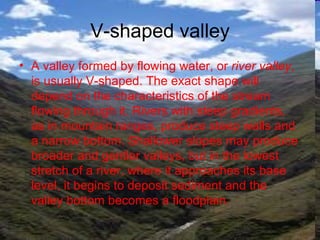
V-shaped valley A valley formed by flowing water, or  river valley , is usually V-shaped. The exact shape will depend on the characteristics of the stream flowing through it. Rivers with steep gradients, as in mountain ranges, produce steep walls and a narrow bottom. Shallower slopes may produce broader and gentler valleys, but in the lowest stretch of a river, where it approaches its base level, it begins to deposit sediment and the valley bottom becomes a floodplain.
Waterfall Waterfalls are most commonly formed when a river is young. At these times the channel is often narrow and deep. When the river courses over resistant bedrock, erosion happens slowly, while downstream the erosion occurs more rapidly. As the watercourse increases its velocity at the edge of the waterfall, it plucks material from the riverbed. Whirlpools created in the turbulence as well as sand and stones carried by the watercourse increase the erosion capacity.
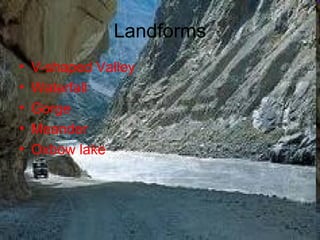
Gorge  A  canyon  or  gorge  is a deep ravine between cliffs often carved from the landscape by a river. Rivers have a natural tendency to reach a baseline elevation, which is the same elevation as the body of water it will eventually drain into. This forms a canyon. Most canyons were formed by a process of long-time erosion from a plateau level. The cliffs form because harder rock strata that are resistant to erosion and weathering remain exposed on the valley walls. Canyons are much more common in arid areas than in wet areas because physical weathering has a greater effect in arid zones
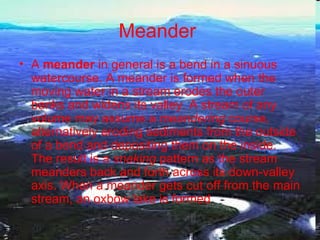
Meander   A  meander  in general is a bend in a sinuous watercourse. A meander is formed when the moving water in a stream erodes the outer banks and widens its valley. A stream of any volume may assume a  meandering  course, alternatively eroding sediments from the outside of a bend and depositing them on the inside. The result is a  snaking  pattern as the stream meanders back and forth across its down-valley axis. When a meander gets cut off from the main stream, an oxbow lake is formed
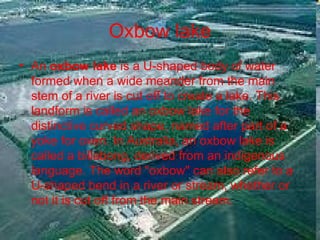
Oxbow lake An  oxbow lake  is a U-shaped body of water formed when a wide meander from the main stem of a river is cut off to create a lake. This landform is called an oxbow lake for the distinctive curved shape, named after part of a yoke for oxen. In Australia, an oxbow lake is called a billabong, derived from an indigenous language. The word "oxbow" can also refer to a U-shaped bend in a river or stream, whether or not it is cut off from the main stream.

Landforms created by a river

  • 1.
    Landforms created bya river By Hasan,Raheel & Abdullah 6-A
  • 2.
    Landforms V-shaped ValleyWaterfall Gorge Meander Oxbow lake
  • 3.
    V-shaped valley Avalley formed by flowing water, or river valley , is usually V-shaped. The exact shape will depend on the characteristics of the stream flowing through it. Rivers with steep gradients, as in mountain ranges, produce steep walls and a narrow bottom. Shallower slopes may produce broader and gentler valleys, but in the lowest stretch of a river, where it approaches its base level, it begins to deposit sediment and the valley bottom becomes a floodplain.
  • 4.
    Waterfall Waterfalls aremost commonly formed when a river is young. At these times the channel is often narrow and deep. When the river courses over resistant bedrock, erosion happens slowly, while downstream the erosion occurs more rapidly. As the watercourse increases its velocity at the edge of the waterfall, it plucks material from the riverbed. Whirlpools created in the turbulence as well as sand and stones carried by the watercourse increase the erosion capacity.
  • 5.
    Gorge A canyon or gorge is a deep ravine between cliffs often carved from the landscape by a river. Rivers have a natural tendency to reach a baseline elevation, which is the same elevation as the body of water it will eventually drain into. This forms a canyon. Most canyons were formed by a process of long-time erosion from a plateau level. The cliffs form because harder rock strata that are resistant to erosion and weathering remain exposed on the valley walls. Canyons are much more common in arid areas than in wet areas because physical weathering has a greater effect in arid zones
  • 6.
    Meander A meander in general is a bend in a sinuous watercourse. A meander is formed when the moving water in a stream erodes the outer banks and widens its valley. A stream of any volume may assume a meandering course, alternatively eroding sediments from the outside of a bend and depositing them on the inside. The result is a snaking pattern as the stream meanders back and forth across its down-valley axis. When a meander gets cut off from the main stream, an oxbow lake is formed
  • 7.
    Oxbow lake An oxbow lake is a U-shaped body of water formed when a wide meander from the main stem of a river is cut off to create a lake. This landform is called an oxbow lake for the distinctive curved shape, named after part of a yoke for oxen. In Australia, an oxbow lake is called a billabong, derived from an indigenous language. The word "oxbow" can also refer to a U-shaped bend in a river or stream, whether or not it is cut off from the main stream.