H.N.B.G.U
Srinagar, U.K
River
by
Anuj Yadav (M.SC.1)
RIVER
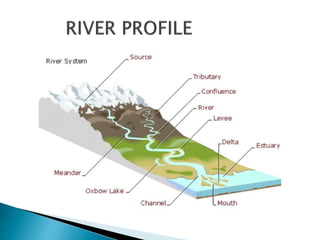
 Every River Channel is Characterized with
a Longitudinal ( Lengthwise ) Profile
 Head Region Is the Highland Region from
where the River Originates.
 Then River Flows Through Gradually
Decreasing Slopes and then through nearly
Flat Lands
 Mouth is The Place where River Enters a
Sea .
While river flows through Head to mouth, It
Exerts Great Influence over topography.
 Basic Terms :-
 Channel
 Velocity
 Gradient
 Type of flow
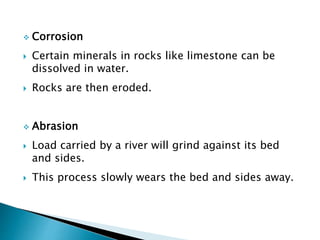
 Hydraulic action
 The work of turbulence in the water.
 Running water causes friction in the joints of rocks
in a stream channel
 Joints may be enlarged
 Loosened fragments of rocks get swept away.
 Attrition
 When thrown against the sides and bed of rivers,
the load gets broken into smaller pieces.
 Corrosion
 Certain minerals in rocks like limestone can be
dissolved in water.
 Rocks are then eroded.
 Abrasion
 Load carried by a river will grind against its bed
and sides.
 This process slowly wears the bed and sides away.
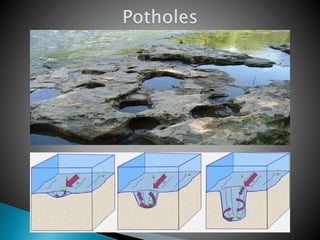
 Potholes
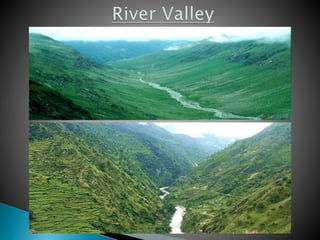
 River Valley
 Gorges and Canyons
 Waterfall
 They are variously shaped depressions of
different dimensions
 Formed by plucking of an outstanding rock
projection, resulting in small depressions
 Abrasive action, on depressions leads to
further deeping and widening of potholes
 Area of low land surrounded on sides by
inclined hill slopes and mountains.
 Origin, development and modification of
valley, depends on river flowing through it.
 Valley formed in the youthful stage of fluvial
cycle of erosion and in the initial stage of
valley development is V shaped having steep
side valley slope of convex element.
 The valleys are gradually widened due to
lateral erosion.
 The process of valley deepening often gives
rise this type of surface feature
 Gorges are very deep and narrow valleys with
very steep and high walls on either side.
 Canyon is a specific type of george where the
layers cut down by a river are essentially
stratified and horizontal in altitude.
 Canyon has been formed through a long
period of time and frequent erosion from
plateau.
 Gorges are normally formed from the flow of
water.
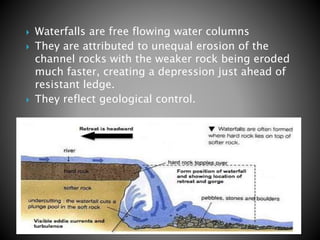
 Waterfalls are free flowing water columns
 They are attributed to unequal erosion of the
channel rocks with the weaker rock being eroded
much faster, creating a depression just ahead of
resistant ledge.
 They reflect geological control.
 Suspended Load
 Bed load
 Dissolved Load
 A river will drop its load when:
 Volume decreases
 Speed decrease
 A river’s volume decreases when
 Dry season
 Dry region with high evaporation
 Presence of permeable rocks
 Receding flood waters
 Alluvial fans and cones
 Flood Plains
 Deltas
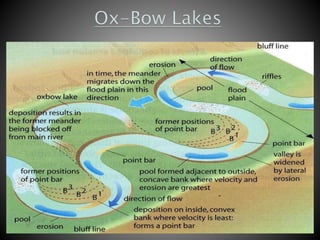
 Oxbow Lakes
 Alluvial fans and cones are always formed at
base of foothills where there is abrupt drop in
channel gradient.
 Alluvial fans have gentle slope below 10
degree, and alluvial cone has a slope in range
of (10-50 degree).
 Alluvial cones are made of coarser material
than alluvial fans.
 There may growth of a fan by repeated
accumulations, Upwards as well as Laterally.
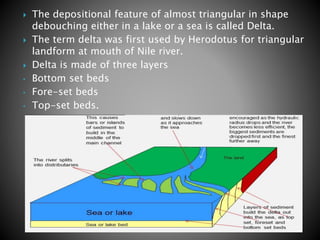
 The depositional feature of almost triangular in shape
debouching either in a lake or a sea is called Delta.
 The term delta was first used by Herodotus for triangular
landform at mouth of Nile river.
 Delta is made of three layers
• Bottom set beds
• Fore-set beds
• Top-set beds.
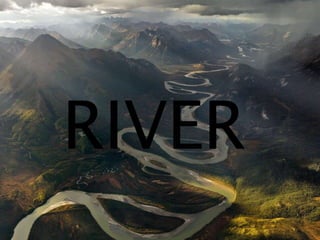
river and its view
river and its view

river and its view

  • 1.
  • 2.
  • 4.
     Every RiverChannel is Characterized with a Longitudinal ( Lengthwise ) Profile  Head Region Is the Highland Region from where the River Originates.  Then River Flows Through Gradually Decreasing Slopes and then through nearly Flat Lands  Mouth is The Place where River Enters a Sea .
  • 5.
    While river flowsthrough Head to mouth, It Exerts Great Influence over topography.  Basic Terms :-  Channel  Velocity  Gradient  Type of flow
  • 6.
     Hydraulic action The work of turbulence in the water.  Running water causes friction in the joints of rocks in a stream channel  Joints may be enlarged  Loosened fragments of rocks get swept away.  Attrition  When thrown against the sides and bed of rivers, the load gets broken into smaller pieces.
  • 7.
     Corrosion  Certainminerals in rocks like limestone can be dissolved in water.  Rocks are then eroded.  Abrasion  Load carried by a river will grind against its bed and sides.  This process slowly wears the bed and sides away.
  • 8.
     Potholes  RiverValley  Gorges and Canyons  Waterfall
  • 10.
     They arevariously shaped depressions of different dimensions  Formed by plucking of an outstanding rock projection, resulting in small depressions  Abrasive action, on depressions leads to further deeping and widening of potholes
  • 12.
     Area oflow land surrounded on sides by inclined hill slopes and mountains.  Origin, development and modification of valley, depends on river flowing through it.  Valley formed in the youthful stage of fluvial cycle of erosion and in the initial stage of valley development is V shaped having steep side valley slope of convex element.  The valleys are gradually widened due to lateral erosion.
  • 15.
     The processof valley deepening often gives rise this type of surface feature  Gorges are very deep and narrow valleys with very steep and high walls on either side.  Canyon is a specific type of george where the layers cut down by a river are essentially stratified and horizontal in altitude.  Canyon has been formed through a long period of time and frequent erosion from plateau.  Gorges are normally formed from the flow of water.
  • 17.
     Waterfalls arefree flowing water columns  They are attributed to unequal erosion of the channel rocks with the weaker rock being eroded much faster, creating a depression just ahead of resistant ledge.  They reflect geological control.
  • 18.
     Suspended Load Bed load  Dissolved Load
  • 19.
     A riverwill drop its load when:  Volume decreases  Speed decrease  A river’s volume decreases when  Dry season  Dry region with high evaporation  Presence of permeable rocks  Receding flood waters
  • 20.
     Alluvial fansand cones  Flood Plains  Deltas  Oxbow Lakes
  • 22.
     Alluvial fansand cones are always formed at base of foothills where there is abrupt drop in channel gradient.  Alluvial fans have gentle slope below 10 degree, and alluvial cone has a slope in range of (10-50 degree).  Alluvial cones are made of coarser material than alluvial fans.  There may growth of a fan by repeated accumulations, Upwards as well as Laterally.
  • 25.
     The depositionalfeature of almost triangular in shape debouching either in a lake or a sea is called Delta.  The term delta was first used by Herodotus for triangular landform at mouth of Nile river.  Delta is made of three layers • Bottom set beds • Fore-set beds • Top-set beds.