Continental drift theory
According to the hypothesis of continental drift, continents have moved slowly to their current locations.Theory of continental was purposed by alferedwegner in (1912)
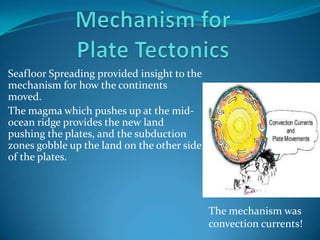
Mechanism for Plate TectonicsSeafloor Spreading provided insight to the mechanism for how the continents moved. The magma which pushes up at the mid-ocean ridge provides the new land pushing the plates, and the subduction zones gobble up the land on the other side of the plates.The mechanism was convection currents!
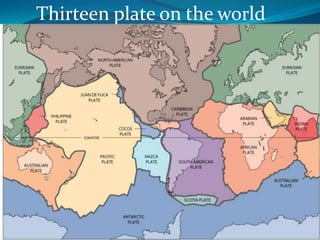
Thirteen plate on the world
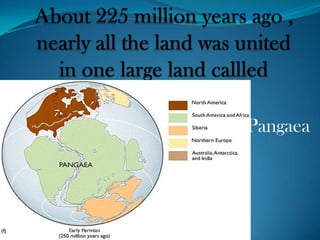
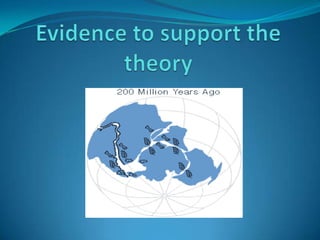
About 225 million years ago , nearly all the land was united in one large land callledPangaea
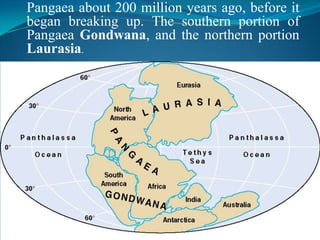
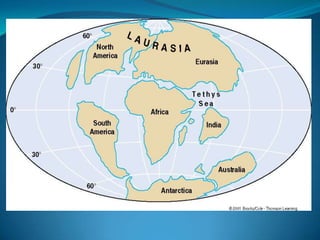
Pangaea about 200 million years ago, before it began breaking up. The southern portion of Pangaea Gondwana, and the northern portion Laurasia.
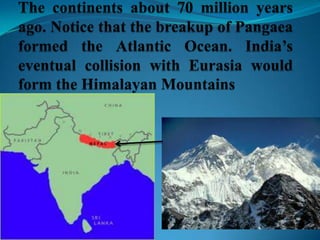
The continents about 70 million years ago. Notice that the breakup of Pangaea formed the Atlantic Ocean. India’s eventual collision with Eurasia would form the Himalayan Mountains
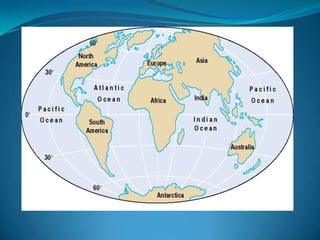
The position of the continents today. The continents are still slowly moving, at about the speed your fingernails grow. Satellite measurements have confirmed that every year the Atlantic Ocean gets a few inches wider!
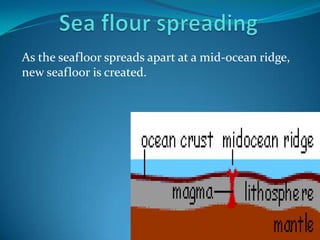
Sea flour spreadingAs the seafloor spreads apart at a mid-ocean ridge, new seafloor is created.
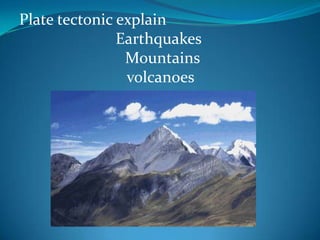
Plate tectonic explainEarthquakes  Mountains volcanoes
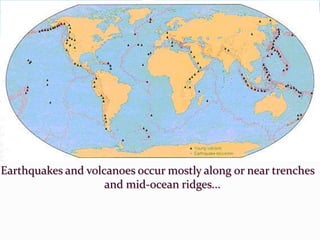
Earthquakes and volcanoes occur mostly along or near trenches and mid-ocean ridges...
 Mountain formation
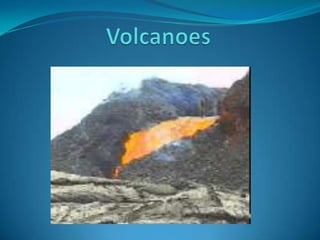
Volcanoes
Thawaearthequakeekkakdanna
Evidence to support the theory
Continental drift fossil evidence
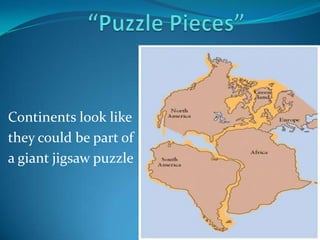
“Puzzle Pieces”Continents look like they could be part of a giant jigsaw puzzle
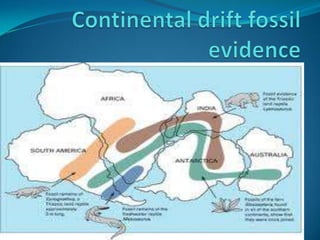
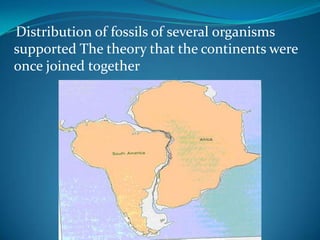
Distribution of fossils of several organisms supported The theory that the continents were once joined together
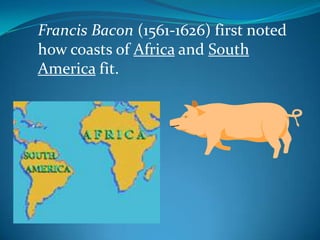
Francis Bacon (1561-1626) first noted how coasts of Africa and South America fit.
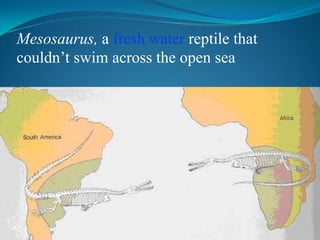
Mesosaurus, a fresh water reptile that couldn’t swim across the open sea
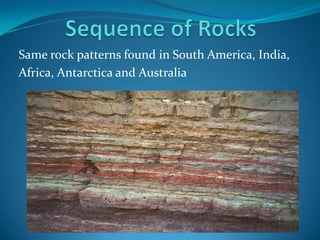
Sequence of RocksSame rock patterns found in South America, India, Africa, Antarctica and Australia
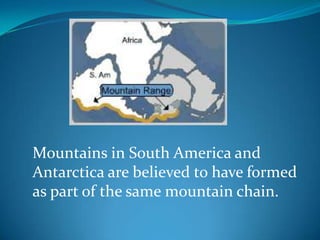
Mountains in South America and Antarctica are believed to have formed as part of the same mountain chain.
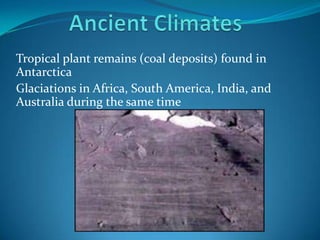
Ancient ClimatesTropical plant remains (coal deposits) found in AntarcticaGlaciations in Africa, South America, India, and Australia during the same time
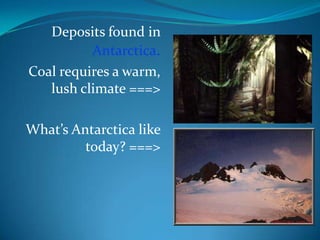
CoalDeposits found inAntarctica.Coal requires a warm, lush climate ===>What’s Antarctica like today? ===>
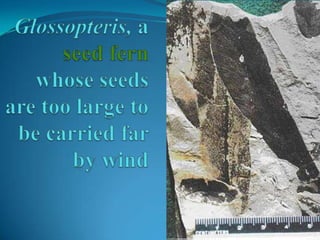
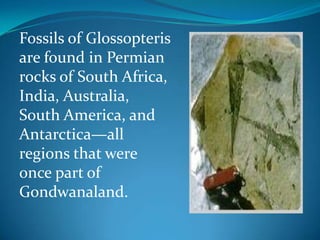
Glossopteris, a seedfern whose seeds are too large to be carried far by wind
Fossils of Glossopteris are found in Permian rocks of South Africa, India, Australia, South America, and Antarctica—all regions that were once part of Gondwanaland.
Problems With The TheoryNo mechanism for movement of continents
Wind and currents could possibly move     fossils

Continental drift theory