River features?

Are facial
features the
same thing for
rivers?

1
River Features
Rivers are eroding, transporting and depositing
constantly.
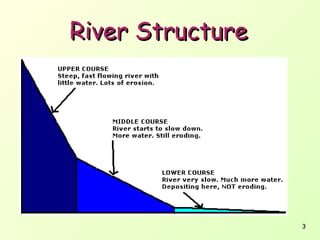
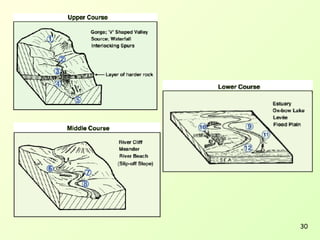
The river can be divided into 3 sections –
Upper Course at the Source, Middle Course
and Lower Course at the Mouth of the river.
The river displays different characteristics at
each section.

2
River Structure

3
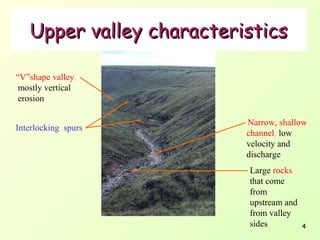
Upper valley characteristics
“V”shape valley,
mostly vertical
erosion
Interlocking spurs

Narrow, shallow
channel, low
velocity and
discharge
Large rocks
that come
from
upstream and
from valley
sides

4
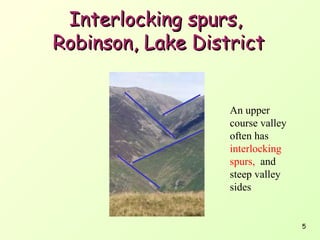
Interlocking spurs,
Robinson, Lake District
An upper
course valley
often has
interlocking
spurs, and
steep valley
sides

5
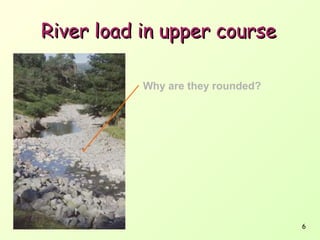
River load in upper course
Why are they rounded?

6
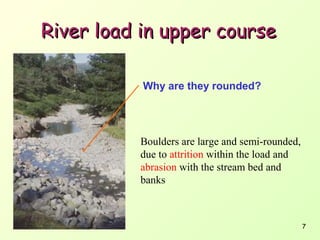
River load in upper course
Why are they rounded?

Boulders are large and semi-rounded,
due to attrition within the load and
abrasion with the stream bed and
banks

7
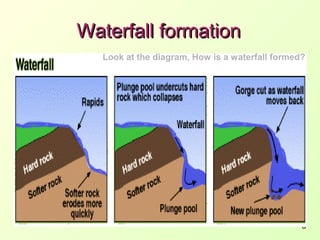
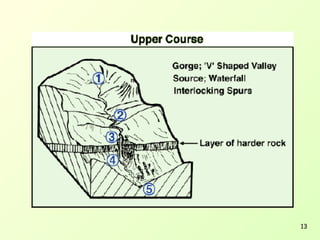
Waterfall formation
Look at the diagram, How is a waterfall formed?

8
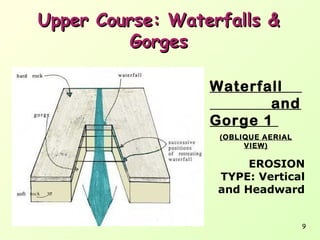
Upper Course: Waterfalls &
Gorges
Waterfall
and
Gorge 1
(OBLIQUE AERIAL
VIEW)

EROSION
TYPE: Vertical
and Headward
9
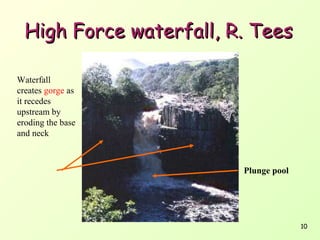
High Force waterfall, R. Tees
Waterfall
creates gorge as
it recedes
upstream by
eroding the base
and neck

Plunge pool

10
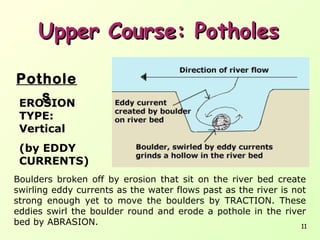
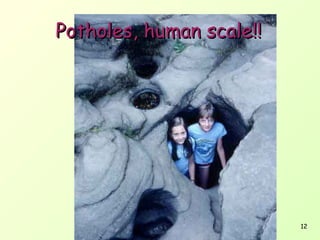
Upper Course: Potholes
Pothole
s
EROSION
TYPE:
Vertical

(by EDDY
CURRENTS)
Boulders broken off by erosion that sit on the river bed create
swirling eddy currents as the water flows past as the river is not
strong enough yet to move the boulders by TRACTION. These
eddies swirl the boulder round and erode a pothole in the river
bed by ABRASION.
11
Potholes, human scale!!

12
13
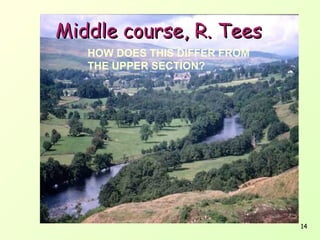
Middle course, R. Tees
HOW DOES THIS DIFFER FROM
THE UPPER SECTION?

14
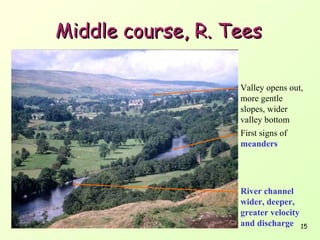
Middle course, R. Tees
Valley opens out,
more gentle
slopes, wider
valley bottom
First signs of
meanders

River channel
wider, deeper,
greater velocity
and discharge 15
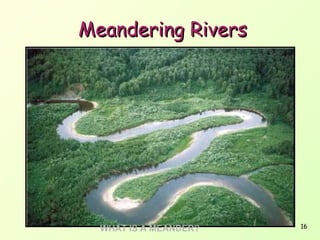
Meandering Rivers

WHAT IS A MEANDER?

16
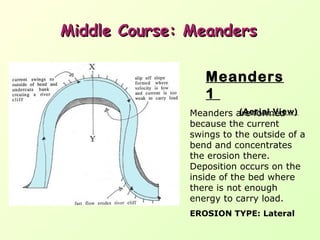
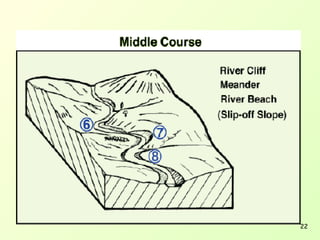
Middle Course: Meanders
Meanders
1
(Aerial View)
Meanders are formed
because the current
swings to the outside of a
bend and concentrates
the erosion there.
Deposition occurs on the
inside of the bed where
there is not enough
energy to carry load.
EROSION TYPE: Lateral
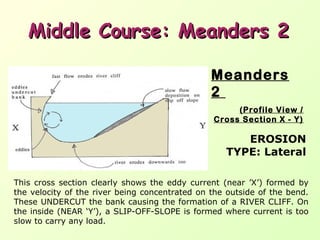
Middle Course: Meanders 2
Meanders
2
(Profile View /
Cross Section X - Y)

EROSION
TYPE: Lateral
This cross section clearly shows the eddy current (near ’X’) formed by
the velocity of the river being concentrated on the outside of the bend.
These UNDERCUT the bank causing the formation of a RIVER CLIFF. On
the inside (NEAR ‘Y’), a SLIP-OFF-SLOPE is formed where current is too
slow to carry any load.
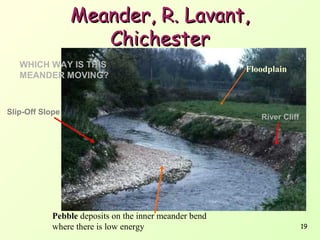
Meander, R. Lavant,
Chichester
WHICH WAY IS THIS
MEANDER MOVING?

Slip-Off Slope

Pebble deposits on the inner meander bend
where there is low energy

Floodplain

River Cliff

19
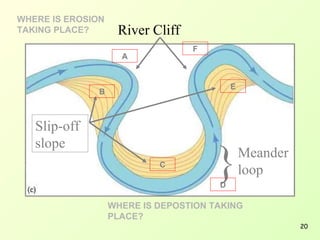
WHERE IS EROSION
TAKING PLACE?

River Cliff
F

A

E

B

Slip-off
slope
C

}

Meander
loop

D

WHERE IS DEPOSTION TAKING
PLACE?
20
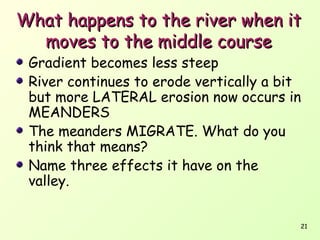
What happens to the river when it
moves to the middle course
Gradient becomes less steep
River continues to erode vertically a bit
but more LATERAL erosion now occurs in
MEANDERS
The meanders MIGRATE. What do you
think that means?
Name three effects it have on the
valley.

21
22
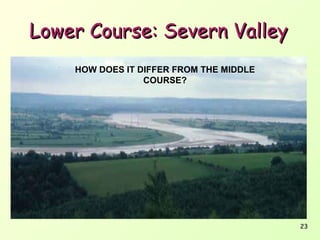
Lower Course: Severn Valley
HOW DOES IT DIFFER FROM THE MIDDLE
COURSE?

23
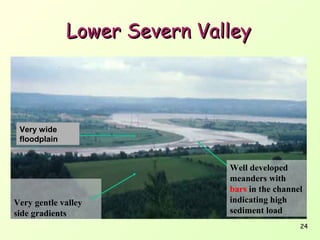
Lower Severn Valley

Very wide
floodplain

Very gentle valley
side gradients

Well developed
meanders with
bars in the channel
indicating high
sediment load
24
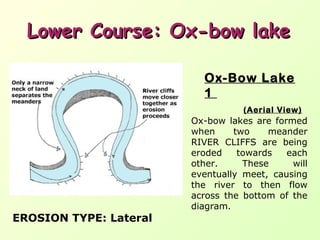
Lower Course: Ox-bow lake
Ox-Bow Lake
1
(Aerial View)

EROSION TYPE: Lateral

Ox-bow lakes are formed
when
two
meander
RIVER CLIFFS are being
eroded
towards
each
other.
These
will
eventually meet, causing
the river to then flow
across the bottom of the
diagram.
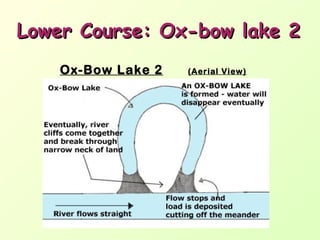
Lower Course: Ox-bow lake 2
Ox-Bow Lake 2

(Aerial View)
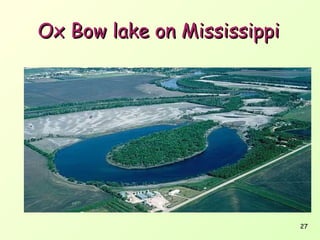
Ox Bow lake on Mississippi

27
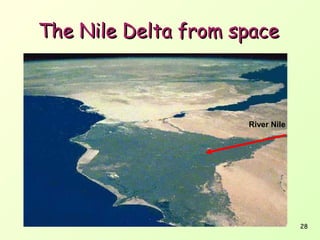
The Nile Delta from space

River Nile

28
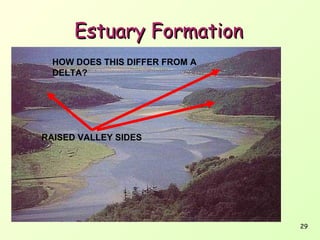
Estuary Formation
HOW DOES THIS DIFFER FROM A
DELTA?

RAISED VALLEY SIDES

29
30

River processes

  • 1.
    River features? Are facial featuresthe same thing for rivers? 1
  • 2.
    River Features Rivers areeroding, transporting and depositing constantly. The river can be divided into 3 sections – Upper Course at the Source, Middle Course and Lower Course at the Mouth of the river. The river displays different characteristics at each section. 2
  • 3.
  • 4.
    Upper valley characteristics “V”shapevalley, mostly vertical erosion Interlocking spurs Narrow, shallow channel, low velocity and discharge Large rocks that come from upstream and from valley sides 4
  • 5.
    Interlocking spurs, Robinson, LakeDistrict An upper course valley often has interlocking spurs, and steep valley sides 5
  • 6.
    River load inupper course Why are they rounded? 6
  • 7.
    River load inupper course Why are they rounded? Boulders are large and semi-rounded, due to attrition within the load and abrasion with the stream bed and banks 7
  • 8.
    Waterfall formation Look atthe diagram, How is a waterfall formed? 8
  • 9.
    Upper Course: Waterfalls& Gorges Waterfall and Gorge 1 (OBLIQUE AERIAL VIEW) EROSION TYPE: Vertical and Headward 9
  • 10.
    High Force waterfall,R. Tees Waterfall creates gorge as it recedes upstream by eroding the base and neck Plunge pool 10
  • 11.
    Upper Course: Potholes Pothole s EROSION TYPE: Vertical (byEDDY CURRENTS) Boulders broken off by erosion that sit on the river bed create swirling eddy currents as the water flows past as the river is not strong enough yet to move the boulders by TRACTION. These eddies swirl the boulder round and erode a pothole in the river bed by ABRASION. 11
  • 12.
  • 13.
  • 14.
    Middle course, R.Tees HOW DOES THIS DIFFER FROM THE UPPER SECTION? 14
  • 15.
    Middle course, R.Tees Valley opens out, more gentle slopes, wider valley bottom First signs of meanders River channel wider, deeper, greater velocity and discharge 15
  • 16.
  • 17.
    Middle Course: Meanders Meanders 1 (AerialView) Meanders are formed because the current swings to the outside of a bend and concentrates the erosion there. Deposition occurs on the inside of the bed where there is not enough energy to carry load. EROSION TYPE: Lateral
  • 18.
    Middle Course: Meanders2 Meanders 2 (Profile View / Cross Section X - Y) EROSION TYPE: Lateral This cross section clearly shows the eddy current (near ’X’) formed by the velocity of the river being concentrated on the outside of the bend. These UNDERCUT the bank causing the formation of a RIVER CLIFF. On the inside (NEAR ‘Y’), a SLIP-OFF-SLOPE is formed where current is too slow to carry any load.
  • 19.
    Meander, R. Lavant, Chichester WHICHWAY IS THIS MEANDER MOVING? Slip-Off Slope Pebble deposits on the inner meander bend where there is low energy Floodplain River Cliff 19
  • 20.
    WHERE IS EROSION TAKINGPLACE? River Cliff F A E B Slip-off slope C } Meander loop D WHERE IS DEPOSTION TAKING PLACE? 20
  • 21.
    What happens tothe river when it moves to the middle course Gradient becomes less steep River continues to erode vertically a bit but more LATERAL erosion now occurs in MEANDERS The meanders MIGRATE. What do you think that means? Name three effects it have on the valley. 21
  • 22.
  • 23.
    Lower Course: SevernValley HOW DOES IT DIFFER FROM THE MIDDLE COURSE? 23
  • 24.
    Lower Severn Valley Verywide floodplain Very gentle valley side gradients Well developed meanders with bars in the channel indicating high sediment load 24
  • 25.
    Lower Course: Ox-bowlake Ox-Bow Lake 1 (Aerial View) EROSION TYPE: Lateral Ox-bow lakes are formed when two meander RIVER CLIFFS are being eroded towards each other. These will eventually meet, causing the river to then flow across the bottom of the diagram.
  • 26.
    Lower Course: Ox-bowlake 2 Ox-Bow Lake 2 (Aerial View)
  • 27.
    Ox Bow lakeon Mississippi 27
  • 28.
    The Nile Deltafrom space River Nile 28
  • 29.
    Estuary Formation HOW DOESTHIS DIFFER FROM A DELTA? RAISED VALLEY SIDES 29
  • 30.