River Processes
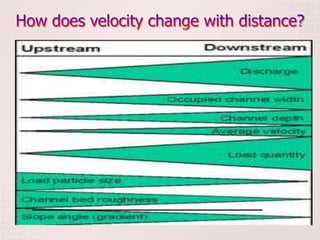
Velocity
Flow
Hjulstrom Curve
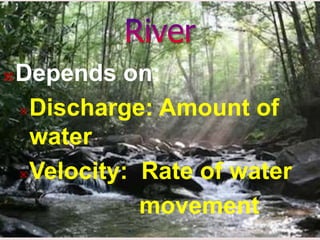
Depends on:
Discharge: Amount of
water
Velocity: Rate of water
movement
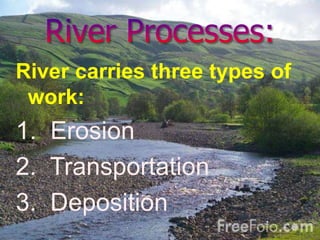
River carries three types of
work:
1. Erosion
2. Transportation
3. Deposition
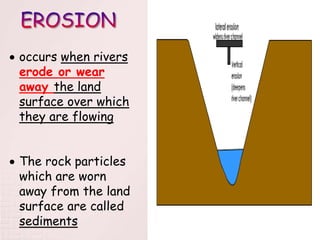
 occurs when rivers
erode or wear
away the land
surface over which
they are flowing
 The rock particles
which are worn
away from the land
surface are called
sediments
is a process where the
sediment produced by erosion
is carried away downstream
by the river
happens when the sediment may
settle either on the river bed
where the water flows more
slowly as in the flood plain, or
eventually on the sea bed
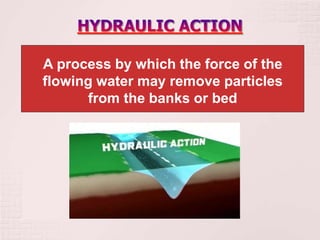
A process by which the force of the
flowing water may remove particles
from the banks or bed
 A form of hydraulic action caused by
bubbles of air collapsing
 The resultant shock waves hit and
slowly weaken the banks
 This is the slowest and least effective
erosion in process
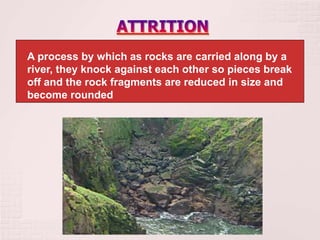
A process by which as rocks are carried along by a
river, they knock against each other so pieces break
off and the rock fragments are reduced in size and
become rounded
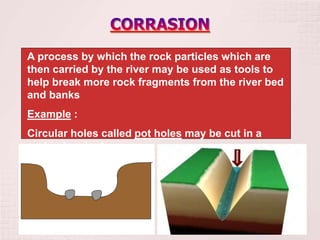
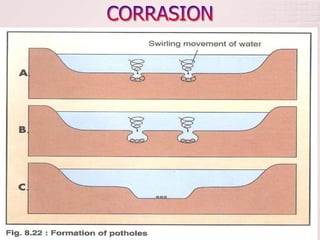
A process by which the rock particles which are
then carried by the river may be used as tools to
help break more rock fragments from the river bed
and banks
Example :
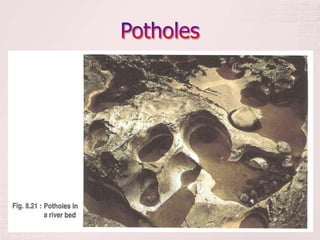
Circular holes called pot holes may be cut in a
rocky river bed
A process by which rivers can dissolve some rocks such
as limestone
Example :
At Mulu in Sarawak, rivers have dissolved the limestone
and created huge caverns (large caves) through which
they flow underground
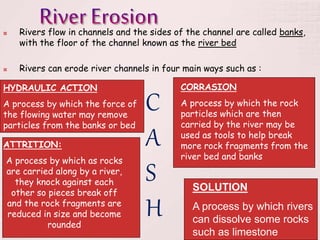
 Rivers flow in channels and the sides of the channel are called banks,
with the floor of the channel known as the river bed
 Rivers can erode river channels in four main ways such as :
HYDRAULIC ACTION
A process by which the force of
the flowing water may remove
particles from the banks or bed
CORRASION
A process by which the rock
particles which are then
carried by the river may be
used as tools to help break
more rock fragments from the
river bed and banks
ATTRITION:
A process by which as rocks
are carried along by a river,
they knock against each
other so pieces break off
and the rock fragments are
reduced in size and become
rounded
SOLUTION
A process by which rivers
can dissolve some rocks
such as limestone
C
A
S
H
• is a process where the sediment
produced by erosion is carried
away downstream by the river
• 3 main processes:
• Bedload
• Suspended Load
• Dissolved / Solution Load
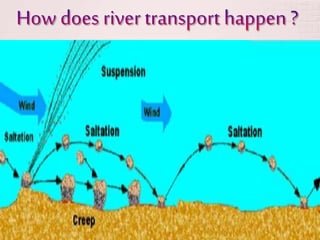
 Larger particles which cannot be
picked up by current may be moved
along the bed of the river in two
ways:
 Traction
 Saltation
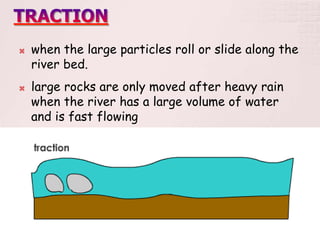
 when the large particles roll or slide along the
river bed.
 large rocks are only moved after heavy rain
when the river has a large volume of water
and is fast flowing
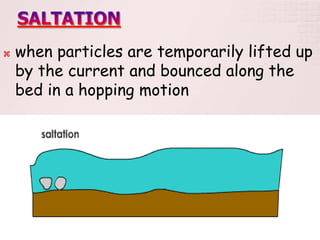
 when particles are temporarily lifted up
by the current and bounced along the
bed in a hopping motion
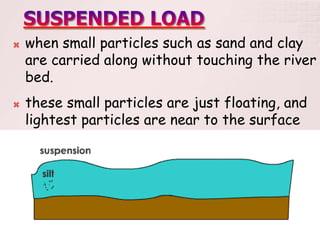
 when small particles such as sand and clay
are carried along without touching the river
bed.
 these small particles are just floating, and
lightest particles are near to the surface
of the water
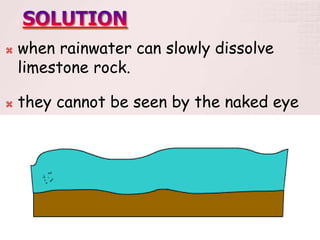
 when rainwater can slowly dissolve
limestone rock.
 they cannot be seen by the naked eye
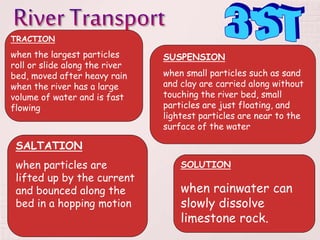
SUSPENSION
when small particles such as sand
and clay are carried along without
touching the river bed, small
particles are just floating, and
lightest particles are near to the
surface of the water
SOLUTION
when rainwater can
slowly dissolve
limestone rock.
SALTATION
when particles are
lifted up by the current
and bounced along the
bed in a hopping motion
TRACTION
when the largest particles
roll or slide along the river
bed, moved after heavy rain
when the river has a large
volume of water and is fast
flowing
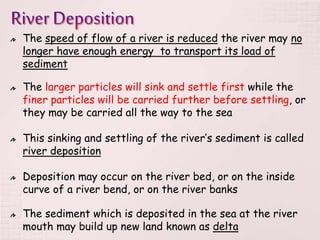
The speed of flow of a river is reduced the river may no
longer have enough energy to transport its load of
sediment
The larger particles will sink and settle first while the
finer particles will be carried further before settling, or
they may be carried all the way to the sea
This sinking and settling of the river’s sediment is called
river deposition
Deposition may occur on the river bed, or on the inside
curve of a river bend, or on the river banks
The sediment which is deposited in the sea at the river
mouth may build up new land known as delta
 decrease in velocity  less energy and no longer had
competence and capacity to carry all its load
 Therefore, largest / heaviest particles, materials begins to
be deposited.
Occurs when:
1. Low discharge following a period of low
precipitation
2. Less velocity when river enter sea or lake.
3. Shallower water occurs on inside of a meander.
4. The load suddenly increase (debris from landslide)
5. River overflow its bank so velocity outside channel
VELOCITY
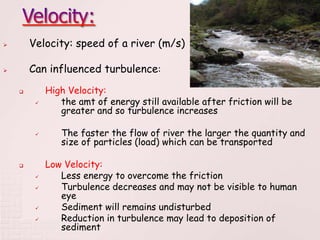
 Velocity: speed of a river (m/s)
 Can influenced turbulence:
 High Velocity:
 the amt of energy still available after friction will be
greater and so turbulence increases
 The faster the flow of river the larger the quantity and
size of particles (load) which can be transported
 Low Velocity:
 Less energy to overcome the friction
 Turbulence decreases and may not be visible to human
eye
 Sediment will remains undisturbed
 Reduction in turbulence may lead to deposition of
sediment
Velocity of a river is influence by 3 factors:
(i) Channel shape in cross-section.
(ii) Roughness of the channel’s bed and banks.
(iii) Channel slope.
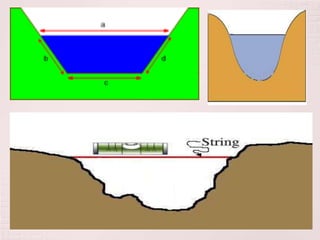
 Simply describe by the term ‘Hydraulic radius’
 i.e: Cross section area / wetted perimeter
 Wetted perimeter - shape of the channel or its cross
section
affects the extent to which water is in
contact with its channel.
 The greater the wetted perimeter, the greater the
friction between the water and the banks and the bed
of the channel,
 and the slower the flow of river.
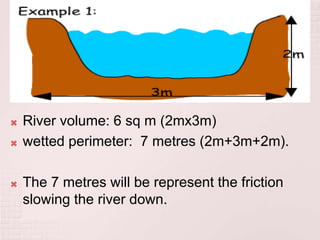
 River volume: 6 sq m (2mx3m)
 wetted perimeter: 7 metres (2m+3m+2m).
 The 7 metres will be represent the friction
slowing the river down.
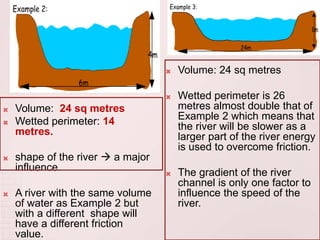
 Volume: 24 sq metres
 Wetted perimeter: 14
metres.
 shape of the river  a major
influence.
 A river with the same volume
of water as Example 2 but
with a different shape will
have a different friction
value.
 Volume: 24 sq metres
 Wetted perimeter is 26
metres almost double that of
Example 2 which means that
the river will be slower as a
larger part of the river energy
is used to overcome friction.
 The gradient of the river
channel is only one factor to
influence the speed of the
river.
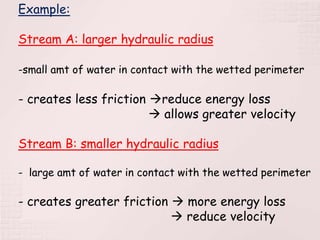
Example:
Stream A: larger hydraulic radius
-small amt of water in contact with the wetted perimeter
- creates less friction reduce energy loss
 allows greater velocity
Stream B: smaller hydraulic radius
- large amt of water in contact with the wetted perimeter
- creates greater friction  more energy loss
 reduce velocity
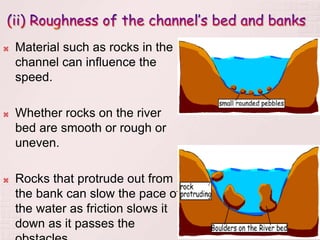
 Material such as rocks in the
channel can influence the
speed.
 Whether rocks on the river
bed are smooth or rough or
uneven.
 Rocks that protrude out from
the bank can slow the pace of
the water as friction slows it
down as it passes the
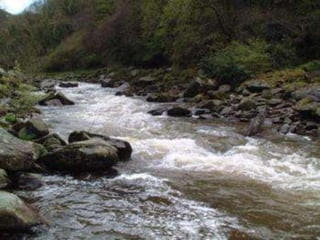
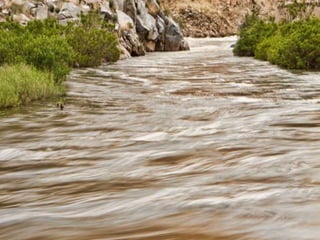
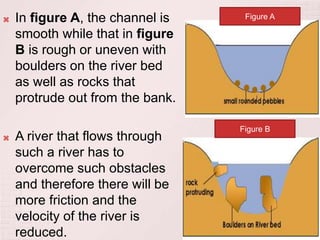
 In figure A, the channel is
smooth while that in figure
B is rough or uneven with
boulders on the river bed
as well as rocks that
protrude out from the bank.
 A river that flows through
such a river has to
overcome such obstacles
and therefore there will be
more friction and the
velocity of the river is
reduced.
Figure A
Figure B
 Velocity of a mountain stream is less than that of
a lowland
 Mountain stream is likely to pick up loose material
and carry it downstream
 Example:
 Mountainous / Upper course of a river:
 Despite high velocity in waterfalls, the large number
of angular rocks, coarse-grained banks and
protrusions increase frictions and reduce overall
velocity
 Lower course of a river:
 As there is little resistance from the smooth bed and
banks, there is little friction and river flows faster
 A river flowing down a
steep slope or gradient has
higher velocity than one
which flows down a gentler
gradient.
 For example, the speed
of flow in a river that
plunges down a steep slope
in the form of a waterfall
is much higher than the
speed of flow in a river
that winds down a gentler
slope.
 Gradient = steepness
 As more tributaries and water from the
surface, throughflow join the main river
 the discharge, channel cross-section and
hydraulic radius increases.
 less energy will be loss through friction
 erosive power will decrease
 river flows over a gradually decrease gradient
 Changes in gradient are related to changes
in discharge.
 Discharge is higher in the lower course
 Since gradient decreases as discharge
increases, river can transport the same
quantity and size of sediment load in the
gentler lower course as it can in the steeper
upper course.
FLOW
- River water  has a certain amount of available energy.
- greatest when there is a large amt of water and when there is steep
gradient.
- Most of the river’s energy used up in overcoming friction with the bed and
banks
- Friction  high in the upper reaches of a river where large boulders
may protrude into large river’s flow
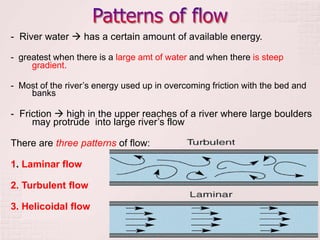
There are three patterns of flow:
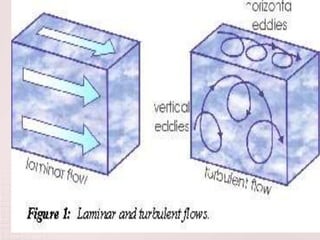
1. Laminar flow
2. Turbulent flow
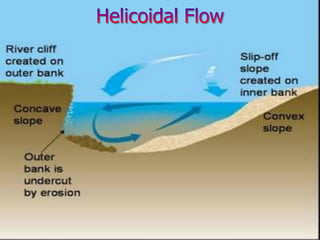
3. Helicoidal flow
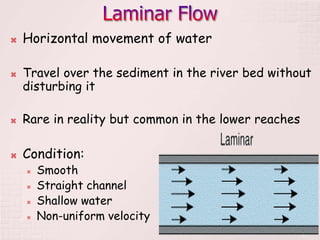
 Horizontal movement of water
 Travel over the sediment in the river bed without
disturbing it
 Rare in reality but common in the lower reaches
 Condition:
 Smooth
 Straight channel
 Shallow water
 Non-uniform velocity
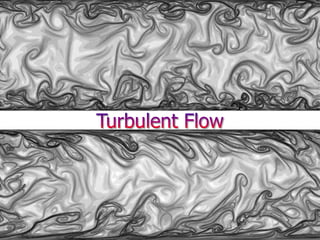
 Series of erratic (inconsistent) eddies
 Both vertical & horizontal in downstream
direction
 Depends on the amt of energy available after
friction has been overcome
 Conditions:
 Complex channel shape eg. Winding channels, riffles
and pools
 Cavitation as eddies trap air in pores, cracks
crevices which is then release under great pressure
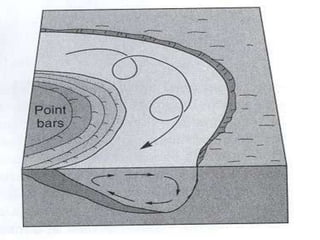
 Usually occur in meanders
 A corkscrew movement in a meander
 It is responsible for moving material
from the outside of one meander bend
and depositing on the inside of the next
bend.
Hjulstrom
curve
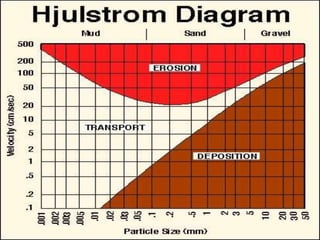
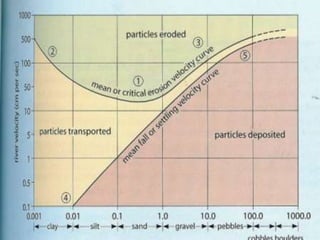
 a graph used by hydrologists to
determine whether a river will erode,
transport or deposit sediment.
 The graph takes sediment size and
channel velocity into account.
 The curve shows several key ideas
about the relationships between
erosion, transportation and deposition.
Hjulstrom Curve
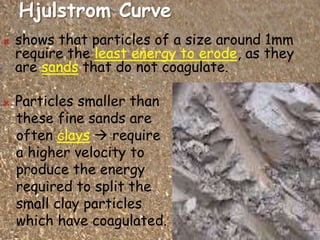
 shows that particles of a size around 1mm
require the least energy to erode, as they
are sands that do not coagulate.
 Particles smaller than
these fine sands are
often clays  require
a higher velocity to
produce the energy
required to split the
small clay particles
which have coagulated.
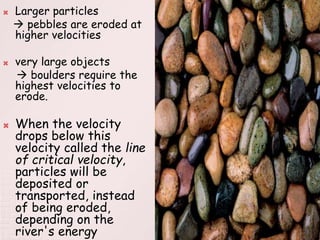
 Larger particles
 pebbles are eroded at
higher velocities
 very large objects
 boulders require the
highest velocities to
erode.
 When the velocity
drops below this
velocity called the line
of critical velocity,
particles will be
deposited or
transported, instead
of being eroded,
depending on the
river's energy
 Critical erosion velocity : the lowest velocity at which grains of a
certain size can be moved.
 Critical deposition velocity: The velocity at which particles of
particular sizes are laid down
 Entrainment: materials being picked up by river
 Flocculate: materials stick together in the river
 Clay particles: Tiny particles between 0.001 and 0.01mm in size
 Sand particles: Sediments between 0.1 and 2mm in size
 Cobbles: Sediments between 20 and 300mm in size
 Key:
 Silt / sand are picked up (entrained) at the
lowest velocities
 Clays are difficult to pick up as pebbles –
although they are small particles, they are very
cohesive and the claybed is very smooth
 Large boulders are dropped easily
 Clay particles can be transported in suspension
at very low velocities
 Hydraulic action
 Cavitation
 Attrition
 Corassion
 Solution
 Bedload
 Suspended load
 Solution
 Traction
 Saltation
 Hydraulic radius
 Wetted perimeter
 Laminar
 Turbulent
 Helicoidal
 Hjulstrom Curve
 Critical erosion curve
 Critical deposition curve
 Entrainment
 Flocculate
 Clay particles
 Sand particles
 Cobbles
1. Name the type of sediment that requires the lowest
velocity to be eroded. [1]
2. Name the type of sediment that is likely to be
transported at all velocities. [1]
3. Describe and explain the relationship between
water velocity and the erosion of clay
and sand particles. [4]
4. Explain the variation in water velocity that is
required to transport and to deposit
sediments of different particle diameter. [4]
1. Sand
2. Clay
3. Clay – requires higher energy to be eroded
- tend to stick together
- are difficult to pick up as pebbles
– although they are small particles, they are very
cohesive
Sand – requires lower energy
- sand particles are unconsolidated (loose)
4. Boulders – require large velocities to be transported
Small particles – Clay & silt – can be held in suspension area
at low velocity
Energy velocity to transport is always lower than energy
to erode

River channel processes

  • 2.
  • 3.
    Depends on: Discharge: Amountof water Velocity: Rate of water movement
  • 4.
    River carries threetypes of work: 1. Erosion 2. Transportation 3. Deposition
  • 5.
     occurs whenrivers erode or wear away the land surface over which they are flowing  The rock particles which are worn away from the land surface are called sediments
  • 6.
    is a processwhere the sediment produced by erosion is carried away downstream by the river
  • 7.
    happens when thesediment may settle either on the river bed where the water flows more slowly as in the flood plain, or eventually on the sea bed
  • 8.
    A process bywhich the force of the flowing water may remove particles from the banks or bed
  • 9.
     A formof hydraulic action caused by bubbles of air collapsing  The resultant shock waves hit and slowly weaken the banks  This is the slowest and least effective erosion in process
  • 15.
    A process bywhich as rocks are carried along by a river, they knock against each other so pieces break off and the rock fragments are reduced in size and become rounded
  • 16.
    A process bywhich the rock particles which are then carried by the river may be used as tools to help break more rock fragments from the river bed and banks Example : Circular holes called pot holes may be cut in a rocky river bed
  • 19.
    A process bywhich rivers can dissolve some rocks such as limestone Example : At Mulu in Sarawak, rivers have dissolved the limestone and created huge caverns (large caves) through which they flow underground
  • 20.
     Rivers flowin channels and the sides of the channel are called banks, with the floor of the channel known as the river bed  Rivers can erode river channels in four main ways such as : HYDRAULIC ACTION A process by which the force of the flowing water may remove particles from the banks or bed CORRASION A process by which the rock particles which are then carried by the river may be used as tools to help break more rock fragments from the river bed and banks ATTRITION: A process by which as rocks are carried along by a river, they knock against each other so pieces break off and the rock fragments are reduced in size and become rounded SOLUTION A process by which rivers can dissolve some rocks such as limestone C A S H
  • 21.
    • is aprocess where the sediment produced by erosion is carried away downstream by the river • 3 main processes: • Bedload • Suspended Load • Dissolved / Solution Load
  • 22.
     Larger particleswhich cannot be picked up by current may be moved along the bed of the river in two ways:  Traction  Saltation
  • 23.
     when thelarge particles roll or slide along the river bed.  large rocks are only moved after heavy rain when the river has a large volume of water and is fast flowing
  • 24.
     when particlesare temporarily lifted up by the current and bounced along the bed in a hopping motion
  • 25.
     when smallparticles such as sand and clay are carried along without touching the river bed.  these small particles are just floating, and lightest particles are near to the surface of the water
  • 26.
     when rainwatercan slowly dissolve limestone rock.  they cannot be seen by the naked eye
  • 27.
    SUSPENSION when small particlessuch as sand and clay are carried along without touching the river bed, small particles are just floating, and lightest particles are near to the surface of the water SOLUTION when rainwater can slowly dissolve limestone rock. SALTATION when particles are lifted up by the current and bounced along the bed in a hopping motion TRACTION when the largest particles roll or slide along the river bed, moved after heavy rain when the river has a large volume of water and is fast flowing
  • 29.
    The speed offlow of a river is reduced the river may no longer have enough energy to transport its load of sediment The larger particles will sink and settle first while the finer particles will be carried further before settling, or they may be carried all the way to the sea This sinking and settling of the river’s sediment is called river deposition Deposition may occur on the river bed, or on the inside curve of a river bend, or on the river banks The sediment which is deposited in the sea at the river mouth may build up new land known as delta
  • 30.
     decrease invelocity  less energy and no longer had competence and capacity to carry all its load  Therefore, largest / heaviest particles, materials begins to be deposited. Occurs when: 1. Low discharge following a period of low precipitation 2. Less velocity when river enter sea or lake. 3. Shallower water occurs on inside of a meander. 4. The load suddenly increase (debris from landslide) 5. River overflow its bank so velocity outside channel
  • 31.
  • 32.
     Velocity: speedof a river (m/s)  Can influenced turbulence:  High Velocity:  the amt of energy still available after friction will be greater and so turbulence increases  The faster the flow of river the larger the quantity and size of particles (load) which can be transported  Low Velocity:  Less energy to overcome the friction  Turbulence decreases and may not be visible to human eye  Sediment will remains undisturbed  Reduction in turbulence may lead to deposition of sediment
  • 35.
    Velocity of ariver is influence by 3 factors: (i) Channel shape in cross-section. (ii) Roughness of the channel’s bed and banks. (iii) Channel slope.
  • 36.
     Simply describeby the term ‘Hydraulic radius’  i.e: Cross section area / wetted perimeter  Wetted perimeter - shape of the channel or its cross section affects the extent to which water is in contact with its channel.  The greater the wetted perimeter, the greater the friction between the water and the banks and the bed of the channel,  and the slower the flow of river.
  • 38.
     River volume:6 sq m (2mx3m)  wetted perimeter: 7 metres (2m+3m+2m).  The 7 metres will be represent the friction slowing the river down.
  • 39.
     Volume: 24sq metres  Wetted perimeter: 14 metres.  shape of the river  a major influence.  A river with the same volume of water as Example 2 but with a different shape will have a different friction value.  Volume: 24 sq metres  Wetted perimeter is 26 metres almost double that of Example 2 which means that the river will be slower as a larger part of the river energy is used to overcome friction.  The gradient of the river channel is only one factor to influence the speed of the river.
  • 40.
    Example: Stream A: largerhydraulic radius -small amt of water in contact with the wetted perimeter - creates less friction reduce energy loss  allows greater velocity Stream B: smaller hydraulic radius - large amt of water in contact with the wetted perimeter - creates greater friction  more energy loss  reduce velocity
  • 41.
     Material suchas rocks in the channel can influence the speed.  Whether rocks on the river bed are smooth or rough or uneven.  Rocks that protrude out from the bank can slow the pace of the water as friction slows it down as it passes the
  • 42.
     In figureA, the channel is smooth while that in figure B is rough or uneven with boulders on the river bed as well as rocks that protrude out from the bank.  A river that flows through such a river has to overcome such obstacles and therefore there will be more friction and the velocity of the river is reduced. Figure A Figure B
  • 43.
     Velocity ofa mountain stream is less than that of a lowland  Mountain stream is likely to pick up loose material and carry it downstream  Example:  Mountainous / Upper course of a river:  Despite high velocity in waterfalls, the large number of angular rocks, coarse-grained banks and protrusions increase frictions and reduce overall velocity  Lower course of a river:  As there is little resistance from the smooth bed and banks, there is little friction and river flows faster
  • 44.
     A riverflowing down a steep slope or gradient has higher velocity than one which flows down a gentler gradient.  For example, the speed of flow in a river that plunges down a steep slope in the form of a waterfall is much higher than the speed of flow in a river that winds down a gentler slope.
  • 45.
     Gradient =steepness  As more tributaries and water from the surface, throughflow join the main river  the discharge, channel cross-section and hydraulic radius increases.  less energy will be loss through friction  erosive power will decrease  river flows over a gradually decrease gradient
  • 46.
     Changes ingradient are related to changes in discharge.  Discharge is higher in the lower course  Since gradient decreases as discharge increases, river can transport the same quantity and size of sediment load in the gentler lower course as it can in the steeper upper course.
  • 48.
  • 49.
    - River water has a certain amount of available energy. - greatest when there is a large amt of water and when there is steep gradient. - Most of the river’s energy used up in overcoming friction with the bed and banks - Friction  high in the upper reaches of a river where large boulders may protrude into large river’s flow There are three patterns of flow: 1. Laminar flow 2. Turbulent flow 3. Helicoidal flow
  • 50.
     Horizontal movementof water  Travel over the sediment in the river bed without disturbing it  Rare in reality but common in the lower reaches  Condition:  Smooth  Straight channel  Shallow water  Non-uniform velocity
  • 51.
     Series oferratic (inconsistent) eddies  Both vertical & horizontal in downstream direction  Depends on the amt of energy available after friction has been overcome  Conditions:  Complex channel shape eg. Winding channels, riffles and pools  Cavitation as eddies trap air in pores, cracks crevices which is then release under great pressure
  • 54.
     Usually occurin meanders  A corkscrew movement in a meander  It is responsible for moving material from the outside of one meander bend and depositing on the inside of the next bend.
  • 57.
  • 58.
     a graphused by hydrologists to determine whether a river will erode, transport or deposit sediment.  The graph takes sediment size and channel velocity into account.  The curve shows several key ideas about the relationships between erosion, transportation and deposition.
  • 59.
    Hjulstrom Curve  showsthat particles of a size around 1mm require the least energy to erode, as they are sands that do not coagulate.  Particles smaller than these fine sands are often clays  require a higher velocity to produce the energy required to split the small clay particles which have coagulated.
  • 60.
     Larger particles pebbles are eroded at higher velocities  very large objects  boulders require the highest velocities to erode.  When the velocity drops below this velocity called the line of critical velocity, particles will be deposited or transported, instead of being eroded, depending on the river's energy
  • 63.
     Critical erosionvelocity : the lowest velocity at which grains of a certain size can be moved.  Critical deposition velocity: The velocity at which particles of particular sizes are laid down  Entrainment: materials being picked up by river  Flocculate: materials stick together in the river  Clay particles: Tiny particles between 0.001 and 0.01mm in size  Sand particles: Sediments between 0.1 and 2mm in size  Cobbles: Sediments between 20 and 300mm in size
  • 64.
     Key:  Silt/ sand are picked up (entrained) at the lowest velocities  Clays are difficult to pick up as pebbles – although they are small particles, they are very cohesive and the claybed is very smooth  Large boulders are dropped easily  Clay particles can be transported in suspension at very low velocities
  • 65.
     Hydraulic action Cavitation  Attrition  Corassion  Solution  Bedload  Suspended load  Solution  Traction  Saltation  Hydraulic radius  Wetted perimeter  Laminar  Turbulent  Helicoidal  Hjulstrom Curve  Critical erosion curve  Critical deposition curve  Entrainment  Flocculate  Clay particles  Sand particles  Cobbles
  • 66.
    1. Name thetype of sediment that requires the lowest velocity to be eroded. [1] 2. Name the type of sediment that is likely to be transported at all velocities. [1] 3. Describe and explain the relationship between water velocity and the erosion of clay and sand particles. [4] 4. Explain the variation in water velocity that is required to transport and to deposit sediments of different particle diameter. [4]
  • 67.
    1. Sand 2. Clay 3.Clay – requires higher energy to be eroded - tend to stick together - are difficult to pick up as pebbles – although they are small particles, they are very cohesive Sand – requires lower energy - sand particles are unconsolidated (loose) 4. Boulders – require large velocities to be transported Small particles – Clay & silt – can be held in suspension area at low velocity Energy velocity to transport is always lower than energy to erode