• Portfolio is a combination of securities such as stocks, bonds, and
  money market instruments.

• The process of blending together the broad classes so as to
  obtain return with minimum risk is called PORTFOLIO
  CONSTRUCTION.

• Diversification of investments helps to spread risk over many
  assets and thus reduces unsystematic risk.
• TRADITIONAL APPROACH: investors need’s in terms of income
  and capital appreciation are evaluated and appropriate
  securities are selected to meet the needs of investor.

• MARKOWITZ EFFICIENT FRONTIER APPROACH: portfolios are
  constructed to maximise the expected return for a given level of
  risk as it views portfolio construction in terms of expected return
  and the risk associated.
• It deals with two major decisions :-

(a) Determining the objectives of the portfolio.

(b) selection of securities to be included in the portfolio.
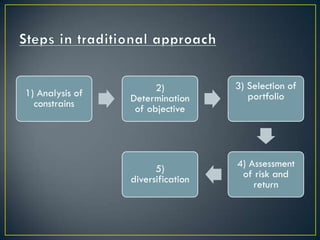
2)          3) Selection of
1) Analysis of   Determination        portfolio
  constrains      of objective


                       5)          4) Assessment
                 diversification    of risk and
                                       return
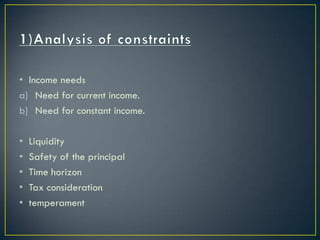
• Income needs
a) Need for current income.
b) Need for constant income.

•   Liquidity
•   Safety of the principal
•   Time horizon
•   Tax consideration
•   temperament
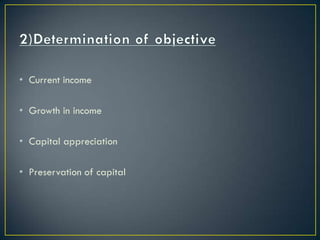
• Current income

• Growth in income

• Capital appreciation

• Preservation of capital
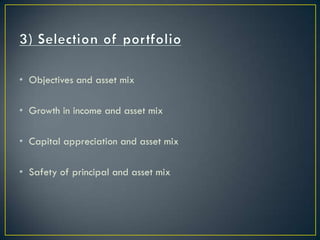
• Objectives and asset mix

• Growth in income and asset mix

• Capital appreciation and asset mix

• Safety of principal and asset mix
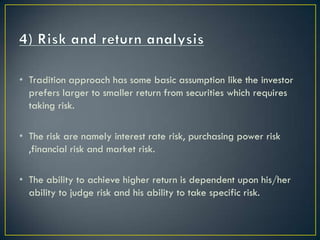
• Tradition approach has some basic assumption like the investor
  prefers larger to smaller return from securities which requires
  taking risk.

• The risk are namely interest rate risk, purchasing power risk
  ,financial risk and market risk.

• The ability to achieve higher return is dependent upon his/her
  ability to judge risk and his ability to take specific risk.
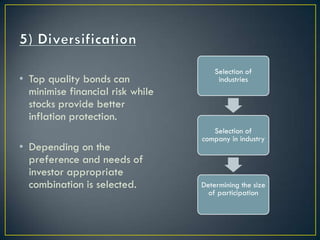
Selection of
• Top quality bonds can                industries
  minimise financial risk while
  stocks provide better
  inflation protection.
                                     Selection of
                                  company in industry
• Depending on the
  preference and needs of
  investor appropriate
  combination is selected.        Determining the size
                                    of participation
• Harry Markowitz put forward this model in 1952.

• It assists in the selection of the most efficient by analysing
  various possible portfolios of the given securities. By choosing
  securities that do not 'move' exactly together, the HM model
  shows investors how to reduce their risk.
• Assumptions
i. Risk of a portfolio is based on the variability of returns from
    the said portfolio.

i.    An investor is risk averse.

ii.   An investor either maximizes his portfolio return for
      a given level of risk or maximizes his return for
      the minimum risk.
• To choose the best portfolio from a number of possible
  portfolios, each with different return and risk, two separate
  decisions are to be made:

1. Determination of a set of efficient portfolios.

2. Selection of the best portfolio out of the efficient set.
• A portfolio that gives maximum return for a given risk, or
  minimum risk for given return is an efficient portfolio.
  Thus, portfolios are selected as follows:

(a) From the portfolios that have the same return, the investor will
prefer the portfolio with lower risk, and

(b) From the portfolios that have the same risk level, an investor
will prefer the portfolio with higher rate of return.
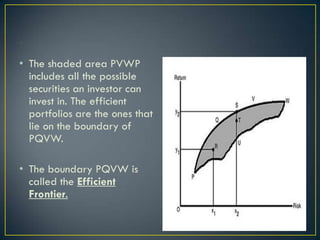
• The shaded area PVWP
  includes all the possible
  securities an investor can
  invest in. The efficient
  portfolios are the ones that
  lie on the boundary of
  PQVW.

• The boundary PQVW is
  called the Efficient
  Frontier.
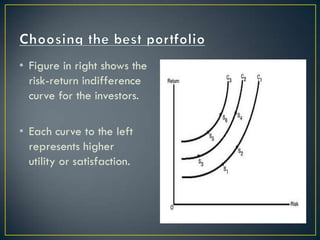
• Figure in right shows the
  risk-return indifference
  curve for the investors.

• Each curve to the left
  represents higher
  utility or satisfaction.
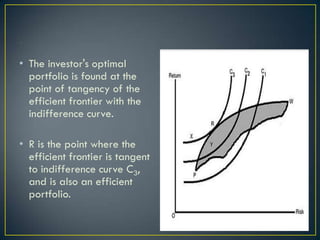
• The investor's optimal
  portfolio is found at the
  point of tangency of the
  efficient frontier with the
  indifference curve.

• R is the point where the
  efficient frontier is tangent
  to indifference curve C3,
  and is also an efficient
  portfolio.
• All portfolios so far have been evaluated in terms of risky
  securities only, and it is possible to include risk-free securities in
  a portfolio as well.

• A portfolio with risk-free securities will enable an investor to
  achieve a higher level of satisfaction. This has been explained
  further.
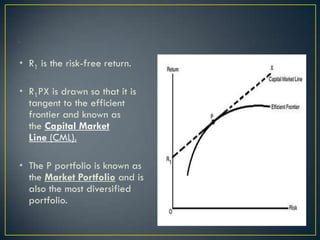
• R1 is the risk-free return.

• R1PX is drawn so that it is
  tangent to the efficient
  frontier and known as
  the Capital Market
  Line (CML).

• The P portfolio is known as
  the Market Portfolio and is
  also the most diversified
  portfolio.
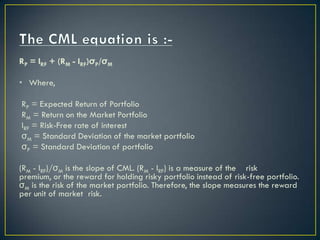
RP = IRF + (RM - IRF)σP/σM

• Where,

RP = Expected Return of Portfolio
RM = Return on the Market Portfolio
IRF = Risk-Free rate of interest
σM = Standard Deviation of the market portfolio
σP = Standard Deviation of portfolio

(RM - IRF)/σM is the slope of CML. (RM - IRF) is a measure of the risk
premium, or the reward for holding risky portfolio instead of risk-free portfolio.
σM is the risk of the market portfolio. Therefore, the slope measures the reward
per unit of market risk.
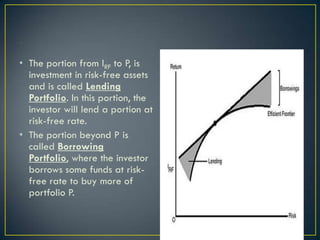
• The portion from IRF to P, is
  investment in risk-free assets
  and is called Lending
  Portfolio. In this portion, the
  investor will lend a portion at
  risk-free rate.
• The portion beyond P is
  called Borrowing
  Portfolio, where the investor
  borrows some funds at risk-
  free rate to buy more of
  portfolio P.
• It requires lots of data to be included. An investor must obtain
  variances of return, covariance of returns and estimates of
  return for all the securities in a portfolio.

• There are numerous calculations involved that are complicated
  because from a given set of securities, a very large number of
  portfolio combinations can be made.

• The expected return and variance will also have to computed
  for each securities.

Portfolio construction

  • 2.
    • Portfolio isa combination of securities such as stocks, bonds, and money market instruments. • The process of blending together the broad classes so as to obtain return with minimum risk is called PORTFOLIO CONSTRUCTION. • Diversification of investments helps to spread risk over many assets and thus reduces unsystematic risk.
  • 3.
    • TRADITIONAL APPROACH:investors need’s in terms of income and capital appreciation are evaluated and appropriate securities are selected to meet the needs of investor. • MARKOWITZ EFFICIENT FRONTIER APPROACH: portfolios are constructed to maximise the expected return for a given level of risk as it views portfolio construction in terms of expected return and the risk associated.
  • 4.
    • It dealswith two major decisions :- (a) Determining the objectives of the portfolio. (b) selection of securities to be included in the portfolio.
  • 5.
    2) 3) Selection of 1) Analysis of Determination portfolio constrains of objective 5) 4) Assessment diversification of risk and return
  • 6.
    • Income needs a)Need for current income. b) Need for constant income. • Liquidity • Safety of the principal • Time horizon • Tax consideration • temperament
  • 7.
    • Current income •Growth in income • Capital appreciation • Preservation of capital
  • 8.
    • Objectives andasset mix • Growth in income and asset mix • Capital appreciation and asset mix • Safety of principal and asset mix
  • 9.
    • Tradition approachhas some basic assumption like the investor prefers larger to smaller return from securities which requires taking risk. • The risk are namely interest rate risk, purchasing power risk ,financial risk and market risk. • The ability to achieve higher return is dependent upon his/her ability to judge risk and his ability to take specific risk.
  • 10.
    Selection of • Topquality bonds can industries minimise financial risk while stocks provide better inflation protection. Selection of company in industry • Depending on the preference and needs of investor appropriate combination is selected. Determining the size of participation
  • 11.
    • Harry Markowitzput forward this model in 1952. • It assists in the selection of the most efficient by analysing various possible portfolios of the given securities. By choosing securities that do not 'move' exactly together, the HM model shows investors how to reduce their risk.
  • 12.
    • Assumptions i. Riskof a portfolio is based on the variability of returns from the said portfolio. i. An investor is risk averse. ii. An investor either maximizes his portfolio return for a given level of risk or maximizes his return for the minimum risk.
  • 13.
    • To choosethe best portfolio from a number of possible portfolios, each with different return and risk, two separate decisions are to be made: 1. Determination of a set of efficient portfolios. 2. Selection of the best portfolio out of the efficient set.
  • 14.
    • A portfoliothat gives maximum return for a given risk, or minimum risk for given return is an efficient portfolio. Thus, portfolios are selected as follows: (a) From the portfolios that have the same return, the investor will prefer the portfolio with lower risk, and (b) From the portfolios that have the same risk level, an investor will prefer the portfolio with higher rate of return.
  • 15.
    • The shadedarea PVWP includes all the possible securities an investor can invest in. The efficient portfolios are the ones that lie on the boundary of PQVW. • The boundary PQVW is called the Efficient Frontier.
  • 16.
    • Figure inright shows the risk-return indifference curve for the investors. • Each curve to the left represents higher utility or satisfaction.
  • 17.
    • The investor'soptimal portfolio is found at the point of tangency of the efficient frontier with the indifference curve. • R is the point where the efficient frontier is tangent to indifference curve C3, and is also an efficient portfolio.
  • 18.
    • All portfoliosso far have been evaluated in terms of risky securities only, and it is possible to include risk-free securities in a portfolio as well. • A portfolio with risk-free securities will enable an investor to achieve a higher level of satisfaction. This has been explained further.
  • 19.
    • R1 isthe risk-free return. • R1PX is drawn so that it is tangent to the efficient frontier and known as the Capital Market Line (CML). • The P portfolio is known as the Market Portfolio and is also the most diversified portfolio.
  • 20.
    RP = IRF+ (RM - IRF)σP/σM • Where, RP = Expected Return of Portfolio RM = Return on the Market Portfolio IRF = Risk-Free rate of interest σM = Standard Deviation of the market portfolio σP = Standard Deviation of portfolio (RM - IRF)/σM is the slope of CML. (RM - IRF) is a measure of the risk premium, or the reward for holding risky portfolio instead of risk-free portfolio. σM is the risk of the market portfolio. Therefore, the slope measures the reward per unit of market risk.
  • 21.
    • The portionfrom IRF to P, is investment in risk-free assets and is called Lending Portfolio. In this portion, the investor will lend a portion at risk-free rate. • The portion beyond P is called Borrowing Portfolio, where the investor borrows some funds at risk- free rate to buy more of portfolio P.
  • 22.
    • It requireslots of data to be included. An investor must obtain variances of return, covariance of returns and estimates of return for all the securities in a portfolio. • There are numerous calculations involved that are complicated because from a given set of securities, a very large number of portfolio combinations can be made. • The expected return and variance will also have to computed for each securities.