Risk, Return and Capital Asset Pricing ModelTopic 05GSB711 – Managerial FinanceReadings: Chapter: Introduction to Risk, Return and the Opportunity Cost of Capital (Pages 220 – 246) Questions: 1, 3, 6, 7 and Problems: 9, 13, 16, 20, 21 and 23.Chapter: Risk, Return and Capital Budgeting (Pages 248 – 273)Questions: 1, 2, 4  and Problems: 6, 7, 9, 10, 13, 16, 17, 21, 25 and 29.
Topics CoveredRates of Return: A ReviewA Century of Capital Market HistoryMeasuring RiskRisk & DiversificationMeasuring Market RiskBetaRisk and ReturnCAPMCapital Budgeting and Project Risk
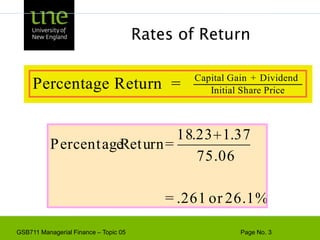
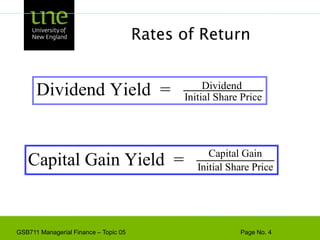
Rates of Return
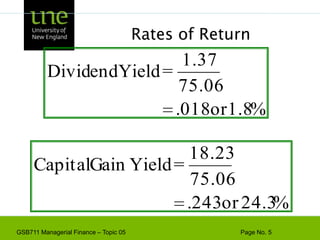
Rates of Return
Rates of Return
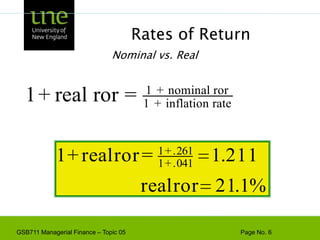
Nominal vs. RealRates of Return
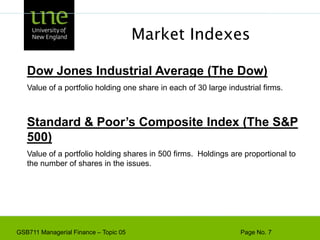
Dow Jones Industrial Average (The Dow)Value of a portfolio holding one share in each of 30 large industrial firms.Standard & Poor’s Composite Index (The S&P 500)Value of a portfolio holding shares in 500 firms.  Holdings are proportional to the number of shares in the issues.Market Indexes
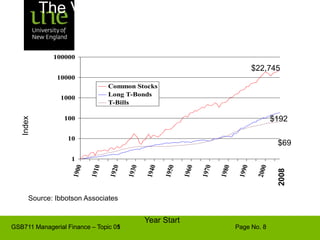
The Value of an Investment of $1 in 1900$22,745Index$192$692008Source: Ibbotson AssociatesYear Start
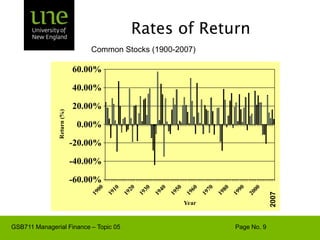
Rates of ReturnCommon Stocks (1900-2007)2007
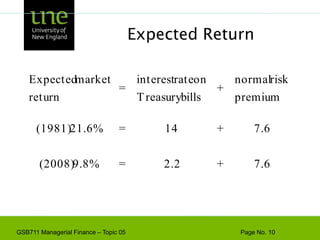
Expected Return
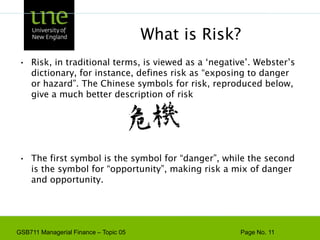
What is Risk?Risk, in traditional terms, is viewed as a ‘negative’. Webster’s dictionary, for instance, defines risk as “exposing to danger or hazard”. The Chinese symbols for risk, reproduced below, give a much better description of riskThe first symbol is the symbol for “danger”, while the second is the symbol for “opportunity”, making risk a mix of danger and opportunity.
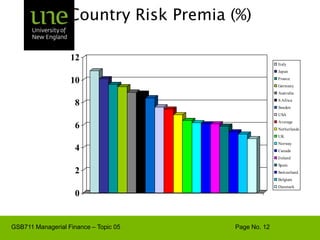
Country Risk Premia (%)
Measuring RiskVariance - Average value of squared deviations from mean.  A measure of volatility.Standard Deviation - Average value of squared deviations from mean.  A measure of volatility.
Expected ReturnsExpected returns are based on the probabilities of possible outcomesIn this context, “expected” means average if the process is repeated many timesThe “expected” return does not even have to be a possible return
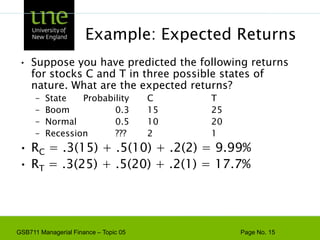
Example: Expected ReturnsSuppose you have predicted the following returns for stocks C and T in three possible states of nature. What are the expected returns?State	Probability	C		TBoom		0.3	15		25Normal		0.5	10		20Recession	???	2		1RC = .3(15) + .5(10) + .2(2) = 9.99%RT = .3(25) + .5(20) + .2(1) = 17.7%
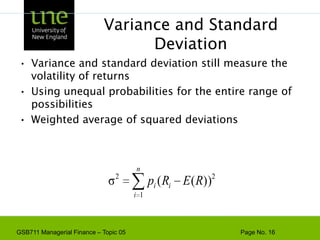
Variance and Standard DeviationVariance and standard deviation still measure the volatility of returnsUsing unequal probabilities for the entire range of possibilitiesWeighted average of squared deviations
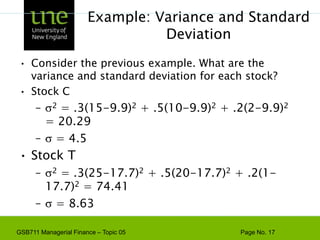
Example: Variance and Standard DeviationConsider the previous example. What are the variance and standard deviation for each stock?Stock C2 = .3(15-9.9)2 + .5(10-9.9)2 + .2(2-9.9)2 = 20.29 = 4.5Stock T2 = .3(25-17.7)2 + .5(20-17.7)2 + .2(1-17.7)2 = 74.41 = 8.63
PortfoliosA portfolio is a collection of assetsAn asset’s risk and return are important in how they affect the risk and return of the portfolioThe risk-return trade-off for a portfolio is measured by the portfolio expected return and standard deviation, just as with individual assets
Example: Portfolio WeightsSuppose you have $15,000 to invest and you have purchased securities in the following amounts. What are your portfolio weights in each security?$2000 of DCLK$3000 of KO$4000 of INTC$6000 of KEIDCLK: 2/15 = .133
KO: 3/15 = .2
INTC: 4/15 = .267
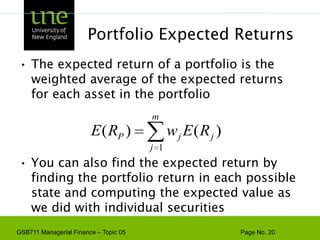
KEI: 6/15 = .4Portfolio Expected ReturnsThe expected return of a portfolio is the weighted average of the expected returns for each asset in the portfolioYou can also find the expected return by finding the portfolio return in each possible state and computing the expected value as we did with individual securities
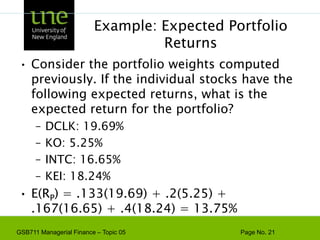
Example: Expected Portfolio ReturnsConsider the portfolio weights computed previously. If the individual stocks have the following expected returns, what is the expected return for the portfolio?DCLK: 19.69%KO: 5.25%INTC: 16.65%KEI: 18.24%E(RP) = .133(19.69) + .2(5.25) + .167(16.65) + .4(18.24) = 13.75%
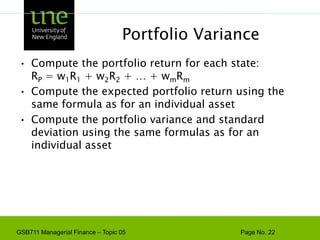
Portfolio VarianceCompute the portfolio return for each state:RP = w1R1 + w2R2 + … + wmRmCompute the expected portfolio return using the same formula as for an individual assetCompute the portfolio variance and standard deviation using the same formulas as for an individual asset
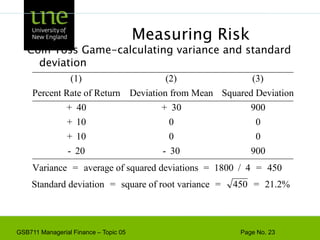
Coin Toss Game-calculating variance and standard deviationMeasuring Risk
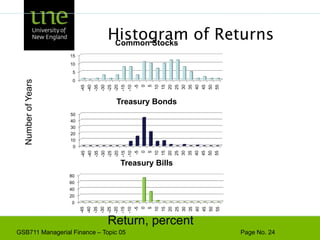
Histogram of ReturnsNumber of YearsReturn, percent
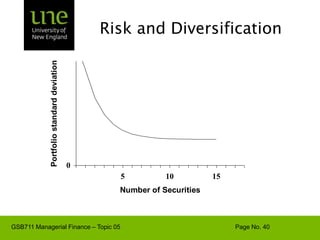
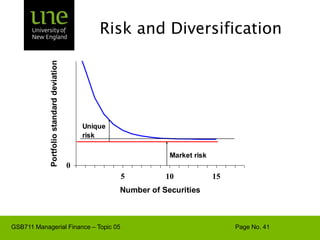
Risk and DiversificationDiversification -  Strategy designed to reduce risk by spreading the portfolio across many investments.Unique Risk - Risk factors affecting only that firm.  Also called “diversifiable risk.”Market Risk - Economy-wide sources of risk that affect the overall stock market.  Also called “systematic risk.”
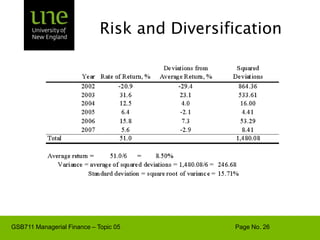
Risk and Diversification
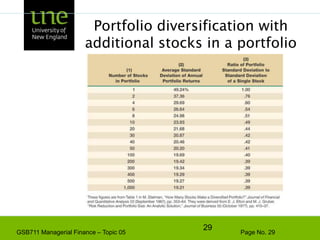
DiversificationPortfolio diversification is the investment in several different asset classes or sectorsDiversification is not just holding a lot of assetsFor example, if you own 50 internet stocks, you are not diversifiedHowever, if you own 50 stocks that span 20 different industries, then you are diversified
29Portfolio diversification with additional stocks in a portfolio
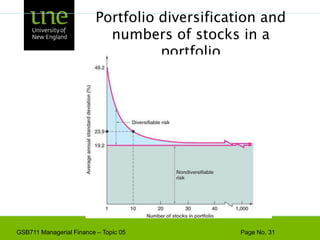
The Principle of DiversificationDiversification can substantially reduce the variability of returns without an equivalent reduction in expected returnsThis reduction in risk arises because worse than expected returns from one asset are offset by better than expected returns from anotherHowever, there is a minimum level of risk that cannot be diversified away and that is the systematic portion
Portfolio diversification and numbers of stocks in a portfolio
Diversifiable RiskThe risk that can be eliminated by combining assets into a portfolioOften considered the same as unsystematic, unique or asset-specific riskIf we hold only one asset, or assets in the same industry, then we are exposing ourselves to risk that we could diversify away
Total RiskTotal risk = systematic risk + unsystematic riskThe standard deviation of returns is a measure of total riskFor well-diversified portfolios, unsystematic risk is very smallConsequently, the total risk for a diversified portfolio is essentially equivalent to the systematic risk
Systematic Risk PrincipleThere is a reward for bearing riskThere is not a reward for bearing risk unnecessarilyThe expected return on a risky asset depends only on that asset’s systematic risk since unsystematic risk can be diversified away
Measuring Systematic RiskHow do we measure systematic risk?We use the beta coefficient to measure systematic riskWhat does beta tell us?A beta of 1 implies the asset has the same systematic risk as the overall marketA beta < 1 implies the asset has less systematic risk than the overall marketA beta > 1 implies the asset has more systematic risk than the overall market
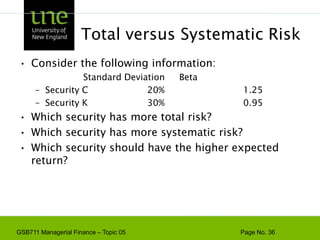
Total versus Systematic RiskConsider the following information:   			Standard Deviation	BetaSecurity C		20%			1.25Security K		30%			0.95Which security has more total risk?Which security has more systematic risk?Which security should have the higher expected return?
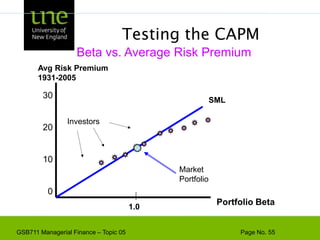
Beta and the Risk PremiumRemember that the risk premium = expected return – risk-free rateThe higher the beta, the greater the risk premium should beCan we define the relationship between the risk premium and beta so that we can estimate the expected return?YES!
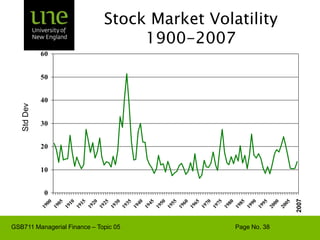
Stock Market Volatility 1900-2007Std Dev2007
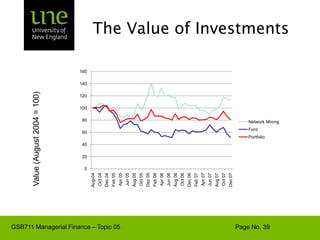
The Value of InvestmentsValue (August 2004 = 100)
Risk and Diversification
Measuring Market RiskMarket Portfolio - Portfolio of all assets in the economy.  In practice a broad stock market index is used to represent the market.Beta - Sensitivity of a stock’s return to the return on the market portfolio.
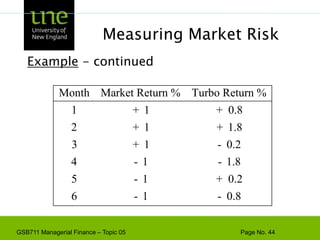
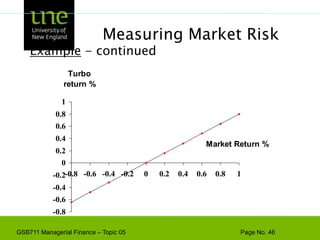
Measuring Market RiskExample - Turbo Charged Seafood has the following % returns on its stock, relative to the listed changes in the % return on the market portfolio. The beta of Turbo Charged Seafood can be derived from this information.
Example - continuedMeasuring Market Risk
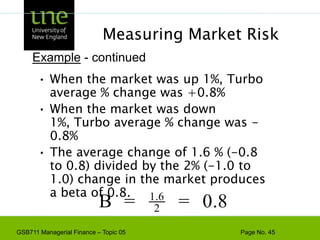
Measuring Market RiskExample - continuedWhen the market was up 1%, Turbo average % change was +0.8%When the market was down 1%, Turbo average % change was -0.8% The average change of 1.6 % (-0.8 to 0.8) divided by the 2% (-1.0 to 1.0) change in the market produces a beta of 0.8.
Example - continuedMeasuring Market Risk
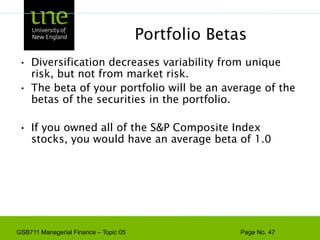
Portfolio BetasDiversification decreases variability from unique risk, but not from market risk.The beta of your portfolio will be an average of the betas of the securities in the portfolio.If you owned all of the S&P Composite Index stocks, you would have an average beta of 1.0
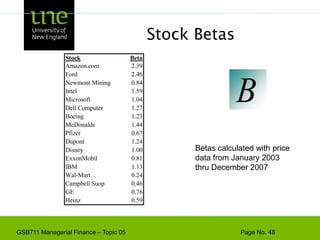
Betas calculated with price data from January 2003 thru December 2007Stock Betas
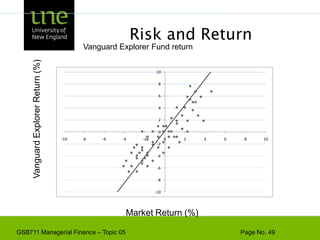
Risk and ReturnVanguard Explorer Fund returnVanguard Explorer Return (%)Market Return (%)
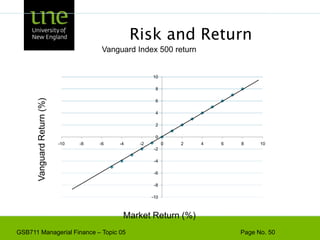
Risk and ReturnVanguard Index 500 returnVanguard Return (%)Market Return (%)
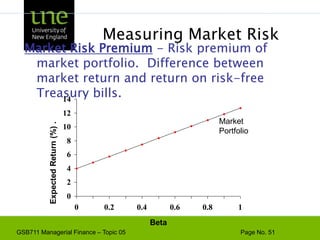
Measuring Market RiskMarket PortfolioMarket Risk Premium - Risk premium of market portfolio.  Difference between market return and return on risk-free Treasury bills.
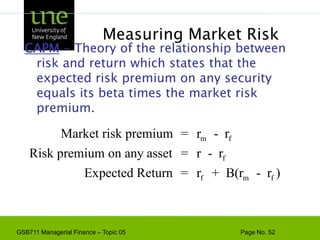
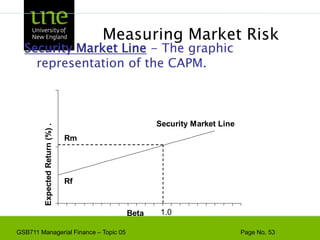
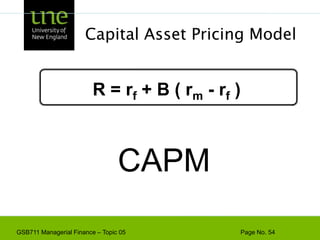
CAPM - Theory of the relationship between risk and return which states that the expected risk premium on any security equals its beta times the market risk premium.Measuring Market Risk
Measuring Market Risk1.0Security Market Line - The graphic representation of the CAPM.
Capital Asset Pricing Model R = rf + B ( rm - rf )CAPM
Testing the CAPMBeta vs. Average Risk PremiumAvg Risk Premium 1931-20053020100SMLInvestorsMarket PortfolioPortfolio Beta1.0
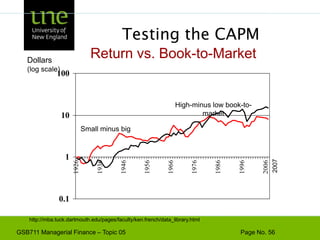
Testing the CAPMReturn vs. Book-to-MarketDollars(log scale)High-minus low book-to-marketSmall minus big2007http://mba.tuck.dartmouth.edu/pages/faculty/ken.french/data_library.html
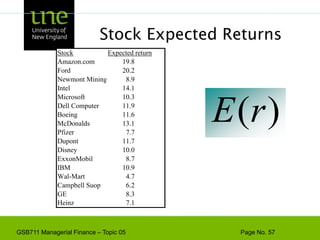
Stock Expected Returns
Capital Budgeting & Project RiskWe discuss more on capital budgeting in a later topicThe project cost of capital depends on the use to which the capital is being put.  Therefore, it depends on the risk of the project and not the risk of the company.
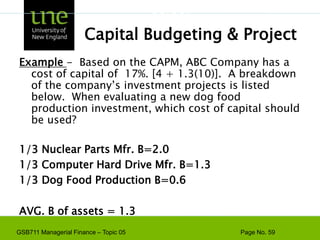
Capital Budgeting & ProjectExample -  Based on the CAPM, ABC Company has a cost of capital of  17%. [4 + 1.3(10)].  A breakdown of the company’s investment projects is listed below.  When evaluating a new dog food production investment, which cost of capital should be used?1/3 Nuclear Parts Mfr. B=2.01/3 Computer Hard Drive Mfr. B=1.31/3 Dog Food Production B=0.6AVG. B of assets = 1.3Risk

GSB-711-Lecture-Note-05-Risk-Return-and-CAPM

  • 1.
    Risk, Return andCapital Asset Pricing ModelTopic 05GSB711 – Managerial FinanceReadings: Chapter: Introduction to Risk, Return and the Opportunity Cost of Capital (Pages 220 – 246) Questions: 1, 3, 6, 7 and Problems: 9, 13, 16, 20, 21 and 23.Chapter: Risk, Return and Capital Budgeting (Pages 248 – 273)Questions: 1, 2, 4 and Problems: 6, 7, 9, 10, 13, 16, 17, 21, 25 and 29.
  • 2.
    Topics CoveredRates ofReturn: A ReviewA Century of Capital Market HistoryMeasuring RiskRisk & DiversificationMeasuring Market RiskBetaRisk and ReturnCAPMCapital Budgeting and Project Risk
  • 3.
  • 4.
  • 5.
  • 6.
  • 7.
    Dow Jones IndustrialAverage (The Dow)Value of a portfolio holding one share in each of 30 large industrial firms.Standard & Poor’s Composite Index (The S&P 500)Value of a portfolio holding shares in 500 firms. Holdings are proportional to the number of shares in the issues.Market Indexes
  • 8.
    The Value ofan Investment of $1 in 1900$22,745Index$192$692008Source: Ibbotson AssociatesYear Start
  • 9.
    Rates of ReturnCommonStocks (1900-2007)2007
  • 10.
  • 11.
    What is Risk?Risk,in traditional terms, is viewed as a ‘negative’. Webster’s dictionary, for instance, defines risk as “exposing to danger or hazard”. The Chinese symbols for risk, reproduced below, give a much better description of riskThe first symbol is the symbol for “danger”, while the second is the symbol for “opportunity”, making risk a mix of danger and opportunity.
  • 12.
  • 13.
    Measuring RiskVariance -Average value of squared deviations from mean. A measure of volatility.Standard Deviation - Average value of squared deviations from mean. A measure of volatility.
  • 14.
    Expected ReturnsExpected returnsare based on the probabilities of possible outcomesIn this context, “expected” means average if the process is repeated many timesThe “expected” return does not even have to be a possible return
  • 15.
    Example: Expected ReturnsSupposeyou have predicted the following returns for stocks C and T in three possible states of nature. What are the expected returns?State Probability C TBoom 0.3 15 25Normal 0.5 10 20Recession ??? 2 1RC = .3(15) + .5(10) + .2(2) = 9.99%RT = .3(25) + .5(20) + .2(1) = 17.7%
  • 16.
    Variance and StandardDeviationVariance and standard deviation still measure the volatility of returnsUsing unequal probabilities for the entire range of possibilitiesWeighted average of squared deviations
  • 17.
    Example: Variance andStandard DeviationConsider the previous example. What are the variance and standard deviation for each stock?Stock C2 = .3(15-9.9)2 + .5(10-9.9)2 + .2(2-9.9)2 = 20.29 = 4.5Stock T2 = .3(25-17.7)2 + .5(20-17.7)2 + .2(1-17.7)2 = 74.41 = 8.63
  • 18.
    PortfoliosA portfolio isa collection of assetsAn asset’s risk and return are important in how they affect the risk and return of the portfolioThe risk-return trade-off for a portfolio is measured by the portfolio expected return and standard deviation, just as with individual assets
  • 19.
    Example: Portfolio WeightsSupposeyou have $15,000 to invest and you have purchased securities in the following amounts. What are your portfolio weights in each security?$2000 of DCLK$3000 of KO$4000 of INTC$6000 of KEIDCLK: 2/15 = .133
  • 20.
  • 21.
  • 22.
    KEI: 6/15 =.4Portfolio Expected ReturnsThe expected return of a portfolio is the weighted average of the expected returns for each asset in the portfolioYou can also find the expected return by finding the portfolio return in each possible state and computing the expected value as we did with individual securities
  • 23.
    Example: Expected PortfolioReturnsConsider the portfolio weights computed previously. If the individual stocks have the following expected returns, what is the expected return for the portfolio?DCLK: 19.69%KO: 5.25%INTC: 16.65%KEI: 18.24%E(RP) = .133(19.69) + .2(5.25) + .167(16.65) + .4(18.24) = 13.75%
  • 24.
    Portfolio VarianceCompute theportfolio return for each state:RP = w1R1 + w2R2 + … + wmRmCompute the expected portfolio return using the same formula as for an individual assetCompute the portfolio variance and standard deviation using the same formulas as for an individual asset
  • 25.
    Coin Toss Game-calculatingvariance and standard deviationMeasuring Risk
  • 26.
    Histogram of ReturnsNumberof YearsReturn, percent
  • 27.
    Risk and DiversificationDiversification- Strategy designed to reduce risk by spreading the portfolio across many investments.Unique Risk - Risk factors affecting only that firm. Also called “diversifiable risk.”Market Risk - Economy-wide sources of risk that affect the overall stock market. Also called “systematic risk.”
  • 28.
  • 29.
  • 30.
    DiversificationPortfolio diversification isthe investment in several different asset classes or sectorsDiversification is not just holding a lot of assetsFor example, if you own 50 internet stocks, you are not diversifiedHowever, if you own 50 stocks that span 20 different industries, then you are diversified
  • 31.
    29Portfolio diversification withadditional stocks in a portfolio
  • 32.
    The Principle ofDiversificationDiversification can substantially reduce the variability of returns without an equivalent reduction in expected returnsThis reduction in risk arises because worse than expected returns from one asset are offset by better than expected returns from anotherHowever, there is a minimum level of risk that cannot be diversified away and that is the systematic portion
  • 33.
    Portfolio diversification andnumbers of stocks in a portfolio
  • 34.
    Diversifiable RiskThe riskthat can be eliminated by combining assets into a portfolioOften considered the same as unsystematic, unique or asset-specific riskIf we hold only one asset, or assets in the same industry, then we are exposing ourselves to risk that we could diversify away
  • 35.
    Total RiskTotal risk= systematic risk + unsystematic riskThe standard deviation of returns is a measure of total riskFor well-diversified portfolios, unsystematic risk is very smallConsequently, the total risk for a diversified portfolio is essentially equivalent to the systematic risk
  • 36.
    Systematic Risk PrincipleThereis a reward for bearing riskThere is not a reward for bearing risk unnecessarilyThe expected return on a risky asset depends only on that asset’s systematic risk since unsystematic risk can be diversified away
  • 37.
    Measuring Systematic RiskHowdo we measure systematic risk?We use the beta coefficient to measure systematic riskWhat does beta tell us?A beta of 1 implies the asset has the same systematic risk as the overall marketA beta < 1 implies the asset has less systematic risk than the overall marketA beta > 1 implies the asset has more systematic risk than the overall market
  • 38.
    Total versus SystematicRiskConsider the following information: Standard Deviation BetaSecurity C 20% 1.25Security K 30% 0.95Which security has more total risk?Which security has more systematic risk?Which security should have the higher expected return?
  • 39.
    Beta and theRisk PremiumRemember that the risk premium = expected return – risk-free rateThe higher the beta, the greater the risk premium should beCan we define the relationship between the risk premium and beta so that we can estimate the expected return?YES!
  • 40.
    Stock Market Volatility1900-2007Std Dev2007
  • 41.
    The Value ofInvestmentsValue (August 2004 = 100)
  • 42.
  • 43.
  • 44.
    Measuring Market RiskMarketPortfolio - Portfolio of all assets in the economy. In practice a broad stock market index is used to represent the market.Beta - Sensitivity of a stock’s return to the return on the market portfolio.
  • 45.
    Measuring Market RiskExample- Turbo Charged Seafood has the following % returns on its stock, relative to the listed changes in the % return on the market portfolio. The beta of Turbo Charged Seafood can be derived from this information.
  • 46.
  • 47.
    Measuring Market RiskExample- continuedWhen the market was up 1%, Turbo average % change was +0.8%When the market was down 1%, Turbo average % change was -0.8% The average change of 1.6 % (-0.8 to 0.8) divided by the 2% (-1.0 to 1.0) change in the market produces a beta of 0.8.
  • 48.
  • 49.
    Portfolio BetasDiversification decreasesvariability from unique risk, but not from market risk.The beta of your portfolio will be an average of the betas of the securities in the portfolio.If you owned all of the S&P Composite Index stocks, you would have an average beta of 1.0
  • 50.
    Betas calculated withprice data from January 2003 thru December 2007Stock Betas
  • 51.
    Risk and ReturnVanguardExplorer Fund returnVanguard Explorer Return (%)Market Return (%)
  • 52.
    Risk and ReturnVanguardIndex 500 returnVanguard Return (%)Market Return (%)
  • 53.
    Measuring Market RiskMarketPortfolioMarket Risk Premium - Risk premium of market portfolio. Difference between market return and return on risk-free Treasury bills.
  • 54.
    CAPM - Theoryof the relationship between risk and return which states that the expected risk premium on any security equals its beta times the market risk premium.Measuring Market Risk
  • 55.
    Measuring Market Risk1.0SecurityMarket Line - The graphic representation of the CAPM.
  • 56.
    Capital Asset PricingModel R = rf + B ( rm - rf )CAPM
  • 57.
    Testing the CAPMBetavs. Average Risk PremiumAvg Risk Premium 1931-20053020100SMLInvestorsMarket PortfolioPortfolio Beta1.0
  • 58.
    Testing the CAPMReturnvs. Book-to-MarketDollars(log scale)High-minus low book-to-marketSmall minus big2007http://mba.tuck.dartmouth.edu/pages/faculty/ken.french/data_library.html
  • 59.
  • 60.
    Capital Budgeting &Project RiskWe discuss more on capital budgeting in a later topicThe project cost of capital depends on the use to which the capital is being put. Therefore, it depends on the risk of the project and not the risk of the company.
  • 61.
    Capital Budgeting &ProjectExample - Based on the CAPM, ABC Company has a cost of capital of 17%. [4 + 1.3(10)]. A breakdown of the company’s investment projects is listed below. When evaluating a new dog food production investment, which cost of capital should be used?1/3 Nuclear Parts Mfr. B=2.01/3 Computer Hard Drive Mfr. B=1.31/3 Dog Food Production B=0.6AVG. B of assets = 1.3Risk