Rickets
ObjectivesDefinitionEpidemiologyPathophysiologyPresentationRole of vitamin DEtiologyManagementSummary
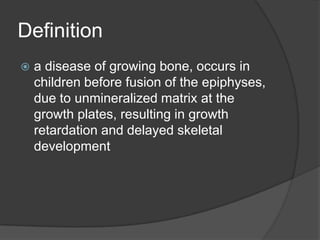
Definitiona disease of growing bone, occurs in children before fusion of the epiphyses, due to unmineralized matrix at the growth plates, resulting in growth retardation and delayed skeletal development
epidemiologyIn developed countries, rickets is a rare disease incidence of less than 1 in 200,000In saudiarabia[1]retrospective study at King Abdulaziz Medical City-King Fahad National Guard Hospital in Riyadh, Saudi Arabia 2009196 infants (70%) were exclusively on breast-feeding (127 males, 69 females) with no supplementationThe records of Saudi infants and children under the age of 14 months over a 10-year period (between January 1990 and January 2000) were reviewed.283 infants were studied.Epidemiology of nutritional rickets in children.Al-Atawi MS, Al-Alwan IA, Al-Mutair AN, Tamim HM, Al-Jurayyan NA.Department of Pediatric, National Guard Health Affairs, King Abdulaziz Medical City, Riyadh, Saudi Arabia
EpidemiologyHigher risk for developing rickets include:Children ages 6 months to 24 months are at highest risk, because of rapidly growing bonesBreast-fed infants whose mothers are not exposed to sunlightBreast-fed infants who are not exposed to sunlightPremature Babies dark skin Babies Individuals consuming some medications:Anticonvulsants, Cadmium, Fluoride, Lead, Aluminum
PathophysiologyBone consists of a protein matrix called osteoidand a minerals, principally composed of calcium and phosphate, mostly in the form of hydroxyapatite.Because growth plate cartilage and osteoid continue to expand, but mineralization is inadequate, the growth plate thickens. There is also an increase in the circumference of the growth plate and the metaphysis.
GENERAL    Failure to thrive   
Listlessness   
Protuding abdomen   
Muscle weakness (especially proximal)   
FracturesHEAD    Craniotabes   
Frontal bossing   
Delayed fontanelle closure   
Delayed dentition; caries   
CraniosynostosisCHEST :   Rachitic rosary “Costochondral swelling”   Harrison groove    Respiratory infections and atelectasisBACK  :  Scoliosis    Kyphosis    Lordosis
EXTREMITIES    Enlargement of wrists and ankles   
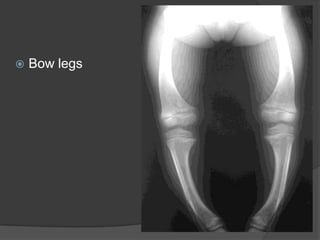
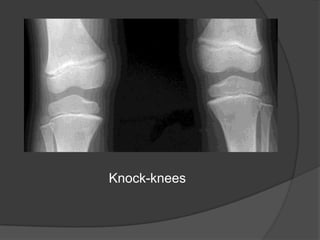
Valgus or varus deformities   
Bowed legs (genuvarum) in Toddlers
Knock-knees(genuvalgum) in older children   
Anterior bowing of the tibia and femur   
Coxavara   
Leg painHYPOCALCEMIC SYMPTOMS :Tetany   
Seizures   
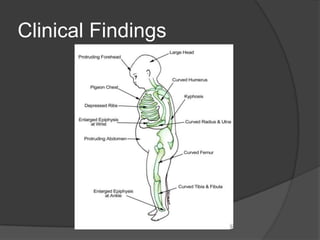
Stridor due to laryngeal spasmClinical Findings
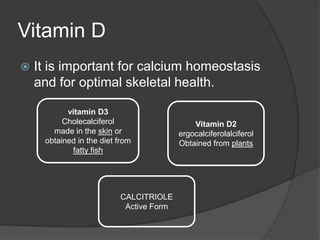
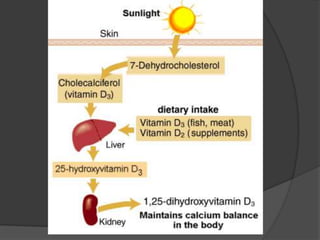
Vitamin DIt is important for calcium homeostasis and for optimal skeletal health. vitamin D3Cholecalciferolmade in the skin or obtained in the diet from fatty fishVitamin D2ergocalciferolalciferolObtained from plantsCALCITRIOLEActive Form
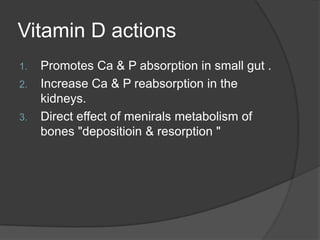
Vitamin D actionsPromotes Ca & P absorption in small gut .Increase Ca & P reabsorption in the kidneys.Direct effect of menirals metabolism of bones "depositioin & resorption "
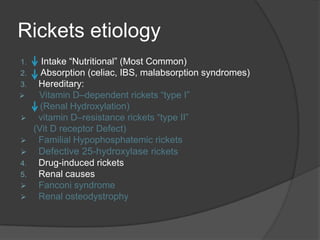
Rickets etiology  Intake “Nutritional” (Most Common)  Absorption (celiac, IBS, malabsorption syndromes)Hereditary:Vitamin D–dependent rickets “type I”        (Renal Hydroxylation)vitamin D–resistance rickets “type II”     (Vit D receptor Defect)Familial Hypophosphatemic rickets
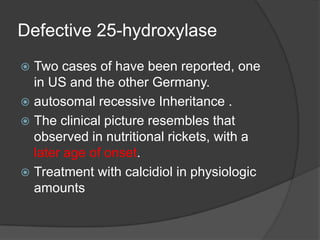
Defective 25-hydroxylase ricketsDrug-induced ricketsRenal causesFanconi syndrome
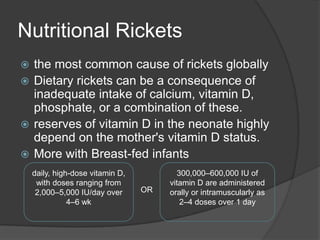
Renal osteodystrophyNutritional Ricketsthe most common cause of rickets globally Dietary rickets can be a consequence of inadequate intake of calcium, vitamin D, phosphate, or a combination of these.reserves of vitamin D in the neonate highly depend on the mother's vitamin D status. More with Breast-fed infants300,000–600,000 IU of vitamin D are administered orally or intramuscularly as 2–4 doses over 1 daydaily, high-dose vitamin D, with doses ranging from 2,000–5,000 IU/day over 4–6 wkOR
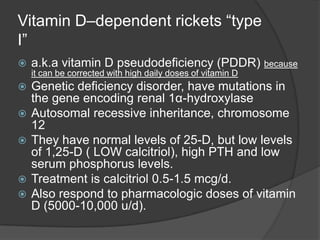
Vitamin D–dependent rickets “type I”a.k.a vitamin D pseudodeficiency (PDDR) because it can be corrected with high daily doses of vitamin DGenetic deficiency disorder, have mutations in the gene encoding renal 1α-hydroxylase Autosomal recessive inheritance, chromosome 12They have normal levels of 25-D, but low levels of 1,25-D ( LOW calcitriol), high PTH and low serum phosphorus levels.Treatment is calcitriol 0.5-1.5 mcg/d. Also respond to pharmacologic doses of vitamin D (5000-10,000 u/d).
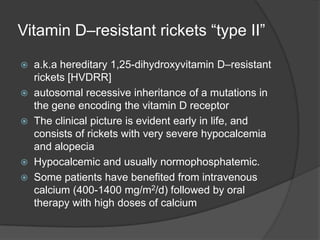
Vitamin D–resistant rickets “type II”a.k.a hereditary 1,25-dihydroxyvitamin D–resistant rickets [HVDRR]autosomal recessive inheritance of a mutations in the gene encoding the vitamin D receptorThe clinical picture is evident early in life, and consists of rickets with very severe hypocalcemia and alopeciaHypocalcemic and usually normophosphatemic. Some patients have benefited from intravenous calcium (400-1400 mg/m2/d) followed by oral therapy with high doses of calcium

Rickets

  • 1.
  • 2.
  • 3.
    Definitiona disease ofgrowing bone, occurs in children before fusion of the epiphyses, due to unmineralized matrix at the growth plates, resulting in growth retardation and delayed skeletal development
  • 4.
    epidemiologyIn developed countries,rickets is a rare disease incidence of less than 1 in 200,000In saudiarabia[1]retrospective study at King Abdulaziz Medical City-King Fahad National Guard Hospital in Riyadh, Saudi Arabia 2009196 infants (70%) were exclusively on breast-feeding (127 males, 69 females) with no supplementationThe records of Saudi infants and children under the age of 14 months over a 10-year period (between January 1990 and January 2000) were reviewed.283 infants were studied.Epidemiology of nutritional rickets in children.Al-Atawi MS, Al-Alwan IA, Al-Mutair AN, Tamim HM, Al-Jurayyan NA.Department of Pediatric, National Guard Health Affairs, King Abdulaziz Medical City, Riyadh, Saudi Arabia
  • 5.
    EpidemiologyHigher risk fordeveloping rickets include:Children ages 6 months to 24 months are at highest risk, because of rapidly growing bonesBreast-fed infants whose mothers are not exposed to sunlightBreast-fed infants who are not exposed to sunlightPremature Babies dark skin Babies Individuals consuming some medications:Anticonvulsants, Cadmium, Fluoride, Lead, Aluminum
  • 6.
    PathophysiologyBone consists ofa protein matrix called osteoidand a minerals, principally composed of calcium and phosphate, mostly in the form of hydroxyapatite.Because growth plate cartilage and osteoid continue to expand, but mineralization is inadequate, the growth plate thickens. There is also an increase in the circumference of the growth plate and the metaphysis.
  • 7.
    GENERAL    Failureto thrive   
  • 8.
  • 9.
  • 10.
  • 11.
  • 12.
  • 13.
  • 14.
  • 15.
    CraniosynostosisCHEST :   Rachiticrosary “Costochondral swelling”   Harrison groove    Respiratory infections and atelectasisBACK  :  Scoliosis    Kyphosis    Lordosis
  • 16.
    EXTREMITIES    Enlargementof wrists and ankles   
  • 17.
    Valgus or varusdeformities   
  • 18.
  • 19.
  • 20.
    Anterior bowing ofthe tibia and femur   
  • 21.
  • 22.
  • 23.
  • 24.
    Stridor due tolaryngeal spasmClinical Findings
  • 25.
    Vitamin DIt isimportant for calcium homeostasis and for optimal skeletal health. vitamin D3Cholecalciferolmade in the skin or obtained in the diet from fatty fishVitamin D2ergocalciferolalciferolObtained from plantsCALCITRIOLEActive Form
  • 27.
    Vitamin D actionsPromotesCa & P absorption in small gut .Increase Ca & P reabsorption in the kidneys.Direct effect of menirals metabolism of bones "depositioin & resorption "
  • 28.
    Rickets etiology Intake “Nutritional” (Most Common) Absorption (celiac, IBS, malabsorption syndromes)Hereditary:Vitamin D–dependent rickets “type I” (Renal Hydroxylation)vitamin D–resistance rickets “type II” (Vit D receptor Defect)Familial Hypophosphatemic rickets
  • 29.
    Defective 25-hydroxylase ricketsDrug-inducedricketsRenal causesFanconi syndrome
  • 30.
    Renal osteodystrophyNutritional Ricketsthemost common cause of rickets globally Dietary rickets can be a consequence of inadequate intake of calcium, vitamin D, phosphate, or a combination of these.reserves of vitamin D in the neonate highly depend on the mother's vitamin D status. More with Breast-fed infants300,000–600,000 IU of vitamin D are administered orally or intramuscularly as 2–4 doses over 1 daydaily, high-dose vitamin D, with doses ranging from 2,000–5,000 IU/day over 4–6 wkOR
  • 31.
    Vitamin D–dependent rickets“type I”a.k.a vitamin D pseudodeficiency (PDDR) because it can be corrected with high daily doses of vitamin DGenetic deficiency disorder, have mutations in the gene encoding renal 1α-hydroxylase Autosomal recessive inheritance, chromosome 12They have normal levels of 25-D, but low levels of 1,25-D ( LOW calcitriol), high PTH and low serum phosphorus levels.Treatment is calcitriol 0.5-1.5 mcg/d. Also respond to pharmacologic doses of vitamin D (5000-10,000 u/d).
  • 32.
    Vitamin D–resistant rickets“type II”a.k.a hereditary 1,25-dihydroxyvitamin D–resistant rickets [HVDRR]autosomal recessive inheritance of a mutations in the gene encoding the vitamin D receptorThe clinical picture is evident early in life, and consists of rickets with very severe hypocalcemia and alopeciaHypocalcemic and usually normophosphatemic. Some patients have benefited from intravenous calcium (400-1400 mg/m2/d) followed by oral therapy with high doses of calcium