ASTHMA
Asthma
Definition
• Reactive airway disease
• Chronic inflammatory lung disease
Inflammation causes varying degrees of obstruction in the airways
• Asthma is reversible in early stages
TRIGGERS OF ASTHMA
• Allergens
• Exercise
• Respiratory Infections
• Nose and Sinus problems
• Drugs and Food Additives
• GERD
• Emotional Stress
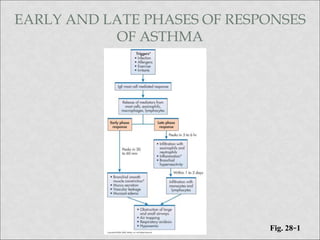
EARLY AND LATE PHASES OF RESPONSES
OF ASTHMA
Fig. 28-1
ASTHMA
PATHOPHYSIOLOGY
• Bronchospasm
• Airway inflammation
ASTHMA
PATHOPHYSIOLOGY
Early-Phase Response
• Peaks 30-60 minutes post exposure, subsides 30-90 minutes
later
• Characterized primarily by bronchospasm
• Increased mucous secretion, edema formation, and increased
amounts of tenacious sputum
• Patient experiences wheezing, cough, chest tightness, and
dyspnea
ASTHMA
PATHOPHYSIOLOGY
Late-Phase Response
• Characterized primarily by inflammation
• Histamine and other mediators set up a self-
sustaining cycle increasing airway reactivity
causing hyperresponsiveness to allergens and
other stimuli
• Increased airway resistance leads to air trapping
in alveoli and hyperinflation of the lungs
• If airway inflammation is not treated or does not
resolve, may lead to irreversible lung damage
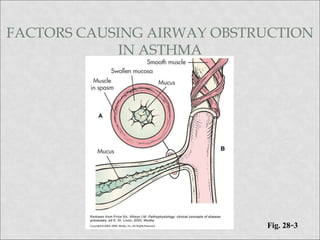
FACTORS CAUSING AIRWAY OBSTRUCTION
IN ASTHMA
Fig. 28-3
SUMMARY OF
PATHOPHYSIOLOGIC FEATURES
• Reduction in airway diameter
• Increase in airway resistance r/t
• Mucosal inflammation
• Constriction of smooth muscle
• Excess mucus production
ASTHMA
CLINICAL MANIFESTATIONS
• Unpredictable and variable
• Recurrent episodes of wheezing, breathlessness, cough,
and tight chest
ASTHMA
CLINICAL MANIFESTATIONS
• Expiration may be prolonged from a inspiration-
expiration ratio of 1:2 to 1:3 or 1:4
• Between attacks may be asymptomatic with normal or
near-normal lung function
ASTHMA
CLINICAL MANIFESTATIONS
• Wheezing is an unreliable sign to gauge severity of
attack
• Severe attacks can have no audible wheezing due to
reduction in airflow
• “Silent chest” is ominous sign of impending
respiratory failure
ASTHMA
CLINICAL MANIFESTATIONS
Difficulty with air movement can create a feeling of
suffocation
• Patient may feel increasingly anxious
• Mobilizing secretions may become difficult
ASTHMA
CLINICAL MANIFESTATIONS
Examination of the patient during an acute attack usually
reveals signs of hypoxemia
• Restlessness
• Increased anxiety
• Inappropriate behavior
• Increased pulse and blood pressure
• Pulsus paradoxus (drop in systolic BP during inspiratory cycle
>10)
ASTHMA
COMPLICATIONS
Status asthmaticus
• Severe, life-threatening attack refractory
to usual treatment where patient poses
risk for respiratory failure
ASTHMA
DIAGNOSTIC STUDIES
• Detailed history and physical exam
• Peak flow monitoring
• Chest x-ray
• ABGs!!
ASTHMA
COLLABORATIVE CARE
• Education
• Start at time of diagnosis
• Integrated into every step of clinical care
• Self-management
• Tailored to needs of patient
• Emphasis on evaluating outcome in terms of patient’s
perceptions of improvement
ASTHMA
COLLABORATIVE CARE
Acute Asthma Episode
• O2 therapy should be started and monitored with pulse oximetry
or ABGs in severe cases
• Inhaled -adrenergic agonists by metered dose using a spacer or
nebulizer
• Corticosteroids indicated if initial response is insufficient
ASTHMA
COLLABORATIVE CARE
Acute Asthma Episode
Therapy should continue until patient
• is breathing comfortably
• wheezing has disappeared
• pulmonary function study results are
near baseline values
ASTHMA
COLLABORATIVE CARE
Status asthmaticus
• IV corticosteroids
• Continuous monitoring
• Supplemental O2 to achieve values of 90%
• IV fluids are given due to insensible loss of fluids
• Mechanical ventilation is required if there is no response to
treatment
BETA AGONISTS
• Bronchodilators
• -adrenergic agonists
(e.g., albuterol, salbutamol[Ventolin])
• Acts in minutes, lasts 4 to 8 hours
• Short-term relief of bronchoconstriction
• Treatment of choice in acute exacerbations
STEROIDS
Antiinflammatory drugs
• Corticosteroids (e.g., beclomethasone, budesonide)
• Suppress inflammatory response
• Inhaled form is used in long-term control
• Systemic form to control exacerbations and manage persistent
asthma
MAGNESIUM SULFATE
• Based on 2 Cochrane reviews, both IV and inhaled
magnesium are effective for the treatment of asthma.
EPINEPHRINE
• For severe asthma.
• IV/IM dose.
AMINOPHYLLINE
• Multiple Cochrane reviews in both children and adults
have found no benefit to standard care with the addition
of aminophylline.
ASTHMA
PATIENT TEACHING RELATED TO
DRUG THERAPY
Correct administration of drugs is a major factor in
determining success in asthma management
• Some persons may have difficulty using an MDI and therefore
should use a spacer or nebulizer
• DPI (dry powder inhaler) requires less manual dexterity and
coordination
ASTHMA
PATIENT TEACHING RELATED TO
DRUG THERAPY
• Inhalers should be cleaned by removing dust cap and rinsing with
warm water
• -adrenergic agonists should be taken first if taking in conjunction
with corticosteroids
NURSING MANAGEMENT
NURSING DIAGNOSES
• Ineffective airway clearance
• Anxiety
• Ineffective therapeutic regimen management
NURSING MANAGEMENT
PLANNING
• Normal or near-normal pulmonary function
• Normal activity levels
• No recurrent exacerbations of asthma or decreased
incidence of asthma attacks
• Adequate knowledge to participate in and carry out
management
NURSING MANAGEMENT
HEALTH PROMOTION
• Teach patient to identify and avoid
known triggers
• Use dust covers
• Use of scarves or masks for cold air
• Avoid aspirin or NSAIDs
• Desensitization can decrease
sensitivity to allergens
NURSING MANAGEMENT
HEALTH PROMOTION
• Prompt diagnosis and treatment of upper
respiratory infections and sinusitis may
prevent exacerbation
• Fluid intake of 2 to 3L every day
NURSING MANAGEMENT
HEALTH PROMOTION
• Adequate nutrition
• Adequate sleep
• Take -adrenergic agonist 10 to 20
minutes prior to exercising
Nursing Management
Nursing Implementation
Acute Intervention
• Monitor respiratory and cardiovascular systems
• Lung sounds
• Respiratory rate
• Pulse
• BP
Nursing Management
Nursing Implementation
• ABGs
• Pulse oximetry
• FEV and PEFR
• Work of breathing
• Response to therapy
Nursing Management
Nursing Implementation
• Nursing Interventions
• Administer O2
• Bronchodilators
• Chest physiotherapy
• Medications (as ordered)
• Ongoing patient monitoring
Nursing Management
Nursing Implementation
An important goal of nursing is to decrease the
patient’s sense of panic
• Stay with patient
• Encourage slow breathing using pursed lips for prolonged
expiration
• Position comfortably
Nursing Management
Nursing Implementation
• The patient must learn about medications and develop self-
management strategies
• Patient and health care professional must monitor responsiveness to
medication
• Patient must understand importance of continuing medication when
symptoms are not present
Nursing Management
Nursing Implementation
• Important patient teaching:
• Seek medical attention for bronchospasm or when severe side
effects occur
• Maintain good nutrition
• Exercise within limits of tolerance
Nursing Management
Nursing Implementation
• Important patient teaching (cont.):
• Patient must learn to measure their peak flow at least daily
• Asthmatics frequently do not perceive changes in their breathing
Nursing Management
Nursing Implementation
• Counseling may be indicated to resolve problems
• Relaxation therapies may help relax respiratory muscles
and decrease respiratory rate
Nursing Management
Nursing Implementation
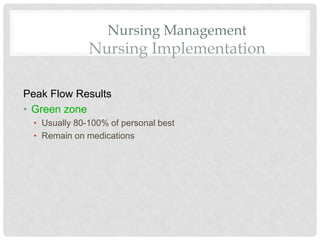
Peak Flow Results
• Green zone
• Usually 80-100% of personal best
• Remain on medications
Nursing Management
Nursing Implementation
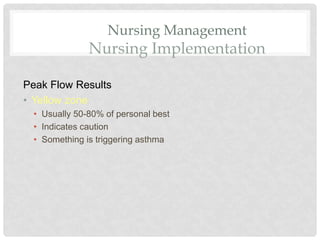
Peak Flow Results
• Yellow zone
• Usually 50-80% of personal best
• Indicates caution
• Something is triggering asthma
Nursing Management
Nursing Implementation
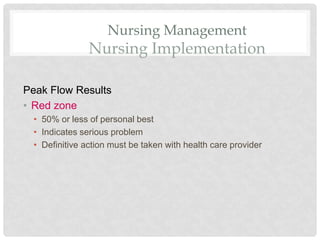
Peak Flow Results
• Red zone
• 50% or less of personal best
• Indicates serious problem
• Definitive action must be taken with health care provider

Asthma