Selected for publication in student’s
corner


   Biochemistry for Medics
   www.namrata.co
CASE REPORT


      Presented by:
Yashveer Anand Rughoobur
     Roll number:107
CASE PRESENTATION
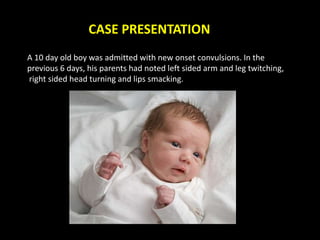
A 10 day old boy was admitted with new onset convulsions. In the
previous 6 days, his parents had noted left sided arm and leg twitching,
right sided head turning and lips smacking.
These episodes lasted for approximately 30secs and their
frequency had increased to seven times per hour before
admission.

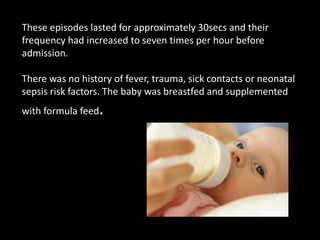
There was no history of fever, trauma, sick contacts or neonatal
sepsis risk factors. The baby was breastfed and supplemented
with formula feed   .
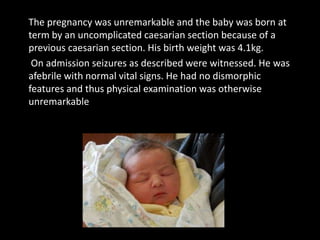
The pregnancy was unremarkable and the baby was born at
term by an uncomplicated caesarian section because of a
previous caesarian section. His birth weight was 4.1kg.
 On admission seizures as described were witnessed. He was
afebrile with normal vital signs. He had no dismorphic
features and thus physical examination was otherwise
unremarkable
Blood Biochemistry

 Initial blood biochemistry showed normal renal function and
  electrolytes but with hypocalcemia.

       Total calcium - 1.80 mmol/L (Normal 1.96mmol/L- 2.66
                             mmol/L) and

        ionized calcium - 0.82 mmol/L (normal 1.62 mmol/L –
                             3.10mmol/L).

 His blood glucose level was within normal limits at 4.3 mmol/L.


  There was low 25-OH vit D level 13mmol/L ( Normal 27-
  110mmol/L), with a normal 1,25 hydroxy vit D urinary calcium,
  Head ultrasound was normal and there was no clinical or
  radiological evidence of Rickets.
Maternal investigations demonstrated normal calcium level of 2.27
mmol/L (Normal 2.19-2.60 mmol/L). 25-OH Vit D was low.

The diagnosis was further revealed after further maternal history. The
mother was noted to have a diet low in calcium and she reported not
taking any antenatal vitamin supplement. She also reported always
wearing sunscreen when outdoor. The baby had not been started on
vitamin D supplements.
CASE DISCUSSION
QUESTION?
What is the cause of Hypocalcemia in this baby?
HYPOCALCEMIA
 Definition:
serum total concentration of <8mg/dL
 (2mmol/L) in terms of infants or
 <7mg/dL(<1.75mmol/L) in preterm infants.

It is also defined as an ionized calcium level of
<3.0 to 4.4 mg/dL (0.75- 1.10mmol/L)
depending upon the method used for
estimation.
CAUSES
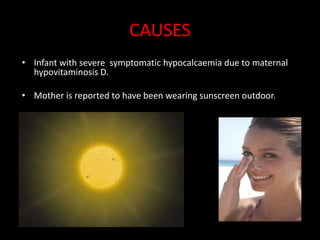
• Infant with severe symptomatic hypocalcaemia due to maternal
  hypovitaminosis D.

• Mother is reported to have been wearing sunscreen outdoor.
How did the mother get
           hypovitaminosis D??
• Sunscreen with a sun protection factor of 8 reduces
  cutaneous production of vitamin D by 98%.

• So she did not supplement with vitamin D during
  pregnancy.
TESTS
• 25-OH and 1,25 –OH vit D levels,
• serum and urinary calcium level,

• PTH level ,
• Renal function tests.
RESULTS
• Low 25-OH vit D level in the baby indicates
  that vit D stores are low.
• Note: Normal 1,25 hydroxy vitamin D
  confirms that the child is able to convert vit D
  to its active form.
• The child’s parathyroid hormone was
  appropriately elevated.
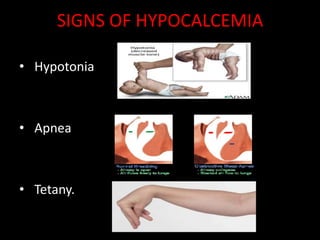
SIGNS OF HYPOCALCEMIA

• Hypotonia


• Apnea


• Tetany.
RISK FACTORS OF NEONATAL
             HYPOCALCEMIA
 Symptomatic hypocalcemia without evidence of
  rickets may present in the early neonatal period.
 Risk factors of neonatal vit D deficiency
  secondary to maternal hypovitaminosis D
  include:
      having a mother with dark skin,
     being born in winter months,
     living at extreme latitude,
     maternal diet low in vit D during pregnancy and
      lactation
     lack of maternal sun exposure.
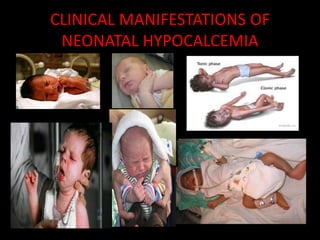
CLINICAL MANIFESTATIONS OF
        NEONATAL HYPOCALCEMIA
•   Jitteriness
•   Muscle jerking
•   Generalized or focal seizures
•   Stridor ( secondary to laryngospasm)
•   Wheezing( secondary to bronchospasm)
•   Vomiting (secondary to pylorospasm)
CLINICAL MANIFESTATIONS OF
 NEONATAL HYPOCALCEMIA
TREATMENT
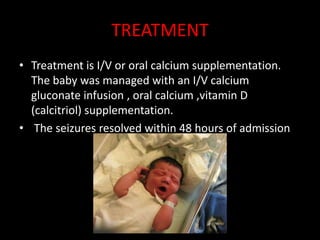
• Treatment is I/V or oral calcium supplementation.
  The baby was managed with an I/V calcium
  gluconate infusion , oral calcium ,vitamin D
  (calcitriol) supplementation.
• The seizures resolved within 48 hours of admission
PREVENTION
• Vitamin D
  deficiency in infants
  and mothers is a
  public health issue.
• There is no current
  consensus for
  maternal vitamin D
  requirement,
  however 400IU/day
  is recommended for
  a pregnant woman
  to have a healthy
  child.
References
• Class Notes
• Biochemistry for medics
THANK YOU FOR YOUR ATTENTION

Vitamin d deficiency -A case report(final)

  • 1.
    Selected for publicationin student’s corner Biochemistry for Medics www.namrata.co
  • 2.
    CASE REPORT Presented by: Yashveer Anand Rughoobur Roll number:107
  • 3.
    CASE PRESENTATION A 10day old boy was admitted with new onset convulsions. In the previous 6 days, his parents had noted left sided arm and leg twitching, right sided head turning and lips smacking.
  • 4.
    These episodes lastedfor approximately 30secs and their frequency had increased to seven times per hour before admission. There was no history of fever, trauma, sick contacts or neonatal sepsis risk factors. The baby was breastfed and supplemented with formula feed .
  • 5.
    The pregnancy wasunremarkable and the baby was born at term by an uncomplicated caesarian section because of a previous caesarian section. His birth weight was 4.1kg. On admission seizures as described were witnessed. He was afebrile with normal vital signs. He had no dismorphic features and thus physical examination was otherwise unremarkable
  • 6.
    Blood Biochemistry Initialblood biochemistry showed normal renal function and electrolytes but with hypocalcemia.  Total calcium - 1.80 mmol/L (Normal 1.96mmol/L- 2.66 mmol/L) and  ionized calcium - 0.82 mmol/L (normal 1.62 mmol/L – 3.10mmol/L).  His blood glucose level was within normal limits at 4.3 mmol/L. There was low 25-OH vit D level 13mmol/L ( Normal 27- 110mmol/L), with a normal 1,25 hydroxy vit D urinary calcium, Head ultrasound was normal and there was no clinical or radiological evidence of Rickets.
  • 7.
    Maternal investigations demonstratednormal calcium level of 2.27 mmol/L (Normal 2.19-2.60 mmol/L). 25-OH Vit D was low. The diagnosis was further revealed after further maternal history. The mother was noted to have a diet low in calcium and she reported not taking any antenatal vitamin supplement. She also reported always wearing sunscreen when outdoor. The baby had not been started on vitamin D supplements.
  • 8.
  • 9.
    QUESTION? What is thecause of Hypocalcemia in this baby?
  • 10.
    HYPOCALCEMIA Definition: serum totalconcentration of <8mg/dL (2mmol/L) in terms of infants or <7mg/dL(<1.75mmol/L) in preterm infants. It is also defined as an ionized calcium level of <3.0 to 4.4 mg/dL (0.75- 1.10mmol/L) depending upon the method used for estimation.
  • 11.
    CAUSES • Infant withsevere symptomatic hypocalcaemia due to maternal hypovitaminosis D. • Mother is reported to have been wearing sunscreen outdoor.
  • 12.
    How did themother get hypovitaminosis D?? • Sunscreen with a sun protection factor of 8 reduces cutaneous production of vitamin D by 98%. • So she did not supplement with vitamin D during pregnancy.
  • 13.
    TESTS • 25-OH and1,25 –OH vit D levels, • serum and urinary calcium level, • PTH level , • Renal function tests.
  • 14.
    RESULTS • Low 25-OHvit D level in the baby indicates that vit D stores are low. • Note: Normal 1,25 hydroxy vitamin D confirms that the child is able to convert vit D to its active form. • The child’s parathyroid hormone was appropriately elevated.
  • 15.
    SIGNS OF HYPOCALCEMIA •Hypotonia • Apnea • Tetany.
  • 16.
    RISK FACTORS OFNEONATAL HYPOCALCEMIA  Symptomatic hypocalcemia without evidence of rickets may present in the early neonatal period.  Risk factors of neonatal vit D deficiency secondary to maternal hypovitaminosis D include:  having a mother with dark skin, being born in winter months, living at extreme latitude, maternal diet low in vit D during pregnancy and lactation lack of maternal sun exposure.
  • 17.
    CLINICAL MANIFESTATIONS OF NEONATAL HYPOCALCEMIA • Jitteriness • Muscle jerking • Generalized or focal seizures • Stridor ( secondary to laryngospasm) • Wheezing( secondary to bronchospasm) • Vomiting (secondary to pylorospasm)
  • 18.
    CLINICAL MANIFESTATIONS OF NEONATAL HYPOCALCEMIA
  • 19.
    TREATMENT • Treatment isI/V or oral calcium supplementation. The baby was managed with an I/V calcium gluconate infusion , oral calcium ,vitamin D (calcitriol) supplementation. • The seizures resolved within 48 hours of admission
  • 20.
    PREVENTION • Vitamin D deficiency in infants and mothers is a public health issue. • There is no current consensus for maternal vitamin D requirement, however 400IU/day is recommended for a pregnant woman to have a healthy child.
  • 21.
    References • Class Notes •Biochemistry for medics
  • 22.
    THANK YOU FORYOUR ATTENTION