Electrical Injuries
Abdalmohsen Ababtain
Emergency Resident
Saudi Board for Emergency Medicine
20th April 2013
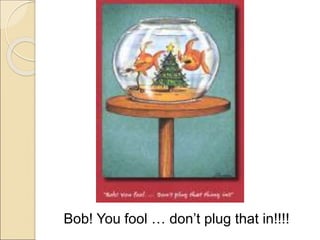
Bob! You fool … don’t plug that in!!!!
Objectives
 Epidemiology
 Factors Determining Electrical Injury
 Mechanisms of injury
 Associated injuries
 Management
 Prognosis
Epidemiology:
 Account for ~ 3% all burn-related injuries
 Estimated 3,000 annual admits to burn units
 ~ 1/3 fatal - about 1,000 US deaths annually
 Bimodal distribution
◦ ~1/3 children <6 yrs (electric cords & wall
outlets)
◦ ~2/3 miners, construction, & electrical
workers
◦ Common cause occupational deaths
 Lightning responsible for ~300 injuries, 100
deaths
Physics 101
 Ohm’s Law :
 I (Current) = V (Voltage) / R
(Resistance)
 Example = Grasp 120V source, with
1000Ohms resistance = 120mAmps
 Joule’s Law
Energy = I2 x R x time
 Electrical energy will be converted to
heat
 Heat causes the most tissue damage
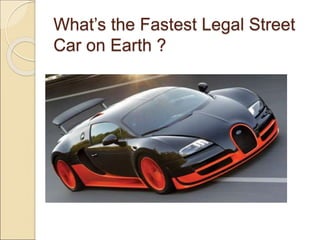
What’s the Fastest Legal Street
Car on Earth ?
Bugatti Veyron Super Sport
 Max Speed 430km/hr
 0-100 km in 2.4 Seconds !!
 1200 hp !!
 Base Price $2,400,000
Factors Determining Electrical
Injury
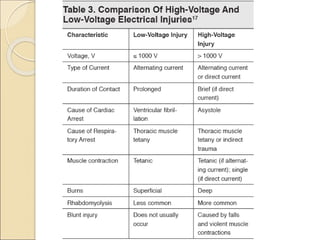
 Type of circuit
 Resistance of tissues
 Amperage (Current)
 Duration
 Voltage
 Pathway of current
Type of circuit
 Either direct current (DC) or
alternating current (AC).
 High-voltage DC contact tends to
cause a single muscle spasm, often
throwing the victim from the source
 AC exposure to the same voltage
tends to be three times more
dangerous than DC.
Resistance
 Resistance is the tendency of a
material to resist the flow of electric
current; it is specific for a given tissue,
depending on its moisture content,
temperature, and other physical
properties.
 The higher the resistance, the greater
the potential for transformation of
electrical energy to thermal energy.
 Nerves, muscle and blood vessels,
because of their high electrolyte and
water content, have a low resistance
and are good conductors.
 Bone, tendon, and fat, which all
contain a large amount of inert matrix,
have a very high resistance and tend
to heat up and coagulate rather than
transmit current.
 The other tissues of the body are
Current
 Current, expressed in amperes, is a
measure of the amount of energy that
flows through an object
 Amperage is dependent on the source
voltage and the resistance of the
conductor. (Remember I=V/R)
 The voltage of the source is known but
the resistance varies
 The physical effect vary with different
amperage.
 "let go" current
• The maximum current at which a person
can grasp the current and then release it
before muscle tetany makes letting go
impossible.
Duration of contact
 The longer the duration of contact with
high-voltage current, the greater the
electro thermal heating and degree of
tissue destruction.
With lightening injury The extremely
short duration and extraordinarily high
voltage and amperage of lightning
both result in a very short flow of
current internally, with little, if any, skin
breakdown and almost immediate
flashover of current around the body.
Voltage
 Voltage is a measure of the difference
in electrical potential between two
points and is determined by the
electrical source. Electrical injuries are
conventionally divided into high or low
voltage using 500 or 1000 V as the
most common cutpoint.
The higher the voltage the more is
tissue distraction
Pathway
 The pathway that a current takes
determines the tissues at risk, the type
of injury seen, and the degree of
conversion of electrical energy to heat.
 Heart: Dysrhythmias and myocardial
damage
 Brain: Seizures, and paralysis.
 Eyes: Cataracts
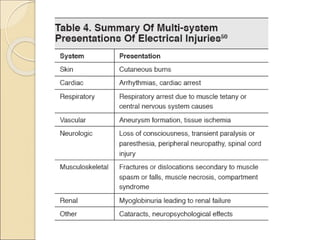
Mechanisms of Injury
 Direct effect of electrical current
 Thermal burns (conversion I to E)
 Mechanical Trauma
 Post-trauma sequelae
Direct effects of current
 In general, type & extent of injury depends on
current intensity (amps) (I = V/R)
 Cardiac, neurologic and respiratory systems
most susceptible to direct effects
 Skin is the resistor most effecting severity of
injury
◦ Wet skin has lower R (~1K ohm) vs. dry or
thick skin (>100K ohm), resulting in greater
current flow
Thermal (Burn) Injuries
 Heat (E) = IVT
 Type & extent of injury depends on current
intensity (I)
 R varies significantly between tissues
◦ Tissues with high R (e.g., bone), generate
more heat, resulting in osteonecrosis and
deep tissue periosteal burns
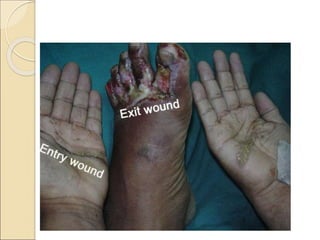
◦ Skin also has high R, thus entry/exit wounds
◦ Decreasing R (e.g., wet skin) results in lower
thermal injury, but higher current
conductance
 Coagulation of muscle, fat, vessels
Mechanical Trauma
 Trauma can result from fall or muscle
contraction
 Classic example is shock wave of lightning
causing blast injuries
 Even at low V, tetanic muscle contraction
can result in bone fx
◦ Cord injury can result from severe muscle
contraction, w/o any external signs of
trauma
 Can result in vascular compromise
◦ Acute hypotension should always prompt
search for thoracic or intra-abdominal
Post-trauma sequelae
 Crush injury syndrome (rhabdomyolysis,
myoglobinuria)
 Multi-organ ischemic injury 2o to vascular
coagulation or dissection
 Hypovolemic shock 2o to massive 3rd
spacing
 Iatrogenic injuries from acute resuscitation
◦ Abdominal compartment syndrome
◦ ARDS
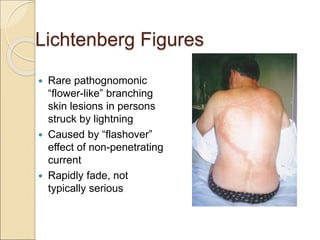
Lichtenberg Figures
 Rare pathognomonic
“flower-like” branching
skin lesions in persons
struck by lightning
 Caused by “flashover”
effect of non-penetrating
current
 Rapidly fade, not
typically serious
Management I
 Standard ABCDEs of any major trauma
 Pulmonary
◦ Low threshold for intubation, as respiratory
failure common
 Cardiac
◦ Serial monitoring if high V, abnormal ECG,
LOC, respiratory arrest, or PMH of CV
dysfunction
 Neuro
◦ C-spine and log-roll precautions; CT head &
spine often warranted
◦ Thorough serial neurological exams, as
vessel coagulation can result in late
Management II
 Musculoskeletal
◦ Thorough evaluation for fractures
◦ Serial evaluations of limbs for compartment
syndrome requiring emergent decompression
◦ Even in absence of compartment syndrome,
persistent aciduria or myoglobinuria may require
limb amputation
 Skin
◦ Early debridement and later reconstruction
◦ Antibiotic prophylaxis (controversial)
 Renal
◦ Fluid resuscitation key, as 3rd spacing common &
myoglobinuria 2o/2 rhabdomyolysis can cause ARF
Management III
 GI
◦ Ulcer prophylaxis, as gastric ulcers
(Curling’s ulcers) can develop
◦ Ileus uncommon, but should prompt
evaluation for other injury
 Serial evaluation of liver, pancreatic, & renal
function for traumatic/anoxic/ischemic injury
 Judicious management of fluid and
electrolytes to avoid acidosis and
compartment syndromes
 Admission:
 In contact >600V
 Symptoms (Chest Pain, Palpitation, LOC,
confusion, weakness, dyspnea, abdominal
pain)
 Signs (weakness, burns with subcutaneous
damage, vascular compromise)
 Ancillary changes (ECG, CK,
myoglobinuria)
 Cardiac monitoring: If ECG abnormal
 No Admission:
 Household voltage injury 100-220V in adult
 Negligible risk for delayed arrhythmias
 Asymptomatic, normal ECG and normal
Prognosis
 Highly variable, depending on severity of
both initial injury and subsequent
complications
 High morbidity/mortality in patients with
multisystem organ failure
 Advances in surgical interventions (early
excision, fasciotomy, skin grafts, etc…)
have improved
References
 DM Mozingo & BA Pruitt. 1998. Electric Injury. in Fundamentals
of Surgery, 1st ed, JE Niederhuber, pp 194-195.
 DS Pinto & PF Clardy. 2007. Environmental electric injuries. Up-
to-Date, accessed 06/01/2007.
 TN Pham & NS Gibran. 2007. Thermal & Electrical Injuries.
Surg Clin N Am 87:185-206.
 AC Koumbourlis. 2002. Electrical Injuries. Crit Care Med
30:S424-S430.
 C Spies & RG Trohman. 2006. Electrocution & Life-Threatening
Electrical Injuries. Ann Intern Med 145:531-537.
Electrical injuries

Electrical injuries

  • 1.
    Electrical Injuries Abdalmohsen Ababtain EmergencyResident Saudi Board for Emergency Medicine 20th April 2013
  • 2.
    Bob! You fool… don’t plug that in!!!!
  • 3.
    Objectives  Epidemiology  FactorsDetermining Electrical Injury  Mechanisms of injury  Associated injuries  Management  Prognosis
  • 4.
    Epidemiology:  Account for~ 3% all burn-related injuries  Estimated 3,000 annual admits to burn units  ~ 1/3 fatal - about 1,000 US deaths annually  Bimodal distribution ◦ ~1/3 children <6 yrs (electric cords & wall outlets) ◦ ~2/3 miners, construction, & electrical workers ◦ Common cause occupational deaths  Lightning responsible for ~300 injuries, 100 deaths
  • 5.
    Physics 101  Ohm’sLaw :  I (Current) = V (Voltage) / R (Resistance)  Example = Grasp 120V source, with 1000Ohms resistance = 120mAmps
  • 6.
     Joule’s Law Energy= I2 x R x time  Electrical energy will be converted to heat  Heat causes the most tissue damage
  • 7.
    What’s the FastestLegal Street Car on Earth ?
  • 8.
    Bugatti Veyron SuperSport  Max Speed 430km/hr  0-100 km in 2.4 Seconds !!  1200 hp !!  Base Price $2,400,000
  • 9.
    Factors Determining Electrical Injury Type of circuit  Resistance of tissues  Amperage (Current)  Duration  Voltage  Pathway of current
  • 10.
    Type of circuit Either direct current (DC) or alternating current (AC).  High-voltage DC contact tends to cause a single muscle spasm, often throwing the victim from the source  AC exposure to the same voltage tends to be three times more dangerous than DC.
  • 11.
    Resistance  Resistance isthe tendency of a material to resist the flow of electric current; it is specific for a given tissue, depending on its moisture content, temperature, and other physical properties.  The higher the resistance, the greater the potential for transformation of electrical energy to thermal energy.
  • 12.
     Nerves, muscleand blood vessels, because of their high electrolyte and water content, have a low resistance and are good conductors.  Bone, tendon, and fat, which all contain a large amount of inert matrix, have a very high resistance and tend to heat up and coagulate rather than transmit current.  The other tissues of the body are
  • 13.
    Current  Current, expressedin amperes, is a measure of the amount of energy that flows through an object  Amperage is dependent on the source voltage and the resistance of the conductor. (Remember I=V/R)  The voltage of the source is known but the resistance varies  The physical effect vary with different amperage.
  • 14.
     "let go"current • The maximum current at which a person can grasp the current and then release it before muscle tetany makes letting go impossible.
  • 15.
    Duration of contact The longer the duration of contact with high-voltage current, the greater the electro thermal heating and degree of tissue destruction. With lightening injury The extremely short duration and extraordinarily high voltage and amperage of lightning both result in a very short flow of current internally, with little, if any, skin breakdown and almost immediate flashover of current around the body.
  • 16.
    Voltage  Voltage isa measure of the difference in electrical potential between two points and is determined by the electrical source. Electrical injuries are conventionally divided into high or low voltage using 500 or 1000 V as the most common cutpoint. The higher the voltage the more is tissue distraction
  • 17.
    Pathway  The pathwaythat a current takes determines the tissues at risk, the type of injury seen, and the degree of conversion of electrical energy to heat.  Heart: Dysrhythmias and myocardial damage  Brain: Seizures, and paralysis.  Eyes: Cataracts
  • 18.
    Mechanisms of Injury Direct effect of electrical current  Thermal burns (conversion I to E)  Mechanical Trauma  Post-trauma sequelae
  • 19.
    Direct effects ofcurrent  In general, type & extent of injury depends on current intensity (amps) (I = V/R)  Cardiac, neurologic and respiratory systems most susceptible to direct effects  Skin is the resistor most effecting severity of injury ◦ Wet skin has lower R (~1K ohm) vs. dry or thick skin (>100K ohm), resulting in greater current flow
  • 20.
    Thermal (Burn) Injuries Heat (E) = IVT  Type & extent of injury depends on current intensity (I)  R varies significantly between tissues ◦ Tissues with high R (e.g., bone), generate more heat, resulting in osteonecrosis and deep tissue periosteal burns ◦ Skin also has high R, thus entry/exit wounds ◦ Decreasing R (e.g., wet skin) results in lower thermal injury, but higher current conductance  Coagulation of muscle, fat, vessels
  • 21.
    Mechanical Trauma  Traumacan result from fall or muscle contraction  Classic example is shock wave of lightning causing blast injuries  Even at low V, tetanic muscle contraction can result in bone fx ◦ Cord injury can result from severe muscle contraction, w/o any external signs of trauma  Can result in vascular compromise ◦ Acute hypotension should always prompt search for thoracic or intra-abdominal
  • 22.
    Post-trauma sequelae  Crushinjury syndrome (rhabdomyolysis, myoglobinuria)  Multi-organ ischemic injury 2o to vascular coagulation or dissection  Hypovolemic shock 2o to massive 3rd spacing  Iatrogenic injuries from acute resuscitation ◦ Abdominal compartment syndrome ◦ ARDS
  • 26.
    Lichtenberg Figures  Rarepathognomonic “flower-like” branching skin lesions in persons struck by lightning  Caused by “flashover” effect of non-penetrating current  Rapidly fade, not typically serious
  • 27.
    Management I  StandardABCDEs of any major trauma  Pulmonary ◦ Low threshold for intubation, as respiratory failure common  Cardiac ◦ Serial monitoring if high V, abnormal ECG, LOC, respiratory arrest, or PMH of CV dysfunction  Neuro ◦ C-spine and log-roll precautions; CT head & spine often warranted ◦ Thorough serial neurological exams, as vessel coagulation can result in late
  • 28.
    Management II  Musculoskeletal ◦Thorough evaluation for fractures ◦ Serial evaluations of limbs for compartment syndrome requiring emergent decompression ◦ Even in absence of compartment syndrome, persistent aciduria or myoglobinuria may require limb amputation  Skin ◦ Early debridement and later reconstruction ◦ Antibiotic prophylaxis (controversial)  Renal ◦ Fluid resuscitation key, as 3rd spacing common & myoglobinuria 2o/2 rhabdomyolysis can cause ARF
  • 29.
    Management III  GI ◦Ulcer prophylaxis, as gastric ulcers (Curling’s ulcers) can develop ◦ Ileus uncommon, but should prompt evaluation for other injury  Serial evaluation of liver, pancreatic, & renal function for traumatic/anoxic/ischemic injury  Judicious management of fluid and electrolytes to avoid acidosis and compartment syndromes
  • 30.
     Admission:  Incontact >600V  Symptoms (Chest Pain, Palpitation, LOC, confusion, weakness, dyspnea, abdominal pain)  Signs (weakness, burns with subcutaneous damage, vascular compromise)  Ancillary changes (ECG, CK, myoglobinuria)  Cardiac monitoring: If ECG abnormal  No Admission:  Household voltage injury 100-220V in adult  Negligible risk for delayed arrhythmias  Asymptomatic, normal ECG and normal
  • 31.
    Prognosis  Highly variable,depending on severity of both initial injury and subsequent complications  High morbidity/mortality in patients with multisystem organ failure  Advances in surgical interventions (early excision, fasciotomy, skin grafts, etc…) have improved
  • 33.
    References  DM Mozingo& BA Pruitt. 1998. Electric Injury. in Fundamentals of Surgery, 1st ed, JE Niederhuber, pp 194-195.  DS Pinto & PF Clardy. 2007. Environmental electric injuries. Up- to-Date, accessed 06/01/2007.  TN Pham & NS Gibran. 2007. Thermal & Electrical Injuries. Surg Clin N Am 87:185-206.  AC Koumbourlis. 2002. Electrical Injuries. Crit Care Med 30:S424-S430.  C Spies & RG Trohman. 2006. Electrocution & Life-Threatening Electrical Injuries. Ann Intern Med 145:531-537.