Sodium Disorders
Abdalmohsen ababtain
Outlines
 Definitions of sodium disorders
 Classifications
 Approach
 To know the etiologies
 Treatment
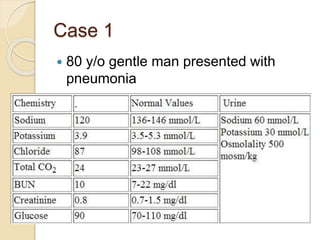
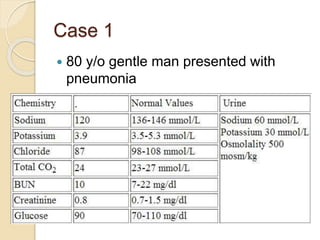
Case 1
 80 y/o gentle man presented with
pneumonia
Categorizations
 Based on the level
 Onset
 Volume status
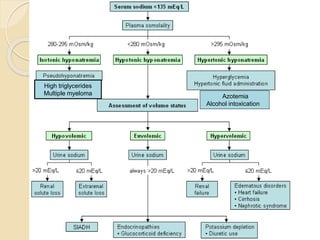
 Osmolality
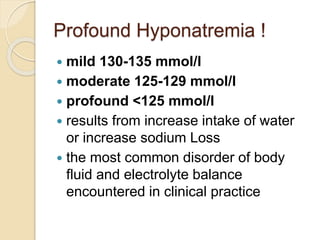
Profound Hyponatremia !
 mild 130-135 mmol/l
 moderate 125-129 mmol/l
 profound <125 mmol/l
 results from increase intake of water
or increase sodium Loss
 the most common disorder of body
fluid and electrolyte balance
encountered in clinical practice
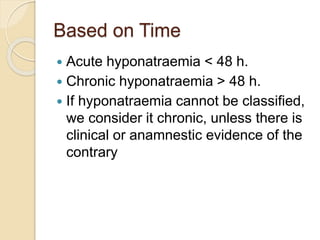
Based on Time
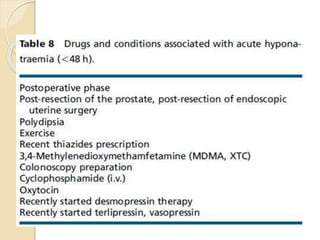
 Acute hyponatraemia < 48 h.
 Chronic hyponatraemia > 48 h.
 If hyponatraemia cannot be classified,
we consider it chronic, unless there is
clinical or anamnestic evidence of the
contrary
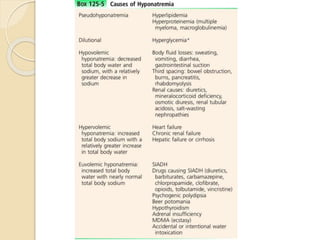
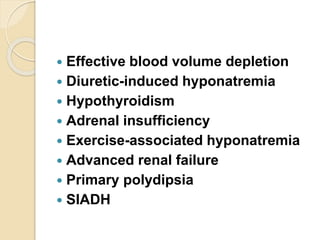
 Effective blood volume depletion
 Diuretic-induced hyponatremia
 Hypothyroidism
 Adrenal insufficiency
 Exercise-associated hyponatremia
 Advanced renal failure
 Primary polydipsia
 SIADH
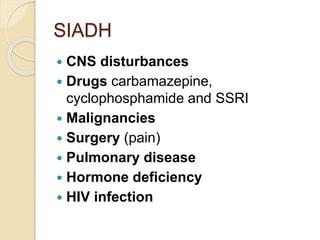
SIADH
 CNS disturbances
 Drugs carbamazepine,
cyclophosphamide and SSRI
 Malignancies
 Surgery (pain)
 Pulmonary disease
 Hormone deficiency
 HIV infection
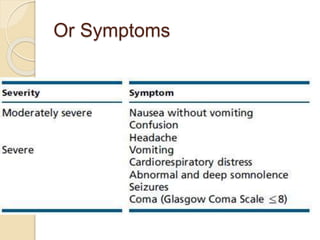
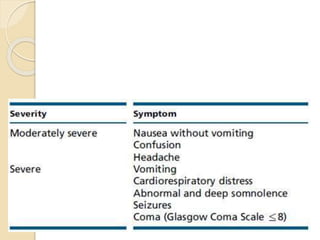
Or Symptoms
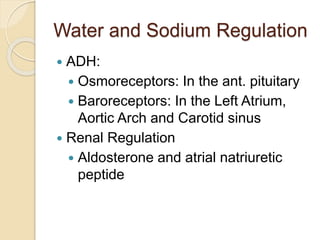
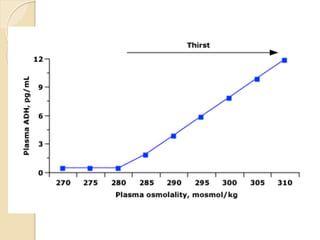
Water and Sodium Regulation
 ADH:
 Osmoreceptors: In the ant. pituitary
 Baroreceptors: In the Left Atrium,
Aortic Arch and Carotid sinus
 Renal Regulation
 Aldosterone and atrial natriuretic
peptide
High triglycerides
Multiple myeloma Azotemia
Alcohol intoxication
Case 1
 80 y/o gentle man presented with
pneumonia
Hx and Exam
 Hx: fluid loss (vomiting, diarrhea,
diuretic therapy)
 Hx of SIADH
 Hx or signs adrenal insufficiency or
hypothyroidism
 PE: Signs of peripheral
edema and/or ascites
 Or signs of dehydration
Labs
 Serum osmolality
 Urine osmolality
 Urine sodium, potassium, and chloride
concentrations
 uric acid
 cortisol
 TSH
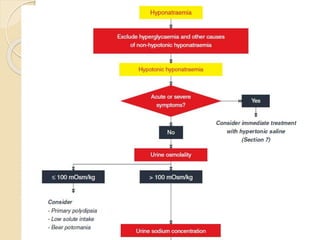
urine osmolality
 urine osmolality can be used to
distinguish between impaired water
excretion and primary polydipsia .
 > 100 mosmol/kg high ADH
 < 100 mosmol/kg appropriate
suppression of ADH may be due to
primary polydipsia or Malnutrition or
Reset osmostat
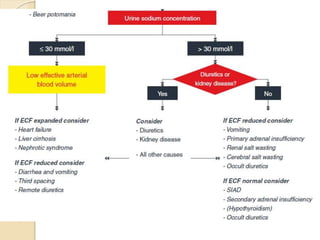
Urine sodium and chloride
concentration
 In Hypovolemia urine Na is <
25 meq/L
 In SIADH urine Na >40 meq/L
 In hypovolemic hyponatremic patients
who have metabolic alkalosis caused
by vomiting urine Na > 25 meq/L, but
the urine Cl < 25 meq/L
How to Assess for
Extracellular fluid volume ?
Assessment of extracellular fluid
volume in hyponatremia
 Clinical assessment correctly
identified only 47% of hypovolemic
patients and 48% of normovolemic
patients !
 Concentration of sodium clearly
separated hypovolemic (mean UNa =
18 meq/L) from normovolemic (mean
UNa = 72 meq/L)
Am J Med. 1987 Nov;83(5):905-8
 accuracy of clinical evaluation for
predicting the state of extracellular
fluid volume in hyponatremia is low.
 The combination of low fractional
sodium excretion (< 0.5%) and low
fractional urea excretion (< 55%) is
the best biochemical way to predict
saline response, whereas high
fractional potassium excretion (> 20%)
indicates diuretic intake.
Am J Med. 1995 Oct;99(4):348-55
FENa
 FENa < 1 % suggests effective
volume depletion, while a value about
2 percent suggests acute tubular
necrosis
Hyperglycemia
 a correction factor of a 2.4 meq/L
decrease in sodium concentration per
100 mg/dL increase in glucose
concentration is a better overall
estimate of this association than the
usual correction factor of 1.6
 Shall we change it !!
Am J Med. 1999 Apr;106(4):399-403
Case 2
 66 yo lady called from home PHx
hypertension, hyperlipidaemia
 1/52 ago dx with UTI, given Bactrim
 4/7 vomiting, diarrhoea, anorexia,
increasing confusion 2/7
 Na 110, asked to present to ED
Presented to ED with confusion,
lethargy, anorexia. No seizures.
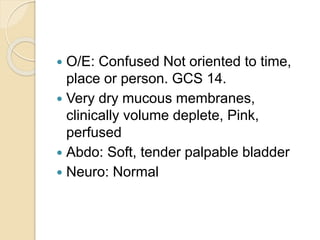
 O/E: Confused Not oriented to time,
place or person. GCS 14.
 Very dry mucous membranes,
clinically volume deplete, Pink,
perfused
 Abdo: Soft, tender palpable bladder
 Neuro: Normal
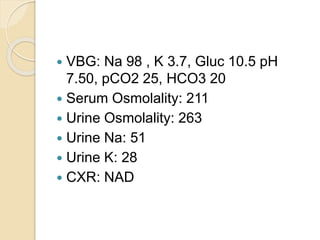
 VBG: Na 98 , K 3.7, Gluc 10.5 pH
7.50, pCO2 25, HCO3 20
 Serum Osmolality: 211
 Urine Osmolality: 263
 Urine Na: 51
 Urine K: 28
 CXR: NAD
Hyponatremia Treatment
 Treat the underlying disease, if
possible.
 Fluid restriction.
 intravenous sodium chloride in
patients with true volume depletion
 Glucocorticoids to patients with
adrenal insufficiency
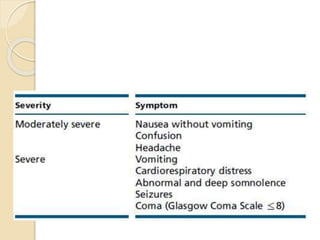
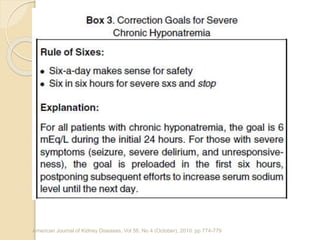
Severe Symptoms
 150 ml (2ml/kg) 3% hypertonic over 20
min can be repeated.
 until a target of 5 mmol/l increase in
serum sodium concentration is
achieved
 If no improvement continue 3%NS till
pt is stabilized
If not improving
 If symptoms do not improve after a 10
mmol/l increase in serum sodium
concentration,Think of something else
!
After resolution of symptoms
 keeping the i.v. line open by infusing
the smallest feasible volume of 0.9%
saline until cause-specific treatment is
started
 limiting the increase in serum sodium
concentration to a total of 10 mmol/l
during the first 24h
 an additional 8 mmol/l during every 24
h thereafter until the serum sodium
concentration reaches 130 mmol/l
 Keep in mind that if hypokalaemia is
present, correction of the
hypokalaemia will contribute to an
increase in serum sodium
concentration
Studies supporting use of hypertonic
saline in severe symptomatic
hyponatremia
 October 2009, Volume II, Issue 2, pp
228-234
 Clin J Am Soc Nephrol. 2007
Nov;2(6):1110-7
 Acta Med Scand. 1980;207(4):279-81
 Am J Med. 1982 Jan;72(1):43-8
 Br Med J (Clin Res Ed). 1986 Jan
18;292(6514)
 250–750 ml 3% NaCl, presenting
symptoms of seizures and delirium
resolved, although averaged initial
increases in serum sodium
concentration were limited to 6-12
mmol/l/h
Acute Hyponatraemia with
moderately severe symptoms
 ‘acute’ hyponatraemia as hyponatraemia
that is documented to exist <48 h
 Stop, if possible, medications and other
factors that can contribute to or provoke
hyponatraemia
 Start Diagnostic assessment
 Single i.v. infusion of 150 ml 3%
hypertonic saline over 20 min can be
started aiming for a 5 mmol/l per 24-h
increase in Na concentration
 After 1 h, the serum sodium
concentration was 4.3 mmol/l higher
for the participants receiving i.v. fluids
than for the patients receiving oral
rehydration
Acute hyponatraemia without
symptoms
 stop fluids, medications and other
factors that can contribute to or
provoke hyponatraemia
 starting prompt diagnostic assessment
 If the acute decrease in serum sodium
concentration exceeds 10 mmol/l, we
suggest a single i.v. infusion of 150 ml
3% hypertonic saline or equivalent
over 20 min
Chronic hyponatraemia without
symptoms
 mild hyponatraemia, we suggest
against treatment with the sole aim of
increasing the serum sodium
concentration
 Aim for increase in serum sodium
concentration of <10 mmol/l during the
first 24 h and <8 mmol/l during every
24 h thereafter
American Journal of Kidney Diseases, Vol 56, No 4 (October), 2010: pp 774-779
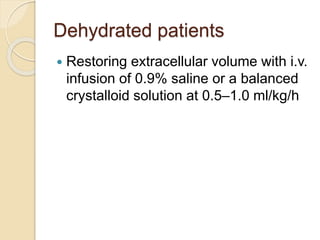
Dehydrated patients
 Restoring extracellular volume with i.v.
infusion of 0.9% saline or a balanced
crystalloid solution at 0.5–1.0 ml/kg/h
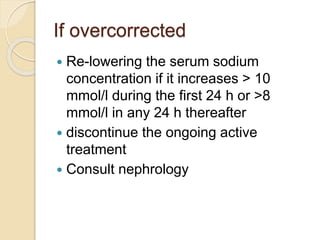
If overcorrected
 Re-lowering the serum sodium
concentration if it increases > 10
mmol/l during the first 24 h or >8
mmol/l in any 24 h thereafter
 discontinue the ongoing active
treatment
 Consult nephrology
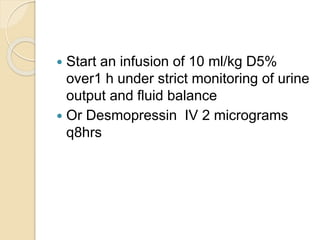
 Start an infusion of 10 ml/kg D5%
over1 h under strict monitoring of urine
output and fluid balance
 Or Desmopressin IV 2 micrograms
q8hrs
Your Goal
 Decreasing Serum Na at a rate of
1 meq/L /hour
 Aiming for a net Change of
<10meq/L/day
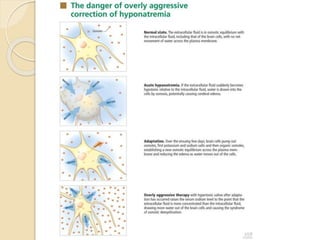
Osmotic demyelination
syndrome
 Systematic review of the cases of
osmotic demyelination syndrome
published during the past 15 years
supports restricting increases in serum
sodium concentration <10 mmol/l in
the first 24 h and <18 mmol/l in the
first 48 h.
 rare but dramatic complication that
occurs in chronic hyponatraemia when
the serum sodium concentration
increases too rapidly
Risk of osmotic demyelination
syndrome
 Liver disease
 Use of thiazides
 Antidepressant medications
 Original biochemical degree
 Duration of hyponatraemia
 Chronic hyponatremia
 Serum sodium concentration <105
mEq/L
 Hypokalemia
 Alcoholism
 Malnutrition
Symptoms
 Irreversible or only partially reversible
 Delayed for 2-6 days
 dysarthria
 dysphagia
 quadriparesis
 behavioral disturbances
 lethargy
 Confusion, disorientation or
obtundation
 54 cases of osmotic demyelination
syndrome published since 1997
 In 96%, the Dx of osmotic demyelination
syndrome was based on MRI
 In 96% the initial serum Na concentration
was <120 mmol/l
 In 87%, the Na concentration increased >12
mmol/l during the first 24 h or >20 mmol/l
during the first 48 h
Case 3
 90 yo bedridden presented with
lethargy, weakness, and irritability for
2 days
 Vitally stable
 Looks dehydrated
 Na 160
 Values above 180 meq/L are
associated with a high mortality rate,
particularly in adults
Mayo Clin Proc. 1990;65(12):1587
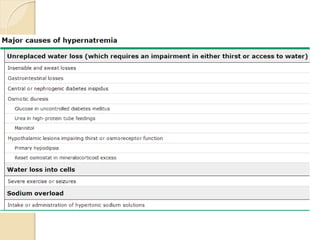
HYPERNATREMIA
 Water loss
 Potassium intake
 Sodium intake (salt poisoning)
 Iatrogenic
 Impaired thirst mechanism
 diabetes insipidus
 Osmotic diuresis
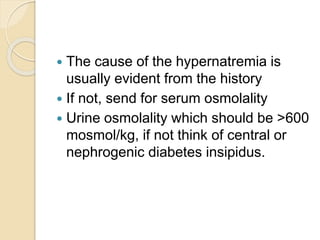
 The cause of the hypernatremia is
usually evident from the history
 If not, send for serum osmolality
 Urine osmolality which should be >600
mosmol/kg, if not think of central or
nephrogenic diabetes insipidus.
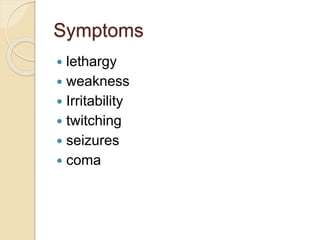
Symptoms
 lethargy
 weakness
 Irritability
 twitching
 seizures
 coma
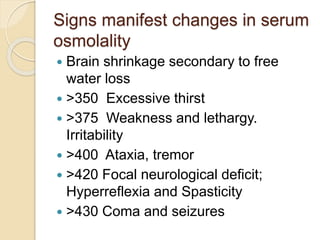
Signs manifest changes in serum
osmolality
 Brain shrinkage secondary to free
water loss
 >350 Excessive thirst
 >375 Weakness and lethargy.
Irritability
 >400 Ataxia, tremor
 >420 Focal neurological deficit;
Hyperreflexia and Spasticity
 >430 Coma and seizures
Treatment
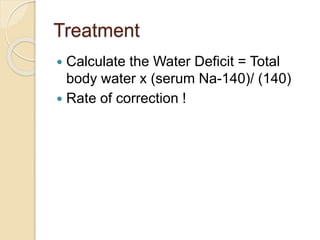
 Calculate the Water Deficit = Total
body water x (serum Na-140)/ (140)
 Rate of correction !
Fast or slow correction in
elderlies with acute symptoms !
 Correction of less than 6 meq/L per
day [<0.25 meq/L/hr] should be
avoided
 slow rate of hypernatremia correction
during the first 24 hours were found to
be significant predictor of 30-day
patient mortality
Am J Med Sci. 2011 May;341(5):356-60
Chronic Hypernatremia
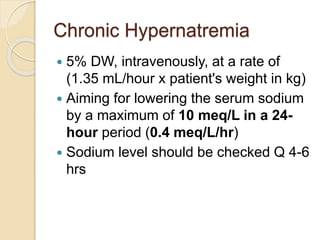
 5% DW, intravenously, at a rate of
(1.35 mL/hour x patient's weight in kg)
 Aiming for lowering the serum sodium
by a maximum of 10 meq/L in a 24-
hour period (0.4 meq/L/hr)
 Sodium level should be checked Q 4-6
hrs
Acute Hypernatremia
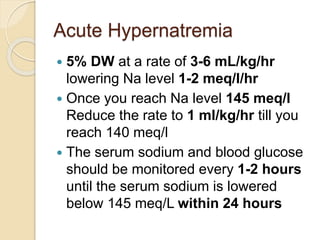
 5% DW at a rate of 3-6 mL/kg/hr
lowering Na level 1-2 meq/l/hr
 Once you reach Na level 145 meq/l
Reduce the rate to 1 ml/kg/hr till you
reach 140 meq/l
 The serum sodium and blood glucose
should be monitored every 1-2 hours
until the serum sodium is lowered
below 145 meq/L within 24 hours
Acute Hypernatremia
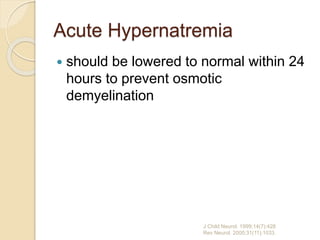
 should be lowered to normal within 24
hours to prevent osmotic
demyelination
J Child Neurol. 1999;14(7):428
Rev Neurol. 2000;31(11):1033.
If you suspect DI
 Consult Nephrology to start
desmopressin may be necessary in
patients with diabetes insipidus
Thank You

Na and mg disorders 2

  • 1.
  • 2.
    Outlines  Definitions ofsodium disorders  Classifications  Approach  To know the etiologies  Treatment
  • 3.
    Case 1  80y/o gentle man presented with pneumonia
  • 4.
    Categorizations  Based onthe level  Onset  Volume status  Osmolality
  • 5.
    Profound Hyponatremia ! mild 130-135 mmol/l  moderate 125-129 mmol/l  profound <125 mmol/l  results from increase intake of water or increase sodium Loss  the most common disorder of body fluid and electrolyte balance encountered in clinical practice
  • 6.
    Based on Time Acute hyponatraemia < 48 h.  Chronic hyponatraemia > 48 h.  If hyponatraemia cannot be classified, we consider it chronic, unless there is clinical or anamnestic evidence of the contrary
  • 9.
     Effective bloodvolume depletion  Diuretic-induced hyponatremia  Hypothyroidism  Adrenal insufficiency  Exercise-associated hyponatremia  Advanced renal failure  Primary polydipsia  SIADH
  • 10.
    SIADH  CNS disturbances Drugs carbamazepine, cyclophosphamide and SSRI  Malignancies  Surgery (pain)  Pulmonary disease  Hormone deficiency  HIV infection
  • 11.
  • 12.
    Water and SodiumRegulation  ADH:  Osmoreceptors: In the ant. pituitary  Baroreceptors: In the Left Atrium, Aortic Arch and Carotid sinus  Renal Regulation  Aldosterone and atrial natriuretic peptide
  • 14.
    High triglycerides Multiple myelomaAzotemia Alcohol intoxication
  • 17.
    Case 1  80y/o gentle man presented with pneumonia
  • 18.
    Hx and Exam Hx: fluid loss (vomiting, diarrhea, diuretic therapy)  Hx of SIADH  Hx or signs adrenal insufficiency or hypothyroidism  PE: Signs of peripheral edema and/or ascites  Or signs of dehydration
  • 20.
    Labs  Serum osmolality Urine osmolality  Urine sodium, potassium, and chloride concentrations  uric acid  cortisol  TSH
  • 21.
    urine osmolality  urineosmolality can be used to distinguish between impaired water excretion and primary polydipsia .  > 100 mosmol/kg high ADH  < 100 mosmol/kg appropriate suppression of ADH may be due to primary polydipsia or Malnutrition or Reset osmostat
  • 22.
    Urine sodium andchloride concentration  In Hypovolemia urine Na is < 25 meq/L  In SIADH urine Na >40 meq/L  In hypovolemic hyponatremic patients who have metabolic alkalosis caused by vomiting urine Na > 25 meq/L, but the urine Cl < 25 meq/L
  • 23.
    How to Assessfor Extracellular fluid volume ?
  • 24.
    Assessment of extracellularfluid volume in hyponatremia  Clinical assessment correctly identified only 47% of hypovolemic patients and 48% of normovolemic patients !  Concentration of sodium clearly separated hypovolemic (mean UNa = 18 meq/L) from normovolemic (mean UNa = 72 meq/L) Am J Med. 1987 Nov;83(5):905-8
  • 25.
     accuracy ofclinical evaluation for predicting the state of extracellular fluid volume in hyponatremia is low.  The combination of low fractional sodium excretion (< 0.5%) and low fractional urea excretion (< 55%) is the best biochemical way to predict saline response, whereas high fractional potassium excretion (> 20%) indicates diuretic intake. Am J Med. 1995 Oct;99(4):348-55
  • 26.
    FENa  FENa <1 % suggests effective volume depletion, while a value about 2 percent suggests acute tubular necrosis
  • 27.
    Hyperglycemia  a correctionfactor of a 2.4 meq/L decrease in sodium concentration per 100 mg/dL increase in glucose concentration is a better overall estimate of this association than the usual correction factor of 1.6  Shall we change it !! Am J Med. 1999 Apr;106(4):399-403
  • 28.
    Case 2  66yo lady called from home PHx hypertension, hyperlipidaemia  1/52 ago dx with UTI, given Bactrim  4/7 vomiting, diarrhoea, anorexia, increasing confusion 2/7  Na 110, asked to present to ED Presented to ED with confusion, lethargy, anorexia. No seizures.
  • 30.
     O/E: ConfusedNot oriented to time, place or person. GCS 14.  Very dry mucous membranes, clinically volume deplete, Pink, perfused  Abdo: Soft, tender palpable bladder  Neuro: Normal
  • 31.
     VBG: Na98 , K 3.7, Gluc 10.5 pH 7.50, pCO2 25, HCO3 20  Serum Osmolality: 211  Urine Osmolality: 263  Urine Na: 51  Urine K: 28  CXR: NAD
  • 33.
    Hyponatremia Treatment  Treatthe underlying disease, if possible.  Fluid restriction.  intravenous sodium chloride in patients with true volume depletion  Glucocorticoids to patients with adrenal insufficiency
  • 34.
    Severe Symptoms  150ml (2ml/kg) 3% hypertonic over 20 min can be repeated.  until a target of 5 mmol/l increase in serum sodium concentration is achieved  If no improvement continue 3%NS till pt is stabilized
  • 35.
    If not improving If symptoms do not improve after a 10 mmol/l increase in serum sodium concentration,Think of something else !
  • 36.
    After resolution ofsymptoms  keeping the i.v. line open by infusing the smallest feasible volume of 0.9% saline until cause-specific treatment is started  limiting the increase in serum sodium concentration to a total of 10 mmol/l during the first 24h  an additional 8 mmol/l during every 24 h thereafter until the serum sodium concentration reaches 130 mmol/l
  • 37.
     Keep inmind that if hypokalaemia is present, correction of the hypokalaemia will contribute to an increase in serum sodium concentration
  • 38.
    Studies supporting useof hypertonic saline in severe symptomatic hyponatremia  October 2009, Volume II, Issue 2, pp 228-234  Clin J Am Soc Nephrol. 2007 Nov;2(6):1110-7  Acta Med Scand. 1980;207(4):279-81  Am J Med. 1982 Jan;72(1):43-8  Br Med J (Clin Res Ed). 1986 Jan 18;292(6514)
  • 39.
     250–750 ml3% NaCl, presenting symptoms of seizures and delirium resolved, although averaged initial increases in serum sodium concentration were limited to 6-12 mmol/l/h
  • 40.
    Acute Hyponatraemia with moderatelysevere symptoms  ‘acute’ hyponatraemia as hyponatraemia that is documented to exist <48 h  Stop, if possible, medications and other factors that can contribute to or provoke hyponatraemia  Start Diagnostic assessment  Single i.v. infusion of 150 ml 3% hypertonic saline over 20 min can be started aiming for a 5 mmol/l per 24-h increase in Na concentration
  • 41.
     After 1h, the serum sodium concentration was 4.3 mmol/l higher for the participants receiving i.v. fluids than for the patients receiving oral rehydration
  • 43.
    Acute hyponatraemia without symptoms stop fluids, medications and other factors that can contribute to or provoke hyponatraemia  starting prompt diagnostic assessment  If the acute decrease in serum sodium concentration exceeds 10 mmol/l, we suggest a single i.v. infusion of 150 ml 3% hypertonic saline or equivalent over 20 min
  • 44.
    Chronic hyponatraemia without symptoms mild hyponatraemia, we suggest against treatment with the sole aim of increasing the serum sodium concentration  Aim for increase in serum sodium concentration of <10 mmol/l during the first 24 h and <8 mmol/l during every 24 h thereafter
  • 45.
    American Journal ofKidney Diseases, Vol 56, No 4 (October), 2010: pp 774-779
  • 46.
    Dehydrated patients  Restoringextracellular volume with i.v. infusion of 0.9% saline or a balanced crystalloid solution at 0.5–1.0 ml/kg/h
  • 47.
    If overcorrected  Re-loweringthe serum sodium concentration if it increases > 10 mmol/l during the first 24 h or >8 mmol/l in any 24 h thereafter  discontinue the ongoing active treatment  Consult nephrology
  • 48.
     Start aninfusion of 10 ml/kg D5% over1 h under strict monitoring of urine output and fluid balance  Or Desmopressin IV 2 micrograms q8hrs
  • 49.
    Your Goal  DecreasingSerum Na at a rate of 1 meq/L /hour  Aiming for a net Change of <10meq/L/day
  • 50.
    Osmotic demyelination syndrome  Systematicreview of the cases of osmotic demyelination syndrome published during the past 15 years supports restricting increases in serum sodium concentration <10 mmol/l in the first 24 h and <18 mmol/l in the first 48 h.  rare but dramatic complication that occurs in chronic hyponatraemia when the serum sodium concentration increases too rapidly
  • 51.
    Risk of osmoticdemyelination syndrome  Liver disease  Use of thiazides  Antidepressant medications  Original biochemical degree  Duration of hyponatraemia  Chronic hyponatremia  Serum sodium concentration <105 mEq/L  Hypokalemia  Alcoholism  Malnutrition
  • 52.
    Symptoms  Irreversible oronly partially reversible  Delayed for 2-6 days  dysarthria  dysphagia  quadriparesis  behavioral disturbances  lethargy  Confusion, disorientation or obtundation
  • 53.
     54 casesof osmotic demyelination syndrome published since 1997  In 96%, the Dx of osmotic demyelination syndrome was based on MRI  In 96% the initial serum Na concentration was <120 mmol/l  In 87%, the Na concentration increased >12 mmol/l during the first 24 h or >20 mmol/l during the first 48 h
  • 54.
    Case 3  90yo bedridden presented with lethargy, weakness, and irritability for 2 days  Vitally stable  Looks dehydrated  Na 160
  • 55.
     Values above180 meq/L are associated with a high mortality rate, particularly in adults Mayo Clin Proc. 1990;65(12):1587
  • 56.
    HYPERNATREMIA  Water loss Potassium intake  Sodium intake (salt poisoning)  Iatrogenic  Impaired thirst mechanism  diabetes insipidus  Osmotic diuresis
  • 58.
     The causeof the hypernatremia is usually evident from the history  If not, send for serum osmolality  Urine osmolality which should be >600 mosmol/kg, if not think of central or nephrogenic diabetes insipidus.
  • 59.
    Symptoms  lethargy  weakness Irritability  twitching  seizures  coma
  • 60.
    Signs manifest changesin serum osmolality  Brain shrinkage secondary to free water loss  >350 Excessive thirst  >375 Weakness and lethargy. Irritability  >400 Ataxia, tremor  >420 Focal neurological deficit; Hyperreflexia and Spasticity  >430 Coma and seizures
  • 61.
    Treatment  Calculate theWater Deficit = Total body water x (serum Na-140)/ (140)  Rate of correction !
  • 62.
    Fast or slowcorrection in elderlies with acute symptoms !  Correction of less than 6 meq/L per day [<0.25 meq/L/hr] should be avoided  slow rate of hypernatremia correction during the first 24 hours were found to be significant predictor of 30-day patient mortality Am J Med Sci. 2011 May;341(5):356-60
  • 63.
    Chronic Hypernatremia  5%DW, intravenously, at a rate of (1.35 mL/hour x patient's weight in kg)  Aiming for lowering the serum sodium by a maximum of 10 meq/L in a 24- hour period (0.4 meq/L/hr)  Sodium level should be checked Q 4-6 hrs
  • 64.
    Acute Hypernatremia  5%DW at a rate of 3-6 mL/kg/hr lowering Na level 1-2 meq/l/hr  Once you reach Na level 145 meq/l Reduce the rate to 1 ml/kg/hr till you reach 140 meq/l  The serum sodium and blood glucose should be monitored every 1-2 hours until the serum sodium is lowered below 145 meq/L within 24 hours
  • 65.
    Acute Hypernatremia  shouldbe lowered to normal within 24 hours to prevent osmotic demyelination J Child Neurol. 1999;14(7):428 Rev Neurol. 2000;31(11):1033.
  • 66.
    If you suspectDI  Consult Nephrology to start desmopressin may be necessary in patients with diabetes insipidus
  • 67.

Editor's Notes

  • #22 normal response to hyponatremia (which is maintained in primary polydipsia) is to suppress ADH secretion, resulting in the excretion of a maximally dilute urine with an osmolality below 100 mosmol/kg and a specific gravity ≤1.003. Values above this level indicate an inability to normally excrete free water, most commonly because of persistent secretion of ADH
  • #35 Severe symp are due to brain edema and it may take time to reverse it
  • #63 severe hypernatremia correction rate and mortality in hospitalized patients Am J Med Sci. 2011 May;341(5):356-60.
  • #65 alt poisoning or in patients with diabetes insipidus who acutely lose the ability to replace their water losses
  • #66 J Child Neurol. 1999;14(7):428. Rev Neurol. 2000;31(11):1033.