Rheology being defined as the study of the flow and deformation of matter under stress which describes the
interrelation between force, deformation and time
The term rheology originates from the Greek words 'rheo' translating as ‘to flow' and 'logia’ meaning 'the study
of', although as from the definition above, rheology is as much about the deformation of solid-like materials as it
is about the flow of liquid-like materials and in particular deals with the behavior of complex viscoelastic
materials that show properties of both solids and liquids in response to force, deformation and time.
The term rheology was coined by Eugene C. Bingham, a professor at LafayetteCollege, in 1920.
Shear Stress: The force per unit area F/A required to bring about flow is called SHEAR STRESS. Since the units of
force are Newton and the units of area are m² it follows that the units of Shear Stress are N/m²
Rate of Shear:Rate of Shear is the change of velocity when a fluid passesover adjacent layers.It is a simple test to
check the viscometry of fluids.If the viscosity increases, the Rate of Shear decreasesIf the viscosity decreases, the
Rate of Shear increasesMoreover, when shear rate is multiplied with the viscosity it gives the valueof shear stress.
The units of Rate of Shear are denoted by the inverse of sec-onds.
Importance & Fundamentals of Rheology
Formulations of cream, ointments, solution, paste & lotions.•Formulations of emulsion, suspension, tablet
coating etc.•In mixing of flow of materials, their packaging into containers.•Extrusion of paste from
tube.•Pouring of liquid from bottle.•Can affect patient's acceptability, absorption rate of drug in GIT.
Manufacturing of Dosage Form: Materials undergo process like mixing, flowingthrough pipes, filling into containers
etc. Flow related changes, influence the selectionof equipment.•Drug Handling for Administration: The pouring of
liquid into container, extrusion ofointment from tubes, all depends on changes in the flow behaviors of dosage form.
NEWTON'S LAW
•Higher the viscosity of a liquid, the greater is the force per unit area
i.e.shearing stress (F) required to produce a certain rate of shear(G).
shearing stress(F) α rate of shear (G)
F α G
F=ῃG
Where, F=F’/A
G=dv/dr
ῃ=viscosity
Types of Flow
1- Newtonian Fluid:
Newton was the first to study the flow properties of liquids in quantitative terms.
•
Newtonian fluids are named after Sir Issac Newton (1642-1726) who described the flow behavior of fluids with a
simple linear relation between shear stress and shear rate.
This relationship is now known as Newton's Law of Viscosity, where the proportionality constant η.
Liquids that obey Newton's law of flow are called as Newtonian fluids.
•
A Newtonian fluid is a fluid whose stress versus rate of shear curve is linear and passes through the origin.
•
The constant of proportionality is known as the viscosity. Examples are Water, Chloroform, Castor oil, Ethyl Alcohol
etc.
•
The higher the viscosity of a liquid, the greater is the force per unit area (shearing stress) required to produce a
certain rate of shear.
•
In common terms, this means the fluid continues to flow,
regardless of the forces acting on it. For example, water
is Newtonian, because it continues to exemplify fluid
properties no matter how fast it is stirred or mixed.
•
The constant of proportionality being the coefficient of
viscosity.
For a Newtonian fluid, the viscosity, by definition,
depends only on temperature and pressure (and also the
chemical composition of the fluid if the fluid is not a pure
substance), not on the forces acting upon it.
Shearing Stress(F) α Rate of Shear(G)
F=ῃG
2- Non-Newtonian Fluid:
•
Non-Newtonian bodies are those substances, which fail to follow
Newton's
law i.e. liquid & solid, heterogeneous dispersions such as colloidal
solutions,
emulsions, liquid suspensions and ointments. A non-Newtonian fluid is a
fluid
whose flow properties are not described by a single constant value of
viscosity. Many polymer solutions and molten polymers are non-
Newtonian
fluids, as are many commonly found substances such as ketchup, starch
suspensions, paint, blood and shampoo.
•
Non-Newtonian flow can also be defined as one for which the relation
between Shearing Stress(F) & Rate of Shear(G) is not linear.
•
In other words when the shear rate is varied, the shear stress is not
varied
in the same proportion.
•
Examples are, many polymer solutions, ketchup, starch suspensions,
paint,
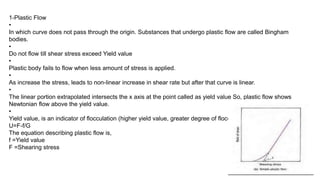
1-Plastic Flow
•
In which curve does not pass through the origin. Substances that undergo plastic flow are called Bingham
bodies.
•
Do not flow till shear stress exceed Yield value
•
Plastic body fails to flow when less amount of stress is applied.
•
As increase the stress, leads to non-linear increase in shear rate but after that curve is linear.
•
The linear portion extrapolated intersects the x axis at the point called as yield value So, plastic flow shows
Newtonian flow above the yield value.
•
Yield value, is an indicator of flocculation (higher yield value, greater degree of flocculation).
U=F-f/G
The equation describing plastic flow is,
f =Yield value
F =Shearing stress
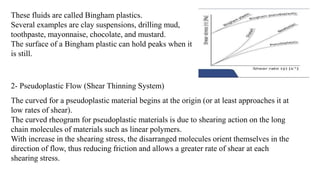
These fluids are called Bingham plastics.
Several examples are clay suspensions, drilling mud,
toothpaste, mayonnaise, chocolate, and mustard.
The surface of a Bingham plastic can hold peaks when it
is still.
2- Pseudoplastic Flow (Shear Thinning System)
The curved for a pseudoplastic material begins at the origin (or at least approaches it at
low rates of shear).
The curved rheogram for pseudoplastic materials is due to shearing action on the long
chain molecules of materials such as linear polymers.
With increase in the shearing stress, the disarranged molecules orient themselves in the
direction of flow, thus reducing friction and allows a greater rate of shear at each
shearing stress.
Some of the solvent associated will be released resulting in decreased viscosity.
This type of flow behavior is also called as shear thinning system.
On applying F/A, shearing stress molecules (water & polymer) arrange long axis in the
direction of force applied.
This stress reduces internal resistance & solvent molecules released form polymer molecules.
•Then reduce the concentration and size of molecules with decrease in viscosity.
Theshear rate increase with increase in shear stress.
As we apply much shear stress the shear rate of fluid increases; i.e. as we increase the shear
stress further, the fluid begins to deforms more easily and shows to be less viscous.
•Example:Tragacanth, Acacia, Ketchup, Cellulose like HPMC,CMCin water etc.
A large of number of pharmaceutical products including
natural and synthetic gums (eg, liquid dispersions
of tragacanth, sodium alginate, methyl cellulose, and
sodium carboxymethylcellulose) exhibit pseudoplastic
flow properties
•
Pseudoplastic substances begin flow when a shearing
stress is applied, ie, there is no yield value (it does
cross the origin).
•
Viscosity of a pseudoplastic substance decreases with
increasing shear rate.
•
With increasing shearing stress, the rate of shear
increases; these materials are called shear-thinning
systems.
3- Dilatant Flow (Shear Thickening System)
As we apply more shears, they slow down the deformation rate.
Viscosity increases with increasing shear rate.
We can't further deform these fluids easily.
Example: Starch is shear thickening fluid which tends to deform less or increase in viscosity as we increase the
shear stress.
Particles are closely packed with less void's spaces, also amount of vehicle is sufficient to fill the void volume.
This leads particles to move relative to one another at low rate of shear.
Volume Increased when sheared.
Dilatant materials increase in volume when sheared.
They are also known as shear-thickening systems (opposite of
pseudoplastic systems).
When the stress is removed, the dilatant system returns to its
original state of fluidity.
Dilatant materials may solidify under conditions of high shear
viscoelasticity unit.pptx

viscoelasticity unit.pptx

  • 1.
    Rheology being definedas the study of the flow and deformation of matter under stress which describes the interrelation between force, deformation and time The term rheology originates from the Greek words 'rheo' translating as ‘to flow' and 'logia’ meaning 'the study of', although as from the definition above, rheology is as much about the deformation of solid-like materials as it is about the flow of liquid-like materials and in particular deals with the behavior of complex viscoelastic materials that show properties of both solids and liquids in response to force, deformation and time. The term rheology was coined by Eugene C. Bingham, a professor at LafayetteCollege, in 1920.
  • 2.
    Shear Stress: Theforce per unit area F/A required to bring about flow is called SHEAR STRESS. Since the units of force are Newton and the units of area are m² it follows that the units of Shear Stress are N/m² Rate of Shear:Rate of Shear is the change of velocity when a fluid passesover adjacent layers.It is a simple test to check the viscometry of fluids.If the viscosity increases, the Rate of Shear decreasesIf the viscosity decreases, the Rate of Shear increasesMoreover, when shear rate is multiplied with the viscosity it gives the valueof shear stress. The units of Rate of Shear are denoted by the inverse of sec-onds. Importance & Fundamentals of Rheology Formulations of cream, ointments, solution, paste & lotions.•Formulations of emulsion, suspension, tablet coating etc.•In mixing of flow of materials, their packaging into containers.•Extrusion of paste from tube.•Pouring of liquid from bottle.•Can affect patient's acceptability, absorption rate of drug in GIT.
  • 3.
    Manufacturing of DosageForm: Materials undergo process like mixing, flowingthrough pipes, filling into containers etc. Flow related changes, influence the selectionof equipment.•Drug Handling for Administration: The pouring of liquid into container, extrusion ofointment from tubes, all depends on changes in the flow behaviors of dosage form. NEWTON'S LAW •Higher the viscosity of a liquid, the greater is the force per unit area i.e.shearing stress (F) required to produce a certain rate of shear(G). shearing stress(F) α rate of shear (G) F α G F=ῃG Where, F=F’/A G=dv/dr ῃ=viscosity
  • 4.
    Types of Flow 1-Newtonian Fluid: Newton was the first to study the flow properties of liquids in quantitative terms. • Newtonian fluids are named after Sir Issac Newton (1642-1726) who described the flow behavior of fluids with a simple linear relation between shear stress and shear rate. This relationship is now known as Newton's Law of Viscosity, where the proportionality constant η. Liquids that obey Newton's law of flow are called as Newtonian fluids. • A Newtonian fluid is a fluid whose stress versus rate of shear curve is linear and passes through the origin. • The constant of proportionality is known as the viscosity. Examples are Water, Chloroform, Castor oil, Ethyl Alcohol etc. • The higher the viscosity of a liquid, the greater is the force per unit area (shearing stress) required to produce a certain rate of shear.
  • 5.
    • In common terms,this means the fluid continues to flow, regardless of the forces acting on it. For example, water is Newtonian, because it continues to exemplify fluid properties no matter how fast it is stirred or mixed. • The constant of proportionality being the coefficient of viscosity. For a Newtonian fluid, the viscosity, by definition, depends only on temperature and pressure (and also the chemical composition of the fluid if the fluid is not a pure substance), not on the forces acting upon it. Shearing Stress(F) α Rate of Shear(G) F=ῃG
  • 6.
    2- Non-Newtonian Fluid: • Non-Newtonianbodies are those substances, which fail to follow Newton's law i.e. liquid & solid, heterogeneous dispersions such as colloidal solutions, emulsions, liquid suspensions and ointments. A non-Newtonian fluid is a fluid whose flow properties are not described by a single constant value of viscosity. Many polymer solutions and molten polymers are non- Newtonian fluids, as are many commonly found substances such as ketchup, starch suspensions, paint, blood and shampoo. • Non-Newtonian flow can also be defined as one for which the relation between Shearing Stress(F) & Rate of Shear(G) is not linear. • In other words when the shear rate is varied, the shear stress is not varied in the same proportion. • Examples are, many polymer solutions, ketchup, starch suspensions, paint,
  • 7.
    1-Plastic Flow • In whichcurve does not pass through the origin. Substances that undergo plastic flow are called Bingham bodies. • Do not flow till shear stress exceed Yield value • Plastic body fails to flow when less amount of stress is applied. • As increase the stress, leads to non-linear increase in shear rate but after that curve is linear. • The linear portion extrapolated intersects the x axis at the point called as yield value So, plastic flow shows Newtonian flow above the yield value. • Yield value, is an indicator of flocculation (higher yield value, greater degree of flocculation). U=F-f/G The equation describing plastic flow is, f =Yield value F =Shearing stress
  • 8.
    These fluids arecalled Bingham plastics. Several examples are clay suspensions, drilling mud, toothpaste, mayonnaise, chocolate, and mustard. The surface of a Bingham plastic can hold peaks when it is still. 2- Pseudoplastic Flow (Shear Thinning System) The curved for a pseudoplastic material begins at the origin (or at least approaches it at low rates of shear). The curved rheogram for pseudoplastic materials is due to shearing action on the long chain molecules of materials such as linear polymers. With increase in the shearing stress, the disarranged molecules orient themselves in the direction of flow, thus reducing friction and allows a greater rate of shear at each shearing stress.
  • 9.
    Some of thesolvent associated will be released resulting in decreased viscosity. This type of flow behavior is also called as shear thinning system. On applying F/A, shearing stress molecules (water & polymer) arrange long axis in the direction of force applied. This stress reduces internal resistance & solvent molecules released form polymer molecules. •Then reduce the concentration and size of molecules with decrease in viscosity. Theshear rate increase with increase in shear stress. As we apply much shear stress the shear rate of fluid increases; i.e. as we increase the shear stress further, the fluid begins to deforms more easily and shows to be less viscous. •Example:Tragacanth, Acacia, Ketchup, Cellulose like HPMC,CMCin water etc.
  • 10.
    A large ofnumber of pharmaceutical products including natural and synthetic gums (eg, liquid dispersions of tragacanth, sodium alginate, methyl cellulose, and sodium carboxymethylcellulose) exhibit pseudoplastic flow properties • Pseudoplastic substances begin flow when a shearing stress is applied, ie, there is no yield value (it does cross the origin). • Viscosity of a pseudoplastic substance decreases with increasing shear rate. • With increasing shearing stress, the rate of shear increases; these materials are called shear-thinning systems.
  • 12.
    3- Dilatant Flow(Shear Thickening System) As we apply more shears, they slow down the deformation rate. Viscosity increases with increasing shear rate. We can't further deform these fluids easily. Example: Starch is shear thickening fluid which tends to deform less or increase in viscosity as we increase the shear stress. Particles are closely packed with less void's spaces, also amount of vehicle is sufficient to fill the void volume. This leads particles to move relative to one another at low rate of shear. Volume Increased when sheared. Dilatant materials increase in volume when sheared. They are also known as shear-thickening systems (opposite of pseudoplastic systems). When the stress is removed, the dilatant system returns to its original state of fluidity. Dilatant materials may solidify under conditions of high shear