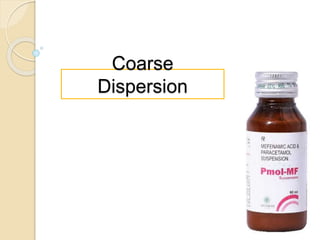
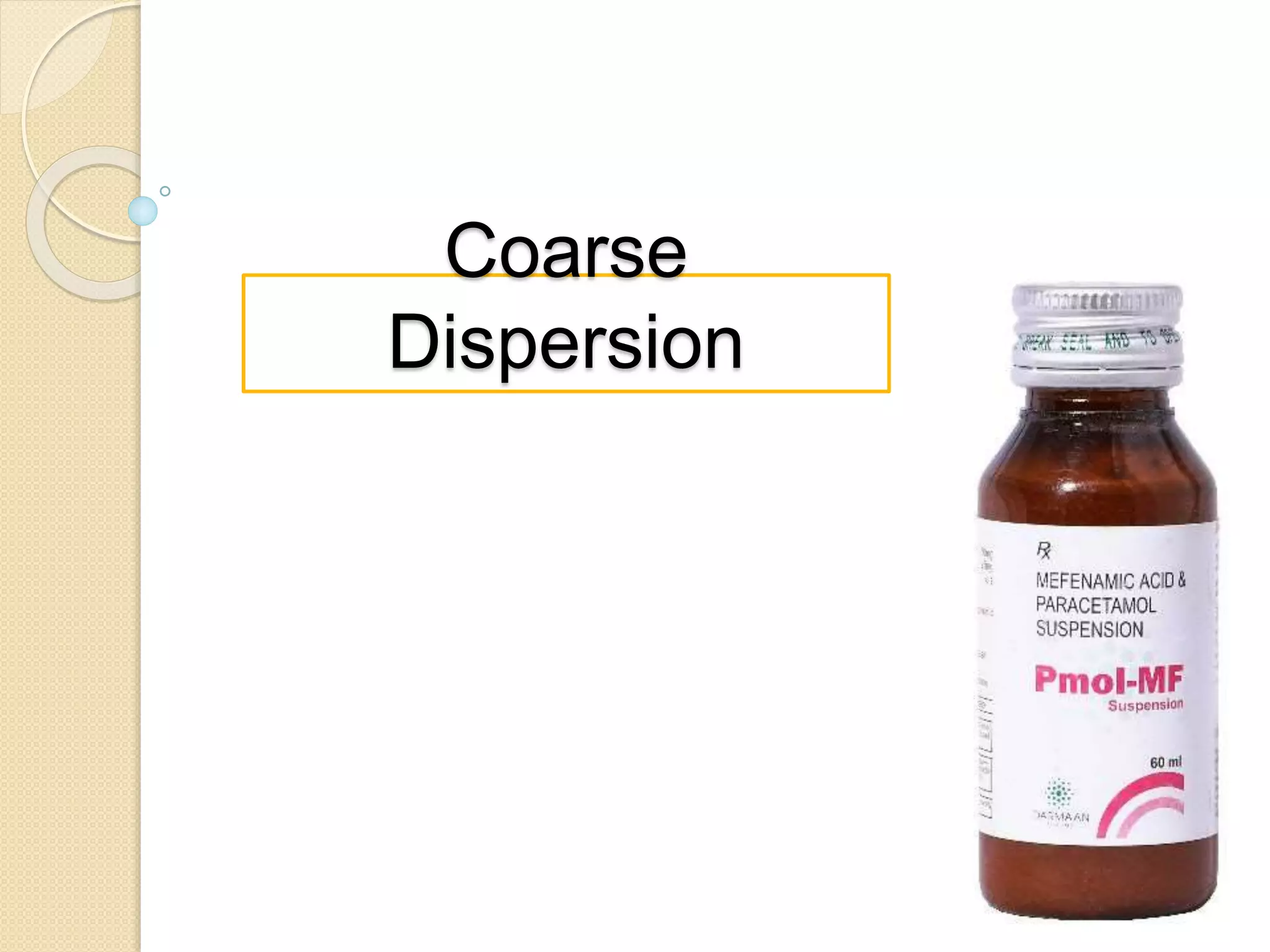
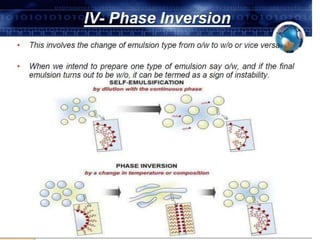
Coarse
Dispersion
What mean by coarse?
 Coarse dispersions are heterogeneous
dispersed systems, in which the dispersed
phase particles are larger than 1000 nm.
Coarse dispersions are characterized by
relatively fast sedimentation of the dispersed
phase caused by gravity or other forces.
Dispersed phase of coarse dispersions may
be easily separated from the continuous
phase by filtration.
Dispersed
system
• The term "Disperse S ys t e m " refers
to a system in which one substance
(The Dispersed Phase) is
distributed throughout a second
substance (the continuous P h a s e ).
• Suspensions are heterogenous
system consisting of 2 phases.
Suspension
 A Pharmaceutical suspension is a coarse dispersion in
which internal phase (therapeutically active
ingredient)is dispersed uniformly throughout the external
phase.
 The internal p h a s e consisting of insoluble solid
particles having a range of size 0.5 t o 5 mic ro n s
which is maintained uniformly through out the
suspending vehicle with aid of s i n g l e o r
c o m b i n a t i o n o f s u s p e n d i n g a g e n t .

 The external phase ( s u s p e n d i n g m e d i u m ) is
generally aqueous in some instance, m a y be an
organic or oily liquid for non oraluse.
DLVO Theory
 DLVO stands for Derjaguin, Landau, Verway and
Overbeek.
 According to this theory the distance between two
dispersed particles mainly influence the particle -
particle interaction.
DLVO Theory
 Consider two colloidal particles.
 There will exist two types of interaction in these particles as force of
attraction and force of repulsion.
 When repulsion predominates the particles will not aggregate.
 But when attractive forces are more the particles will form aggregate.
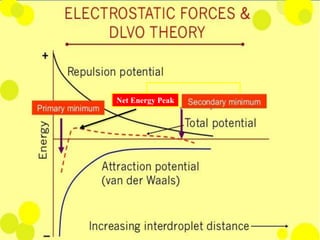
 DLVO theory mainly gives relationship between potential energy
versus interparticulate distance.
DLVO Theory
Net Energy Peak
DLVO Theory
The interaction between particles is described below
 1) Forces of attraction: If potential energy between the
particles is low then there exists a attractive forces in
between particles. These forces are mainly Vander Wall
type forces.
 2) Forces of repulsion: If there exists any potential
energy in between the particles then particles will repel
each other. This potential energy is present due to
charges present on colloidal particles and electrical
double layer.
 Net Energy of Interaction: If we combine these two forces i.e. attractive and
repulsive forces then we get net energy of interaction denoted by dotted line.
 Primary Minimum (sign of precipitation): When we bring particles very
close to each other, there orbitals overlap and penetrate with each other due to
which there is presence of strong attractive force and particles will form
precipitation.
 Secondary minimum (sign of precipitation): This is observed when particles
are separated by long distance and there is presence of electrolytes. These
electrolyte will settle in between the particles and form floccules due to which
particles will be attracted to each other though distance in between them is
more. At this point potential energy will be minimum because particles are far
from each other.
DLVO Theory
 Net Energy peak (Sign of Better stability): At intermediate
distance a good amount of repulsive forces exists because of zeta
potential present on colloidal particles. This potential barrier keeps
the particles in Brownian motion and gives stability to dispersion.
At this point there exists a maximum potential energy in between
colloidal particles.
DEFINITION
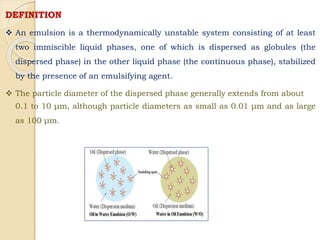
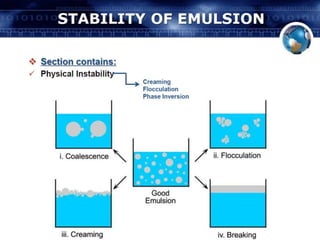
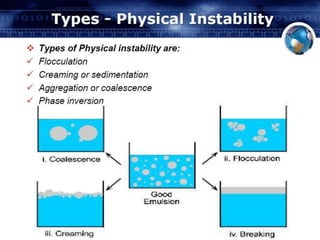
 An emulsion is a thermodynamically unstable system consisting of at least
two immiscible liquid phases, one of which is dispersed as globules (the
dispersed phase) in the other liquid phase (the continuous phase), stabilized
by the presence of an emulsifying agent.
 The particle diameter of the dispersed phase generally extends from about
0.1 to 10 μm, although particle diameters as small as 0.01 μm and as large
as 100 μm.
Microemulsion
Theories of Emulsions
 Monomolecular Adsorption theory
 Oriented-Wedge Theory
 Oriented adsorption theory
 Plastic or Interfacial film theory
 Surface tension theory
 Interfacial tension theory
 Fischer’s theory of hydrates and solvates
 Viscosity theory
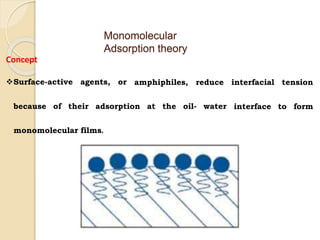
Monomolecular
Adsorption theory
Concept
Surface-active agents, or
oil- water
amphiphiles, reduce interfacial tension
interface to form
because of their adsorption at the
monomolecular films.
Explanation
 In practice, combinations of emulsifiers rather than single agents are
used most frequently today in the preparations of emulsions.
Hydrophilic emulsifier in the aqueous phase and a hydrophobic agent
in the oil phase to form a complex film at the interface.
Example
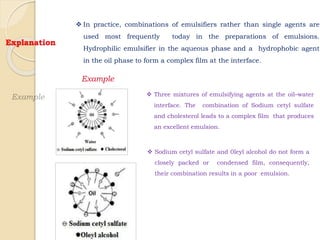
 Three mixtures of emulsifying agents at the oil–water
interface. The combination of Sodium cetyl sulfate
and cholesterol leads to a complex film that produces
an excellent emulsion.
 Sodium cetyl sulfate and 0leyl alcohol do not form a
closely packed or condensed film, consequently,
their combination results in a poor emulsion.
Oriented-Wedge
Theory
Concept
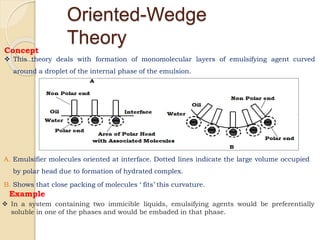
 This theory deals with formation of monomolecular layers of emulsifying agent curved
around a droplet of the internal phase of the emulsion.
A. Emulsifier molecules oriented at interface. Dotted lines indicate the large volume occupied
by polar head due to formation of hydrated complex.
B. Shows that close packing of molecules ‘ fits’ this curvature.
Example
 In a system containing two immicible liquids, emulsifying agents would be preferentially
soluble in one of the phases and would be embaded in that phase.
As per this theory, the added emulsifying agent forms a mechanical
film by getting adsorption at the interface of the liquid and offers
stability to emulsion.
 However,this theory could not explain the formation of type of
emulsion.
Oriented adsorbtion
theory
Interfacial film theory
 Interfacial film theory places the emulsifying agent at the
interface between the oil and water, surrounding the droplets of the internal
phase as a thin layer of film adsorbed on the surface of the drops.
 The formation of an o/w or a w/o emulsion depends on the degree of
solubility of the agent in the two phases, with water-soluble agents
encouraging o/w emulsions and oil-soluble emulsifier the reverse.
Surface tension
theory
 According to the surface tension theory of emulsification, the emulsifying agents cause a
reduction in the interfacial tension of the two immiscible liquids, reducing the repellent
force between the liquids and withdrawing the attraction of liquids for their own
molecules. In this way, the surfactants convert large globules into small ones and avoid
small globules from coalescing into large ones.
 In this way, the surfactants convert large globules into small ones and avoid small globules
from coalescing into large ones.
Interfacial tension
theory
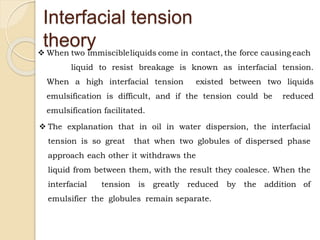
 When two immiscibleliquids come in contact, the force causing each
liquid to resist breakage is known as interfacial tension.
When a high interfacial tension existed between two liquids
emulsification is difficult, and if the tension could be reduced
emulsification facilitated.
 The explanation that in oil in water dispersion, the interfacial
tension is so great that when two globules of dispersed phase
approach each other it withdraws the
liquid from between them, with the result they coalesce. When the
interfacial tension is greatly reduced by the addition of
emulsifier the globules remain separate.
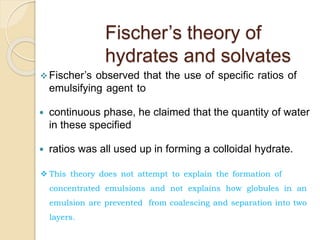
 Fischer’s observed that the use of specific ratios of
emulsifying agent to
 continuous phase, he claimed that the quantity of water
in these specified
 ratios was all used up in forming a colloidal hydrate.
Fischer’s theory of
hydrates and solvates
 This theory does not attempt to explain the formation of
concentrated emulsions and not explains how globules in an
emulsion are prevented from coalescing and separation into two
layers.
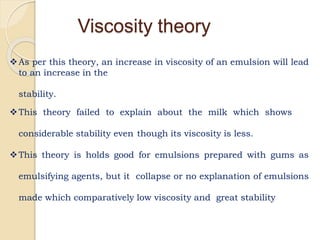
Viscosity theory
As per this theory, an increase in viscosity of an emulsion will lead
to an increase in the
stability.
This theory failed to explain about the milk which shows
considerable stability even though its viscosity is less.
This theory is holds good for emulsions prepared with gums as
emulsifying agents, but it collapse or no explanation of emulsions
made which comparatively low viscosity and great stability
Preservation of emulsion
 Microbial contamination may occur due to:
 contamination during development or
production of emulsion or during its use.
 Usage of impure raw materials
 Poor sanitation conditions
 Invasion by an opportunistic microorganisms.
 Contamination by the consumer during use of
the product.
Precautions to prevent microbial growth ;
 Use of uncontaminated raw materials
 Careful cleaning of equipment with steam .
The preservative must be :
 Less toxic .
 Stable to heat and storage
 Chemically compatible
 Reasonable cost
 Acceptable taste, odor and color.
 Effective against fungus, yeast, bacteria.
 Available in oil and aqueous phase at
effective level concentration.
 Preservative should be in unionized state to
penetrate the bacteria.
 Preservative must no bind to other
components of the emulsion
Examples of antimicrobial preservatives
used to preserve emulsified systems
include
 parahydroxybenzoate esters such as
methyl, propyl and butyl parabens,
 organic acids such as ascorbic acid and
benzoic acid,
 organic mercurials such as
phenylmercuric acetate and
phenylmercuric nitrate,
 quaternary ammonium compounds such
as cetrimide,
 cresol derivatives such as chlorocresol
 and miscellaneous agents such as
sodium benzoate, chloroform and
phenoxyethano
Antioxidant must be….
 Nontoxic, nonirritant,
 effective at low concentration under
the expected conditions of storage
and use,
 soluble in the medium and stable.
 Antioxidants for use in oral preparation
should also be odorless and tasteless.
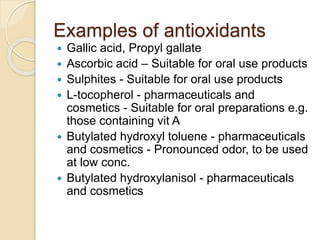
Examples of antioxidants
 Gallic acid, Propyl gallate
 Ascorbic acid – Suitable for oral use products
 Sulphites - Suitable for oral use products
 L-tocopherol - pharmaceuticals and
cosmetics - Suitable for oral preparations e.g.
those containing vit A
 Butylated hydroxyl toluene - pharmaceuticals
and cosmetics - Pronounced odor, to be used
at low conc.
 Butylated hydroxylanisol - pharmaceuticals
and cosmetics
Rheological Properties
suspension
 Suspensions & emulsions falls under the category of
coarse dispersion systems.
 In suspensions & emulsions, the flow properties have
major influence in the manufacture, during storage &
administration of drugs.
 The flow properties such as pseudo plastic & thixotropy
are important for physical stability of suspensions.
 For emulsions flow type may vary according to their
concentration.
RHEOLOGICAL PROPERTIES OF SUSPENSIONS
 During storage, the suspensions exhibit gel like
structure & lowers the rate of settling.
 On moderate shaking, the product assumes sol-like
behaviour, which permit pouring of the product from
the bottle.
 The sol like behaviour also helps in uniform spreading
of dermatological preparations.
 Therefore, in order to maintain these properties the
flow properties should be studied.
 Dispersion medium is largely responsible for
determining the rheology of the suspensions.
 The preformulation studies include evaluation of
vehicles used in the suspension. An optimum viscosity
of this medium should be selected through
experimentation.
 Rheological evaluation is used as a quality control
parameter for comparing products.
 The consistency of suspensions are evaluated
using cup & bob or cone & plate viscometers.
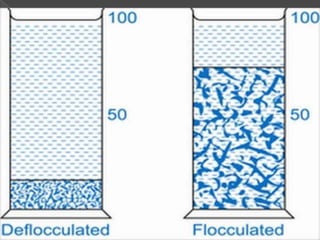
 These are not applicable for flocculated
suspensions because the structure of the flocs are
destroyed during the analysis.
RHEOLOGICAL PROPERTIES OF EMULSIONS
 The following flow related attributes are desirable
for the overall performance of an emulsion
 Removal of an emulsion from a bottle or tube
 Flow of an emulsion through a hypodermic needle
 Spreadability of an emulsion on the skin
 Stress induced flow changes during manufacture
 The rheology of emulsions has many similar features to that
of suspensions. However, they differ in three main aspects
 The liquid/liquid interface that contains surfactant or polymer
layers introduces a response to deformation & one has to
consider the interfacial rheology
 The dispersed phase viscosity relative to that of the medium
has an effect on the rheology of the emulsion
 The deformable nature of the dispersed phase droplets,
particularly for large droplets, has an effect on the emulsion
rheology
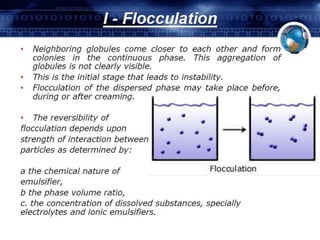
 In general, dilute emulsions exhibit “Newtonian
flow”.
 As the viscosity of the emulsion increases,
flocculation of globules will be reduced because
the mobility of globules is restricted, leads to
creaming.
 Concentrated emulsions exhibit “non-Newtonian
flow”. Multipoint viscometers are used for
viscosity analysis.
Coarse dispersion
Coarse dispersion
Coarse dispersion
Coarse dispersion
Coarse dispersion
Coarse dispersion
Coarse dispersion
Coarse dispersion
Coarse dispersion

Coarse dispersion

  • 1.
  • 2.
    What mean bycoarse?  Coarse dispersions are heterogeneous dispersed systems, in which the dispersed phase particles are larger than 1000 nm. Coarse dispersions are characterized by relatively fast sedimentation of the dispersed phase caused by gravity or other forces. Dispersed phase of coarse dispersions may be easily separated from the continuous phase by filtration.
  • 3.
    Dispersed system • The term"Disperse S ys t e m " refers to a system in which one substance (The Dispersed Phase) is distributed throughout a second substance (the continuous P h a s e ). • Suspensions are heterogenous system consisting of 2 phases.
  • 4.
    Suspension  A Pharmaceuticalsuspension is a coarse dispersion in which internal phase (therapeutically active ingredient)is dispersed uniformly throughout the external phase.  The internal p h a s e consisting of insoluble solid particles having a range of size 0.5 t o 5 mic ro n s which is maintained uniformly through out the suspending vehicle with aid of s i n g l e o r c o m b i n a t i o n o f s u s p e n d i n g a g e n t .  The external phase ( s u s p e n d i n g m e d i u m ) is generally aqueous in some instance, m a y be an organic or oily liquid for non oraluse.
  • 8.
    DLVO Theory  DLVOstands for Derjaguin, Landau, Verway and Overbeek.  According to this theory the distance between two dispersed particles mainly influence the particle - particle interaction.
  • 9.
    DLVO Theory  Considertwo colloidal particles.  There will exist two types of interaction in these particles as force of attraction and force of repulsion.  When repulsion predominates the particles will not aggregate.  But when attractive forces are more the particles will form aggregate.  DLVO theory mainly gives relationship between potential energy versus interparticulate distance.
  • 10.
  • 11.
    DLVO Theory The interactionbetween particles is described below  1) Forces of attraction: If potential energy between the particles is low then there exists a attractive forces in between particles. These forces are mainly Vander Wall type forces.  2) Forces of repulsion: If there exists any potential energy in between the particles then particles will repel each other. This potential energy is present due to charges present on colloidal particles and electrical double layer.
  • 12.
     Net Energyof Interaction: If we combine these two forces i.e. attractive and repulsive forces then we get net energy of interaction denoted by dotted line.  Primary Minimum (sign of precipitation): When we bring particles very close to each other, there orbitals overlap and penetrate with each other due to which there is presence of strong attractive force and particles will form precipitation.  Secondary minimum (sign of precipitation): This is observed when particles are separated by long distance and there is presence of electrolytes. These electrolyte will settle in between the particles and form floccules due to which particles will be attracted to each other though distance in between them is more. At this point potential energy will be minimum because particles are far from each other.
  • 13.
    DLVO Theory  NetEnergy peak (Sign of Better stability): At intermediate distance a good amount of repulsive forces exists because of zeta potential present on colloidal particles. This potential barrier keeps the particles in Brownian motion and gives stability to dispersion. At this point there exists a maximum potential energy in between colloidal particles.
  • 26.
    DEFINITION  An emulsionis a thermodynamically unstable system consisting of at least two immiscible liquid phases, one of which is dispersed as globules (the dispersed phase) in the other liquid phase (the continuous phase), stabilized by the presence of an emulsifying agent.  The particle diameter of the dispersed phase generally extends from about 0.1 to 10 μm, although particle diameters as small as 0.01 μm and as large as 100 μm.
  • 39.
  • 53.
    Theories of Emulsions Monomolecular Adsorption theory  Oriented-Wedge Theory  Oriented adsorption theory  Plastic or Interfacial film theory  Surface tension theory  Interfacial tension theory  Fischer’s theory of hydrates and solvates  Viscosity theory
  • 54.
    Monomolecular Adsorption theory Concept Surface-active agents,or oil- water amphiphiles, reduce interfacial tension interface to form because of their adsorption at the monomolecular films.
  • 55.
    Explanation  In practice,combinations of emulsifiers rather than single agents are used most frequently today in the preparations of emulsions. Hydrophilic emulsifier in the aqueous phase and a hydrophobic agent in the oil phase to form a complex film at the interface. Example  Three mixtures of emulsifying agents at the oil–water interface. The combination of Sodium cetyl sulfate and cholesterol leads to a complex film that produces an excellent emulsion.  Sodium cetyl sulfate and 0leyl alcohol do not form a closely packed or condensed film, consequently, their combination results in a poor emulsion.
  • 56.
    Oriented-Wedge Theory Concept  This theorydeals with formation of monomolecular layers of emulsifying agent curved around a droplet of the internal phase of the emulsion. A. Emulsifier molecules oriented at interface. Dotted lines indicate the large volume occupied by polar head due to formation of hydrated complex. B. Shows that close packing of molecules ‘ fits’ this curvature. Example  In a system containing two immicible liquids, emulsifying agents would be preferentially soluble in one of the phases and would be embaded in that phase.
  • 57.
    As per thistheory, the added emulsifying agent forms a mechanical film by getting adsorption at the interface of the liquid and offers stability to emulsion.  However,this theory could not explain the formation of type of emulsion. Oriented adsorbtion theory
  • 58.
    Interfacial film theory Interfacial film theory places the emulsifying agent at the interface between the oil and water, surrounding the droplets of the internal phase as a thin layer of film adsorbed on the surface of the drops.  The formation of an o/w or a w/o emulsion depends on the degree of solubility of the agent in the two phases, with water-soluble agents encouraging o/w emulsions and oil-soluble emulsifier the reverse.
  • 59.
    Surface tension theory  Accordingto the surface tension theory of emulsification, the emulsifying agents cause a reduction in the interfacial tension of the two immiscible liquids, reducing the repellent force between the liquids and withdrawing the attraction of liquids for their own molecules. In this way, the surfactants convert large globules into small ones and avoid small globules from coalescing into large ones.  In this way, the surfactants convert large globules into small ones and avoid small globules from coalescing into large ones.
  • 60.
    Interfacial tension theory  Whentwo immiscibleliquids come in contact, the force causing each liquid to resist breakage is known as interfacial tension. When a high interfacial tension existed between two liquids emulsification is difficult, and if the tension could be reduced emulsification facilitated.  The explanation that in oil in water dispersion, the interfacial tension is so great that when two globules of dispersed phase approach each other it withdraws the liquid from between them, with the result they coalesce. When the interfacial tension is greatly reduced by the addition of emulsifier the globules remain separate.
  • 61.
     Fischer’s observedthat the use of specific ratios of emulsifying agent to  continuous phase, he claimed that the quantity of water in these specified  ratios was all used up in forming a colloidal hydrate. Fischer’s theory of hydrates and solvates  This theory does not attempt to explain the formation of concentrated emulsions and not explains how globules in an emulsion are prevented from coalescing and separation into two layers.
  • 62.
    Viscosity theory As perthis theory, an increase in viscosity of an emulsion will lead to an increase in the stability. This theory failed to explain about the milk which shows considerable stability even though its viscosity is less. This theory is holds good for emulsions prepared with gums as emulsifying agents, but it collapse or no explanation of emulsions made which comparatively low viscosity and great stability
  • 63.
    Preservation of emulsion Microbial contamination may occur due to:  contamination during development or production of emulsion or during its use.  Usage of impure raw materials  Poor sanitation conditions  Invasion by an opportunistic microorganisms.  Contamination by the consumer during use of the product. Precautions to prevent microbial growth ;  Use of uncontaminated raw materials  Careful cleaning of equipment with steam .
  • 64.
    The preservative mustbe :  Less toxic .  Stable to heat and storage  Chemically compatible  Reasonable cost  Acceptable taste, odor and color.  Effective against fungus, yeast, bacteria.  Available in oil and aqueous phase at effective level concentration.  Preservative should be in unionized state to penetrate the bacteria.  Preservative must no bind to other components of the emulsion
  • 65.
    Examples of antimicrobialpreservatives used to preserve emulsified systems include  parahydroxybenzoate esters such as methyl, propyl and butyl parabens,  organic acids such as ascorbic acid and benzoic acid,  organic mercurials such as phenylmercuric acetate and phenylmercuric nitrate,  quaternary ammonium compounds such as cetrimide,  cresol derivatives such as chlorocresol  and miscellaneous agents such as sodium benzoate, chloroform and phenoxyethano
  • 66.
    Antioxidant must be…. Nontoxic, nonirritant,  effective at low concentration under the expected conditions of storage and use,  soluble in the medium and stable.  Antioxidants for use in oral preparation should also be odorless and tasteless.
  • 67.
    Examples of antioxidants Gallic acid, Propyl gallate  Ascorbic acid – Suitable for oral use products  Sulphites - Suitable for oral use products  L-tocopherol - pharmaceuticals and cosmetics - Suitable for oral preparations e.g. those containing vit A  Butylated hydroxyl toluene - pharmaceuticals and cosmetics - Pronounced odor, to be used at low conc.  Butylated hydroxylanisol - pharmaceuticals and cosmetics
  • 68.
    Rheological Properties suspension  Suspensions& emulsions falls under the category of coarse dispersion systems.  In suspensions & emulsions, the flow properties have major influence in the manufacture, during storage & administration of drugs.  The flow properties such as pseudo plastic & thixotropy are important for physical stability of suspensions.  For emulsions flow type may vary according to their concentration.
  • 69.
    RHEOLOGICAL PROPERTIES OFSUSPENSIONS  During storage, the suspensions exhibit gel like structure & lowers the rate of settling.  On moderate shaking, the product assumes sol-like behaviour, which permit pouring of the product from the bottle.  The sol like behaviour also helps in uniform spreading of dermatological preparations.  Therefore, in order to maintain these properties the flow properties should be studied.  Dispersion medium is largely responsible for determining the rheology of the suspensions.  The preformulation studies include evaluation of vehicles used in the suspension. An optimum viscosity of this medium should be selected through experimentation.
  • 70.
     Rheological evaluationis used as a quality control parameter for comparing products.  The consistency of suspensions are evaluated using cup & bob or cone & plate viscometers.  These are not applicable for flocculated suspensions because the structure of the flocs are destroyed during the analysis.
  • 71.
    RHEOLOGICAL PROPERTIES OFEMULSIONS  The following flow related attributes are desirable for the overall performance of an emulsion  Removal of an emulsion from a bottle or tube  Flow of an emulsion through a hypodermic needle  Spreadability of an emulsion on the skin  Stress induced flow changes during manufacture
  • 72.
     The rheologyof emulsions has many similar features to that of suspensions. However, they differ in three main aspects  The liquid/liquid interface that contains surfactant or polymer layers introduces a response to deformation & one has to consider the interfacial rheology  The dispersed phase viscosity relative to that of the medium has an effect on the rheology of the emulsion  The deformable nature of the dispersed phase droplets, particularly for large droplets, has an effect on the emulsion rheology
  • 73.
     In general,dilute emulsions exhibit “Newtonian flow”.  As the viscosity of the emulsion increases, flocculation of globules will be reduced because the mobility of globules is restricted, leads to creaming.  Concentrated emulsions exhibit “non-Newtonian flow”. Multipoint viscometers are used for viscosity analysis.