RHEOLOGY
Part – 1
www.medacademy.org.in
• The term ‘rheology' was derived from the Greek words rheo (flow) and logos (science) and is used to describe
the flow of liquids and the deformation of solids.
• Rheology is the science concerned with the deformation of matter under the influence of stress.
• Viscosity is an expression of the resistance of a fluid to flow: the higher the viscosity, the greater the
resistance.
• The stresses may be,
• Tensile stress, shearing stress, and stress are applied at any other angle to the surface of a body.
• The deformation is of two types: elastic deformation & plastic deformation.
2
www.medacademy.org.in
VISCOSITY & RHEOLOGY
• i. Manufacturing of dosage forms:
• Materials undergo process such as mixing, flowing through pipes, filling into the containers etc.
Flow related changes influence the selection of mixing equipment.
• ii. Handling of drugs for administration:
• The syringibility of the medicines, the pouring of the liquids from containers, extrusion of ointment
from tubes, all depend on the changes in flow behavior of dosage forms.
3
www.medacademy.org.in
FUNDAMENTALS OF RHEOLOGY
• Rheology is involved in • the mixing and flow of materials, • their packaging into containers, and •
their removal prior to use, whether this is achieved by pouring from a bottle, extrusion from a tube,
or passage through a syringe needle.
4
www.medacademy.org.in
TYPES OF RHEOLOGY
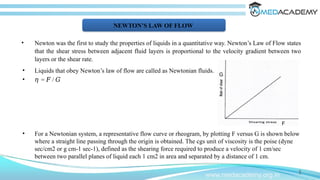
• Newton was the first to study the properties of liquids in a quantitative way. Newton’s Law of Flow states
that the shear stress between adjacent fluid layers is proportional to the velocity gradient between two
layers or the shear rate.
• Liquids that obey Newton’s law of flow are called as Newtonian fluids.
• 𝜂 = /
𝐹 𝐺
• For a Newtonian system, a representative flow curve or rheogram, by plotting F versus G is shown below
where a straight line passing through the origin is obtained. The cgs unit of viscosity is the poise (dyne
sec/cm2 or g cm-1 sec-1), defined as the shearing force required to produce a velocity of 1 cm/sec
between two parallel planes of liquid each 1 cm2 in area and separated by a distance of 1 cm.
5
www.medacademy.org.in
NEWTON’S LAW OF FLOW
• Fluidity, is defined as the reciprocal of viscosity: =1/η
ϕ 𝜙
• Kinematic viscosity is the absolute viscosity η divided by the density of the liquid.
• The units are Stoke and centistoke.
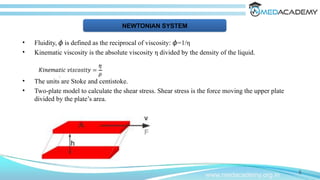
• Two-plate model to calculate the shear stress. Shear stress is the force moving the upper plate
divided by the plate’s area.
6
www.medacademy.org.in
NEWTONIAN SYSTEM
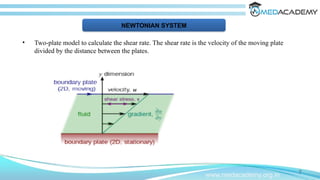
• Two-plate model to calculate the shear rate. The shear rate is the velocity of the moving plate
divided by the distance between the plates.
7
www.medacademy.org.in
NEWTONIAN SYSTEM
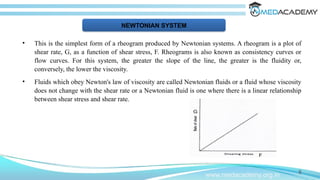
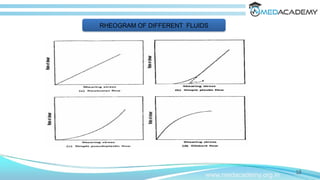
• This is the simplest form of a rheogram produced by Newtonian systems. A rheogram is a plot of
shear rate, G, as a function of shear stress, F. Rheograms is also known as consistency curves or
flow curves. For this system, the greater the slope of the line, the greater is the fluidity or,
conversely, the lower the viscosity.
• Fluids which obey Newton's law of viscosity are called Newtonian fluids or a fluid whose viscosity
does not change with the shear rate or a Newtonian fluid is one where there is a linear relationship
between shear stress and shear rate.
8
www.medacademy.org.in
NEWTONIAN SYSTEM
• Non-Newtonian Systems
The majority of fluid pharmaceutical products do not follow Newton's law of flow. These
systems are referred to as non-Newtonian. Non-Newtonian behaviour is generally exhibited by liquid
and solid heterogeneous dispersions such as colloidal solutions, emulsions, liquid suspensions, and
ointments.
Non-Newtonian Flow
• (a) Plastic
• (b) Pseudoplastic
• (c) Dilatant
9
www.medacademy.org.in
NON-NEWTONIAN SYSTEMS
• The materials that exhibit plastic flow, such materials are known as Bingham bodies. Plastic flow
curves do not pass through the origin but rather intersect the shearing stress axis (or will if the
straight part of the curve is extrapolated to the axis) at a particular point referred to as the yield
value. A Bingham body does not begin to flow until a shearing stress corresponding to the yield
value is exceeded. At stresses below the yield value, the substance acts as an elastic material. The
slope of the rheogram is termed the mobility, analogous to fluidity in Newtonian systems, and its
reciprocal is known as the plastic viscosity, U.
• The equation describing plastic flow is
• where f is the yield value, or intercept on the shear stress axis in dynes/cm2
.
• Plastic flow is associated with the presence of flocculated particles in concentrated suspensions. As
a result, a continuous structure is set up throughout the system. A yield value exists because of the
contacts between adjacent particles (brought about by van der Waals forces), which must be broken
down before flow can occur.
10
www.medacademy.org.in
PLASTIC FLOW
In practice, deformation and flow usually occurs at a lower shear
stress value and this accounts for the curved portion of the curve.
• The viscosity decreases initially and then remains constant.
• In a highly flocculated system, there is interaction between flocs
which results in a structured system and plastic flow is associated with these systems e.g highly
flocculated suspensions.
• The yield value is present because of the contacts between adjacent particles (caused by van der Waals
forces which may be capable of withstanding weak stresses) which must be broken down before flow
can occur.
• Consequently, the yield value is an indication of the degree of flocculation; the more flocculated the
suspension, the higher will be the yield value.
• This type of behaviour is also exhibited by creams and ointments.
11
www.medacademy.org.in
PLASTIC FLOW
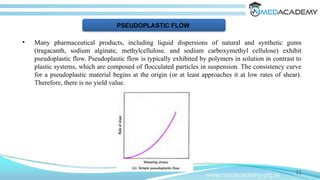
• Many pharmaceutical products, including liquid dispersions of natural and synthetic gums
(tragacanth, sodium alginate, methylcellulose. and sodium carboxymethyl cellulose) exhibit
pseudoplastic flow. Pseudoplastic flow is typically exhibited by polymers in solution in contrast to
plastic systems, which are composed of flocculated particles in suspension. The consistency curve
for a pseudoplastic material begins at the origin (or at least approaches it at low rates of shear).
Therefore, there is no yield value.
12
www.medacademy.org.in
PSEUDOPLASTIC FLOW
• Furthermore, because no part of the curve is linear, the viscosity of a pseudoplastic material cannot
be expressed by any single value. The viscosity of a pseudoplastic substance decreases with an
increasing rate of shear and this system is known as the shear thinning system.
• As shearing stress is increased, normally disarranged molecules begin to align their long axes in the
direction of flow. This orientation reduces the internal resistance of the material and allows a
greater rate of shear at each successive shearing stress. In addition, some of the solvents associated
with the molecules may be released, resulting in an effective lowering of both the concentration
and the site of the dispersed molecules. This, too, will decrease apparent viscosity.
13
www.medacademy.org.in
PSEUDOPLASTIC FLOW
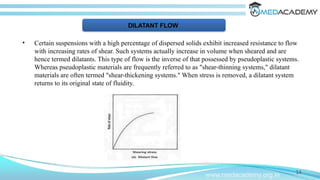
• Certain suspensions with a high percentage of dispersed solids exhibit increased resistance to flow
with increasing rates of shear. Such systems actually increase in volume when sheared and are
hence termed dilatants. This type of flow is the inverse of that possessed by pseudoplastic systems.
Whereas pseudoplastic materials are frequently referred to as "shear-thinning systems," dilatant
materials are often termed "shear-thickening systems." When stress is removed, a dilatant system
returns to its original state of fluidity.
14
www.medacademy.org.in
DILATANT FLOW
• Substances possessing dilatant flow properties are invariably suspensions containing a high
concentration (about 50% or greater) of small, deflocculated particles.
• Dilatant behaviour can be explained as follows. At rest, the particles are closely packed with
minimal inter-particle volume (voids). The amount of vehicle in the suspension is sufficient,
however, to fill voids and permits particles to move relative to one another at low rates of shear.
Thus, a dilatant suspension can be poured from a bottle because under these conditions it is
reasonably fluid.
15
www.medacademy.org.in
DILATANT FLOW
• As shear stress is increased, the bulk of the system expands or dilates; hence the term dilatant. The
particles, in an attempt to move quickly past each other, take on an open form of packing, as
depicted in the above figure. Such an arrangement leads to a significant increase in the interparticle
void volume. The amount of vehicle remains constant and, at some point, becomes insufficient to
fill the increased voids between particles. Because the particles are no longer completely wetted or
lubricated by the vehicle, the resistance to flow increases. Eventually, the suspension will be set up
as a firm paste.
16
www.medacademy.org.in
DILATANT FLOW
17
www.medacademy.org.in
DILATANT FLOW
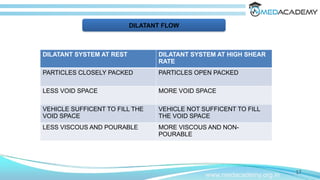
DILATANT SYSTEM AT REST DILATANT SYSTEM AT HIGH SHEAR
RATE
PARTICLES CLOSELY PACKED PARTICLES OPEN PACKED
LESS VOID SPACE MORE VOID SPACE
VEHICLE SUFFICENT TO FILL THE
VOID SPACE
VEHICLE NOT SUFFICENT TO FILL
THE VOID SPACE
LESS VISCOUS AND POURABLE MORE VISCOUS AND NON-
POURABLE
18
www.medacademy.org.in
RHEOGRAM OF DIFFERENT FLUIDS
Thank You
www.medacademy.org.in
“MAKING PROFESSIONALS, PROFESSIONALLY”

RHEOLOGY PART 1.pptx

  • 1.
  • 2.
    • The term‘rheology' was derived from the Greek words rheo (flow) and logos (science) and is used to describe the flow of liquids and the deformation of solids. • Rheology is the science concerned with the deformation of matter under the influence of stress. • Viscosity is an expression of the resistance of a fluid to flow: the higher the viscosity, the greater the resistance. • The stresses may be, • Tensile stress, shearing stress, and stress are applied at any other angle to the surface of a body. • The deformation is of two types: elastic deformation & plastic deformation. 2 www.medacademy.org.in VISCOSITY & RHEOLOGY
  • 3.
    • i. Manufacturingof dosage forms: • Materials undergo process such as mixing, flowing through pipes, filling into the containers etc. Flow related changes influence the selection of mixing equipment. • ii. Handling of drugs for administration: • The syringibility of the medicines, the pouring of the liquids from containers, extrusion of ointment from tubes, all depend on the changes in flow behavior of dosage forms. 3 www.medacademy.org.in FUNDAMENTALS OF RHEOLOGY
  • 4.
    • Rheology isinvolved in • the mixing and flow of materials, • their packaging into containers, and • their removal prior to use, whether this is achieved by pouring from a bottle, extrusion from a tube, or passage through a syringe needle. 4 www.medacademy.org.in TYPES OF RHEOLOGY
  • 5.
    • Newton wasthe first to study the properties of liquids in a quantitative way. Newton’s Law of Flow states that the shear stress between adjacent fluid layers is proportional to the velocity gradient between two layers or the shear rate. • Liquids that obey Newton’s law of flow are called as Newtonian fluids. • 𝜂 = / 𝐹 𝐺 • For a Newtonian system, a representative flow curve or rheogram, by plotting F versus G is shown below where a straight line passing through the origin is obtained. The cgs unit of viscosity is the poise (dyne sec/cm2 or g cm-1 sec-1), defined as the shearing force required to produce a velocity of 1 cm/sec between two parallel planes of liquid each 1 cm2 in area and separated by a distance of 1 cm. 5 www.medacademy.org.in NEWTON’S LAW OF FLOW
  • 6.
    • Fluidity, isdefined as the reciprocal of viscosity: =1/η ϕ 𝜙 • Kinematic viscosity is the absolute viscosity η divided by the density of the liquid. • The units are Stoke and centistoke. • Two-plate model to calculate the shear stress. Shear stress is the force moving the upper plate divided by the plate’s area. 6 www.medacademy.org.in NEWTONIAN SYSTEM
  • 7.
    • Two-plate modelto calculate the shear rate. The shear rate is the velocity of the moving plate divided by the distance between the plates. 7 www.medacademy.org.in NEWTONIAN SYSTEM
  • 8.
    • This isthe simplest form of a rheogram produced by Newtonian systems. A rheogram is a plot of shear rate, G, as a function of shear stress, F. Rheograms is also known as consistency curves or flow curves. For this system, the greater the slope of the line, the greater is the fluidity or, conversely, the lower the viscosity. • Fluids which obey Newton's law of viscosity are called Newtonian fluids or a fluid whose viscosity does not change with the shear rate or a Newtonian fluid is one where there is a linear relationship between shear stress and shear rate. 8 www.medacademy.org.in NEWTONIAN SYSTEM
  • 9.
    • Non-Newtonian Systems Themajority of fluid pharmaceutical products do not follow Newton's law of flow. These systems are referred to as non-Newtonian. Non-Newtonian behaviour is generally exhibited by liquid and solid heterogeneous dispersions such as colloidal solutions, emulsions, liquid suspensions, and ointments. Non-Newtonian Flow • (a) Plastic • (b) Pseudoplastic • (c) Dilatant 9 www.medacademy.org.in NON-NEWTONIAN SYSTEMS
  • 10.
    • The materialsthat exhibit plastic flow, such materials are known as Bingham bodies. Plastic flow curves do not pass through the origin but rather intersect the shearing stress axis (or will if the straight part of the curve is extrapolated to the axis) at a particular point referred to as the yield value. A Bingham body does not begin to flow until a shearing stress corresponding to the yield value is exceeded. At stresses below the yield value, the substance acts as an elastic material. The slope of the rheogram is termed the mobility, analogous to fluidity in Newtonian systems, and its reciprocal is known as the plastic viscosity, U. • The equation describing plastic flow is • where f is the yield value, or intercept on the shear stress axis in dynes/cm2 . • Plastic flow is associated with the presence of flocculated particles in concentrated suspensions. As a result, a continuous structure is set up throughout the system. A yield value exists because of the contacts between adjacent particles (brought about by van der Waals forces), which must be broken down before flow can occur. 10 www.medacademy.org.in PLASTIC FLOW
  • 11.
    In practice, deformationand flow usually occurs at a lower shear stress value and this accounts for the curved portion of the curve. • The viscosity decreases initially and then remains constant. • In a highly flocculated system, there is interaction between flocs which results in a structured system and plastic flow is associated with these systems e.g highly flocculated suspensions. • The yield value is present because of the contacts between adjacent particles (caused by van der Waals forces which may be capable of withstanding weak stresses) which must be broken down before flow can occur. • Consequently, the yield value is an indication of the degree of flocculation; the more flocculated the suspension, the higher will be the yield value. • This type of behaviour is also exhibited by creams and ointments. 11 www.medacademy.org.in PLASTIC FLOW
  • 12.
    • Many pharmaceuticalproducts, including liquid dispersions of natural and synthetic gums (tragacanth, sodium alginate, methylcellulose. and sodium carboxymethyl cellulose) exhibit pseudoplastic flow. Pseudoplastic flow is typically exhibited by polymers in solution in contrast to plastic systems, which are composed of flocculated particles in suspension. The consistency curve for a pseudoplastic material begins at the origin (or at least approaches it at low rates of shear). Therefore, there is no yield value. 12 www.medacademy.org.in PSEUDOPLASTIC FLOW
  • 13.
    • Furthermore, becauseno part of the curve is linear, the viscosity of a pseudoplastic material cannot be expressed by any single value. The viscosity of a pseudoplastic substance decreases with an increasing rate of shear and this system is known as the shear thinning system. • As shearing stress is increased, normally disarranged molecules begin to align their long axes in the direction of flow. This orientation reduces the internal resistance of the material and allows a greater rate of shear at each successive shearing stress. In addition, some of the solvents associated with the molecules may be released, resulting in an effective lowering of both the concentration and the site of the dispersed molecules. This, too, will decrease apparent viscosity. 13 www.medacademy.org.in PSEUDOPLASTIC FLOW
  • 14.
    • Certain suspensionswith a high percentage of dispersed solids exhibit increased resistance to flow with increasing rates of shear. Such systems actually increase in volume when sheared and are hence termed dilatants. This type of flow is the inverse of that possessed by pseudoplastic systems. Whereas pseudoplastic materials are frequently referred to as "shear-thinning systems," dilatant materials are often termed "shear-thickening systems." When stress is removed, a dilatant system returns to its original state of fluidity. 14 www.medacademy.org.in DILATANT FLOW
  • 15.
    • Substances possessingdilatant flow properties are invariably suspensions containing a high concentration (about 50% or greater) of small, deflocculated particles. • Dilatant behaviour can be explained as follows. At rest, the particles are closely packed with minimal inter-particle volume (voids). The amount of vehicle in the suspension is sufficient, however, to fill voids and permits particles to move relative to one another at low rates of shear. Thus, a dilatant suspension can be poured from a bottle because under these conditions it is reasonably fluid. 15 www.medacademy.org.in DILATANT FLOW
  • 16.
    • As shearstress is increased, the bulk of the system expands or dilates; hence the term dilatant. The particles, in an attempt to move quickly past each other, take on an open form of packing, as depicted in the above figure. Such an arrangement leads to a significant increase in the interparticle void volume. The amount of vehicle remains constant and, at some point, becomes insufficient to fill the increased voids between particles. Because the particles are no longer completely wetted or lubricated by the vehicle, the resistance to flow increases. Eventually, the suspension will be set up as a firm paste. 16 www.medacademy.org.in DILATANT FLOW
  • 17.
    17 www.medacademy.org.in DILATANT FLOW DILATANT SYSTEMAT REST DILATANT SYSTEM AT HIGH SHEAR RATE PARTICLES CLOSELY PACKED PARTICLES OPEN PACKED LESS VOID SPACE MORE VOID SPACE VEHICLE SUFFICENT TO FILL THE VOID SPACE VEHICLE NOT SUFFICENT TO FILL THE VOID SPACE LESS VISCOUS AND POURABLE MORE VISCOUS AND NON- POURABLE
  • 18.
  • 19.