
RHEOLOGY
OF FLUIDS
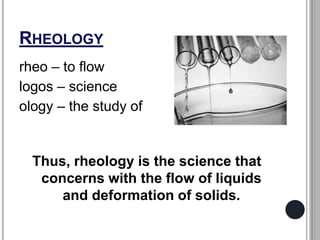
RHEOLOGY
rheo – to flow
logos – science
ology – the study of
Thus, rheology is the science that
concerns with the flow of liquids
and deformation of solids.
 The study of viscosity is of true liquids, solutions,
dilute and concentrated colloidal systems.
 It is involved in the mixing and flow of materials,
their packaging into containers, the pouring from
the bottle, extrusion from a tube or a passage of
the liquid to a syringe needle.
 It can affect the patient’s acceptability of the
product, physical stability, biologic availability,
absorption rate of drugs in the gastrointestinal
tract.
 It influence the choice of processing
equipments in the pharmaceutical system
TWO CATEGORIES OF FLOW &
DEFORMATION
Newtonian (Newtonian Law of Flow)
“the higher the viscosity of a liquid, the greater is
the force per unit area (shearing stress) required to
produce a certain rate of shear”
Shear – is a stress which is applied parallel or
tangential to a face of a material, as opposed to a
normal stress which is applied perpendicularly.
Shear stress
Measured in (SI unit): pascal
Commonly used symbols: τ
Expressed in other quantities: τ = F / A
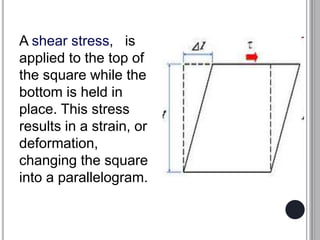
A shear stress, is
applied to the top of
the square while the
bottom is held in
place. This stress
results in a strain, or
deformation,
changing the square
into a parallelogram.
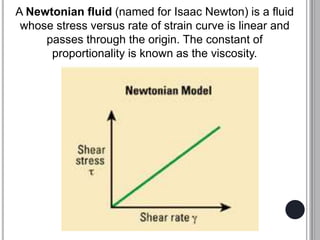
A Newtonian fluid (named for Isaac Newton) is a fluid
whose stress versus rate of strain curve is linear and
passes through the origin. The constant of
proportionality is known as the viscosity.
In common terms, this means the fluid continues
to flow, regardless of the forces acting on it. For
example, water is Newtonian, because it continues
to exemplify fluid properties no matter how fast it is
stirred or mixed.
For a Newtonian fluid, the viscosity, by definition,
depends only on temperature and pressure (and
also the chemical composition of the fluid if the
fluid is not a pure substance), not on the forces
acting upon it.
Non-Newtonian
A non-Newtonian fluid is a fluid whose flow
properties are not described by a single constant value
of viscosity.
Many polymer solutions and molten polymers are
non-Newtonian fluids, as are many commonly found
substances such as ketchup, starch suspensions,
paint, blood and shampoo.
In a non-Newtonian fluid, the relation between the
shear stress and the strain rate is nonlinear, and can
even be time-dependent. Therefore a constant
coefficient of viscosity cannot be defined.
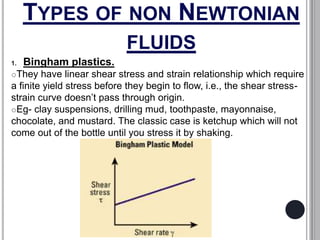
1. Bingham plastics.
They have linear shear stress and strain relationship which require
a finite yield stress before they begin to flow, i.e., the shear stress-
strain curve doesn’t pass through origin.
Eg- clay suspensions, drilling mud, toothpaste, mayonnaise,
chocolate, and mustard. The classic case is ketchup which will not
come out of the bottle until you stress it by shaking.
TYPES OF NON NEWTONIAN
FLUIDS
2. Pseudoplastic Flow
Polymers in solutions such as tragacant, sodium
alginate, methylcellulose
Viscosity decreases with an increase in shear
thinning
Caused by the re-alignment of polymer and/or the
release of solvents associated with the polymers
3. Dilatant Flow
Volume increases when sheared
Shear thickening
Suspension containing high-concentration of small
deflocculated particles
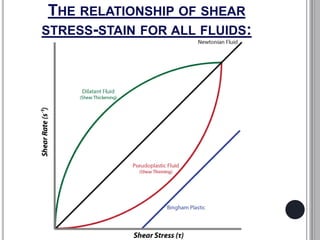
THE RELATIONSHIP OF SHEAR
STRESS-STAIN FOR ALL FLUIDS:
There are also fluids whose strain rate is a function of
time. Fluids that require a gradually increasing shear stress
to maintain a constant strain rate are referred to as
rheopectic.
An opposite case of this, is a fluid that thins out with time
and requires a decreasing stress to maintain a constant
strain rate (thixotropic).
THIXOTROPY
 is the property of some non-Newtonian
pseudoplastic fluids to show a time-dependent
change in viscosity; the longer the fluid
undergoes shear stress, the lower its viscosity.
 A thixotropic fluid is a fluid which takes a finite
time to attain equilibrium viscosity when
introduced to a step change in shear rate.
 the term is sometimes applied to pseudoplastic
fluids without a viscosity/time component. Many
gels and colloids are thixotropic materials,
exhibiting a stable form at rest but becoming fluid
when agitated.
THANK YOU!

Rheology

  • 1.
  • 2.
    RHEOLOGY rheo – toflow logos – science ology – the study of Thus, rheology is the science that concerns with the flow of liquids and deformation of solids.
  • 3.
     The studyof viscosity is of true liquids, solutions, dilute and concentrated colloidal systems.  It is involved in the mixing and flow of materials, their packaging into containers, the pouring from the bottle, extrusion from a tube or a passage of the liquid to a syringe needle.  It can affect the patient’s acceptability of the product, physical stability, biologic availability, absorption rate of drugs in the gastrointestinal tract.  It influence the choice of processing equipments in the pharmaceutical system
  • 4.
    TWO CATEGORIES OFFLOW & DEFORMATION Newtonian (Newtonian Law of Flow) “the higher the viscosity of a liquid, the greater is the force per unit area (shearing stress) required to produce a certain rate of shear” Shear – is a stress which is applied parallel or tangential to a face of a material, as opposed to a normal stress which is applied perpendicularly. Shear stress Measured in (SI unit): pascal Commonly used symbols: τ Expressed in other quantities: τ = F / A
  • 5.
    A shear stress,is applied to the top of the square while the bottom is held in place. This stress results in a strain, or deformation, changing the square into a parallelogram.
  • 6.
    A Newtonian fluid(named for Isaac Newton) is a fluid whose stress versus rate of strain curve is linear and passes through the origin. The constant of proportionality is known as the viscosity.
  • 7.
    In common terms,this means the fluid continues to flow, regardless of the forces acting on it. For example, water is Newtonian, because it continues to exemplify fluid properties no matter how fast it is stirred or mixed. For a Newtonian fluid, the viscosity, by definition, depends only on temperature and pressure (and also the chemical composition of the fluid if the fluid is not a pure substance), not on the forces acting upon it.
  • 8.
    Non-Newtonian A non-Newtonian fluidis a fluid whose flow properties are not described by a single constant value of viscosity. Many polymer solutions and molten polymers are non-Newtonian fluids, as are many commonly found substances such as ketchup, starch suspensions, paint, blood and shampoo. In a non-Newtonian fluid, the relation between the shear stress and the strain rate is nonlinear, and can even be time-dependent. Therefore a constant coefficient of viscosity cannot be defined.
  • 9.
    1. Bingham plastics. Theyhave linear shear stress and strain relationship which require a finite yield stress before they begin to flow, i.e., the shear stress- strain curve doesn’t pass through origin. Eg- clay suspensions, drilling mud, toothpaste, mayonnaise, chocolate, and mustard. The classic case is ketchup which will not come out of the bottle until you stress it by shaking. TYPES OF NON NEWTONIAN FLUIDS
  • 10.
    2. Pseudoplastic Flow Polymersin solutions such as tragacant, sodium alginate, methylcellulose Viscosity decreases with an increase in shear thinning Caused by the re-alignment of polymer and/or the release of solvents associated with the polymers 3. Dilatant Flow Volume increases when sheared Shear thickening Suspension containing high-concentration of small deflocculated particles
  • 11.
    THE RELATIONSHIP OFSHEAR STRESS-STAIN FOR ALL FLUIDS:
  • 12.
    There are alsofluids whose strain rate is a function of time. Fluids that require a gradually increasing shear stress to maintain a constant strain rate are referred to as rheopectic. An opposite case of this, is a fluid that thins out with time and requires a decreasing stress to maintain a constant strain rate (thixotropic).
  • 13.
    THIXOTROPY  is theproperty of some non-Newtonian pseudoplastic fluids to show a time-dependent change in viscosity; the longer the fluid undergoes shear stress, the lower its viscosity.  A thixotropic fluid is a fluid which takes a finite time to attain equilibrium viscosity when introduced to a step change in shear rate.  the term is sometimes applied to pseudoplastic fluids without a viscosity/time component. Many gels and colloids are thixotropic materials, exhibiting a stable form at rest but becoming fluid when agitated.
  • 14.