
Review and Investigation on
Titanium Nanostructures for
Biomedical Application
Submitted by
Preeti Choudhary (Roll no. 17/MAP/016)
M.Sc.(Applied Physics)
Under supervision of
Dr. Ashish Kumar Keshari
Contents
Introduction
TiO₂ Nanostructures
Properties
Current trends in Biomedical
Application(TiO2)
Synthesis of TiO₂ Nanoparticle
Chemical Route
Characterization Technique
Objective and Future plan
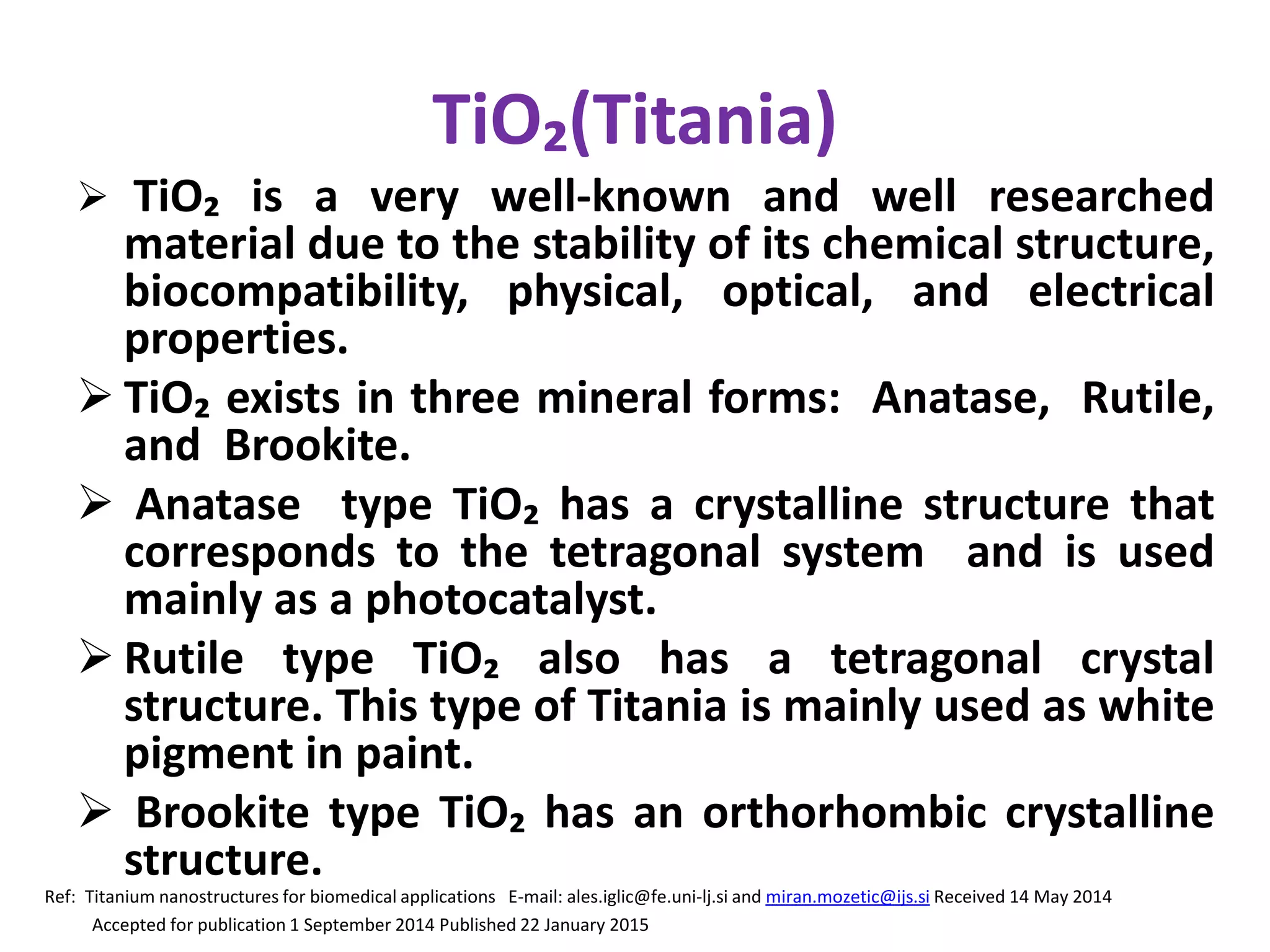
TiO₂(Titania)
 TiO₂ is a very well-known and well researched
material due to the stability of its chemical structure,
biocompatibility, physical, optical, and electrical
properties.
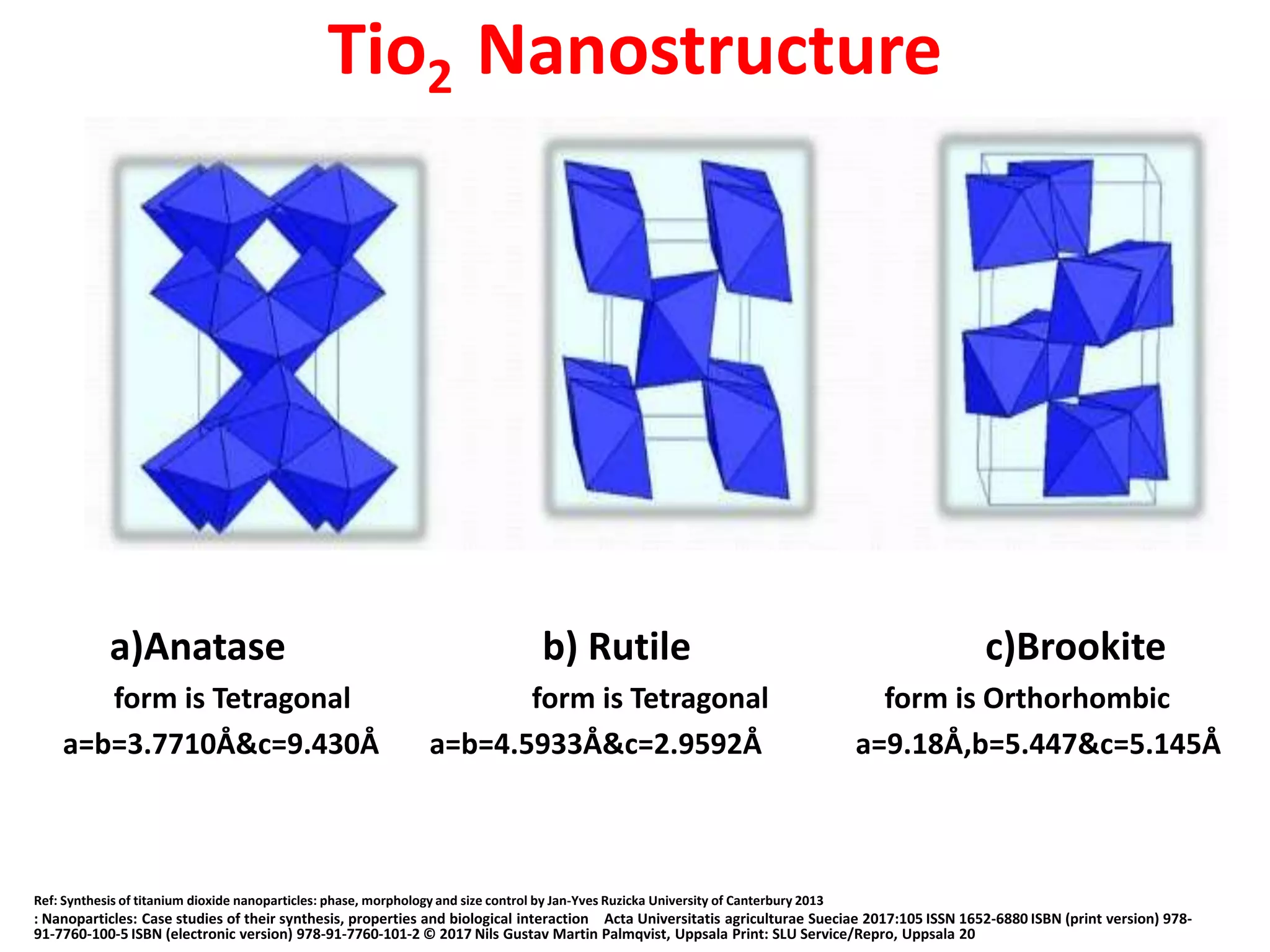
 TiO₂ exists in three mineral forms: Anatase, Rutile,
and Brookite.
 Anatase type TiO₂ has a crystalline structure that
corresponds to the tetragonal system and is used
mainly as a photocatalyst.
 Rutile type TiO₂ also has a tetragonal crystal
structure. This type of Titania is mainly used as white
pigment in paint.
 Brookite type TiO₂ has an orthorhombic crystalline
structure.
Ref: Titanium nanostructures for biomedical applications E-mail: ales.iglic@fe.uni-lj.si and miran.mozetic@ijs.si Received 14 May 2014
Accepted for publication 1 September 2014 Published 22 January 2015
Tio2 Nanostructure
Ref: Synthesis of titanium dioxide nanoparticles: phase, morphology and size control by Jan-Yves Ruzicka University of Canterbury 2013
: Nanoparticles: Case studies of their synthesis, properties and biological interaction Acta Universitatis agriculturae Sueciae 2017:105 ISSN 1652-6880 ISBN (print version) 978-
91-7760-100-5 ISBN (electronic version) 978-91-7760-101-2 © 2017 Nils Gustav Martin Palmqvist, Uppsala Print: SLU Service/Repro, Uppsala 20
a)Anatase b) Rutile c)Brookite
form is Tetragonal form is Tetragonal form is Orthorhombic
a=b=3.7710Å&c=9.430Å a=b=4.5933Å&c=2.9592Å a=9.18Å,b=5.447&c=5.145Å
Properties
Structural Properties (e.g, Morphology )
Optical Properties(e.g, Color)
Electronic Properties(e.g, Band gap Energy )
Ref: Nanoparticles: Case studies of their synthesis, properties and biological interaction Acta Universitatis agriculturae Sueciae 2017:105 ISSN 1652-6880
ISBN (print version) 978-91-7760-100-5 ISBN (electronic version) 978-91-7760-101-2 © 2017 Nils Gustav Martin Palmqvist, Uppsala Print: SLU
Service/Repro, Uppsala 20
Current Trends in Biomedical
Application
Nanocrystalline TiO₂ is strength and
biocompatibility, which is used in medical
application.
Target Drug Delivery
Photodynamic Therapy of cancer
Cell Imaging
Biosensors & biological assay
Antimicrobial Agents and Coating
Ref: Titanium nanostructures for biomedical applications E-mail: ales.iglic@fe.uni-lj.si and miran.mozetic@ijs.si Received 14 May 2014
Accepted for publication 1 September 2014 Published 22 January 2015
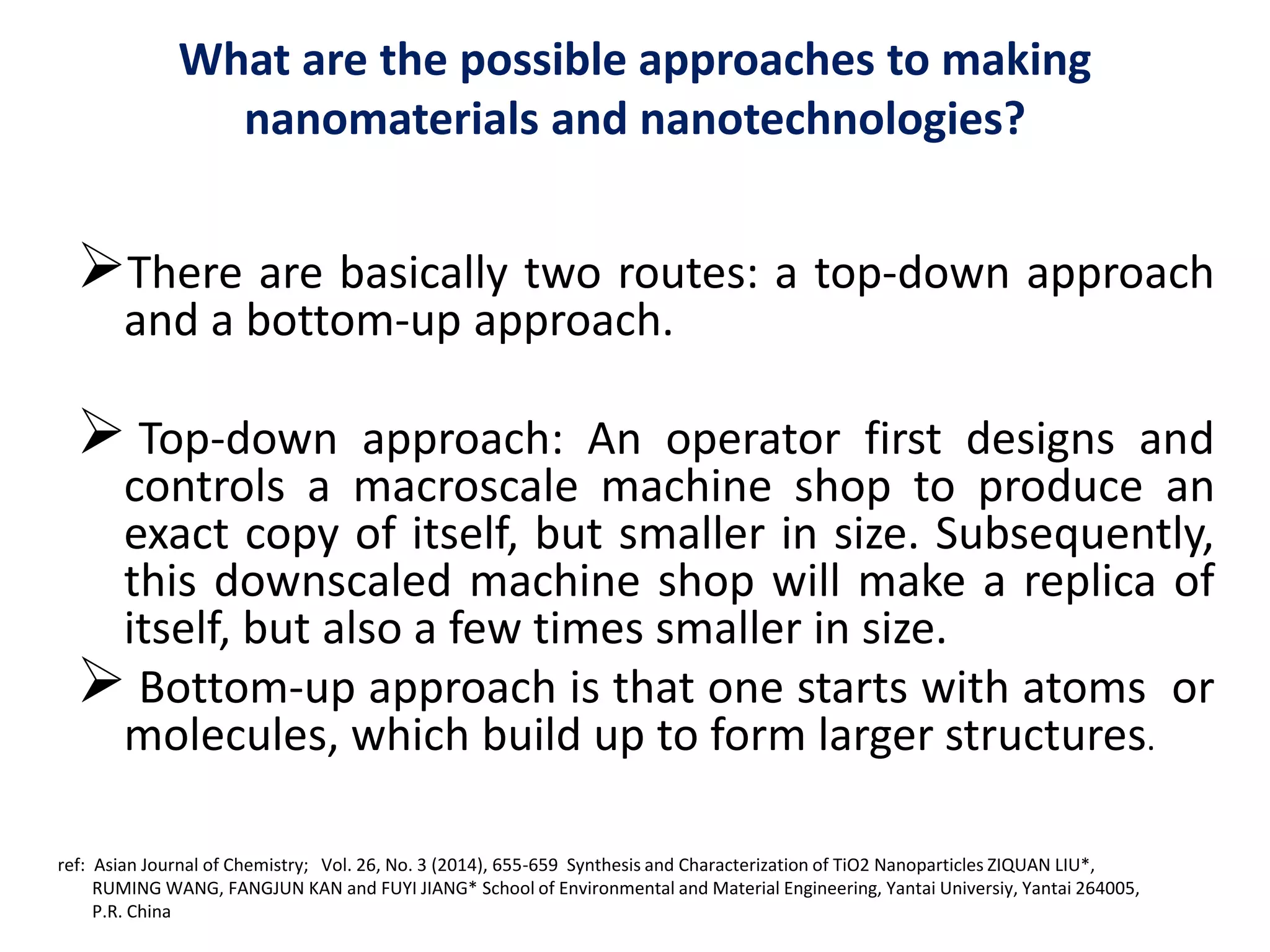
What are the possible approaches to making
nanomaterials and nanotechnologies?
There are basically two routes: a top-down approach
and a bottom-up approach.
 Top-down approach: An operator first designs and
controls a macroscale machine shop to produce an
exact copy of itself, but smaller in size. Subsequently,
this downscaled machine shop will make a replica of
itself, but also a few times smaller in size.
 Bottom-up approach is that one starts with atoms or
molecules, which build up to form larger structures.
ref: Asian Journal of Chemistry; Vol. 26, No. 3 (2014), 655-659 Synthesis and Characterization of TiO2 Nanoparticles ZIQUAN LIU*,
RUMING WANG, FANGJUN KAN and FUYI JIANG* School of Environmental and Material Engineering, Yantai Universiy, Yantai 264005,
P.R. China
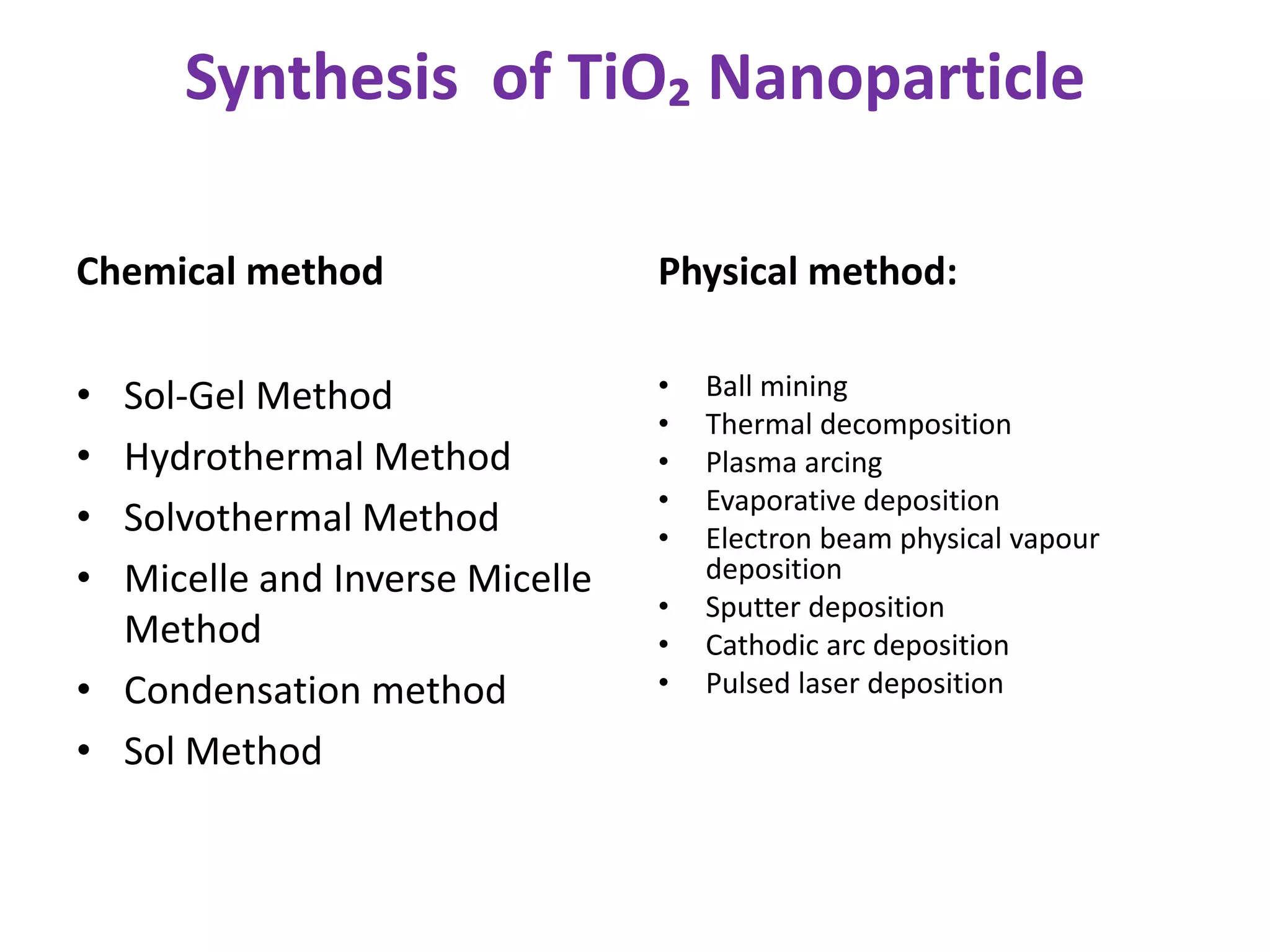
Synthesis of TiO₂ Nanoparticle
Chemical method
• Sol-Gel Method
• Hydrothermal Method
• Solvothermal Method
• Micelle and Inverse Micelle
Method
• Condensation method
• Sol Method
Physical method:
• Ball mining
• Thermal decomposition
• Plasma arcing
• Evaporative deposition
• Electron beam physical vapour
deposition
• Sputter deposition
• Cathodic arc deposition
• Pulsed laser deposition
Sol-Gel Method
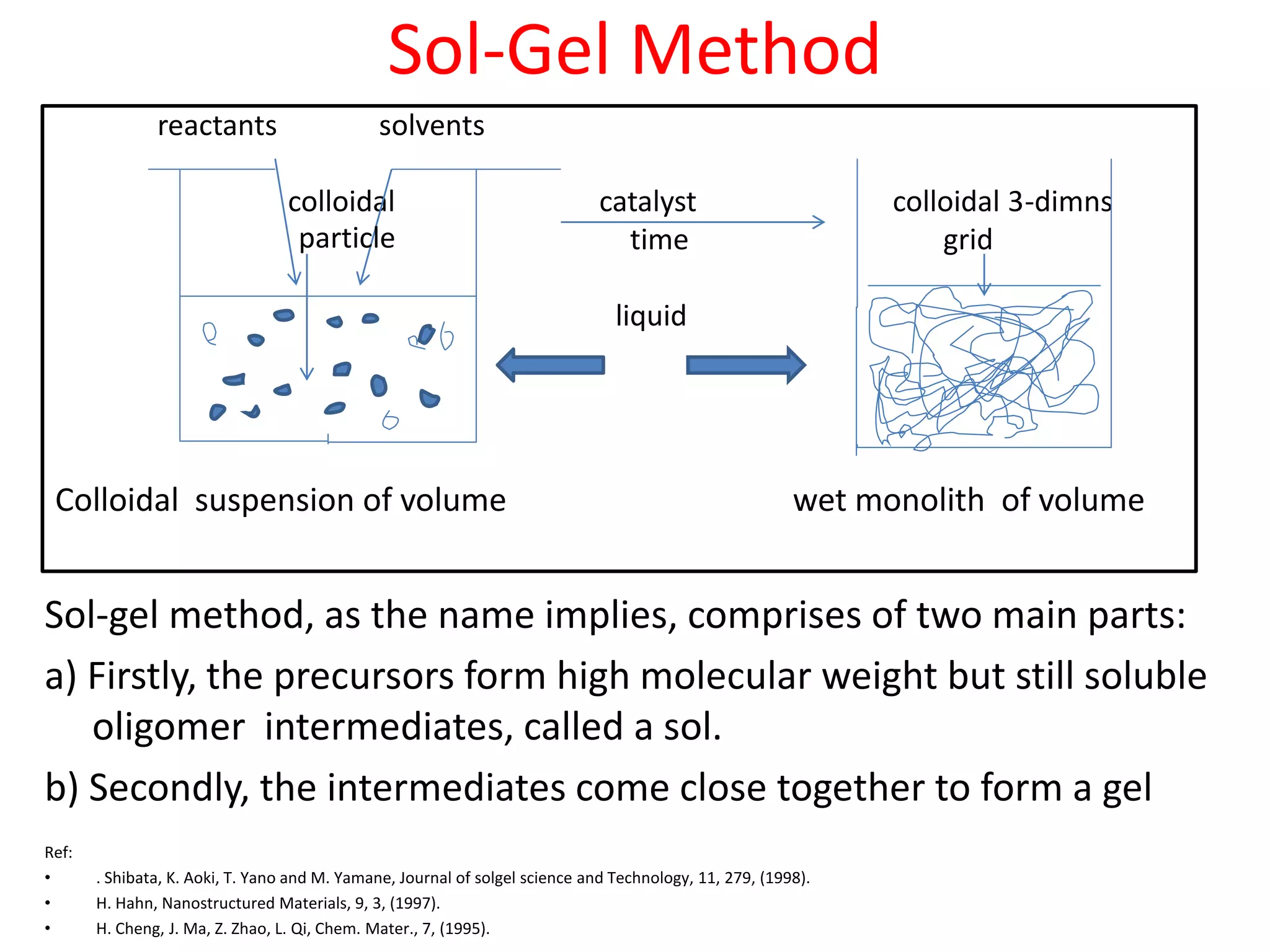
Sol-gel method, as the name implies, comprises of two main parts:
a) Firstly, the precursors form high molecular weight but still soluble
oligomer intermediates, called a sol.
b) Secondly, the intermediates come close together to form a gel
Ref:
• . Shibata, K. Aoki, T. Yano and M. Yamane, Journal of solgel science and Technology, 11, 279, (1998).
• H. Hahn, Nanostructured Materials, 9, 3, (1997).
• H. Cheng, J. Ma, Z. Zhao, L. Qi, Chem. Mater., 7, (1995).
reactants solvents
colloidal catalyst colloidal 3-dimns
time grid
liquid
Colloidal suspension of volume wet monolith of volume
particle
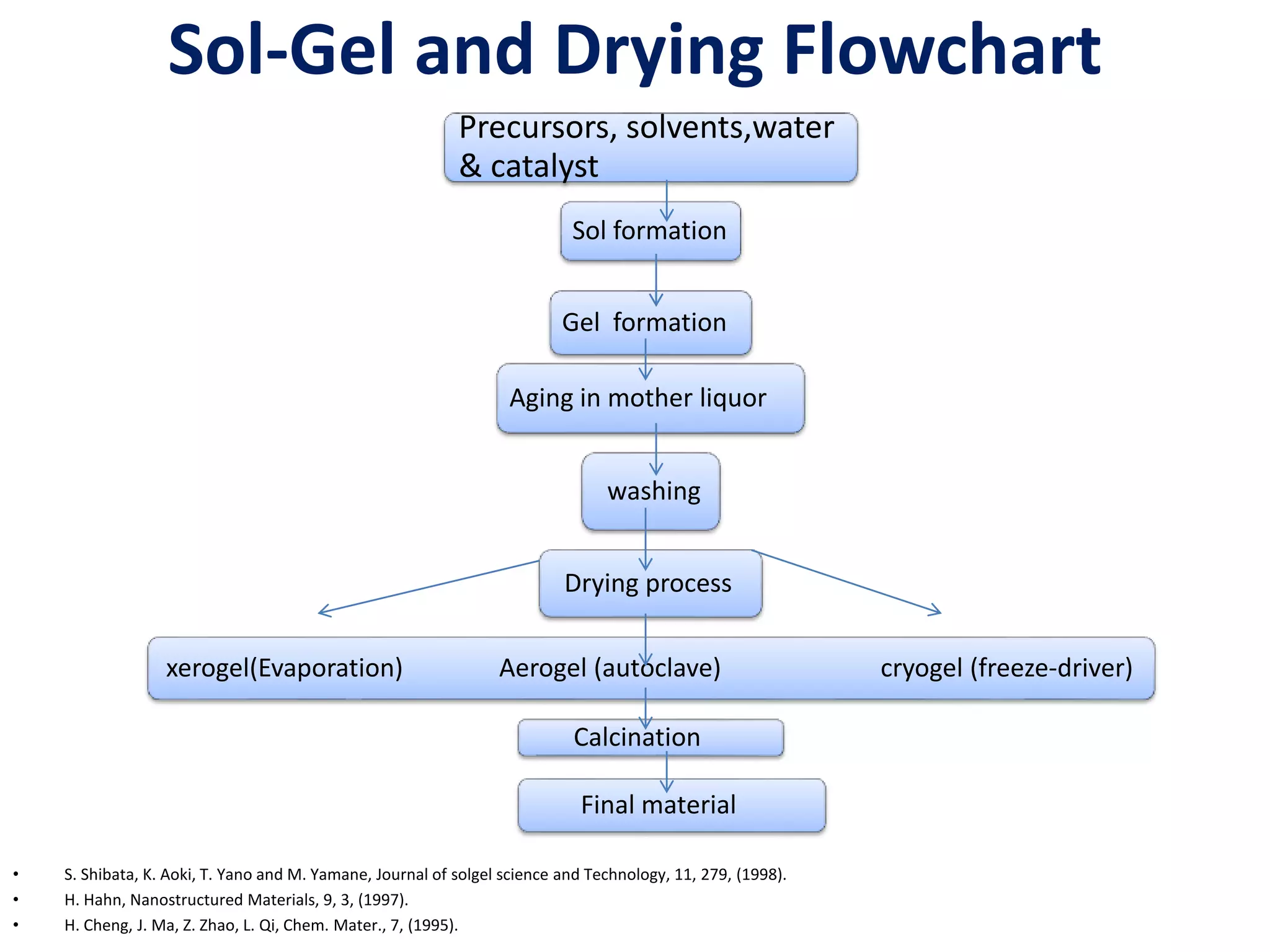
Sol-Gel and Drying Flowchart
Precursors, solvents,water
& catalyst
Sol formation
Gel formation
Aging in mother liquor
washing
Drying process
xerogel(Evaporation) Aerogel (autoclave) cryogel (freeze-driver)
Calcination
Final material
• S. Shibata, K. Aoki, T. Yano and M. Yamane, Journal of solgel science and Technology, 11, 279, (1998).
• H. Hahn, Nanostructured Materials, 9, 3, (1997).
• H. Cheng, J. Ma, Z. Zhao, L. Qi, Chem. Mater., 7, (1995).
Hydrothermal method
• Hydrothermal synthesis is normally conducted in
steel pressure vessels called autoclaves with
controlled temperature or pressure.
• The temperature and the amount of solution added
to the autoclave largely determine the internal
pressure produced.
• It is a method that is widely used for the production
of small particles in the ceramics industry.
• Asian Journal of Chemistry; Vol. 26, No. 3 (2014), 655-659 Synthesis and Characterization of TiO2 Nanoparticles ZIQUAN LIU*, RUMING
WANG, FANGJUN KAN and FUYI JIANG* School of Environmental and Material Engineering, Yantai Universiy, Yantai 264005, P.R. China
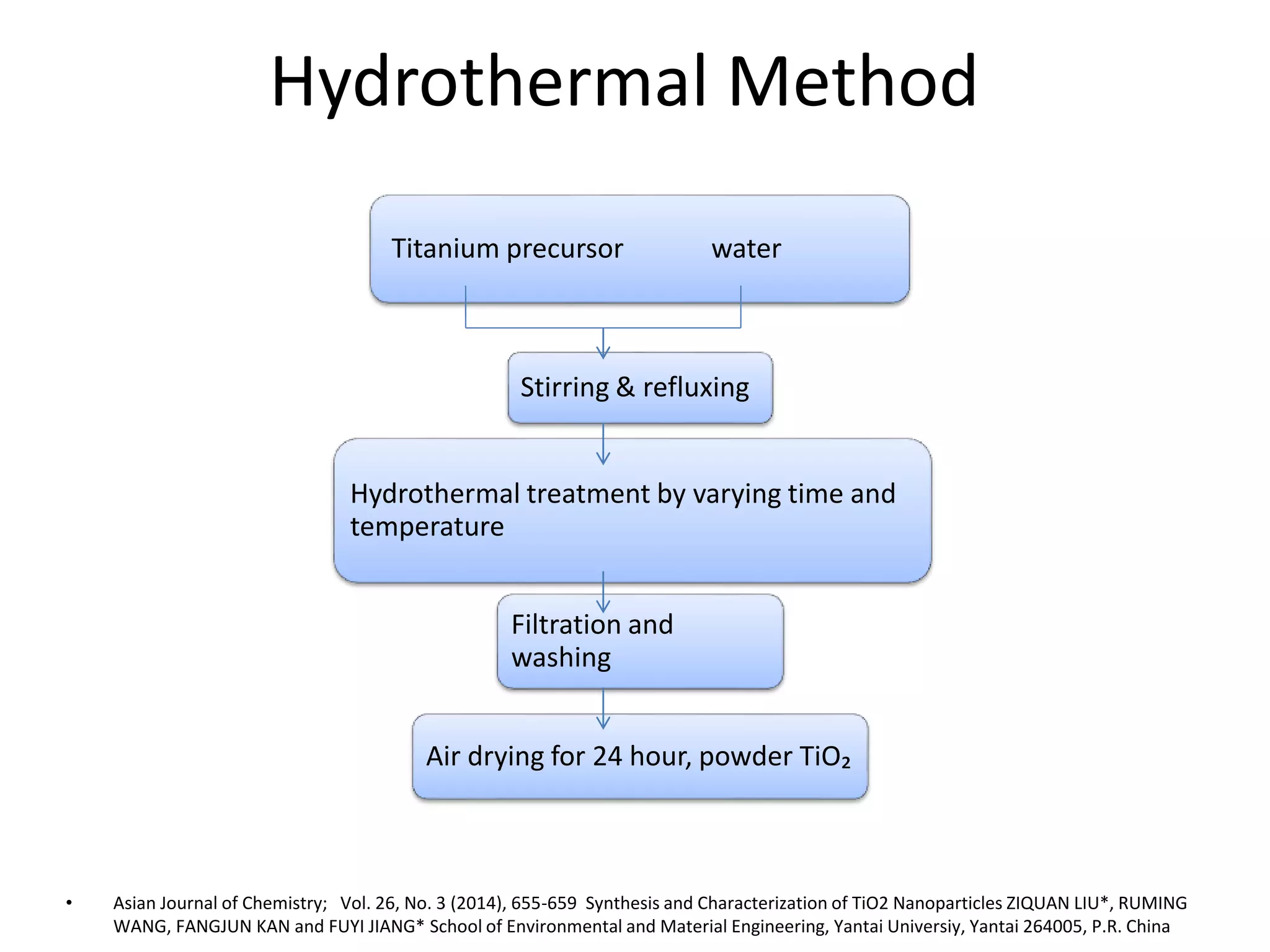
Hydrothermal Method
Titanium precursor water
Stirring & refluxing
Hydrothermal treatment by varying time and
temperature
Filtration and
washing
Air drying for 24 hour, powder TiO₂
• Asian Journal of Chemistry; Vol. 26, No. 3 (2014), 655-659 Synthesis and Characterization of TiO2 Nanoparticles ZIQUAN LIU*, RUMING
WANG, FANGJUN KAN and FUYI JIANG* School of Environmental and Material Engineering, Yantai Universiy, Yantai 264005, P.R. China
Characterization used for Tio2 Nanoparticles
• X-ray diffraction techniques
• SEM
• TEM
• UV-VIS spectroscopy
• Photoluminescence Spectroscopy
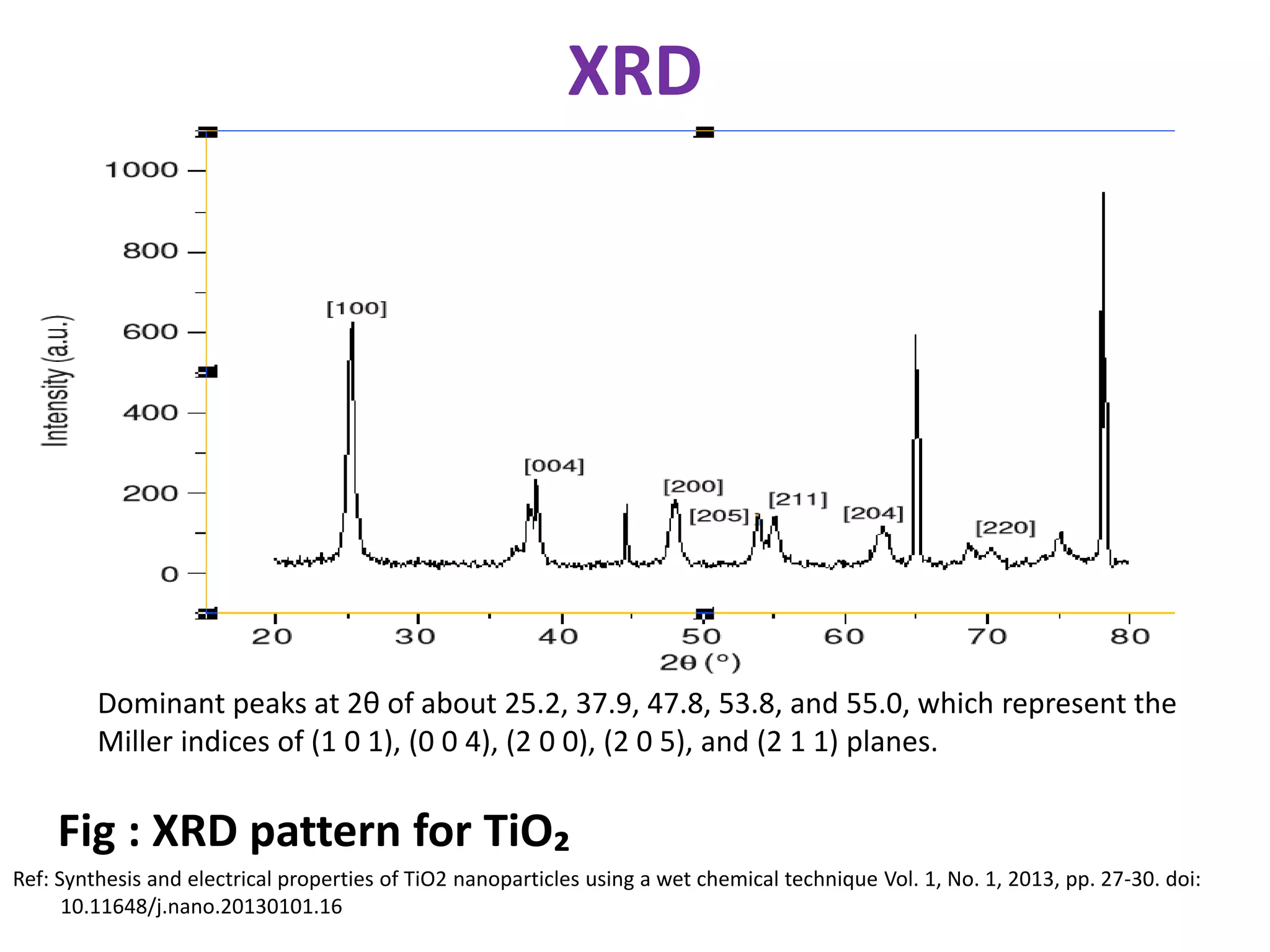
XRD
Fig : XRD pattern for TiO₂
Ref: Synthesis and electrical properties of TiO2 nanoparticles using a wet chemical technique Vol. 1, No. 1, 2013, pp. 27-30. doi:
10.11648/j.nano.20130101.16
Dominant peaks at 2θ of about 25.2, 37.9, 47.8, 53.8, and 55.0, which represent the
Miller indices of (1 0 1), (0 0 4), (2 0 0), (2 0 5), and (2 1 1) planes.
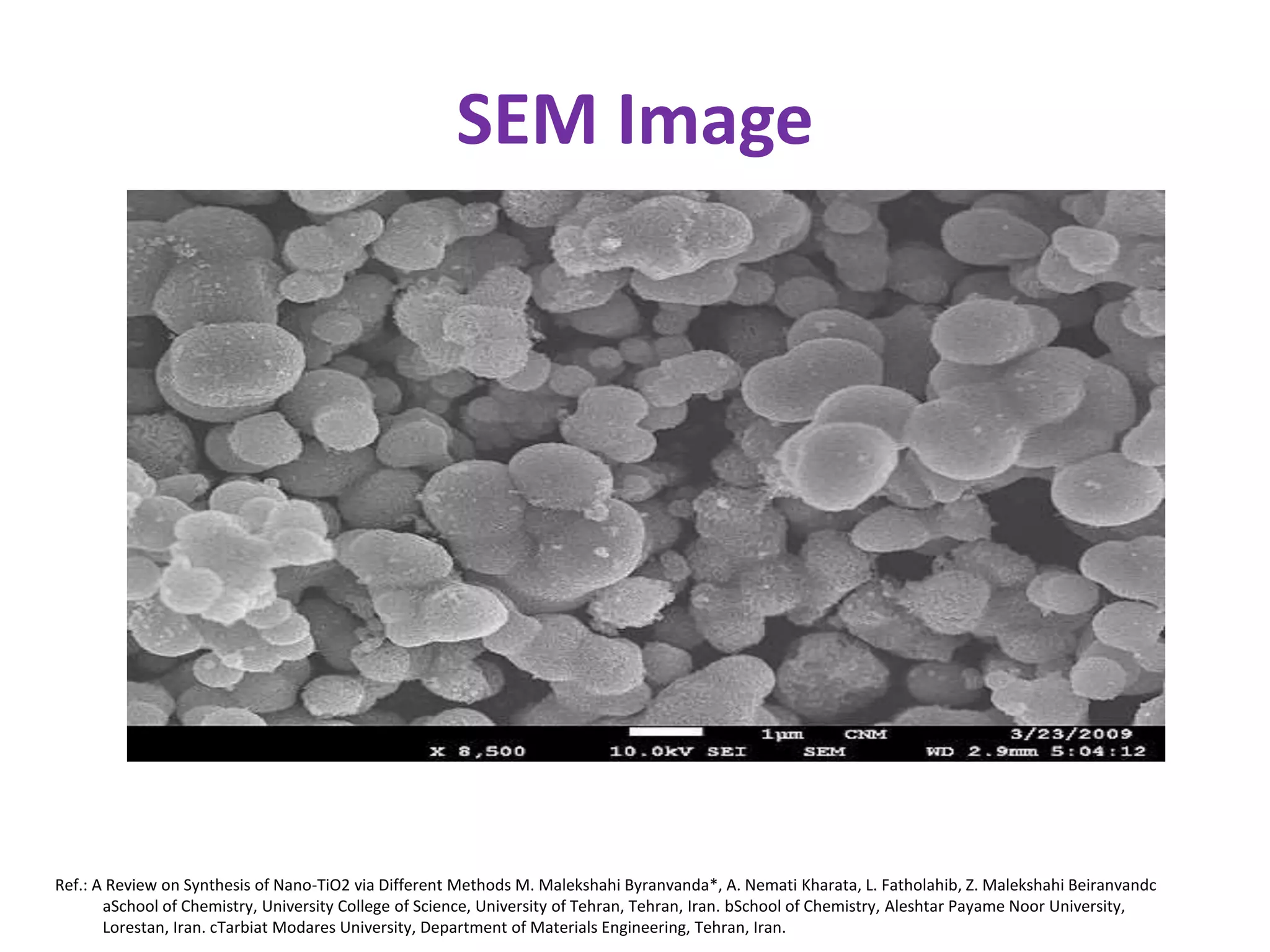
SEM Image
Ref.: A Review on Synthesis of Nano-TiO2 via Different Methods M. Malekshahi Byranvanda*, A. Nemati Kharata, L. Fatholahib, Z. Malekshahi Beiranvandc
aSchool of Chemistry, University College of Science, University of Tehran, Tehran, Iran. bSchool of Chemistry, Aleshtar Payame Noor University,
Lorestan, Iran. cTarbiat Modares University, Department of Materials Engineering, Tehran, Iran.
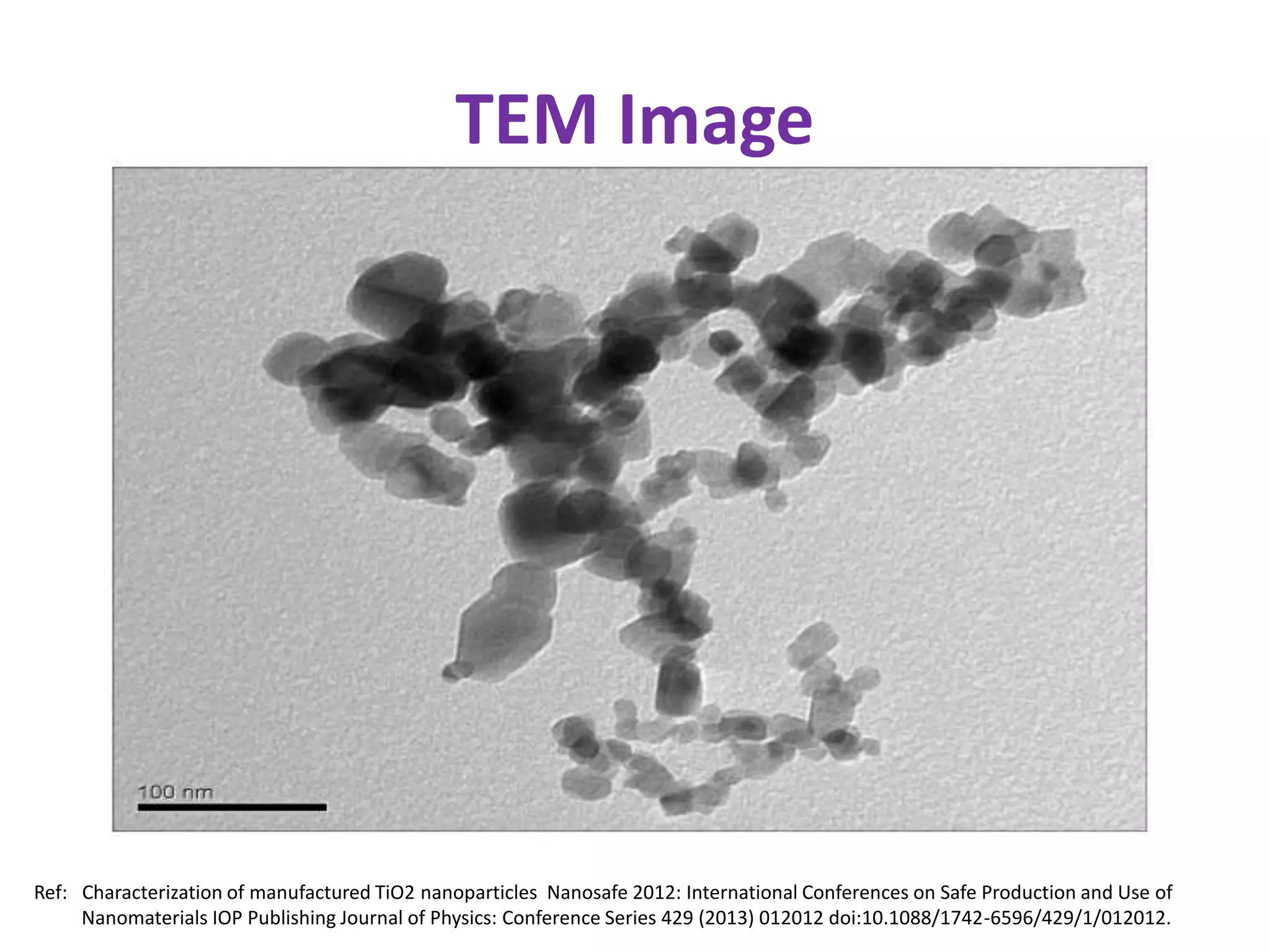
TEM Image
Ref: Characterization of manufactured TiO2 nanoparticles Nanosafe 2012: International Conferences on Safe Production and Use of
Nanomaterials IOP Publishing Journal of Physics: Conference Series 429 (2013) 012012 doi:10.1088/1742-6596/429/1/012012.
Objective & Future Plan
 Synthesized TiO₂ Powder by Sol gel
Method.
 Characterization of TiO₂ by XRD,
SEM,TEM,& UV-Visible Spectroscopy .
Synthesized TiO₂ Powder used in
Biomedical Application.
Nanoparticle Applications: TiO2
• Titanium Dioxide is used as an inorganic white pigment for
paper, paints, plastics, and whitening agents.
• TiO2 nanoparticles are used as UV blocking pigments in
sunscreens, cosmetics, varnishes, and fabrics.
• TiO2 has unique photocatalytic properties that make it suitable
for a number of advanced applications:
– Self-cleaning glass and antifogging coatings
– Detoxification of waste water
– Hydrolysis
• COMPUTATIONAL MODELING OF THE PROPERTIES OF TiO2 NANOPARTICLESActa Universitatis Lappeenrantaensis 564Thesis for the degree of Doctor of Science
(Technology) to be presented with due permission for public examination and criticism in the Auditorium of the Student Union House at Lappeenranta University of
Technology, Lappeenranta, Finland on the 19th of December, 2013, at noon.
TiO2 nanostructure for biomedical application.

TiO2 nanostructure for biomedical application.

  • 1.
    Review and Investigationon Titanium Nanostructures for Biomedical Application Submitted by Preeti Choudhary (Roll no. 17/MAP/016) M.Sc.(Applied Physics) Under supervision of Dr. Ashish Kumar Keshari
  • 2.
    Contents Introduction TiO₂ Nanostructures Properties Current trendsin Biomedical Application(TiO2) Synthesis of TiO₂ Nanoparticle Chemical Route Characterization Technique Objective and Future plan
  • 3.
    TiO₂(Titania)  TiO₂ isa very well-known and well researched material due to the stability of its chemical structure, biocompatibility, physical, optical, and electrical properties.  TiO₂ exists in three mineral forms: Anatase, Rutile, and Brookite.  Anatase type TiO₂ has a crystalline structure that corresponds to the tetragonal system and is used mainly as a photocatalyst.  Rutile type TiO₂ also has a tetragonal crystal structure. This type of Titania is mainly used as white pigment in paint.  Brookite type TiO₂ has an orthorhombic crystalline structure. Ref: Titanium nanostructures for biomedical applications E-mail: ales.iglic@fe.uni-lj.si and miran.mozetic@ijs.si Received 14 May 2014 Accepted for publication 1 September 2014 Published 22 January 2015
  • 4.
    Tio2 Nanostructure Ref: Synthesisof titanium dioxide nanoparticles: phase, morphology and size control by Jan-Yves Ruzicka University of Canterbury 2013 : Nanoparticles: Case studies of their synthesis, properties and biological interaction Acta Universitatis agriculturae Sueciae 2017:105 ISSN 1652-6880 ISBN (print version) 978- 91-7760-100-5 ISBN (electronic version) 978-91-7760-101-2 © 2017 Nils Gustav Martin Palmqvist, Uppsala Print: SLU Service/Repro, Uppsala 20 a)Anatase b) Rutile c)Brookite form is Tetragonal form is Tetragonal form is Orthorhombic a=b=3.7710Å&c=9.430Å a=b=4.5933Å&c=2.9592Å a=9.18Å,b=5.447&c=5.145Å
  • 5.
    Properties Structural Properties (e.g,Morphology ) Optical Properties(e.g, Color) Electronic Properties(e.g, Band gap Energy ) Ref: Nanoparticles: Case studies of their synthesis, properties and biological interaction Acta Universitatis agriculturae Sueciae 2017:105 ISSN 1652-6880 ISBN (print version) 978-91-7760-100-5 ISBN (electronic version) 978-91-7760-101-2 © 2017 Nils Gustav Martin Palmqvist, Uppsala Print: SLU Service/Repro, Uppsala 20
  • 6.
    Current Trends inBiomedical Application Nanocrystalline TiO₂ is strength and biocompatibility, which is used in medical application. Target Drug Delivery Photodynamic Therapy of cancer Cell Imaging Biosensors & biological assay Antimicrobial Agents and Coating Ref: Titanium nanostructures for biomedical applications E-mail: ales.iglic@fe.uni-lj.si and miran.mozetic@ijs.si Received 14 May 2014 Accepted for publication 1 September 2014 Published 22 January 2015
  • 7.
    What are thepossible approaches to making nanomaterials and nanotechnologies? There are basically two routes: a top-down approach and a bottom-up approach.  Top-down approach: An operator first designs and controls a macroscale machine shop to produce an exact copy of itself, but smaller in size. Subsequently, this downscaled machine shop will make a replica of itself, but also a few times smaller in size.  Bottom-up approach is that one starts with atoms or molecules, which build up to form larger structures. ref: Asian Journal of Chemistry; Vol. 26, No. 3 (2014), 655-659 Synthesis and Characterization of TiO2 Nanoparticles ZIQUAN LIU*, RUMING WANG, FANGJUN KAN and FUYI JIANG* School of Environmental and Material Engineering, Yantai Universiy, Yantai 264005, P.R. China
  • 8.
    Synthesis of TiO₂Nanoparticle Chemical method • Sol-Gel Method • Hydrothermal Method • Solvothermal Method • Micelle and Inverse Micelle Method • Condensation method • Sol Method Physical method: • Ball mining • Thermal decomposition • Plasma arcing • Evaporative deposition • Electron beam physical vapour deposition • Sputter deposition • Cathodic arc deposition • Pulsed laser deposition
  • 9.
    Sol-Gel Method Sol-gel method,as the name implies, comprises of two main parts: a) Firstly, the precursors form high molecular weight but still soluble oligomer intermediates, called a sol. b) Secondly, the intermediates come close together to form a gel Ref: • . Shibata, K. Aoki, T. Yano and M. Yamane, Journal of solgel science and Technology, 11, 279, (1998). • H. Hahn, Nanostructured Materials, 9, 3, (1997). • H. Cheng, J. Ma, Z. Zhao, L. Qi, Chem. Mater., 7, (1995). reactants solvents colloidal catalyst colloidal 3-dimns time grid liquid Colloidal suspension of volume wet monolith of volume particle
  • 10.
    Sol-Gel and DryingFlowchart Precursors, solvents,water & catalyst Sol formation Gel formation Aging in mother liquor washing Drying process xerogel(Evaporation) Aerogel (autoclave) cryogel (freeze-driver) Calcination Final material • S. Shibata, K. Aoki, T. Yano and M. Yamane, Journal of solgel science and Technology, 11, 279, (1998). • H. Hahn, Nanostructured Materials, 9, 3, (1997). • H. Cheng, J. Ma, Z. Zhao, L. Qi, Chem. Mater., 7, (1995).
  • 11.
    Hydrothermal method • Hydrothermalsynthesis is normally conducted in steel pressure vessels called autoclaves with controlled temperature or pressure. • The temperature and the amount of solution added to the autoclave largely determine the internal pressure produced. • It is a method that is widely used for the production of small particles in the ceramics industry. • Asian Journal of Chemistry; Vol. 26, No. 3 (2014), 655-659 Synthesis and Characterization of TiO2 Nanoparticles ZIQUAN LIU*, RUMING WANG, FANGJUN KAN and FUYI JIANG* School of Environmental and Material Engineering, Yantai Universiy, Yantai 264005, P.R. China
  • 12.
    Hydrothermal Method Titanium precursorwater Stirring & refluxing Hydrothermal treatment by varying time and temperature Filtration and washing Air drying for 24 hour, powder TiO₂ • Asian Journal of Chemistry; Vol. 26, No. 3 (2014), 655-659 Synthesis and Characterization of TiO2 Nanoparticles ZIQUAN LIU*, RUMING WANG, FANGJUN KAN and FUYI JIANG* School of Environmental and Material Engineering, Yantai Universiy, Yantai 264005, P.R. China
  • 13.
    Characterization used forTio2 Nanoparticles • X-ray diffraction techniques • SEM • TEM • UV-VIS spectroscopy • Photoluminescence Spectroscopy
  • 14.
    XRD Fig : XRDpattern for TiO₂ Ref: Synthesis and electrical properties of TiO2 nanoparticles using a wet chemical technique Vol. 1, No. 1, 2013, pp. 27-30. doi: 10.11648/j.nano.20130101.16 Dominant peaks at 2θ of about 25.2, 37.9, 47.8, 53.8, and 55.0, which represent the Miller indices of (1 0 1), (0 0 4), (2 0 0), (2 0 5), and (2 1 1) planes.
  • 15.
    SEM Image Ref.: AReview on Synthesis of Nano-TiO2 via Different Methods M. Malekshahi Byranvanda*, A. Nemati Kharata, L. Fatholahib, Z. Malekshahi Beiranvandc aSchool of Chemistry, University College of Science, University of Tehran, Tehran, Iran. bSchool of Chemistry, Aleshtar Payame Noor University, Lorestan, Iran. cTarbiat Modares University, Department of Materials Engineering, Tehran, Iran.
  • 16.
    TEM Image Ref: Characterizationof manufactured TiO2 nanoparticles Nanosafe 2012: International Conferences on Safe Production and Use of Nanomaterials IOP Publishing Journal of Physics: Conference Series 429 (2013) 012012 doi:10.1088/1742-6596/429/1/012012.
  • 17.
    Objective & FuturePlan  Synthesized TiO₂ Powder by Sol gel Method.  Characterization of TiO₂ by XRD, SEM,TEM,& UV-Visible Spectroscopy . Synthesized TiO₂ Powder used in Biomedical Application.
  • 18.
    Nanoparticle Applications: TiO2 •Titanium Dioxide is used as an inorganic white pigment for paper, paints, plastics, and whitening agents. • TiO2 nanoparticles are used as UV blocking pigments in sunscreens, cosmetics, varnishes, and fabrics. • TiO2 has unique photocatalytic properties that make it suitable for a number of advanced applications: – Self-cleaning glass and antifogging coatings – Detoxification of waste water – Hydrolysis • COMPUTATIONAL MODELING OF THE PROPERTIES OF TiO2 NANOPARTICLESActa Universitatis Lappeenrantaensis 564Thesis for the degree of Doctor of Science (Technology) to be presented with due permission for public examination and criticism in the Auditorium of the Student Union House at Lappeenranta University of Technology, Lappeenranta, Finland on the 19th of December, 2013, at noon.