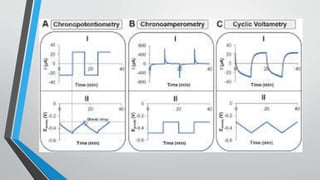


chronopotentiometry
Done by
K. Revathi
I-M.sc Chemistry
Introduction…
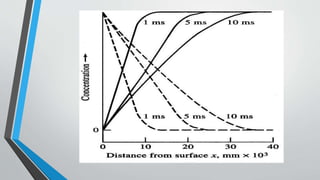
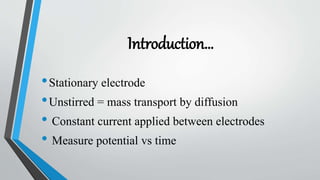
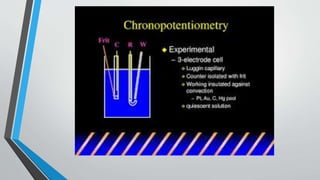
•Stationary electrode
•Unstirred = mass transport by diffusion
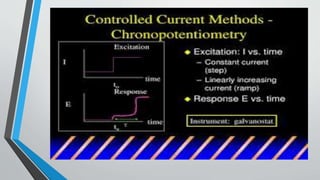
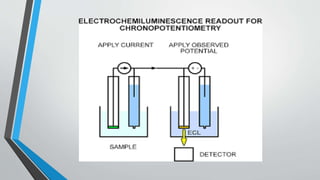
• Constant current applied between electrodes
• Measure potential vs time
Introduction
• Chronopotentiometry is useful for investigation of electroporation
phenomenon of bilayer lipid membranes.
• The measurements are provided in current-clamp conditions.
• This technique allows to obtain only simple pore in the membrane.
• The pore has size about few nano meters - size similar to the membrane
thickness.
• The pores are stable or irregular oscillating.
Theory of Chronopotentiometry
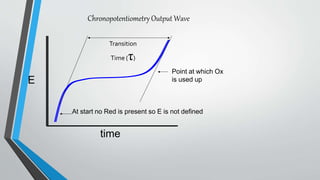
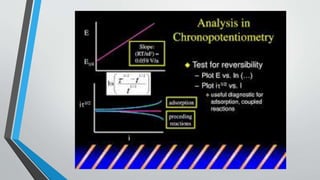
•A gradual change in E occurs as [Red] goes up and [Ox] goes
down (transition region) Ultimately the surface concentration of
Ox goes to zero & to sustain the constant current applied,
electrode potential makes a rapid change to the value required to
make a new process go
Chronopotentiometry Output Wave
E
time
Transition
Time (τ)
At start no Red is present so E is not defined
Point at which Ox
is used up
Hardware
•The program controls the KSP measurement system with
following modules:
• DPTG-461 - programmable potentiostat - galvanostat
ADC-1204 – analog – to - digital convereter.
DAC-1201 - digital-to- analog convereter.
TIMER-49 - programmable timer
• Measurements are made in a four-electrode arrangement
Features of the program
• saving of data and printing of the report.
• writing of data as a text file for using in worksheets and graphic
programs.
• selection 2-, 3- or 4-electrode system.
• setting up to 10 methods (sets of measurement parameters and
experiment descriptions).
• readout of data directly from the graph.
• readout of curve slope directly from the graph.
• zoom of the graph.
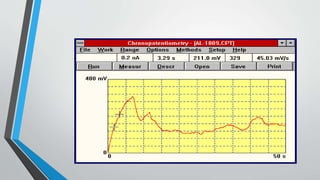
Mainwindow of the "Chronopotentiometry" program.
• The curve shows electroporation of the bilayer lipid membrane made from egg yolk lecithin.
• The begin increasing of the potential is for the membrane without pores.
• Membrane voltage increased with speed dependent on current intensity, membrane capacitance and
membrane resistance.
• When voltage attains to the breakdown voltage value the membrane resistance rapidly decreases
causing decreasing of voltage on the membrane.
• Size of the pore irregular oscillates and membrane potential changes.
• There is an irreversible breakdown of the membrane.
• The generated pore is full filled by the electrolyte.
• Disconnecting of the current flowing causes closing of the pore and recovering of uniform structure of
the membrane in time of seconds to minutes.
Used files
• CHRONPOT.EXE - main program file
CHRONPOT.INI - configuration file
CHRONPOT.HLP - help file
• DPTG.DLL - driver for the potentiostat/galvanostat module
ADC.DLL - driver for the analog-to-digital converter module
DAC.DLL - driver for the digital-to-analog converter module
TIMER.DLL - driver for the programmable timer module
Application of chrono potentiometric measurements
• studies of membrane electroporation phenomenon.
• studies of membrane transport processes.
• studies of basic properties of membranes as capacitance and
resistance.
Summary
• In reality it is better done by other methods.
• Chronopotentiometry illustrates constant current
situation in electrochemistry.
• Chronopotentiometry is very poor at handling
capacitive current.
Reference
1. S. Kalinowski and Z. Figaszewski, A four-electrode potentiostat-
galvanostat for studies of bilayer lipid membranes, Meas. Sci. Technol., 6 (1995)
1050-1056.
2. S. Kalinowski, G. Ibron, K. Bryl and Z. Figaszewski, Chrono potentiometric
studies of electroporation of bilayer lipid membranes, Biochim. Biophys. Acta, in
press (1998).
Thank you friends..

Chronopotentiometry

  • 1.
  • 2.
    Introduction… •Stationary electrode •Unstirred =mass transport by diffusion • Constant current applied between electrodes • Measure potential vs time
  • 3.
    Introduction • Chronopotentiometry isuseful for investigation of electroporation phenomenon of bilayer lipid membranes. • The measurements are provided in current-clamp conditions. • This technique allows to obtain only simple pore in the membrane. • The pore has size about few nano meters - size similar to the membrane thickness. • The pores are stable or irregular oscillating.
  • 6.
    Theory of Chronopotentiometry •Agradual change in E occurs as [Red] goes up and [Ox] goes down (transition region) Ultimately the surface concentration of Ox goes to zero & to sustain the constant current applied, electrode potential makes a rapid change to the value required to make a new process go
  • 9.
    Chronopotentiometry Output Wave E time Transition Time(τ) At start no Red is present so E is not defined Point at which Ox is used up
  • 14.
    Hardware •The program controlsthe KSP measurement system with following modules: • DPTG-461 - programmable potentiostat - galvanostat ADC-1204 – analog – to - digital convereter. DAC-1201 - digital-to- analog convereter. TIMER-49 - programmable timer • Measurements are made in a four-electrode arrangement
  • 15.
    Features of theprogram • saving of data and printing of the report. • writing of data as a text file for using in worksheets and graphic programs. • selection 2-, 3- or 4-electrode system. • setting up to 10 methods (sets of measurement parameters and experiment descriptions). • readout of data directly from the graph. • readout of curve slope directly from the graph. • zoom of the graph.
  • 17.
    Mainwindow of the"Chronopotentiometry" program. • The curve shows electroporation of the bilayer lipid membrane made from egg yolk lecithin. • The begin increasing of the potential is for the membrane without pores. • Membrane voltage increased with speed dependent on current intensity, membrane capacitance and membrane resistance. • When voltage attains to the breakdown voltage value the membrane resistance rapidly decreases causing decreasing of voltage on the membrane. • Size of the pore irregular oscillates and membrane potential changes. • There is an irreversible breakdown of the membrane. • The generated pore is full filled by the electrolyte. • Disconnecting of the current flowing causes closing of the pore and recovering of uniform structure of the membrane in time of seconds to minutes.
  • 18.
    Used files • CHRONPOT.EXE- main program file CHRONPOT.INI - configuration file CHRONPOT.HLP - help file • DPTG.DLL - driver for the potentiostat/galvanostat module ADC.DLL - driver for the analog-to-digital converter module DAC.DLL - driver for the digital-to-analog converter module TIMER.DLL - driver for the programmable timer module
  • 21.
    Application of chronopotentiometric measurements • studies of membrane electroporation phenomenon. • studies of membrane transport processes. • studies of basic properties of membranes as capacitance and resistance.
  • 23.
    Summary • In realityit is better done by other methods. • Chronopotentiometry illustrates constant current situation in electrochemistry. • Chronopotentiometry is very poor at handling capacitive current.
  • 24.
    Reference 1. S. Kalinowskiand Z. Figaszewski, A four-electrode potentiostat- galvanostat for studies of bilayer lipid membranes, Meas. Sci. Technol., 6 (1995) 1050-1056. 2. S. Kalinowski, G. Ibron, K. Bryl and Z. Figaszewski, Chrono potentiometric studies of electroporation of bilayer lipid membranes, Biochim. Biophys. Acta, in press (1998).
  • 25.