The Principle and Application
of Photocatalysis
Teacher: Dr. Xin Yan
E-mail: xinyan@chd.edu.cn
西安
Xi’an
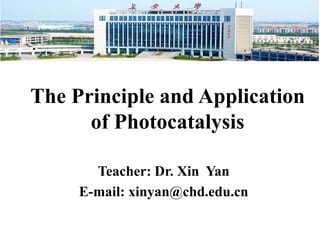
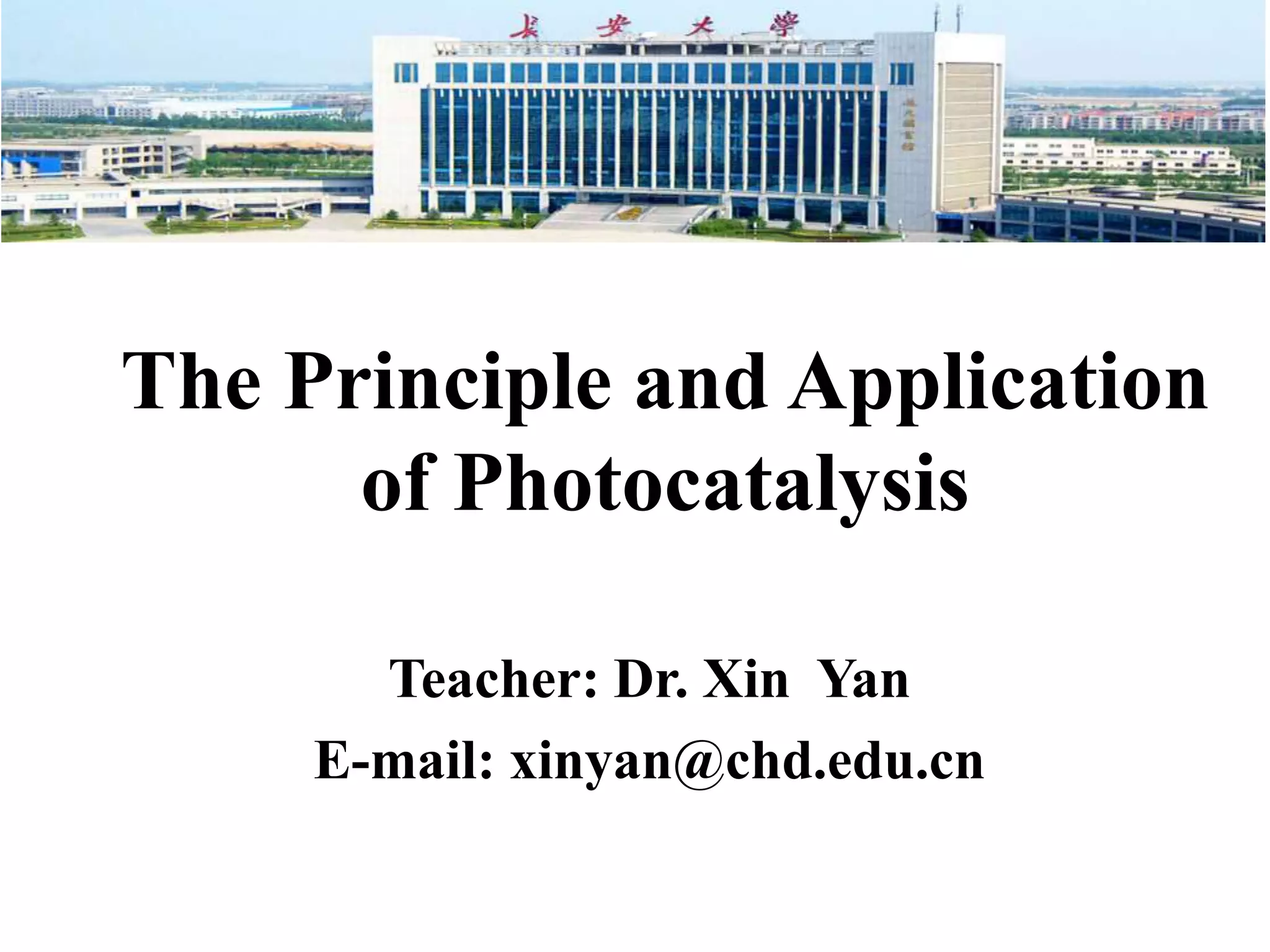
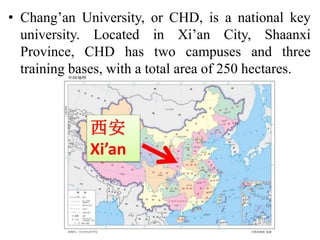
• Chang’an University, or CHD, is a national key
university. Located in Xi’an City, Shaanxi
Province, CHD has two campuses and three
training bases, with a total area of 250 hectares.
A Video Introduction to Xi’an
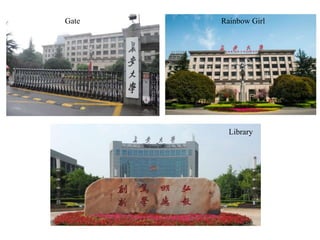
Gate Rainbow Girl
Library
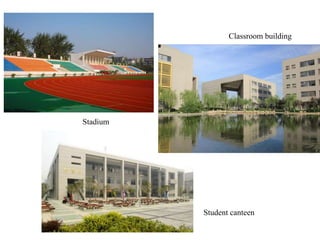
Classroom building
Student canteen
Stadium
Course Information
Brief introduction of Course
Course name
The principle and application of photocatalysis
Course Type
Specialized and basic course for postgraduate students
Credits: 2
Teaching Hours: 32 hours (2 hours every week)
Exam method
Presentation and assignments (paper reports)
The basic knowledge and principles of photocatalytic
reaction are described in a comprehensive and systematic way.
The research progress and achievements of the design,
preparation and modification of photocatalyst are introduced.
The research methods of the physicochemical properties of
photocatalytic materials, the evaluation methods of
photocatalytic activity are summarized. The applications of
hydrogen, self-cleaning and organic matter conversion were
introduced in depth.
Through the study of this course, students can
master the basic theory and concept of photocatalytic
materials, learn how to analyze and solve the design of
materials, establish the basic scientific way of thinking,
and cultivate students' ability to use theoretical
knowledge and engage in scientific practice.
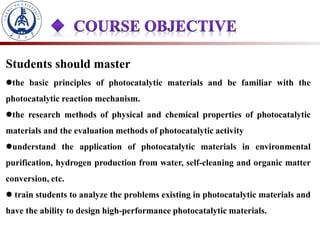
Students should master
the basic principles of photocatalytic materials and be familiar with the
photocatalytic reaction mechanism.
the research methods of physical and chemical properties of photocatalytic
materials and the evaluation methods of photocatalytic activity
understand the application of photocatalytic materials in environmental
purification, hydrogen production from water, self-cleaning and organic matter
conversion, etc.
 train students to analyze the problems existing in photocatalytic materials and
have the ability to design high-performance photocatalytic materials.
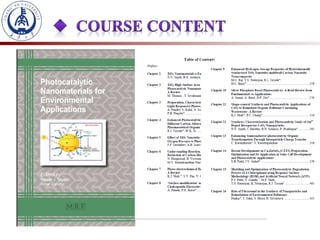
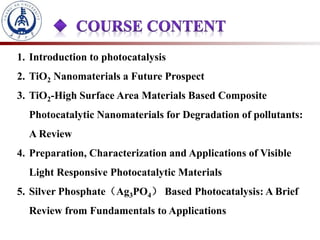
1. Introduction to photocatalysis
2. TiO2 Nanomaterials a Future Prospect
3. TiO2-High Surface Area Materials Based Composite
Photocatalytic Nanomaterials for Degradation of pollutants:
A Review
4. Preparation, Characterization and Applications of Visible
Light Responsive Photocatalytic Materials
5. Silver Phosphate(Ag3PO4) Based Photocatalysis: A Brief
Review from Fundamentals to Applications
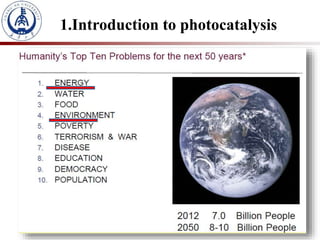
1.Introduction to photocatalysis
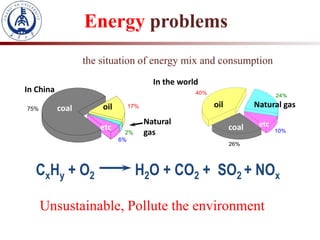
6%
2%
17%
75%
Energy problems
10%
24%
40%
26%
CxHy + O2 H2O + CO2 + SO2 + NOx
coal oil
Natural
gas
etc
In China
In the world
煤
其他
the situation of energy mix and consumption
Unsustainable, Pollute the environment
oil
coal
Natural gas
etc
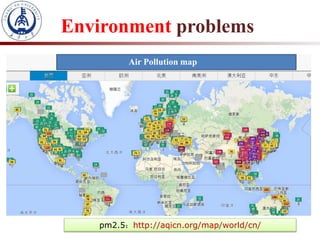
Air Pollution map
pm2.5:http://aqicn.org/map/world/cn/
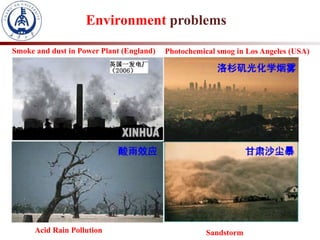
Environment problems
Smoke and dust in Power Plant (England) Photochemical smog in Los Angeles (USA)
Acid Rain Pollution Sandstorm
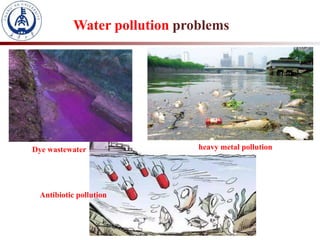
Water pollution problems
Dye wastewater heavy metal pollution
Antibiotic pollution
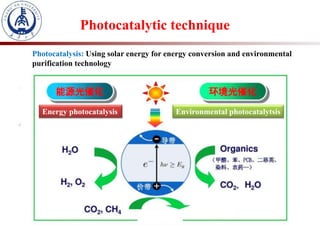
Photocatalytic technique
Photocatalysis: Using solar energy for energy conversion and environmental
purification technology
Energy photocatalysis Environmental photocatalytsis
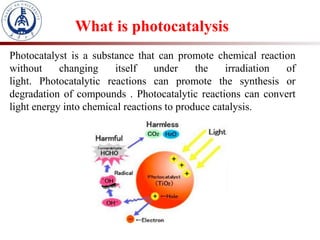
What is photocatalysis
Photocatalyst is a substance that can promote chemical reaction
without changing itself under the irradiation of
light. Photocatalytic reactions can promote the synthesis or
degradation of compounds . Photocatalytic reactions can convert
light energy into chemical reactions to produce catalysis.
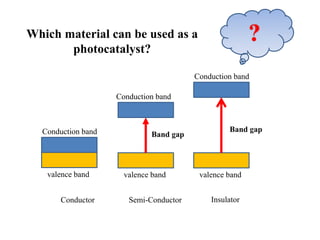
Conduction band
valence band
Conduction band
Conduction band
valence band valence band
Band gap
Band gap
Conductor Semi-Conductor Insulator
Which material can be used as a
photocatalyst?
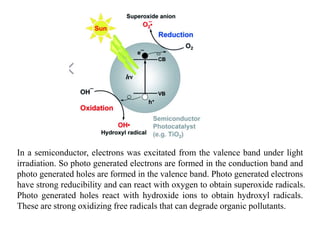
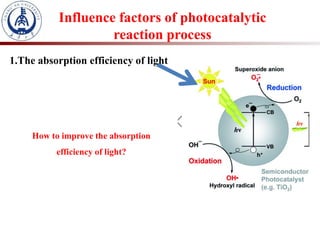
In a semiconductor, electrons was excitated from the valence band under light
irradiation. So photo generated electrons are formed in the conduction band and
photo generated holes are formed in the valence band. Photo generated electrons
have strong reducibility and can react with oxygen to obtain superoxide radicals.
Photo generated holes react with hydroxide ions to obtain hydroxyl radicals.
These are strong oxidizing free radicals that can degrade organic pollutants.
Question 1:
What can we do with photocatalysis?
Question 2:
What kind of enegry does photocatalysis use?
Question 3:
Which materials can be used as photocatalyst?
Influence factors of photocatalytic
reaction process
1.The absorption efficiency of light
How to improve the absorption
efficiency of light?
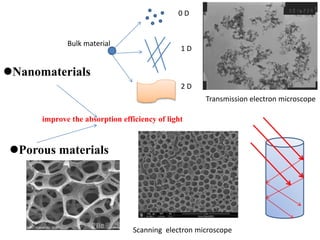
Nanomaterials
Porous materials
improve the absorption efficiency of light
Bulk material
0 D
1 D
2 D
Transmission electron microscope
Scanning electron microscope
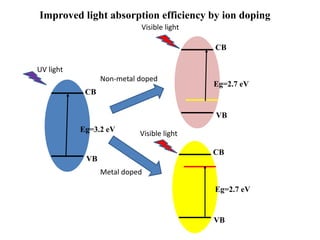
Eg=3.2 eV
Eg=2.7 eV
CB
VB
CB
VB
Eg=2.7 eV
CB
VB
UV light
Visible light
Visible light
Non-metal doped
Metal doped
Improved light absorption efficiency by ion doping
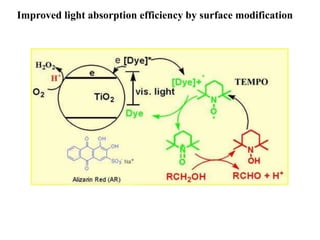
Improved light absorption efficiency by surface modification
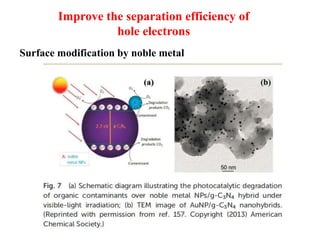
Improve the separation efficiency of
hole electrons
Surface modification by noble metal
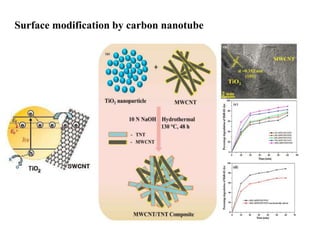
Surface modification by carbon nanotube
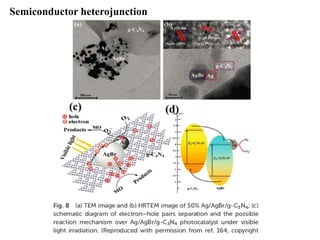
Semiconductor heterojunction
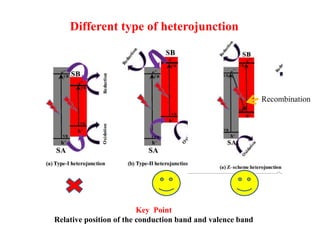
Different type of heterojunction
Key Point
Relative position of the conduction band and valence band
Recombination
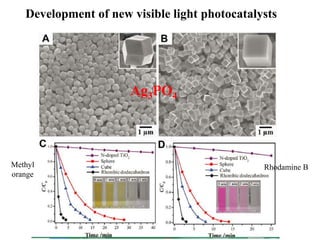
Development of new visible light photocatalysts
Ag3PO4
Methyl
orange
Rhodamine B
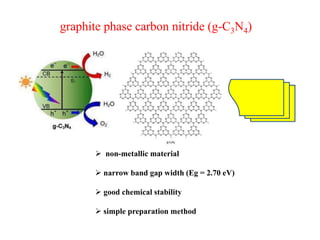
graphite phase carbon nitride (g-C3N4)
 non-metallic material
 narrow band gap width (Eg = 2.70 eV)
 good chemical stability
 simple preparation method
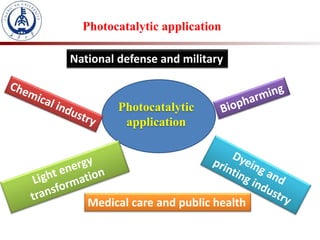
Photocatalytic application
Photocatalytic
application
National defense and military
Medical care and public health
Water treatment
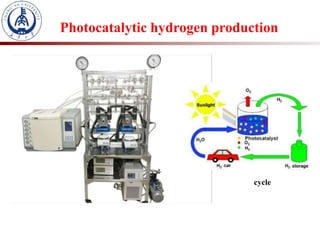
Photocatalytic hydrogen production
cycle
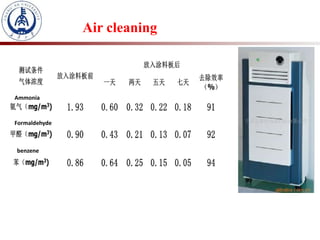
Air cleaning
Ammonia
Formaldehyde
benzene
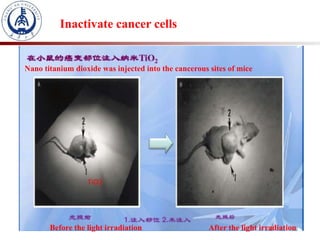
Inactivate cancer cells
Nano titanium dioxide was injected into the cancerous sites of mice
Before the light irradiation After the light irradiation
TiO2
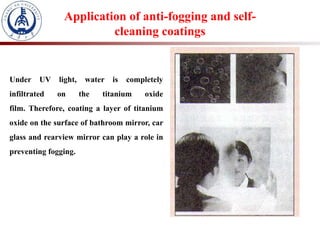
Under UV light, water is completely
infiltrated on the titanium oxide
film. Therefore, coating a layer of titanium
oxide on the surface of bathroom mirror, car
glass and rearview mirror can play a role in
preventing fogging.
Application of anti-fogging and self-
cleaning coatings
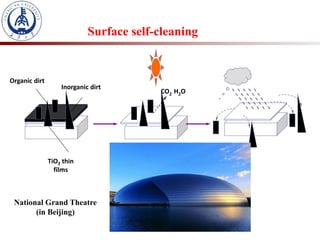
TiO2 thin
films
Organic dirt
Inorganic dirt
CO2 H2O
Surface self-cleaning
National Grand Theatre
(in Beijing)
Conclusion
Environmental problems and the energy crisis have created great challenges for scientist and
technologist at a global level. For the last 3-4 decades, major attention has been given for
photocatalysis to overcome these problems.
Photocatalysis is an effective catalytic process with potential applications in solving above
mentioned problems by degrading pollutants, reducing CO2 levels and water splitting,
respectively.
Till today, various photocatalytic materials, photocatalytic reactor, degradation of various
organic compound present in air and water have been studied and demonstrated. In spite of
significant research work carried out in the field of photocatalysis, there are several challenges
needing to be addressed such as enhancement in photocatalytic activity, development of
visible light activated photocatalysts, search of alternative photocatalytic materials, design and
development of photocatalytic reactors based on the irradiation source.

chapter1.pptx

  • 1.
    The Principle andApplication of Photocatalysis Teacher: Dr. Xin Yan E-mail: xinyan@chd.edu.cn
  • 2.
    西安 Xi’an • Chang’an University,or CHD, is a national key university. Located in Xi’an City, Shaanxi Province, CHD has two campuses and three training bases, with a total area of 250 hectares.
  • 3.
  • 4.
  • 5.
  • 6.
  • 7.
    Brief introduction ofCourse Course name The principle and application of photocatalysis Course Type Specialized and basic course for postgraduate students Credits: 2 Teaching Hours: 32 hours (2 hours every week) Exam method Presentation and assignments (paper reports)
  • 8.
    The basic knowledgeand principles of photocatalytic reaction are described in a comprehensive and systematic way. The research progress and achievements of the design, preparation and modification of photocatalyst are introduced. The research methods of the physicochemical properties of photocatalytic materials, the evaluation methods of photocatalytic activity are summarized. The applications of hydrogen, self-cleaning and organic matter conversion were introduced in depth.
  • 9.
    Through the studyof this course, students can master the basic theory and concept of photocatalytic materials, learn how to analyze and solve the design of materials, establish the basic scientific way of thinking, and cultivate students' ability to use theoretical knowledge and engage in scientific practice.
  • 10.
    Students should master thebasic principles of photocatalytic materials and be familiar with the photocatalytic reaction mechanism. the research methods of physical and chemical properties of photocatalytic materials and the evaluation methods of photocatalytic activity understand the application of photocatalytic materials in environmental purification, hydrogen production from water, self-cleaning and organic matter conversion, etc.  train students to analyze the problems existing in photocatalytic materials and have the ability to design high-performance photocatalytic materials.
  • 12.
    1. Introduction tophotocatalysis 2. TiO2 Nanomaterials a Future Prospect 3. TiO2-High Surface Area Materials Based Composite Photocatalytic Nanomaterials for Degradation of pollutants: A Review 4. Preparation, Characterization and Applications of Visible Light Responsive Photocatalytic Materials 5. Silver Phosphate(Ag3PO4) Based Photocatalysis: A Brief Review from Fundamentals to Applications
  • 13.
  • 14.
    6% 2% 17% 75% Energy problems 10% 24% 40% 26% CxHy +O2 H2O + CO2 + SO2 + NOx coal oil Natural gas etc In China In the world 煤 其他 the situation of energy mix and consumption Unsustainable, Pollute the environment oil coal Natural gas etc
  • 15.
  • 16.
    Environment problems Smoke anddust in Power Plant (England) Photochemical smog in Los Angeles (USA) Acid Rain Pollution Sandstorm
  • 17.
    Water pollution problems Dyewastewater heavy metal pollution Antibiotic pollution
  • 18.
    Photocatalytic technique Photocatalysis: Usingsolar energy for energy conversion and environmental purification technology Energy photocatalysis Environmental photocatalytsis
  • 19.
    What is photocatalysis Photocatalystis a substance that can promote chemical reaction without changing itself under the irradiation of light. Photocatalytic reactions can promote the synthesis or degradation of compounds . Photocatalytic reactions can convert light energy into chemical reactions to produce catalysis.
  • 20.
    Conduction band valence band Conductionband Conduction band valence band valence band Band gap Band gap Conductor Semi-Conductor Insulator Which material can be used as a photocatalyst?
  • 21.
    In a semiconductor,electrons was excitated from the valence band under light irradiation. So photo generated electrons are formed in the conduction band and photo generated holes are formed in the valence band. Photo generated electrons have strong reducibility and can react with oxygen to obtain superoxide radicals. Photo generated holes react with hydroxide ions to obtain hydroxyl radicals. These are strong oxidizing free radicals that can degrade organic pollutants.
  • 22.
    Question 1: What canwe do with photocatalysis? Question 2: What kind of enegry does photocatalysis use? Question 3: Which materials can be used as photocatalyst?
  • 23.
    Influence factors ofphotocatalytic reaction process 1.The absorption efficiency of light How to improve the absorption efficiency of light?
  • 24.
    Nanomaterials Porous materials improve theabsorption efficiency of light Bulk material 0 D 1 D 2 D Transmission electron microscope Scanning electron microscope
  • 25.
    Eg=3.2 eV Eg=2.7 eV CB VB CB VB Eg=2.7eV CB VB UV light Visible light Visible light Non-metal doped Metal doped Improved light absorption efficiency by ion doping
  • 26.
    Improved light absorptionefficiency by surface modification
  • 27.
    Improve the separationefficiency of hole electrons Surface modification by noble metal
  • 28.
    Surface modification bycarbon nanotube
  • 29.
  • 30.
    Different type ofheterojunction Key Point Relative position of the conduction band and valence band Recombination
  • 31.
    Development of newvisible light photocatalysts Ag3PO4 Methyl orange Rhodamine B
  • 32.
    graphite phase carbonnitride (g-C3N4)  non-metallic material  narrow band gap width (Eg = 2.70 eV)  good chemical stability  simple preparation method
  • 33.
  • 34.
  • 35.
  • 36.
  • 37.
    Inactivate cancer cells Nanotitanium dioxide was injected into the cancerous sites of mice Before the light irradiation After the light irradiation TiO2
  • 38.
    Under UV light,water is completely infiltrated on the titanium oxide film. Therefore, coating a layer of titanium oxide on the surface of bathroom mirror, car glass and rearview mirror can play a role in preventing fogging. Application of anti-fogging and self- cleaning coatings
  • 39.
    TiO2 thin films Organic dirt Inorganicdirt CO2 H2O Surface self-cleaning National Grand Theatre (in Beijing)
  • 40.
    Conclusion Environmental problems andthe energy crisis have created great challenges for scientist and technologist at a global level. For the last 3-4 decades, major attention has been given for photocatalysis to overcome these problems. Photocatalysis is an effective catalytic process with potential applications in solving above mentioned problems by degrading pollutants, reducing CO2 levels and water splitting, respectively. Till today, various photocatalytic materials, photocatalytic reactor, degradation of various organic compound present in air and water have been studied and demonstrated. In spite of significant research work carried out in the field of photocatalysis, there are several challenges needing to be addressed such as enhancement in photocatalytic activity, development of visible light activated photocatalysts, search of alternative photocatalytic materials, design and development of photocatalytic reactors based on the irradiation source.
Editor's Notes

  • #13 I've given you an electronic version of the course, and that's the main content, but not the whole thing