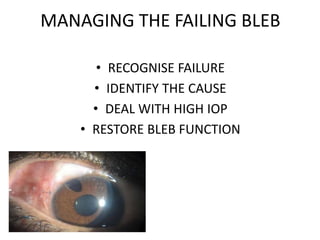
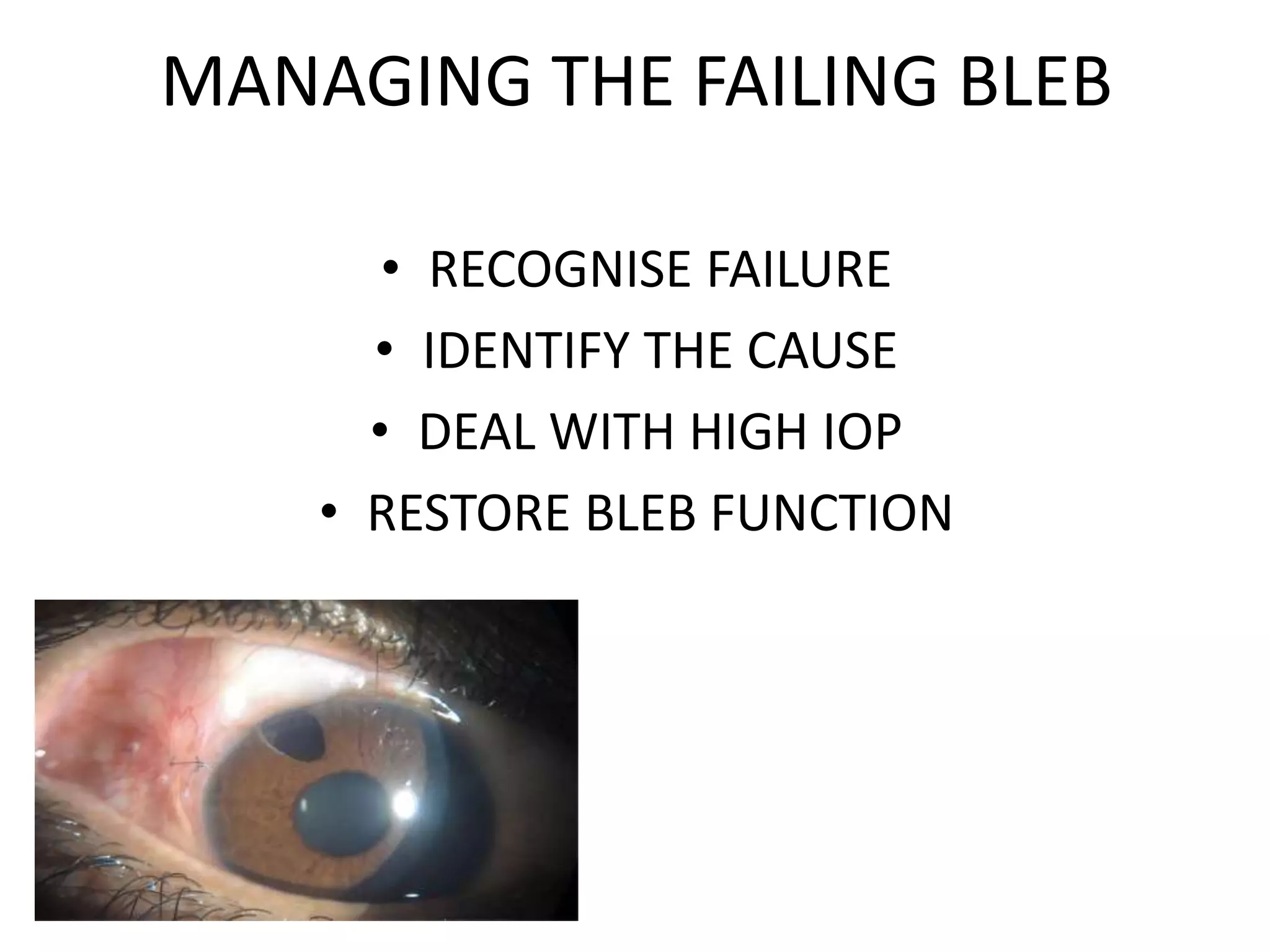
MANAGING THE FAILING BLEB
• RECOGNISE FAILURE
• IDENTIFY THE CAUSE
• DEAL WITH HIGH IOP
• RESTORE BLEB FUNCTION
Risk factors for failing bleb
• Young age
• Males
• Black race
• Congenital and juvenile glaucoma
• Subconjunctival hemorrhage
• Excessive inflammation
– Long-term topical glaucoma therapy
– Traumatic glaucoma
– NVG
• Reaction to sutures
HISTOLOGY
• EPITHELIUM
– Similar in both functioning and failed blebs
• SUBEPITHELIAL CONNECTIVE TISSUE
– Loosely arranged tissue with clear spaces
– Dense collagenous tissue with no spaces
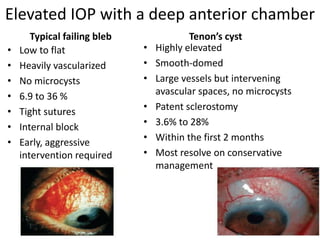
Elevated IOP with a deep anterior chamber
Typical failing bleb
• Low to flat
• Heavily vascularized
• No microcysts
• 6.9 to 36 %
• Tight sutures
• Internal block
• Early, aggressive
intervention required
Tenon’s cyst
• Highly elevated
• Smooth-domed
• Large vessels but intervening
avascular spaces, no microcysts
• Patent sclerostomy
• 3.6% to 28%
• Within the first 2 months
• Most resolve on conservative
management
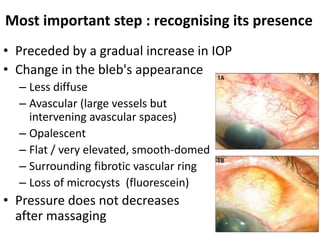
Most important step : recognising its presence
• Preceded by a gradual increase in IOP
• Change in the bleb's appearance
– Less diffuse
– Avascular (large vessels but
intervening avascular spaces)
– Opalescent
– Flat / very elevated, smooth-domed
– Surrounding fibrotic vascular ring
– Loss of microcysts (fluorescein)
• Pressure does not decreases
after massaging
SEEK OUT THE CAUSE
• BLOCK OF INTERNAL OSTIUM
• EXTERNAL BLOCK (most common)
• INTERNAL BLOCK
– Iris
– Ciliary body
– Vitreous
– Blood clot
– Fibrin
• Gonioscopic evaluation
• EXTERNAL BLOCK
– Tenon’s cyst
– Episcleral scarring
• Careful slit lamp evaluation
MANAGEMENT
RAISED IOP
• Digital ocular pressure
– steady pressure over the inferior sclera, through
the eyelids for 10 to 15 seconds
– intermittent
– taught to the patient
• Medical
– Topical (avoid PG anlogues, Brimonidine)
– Systemic
• Frequent anti-inflammatory therapy
• Laser suture lysis
– first 3 wks without antimetabolites; 8 wks with
antimetabolites
– argon or green light laser
– Nd YAG laser. Ruptures conjunctival and episcleral
blood vessels
– 400 mW, 0.01 seconds and 50 μm
– one suture at a time, if no effect within 1 hour, second
suture lysis or removal may be considered
RESTORING BLEB FUNCTION
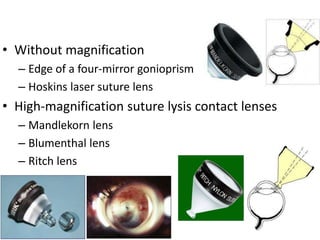
• Without magnification
– Edge of a four-mirror gonioprism
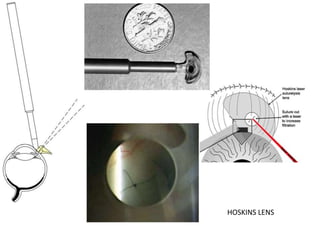
– Hoskins laser suture lens
• High-magnification suture lysis contact lenses
– Mandlekorn lens
– Blumenthal lens
– Ritch lens
HOSKINS LENS
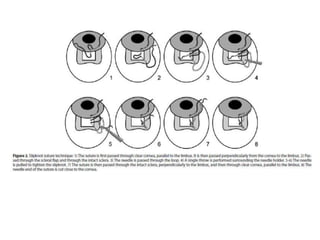
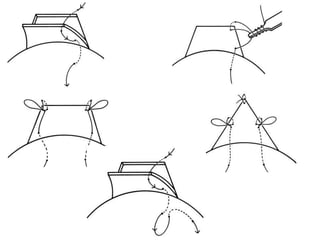
• Releasable sutures
• Topical mitomycin C (0.02% QID for 2 weeks)
• Bleb revision
BLOCKED INTERNAL OSTIUM
• Intracameral tissue plasminogen activator (blocked
internal ostium; blood or fibrin clot )
– 6 to 12.5 µg
– Frozen (TPA) - 25 g/ 0.1ml is diluted with 0.9 % NaCl
• Low-energy argon laser therapy / Nd:YAG laser
disruption (retract the tissue)
– Iris
– Vitreous
• Internal bleb revision
EXTERNAL BLEB REVISION
• Tenon’s cyst / episcleral scarring unresponsive to
conservative management
• First described by Ferrer1 in 1941
– conjunctival dialysis
– incising the scar tissue
– conjunctiva from the sclera with a spatula
• Pederson and Smith2
– needling encapsulated blebs
– 69% success
1.Ferrer H. Conjunctival dialysis in the treatment of glaucoma recurrent after sclerectomy. Am J Ophthalmol. 1941;24:788-
790.
2.Pederson JE, Smith SG. Surgical management of encapsulated filtering blebs. Ophthalmology. 1985;92:955-958.
• Ewing and Stamper3
– 5-fluorouracil (5-FU) in bleb needle revisions
– Postop subconjunctival injections
– 91.6% success rate
– 63.6% : adjunctive medications
• Shin et al4
– single injections of 5-FU during needling
– 80% success rate
– 79% : adjunctive medications
3.Ewing RH, Stamper RL. Needle revision with and without 5-FU for the treatment of failed
filtering blebs.Am J Ophthalmol. 1990;110:254-259.
4. Shin DH, Juzych MS, Khatana AK, et al. Needling revision of failed filtering blebs with
adjunctive 5-fluorouracil. Ophthalmic Surg. 1993;24:242-248.
• Mardelli et al.5 in 1996,
– Slit-lamp procedure
– Mitomycin C (MMC) injections
– 92% success rate
5.Mardelli PG, Lederer CM Jr, Murray PL, et al. Slit-lamp needle revision of failed filtering
blebs using mitomycin C. Ophthalmology. 1996;103:1946-1955.
• Risk factors for failed needling
– Pre procedure IOP > 30 mm Hg
– Trabeculectomy without MMC
– Immediate post procedure IOP >10 mm Hg
– After 4 months of trabeculectomy6
6.Gutierrez-Ortiz C, Cabarga C, Teus MA. Prospective evaluation of preoperative
factors associated with successful mitomycin C needling of failed filtration blebs. J
Glaucoma. 2006;15:98-102.
TECHNIQUE FOR NEEDLING
• Goal :
– Increase the permeability of the bleb's wall
– Produce a more diffuse, better functioning bleb.
• Slit lamp / Operation theatre
– Informed consent
– Antibiotic drops
– Clean-drape if in OT
– Topical anaesthetic
– Lid speculum
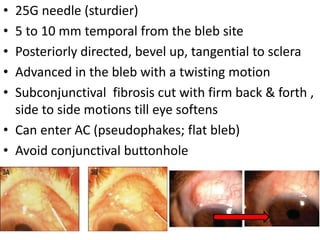
• 25G needle (sturdier)
• 5 to 10 mm temporal from the bleb site
• Posteriorly directed, bevel up, tangential to sclera
• Advanced in the bleb with a twisting motion
• Subconjunctival fibrosis cut with firm back & forth ,
side to side motions till eye softens
• Can enter AC (pseudophakes; flat bleb)
• Avoid conjunctival buttonhole
• Can be accompanied with
– Subconjunctival injection of MMC (0.1 mL 0.04
mg/mL)
– 5-FU (5mg in 0.1 mL lignocaine) given
• 180 degrees away from the bleb
• 15 to 50 mg in 3-10 injection over 3 weeks
• Antibiotic/steroid drops for 2-3 weeks
• Digital massage
COMPLICATIONS
• HYPOTONY
– Buttonhole
– Aggressive neeedling
• BLEBITIS
• ENDOPHTHALMITIS
• EPITHELIAL TOXICITY (5-FU)
• ENDOTHELIAL TOXICITY (MMC)
• MMC drops comparable to 5-FU injections in
terms of
– IOP, bleb appearance,
– success rate, (68.4% MMC, 77.8% 5-FU)
– number of glaucoma medications,
– visual outcome,
– overall complications
Pakravan M, Miraftabi A, Yazdani S.Topical Mitomycin-C versus Subconjunctival 5-
Fluorouracil for Management of Bleb Failure. J Ophthalmic Vis Res. 2011
Apr;6(2):78-86.
TOPICAL MMC
• SIDE EFFECTS
– Local irritation, hyperaemia,
– Epiphora (Punctal stenosis),
– Allergy,
– Keratoconjunctivitis
– Corneal abrasion (superficial punctate keratitis)
– Cataract,
– Persisting keratoconjunctivitis,
– Limbal stem cell deficiency
Shields CL, Naseripour M, Shields JA. Topical mitomycin C for extensive, recurrent conjunctival-corneal squamous cell carcinoma. Am J
Ophthalmol 2002;133:601–6.
Fucht-Pery J, Rozenman Y. Mitomycin C therapy for corneal intraepithelial neoplasia. Am J Ophthalmol1994;117:164–8.
Song JS, Kim JH, Yang M, et al. Mitomycin-C concentration in cornea and aqueous humor and apoptosis in the stroma after mitomycin-C
application. Cornea 2007;26:461–
• Subconjunctival 5-FU application more effective
therapy than bevacizumab for needling
procedures in failed trabeculectomy blebs.
Simsek T1, Cankaya AB, Elgin U. Comparison of needle revision with subconjunctival
bevacizumab and 5-fluorouracil injection of failed trabeculectomy blebs. J Ocul Pharmacol Ther.
2012 Oct;28(5):542-6.

Managing the failing bleb

  • 1.
    MANAGING THE FAILINGBLEB • RECOGNISE FAILURE • IDENTIFY THE CAUSE • DEAL WITH HIGH IOP • RESTORE BLEB FUNCTION
  • 2.
    Risk factors forfailing bleb • Young age • Males • Black race • Congenital and juvenile glaucoma • Subconjunctival hemorrhage • Excessive inflammation – Long-term topical glaucoma therapy – Traumatic glaucoma – NVG • Reaction to sutures
  • 3.
    HISTOLOGY • EPITHELIUM – Similarin both functioning and failed blebs • SUBEPITHELIAL CONNECTIVE TISSUE – Loosely arranged tissue with clear spaces – Dense collagenous tissue with no spaces
  • 4.
    Elevated IOP witha deep anterior chamber Typical failing bleb • Low to flat • Heavily vascularized • No microcysts • 6.9 to 36 % • Tight sutures • Internal block • Early, aggressive intervention required Tenon’s cyst • Highly elevated • Smooth-domed • Large vessels but intervening avascular spaces, no microcysts • Patent sclerostomy • 3.6% to 28% • Within the first 2 months • Most resolve on conservative management
  • 5.
    Most important step: recognising its presence • Preceded by a gradual increase in IOP • Change in the bleb's appearance – Less diffuse – Avascular (large vessels but intervening avascular spaces) – Opalescent – Flat / very elevated, smooth-domed – Surrounding fibrotic vascular ring – Loss of microcysts (fluorescein) • Pressure does not decreases after massaging
  • 6.
    SEEK OUT THECAUSE • BLOCK OF INTERNAL OSTIUM • EXTERNAL BLOCK (most common)
  • 7.
    • INTERNAL BLOCK –Iris – Ciliary body – Vitreous – Blood clot – Fibrin • Gonioscopic evaluation • EXTERNAL BLOCK – Tenon’s cyst – Episcleral scarring • Careful slit lamp evaluation
  • 8.
  • 9.
    RAISED IOP • Digitalocular pressure – steady pressure over the inferior sclera, through the eyelids for 10 to 15 seconds – intermittent – taught to the patient • Medical – Topical (avoid PG anlogues, Brimonidine) – Systemic
  • 10.
    • Frequent anti-inflammatorytherapy • Laser suture lysis – first 3 wks without antimetabolites; 8 wks with antimetabolites – argon or green light laser – Nd YAG laser. Ruptures conjunctival and episcleral blood vessels – 400 mW, 0.01 seconds and 50 μm – one suture at a time, if no effect within 1 hour, second suture lysis or removal may be considered RESTORING BLEB FUNCTION
  • 11.
    • Without magnification –Edge of a four-mirror gonioprism – Hoskins laser suture lens • High-magnification suture lysis contact lenses – Mandlekorn lens – Blumenthal lens – Ritch lens
  • 12.
  • 13.
    • Releasable sutures •Topical mitomycin C (0.02% QID for 2 weeks) • Bleb revision BLOCKED INTERNAL OSTIUM • Intracameral tissue plasminogen activator (blocked internal ostium; blood or fibrin clot ) – 6 to 12.5 µg – Frozen (TPA) - 25 g/ 0.1ml is diluted with 0.9 % NaCl • Low-energy argon laser therapy / Nd:YAG laser disruption (retract the tissue) – Iris – Vitreous • Internal bleb revision
  • 16.
    EXTERNAL BLEB REVISION •Tenon’s cyst / episcleral scarring unresponsive to conservative management • First described by Ferrer1 in 1941 – conjunctival dialysis – incising the scar tissue – conjunctiva from the sclera with a spatula • Pederson and Smith2 – needling encapsulated blebs – 69% success 1.Ferrer H. Conjunctival dialysis in the treatment of glaucoma recurrent after sclerectomy. Am J Ophthalmol. 1941;24:788- 790. 2.Pederson JE, Smith SG. Surgical management of encapsulated filtering blebs. Ophthalmology. 1985;92:955-958.
  • 17.
    • Ewing andStamper3 – 5-fluorouracil (5-FU) in bleb needle revisions – Postop subconjunctival injections – 91.6% success rate – 63.6% : adjunctive medications • Shin et al4 – single injections of 5-FU during needling – 80% success rate – 79% : adjunctive medications 3.Ewing RH, Stamper RL. Needle revision with and without 5-FU for the treatment of failed filtering blebs.Am J Ophthalmol. 1990;110:254-259. 4. Shin DH, Juzych MS, Khatana AK, et al. Needling revision of failed filtering blebs with adjunctive 5-fluorouracil. Ophthalmic Surg. 1993;24:242-248.
  • 18.
    • Mardelli etal.5 in 1996, – Slit-lamp procedure – Mitomycin C (MMC) injections – 92% success rate 5.Mardelli PG, Lederer CM Jr, Murray PL, et al. Slit-lamp needle revision of failed filtering blebs using mitomycin C. Ophthalmology. 1996;103:1946-1955.
  • 19.
    • Risk factorsfor failed needling – Pre procedure IOP > 30 mm Hg – Trabeculectomy without MMC – Immediate post procedure IOP >10 mm Hg – After 4 months of trabeculectomy6 6.Gutierrez-Ortiz C, Cabarga C, Teus MA. Prospective evaluation of preoperative factors associated with successful mitomycin C needling of failed filtration blebs. J Glaucoma. 2006;15:98-102.
  • 20.
    TECHNIQUE FOR NEEDLING •Goal : – Increase the permeability of the bleb's wall – Produce a more diffuse, better functioning bleb. • Slit lamp / Operation theatre – Informed consent – Antibiotic drops – Clean-drape if in OT – Topical anaesthetic – Lid speculum
  • 21.
    • 25G needle(sturdier) • 5 to 10 mm temporal from the bleb site • Posteriorly directed, bevel up, tangential to sclera • Advanced in the bleb with a twisting motion • Subconjunctival fibrosis cut with firm back & forth , side to side motions till eye softens • Can enter AC (pseudophakes; flat bleb) • Avoid conjunctival buttonhole
  • 22.
    • Can beaccompanied with – Subconjunctival injection of MMC (0.1 mL 0.04 mg/mL) – 5-FU (5mg in 0.1 mL lignocaine) given • 180 degrees away from the bleb • 15 to 50 mg in 3-10 injection over 3 weeks • Antibiotic/steroid drops for 2-3 weeks • Digital massage
  • 23.
    COMPLICATIONS • HYPOTONY – Buttonhole –Aggressive neeedling • BLEBITIS • ENDOPHTHALMITIS • EPITHELIAL TOXICITY (5-FU) • ENDOTHELIAL TOXICITY (MMC)
  • 24.
    • MMC dropscomparable to 5-FU injections in terms of – IOP, bleb appearance, – success rate, (68.4% MMC, 77.8% 5-FU) – number of glaucoma medications, – visual outcome, – overall complications Pakravan M, Miraftabi A, Yazdani S.Topical Mitomycin-C versus Subconjunctival 5- Fluorouracil for Management of Bleb Failure. J Ophthalmic Vis Res. 2011 Apr;6(2):78-86.
  • 25.
    TOPICAL MMC • SIDEEFFECTS – Local irritation, hyperaemia, – Epiphora (Punctal stenosis), – Allergy, – Keratoconjunctivitis – Corneal abrasion (superficial punctate keratitis) – Cataract, – Persisting keratoconjunctivitis, – Limbal stem cell deficiency Shields CL, Naseripour M, Shields JA. Topical mitomycin C for extensive, recurrent conjunctival-corneal squamous cell carcinoma. Am J Ophthalmol 2002;133:601–6. Fucht-Pery J, Rozenman Y. Mitomycin C therapy for corneal intraepithelial neoplasia. Am J Ophthalmol1994;117:164–8. Song JS, Kim JH, Yang M, et al. Mitomycin-C concentration in cornea and aqueous humor and apoptosis in the stroma after mitomycin-C application. Cornea 2007;26:461–
  • 26.
    • Subconjunctival 5-FUapplication more effective therapy than bevacizumab for needling procedures in failed trabeculectomy blebs. Simsek T1, Cankaya AB, Elgin U. Comparison of needle revision with subconjunctival bevacizumab and 5-fluorouracil injection of failed trabeculectomy blebs. J Ocul Pharmacol Ther. 2012 Oct;28(5):542-6.