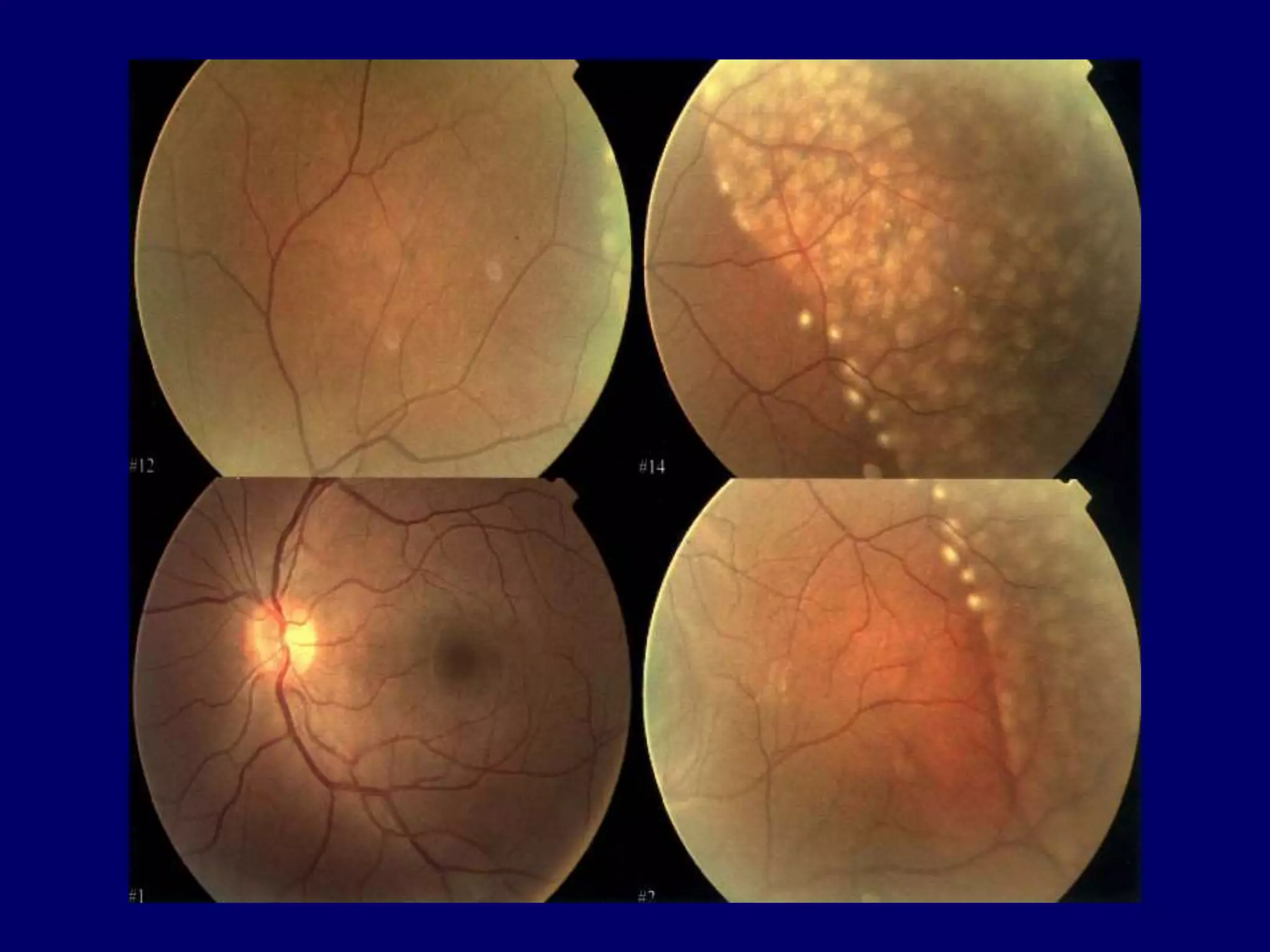
RETINOSCHISIS AND
RETINAL DETACHMENT
BY
A-L SIAM
cd
ta
ta
mc
tp
p
a
T
T = Full-thickness retinal tear
with retinal detachment
a = anterior leaf of retinoschisis
p = posterior leaf
ta = anterior leaf holes
tp = posterior leaf breaks
cd =cyst in old detacht.
mc = macular cyst
Retinoschisis
Retinal
Detacht.
Old-standing
ret. det.with
cyst formation
Ret.det
Retinoschisis
AETIOLOGY AND TYPES
 Sex-linked( or X-linked ),commonly called
Juvenile retinoschisis
Males :
Related to vitreo-tapeto-retinal degeneration with
macular aberration
RETINOSCHISIS
 Degenerative
Both sexes :
Juvenile and Senile degenerative retinoschisis
Related to typical cystoid degeneration,
and reticular cystoid degeneration
SEX–LINKED
JUVENILE RETINOSCHISIS
Affects one in 5,000 to 25,000 individuals,
primarily young males
men who inherit the disease from their unaffected carrier mothers
Males who inherit the disease from their
unaffected carrier mothers
Very few affected individuals go completely
blind from retinoschisis
Sex linked or X-linked (or Juvenile retinoschisis)
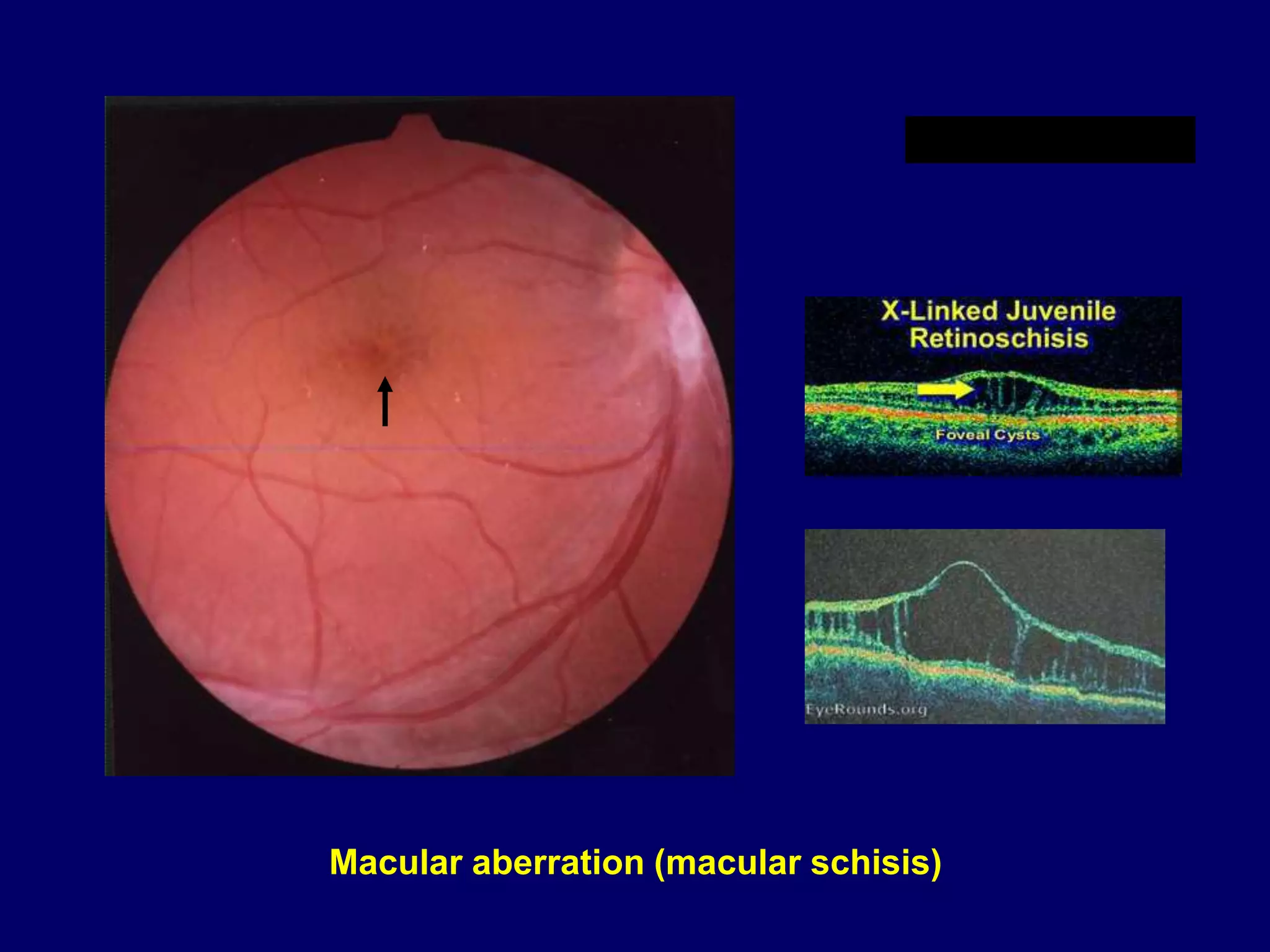
Macular
aberration
DEHISCENCES IN NERVE FIBER LAYER
Macular aberration (macular schisis)
SEX–LINKED OR X–LINKED
RETINOSCHISIS
 Juvenile retinoschisis
 Sex-linked or X-linked vitreoretinal degeneration
 Idiopathic retinoschisis
 Congenital vascular veils of the vitreous
 Congenital retinoscis
 Congenital cystic detachment
 Polycystic detachment of the retina
Synonyms :
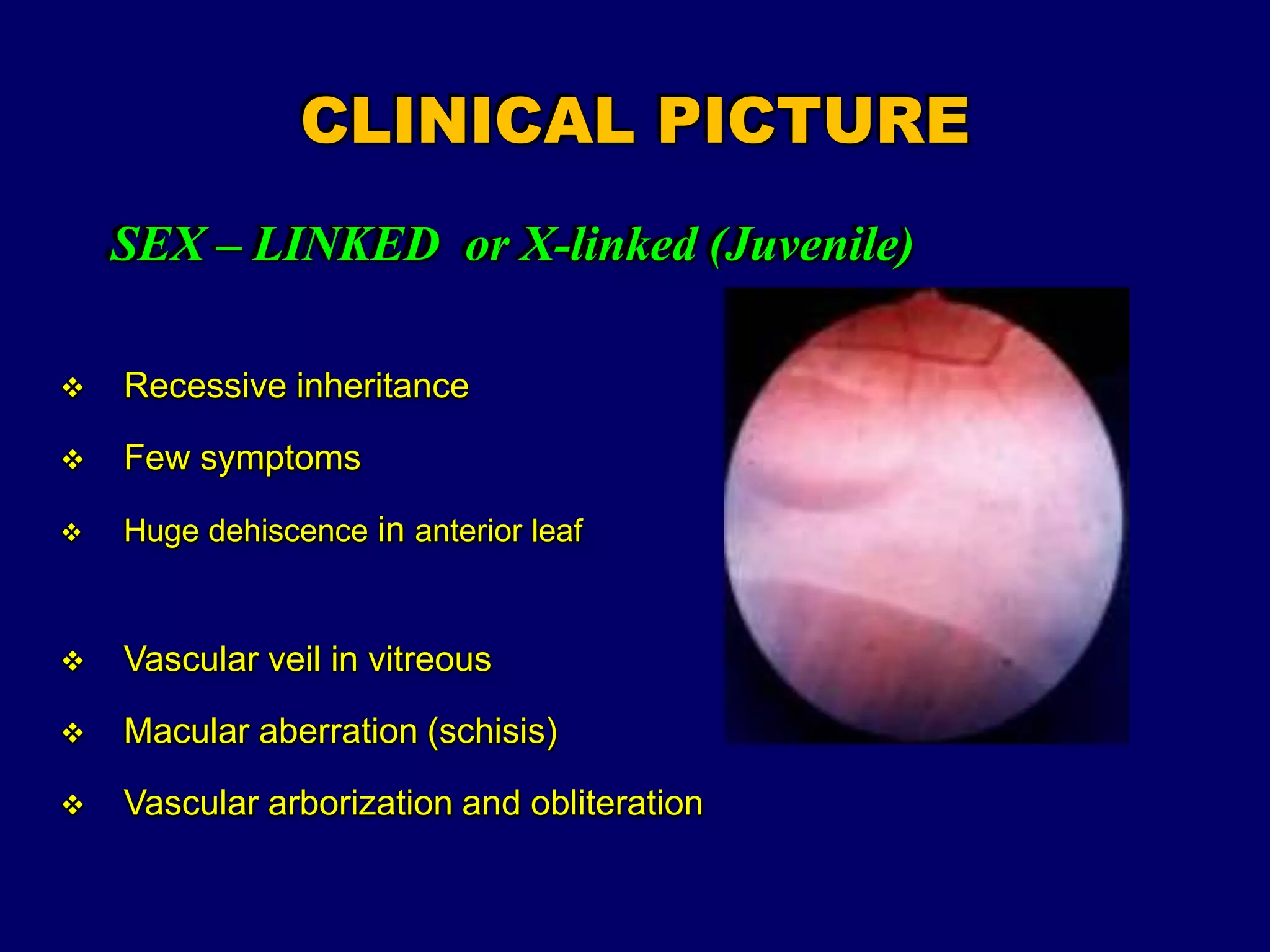
CLINICAL PICTURE
 Recessive inheritance
 Few symptoms
 Huge dehiscence in anterior leaf
 Vascular veil in vitreous
 Macular aberration (schisis)
 Vascular arborization and obliteration
SEX – LINKED or X-linked (Juvenile)
HEREDITY OF CONGENITAL
RETINOSCHISIS
A patient (male) with congenital retinoschisis:
- None of his sons will be affected or be a
carrier:
- 100% of his daughters will be carriers
A carrier (female):
- 50% of her sons will be affected
- 50% of her daughters will be carriers
DEGENERATIVE RETINOSCHISIS
Juvenile & senile
Incidence ----------------------------- All ages ………3.7%
---------------------------- 40 years +……. 7%
Bilateral…………………………………………... 82%
Inferior temporal ………………………………… 72%
Extended post – equatorially…...………........... 42%
Ratio schisis to detach. in general population….. 53:1
CLINICAL STUDY
Bullous
Flat
Two Types
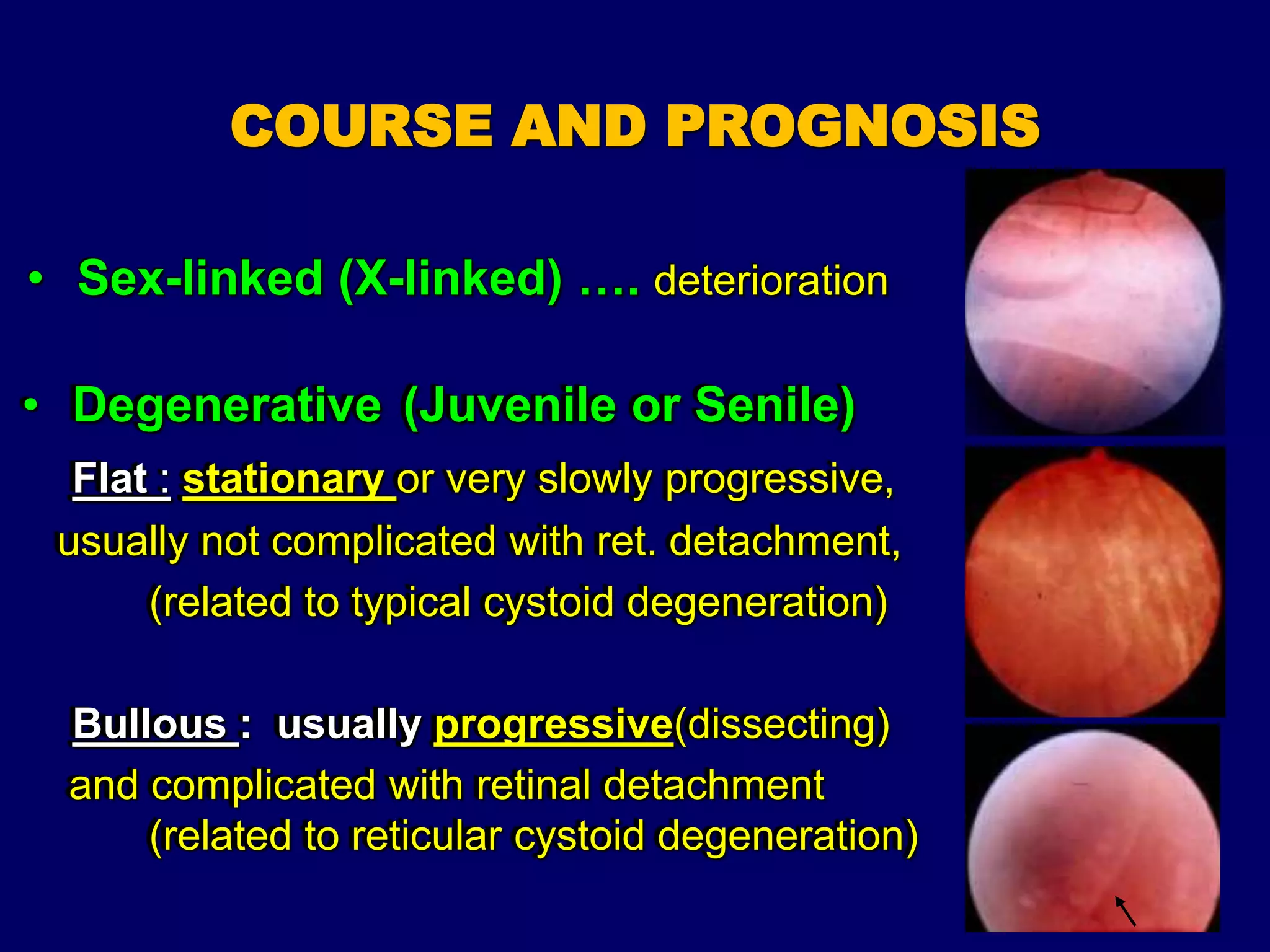
COURSE AND PROGNOSIS
• Sex-linked (X-linked) …. deterioration
• Degenerative (Juvenile or Senile)
Flat : stationary or very slowly progressive,
usually not complicated with ret. detachment,
(related to typical cystoid degeneration)
Bullous : usually progressive(dissecting)
and complicated with retinal detachment
(related to reticular cystoid degeneration)
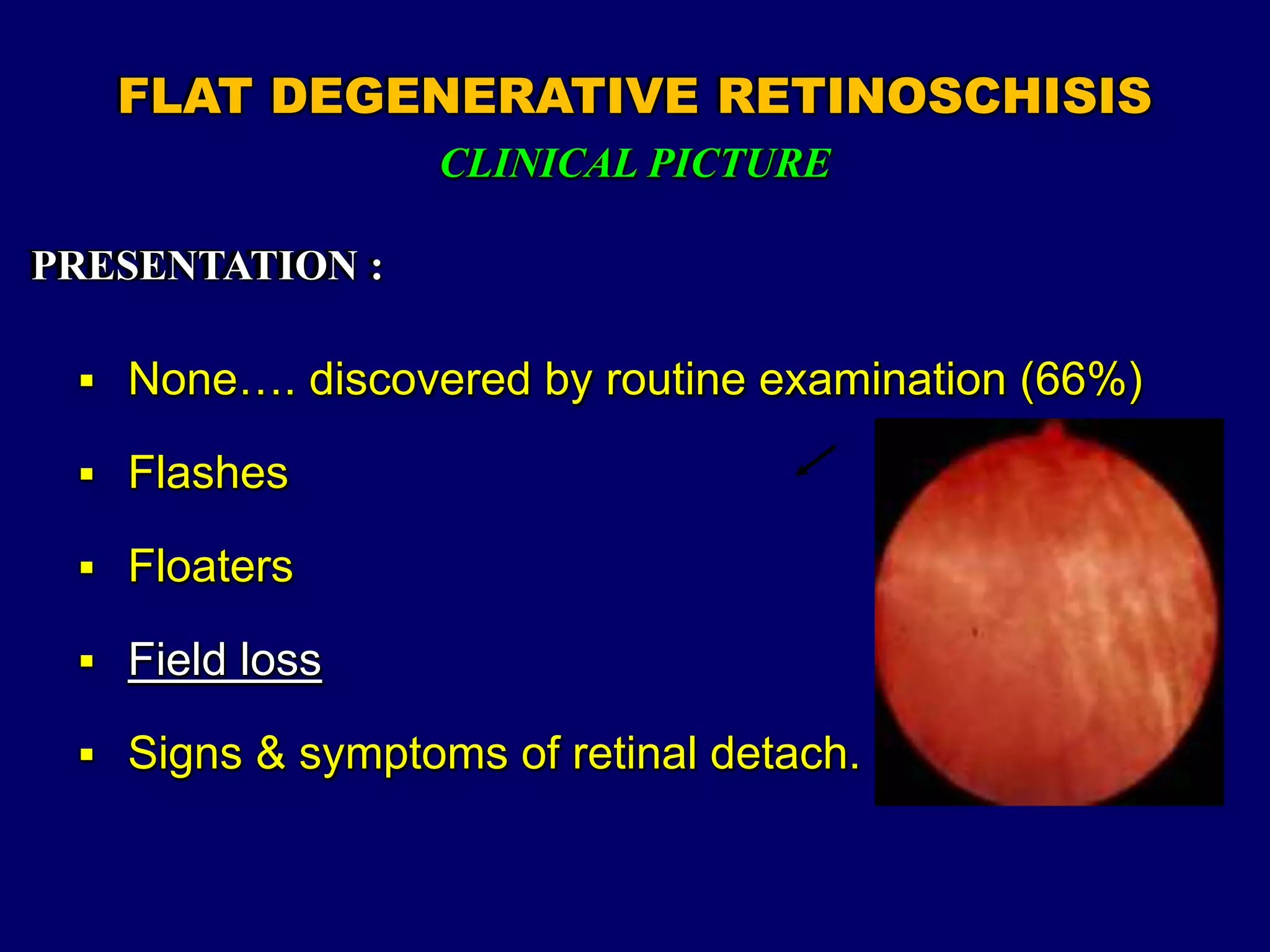
FLAT DEGENERATIVE RETINOSCHISIS
 None…. discovered by routine examination (66%)
 Flashes
 Floaters
 Field loss
 Signs & symptoms of retinal detach.
CLINICAL PICTURE
PRESENTATION :
FLAT DEGENERATIVE
RETINOSCHISIS
 Inferior temporal & temporal location
 Flat smooth elevation
 Scleral indentation : white without pressure
 Striations or flecks (fresh snow flakes)
 Retinal vessels, obliterated peripherally
 Pink outer wall holes
 Vitreous detachment
 Absolute field defects
OPHTHALMOSCOPIC FEATURES
JUVENILE “DEGENERATIVE” RETINOSCHISIS
(age 15 – 40)
 Isolated non-hereditary cases in both sexes
 Has many of the characteristics of senile retinoschisis, and,
therefore, more related to it
 Not associated with macular aberrations but often associated with
choroidal degeneration
 Usually more flat than bullous
 Variable even in both eyes of affected individuals
 Can not be sure of time of incidence
 Course stationary, progressive or complicated with retinal
detachment …………….(very rare)
Flat + Bullous Flat
Flat
Bullous
The Two types of degenerative retinoschisis,
may be present in the same eye
Degenerative bullous retinoschisis- with ret. det. due to outer wall holes.
DIFFERENTIAL DIAGNOSIS
of
 Retinal detachment
 Secondary retinoschisis
 Old-standing retinal detacht.
 Retinal detachment  retinoschisis
Degenerative Retinoschisis
HISTOPATHOLOGY
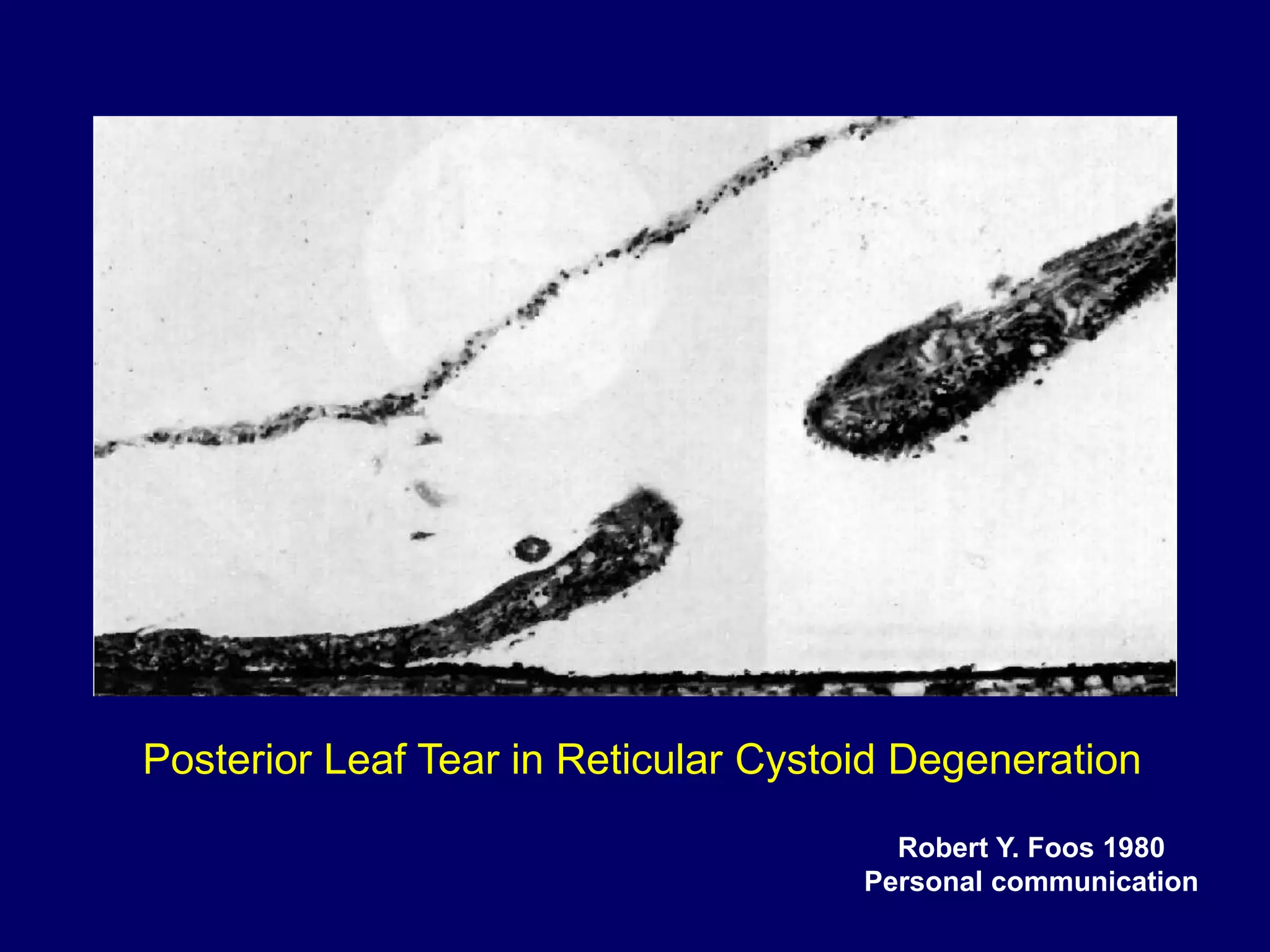
Sex–linked …….. Splitting in the nerve fiber layer
Senile Flat………. related to typical cystoid
degeneration
Bullous … related to reticular cystoid
degeneration
Typical
Reticular
Robert Y. Foos 1980
Personal communication
Bullous retinoschisis Flat retinoschisis
reticular
typical
Reticular & typical
Junction between
cystoid & reticular
Robert Y. Foos 1980
Personal communication
Reticular Cystoid Degeneration
Typical Cystoid Degeneration
Juncture of Reticular (inner retina) and Typical (middle retina)
Degenerating inner plexiform layer
Inner plexiform layer--degenerates
Robert Y. Foos 1980
Personal communication
Typical Cystoid Degeneration
Reticular Cystoid Degeneration
Robert Y. Foos 1980
Personal communication
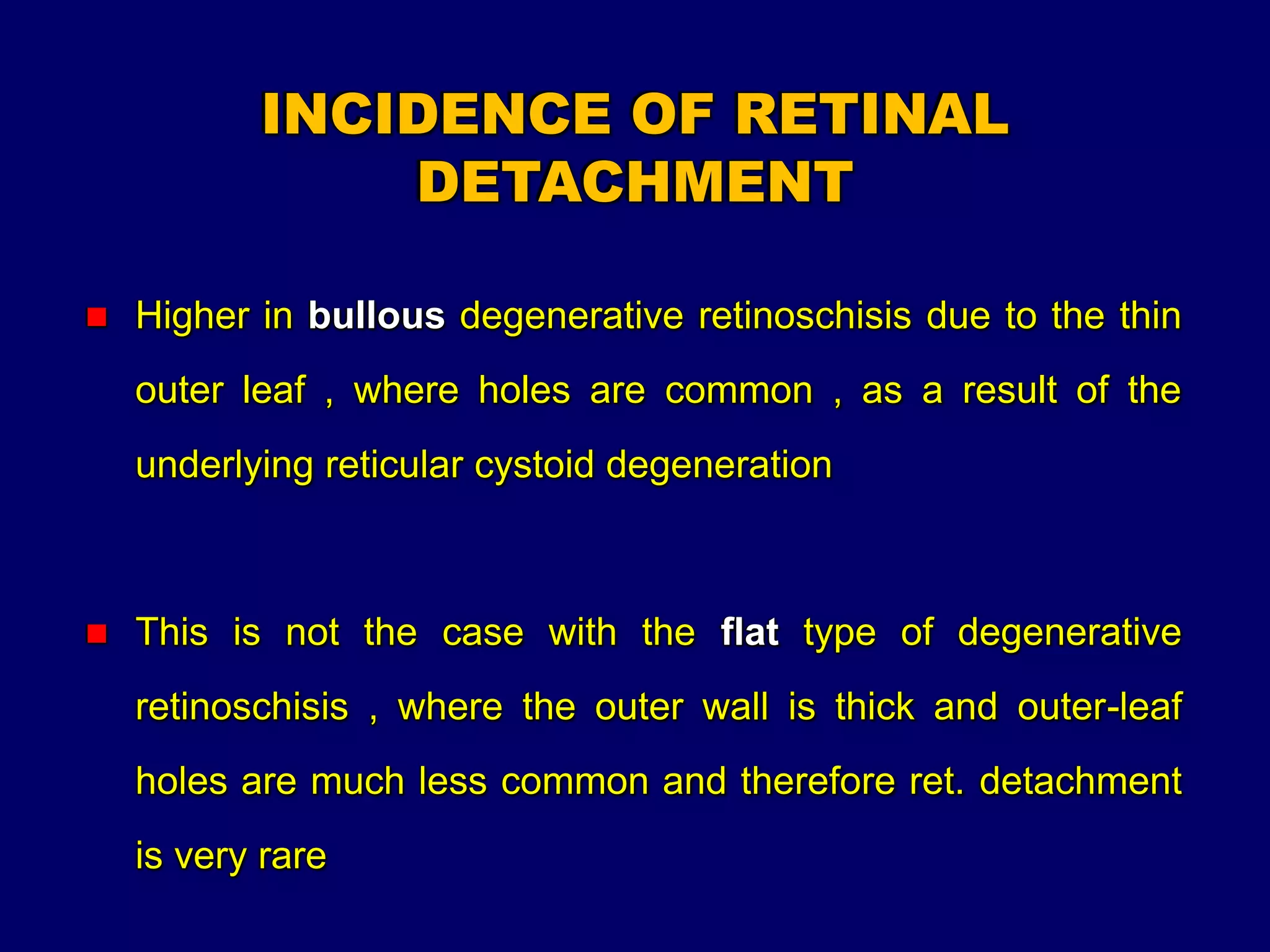
Posterior Leaf Tear in Reticular Cystoid Degeneration
Robert Y. Foos 1980
Personal communication
INCIDENCE OF RETINAL
DETACHMENT
 Higher in bullous degenerative retinoschisis due to the thin
outer leaf , where holes are common , as a result of the
underlying reticular cystoid degeneration
 This is not the case with the flat type of degenerative
retinoschisis , where the outer wall is thick and outer-leaf
holes are much less common and therefore ret. detachment
is very rare
Bullous Flat
Multiple limiting borders
(sign of chronicity)
TREATMENT
Degenerative Retinoschisis (Juvenile & Senile)
bullous retinoschisis only
 Surface diathermy
 Evacuation of cyst fluid and diathermy
 Surface diathermy and scleral buckling
 Photocoagulation
 Cryocoagulation
 Treatment of associated retinal detachment
Bullous retinoschisis treated by cryothermy
Medit. Ophth..Soc. Antalya 13-16 Oct. 2004
Bullous retinoschisis complicated by old standing ret. detachment OD
Bullous retinoschisis OS treated by laser PC for prophylaxis
Dissecting
border
ASSOCIATED RETINAL
DETACHMENT
Total number of retinoschisis cases……...……..119
Detachment related to retinoschisis………………19
Detachment unrelated to retinoschisis……………11
Total……………………………………………..……30
Incidence of detachment.........……………...........25%
Detachment of the schitic and nonschitic retina
RETINOSCHISIS AND RETINAL
DETACHMENT
Retinal detachment complicating retinoschisis has characteristics of
its own :
1. The clinical appearance of the schitic & non-schitic detached retina is different and
denotes the combination of a long-standing retinoschisis recently complicated by
retinal detachment of the schitic and non-schitic parts of the retina
2. Detachment due to outer wall holes moves very slowly, the SRF derived from the
cyst cavity is very viscous. However, more commonly holes in both walls allow
liquid vitreous access to the subretinal space leading to more rapid development of
retinal detachment of both the schitic and non-schitic part of the retina
3. Unfortunately diagnosis can be difficult &, therefore, management can be delayed
cd
ta
ta
mc
tp
p
a
T
T = Full-thickness retinal tear
with retinal detachment
a = anterior leaf of retinoschisis
p = posterior leaf
ta = anterior leaf holes
tp = posterior leaf breaks
cd =cyst in old detacht.
mc = macular cyst
Retinoschisis
Retinal
Detacht.
Old-standing
ret. det.with
cyst formation
Ret.det
Retinoschisis
RETINOSCHISIS AND RETINAL DETACHMENT
MANAGEMENT
4 Posterior leaf breaks are not easy to find and are often missed
5. A wider physical treatment area is necessary and indentation and
cryoapplication can help identify posterior leaf breaks. Over treatment
can cause secondary breaks
6. Drainage needs care and time and should be as complete as possible in
order to drain the subretinal fluid as well as the retinoschisis cavity
7. Usually a broad equatorial buckle is needed to support the schitic part of
the retinal detachment and to cover possibly missed posterior leaf
breaks
CONCLUSIONS
1. Distinction has to be made between retinal detachment and retinoschisis
and secondary retinoschisis in long-standing retinal detachment. This is
usually easy
2. Two types of retinoschisis are well-known : the congenital, “sex-linked” or
“X-linked” type,…..and the degenerative “senile” or “juvenile” : they differ
in their pathogenesis, course, prognosis and treatment
3. The term senile retinoschisis should be replaced by degenerative
retinoschisis which can occur in the young “juvenile degenerative
retinoschisis” and in the elderly “senile degenerative retinoschisis”
CONCLUSIONS (cont.)
4. Distinction has to be made between the flat and bullous types of degenerative
retinoschisis since they differ in their natural course, incidence of
complicating retinal detachment, and therefore, the need for treatment
5. Detachment due to outer wall holes moves very slowly, the SRF is very
viscous. However, more commonly holes in both walls allow liquid vitreous
access to the subretinal space leading to more rapid development of retinal
detachment of both the schitic and non-schitic part of the retina
6. Recognition of the combination of ret. det. and retinoschisis is essential since
it needs special managementand
7. Differential diagnosis may be difficult between old-standing self-limiting
retinal detachment and retinoschisis
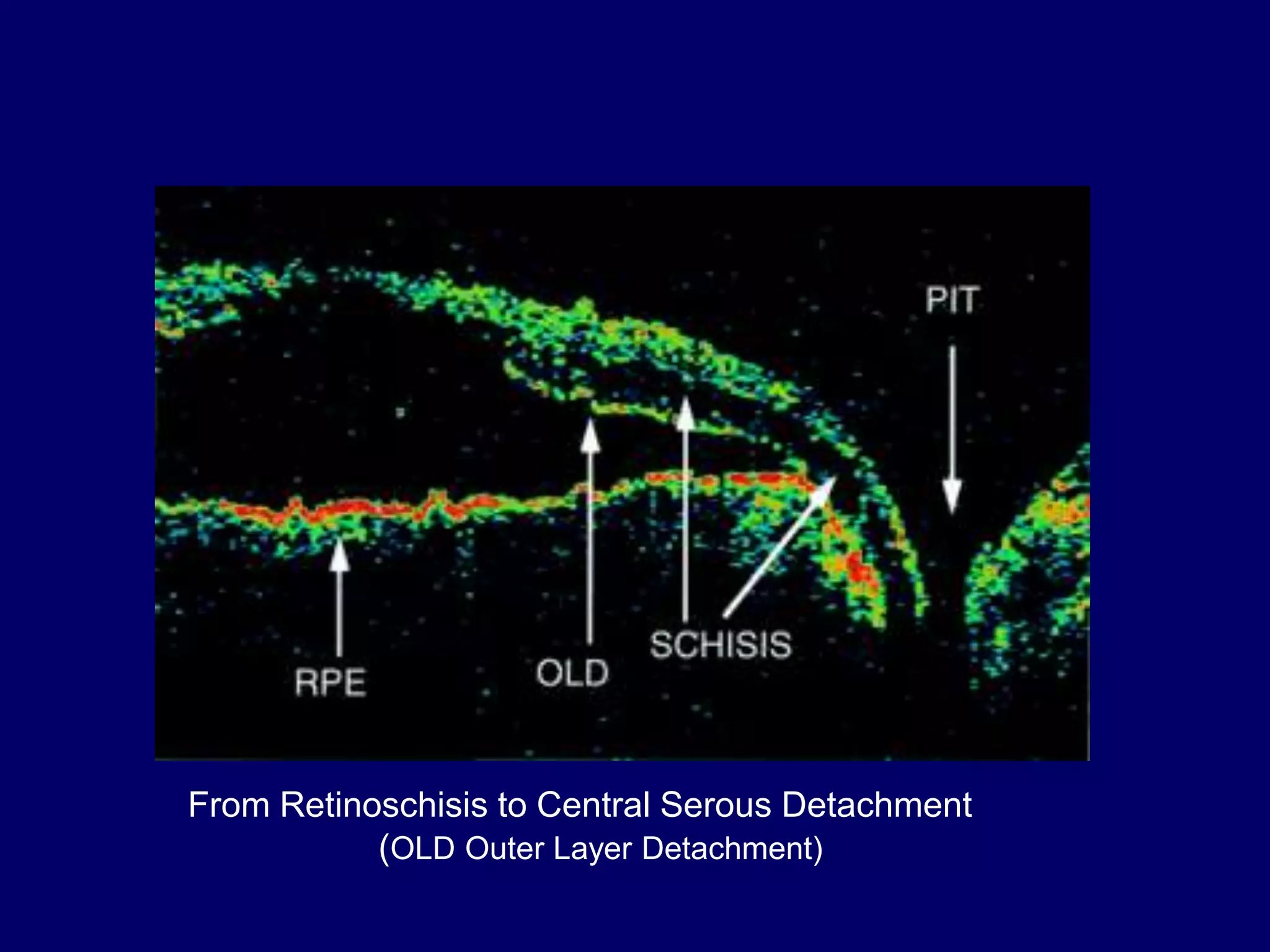
Pit
Choroidal defect
Retinoschisis & neuro-
sensensory det
From Retinoschisis to Central Serous Detachment
(OLD Outer Layer Detachment)

RETINOSCHISIS AND RETINAL DETACHMENT

  • 1.
  • 2.
    cd ta ta mc tp p a T T = Full-thicknessretinal tear with retinal detachment a = anterior leaf of retinoschisis p = posterior leaf ta = anterior leaf holes tp = posterior leaf breaks cd =cyst in old detacht. mc = macular cyst Retinoschisis Retinal Detacht. Old-standing ret. det.with cyst formation Ret.det Retinoschisis
  • 3.
    AETIOLOGY AND TYPES Sex-linked( or X-linked ),commonly called Juvenile retinoschisis Males : Related to vitreo-tapeto-retinal degeneration with macular aberration RETINOSCHISIS  Degenerative Both sexes : Juvenile and Senile degenerative retinoschisis Related to typical cystoid degeneration, and reticular cystoid degeneration
  • 4.
    SEX–LINKED JUVENILE RETINOSCHISIS Affects onein 5,000 to 25,000 individuals, primarily young males men who inherit the disease from their unaffected carrier mothers Males who inherit the disease from their unaffected carrier mothers Very few affected individuals go completely blind from retinoschisis
  • 5.
    Sex linked orX-linked (or Juvenile retinoschisis) Macular aberration DEHISCENCES IN NERVE FIBER LAYER
  • 6.
  • 7.
    SEX–LINKED OR X–LINKED RETINOSCHISIS Juvenile retinoschisis  Sex-linked or X-linked vitreoretinal degeneration  Idiopathic retinoschisis  Congenital vascular veils of the vitreous  Congenital retinoscis  Congenital cystic detachment  Polycystic detachment of the retina Synonyms :
  • 8.
    CLINICAL PICTURE  Recessiveinheritance  Few symptoms  Huge dehiscence in anterior leaf  Vascular veil in vitreous  Macular aberration (schisis)  Vascular arborization and obliteration SEX – LINKED or X-linked (Juvenile)
  • 9.
    HEREDITY OF CONGENITAL RETINOSCHISIS Apatient (male) with congenital retinoschisis: - None of his sons will be affected or be a carrier: - 100% of his daughters will be carriers A carrier (female): - 50% of her sons will be affected - 50% of her daughters will be carriers
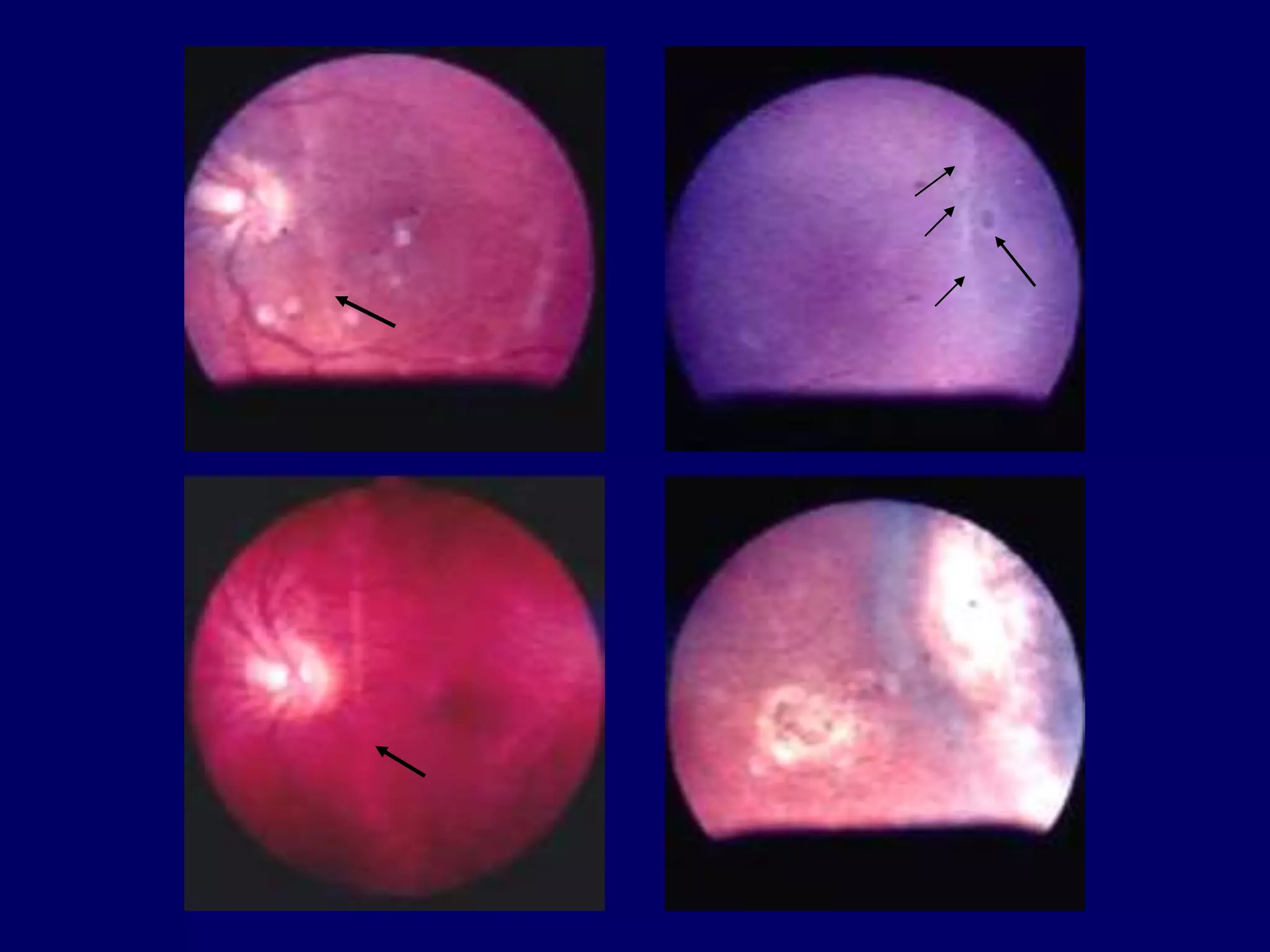
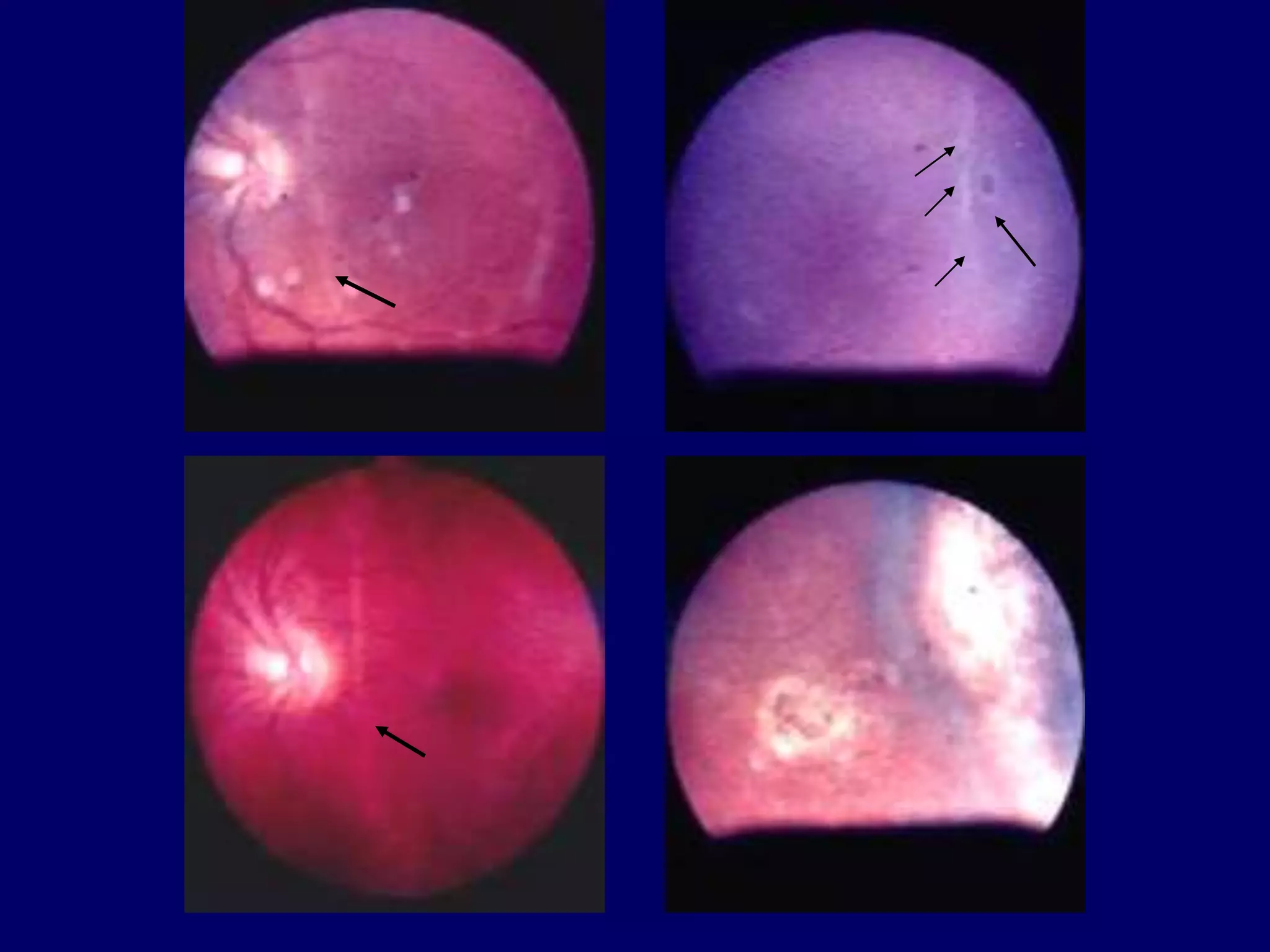
  • 10.
    DEGENERATIVE RETINOSCHISIS Juvenile &senile Incidence ----------------------------- All ages ………3.7% ---------------------------- 40 years +……. 7% Bilateral…………………………………………... 82% Inferior temporal ………………………………… 72% Extended post – equatorially…...………........... 42% Ratio schisis to detach. in general population….. 53:1 CLINICAL STUDY
  • 11.
  • 12.
    COURSE AND PROGNOSIS •Sex-linked (X-linked) …. deterioration • Degenerative (Juvenile or Senile) Flat : stationary or very slowly progressive, usually not complicated with ret. detachment, (related to typical cystoid degeneration) Bullous : usually progressive(dissecting) and complicated with retinal detachment (related to reticular cystoid degeneration)
  • 13.
    FLAT DEGENERATIVE RETINOSCHISIS None…. discovered by routine examination (66%)  Flashes  Floaters  Field loss  Signs & symptoms of retinal detach. CLINICAL PICTURE PRESENTATION :
  • 14.
    FLAT DEGENERATIVE RETINOSCHISIS  Inferiortemporal & temporal location  Flat smooth elevation  Scleral indentation : white without pressure  Striations or flecks (fresh snow flakes)  Retinal vessels, obliterated peripherally  Pink outer wall holes  Vitreous detachment  Absolute field defects OPHTHALMOSCOPIC FEATURES
  • 15.
    JUVENILE “DEGENERATIVE” RETINOSCHISIS (age15 – 40)  Isolated non-hereditary cases in both sexes  Has many of the characteristics of senile retinoschisis, and, therefore, more related to it  Not associated with macular aberrations but often associated with choroidal degeneration  Usually more flat than bullous  Variable even in both eyes of affected individuals  Can not be sure of time of incidence  Course stationary, progressive or complicated with retinal detachment …………….(very rare)
  • 16.
    Flat + BullousFlat Flat Bullous The Two types of degenerative retinoschisis, may be present in the same eye
  • 17.
    Degenerative bullous retinoschisis-with ret. det. due to outer wall holes.
  • 18.
    DIFFERENTIAL DIAGNOSIS of  Retinaldetachment  Secondary retinoschisis  Old-standing retinal detacht.  Retinal detachment  retinoschisis Degenerative Retinoschisis
  • 19.
    HISTOPATHOLOGY Sex–linked …….. Splittingin the nerve fiber layer Senile Flat………. related to typical cystoid degeneration Bullous … related to reticular cystoid degeneration Typical Reticular Robert Y. Foos 1980 Personal communication
  • 20.
    Bullous retinoschisis Flatretinoschisis reticular typical Reticular & typical Junction between cystoid & reticular Robert Y. Foos 1980 Personal communication
  • 21.
    Reticular Cystoid Degeneration TypicalCystoid Degeneration Juncture of Reticular (inner retina) and Typical (middle retina) Degenerating inner plexiform layer Inner plexiform layer--degenerates Robert Y. Foos 1980 Personal communication
  • 22.
    Typical Cystoid Degeneration ReticularCystoid Degeneration Robert Y. Foos 1980 Personal communication
  • 23.
    Posterior Leaf Tearin Reticular Cystoid Degeneration Robert Y. Foos 1980 Personal communication
  • 24.
    INCIDENCE OF RETINAL DETACHMENT Higher in bullous degenerative retinoschisis due to the thin outer leaf , where holes are common , as a result of the underlying reticular cystoid degeneration  This is not the case with the flat type of degenerative retinoschisis , where the outer wall is thick and outer-leaf holes are much less common and therefore ret. detachment is very rare
  • 25.
    Bullous Flat Multiple limitingborders (sign of chronicity)
  • 26.
    TREATMENT Degenerative Retinoschisis (Juvenile& Senile) bullous retinoschisis only  Surface diathermy  Evacuation of cyst fluid and diathermy  Surface diathermy and scleral buckling  Photocoagulation  Cryocoagulation  Treatment of associated retinal detachment
  • 27.
  • 28.
    Medit. Ophth..Soc. Antalya13-16 Oct. 2004 Bullous retinoschisis complicated by old standing ret. detachment OD
  • 29.
    Bullous retinoschisis OStreated by laser PC for prophylaxis Dissecting border
  • 32.
    ASSOCIATED RETINAL DETACHMENT Total numberof retinoschisis cases……...……..119 Detachment related to retinoschisis………………19 Detachment unrelated to retinoschisis……………11 Total……………………………………………..……30 Incidence of detachment.........……………...........25%
  • 33.
    Detachment of theschitic and nonschitic retina
  • 35.
    RETINOSCHISIS AND RETINAL DETACHMENT Retinaldetachment complicating retinoschisis has characteristics of its own : 1. The clinical appearance of the schitic & non-schitic detached retina is different and denotes the combination of a long-standing retinoschisis recently complicated by retinal detachment of the schitic and non-schitic parts of the retina 2. Detachment due to outer wall holes moves very slowly, the SRF derived from the cyst cavity is very viscous. However, more commonly holes in both walls allow liquid vitreous access to the subretinal space leading to more rapid development of retinal detachment of both the schitic and non-schitic part of the retina 3. Unfortunately diagnosis can be difficult &, therefore, management can be delayed
  • 36.
    cd ta ta mc tp p a T T = Full-thicknessretinal tear with retinal detachment a = anterior leaf of retinoschisis p = posterior leaf ta = anterior leaf holes tp = posterior leaf breaks cd =cyst in old detacht. mc = macular cyst Retinoschisis Retinal Detacht. Old-standing ret. det.with cyst formation Ret.det Retinoschisis
  • 37.
    RETINOSCHISIS AND RETINALDETACHMENT MANAGEMENT 4 Posterior leaf breaks are not easy to find and are often missed 5. A wider physical treatment area is necessary and indentation and cryoapplication can help identify posterior leaf breaks. Over treatment can cause secondary breaks 6. Drainage needs care and time and should be as complete as possible in order to drain the subretinal fluid as well as the retinoschisis cavity 7. Usually a broad equatorial buckle is needed to support the schitic part of the retinal detachment and to cover possibly missed posterior leaf breaks
  • 39.
    CONCLUSIONS 1. Distinction hasto be made between retinal detachment and retinoschisis and secondary retinoschisis in long-standing retinal detachment. This is usually easy 2. Two types of retinoschisis are well-known : the congenital, “sex-linked” or “X-linked” type,…..and the degenerative “senile” or “juvenile” : they differ in their pathogenesis, course, prognosis and treatment 3. The term senile retinoschisis should be replaced by degenerative retinoschisis which can occur in the young “juvenile degenerative retinoschisis” and in the elderly “senile degenerative retinoschisis”
  • 40.
    CONCLUSIONS (cont.) 4. Distinctionhas to be made between the flat and bullous types of degenerative retinoschisis since they differ in their natural course, incidence of complicating retinal detachment, and therefore, the need for treatment 5. Detachment due to outer wall holes moves very slowly, the SRF is very viscous. However, more commonly holes in both walls allow liquid vitreous access to the subretinal space leading to more rapid development of retinal detachment of both the schitic and non-schitic part of the retina 6. Recognition of the combination of ret. det. and retinoschisis is essential since it needs special managementand 7. Differential diagnosis may be difficult between old-standing self-limiting retinal detachment and retinoschisis
  • 41.
  • 42.
    From Retinoschisis toCentral Serous Detachment (OLD Outer Layer Detachment)