1
Dr Youssef Hammida
2
3
4
5
6
7
8
9
10
11
12
13
14
15
16
17
18
19
20
21
22
23
24
25
26
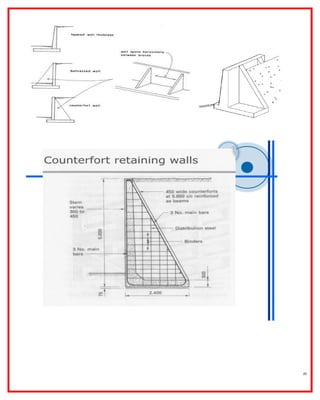
Pilaster masonry wall
27
28


 Steel sheeting provides resistance during installation stresses. The sheets must be
driven into the ground and they have high resistance to the force of being driven
down.
 It is extremely light weight and makes it easier to lift and handle.
 Steel sheeting is reusable and recyclable.
 There is a long life for it both above and under water. It only requires light protection
to keep it maintained.
 The pile length is easily adaptable and can be welded or bolted to make it work.
 They have stronger joints that can withstand the force of being driven into place.
29
Steel Sheet Piling Construction Steps
 First, lay out the sheets in sections to make sure that the piles will interlock
correctly.
 Drive each sheet to the depth that has been mapped out.
 Then drive the second sheet that has the interlocks between the first sheet and
the second locked sheet.
 Repeat until the wall is completed.
 If the wall requires complex shapes use connector elements to ensure that the
integrity of the wall is maintained.
 Vibratory hammers are used for the installation of steel sheet piles. An impact
hammer is used if the soil is too dense for the vibratory hammer.
 At sites where vibrations are not recommended the sheets are pushed into place
using hydraulics.
30
31
32
33
34
35
36
-------------------------------------------------------
37
38
-----------------------------
Sheet Pile Walls...
Sheet pile walls are another method for construction of basements and temporary
excavations, however they are increasingly being used as permanent structures with
the correctly specified surface coating.
‫ا‬‫لخوازيق‬,‫واألوتاد‬‫الساندة‬‫الحفر‬ ‫جوانب‬ ‫سند‬ ‫وظيفتها‬ ‫ألن‬ ‫الموقع‬ ‫حفر‬ ‫قبل‬ ‫تنفيذها‬ ‫بيتم‬
‫مرور‬ ‫قبل‬ ‫الحفر‬ ‫واليتم‬82‫ساند‬ ‫خازوق‬ ‫آخر‬ ‫تنفيذ‬ ‫على‬ ‫يوم‬
‫التأسيس‬ ‫تربة‬ ‫لمنسوب‬ ‫واليصل‬ ‫الحفر‬ ‫بقيمة‬ ‫مرتبط‬ ‫طوله‬ ‫الساند‬ ‫والخازوق‬
.
39
40
41
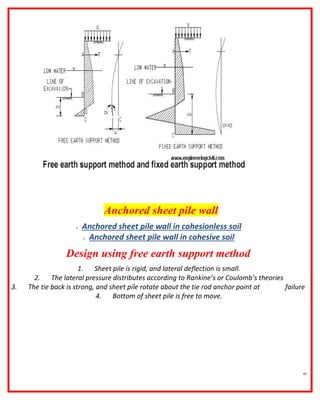
For free earth support method
the soils at the lower part of piling is incapable of inducing effective restraint so that it
would not result in negative bending moments. In essence, the passive pressures in front
of the sheet piles are insufficient to prevent lateral deflection and rotations at the lower
end of piling. No passive resistance is developed on the backside of the piling below the
line of excavation.
For fixed earth support method
, the piling is driven deep enough so that the soil under the line of excavation provides the
required restraint against deformations and rotations. In short, the lower end of piling is
essentially fixed.
42
Anchored sheet pile wall
 Anchored sheet pile wall in cohesionless soil
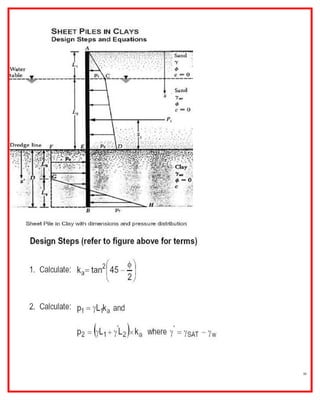
 Anchored sheet pile wall in cohesive soil
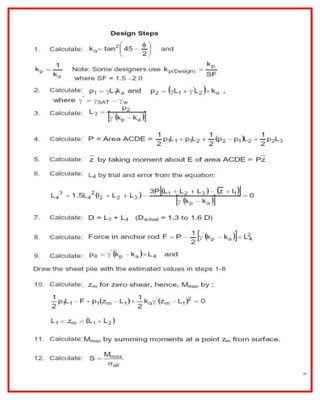
Design using free earth support method
1. Sheet pile is rigid, and lateral deflection is small.
2. The lateral pressure distributes according to Rankine’s or Coulomb’s theories
3. The tie back is strong, and sheet pile rotate about the tie rod anchor point at failure
4. Bottom of sheet pile is free to move.
43
embedded depth can be determined by summarizing horizontal earth pressures and moments about
the anchor.
 Fx = 0 [1]
Mo = 0 [2]
the lateral earth pressure is a function of embedded depth. Both equations are highly nonlinear. A
trial and error method has to be used to determine the root.
r structural design, the sheet pile needs to be able to withstand maximum moment and shear from
lateral pressure. A structural analysis needs to be done to determine maximum moment and
shear.
44
Anchored sheet pile wall in cohesionless soil
Design length of sheet pile
Calculating active earth pressure
The method for calculating active earth pressure is the same as that in cantilever sheet pile wall. The
lateral forces Ha1 is calculated as
Ha1= Ka h2
/2+q Ka h
The depth a can be calculated as
a = pa /  (Kp-Ka)
The lateral forces Ha2 can be calculated as
Ha2=pa*a/2
Calculating passive earth pressure
The slope from point C to E in the figure above is  (Kp-Ka). The passive earth pressure at a depth Y
below a is calculated as
Pp =  (Kp-Ka) Y
45
The passive lateral force
HCEF =  (Kp-Ka) Y2
/2
Derive equation for Y from Mo = 0
Mo = Ha1*y1 + Ha2* y2 – HCEF* y3 = 0
Where
y1 = (2h/3-b)
y2 = (h+a/3-b)
y3 = (h+a+2Y/3)
The equation needs to be determined by a trial and error process.
Determine anchor force T from  Fx = 0
 Fx = Ha1+ Ha2– HCEF-T = 0
Then,
T = Ha1+ Ha2– HCEF
Design size of sheet pile
The structural is the same as cantilever sheet piles in cohesionless soil.
Maximum moment locates at a distance y below T where shear stress equals to zero.
T- Ka (y+b)2
/2=0
Solve for y, we have, y = -b+2*T/( Ka)
The maximum moment is
Mmax = T y -  Ka (y+b)3
/6
The required section modulus is S = Mmax / Fb
The sheet pile section is selected based on section modulus
46
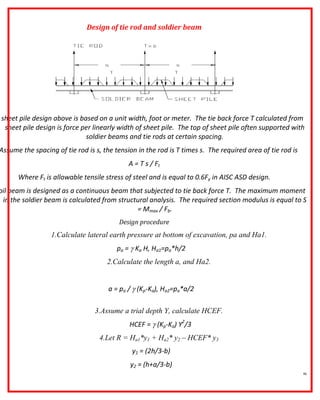
Design of tie rod and soldier beam
sheet pile design above is based on a unit width, foot or meter. The tie back force T calculated from
sheet pile design is force per linearly width of sheet pile. The top of sheet pile often supported with
soldier beams and tie rods at certain spacing.
Assume the spacing of tie rod is s, the tension in the rod is T times s. The required area of tie rod is
A = T s / Ft
Where Ft is allowable tensile stress of steel and is equal to 0.6Fy in AISC ASD design.
oil beam is designed as a continuous beam that subjected to tie back force T. The maximum moment
in the soldier beam is calculated from structural analysis. The required section modulus is equal to S
= Mmax / Fb.
Design procedure
1.Calculate lateral earth pressure at bottom of excavation, pa and Ha1.
pa =  Ka H, Ha1=pa*h/2
2.Calculate the length a, and Ha2.
a = pa /  (Kp-Ka), Ha2=pa*a/2
3.Assume a trial depth Y, calculate HCEF.
HCEF =  (Kp-Ka) Y2
/3
4.Let R = Ha1*y1 + Ha2* y2 – HCEF* y3
y1 = (2h/3-b)
y2 = (h+a/3-b)
47
y3 = (h+a+2Y/3)
Substitute Y into R, if R = 0, the embedded depth, D = Y + a.
If not, assume a new Y, repeat step 3 to 4.
5.Calculate the length of sheet pile, L = h+F.S.*D, FS is from 1.2 to 1.4.
6.Calculate anchored force T = Ha1+ Ha2– HCEF
7.Calculate y = -b+2*T/( Ka)
8.Calculate Mmax = T y -  Ka (y+b)3
/6
9.Calculate required section modulus S= Mmax/Fb.
10. Select sheet pile section.
11. Design tie rod
12. Design soldier beam.
48
Example 3. Design anchored sheet pile in cohesionless soil.
Depth of excavation, h = 10 ft
Unit weight of soil,  = 115 lb/ft3
Internal friction angle,  = 30 degree
Allowable design stress of sheet pile = 32 ksi
Yield strength of soldier beam, Fy = 36 ksi
Location of tie rod at 2 ft below ground surface, spacing, s = 12 ft
Requirement: Design length of an anchored sheet pile, select sheet pile section, and design tie rod
Solution:
Design length of sheet pile:
Calculate lateral earth pressure coefficients:
Ka = tan (45-/2) = 0.333
Kp = tan (45-/2) = 3
The lateral earth pressure at bottom of excavation is
pa = Ka  h = 0.333*115*10 = 383.33 psf
The active lateral force above excavation
Ha1 = pa*h/2 = 383.33*10/2 = 1917 lb/ft
The depth a = pa /  (Kp-Ka) = 383.3 / [115*(3-0.333)] =1.25 ft
The corresponding lateral force
Ha2 = pa*a/2 = 383.33*1.25/2 = 238.6 lb/ft
Assume Y = 2.85 ft
HCEF =  (Kp-Ka) Y2
/3 = 115*(3-0.333)*2.852
/3 = 830.3 lb/ft
y1 = (2h/3-b) = (2*10/3-2)=4.67 ft
y2 = (h+a/3-b) = (10+1.25/3-2)=8.42 ft
y3 = (h+a+2Y/3) = (10+1.25+2*2.85/3) = 13.15 ft
49
R = Ha1*y1 + Ha2* y2 – HCEF* y3 = 1917*4.67+238.6*8.42-830.3*13.15 = 42.5 lb
R closes to zero, D = 2.85+1.25 = 4.1 ft
Length of sheet pile, L = 10 + 1.2* 4.1 = 14.9 ft Use 15 ft
Calculate anchor force,
T = Ha1+ Ha2– HCEF = 1917+238.6-830.3 = 1326 lb/ft
Calculate location of maximum moment,
y = -b+2*T/( Ka) = -2 ft + 2*1326/(115*0.333) = 6.32 ft
Mmax = T y -  Ka (y+b)3
/6 = 1326*6.32 – 115*0.333*(6.32+2)3
/6 = 4.7 kip-ft/ft
The required section modulus S= Mmax/Fb = 4.7*12/32 = 1.8 in3
/ft
Use PS28, S = 1.9 in3
/ft
Design tie rod, the required cross section area,
A = T s / (0.6*Fy) = 1.326*12/(0.6*36) = 0.442 in3
.
Use ¾” diameter tie rod, A = 0.442 in3
.
Design soldier beam:
The maximum moment of a continuous beams with 3 or more span is
M = 0.1*T s2
= 0.1*1326*122
=19.1 kip-ft
Required section modulus, S = M / (0.6*Fy) = 19.1*12/(0.6*36) = 6.4 in3
.
Use W6x15, S = 9.72 in3
.
50
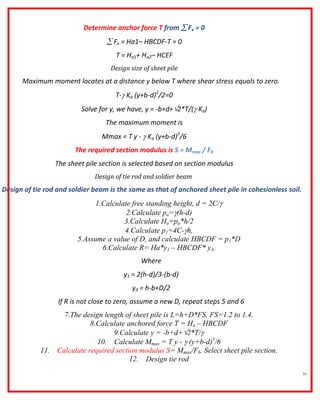
Anchored sheet pile wall in cohesive soil.
Calculating active earth pressure
Calculation of active earth pressure above excavation is the same as that of cantilever sheet pile in
cohesive soil. The free-standing height of soil is d = 2C/
The lateral earth pressure at bottom of excavation, pa =  h – 2C, where  is unit weight of soil. The
resultant force Ha=pa*h/2
Calculating passive earth pressure
For cohesive soil, friction angle,  = 0, Ka = Kp = 1. The earth pressure below excavation,
p1= p-a= 2C-(h-2C) = 4C-h
Assume the embedded depth is D, the resultant force below bottom of excavation is
HBCDF = p1*D
Derive equation for D from Mo = 0
Mo = Ha1*y1 – HBCDF* y3 = 0
Where
y1 = 2(h-d)/3-(b-d)
y3 = h-b+D/2
The equation can be determined with a trial and error process.
51
Determine anchor force T from  Fx = 0
 Fx = Ha1– HBCDF-T = 0
T = Ha1+ Ha2– HCEF
Design size of sheet pile
Maximum moment locates at a distance y below T where shear stress equals to zero.
T- Ka (y+b-d)2
/2=0
Solve for y, we have, y = -b+d+2*T/( Ka)
The maximum moment is
Mmax = T y -  Ka (y+b-d)3
/6
The required section modulus is S = Mmax / Fb
The sheet pile section is selected based on section modulus
Design of tie rod and soldier beam
Design of tie rod and soldier beam is the same as that of anchored sheet pile in cohesionless soil.
1.Calculate free standing height, d = 2C/
2.Calculate pa=(h-d)
3.Calculate Ha=pa*h/2
4.Calculate p1=4C-h,
5.Assume a value of D, and calculate HBCDF = p1*D
6.Calculate R= Ha*y1 – HBCDF* y3.
Where
y1 = 2(h-d)/3-(b-d)
y3 = h-b+D/2
If R is not close to zero, assume a new D, repeat steps 5 and 6
7.The design length of sheet pile is L=h+D*FS, FS=1.2 to 1.4.
8.Calculate anchored force T = Ha – HBCDF
9.Calculate y = -b+d+2*T/
10. Calculate Mmax = T y -  (y+b-d)3
/6
11. Calculate required section modulus S= Mmax/Fb. Select sheet pile section.
12. Design tie rod
52
13. Design soldier beam.
Example 4: Design anchored sheet pile in cohesive soil.
Depth of excavation, h = 15 ft
Unit weight of soil,  = 115 lb/ft3
Cohesion of soil, C = 500 psf
Internal friction angle,  = 0 degree
Allowable design strength of sheet pile = 32 ksi
Yield strength of soldier beam, Fy = 36 ksi
Location of tie rod at 2 ft below ground surface, spacing =12 ft.
Requirement: Design length of sheet pile and select sheet pile section
Solution:
Design length of sheet pile:
The free standing height, d = 2C/ = 2*500/115 = 8.7 ft
The lateral pressure at bottom of sheet pile, pa = (h-d)=115*(10-8.7)=150 psf
Total active force, Ha=pa*h/2 = 150*10/2 = 750 lb/ft
p1=4C-h = 4*550-115*15 = 275 psf
Assume D = 11.5 ft,
HBCDF = p1*D = 3163 lb/ft
y1 = 2(h-d)/3-(b-d) =2 (15-8.7)/3-(2-8.7) = 10.9 ft
y3 = h-b+D/2 = 15-2+11.5/2 = 18.75 ft
R= Ha*y1 – HBCDF* y3 = 5438*10.9-3163*18.75 = -36 lb Close to zero
The length of sheet pile, L = 15 + 1.2*11.5 = 28.8 ft Use 29 ft
Anchored force per foot of wall, T = Ha – HBCDF = 5438 – 3163 = 2275 lb/ft
53
Calculate location of maximum moment,
y = -b+d+2*T/ = -2+8.7+2*2275/115 = 13 ft
Maximum moment,
Mmax = T y -  (y+b-d)3
/6 = 2275*13 – 115*(13+2-8.7)3
/6 = 24770 lb-ft/ft
Required section modulus of sheet pile, S= Mmax/Fb = 22.47*12/32 = 8.4 in3
/ft
Use PDA 27 section modulus 10.7 in3
/ft
Design tie rod
Cross section of tie rod required, A = T*s/(0.6*Fy) = 2.275*12/(0.6*36) = 0.91 in2
.
Diameter of tie rod, d = 4*A/ = 1.08 in
Use 1-1/8” diameter tie rod.
Design soldier beam
Maximum moment in solider beam, Mmax = 0.1*T*s2
= 0.1*2275*122
= 32760 lb-ft
Required section modulus, S= Mmax/Fb= 32.76*12/(0.6*36) = 13.1 in3
.
Use W 8x18, section modulus S = 15.2 in3
.
54
types of deep support systems
are commonly used in metropolitan cities.
(i) Diaphragm walls
(ii) Pile walls (Contiguous, Tangent or Secant)
(iii) Soldier pile w
ith wooden lagging walls
(iv) Sheet pile walls
(v) Composite supporting systems – that is, any of the retaining
systems
Retaining systems like
diaphragm wall, contiguous pile walls;
and soldier piles with wooden lagging
escribed in this article has been successfully used. Case studies of their use indicate that
adequate quality control measures and instrumentation monitoring of these systems go a
long way in ensuring their safeand economic deployment at sit
55
56
57
58
59
60
Contiguous Pile Walls General – Piled Retaining Systems
Abstract
Providing space for parking, public amenities,etc in multi-storey buildings at
own centres has created a need to go deep excavationsinto ground. Deep excavations are
supported by systems like conventional retaining walls, sheet pile walls, braced walls,
diaphragm walls and pile walls. This article describes various excavation supporting
systems that are in vogue essentially contiguous pile wall and its advantages. A detailed
design methodology of an excavation supporting system is furnished in this study.
There are different types of pile walls
(Fig.4).Diameter and spacing of the piles is
decided based on soil type, ground water level and magnitude of design pressures.
Large spacing is avoided as it can result in caving of soil through gaps. In
iguous bored pile construction, center to center spacing of piles is kept slightly greater thanthe pile
diameter.
Secant bored pilesre formed by keeping this spacing of piles less
than the diameter.Tangen
61
Fig. 4: Schematic Arrangement of Contiguous Piled Retaining System.
Contiguous piles serving as retaining walls
are popular since traditional piling equipments can be resorted for their construction. They are considered
more economical than diaphragm wall in small to medium scale excavations due to reduction in cost of site
operations. Common pile diameters adopted are 0.6, 0.8 and
1 .0m. These piles are connected with a Capping beams at the top, which assists equitable pressure
distributions in piles. These retaining piles are suitable in areas where water table is deep or where soil
permeability is low. However, some acceptable amount of water can be collected at the base and pumped
out.
ARRANGEMENT OF CONTIGUOUS PILe
62
63
64
cant Pile Walls are formedby constructing intersecting piles. Secant bored pile walls
are formed by keeping spacing ofpiles lessthan diameter. Secant pile walls are used
tobuild cut off walls for the control of groundwater inflow and to
minimizemovement in weak and wet soils. Secant Wall constructed in the form of
hard/soft or hard/firm and Secant Wall Hard/hard wall. Secant Wall-hard- softs or
hard/firm is similar tothe contiguous bored pile wall
65
66
67
68
Soldier Piles and Wooden Lagging supported system
The supporting system comprised soldier piles
ed at 1.8m c/c and with a closer spacing of 1.6m c/c near the launching shaft (Fig.8).
Wooden laggings of thickness 100mm to 120mm were supported between the soldier
piles.Three levels of Struts were provided at depths 3.285, 7.285, and 10.831m below the
established ground level (EGL-209.80m). Additional level of Waler beam with pre-stressed
rock anchors were provided 2m above the excavation level. Rock anchors with capacity of
86.4T,spaced at 3.6m c/c, were embedded 6m into the quartzitic bedrock to meet the
bond strength consideration
69
Soldier Piles & Laggings Wooden Supporting System
70
71
72
1. Excavate trench for guide wall
73
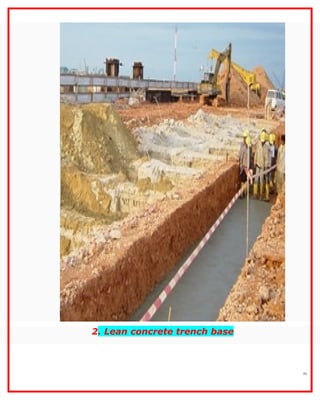
2. Lean concrete trench base
74
3. Place guide wall mould
75
4. Place guide wall reinforcement
76
5. Casting guide wall
77
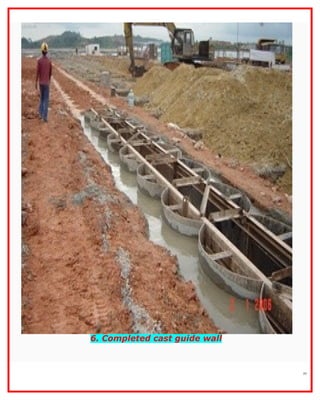
6. Completed cast guide wall
78
7. Remove guide wall mould after concrete set
guide wall 8. Completed guide wall
79
80
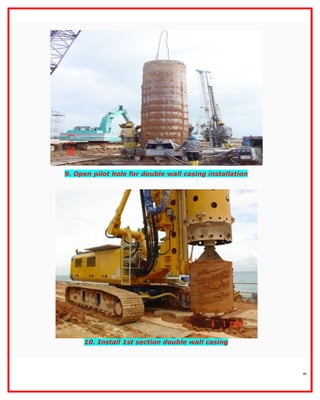
9. Open pilot hole for double wall casing installation
10. Install 1st section double wall casing
81
11. Continue to install more sections of double wall casings
12. Boring & installing double wall casings
82
13. Boring to pile toe level with different types of tools
14. Reinforcement cage ready for installation
83
15. Install reinforcement cage into completed pile bore
16. Concreting secant pile
84
17. Extract double wall casing by casing oscillator
18. Completed secant piles after pile heads trimming
85
Exposed Secant Pile Wall for Capping Beam Construction
Trimmed Secant Pile Wall
86
Ready for Capping Beam Casting
Secant pile cap beam
87
Dr Youssef Hammida

Retaining wall(الجدران الاستنادية).- Scant Piles

  • 1.
  • 2.
  • 3.
  • 4.
  • 5.
  • 6.
  • 7.
  • 8.
  • 9.
  • 10.
  • 11.
  • 12.
  • 13.
  • 14.
  • 15.
  • 16.
  • 17.
  • 18.
  • 19.
  • 20.
  • 21.
  • 22.
  • 23.
  • 24.
  • 25.
  • 26.
  • 27.
  • 28.
    28    Steel sheetingprovides resistance during installation stresses. The sheets must be driven into the ground and they have high resistance to the force of being driven down.  It is extremely light weight and makes it easier to lift and handle.  Steel sheeting is reusable and recyclable.  There is a long life for it both above and under water. It only requires light protection to keep it maintained.  The pile length is easily adaptable and can be welded or bolted to make it work.  They have stronger joints that can withstand the force of being driven into place.
  • 29.
    29 Steel Sheet PilingConstruction Steps  First, lay out the sheets in sections to make sure that the piles will interlock correctly.  Drive each sheet to the depth that has been mapped out.  Then drive the second sheet that has the interlocks between the first sheet and the second locked sheet.  Repeat until the wall is completed.  If the wall requires complex shapes use connector elements to ensure that the integrity of the wall is maintained.  Vibratory hammers are used for the installation of steel sheet piles. An impact hammer is used if the soil is too dense for the vibratory hammer.  At sites where vibrations are not recommended the sheets are pushed into place using hydraulics.
  • 30.
  • 31.
  • 32.
  • 33.
  • 34.
  • 35.
  • 36.
  • 37.
  • 38.
    38 ----------------------------- Sheet Pile Walls... Sheetpile walls are another method for construction of basements and temporary excavations, however they are increasingly being used as permanent structures with the correctly specified surface coating. ‫ا‬‫لخوازيق‬,‫واألوتاد‬‫الساندة‬‫الحفر‬ ‫جوانب‬ ‫سند‬ ‫وظيفتها‬ ‫ألن‬ ‫الموقع‬ ‫حفر‬ ‫قبل‬ ‫تنفيذها‬ ‫بيتم‬ ‫مرور‬ ‫قبل‬ ‫الحفر‬ ‫واليتم‬82‫ساند‬ ‫خازوق‬ ‫آخر‬ ‫تنفيذ‬ ‫على‬ ‫يوم‬ ‫التأسيس‬ ‫تربة‬ ‫لمنسوب‬ ‫واليصل‬ ‫الحفر‬ ‫بقيمة‬ ‫مرتبط‬ ‫طوله‬ ‫الساند‬ ‫والخازوق‬ .
  • 39.
  • 40.
  • 41.
    41 For free earthsupport method the soils at the lower part of piling is incapable of inducing effective restraint so that it would not result in negative bending moments. In essence, the passive pressures in front of the sheet piles are insufficient to prevent lateral deflection and rotations at the lower end of piling. No passive resistance is developed on the backside of the piling below the line of excavation. For fixed earth support method , the piling is driven deep enough so that the soil under the line of excavation provides the required restraint against deformations and rotations. In short, the lower end of piling is essentially fixed.
  • 42.
    42 Anchored sheet pilewall  Anchored sheet pile wall in cohesionless soil  Anchored sheet pile wall in cohesive soil Design using free earth support method 1. Sheet pile is rigid, and lateral deflection is small. 2. The lateral pressure distributes according to Rankine’s or Coulomb’s theories 3. The tie back is strong, and sheet pile rotate about the tie rod anchor point at failure 4. Bottom of sheet pile is free to move.
  • 43.
    43 embedded depth canbe determined by summarizing horizontal earth pressures and moments about the anchor.  Fx = 0 [1] Mo = 0 [2] the lateral earth pressure is a function of embedded depth. Both equations are highly nonlinear. A trial and error method has to be used to determine the root. r structural design, the sheet pile needs to be able to withstand maximum moment and shear from lateral pressure. A structural analysis needs to be done to determine maximum moment and shear.
  • 44.
    44 Anchored sheet pilewall in cohesionless soil Design length of sheet pile Calculating active earth pressure The method for calculating active earth pressure is the same as that in cantilever sheet pile wall. The lateral forces Ha1 is calculated as Ha1= Ka h2 /2+q Ka h The depth a can be calculated as a = pa /  (Kp-Ka) The lateral forces Ha2 can be calculated as Ha2=pa*a/2 Calculating passive earth pressure The slope from point C to E in the figure above is  (Kp-Ka). The passive earth pressure at a depth Y below a is calculated as Pp =  (Kp-Ka) Y
  • 45.
    45 The passive lateralforce HCEF =  (Kp-Ka) Y2 /2 Derive equation for Y from Mo = 0 Mo = Ha1*y1 + Ha2* y2 – HCEF* y3 = 0 Where y1 = (2h/3-b) y2 = (h+a/3-b) y3 = (h+a+2Y/3) The equation needs to be determined by a trial and error process. Determine anchor force T from  Fx = 0  Fx = Ha1+ Ha2– HCEF-T = 0 Then, T = Ha1+ Ha2– HCEF Design size of sheet pile The structural is the same as cantilever sheet piles in cohesionless soil. Maximum moment locates at a distance y below T where shear stress equals to zero. T- Ka (y+b)2 /2=0 Solve for y, we have, y = -b+2*T/( Ka) The maximum moment is Mmax = T y -  Ka (y+b)3 /6 The required section modulus is S = Mmax / Fb The sheet pile section is selected based on section modulus
  • 46.
    46 Design of tierod and soldier beam sheet pile design above is based on a unit width, foot or meter. The tie back force T calculated from sheet pile design is force per linearly width of sheet pile. The top of sheet pile often supported with soldier beams and tie rods at certain spacing. Assume the spacing of tie rod is s, the tension in the rod is T times s. The required area of tie rod is A = T s / Ft Where Ft is allowable tensile stress of steel and is equal to 0.6Fy in AISC ASD design. oil beam is designed as a continuous beam that subjected to tie back force T. The maximum moment in the soldier beam is calculated from structural analysis. The required section modulus is equal to S = Mmax / Fb. Design procedure 1.Calculate lateral earth pressure at bottom of excavation, pa and Ha1. pa =  Ka H, Ha1=pa*h/2 2.Calculate the length a, and Ha2. a = pa /  (Kp-Ka), Ha2=pa*a/2 3.Assume a trial depth Y, calculate HCEF. HCEF =  (Kp-Ka) Y2 /3 4.Let R = Ha1*y1 + Ha2* y2 – HCEF* y3 y1 = (2h/3-b) y2 = (h+a/3-b)
  • 47.
    47 y3 = (h+a+2Y/3) SubstituteY into R, if R = 0, the embedded depth, D = Y + a. If not, assume a new Y, repeat step 3 to 4. 5.Calculate the length of sheet pile, L = h+F.S.*D, FS is from 1.2 to 1.4. 6.Calculate anchored force T = Ha1+ Ha2– HCEF 7.Calculate y = -b+2*T/( Ka) 8.Calculate Mmax = T y -  Ka (y+b)3 /6 9.Calculate required section modulus S= Mmax/Fb. 10. Select sheet pile section. 11. Design tie rod 12. Design soldier beam.
  • 48.
    48 Example 3. Designanchored sheet pile in cohesionless soil. Depth of excavation, h = 10 ft Unit weight of soil,  = 115 lb/ft3 Internal friction angle,  = 30 degree Allowable design stress of sheet pile = 32 ksi Yield strength of soldier beam, Fy = 36 ksi Location of tie rod at 2 ft below ground surface, spacing, s = 12 ft Requirement: Design length of an anchored sheet pile, select sheet pile section, and design tie rod Solution: Design length of sheet pile: Calculate lateral earth pressure coefficients: Ka = tan (45-/2) = 0.333 Kp = tan (45-/2) = 3 The lateral earth pressure at bottom of excavation is pa = Ka  h = 0.333*115*10 = 383.33 psf The active lateral force above excavation Ha1 = pa*h/2 = 383.33*10/2 = 1917 lb/ft The depth a = pa /  (Kp-Ka) = 383.3 / [115*(3-0.333)] =1.25 ft The corresponding lateral force Ha2 = pa*a/2 = 383.33*1.25/2 = 238.6 lb/ft Assume Y = 2.85 ft HCEF =  (Kp-Ka) Y2 /3 = 115*(3-0.333)*2.852 /3 = 830.3 lb/ft y1 = (2h/3-b) = (2*10/3-2)=4.67 ft y2 = (h+a/3-b) = (10+1.25/3-2)=8.42 ft y3 = (h+a+2Y/3) = (10+1.25+2*2.85/3) = 13.15 ft
  • 49.
    49 R = Ha1*y1+ Ha2* y2 – HCEF* y3 = 1917*4.67+238.6*8.42-830.3*13.15 = 42.5 lb R closes to zero, D = 2.85+1.25 = 4.1 ft Length of sheet pile, L = 10 + 1.2* 4.1 = 14.9 ft Use 15 ft Calculate anchor force, T = Ha1+ Ha2– HCEF = 1917+238.6-830.3 = 1326 lb/ft Calculate location of maximum moment, y = -b+2*T/( Ka) = -2 ft + 2*1326/(115*0.333) = 6.32 ft Mmax = T y -  Ka (y+b)3 /6 = 1326*6.32 – 115*0.333*(6.32+2)3 /6 = 4.7 kip-ft/ft The required section modulus S= Mmax/Fb = 4.7*12/32 = 1.8 in3 /ft Use PS28, S = 1.9 in3 /ft Design tie rod, the required cross section area, A = T s / (0.6*Fy) = 1.326*12/(0.6*36) = 0.442 in3 . Use ¾” diameter tie rod, A = 0.442 in3 . Design soldier beam: The maximum moment of a continuous beams with 3 or more span is M = 0.1*T s2 = 0.1*1326*122 =19.1 kip-ft Required section modulus, S = M / (0.6*Fy) = 19.1*12/(0.6*36) = 6.4 in3 . Use W6x15, S = 9.72 in3 .
  • 50.
    50 Anchored sheet pilewall in cohesive soil. Calculating active earth pressure Calculation of active earth pressure above excavation is the same as that of cantilever sheet pile in cohesive soil. The free-standing height of soil is d = 2C/ The lateral earth pressure at bottom of excavation, pa =  h – 2C, where  is unit weight of soil. The resultant force Ha=pa*h/2 Calculating passive earth pressure For cohesive soil, friction angle,  = 0, Ka = Kp = 1. The earth pressure below excavation, p1= p-a= 2C-(h-2C) = 4C-h Assume the embedded depth is D, the resultant force below bottom of excavation is HBCDF = p1*D Derive equation for D from Mo = 0 Mo = Ha1*y1 – HBCDF* y3 = 0 Where y1 = 2(h-d)/3-(b-d) y3 = h-b+D/2 The equation can be determined with a trial and error process.
  • 51.
    51 Determine anchor forceT from  Fx = 0  Fx = Ha1– HBCDF-T = 0 T = Ha1+ Ha2– HCEF Design size of sheet pile Maximum moment locates at a distance y below T where shear stress equals to zero. T- Ka (y+b-d)2 /2=0 Solve for y, we have, y = -b+d+2*T/( Ka) The maximum moment is Mmax = T y -  Ka (y+b-d)3 /6 The required section modulus is S = Mmax / Fb The sheet pile section is selected based on section modulus Design of tie rod and soldier beam Design of tie rod and soldier beam is the same as that of anchored sheet pile in cohesionless soil. 1.Calculate free standing height, d = 2C/ 2.Calculate pa=(h-d) 3.Calculate Ha=pa*h/2 4.Calculate p1=4C-h, 5.Assume a value of D, and calculate HBCDF = p1*D 6.Calculate R= Ha*y1 – HBCDF* y3. Where y1 = 2(h-d)/3-(b-d) y3 = h-b+D/2 If R is not close to zero, assume a new D, repeat steps 5 and 6 7.The design length of sheet pile is L=h+D*FS, FS=1.2 to 1.4. 8.Calculate anchored force T = Ha – HBCDF 9.Calculate y = -b+d+2*T/ 10. Calculate Mmax = T y -  (y+b-d)3 /6 11. Calculate required section modulus S= Mmax/Fb. Select sheet pile section. 12. Design tie rod
  • 52.
    52 13. Design soldierbeam. Example 4: Design anchored sheet pile in cohesive soil. Depth of excavation, h = 15 ft Unit weight of soil,  = 115 lb/ft3 Cohesion of soil, C = 500 psf Internal friction angle,  = 0 degree Allowable design strength of sheet pile = 32 ksi Yield strength of soldier beam, Fy = 36 ksi Location of tie rod at 2 ft below ground surface, spacing =12 ft. Requirement: Design length of sheet pile and select sheet pile section Solution: Design length of sheet pile: The free standing height, d = 2C/ = 2*500/115 = 8.7 ft The lateral pressure at bottom of sheet pile, pa = (h-d)=115*(10-8.7)=150 psf Total active force, Ha=pa*h/2 = 150*10/2 = 750 lb/ft p1=4C-h = 4*550-115*15 = 275 psf Assume D = 11.5 ft, HBCDF = p1*D = 3163 lb/ft y1 = 2(h-d)/3-(b-d) =2 (15-8.7)/3-(2-8.7) = 10.9 ft y3 = h-b+D/2 = 15-2+11.5/2 = 18.75 ft R= Ha*y1 – HBCDF* y3 = 5438*10.9-3163*18.75 = -36 lb Close to zero The length of sheet pile, L = 15 + 1.2*11.5 = 28.8 ft Use 29 ft Anchored force per foot of wall, T = Ha – HBCDF = 5438 – 3163 = 2275 lb/ft
  • 53.
    53 Calculate location ofmaximum moment, y = -b+d+2*T/ = -2+8.7+2*2275/115 = 13 ft Maximum moment, Mmax = T y -  (y+b-d)3 /6 = 2275*13 – 115*(13+2-8.7)3 /6 = 24770 lb-ft/ft Required section modulus of sheet pile, S= Mmax/Fb = 22.47*12/32 = 8.4 in3 /ft Use PDA 27 section modulus 10.7 in3 /ft Design tie rod Cross section of tie rod required, A = T*s/(0.6*Fy) = 2.275*12/(0.6*36) = 0.91 in2 . Diameter of tie rod, d = 4*A/ = 1.08 in Use 1-1/8” diameter tie rod. Design soldier beam Maximum moment in solider beam, Mmax = 0.1*T*s2 = 0.1*2275*122 = 32760 lb-ft Required section modulus, S= Mmax/Fb= 32.76*12/(0.6*36) = 13.1 in3 . Use W 8x18, section modulus S = 15.2 in3 .
  • 54.
    54 types of deepsupport systems are commonly used in metropolitan cities. (i) Diaphragm walls (ii) Pile walls (Contiguous, Tangent or Secant) (iii) Soldier pile w ith wooden lagging walls (iv) Sheet pile walls (v) Composite supporting systems – that is, any of the retaining systems Retaining systems like diaphragm wall, contiguous pile walls; and soldier piles with wooden lagging escribed in this article has been successfully used. Case studies of their use indicate that adequate quality control measures and instrumentation monitoring of these systems go a long way in ensuring their safeand economic deployment at sit
  • 55.
  • 56.
  • 57.
  • 58.
  • 59.
  • 60.
    60 Contiguous Pile WallsGeneral – Piled Retaining Systems Abstract Providing space for parking, public amenities,etc in multi-storey buildings at own centres has created a need to go deep excavationsinto ground. Deep excavations are supported by systems like conventional retaining walls, sheet pile walls, braced walls, diaphragm walls and pile walls. This article describes various excavation supporting systems that are in vogue essentially contiguous pile wall and its advantages. A detailed design methodology of an excavation supporting system is furnished in this study. There are different types of pile walls (Fig.4).Diameter and spacing of the piles is decided based on soil type, ground water level and magnitude of design pressures. Large spacing is avoided as it can result in caving of soil through gaps. In iguous bored pile construction, center to center spacing of piles is kept slightly greater thanthe pile diameter. Secant bored pilesre formed by keeping this spacing of piles less than the diameter.Tangen
  • 61.
    61 Fig. 4: SchematicArrangement of Contiguous Piled Retaining System. Contiguous piles serving as retaining walls are popular since traditional piling equipments can be resorted for their construction. They are considered more economical than diaphragm wall in small to medium scale excavations due to reduction in cost of site operations. Common pile diameters adopted are 0.6, 0.8 and 1 .0m. These piles are connected with a Capping beams at the top, which assists equitable pressure distributions in piles. These retaining piles are suitable in areas where water table is deep or where soil permeability is low. However, some acceptable amount of water can be collected at the base and pumped out. ARRANGEMENT OF CONTIGUOUS PILe
  • 62.
  • 63.
  • 64.
    64 cant Pile Wallsare formedby constructing intersecting piles. Secant bored pile walls are formed by keeping spacing ofpiles lessthan diameter. Secant pile walls are used tobuild cut off walls for the control of groundwater inflow and to minimizemovement in weak and wet soils. Secant Wall constructed in the form of hard/soft or hard/firm and Secant Wall Hard/hard wall. Secant Wall-hard- softs or hard/firm is similar tothe contiguous bored pile wall
  • 65.
  • 66.
  • 67.
  • 68.
    68 Soldier Piles andWooden Lagging supported system The supporting system comprised soldier piles ed at 1.8m c/c and with a closer spacing of 1.6m c/c near the launching shaft (Fig.8). Wooden laggings of thickness 100mm to 120mm were supported between the soldier piles.Three levels of Struts were provided at depths 3.285, 7.285, and 10.831m below the established ground level (EGL-209.80m). Additional level of Waler beam with pre-stressed rock anchors were provided 2m above the excavation level. Rock anchors with capacity of 86.4T,spaced at 3.6m c/c, were embedded 6m into the quartzitic bedrock to meet the bond strength consideration
  • 69.
    69 Soldier Piles &Laggings Wooden Supporting System
  • 70.
  • 71.
  • 72.
    72 1. Excavate trenchfor guide wall
  • 73.
  • 74.
  • 75.
    75 4. Place guidewall reinforcement
  • 76.
  • 77.
  • 78.
    78 7. Remove guidewall mould after concrete set guide wall 8. Completed guide wall
  • 79.
  • 80.
    80 9. Open pilothole for double wall casing installation 10. Install 1st section double wall casing
  • 81.
    81 11. Continue toinstall more sections of double wall casings 12. Boring & installing double wall casings
  • 82.
    82 13. Boring topile toe level with different types of tools 14. Reinforcement cage ready for installation
  • 83.
    83 15. Install reinforcementcage into completed pile bore 16. Concreting secant pile
  • 84.
    84 17. Extract doublewall casing by casing oscillator 18. Completed secant piles after pile heads trimming
  • 85.
    85 Exposed Secant PileWall for Capping Beam Construction Trimmed Secant Pile Wall
  • 86.
    86 Ready for CappingBeam Casting Secant pile cap beam
  • 87.