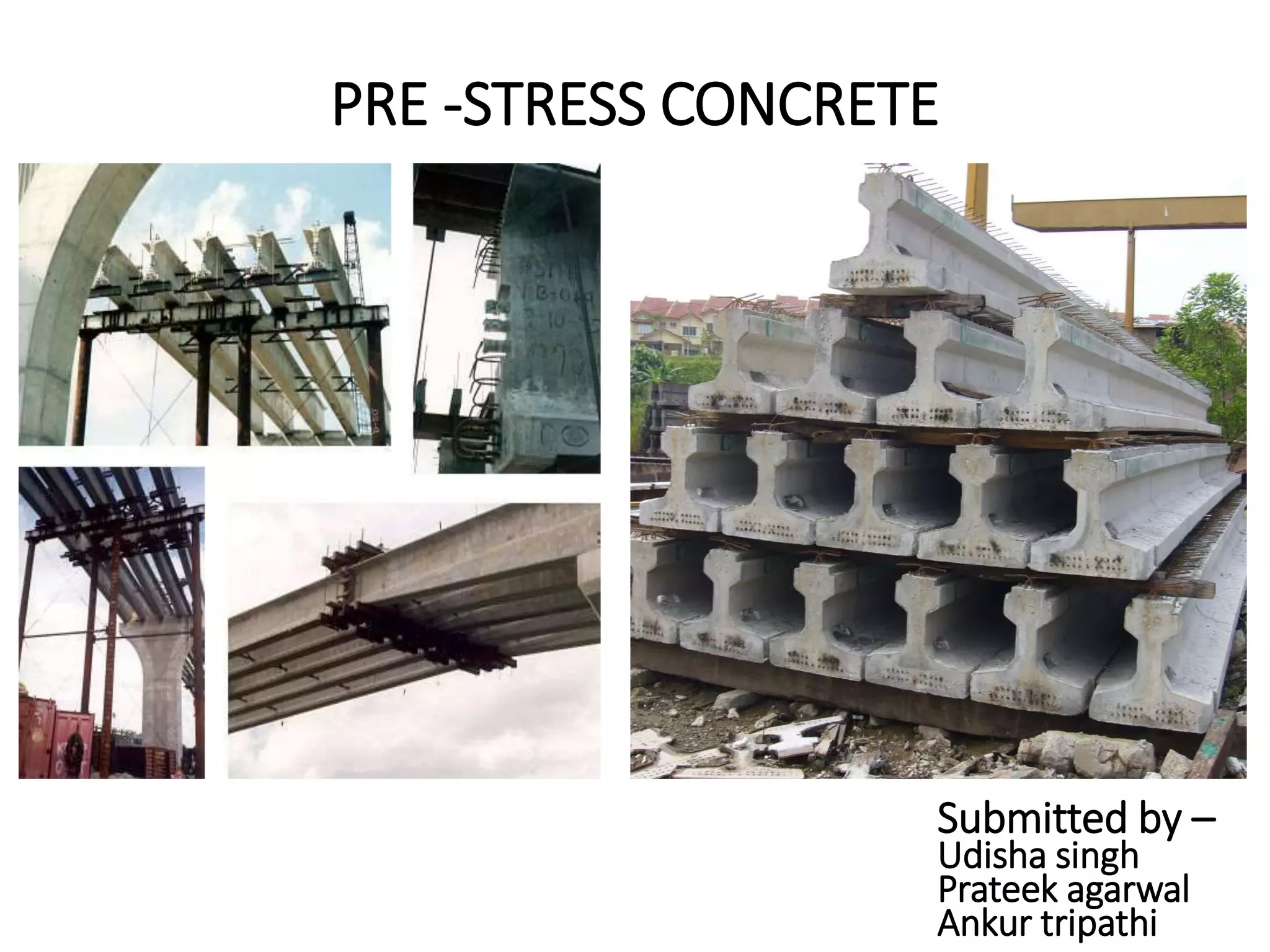
PRE -STRESS CONCRETE
Submitted by –
Udisha singh
Prateek agarwal
Ankur tripathi
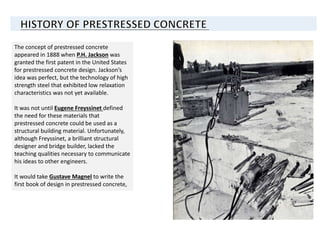
The concept of prestressed concrete
appeared in 1888 when P.H. Jackson was
granted the first patent in the United States
for prestressed concrete design. Jackson’s
idea was perfect, but the technology of high
strength steel that exhibited low relaxation
characteristics was not yet available.
It was not until Eugene Freyssinet defined
the need for these materials that
prestressed concrete could be used as a
structural building material. Unfortunately,
although Freyssinet, a brilliant structural
designer and bridge builder, lacked the
teaching qualities necessary to communicate
his ideas to other engineers.
It would take Gustave Magnel to write the
first book of design in prestressed concrete,
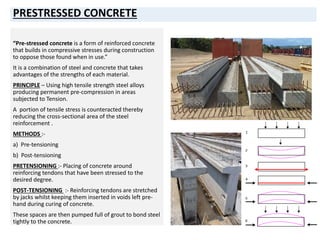
“Pre-stressed concrete is a form of reinforced concrete
that builds in compressive stresses during construction
to oppose those found when in use.”
It is a combination of steel and concrete that takes
advantages of the strengths of each material.
PRINCIPLE – Using high tensile strength steel alloys
producing permanent pre-compression in areas
subjected to Tension.
A portion of tensile stress is counteracted thereby
reducing the cross-sectional area of the steel
reinforcement .
METHODS :-
a) Pre-tensioning
b) Post-tensioning
PRETENSIONING :- Placing of concrete around
reinforcing tendons that have been stressed to the
desired degree.
POST-TENSIONING :- Reinforcing tendons are stretched
by jacks whilst keeping them inserted in voids left pre-
hand during curing of concrete.
These spaces are then pumped full of grout to bond steel
tightly to the concrete.
PRESTRESSED CONCRETE
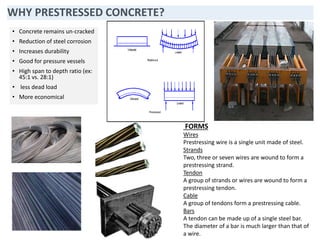
FORMS
Wires
Prestressing wire is a single unit made of steel.
Strands
Two, three or seven wires are wound to form a
prestressing strand.
Tendon
A group of strands or wires are wound to form a
prestressing tendon.
Cable
A group of tendons form a prestressing cable.
Bars
A tendon can be made up of a single steel bar.
The diameter of a bar is much larger than that of
a wire.
WHY PRESTRESSED CONCRETE?
• Concrete remains un-cracked
• Reduction of steel corrosion
• Increases durability
• Good for pressure vessels
• High span to depth ratio (ex:
45:1 vs. 28:1)
• less dead load
• More economical
3 MAIN TYPES OF INTERNAL PRESTRESSED CONCRETE
1. Pre-Tension Concrete: pre-stressing steel is
tension stressed prior to the placement of
the concrete and unloaded after concrete
has harden to required strength.
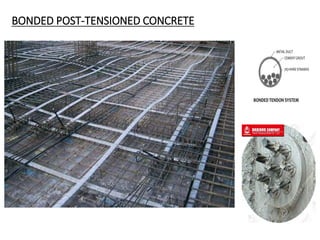
2. Bonded post-tensioned concrete:
unstressed pre-stressing steel is placed
within the concrete and then tension
stressed after concrete has harden to
required strength
3. Un-bonded post-tensioned concrete: differs
from bonded post-tensioning by providing
the pre-stressing steel permanent freedom
of movement relative to the concrete.
PRESTRESSED PRE-TENSIONED CONCRETE
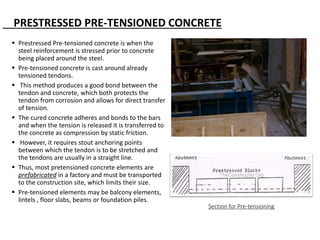
 Prestressed Pre-tensioned concrete is when the
steel reinforcement is stressed prior to concrete
being placed around the steel.
 Pre-tensioned concrete is cast around already
tensioned tendons.
 This method produces a good bond between the
tendon and concrete, which both protects the
tendon from corrosion and allows for direct transfer
of tension.
 The cured concrete adheres and bonds to the bars
and when the tension is released it is transferred to
the concrete as compression by static friction.
 However, it requires stout anchoring points
between which the tendon is to be stretched and
the tendons are usually in a straight line.
 Thus, most pretensioned concrete elements are
prefabricated in a factory and must be transported
to the construction site, which limits their size.
 Pre-tensioned elements may be balcony elements,
lintels , floor slabs, beams or foundation piles.
Section for Pre-tensioning
CONCERNS WITH PRE-TENSION
• Usually uses a mould which is able to resist the
forces within the tendons. Which are more
expensive than regular moulds
• Concrete sample should be taken for every new
mix so that strength obtained may be determined
before cutting the tendons releasing the stresses
onto the concrete.
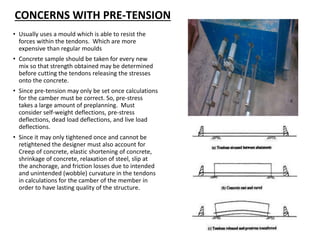
• Since pre-tension may only be set once calculations
for the camber must be correct. So, pre-stress
takes a large amount of preplanning. Must
consider self-weight deflections, pre-stress
deflections, dead load deflections, and live load
deflections.
• Since it may only tightened once and cannot be
retightened the designer must also account for
Creep of concrete, elastic shortening of concrete,
shrinkage of concrete, relaxation of steel, slip at
the anchorage, and friction losses due to intended
and unintended (wobble) curvature in the tendons
in calculations for the camber of the member in
order to have lasting quality of the structure.
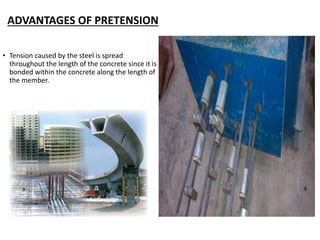
ADVANTAGES OF PRETENSION
• Tension caused by the steel is spread
throughout the length of the concrete since it is
bonded within the concrete along the length of
the member.
POST - TENSIONING
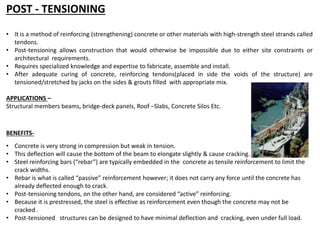
• It is a method of reinforcing (strengthening) concrete or other materials with high-strength steel strands called
tendons.
• Post-tensioning allows construction that would otherwise be impossible due to either site constraints or
architectural requirements.
• Requires specialized knowledge and expertise to fabricate, assemble and install.
• After adequate curing of concrete, reinforcing tendons(placed in side the voids of the structure) are
tensioned/stretched by jacks on the sides & grouts filled with appropriate mix.
APPLICATIONS –
Structural members beams, bridge-deck panels, Roof –Slabs, Concrete Silos Etc.
• Concrete is very strong in compression but weak in tension.
• This deflection will cause the bottom of the beam to elongate slightly & cause cracking.
• Steel reinforcing bars (“rebar”) are typically embedded in the concrete as tensile reinforcement to limit the
crack widths.
• Rebar is what is called “passive” reinforcement however; it does not carry any force until the concrete has
already deflected enough to crack.
• Post-tensioning tendons, on the other hand, are considered “active” reinforcing.
• Because it is prestressed, the steel is effective as reinforcement even though the concrete may not be
cracked .
• Post-tensioned structures can be designed to have minimal deflection and cracking, even under full load.
BENEFITS-
BONDED POST-TENSIONED CONCRETE
Process
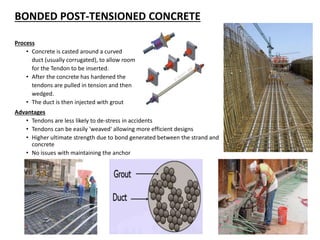
• Concrete is casted around a curved
duct (usually corrugated), to allow room
for the Tendon to be inserted.
• After the concrete has hardened the
tendons are pulled in tension and then
wedged.
• The duct is then injected with grout
Advantages
• Tendons are less likely to de-stress in accidents
• Tendons can be easily 'weaved' allowing more efficient designs
• Higher ultimate strength due to bond generated between the strand and
concrete
• No issues with maintaining the anchor
UNBONDED POST TENSIONED CONCRETE
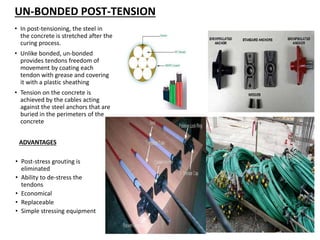
• In post-tensioning, the steel in
the concrete is stretched after the
curing process.
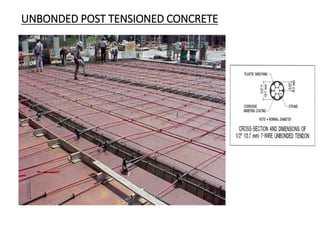
• Unlike bonded, un-bonded
provides tendons freedom of
movement by coating each
tendon with grease and covering
it with a plastic sheathing
• Tension on the concrete is
achieved by the cables acting
against the steel anchors that are
buried in the perimeters of the
concrete
UN-BONDED POST-TENSION
ADVANTAGES
• Post-stress grouting is
eliminated
• Ability to de-stress the
tendons
• Economical
• Replaceable
• Simple stressing equipment
ADVANTAGES
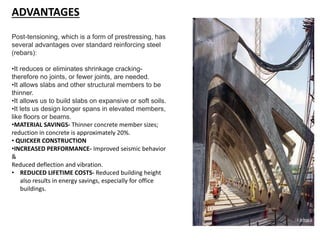
Post-tensioning, which is a form of prestressing, has
several advantages over standard reinforcing steel
(rebars):
•It reduces or eliminates shrinkage cracking-
therefore no joints, or fewer joints, are needed.
•It allows slabs and other structural members to be
thinner.
•It allows us to build slabs on expansive or soft soils.
•It lets us design longer spans in elevated members,
like floors or beams.
•MATERIAL SAVINGS- Thinner concrete member sizes;
reduction in concrete is approximately 20%.
• QUICKER CONSTRUCTION
•INCREASED PERFORMANCE- Improved seismic behavior
&
Reduced deflection and vibration.
• REDUCED LIFETIME COSTS- Reduced building height
also results in energy savings, especially for office
buildings.
POST-TENSIONING
• Can be performed at the project site as well as at precast yards.
There is relatively less loss of prestress due to concrete shrinkage as at the time of prestressing
concerete has already been cured.
• Corrosion of steel is less as compared to pre-tensioning.
• There is more flexibility in design. The prestressing tendons can be configured to almost any shape. As
per requirements the tendons may be bonded or unbonded.
• They are more prone to anchorage failure as the compressive forces are transferred at the beam ends.
Hence compressive stresses are concentrated.
PRE-TENSIONING
• Difficult to perform at site. Only done in precast yards.
• There is greater loss of prestress due to shrinkage of concrete.
• Concrete and steel tendons are in direct contact. So any moisture that slips through cracks in concrete
will cause corrosion in steel.
• Tendons can only be straight or circular.
• Since the compressive forces are transferred over a certain length of bond, they are less prone to
anchorage failure.
So to generalize post-tensioning is usually better than pre-tensioning. However this may not always be
the case. Either method has its applications.
DIFFERENCE BETWEEN POST-TENSIONING AND PRE- TENSIONING
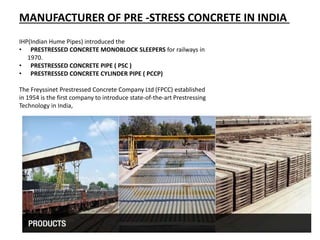
IHP(Indian Hume Pipes) introduced the
• PRESTRESSED CONCRETE MONOBLOCK SLEEPERS for railways in
1970.
• PRESTRESSED CONCRETE PIPE ( PSC )
• PRESTRESSED CONCRETE CYLINDER PIPE ( PCCP)
The Freyssinet Prestressed Concrete Company Ltd (FPCC) established
in 1954 is the first company to introduce state-of-the-art Prestressing
Technology in India,
MANUFACTURER OF PRE -STRESS CONCRETE IN INDIA

Prestressed concrete

  • 1.
    PRE -STRESS CONCRETE Submittedby – Udisha singh Prateek agarwal Ankur tripathi
  • 2.
    The concept ofprestressed concrete appeared in 1888 when P.H. Jackson was granted the first patent in the United States for prestressed concrete design. Jackson’s idea was perfect, but the technology of high strength steel that exhibited low relaxation characteristics was not yet available. It was not until Eugene Freyssinet defined the need for these materials that prestressed concrete could be used as a structural building material. Unfortunately, although Freyssinet, a brilliant structural designer and bridge builder, lacked the teaching qualities necessary to communicate his ideas to other engineers. It would take Gustave Magnel to write the first book of design in prestressed concrete,
  • 3.
    “Pre-stressed concrete isa form of reinforced concrete that builds in compressive stresses during construction to oppose those found when in use.” It is a combination of steel and concrete that takes advantages of the strengths of each material. PRINCIPLE – Using high tensile strength steel alloys producing permanent pre-compression in areas subjected to Tension. A portion of tensile stress is counteracted thereby reducing the cross-sectional area of the steel reinforcement . METHODS :- a) Pre-tensioning b) Post-tensioning PRETENSIONING :- Placing of concrete around reinforcing tendons that have been stressed to the desired degree. POST-TENSIONING :- Reinforcing tendons are stretched by jacks whilst keeping them inserted in voids left pre- hand during curing of concrete. These spaces are then pumped full of grout to bond steel tightly to the concrete. PRESTRESSED CONCRETE
  • 4.
    FORMS Wires Prestressing wire isa single unit made of steel. Strands Two, three or seven wires are wound to form a prestressing strand. Tendon A group of strands or wires are wound to form a prestressing tendon. Cable A group of tendons form a prestressing cable. Bars A tendon can be made up of a single steel bar. The diameter of a bar is much larger than that of a wire. WHY PRESTRESSED CONCRETE? • Concrete remains un-cracked • Reduction of steel corrosion • Increases durability • Good for pressure vessels • High span to depth ratio (ex: 45:1 vs. 28:1) • less dead load • More economical
  • 5.
    3 MAIN TYPESOF INTERNAL PRESTRESSED CONCRETE 1. Pre-Tension Concrete: pre-stressing steel is tension stressed prior to the placement of the concrete and unloaded after concrete has harden to required strength. 2. Bonded post-tensioned concrete: unstressed pre-stressing steel is placed within the concrete and then tension stressed after concrete has harden to required strength 3. Un-bonded post-tensioned concrete: differs from bonded post-tensioning by providing the pre-stressing steel permanent freedom of movement relative to the concrete.
  • 6.
    PRESTRESSED PRE-TENSIONED CONCRETE Prestressed Pre-tensioned concrete is when the steel reinforcement is stressed prior to concrete being placed around the steel.  Pre-tensioned concrete is cast around already tensioned tendons.  This method produces a good bond between the tendon and concrete, which both protects the tendon from corrosion and allows for direct transfer of tension.  The cured concrete adheres and bonds to the bars and when the tension is released it is transferred to the concrete as compression by static friction.  However, it requires stout anchoring points between which the tendon is to be stretched and the tendons are usually in a straight line.  Thus, most pretensioned concrete elements are prefabricated in a factory and must be transported to the construction site, which limits their size.  Pre-tensioned elements may be balcony elements, lintels , floor slabs, beams or foundation piles. Section for Pre-tensioning
  • 7.
    CONCERNS WITH PRE-TENSION •Usually uses a mould which is able to resist the forces within the tendons. Which are more expensive than regular moulds • Concrete sample should be taken for every new mix so that strength obtained may be determined before cutting the tendons releasing the stresses onto the concrete. • Since pre-tension may only be set once calculations for the camber must be correct. So, pre-stress takes a large amount of preplanning. Must consider self-weight deflections, pre-stress deflections, dead load deflections, and live load deflections. • Since it may only tightened once and cannot be retightened the designer must also account for Creep of concrete, elastic shortening of concrete, shrinkage of concrete, relaxation of steel, slip at the anchorage, and friction losses due to intended and unintended (wobble) curvature in the tendons in calculations for the camber of the member in order to have lasting quality of the structure.
  • 8.
    ADVANTAGES OF PRETENSION •Tension caused by the steel is spread throughout the length of the concrete since it is bonded within the concrete along the length of the member.
  • 9.
    POST - TENSIONING •It is a method of reinforcing (strengthening) concrete or other materials with high-strength steel strands called tendons. • Post-tensioning allows construction that would otherwise be impossible due to either site constraints or architectural requirements. • Requires specialized knowledge and expertise to fabricate, assemble and install. • After adequate curing of concrete, reinforcing tendons(placed in side the voids of the structure) are tensioned/stretched by jacks on the sides & grouts filled with appropriate mix. APPLICATIONS – Structural members beams, bridge-deck panels, Roof –Slabs, Concrete Silos Etc. • Concrete is very strong in compression but weak in tension. • This deflection will cause the bottom of the beam to elongate slightly & cause cracking. • Steel reinforcing bars (“rebar”) are typically embedded in the concrete as tensile reinforcement to limit the crack widths. • Rebar is what is called “passive” reinforcement however; it does not carry any force until the concrete has already deflected enough to crack. • Post-tensioning tendons, on the other hand, are considered “active” reinforcing. • Because it is prestressed, the steel is effective as reinforcement even though the concrete may not be cracked . • Post-tensioned structures can be designed to have minimal deflection and cracking, even under full load. BENEFITS-
  • 10.
  • 11.
    BONDED POST-TENSIONED CONCRETE Process •Concrete is casted around a curved duct (usually corrugated), to allow room for the Tendon to be inserted. • After the concrete has hardened the tendons are pulled in tension and then wedged. • The duct is then injected with grout Advantages • Tendons are less likely to de-stress in accidents • Tendons can be easily 'weaved' allowing more efficient designs • Higher ultimate strength due to bond generated between the strand and concrete • No issues with maintaining the anchor
  • 12.
  • 13.
    • In post-tensioning,the steel in the concrete is stretched after the curing process. • Unlike bonded, un-bonded provides tendons freedom of movement by coating each tendon with grease and covering it with a plastic sheathing • Tension on the concrete is achieved by the cables acting against the steel anchors that are buried in the perimeters of the concrete UN-BONDED POST-TENSION ADVANTAGES • Post-stress grouting is eliminated • Ability to de-stress the tendons • Economical • Replaceable • Simple stressing equipment
  • 14.
    ADVANTAGES Post-tensioning, which isa form of prestressing, has several advantages over standard reinforcing steel (rebars): •It reduces or eliminates shrinkage cracking- therefore no joints, or fewer joints, are needed. •It allows slabs and other structural members to be thinner. •It allows us to build slabs on expansive or soft soils. •It lets us design longer spans in elevated members, like floors or beams. •MATERIAL SAVINGS- Thinner concrete member sizes; reduction in concrete is approximately 20%. • QUICKER CONSTRUCTION •INCREASED PERFORMANCE- Improved seismic behavior & Reduced deflection and vibration. • REDUCED LIFETIME COSTS- Reduced building height also results in energy savings, especially for office buildings.
  • 15.
    POST-TENSIONING • Can beperformed at the project site as well as at precast yards. There is relatively less loss of prestress due to concrete shrinkage as at the time of prestressing concerete has already been cured. • Corrosion of steel is less as compared to pre-tensioning. • There is more flexibility in design. The prestressing tendons can be configured to almost any shape. As per requirements the tendons may be bonded or unbonded. • They are more prone to anchorage failure as the compressive forces are transferred at the beam ends. Hence compressive stresses are concentrated. PRE-TENSIONING • Difficult to perform at site. Only done in precast yards. • There is greater loss of prestress due to shrinkage of concrete. • Concrete and steel tendons are in direct contact. So any moisture that slips through cracks in concrete will cause corrosion in steel. • Tendons can only be straight or circular. • Since the compressive forces are transferred over a certain length of bond, they are less prone to anchorage failure. So to generalize post-tensioning is usually better than pre-tensioning. However this may not always be the case. Either method has its applications. DIFFERENCE BETWEEN POST-TENSIONING AND PRE- TENSIONING
  • 16.
    IHP(Indian Hume Pipes)introduced the • PRESTRESSED CONCRETE MONOBLOCK SLEEPERS for railways in 1970. • PRESTRESSED CONCRETE PIPE ( PSC ) • PRESTRESSED CONCRETE CYLINDER PIPE ( PCCP) The Freyssinet Prestressed Concrete Company Ltd (FPCC) established in 1954 is the first company to introduce state-of-the-art Prestressing Technology in India, MANUFACTURER OF PRE -STRESS CONCRETE IN INDIA