Prepared By:- Sacademicus
 The basic approach of earthquake resistant design should be
based on lateral strength as well as deformability and
ductility capacity of structure with limited damage but no
collapse.
 The code IS : 13920-1993 entitled “Ductile Detailing of
Reinforced Concrete Structures Subjected to Seismic Forces-
Code of Practice” is based on this approach.
 This standard covers the requirements for anchorage,
specially bar cut-offs and joint details.
▪ A ductile materials is one which can undergo large elongations
while resisting loads.
▪ When applied to reinforced concrete members and structures,
ductility means the ability to sustain significant inelastic
deformations before collapse.
▪ A brittle material fails suddenly while ductile material gives
sufficient warning before collapse thus saving many lives.
▪ It is very important to incorporate ductility into the structures
to make them earthquake resistant.
▪ To have sufficient ductility, the designer should pay attention to
detailing of reinforcement.
 Ductility in the structure will arise from inelastic material
behavior and detailing of reinforcement in such a manner the
brittle failure is avoided and ductile behavior is induced by
allowing steel to yield in controlled manner.
 If the structure is sufficiently ductile, it can resist unexpected
over loads, load reversals, impact, etc.
 If the structure is ductile, the failure of the structure will not
be sudden. Hence the people occupying the structure get
sufficient time to escape.
 It allows the structure as a whole, to develop its
maximum potential strength, through distribution of
internal forces, which is given by the combination
of maximum strengths of all components.
 Building configuration must be simple and regular.
 Individual members must be designed for ductility.
 Connections and other structural details must be
carefully attended.
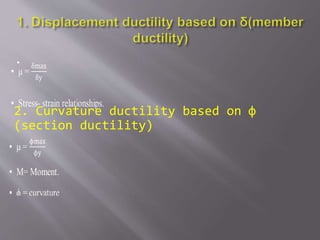
▪
▪
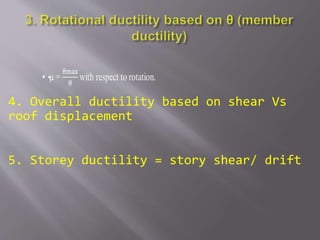
2. Curvature ductility based on φ
(section ductility)
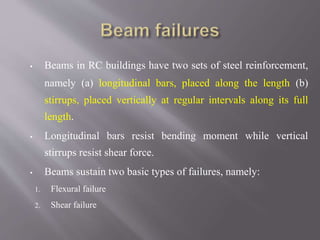
▪
4. Overall ductility based on shear Vs
roof displacement
5. Storey ductility = story shear/ drift
▪ Beams in RC buildings have two sets of steel reinforcement,
namely (a) longitudinal bars, placed along the length (b)
stirrups, placed vertically at regular intervals along its full
length.
▪ Longitudinal bars resist bending moment while vertical
stirrups resist shear force.
▪ Beams sustain two basic types of failures, namely:
1. Flexural failure
2. Shear failure
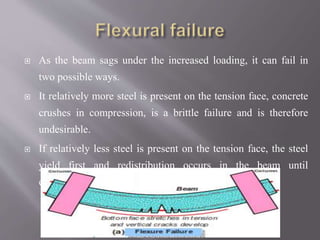
 As the beam sags under the increased loading, it can fail in
two possible ways.
 It relatively more steel is present on the tension face, concrete
crushes in compression, is a brittle failure and is therefore
undesirable.
 If relatively less steel is present on the tension face, the steel
yield first and redistribution occurs in the beam until
eventually the concrete crushes in compression.
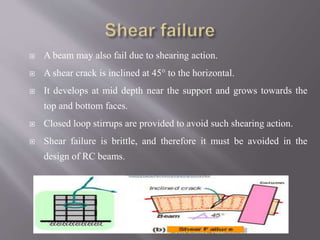
 A beam may also fail due to shearing action.
 A shear crack is inclined at 45° to the horizontal.
 It develops at mid depth near the support and grows towards the
top and bottom faces.
 Closed loop stirrups are provided to avoid such shearing action.
 Shear failure is brittle, and therefore it must be avoided in the
design of RC beams.
 The design and construction of RC buildings shall be governed by
the provisions of IS :456-2000.
 For all buildings which are more than 3 storeys in height, the
minimum grade of concrete shall preferably be M20. But, for
buildings having more than 3 storeys in height and situated in
zones IV and V, the minimum grade of concrete should be M-25.
 Steel reinforcement of grade Fe-415 or less only shall be used.
However, TMT bars of grades Fe-500 and Fe 550 having
elongation more than 14.5 % may also be used for the
reinforcement.
 Clause 6.1 : General
 The factored axial stress on the member under
earthquake loading shall not exceed 0.1 fck..
 The member shall have width/depth ratio of more than
0.3
 The width of the member shall not be less than 200 mm.
 The depth of member (D) should not be more than ¼ of
clear span.
▪
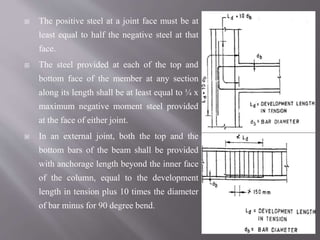
 The positive steel at a joint face must be at
least equal to half the negative steel at that
face.
 The steel provided at each of the top and
bottom face of the member at any section
along its length shall be at least equal to ¼ x
maximum negative moment steel provided
at the face of either joint.
 In an external joint, both the top and the
bottom bars of the beam shall be provided
with anchorage length beyond the inner face
of the column, equal to the development
length in tension plus 10 times the diameter
of bar minus for 90 degree bend.
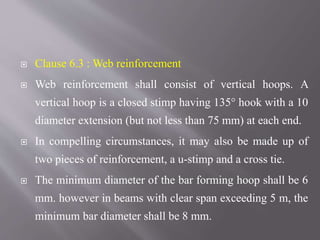
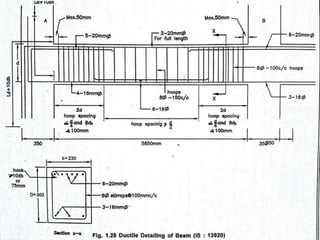
 Clause 6.3 : Web reinforcement
 Web reinforcement shall consist of vertical hoops. A
vertical hoop is a closed stimp having 135° hook with a 10
diameter extension (but not less than 75 mm) at each end.
 In compelling circumstances, it may also be made up of
two pieces of reinforcement, a u-stimp and a cross tie.
 The minimum diameter of the bar forming hoop shall be 6
mm. however in beams with clear span exceeding 5 m, the
minimum bar diameter shall be 8 mm.
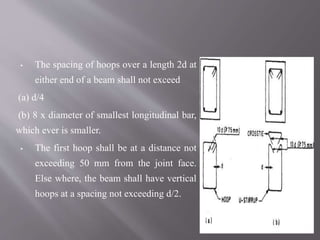
▪ The spacing of hoops over a length 2d at
either end of a beam shall not exceed
(a) d/4
(b) 8 x diameter of smallest longitudinal bar,
which ever is smaller.
▪ The first hoop shall be at a distance not
exceeding 50 mm from the joint face.
Else where, the beam shall have vertical
hoops at a spacing not exceeding d/2.
 Clause 7.1 : General
 These requirements apply to frame members which have a
factored axial stress in excess of 0.1 fck under the effect of
earthquake forces.
 The minimum dimension of the member shall not be less than 200
mm.
 The ratio of the shorter cross sectional dimension to the
perpendicular dimension shall preferably not be less than 0.4.
▪ Clause 7.2 : Longitudinal reinforcement
▪ Lap splices shall be provided only in the central half
of the member length. It should be proportioned as a
tension splice.
▪ Any area of a column that extend move than 100 mm
beyond the confined core due to architectural
requirements.
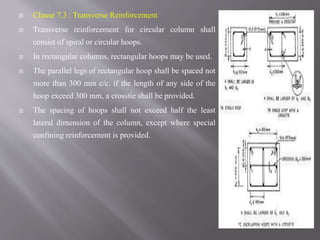
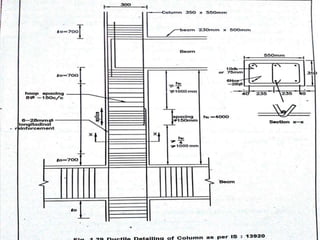
 Clause 7.3 : Transverse Reinforcement
 Transverse reinforcement for circular column shall
consist of spiral or circular hoops.
 In rectangular columns, rectangular hoops may be used.
 The parallel legs of rectangular hoop shall be spaced not
more than 300 mm c/c. if the length of any side of the
hoop exceed 300 mm, a crosstie shall be provided.
 The spacing of hoops shall not exceed half the least
lateral dimension of the column, except where special
confining reinforcement is provided.
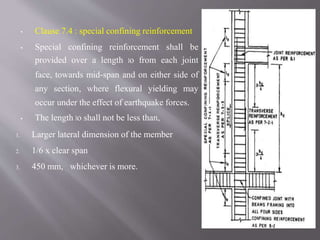
▪ Clause 7.4 : special confining reinforcement
▪ Special confining reinforcement shall be
provided over a length lo from each joint
face, towards mid-span and on either side of
any section, where flexural yielding may
occur under the effect of earthquake forces.
▪ The length lo shall not be less than,
1. Larger lateral dimension of the member
2. 1/6 x clear span
3. 450 mm, whichever is more.
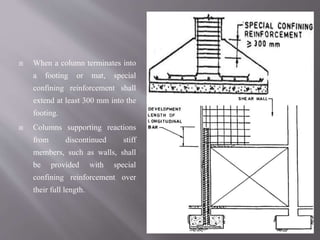
 When a column terminates into
a footing or mat, special
confining reinforcement shall
extend at least 300 mm into the
footing.
 Columns supporting reactions
from discontinued stiff
members, such as walls, shall
be provided with special
confining reinforcement over
their full length.
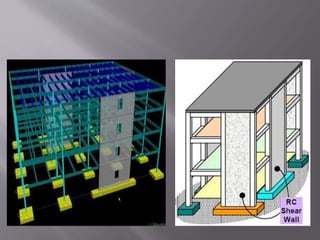
 Reinforced concrete (RC) buildings often have vertical plate like RC
walls called shear walls, in addition to slabs, beams and columns.
 These walls generally start at the foundation level and are continuous
throughout the height of the building.
 Their thickness can be as low as 150 mm or as high as 400 mm in
high rise buildings.
 Shear walls are usually provided along both length and width of
buildings.
 Shear walls like vertically oriented wide beams that carry earthquake
loads downwards to the foundation.
 Properly designed and detailed buildings with shear walls
have shown very good performance in past earthquakes.
 The overwhelming success of buildings with shear walls
in resisting strong earthquakes is summarized in the
quote: “ we can not afford to build concrete building
meant to resist severe earthquakes without shear walls.”
▪
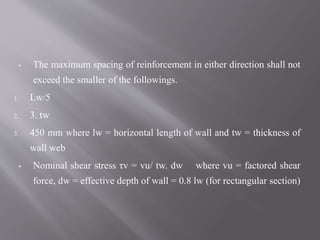
▪ The maximum spacing of reinforcement in either direction shall not
exceed the smaller of the followings.
1. Lw/5
2. 3. tw
3. 450 mm where lw = horizontal length of wall and tw = thickness of
wall web
▪ Nominal shear stress τv = vu/ tw. dw where vu = factored shear
force, dw = effective depth of wall = 0.8 lw (for rectangular section)
Ductile detailing IS 13920

Ductile detailing IS 13920

  • 1.
  • 2.
     The basicapproach of earthquake resistant design should be based on lateral strength as well as deformability and ductility capacity of structure with limited damage but no collapse.  The code IS : 13920-1993 entitled “Ductile Detailing of Reinforced Concrete Structures Subjected to Seismic Forces- Code of Practice” is based on this approach.  This standard covers the requirements for anchorage, specially bar cut-offs and joint details.
  • 3.
    ▪ A ductilematerials is one which can undergo large elongations while resisting loads. ▪ When applied to reinforced concrete members and structures, ductility means the ability to sustain significant inelastic deformations before collapse. ▪ A brittle material fails suddenly while ductile material gives sufficient warning before collapse thus saving many lives. ▪ It is very important to incorporate ductility into the structures to make them earthquake resistant. ▪ To have sufficient ductility, the designer should pay attention to detailing of reinforcement.
  • 4.
     Ductility inthe structure will arise from inelastic material behavior and detailing of reinforcement in such a manner the brittle failure is avoided and ductile behavior is induced by allowing steel to yield in controlled manner.  If the structure is sufficiently ductile, it can resist unexpected over loads, load reversals, impact, etc.  If the structure is ductile, the failure of the structure will not be sudden. Hence the people occupying the structure get sufficient time to escape.
  • 5.
     It allowsthe structure as a whole, to develop its maximum potential strength, through distribution of internal forces, which is given by the combination of maximum strengths of all components.  Building configuration must be simple and regular.  Individual members must be designed for ductility.  Connections and other structural details must be carefully attended.
  • 6.
  • 7.
    ▪ 2. Curvature ductilitybased on φ (section ductility)
  • 8.
    ▪ 4. Overall ductilitybased on shear Vs roof displacement 5. Storey ductility = story shear/ drift
  • 9.
    ▪ Beams inRC buildings have two sets of steel reinforcement, namely (a) longitudinal bars, placed along the length (b) stirrups, placed vertically at regular intervals along its full length. ▪ Longitudinal bars resist bending moment while vertical stirrups resist shear force. ▪ Beams sustain two basic types of failures, namely: 1. Flexural failure 2. Shear failure
  • 10.
     As thebeam sags under the increased loading, it can fail in two possible ways.  It relatively more steel is present on the tension face, concrete crushes in compression, is a brittle failure and is therefore undesirable.  If relatively less steel is present on the tension face, the steel yield first and redistribution occurs in the beam until eventually the concrete crushes in compression.
  • 11.
     A beammay also fail due to shearing action.  A shear crack is inclined at 45° to the horizontal.  It develops at mid depth near the support and grows towards the top and bottom faces.  Closed loop stirrups are provided to avoid such shearing action.  Shear failure is brittle, and therefore it must be avoided in the design of RC beams.
  • 12.
     The designand construction of RC buildings shall be governed by the provisions of IS :456-2000.  For all buildings which are more than 3 storeys in height, the minimum grade of concrete shall preferably be M20. But, for buildings having more than 3 storeys in height and situated in zones IV and V, the minimum grade of concrete should be M-25.  Steel reinforcement of grade Fe-415 or less only shall be used. However, TMT bars of grades Fe-500 and Fe 550 having elongation more than 14.5 % may also be used for the reinforcement.
  • 13.
     Clause 6.1: General  The factored axial stress on the member under earthquake loading shall not exceed 0.1 fck..  The member shall have width/depth ratio of more than 0.3  The width of the member shall not be less than 200 mm.  The depth of member (D) should not be more than ¼ of clear span.
  • 14.
  • 15.
     The positivesteel at a joint face must be at least equal to half the negative steel at that face.  The steel provided at each of the top and bottom face of the member at any section along its length shall be at least equal to ¼ x maximum negative moment steel provided at the face of either joint.  In an external joint, both the top and the bottom bars of the beam shall be provided with anchorage length beyond the inner face of the column, equal to the development length in tension plus 10 times the diameter of bar minus for 90 degree bend.
  • 16.
     Clause 6.3: Web reinforcement  Web reinforcement shall consist of vertical hoops. A vertical hoop is a closed stimp having 135° hook with a 10 diameter extension (but not less than 75 mm) at each end.  In compelling circumstances, it may also be made up of two pieces of reinforcement, a u-stimp and a cross tie.  The minimum diameter of the bar forming hoop shall be 6 mm. however in beams with clear span exceeding 5 m, the minimum bar diameter shall be 8 mm.
  • 17.
    ▪ The spacingof hoops over a length 2d at either end of a beam shall not exceed (a) d/4 (b) 8 x diameter of smallest longitudinal bar, which ever is smaller. ▪ The first hoop shall be at a distance not exceeding 50 mm from the joint face. Else where, the beam shall have vertical hoops at a spacing not exceeding d/2.
  • 18.
     Clause 7.1: General  These requirements apply to frame members which have a factored axial stress in excess of 0.1 fck under the effect of earthquake forces.  The minimum dimension of the member shall not be less than 200 mm.  The ratio of the shorter cross sectional dimension to the perpendicular dimension shall preferably not be less than 0.4.
  • 19.
    ▪ Clause 7.2: Longitudinal reinforcement ▪ Lap splices shall be provided only in the central half of the member length. It should be proportioned as a tension splice. ▪ Any area of a column that extend move than 100 mm beyond the confined core due to architectural requirements.
  • 20.
     Clause 7.3: Transverse Reinforcement  Transverse reinforcement for circular column shall consist of spiral or circular hoops.  In rectangular columns, rectangular hoops may be used.  The parallel legs of rectangular hoop shall be spaced not more than 300 mm c/c. if the length of any side of the hoop exceed 300 mm, a crosstie shall be provided.  The spacing of hoops shall not exceed half the least lateral dimension of the column, except where special confining reinforcement is provided.
  • 21.
    ▪ Clause 7.4: special confining reinforcement ▪ Special confining reinforcement shall be provided over a length lo from each joint face, towards mid-span and on either side of any section, where flexural yielding may occur under the effect of earthquake forces. ▪ The length lo shall not be less than, 1. Larger lateral dimension of the member 2. 1/6 x clear span 3. 450 mm, whichever is more.
  • 22.
     When acolumn terminates into a footing or mat, special confining reinforcement shall extend at least 300 mm into the footing.  Columns supporting reactions from discontinued stiff members, such as walls, shall be provided with special confining reinforcement over their full length.
  • 23.
     Reinforced concrete(RC) buildings often have vertical plate like RC walls called shear walls, in addition to slabs, beams and columns.  These walls generally start at the foundation level and are continuous throughout the height of the building.  Their thickness can be as low as 150 mm or as high as 400 mm in high rise buildings.  Shear walls are usually provided along both length and width of buildings.  Shear walls like vertically oriented wide beams that carry earthquake loads downwards to the foundation.
  • 25.
     Properly designedand detailed buildings with shear walls have shown very good performance in past earthquakes.  The overwhelming success of buildings with shear walls in resisting strong earthquakes is summarized in the quote: “ we can not afford to build concrete building meant to resist severe earthquakes without shear walls.”
  • 26.
  • 27.
    ▪ The maximumspacing of reinforcement in either direction shall not exceed the smaller of the followings. 1. Lw/5 2. 3. tw 3. 450 mm where lw = horizontal length of wall and tw = thickness of wall web ▪ Nominal shear stress τv = vu/ tw. dw where vu = factored shear force, dw = effective depth of wall = 0.8 lw (for rectangular section)