DEPARTMENT OF CIVIL ENGINEERING, UNIVERSITY OF
     ENGINEERING AND TECHNOLOGY, LAHORE


DESIGN OF BEAM
 FOR TORSION
          Engr. Ayaz Waseem Malik
           Lecturer/ Lab Engineer
Engr. Ayaz Waseem ( Lecturer/Lab Engr., C.E.D., U.E.T., Lhr)           Design of Beam for Torsion


             DESIGN OF BEAM FOR TORSION


1.    IMPORTANT TERMINOLIGIES
Acp    Area enclosed by outside perimeter of concrete cross-section
Ag     Gross area of concrete section. For a hollow section, Ag is the area of the concrete only
       and does not include the area of void(s)
Al     Total area of longitudinal reinforcement to resist torsion
Al(min) Minimum area of longitudinal reinforcement to resist torsion
Ao     Gross area enclosed by the shear flow path
Aoh    Area enclosed by centerline of the outermost closed transverse torsional reinforcement
At     Area of one leg of closed stirrup resisting torsion
Av     Area of steel for resisting shear
bt     Width of that part of cross-section containing the closed stirrups resisting torsion
fc'    Specified compressive strength of concrete
fy     Specified yield strength of reinforcement
fyt    Specified yield strength of transverse reinforcement
Nu     Factored axial force normal to cross-section occurring simultaneously with Vu or Tu
Pcp    Outside perimeter of concrete cross-section
Ph     Perimeter of centerline of the outermost closed transverse torsional reinforcement
t      Wall thickness of hollow section
Tcr    Cracking torque
Tn     Nominal torsional moment strength
Tu     Factored torsional moment at section
Vc     Nominal shear strength provided by concrete
Vn     Nominal shear stress
Vu     Factored shear force
      Modification factor reflecting the reduced mechanical properties of lightweight concrete,
       all relative to normalweight concrete of the same compressive strength.

                                                                                                   1
Engr. Ayaz Waseem ( Lecturer/Lab Engr., C.E.D., U.E.T., Lhr)          Design of Beam for Torsion


2.    TORSION
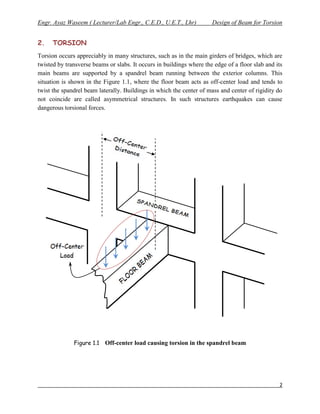
Torsion occurs appreciably in many structures, such as in the main girders of bridges, which are
twisted by transverse beams or slabs. It occurs in buildings where the edge of a floor slab and its
main beams are supported by a spandrel beam running between the exterior columns. This
situation is shown in the Figure 1.1, where the floor beam acts as off-center load and tends to
twist the spandrel beam laterally. Buildings in which the center of mass and center of rigidity do
not coincide are called asymmetrical structures. In such structures earthquakes can cause
dangerous torsional forces.


              Figure 1.1 Off-center load causing torsion in the spandrel beam


                                                                                                 2
Engr. Ayaz Waseem ( Lecturer/Lab Engr., C.E.D., U.E.T., Lhr)            Design of Beam for Torsion


If a plain concrete member is subjected to pure torsion, it will crack and fail along 45 o spiral
lines due to diagonal tension corresponding to the torsional stresses. Although the diagonal
tension stresses produced by twisting are very similar to those caused by shear, they will occur
on all faces of a member. Maximum shears and torsional forces may occur in areas where
bending moments are small. For such cases, the interaction of shear and torsion can be
particularly important as it relates to design.


3.    THRESHOLD TORSION
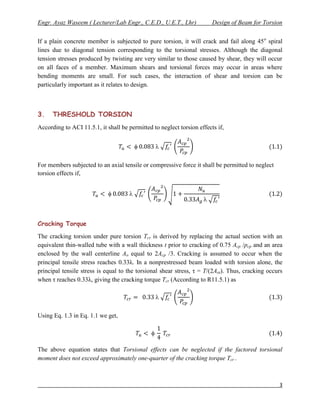
According to ACI 11.5.1, it shall be permitted to neglect torsion effects if,


                                                

For members subjected to an axial tensile or compressive force it shall be permitted to neglect
torsion effects if,


                                     
                                                                    


Cracking Torque
The cracking torsion under pure torsion Tcr is derived by replacing the actual section with an
equivalent thin-walled tube with a wall thickness t prior to cracking of 0.75 Acp /pcp and an area
enclosed by the wall centerline Ao equal to 2Acp /3. Cracking is assumed to occur when the
principal tensile stress reaches 0.33λ. In a nonprestressed beam loaded with torsion alone, the
principal tensile stress is equal to the torsional shear stress, τ = T/(2Aot). Thus, cracking occurs
when τ reaches 0.33λ, giving the cracking torque Tcr (According to R11.5.1) as

                                                

Using Eq. 1.3 in Eq. 1.1 we get,


The above equation states that Torsional effects can be neglected if the factored torsional
moment does not exceed approximately one-quarter of the cracking torque Tcr .


                                                                                                  3
Engr. Ayaz Waseem ( Lecturer/Lab Engr., C.E.D., U.E.T., Lhr)           Design of Beam for Torsion


4.    MOMENT REDISTRIBUTION

Equilibrium Torsion
For a statically determinate structure, there is only one path along which a torsional moment can
be transmitted to the supports. This type of torsional moment, which is referred to as equilibrium
torsion, cannot be reduced by redistribution of internal forces or by a rotation of member.
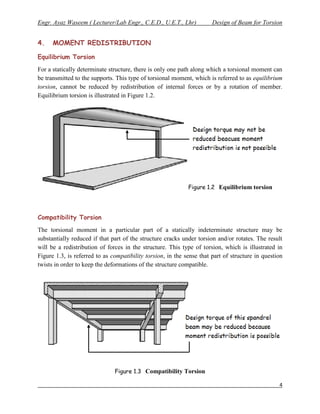
Equilibrium torsion is illustrated in Figure 1.2.


                                                             Figure 1.2 Equilibrium torsion


Compatibility Torsion
The torsional moment in a particular part of a statically indeterminate structure may be
substantially reduced if that part of the structure cracks under torsion and/or rotates. The result
will be a redistribution of forces in the structure. This type of torsion, which is illustrated in
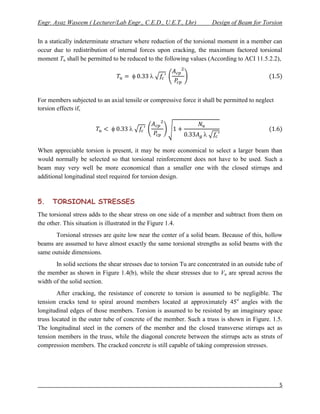
Figure 1.3, is referred to as compatibility torsion, in the sense that part of structure in question
twists in order to keep the deformations of the structure compatible.


                               Figure 1.3 Compatibility Torsion

                                                                                                  4
Engr. Ayaz Waseem ( Lecturer/Lab Engr., C.E.D., U.E.T., Lhr)           Design of Beam for Torsion


In a statically indeterminate structure where reduction of the torsional moment in a member can
occur due to redistribution of internal forces upon cracking, the maximum factored torsional
moment Tu shall be permitted to be reduced to the following values (According to ACI 11.5.2.2),

                                             


For members subjected to an axial tensile or compressive force it shall be permitted to neglect
torsion effects if,


                                     
                                                                   

When appreciable torsion is present, it may be more economical to select a larger beam than
would normally be selected so that torsional reinforcement does not have to be used. Such a
beam may very well be more economical than a smaller one with the closed stirrups and
additional longitudinal steel required for torsion design.


5.    TORSIONAL STRESSES
The torsional stress adds to the shear stress on one side of a member and subtract from them on
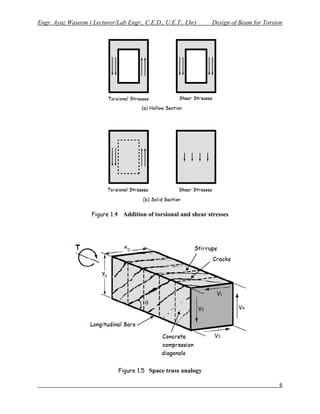
the other. This situation is illustrated in the Figure 1.4.
      Torsional stresses are quite low near the center of a solid beam. Because of this, hollow
beams are assumed to have almost exactly the same torsional strengths as solid beams with the
same outside dimensions.
       In solid sections the shear stresses due to torsion Tu are concentrated in an outside tube of
the member as shown in Figure 1.4(b), while the shear stresses due to Vu are spread across the
width of the solid section.
        After cracking, the resistance of concrete to torsion is assumed to be negligible. The
tension cracks tend to spiral around members located at approximately 45o angles with the
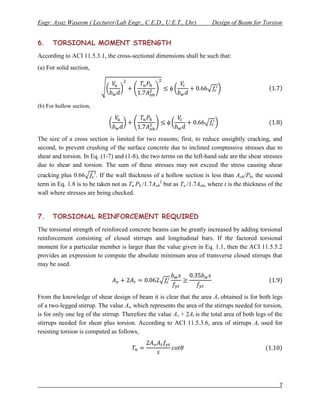
longitudinal edges of those members. Torsion is assumed to be resisted by an imaginary space
truss located in the outer tube of concrete of the member. Such a truss is shown in Figure. 1.5.
The longitudinal steel in the corners of the member and the closed transverse stirrups act as
tension members in the truss, while the diagonal concrete between the stirrups acts as struts of
compression members. The cracked concrete is still capable of taking compression stresses.


                                                                                                  5
Engr. Ayaz Waseem ( Lecturer/Lab Engr., C.E.D., U.E.T., Lhr)    Design of Beam for Torsion


                    Figure 1.4 Addition of torsional and shear stresses


                                        


                              Figure 1.5 Space truss analogy

                                                                                        6
Engr. Ayaz Waseem ( Lecturer/Lab Engr., C.E.D., U.E.T., Lhr)             Design of Beam for Torsion


6.    TORSIONAL MOMENT STRENGTH
According to ACI 11.5.3.1, the cross-sectional dimensions shall be such that:
(a) For solid section,


(b) For hollow section,


The size of a cross section is limited for two reasons; first, to reduce unsightly cracking, and
second, to prevent crushing of the surface concrete due to inclined compressive stresses due to
shear and torsion. In Eq. (1-7) and (1-8), the two terms on the left-hand side are the shear stresses
due to shear and torsion. The sum of these stresses may not exceed the stress causing shear
cracking plus 0.66       . If the wall thickness of a hollow section is less than Aoh/Ph, the second
term in Eq. 1.8 is to be taken not as Tu Ph /1.7Aoh2 but as Tu /1.7Aoh, where t is the thickness of the
wall where stresses are being checked.


7.    TORSIONAL REINFORCEMENT REQUIRED
The torsional strength of reinforced concrete beams can be greatly increased by adding torsional
reinforcement consisting of closed stirrups and longitudinal bars. If the factored torsional
moment for a particular member is larger than the value given in Eq. 1.1, then the ACI 11.5.5.2
provides an expression to compute the absolute minimum area of transverse closed stirrups that
may be used.


From the knowledge of shear design of beam it is clear that the area Av obtained is for both legs
of a two-legged stirrup. The value At, which represents the area of the stirrups needed for torsion,
is for only one leg of the stirrup. Therefore the value Av + 2At is the total area of both legs of the
stirrups needed for shear plus torsion. According to ACI 11.5.3.6, area of stirrups At used for
resisting torsion is computed as follows,


                                                                                                     7
Engr. Ayaz Waseem ( Lecturer/Lab Engr., C.E.D., U.E.T., Lhr)          Design of Beam for Torsion


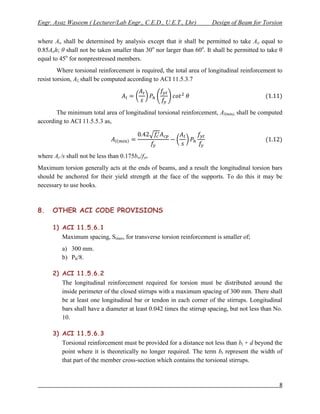
where Ao shall be determined by analysis except that it shall be permitted to take Ao equal to
0.85Aoh; θ shall not be taken smaller than 30o nor larger than 60o. It shall be permitted to take θ
equal to 45o for nonprestressed members.
         Where torsional reinforcement is required, the total area of longitudinal reinforcement to
resist torsion, Al, shall be computed according to ACI 11.5.3.7


       The minimum total area of longitudinal torsional reinforcement, Al(min), shall be computed
according to ACI 11.5.5.3 as,


where At /s shall not be less than 0.175bw/fyt.
Maximum torsion generally acts at the ends of beams, and a result the longitudinal torsion bars
should be anchored for their yield strength at the face of the supports. To do this it may be
necessary to use hooks.


8.    OTHER ACI CODE PROVISIONS

      1) ACI 11.5.6.1
         Maximum spacing, Smax, for transverse torsion reinforcement is smaller of;
          a) 300 mm.
          b) Ph/8.

      2) ACI 11.5.6.2
         The longitudinal reinforcement required for torsion must be distributed around the
         inside perimeter of the closed stirrups with a maximum spacing of 300 mm. There shall
         be at least one longitudinal bar or tendon in each corner of the stirrups. Longitudinal
         bars shall have a diameter at least 0.042 times the stirrup spacing, but not less than No.
         10.

      3) ACI 11.5.6.3
         Torsional reinforcement must be provided for a distance not less than bt + d beyond the
         point where it is theoretically no longer required. The term bt represent the width of
         that part of the member cross-section which contains the torsional stirrups.


                                                                                                 8
Engr. Ayaz Waseem ( Lecturer/Lab Engr., C.E.D., U.E.T., Lhr)      Design of Beam for Torsion


Design Example

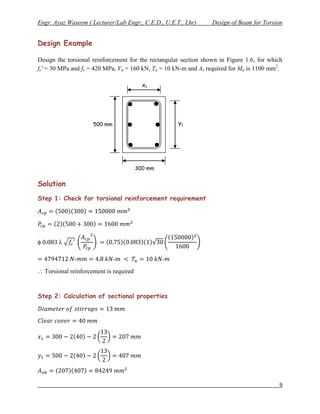
Design the torsional reinforcement for the rectangular section shown in Figure 1.6, for which
fc' = 30 MPa and fy = 420 MPa, Vu = 160 kN, Tu = 10 kN-m and As required for Mu is 1100 mm2.

                                          x1


                     500 mm                          y1


                                        300 mm


Solution
Step 1: Check for torsional reinforcement requirement


        

              -               -                  -
 Torsional reinforcement is required


Step 2: Calculation of sectional properties


                                                                                           9
Engr. Ayaz Waseem ( Lecturer/Lab Engr., C.E.D., U.E.T., Lhr)   Design of Beam for Torsion


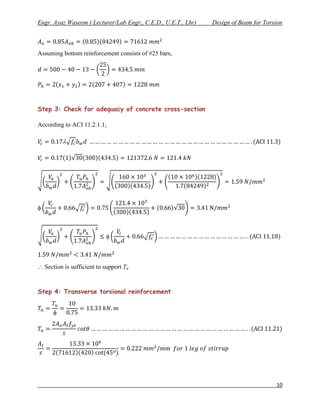
Assuming bottom reinforcement consists of #25 bars,


Step 3: Check for adequacy of concrete cross-section

According to ACI 11.2.1.1,

          


 Section is sufficient to support Tu


Step 4: Transverse torsional reinforcement


                                                                                      10
Engr. Ayaz Waseem ( Lecturer/Lab Engr., C.E.D., U.E.T., Lhr)      Design of Beam for Torsion


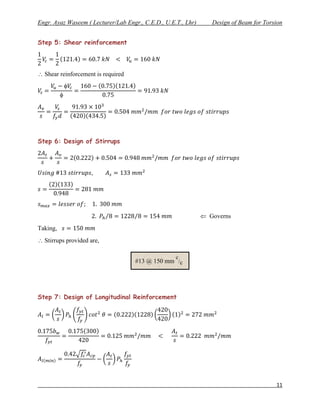
Step 5: Shear reinforcement


 Shear reinforcement is required


Step 6: Design of Stirrups


                                                                Governs
Taking,
 Stirrups provided are,

                                                    c
                                    #13 @ 150 mm /c


Step 7: Design of Longitudinal Reinforcement


                                                                                         11
Engr. Ayaz Waseem ( Lecturer/Lab Engr., C.E.D., U.E.T., Lhr)              Design of Beam for Torsion


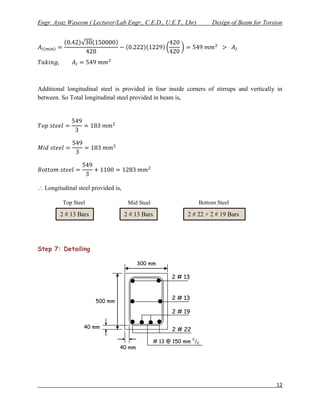
Additional longitudinal steel is provided in four inside corners of stirrups and vertically in
between. So Total longitudinal steel provided in beam is,


 Longitudinal steel provided is,

         Top Steel                   Mid Steel                       Bottom Steel

        2 # 13 Bars                 2 # 13 Bars                2 # 22 + 2 # 19 Bars


Step 7: Detailing

                                        300 mm

                                                        2 # 13
                                                        Bars

                                                        2 # 13
                      500 mm
                                                        Bars
                                                        2 # 19
                                                        Bars
                  40 mm
                                                        2 # 22
                                                                 c
                                                  # 13 @ 150 mm /c
                                40 mm


                                                                                                 12
Engr. Ayaz Waseem ( Lecturer/Lab Engr., C.E.D., U.E.T., Lhr)      Design of Beam for Torsion


REFERENCES
1. Building Code Requirements for Structural Concrete (ACI 318M-08) and Commentary

2. Design of Reinforced concrete, 7th Edition, by Jack C. McCormac and James. K. Nelson

3. Reinforced concrete design, 4th Edition, by W. H. Mosley and J. H. Bungey


                                                                                          13

37467305 torsion-design-of-beam

  • 1.
    DEPARTMENT OF CIVILENGINEERING, UNIVERSITY OF ENGINEERING AND TECHNOLOGY, LAHORE DESIGN OF BEAM FOR TORSION Engr. Ayaz Waseem Malik Lecturer/ Lab Engineer
  • 2.
    Engr. Ayaz Waseem( Lecturer/Lab Engr., C.E.D., U.E.T., Lhr) Design of Beam for Torsion DESIGN OF BEAM FOR TORSION 1. IMPORTANT TERMINOLIGIES Acp Area enclosed by outside perimeter of concrete cross-section Ag Gross area of concrete section. For a hollow section, Ag is the area of the concrete only and does not include the area of void(s) Al Total area of longitudinal reinforcement to resist torsion Al(min) Minimum area of longitudinal reinforcement to resist torsion Ao Gross area enclosed by the shear flow path Aoh Area enclosed by centerline of the outermost closed transverse torsional reinforcement At Area of one leg of closed stirrup resisting torsion Av Area of steel for resisting shear bt Width of that part of cross-section containing the closed stirrups resisting torsion fc' Specified compressive strength of concrete fy Specified yield strength of reinforcement fyt Specified yield strength of transverse reinforcement Nu Factored axial force normal to cross-section occurring simultaneously with Vu or Tu Pcp Outside perimeter of concrete cross-section Ph Perimeter of centerline of the outermost closed transverse torsional reinforcement t Wall thickness of hollow section Tcr Cracking torque Tn Nominal torsional moment strength Tu Factored torsional moment at section Vc Nominal shear strength provided by concrete Vn Nominal shear stress Vu Factored shear force  Modification factor reflecting the reduced mechanical properties of lightweight concrete, all relative to normalweight concrete of the same compressive strength. 1
  • 3.
    Engr. Ayaz Waseem( Lecturer/Lab Engr., C.E.D., U.E.T., Lhr) Design of Beam for Torsion 2. TORSION Torsion occurs appreciably in many structures, such as in the main girders of bridges, which are twisted by transverse beams or slabs. It occurs in buildings where the edge of a floor slab and its main beams are supported by a spandrel beam running between the exterior columns. This situation is shown in the Figure 1.1, where the floor beam acts as off-center load and tends to twist the spandrel beam laterally. Buildings in which the center of mass and center of rigidity do not coincide are called asymmetrical structures. In such structures earthquakes can cause dangerous torsional forces. Figure 1.1 Off-center load causing torsion in the spandrel beam 2
  • 4.
    Engr. Ayaz Waseem( Lecturer/Lab Engr., C.E.D., U.E.T., Lhr) Design of Beam for Torsion If a plain concrete member is subjected to pure torsion, it will crack and fail along 45 o spiral lines due to diagonal tension corresponding to the torsional stresses. Although the diagonal tension stresses produced by twisting are very similar to those caused by shear, they will occur on all faces of a member. Maximum shears and torsional forces may occur in areas where bending moments are small. For such cases, the interaction of shear and torsion can be particularly important as it relates to design. 3. THRESHOLD TORSION According to ACI 11.5.1, it shall be permitted to neglect torsion effects if,  For members subjected to an axial tensile or compressive force it shall be permitted to neglect torsion effects if,   Cracking Torque The cracking torsion under pure torsion Tcr is derived by replacing the actual section with an equivalent thin-walled tube with a wall thickness t prior to cracking of 0.75 Acp /pcp and an area enclosed by the wall centerline Ao equal to 2Acp /3. Cracking is assumed to occur when the principal tensile stress reaches 0.33λ. In a nonprestressed beam loaded with torsion alone, the principal tensile stress is equal to the torsional shear stress, τ = T/(2Aot). Thus, cracking occurs when τ reaches 0.33λ, giving the cracking torque Tcr (According to R11.5.1) as  Using Eq. 1.3 in Eq. 1.1 we get, The above equation states that Torsional effects can be neglected if the factored torsional moment does not exceed approximately one-quarter of the cracking torque Tcr . 3
  • 5.
    Engr. Ayaz Waseem( Lecturer/Lab Engr., C.E.D., U.E.T., Lhr) Design of Beam for Torsion 4. MOMENT REDISTRIBUTION Equilibrium Torsion For a statically determinate structure, there is only one path along which a torsional moment can be transmitted to the supports. This type of torsional moment, which is referred to as equilibrium torsion, cannot be reduced by redistribution of internal forces or by a rotation of member. Equilibrium torsion is illustrated in Figure 1.2. Figure 1.2 Equilibrium torsion Compatibility Torsion The torsional moment in a particular part of a statically indeterminate structure may be substantially reduced if that part of the structure cracks under torsion and/or rotates. The result will be a redistribution of forces in the structure. This type of torsion, which is illustrated in Figure 1.3, is referred to as compatibility torsion, in the sense that part of structure in question twists in order to keep the deformations of the structure compatible. Figure 1.3 Compatibility Torsion 4
  • 6.
    Engr. Ayaz Waseem( Lecturer/Lab Engr., C.E.D., U.E.T., Lhr) Design of Beam for Torsion In a statically indeterminate structure where reduction of the torsional moment in a member can occur due to redistribution of internal forces upon cracking, the maximum factored torsional moment Tu shall be permitted to be reduced to the following values (According to ACI 11.5.2.2),  For members subjected to an axial tensile or compressive force it shall be permitted to neglect torsion effects if,   When appreciable torsion is present, it may be more economical to select a larger beam than would normally be selected so that torsional reinforcement does not have to be used. Such a beam may very well be more economical than a smaller one with the closed stirrups and additional longitudinal steel required for torsion design. 5. TORSIONAL STRESSES The torsional stress adds to the shear stress on one side of a member and subtract from them on the other. This situation is illustrated in the Figure 1.4. Torsional stresses are quite low near the center of a solid beam. Because of this, hollow beams are assumed to have almost exactly the same torsional strengths as solid beams with the same outside dimensions. In solid sections the shear stresses due to torsion Tu are concentrated in an outside tube of the member as shown in Figure 1.4(b), while the shear stresses due to Vu are spread across the width of the solid section. After cracking, the resistance of concrete to torsion is assumed to be negligible. The tension cracks tend to spiral around members located at approximately 45o angles with the longitudinal edges of those members. Torsion is assumed to be resisted by an imaginary space truss located in the outer tube of concrete of the member. Such a truss is shown in Figure. 1.5. The longitudinal steel in the corners of the member and the closed transverse stirrups act as tension members in the truss, while the diagonal concrete between the stirrups acts as struts of compression members. The cracked concrete is still capable of taking compression stresses. 5
  • 7.
    Engr. Ayaz Waseem( Lecturer/Lab Engr., C.E.D., U.E.T., Lhr) Design of Beam for Torsion Figure 1.4 Addition of torsional and shear stresses  Figure 1.5 Space truss analogy 6
  • 8.
    Engr. Ayaz Waseem( Lecturer/Lab Engr., C.E.D., U.E.T., Lhr) Design of Beam for Torsion 6. TORSIONAL MOMENT STRENGTH According to ACI 11.5.3.1, the cross-sectional dimensions shall be such that: (a) For solid section, (b) For hollow section, The size of a cross section is limited for two reasons; first, to reduce unsightly cracking, and second, to prevent crushing of the surface concrete due to inclined compressive stresses due to shear and torsion. In Eq. (1-7) and (1-8), the two terms on the left-hand side are the shear stresses due to shear and torsion. The sum of these stresses may not exceed the stress causing shear cracking plus 0.66 . If the wall thickness of a hollow section is less than Aoh/Ph, the second term in Eq. 1.8 is to be taken not as Tu Ph /1.7Aoh2 but as Tu /1.7Aoh, where t is the thickness of the wall where stresses are being checked. 7. TORSIONAL REINFORCEMENT REQUIRED The torsional strength of reinforced concrete beams can be greatly increased by adding torsional reinforcement consisting of closed stirrups and longitudinal bars. If the factored torsional moment for a particular member is larger than the value given in Eq. 1.1, then the ACI 11.5.5.2 provides an expression to compute the absolute minimum area of transverse closed stirrups that may be used. From the knowledge of shear design of beam it is clear that the area Av obtained is for both legs of a two-legged stirrup. The value At, which represents the area of the stirrups needed for torsion, is for only one leg of the stirrup. Therefore the value Av + 2At is the total area of both legs of the stirrups needed for shear plus torsion. According to ACI 11.5.3.6, area of stirrups At used for resisting torsion is computed as follows, 7
  • 9.
    Engr. Ayaz Waseem( Lecturer/Lab Engr., C.E.D., U.E.T., Lhr) Design of Beam for Torsion where Ao shall be determined by analysis except that it shall be permitted to take Ao equal to 0.85Aoh; θ shall not be taken smaller than 30o nor larger than 60o. It shall be permitted to take θ equal to 45o for nonprestressed members. Where torsional reinforcement is required, the total area of longitudinal reinforcement to resist torsion, Al, shall be computed according to ACI 11.5.3.7 The minimum total area of longitudinal torsional reinforcement, Al(min), shall be computed according to ACI 11.5.5.3 as, where At /s shall not be less than 0.175bw/fyt. Maximum torsion generally acts at the ends of beams, and a result the longitudinal torsion bars should be anchored for their yield strength at the face of the supports. To do this it may be necessary to use hooks. 8. OTHER ACI CODE PROVISIONS 1) ACI 11.5.6.1 Maximum spacing, Smax, for transverse torsion reinforcement is smaller of; a) 300 mm. b) Ph/8. 2) ACI 11.5.6.2 The longitudinal reinforcement required for torsion must be distributed around the inside perimeter of the closed stirrups with a maximum spacing of 300 mm. There shall be at least one longitudinal bar or tendon in each corner of the stirrups. Longitudinal bars shall have a diameter at least 0.042 times the stirrup spacing, but not less than No. 10. 3) ACI 11.5.6.3 Torsional reinforcement must be provided for a distance not less than bt + d beyond the point where it is theoretically no longer required. The term bt represent the width of that part of the member cross-section which contains the torsional stirrups. 8
  • 10.
    Engr. Ayaz Waseem( Lecturer/Lab Engr., C.E.D., U.E.T., Lhr) Design of Beam for Torsion Design Example Design the torsional reinforcement for the rectangular section shown in Figure 1.6, for which fc' = 30 MPa and fy = 420 MPa, Vu = 160 kN, Tu = 10 kN-m and As required for Mu is 1100 mm2. x1 500 mm y1 300 mm Solution Step 1: Check for torsional reinforcement requirement  - - -  Torsional reinforcement is required Step 2: Calculation of sectional properties 9
  • 11.
    Engr. Ayaz Waseem( Lecturer/Lab Engr., C.E.D., U.E.T., Lhr) Design of Beam for Torsion Assuming bottom reinforcement consists of #25 bars, Step 3: Check for adequacy of concrete cross-section According to ACI 11.2.1.1,   Section is sufficient to support Tu Step 4: Transverse torsional reinforcement 10
  • 12.
    Engr. Ayaz Waseem( Lecturer/Lab Engr., C.E.D., U.E.T., Lhr) Design of Beam for Torsion Step 5: Shear reinforcement  Shear reinforcement is required Step 6: Design of Stirrups  Governs Taking,  Stirrups provided are, c #13 @ 150 mm /c Step 7: Design of Longitudinal Reinforcement 11
  • 13.
    Engr. Ayaz Waseem( Lecturer/Lab Engr., C.E.D., U.E.T., Lhr) Design of Beam for Torsion Additional longitudinal steel is provided in four inside corners of stirrups and vertically in between. So Total longitudinal steel provided in beam is,  Longitudinal steel provided is, Top Steel Mid Steel Bottom Steel 2 # 13 Bars 2 # 13 Bars 2 # 22 + 2 # 19 Bars Step 7: Detailing 300 mm 2 # 13 Bars 2 # 13 500 mm Bars 2 # 19 Bars 40 mm 2 # 22 c # 13 @ 150 mm /c 40 mm 12
  • 14.
    Engr. Ayaz Waseem( Lecturer/Lab Engr., C.E.D., U.E.T., Lhr) Design of Beam for Torsion REFERENCES 1. Building Code Requirements for Structural Concrete (ACI 318M-08) and Commentary 2. Design of Reinforced concrete, 7th Edition, by Jack C. McCormac and James. K. Nelson 3. Reinforced concrete design, 4th Edition, by W. H. Mosley and J. H. Bungey 13