GEOTECHNICAL ENGINEERING
ECG 503
LECTURE NOTE 07
TOPIC : 3.0 ANALYSIS AND
DESIGN OF RETAINING
STRUCTURES
LEARNING OUTCOMES
Learning outcomes:
At the end of this lecture/week the students would
be able to:
 Understand natural slope and made engineered
soil slope assessment which include rainfall
induced failure and role of suction.
TOPIC TO BE COVERED
 Types of Retaining Structures
 Sheet Pile Wall – Cantilever and
Anchored Sheet Pile
LATERAL EARTH PRESSURE
Introduction & Overview
2.1 Introduction and overview
Retaining structures such as retaining walls, basement
walls, and bulkheads are commonly encountered in
foundation engineering, and they may support slopes
of earth mass.
Proper design and construction of these structures
require a thorough knowledge of the lateral forces that
act between the retaining structures and the soil mass
being retained.
• Retaining walls are used to prevent the
retained material from assuming its
natural slope. Wall structures are
commonly use to support earth are piles.
Retaining walls may be classified
according to how they produce stability
as reinforced earth, gravity wall,
cantilever wall and anchored wall. At
present, the reinforced earth structure is
the most used particularly for roadwork
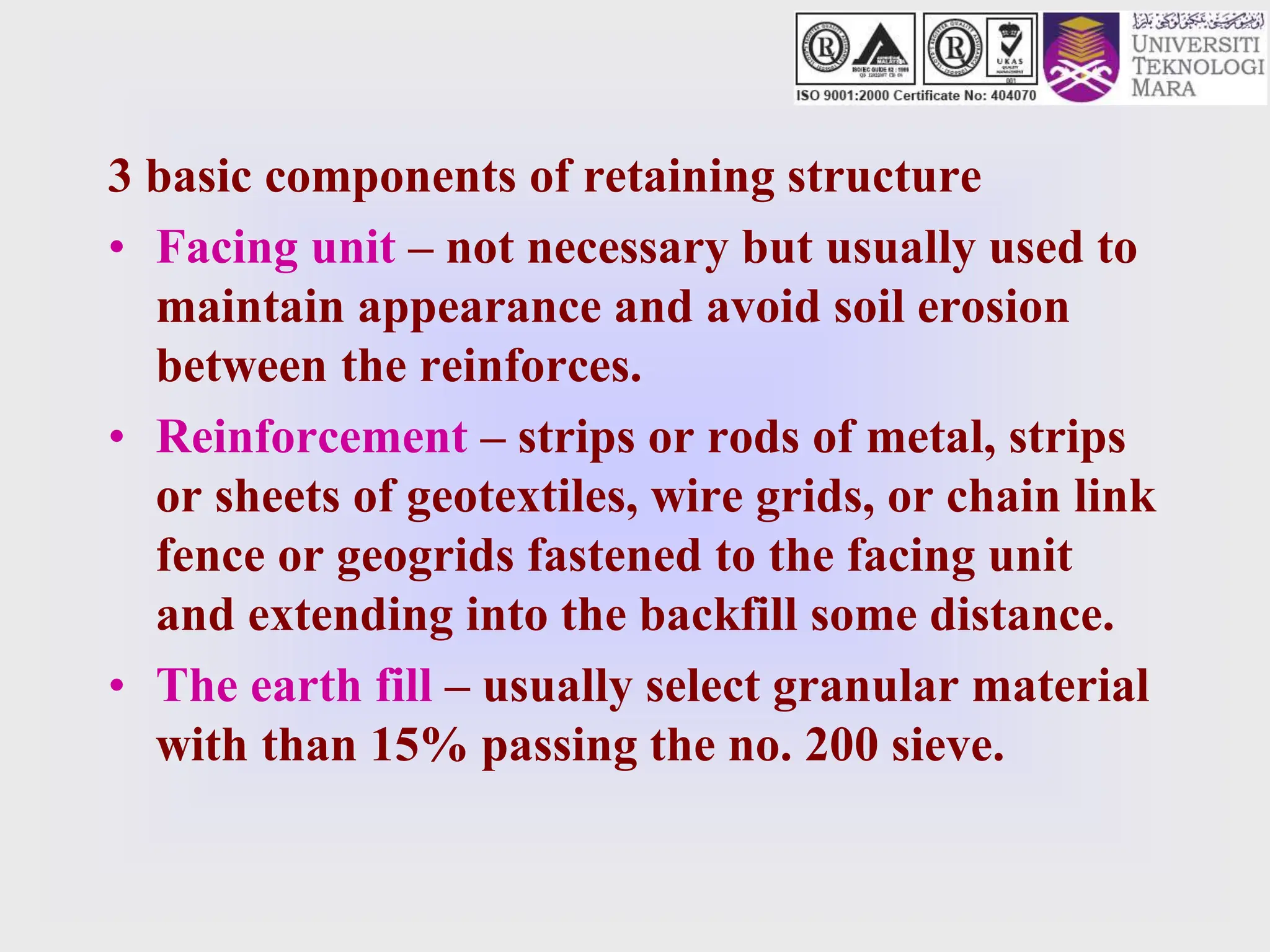
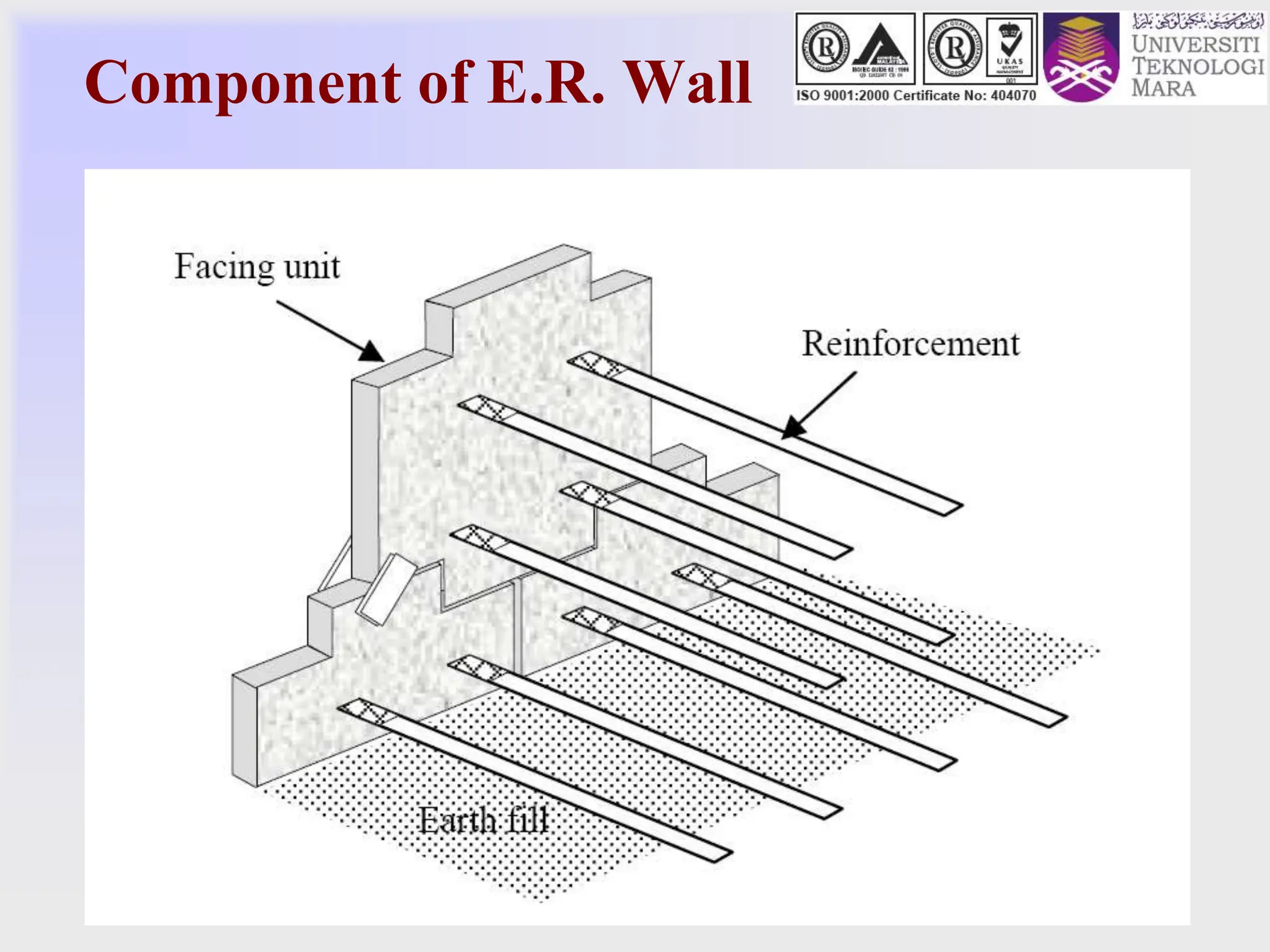
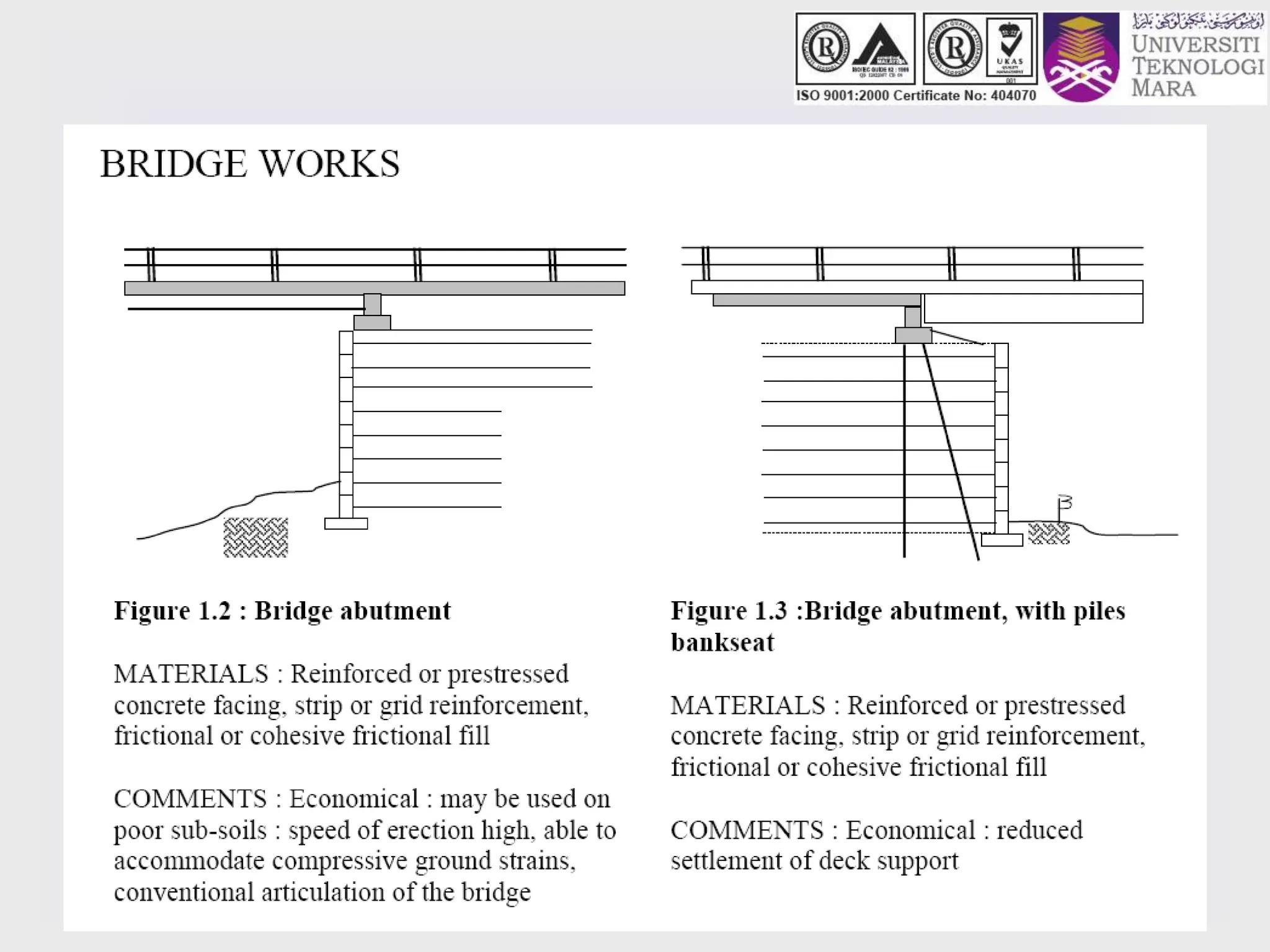
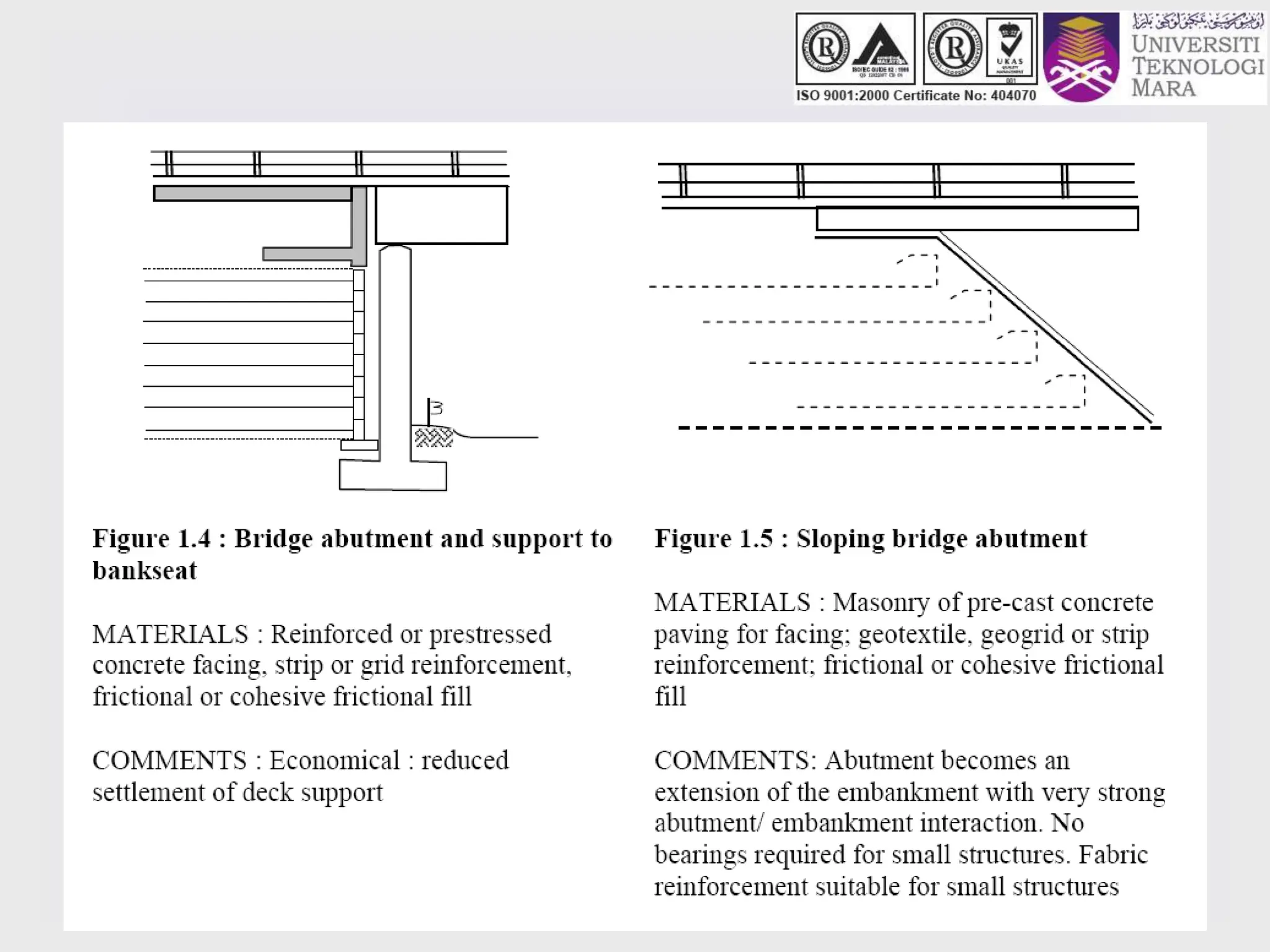
3 basic components of retaining structure
• Facing unit – not necessary but usually used to
maintain appearance and avoid soil erosion
between the reinforces.
• Reinforcement – strips or rods of metal, strips
or sheets of geotextiles, wire grids, or chain link
fence or geogrids fastened to the facing unit
and extending into the backfill some distance.
• The earth fill – usually select granular material
with than 15% passing the no. 200 sieve.
Component of E.R. Wall
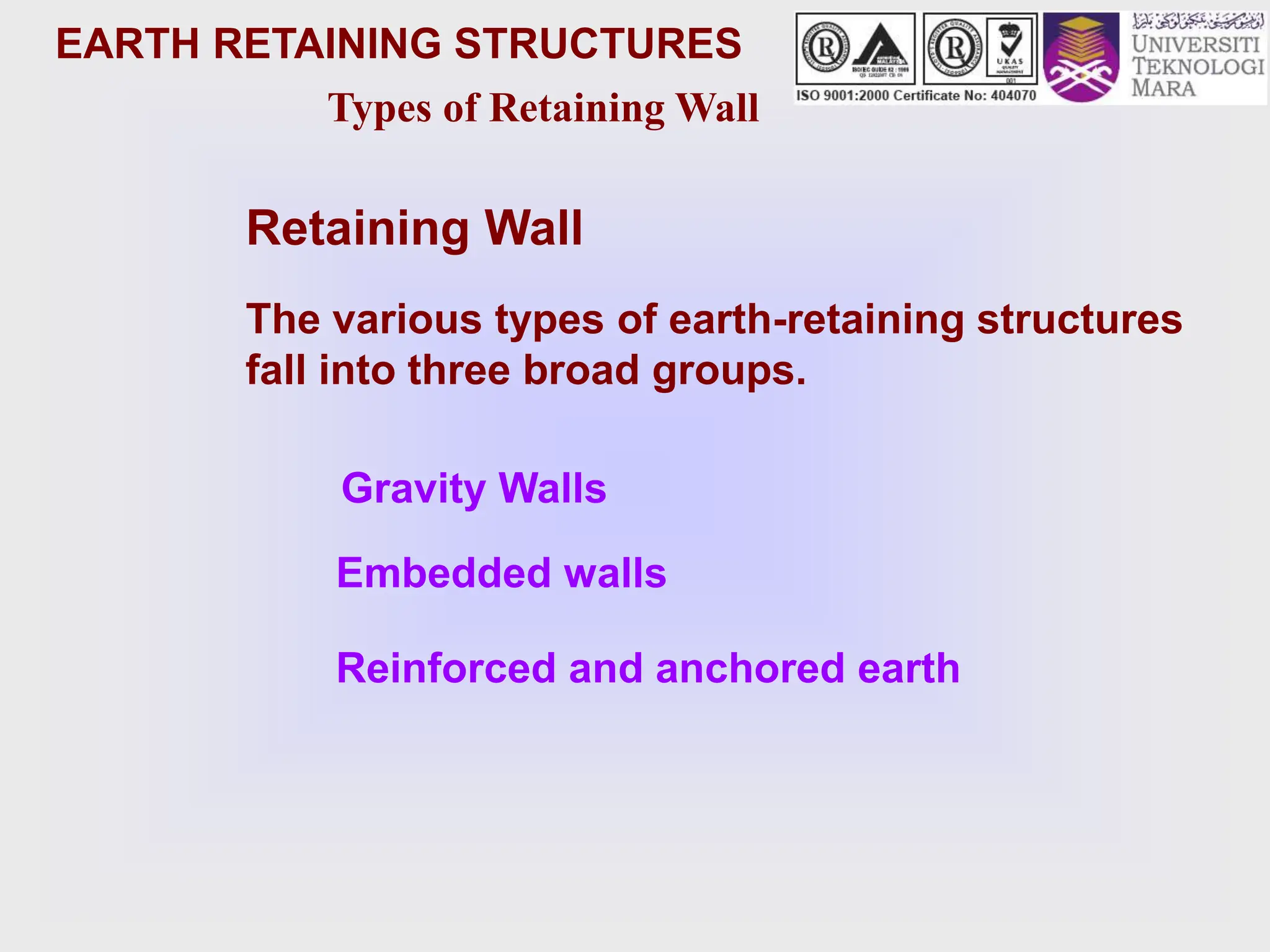
Types of Retaining Wall
Retaining Wall
Gravity Walls
Embedded walls
Reinforced and anchored earth
The various types of earth-retaining structures
fall into three broad groups.
EARTH RETAINING STRUCTURES
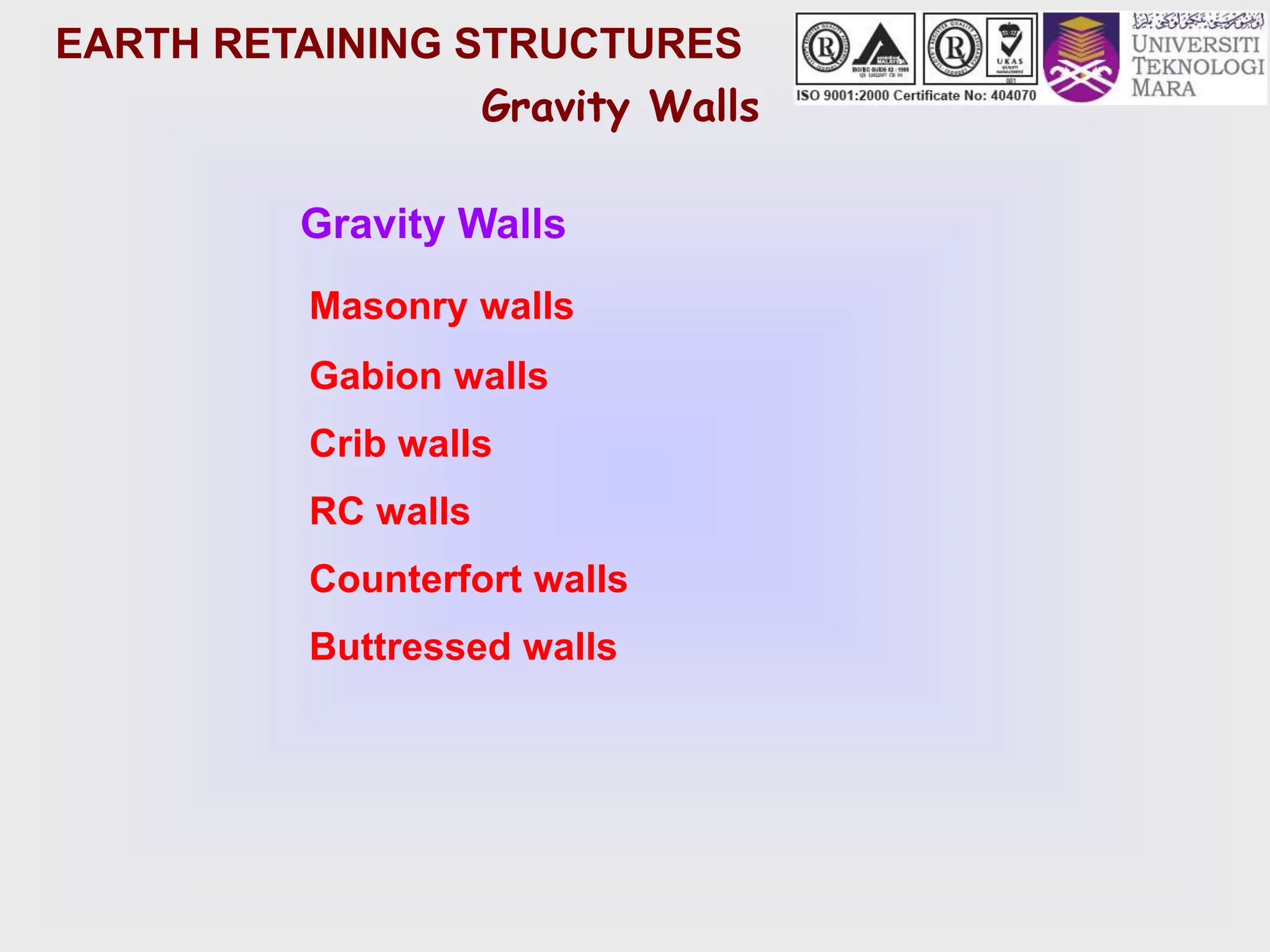
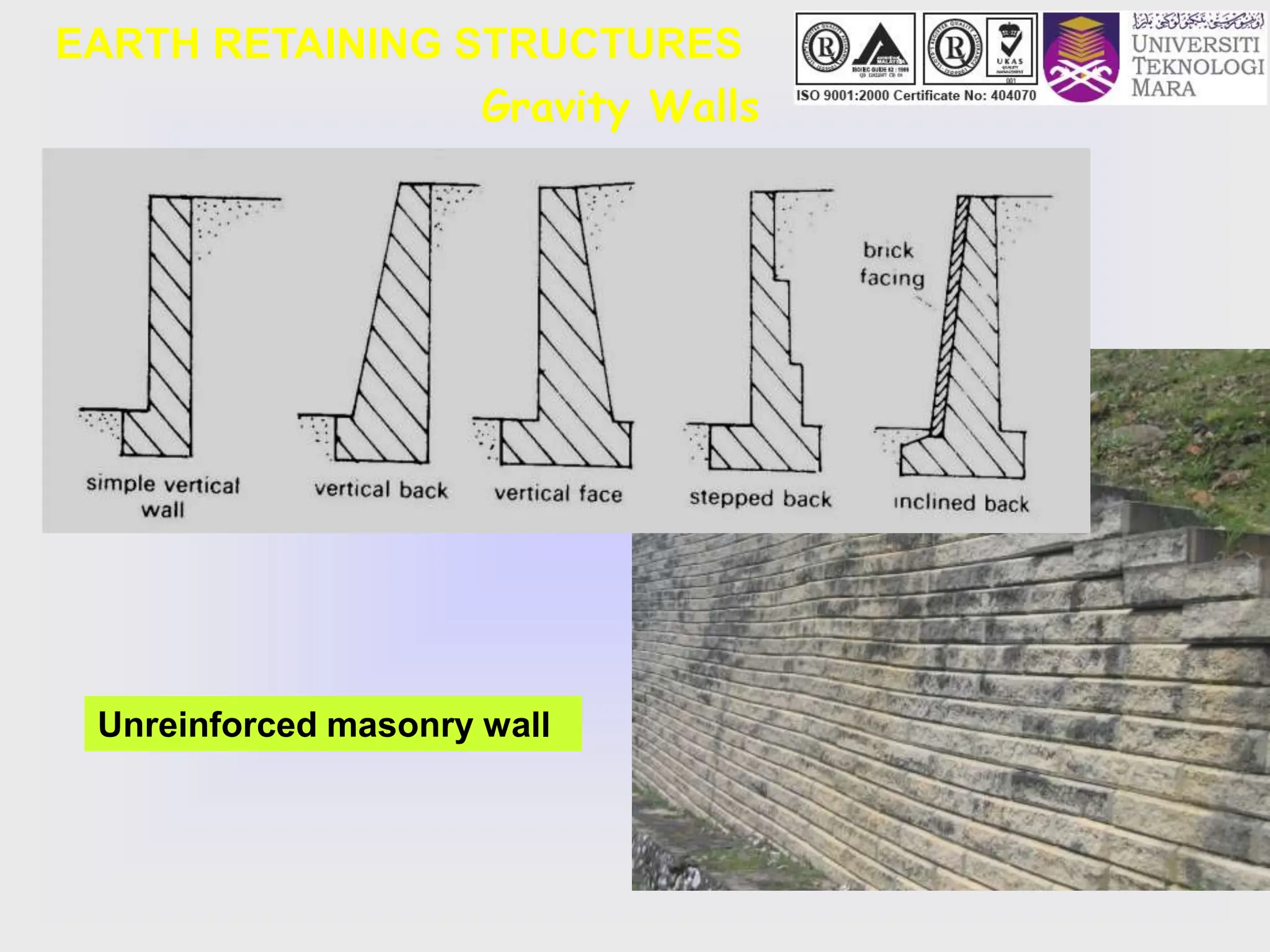
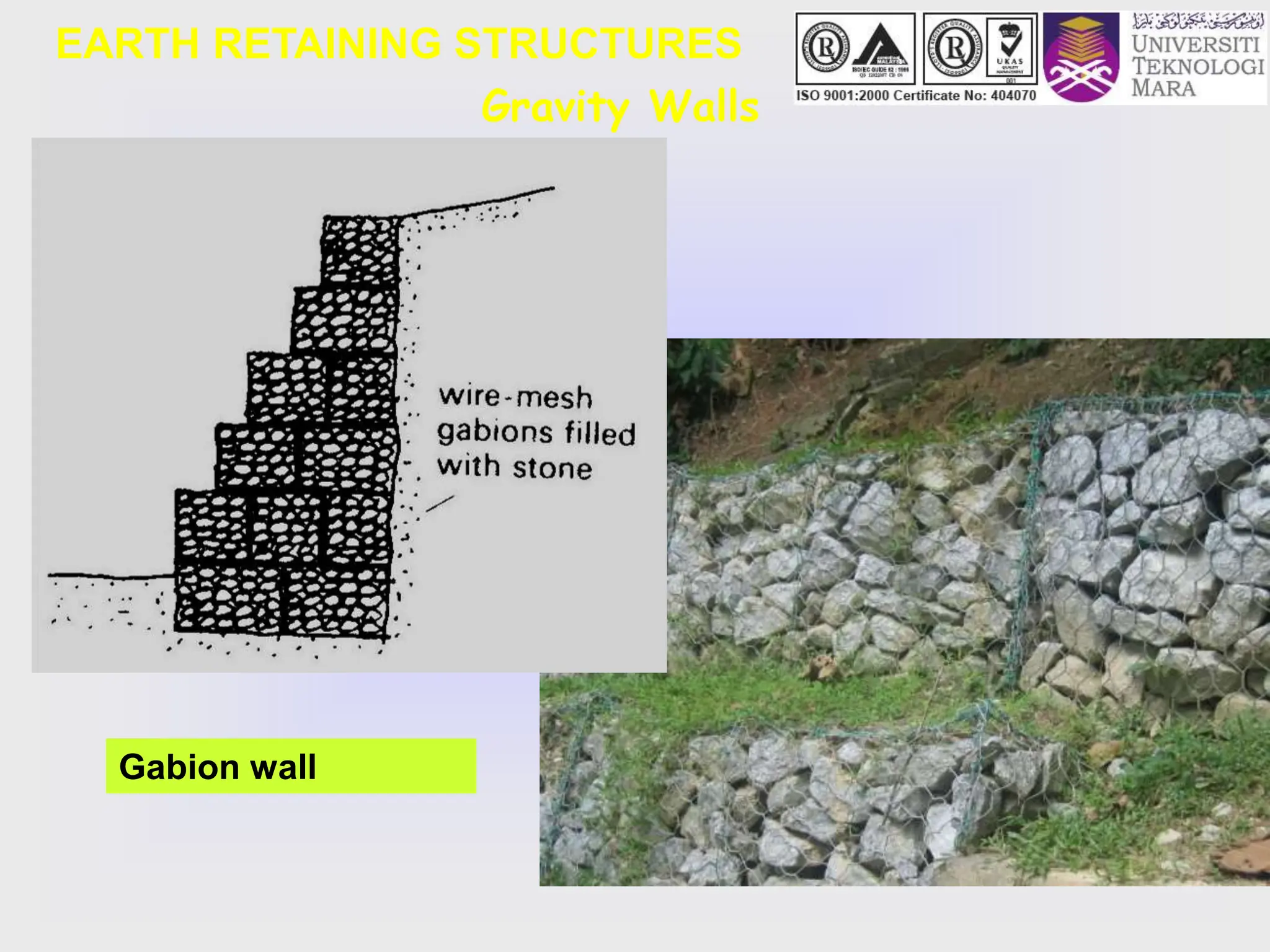
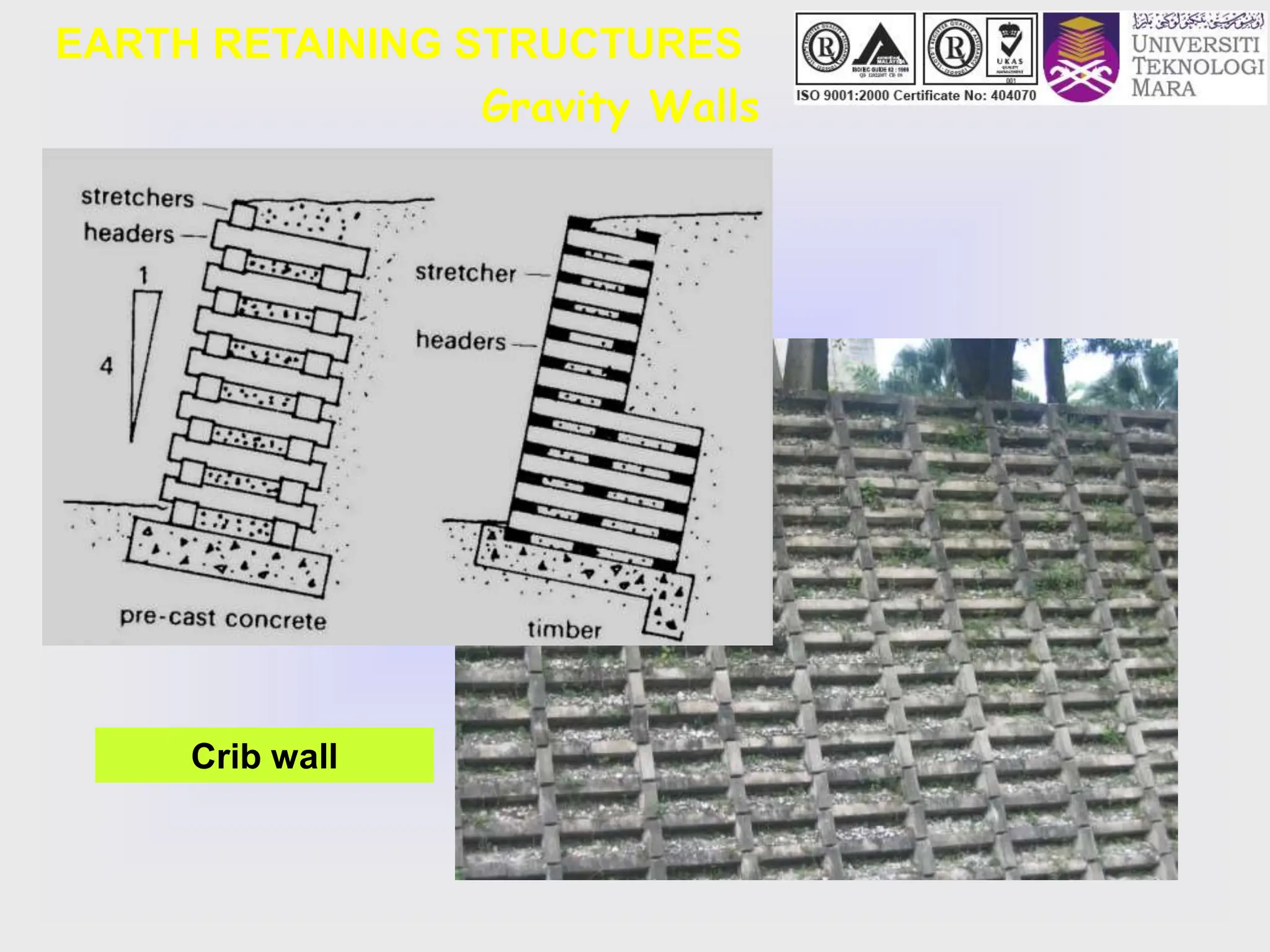
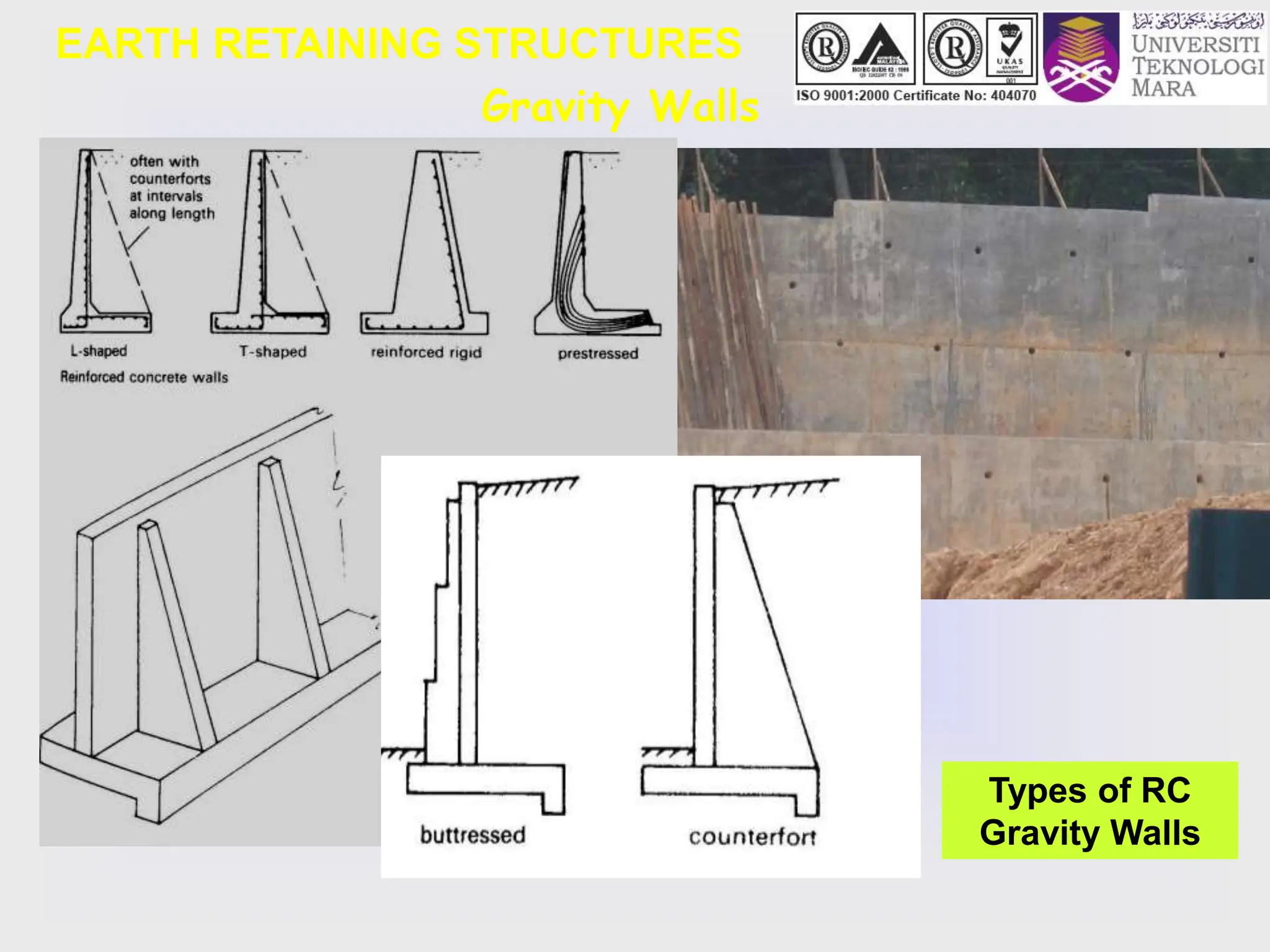
Gravity Walls
Gravity Walls
Masonry walls
Gabion walls
Crib walls
RC walls
Counterfort walls
Buttressed walls
EARTH RETAINING STRUCTURES
Gravity Walls
Unreinforced masonry wall
EARTH RETAINING STRUCTURES
Gravity Walls
Gabion wall
EARTH RETAINING STRUCTURES
Gravity Walls
Crib wall
EARTH RETAINING STRUCTURES
Gravity Walls
Types of RC
Gravity Walls
EARTH RETAINING STRUCTURES
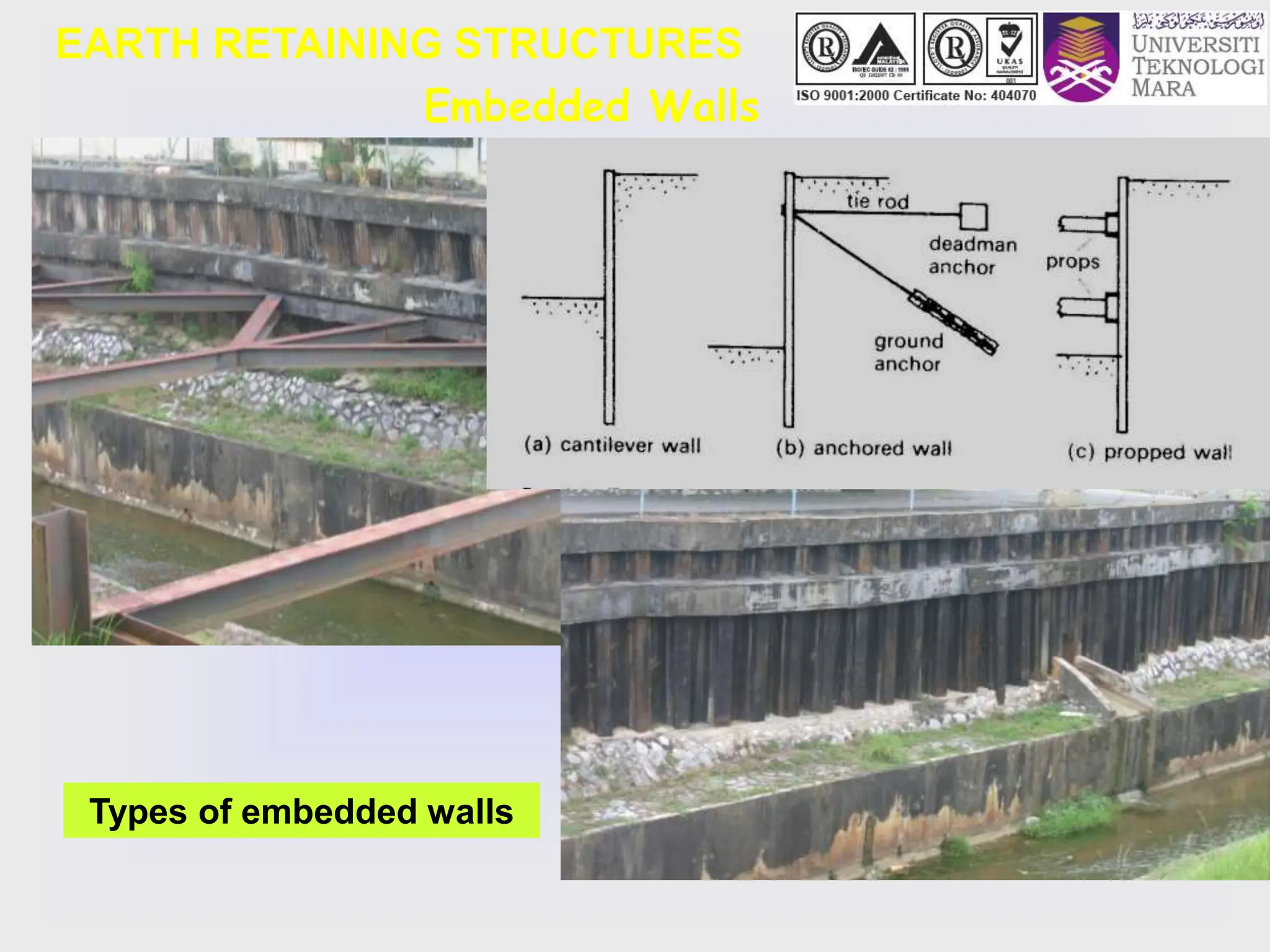
Embedded Walls
Embedded walls
Driven sheet-pile walls
Braced or propped walls
Contiguous bored-pile walls
Secant bored-pile walls
Diaphram walls
EARTH RETAINING STRUCTURES
Embedded Walls
Types of embedded walls
EARTH RETAINING STRUCTURES
Reinforced and Anchored Earth
Reinforced and anchored earth
Reinforced earth wall
Soil nailing
Ground anchors
EARTH RETAINING STRUCTURES
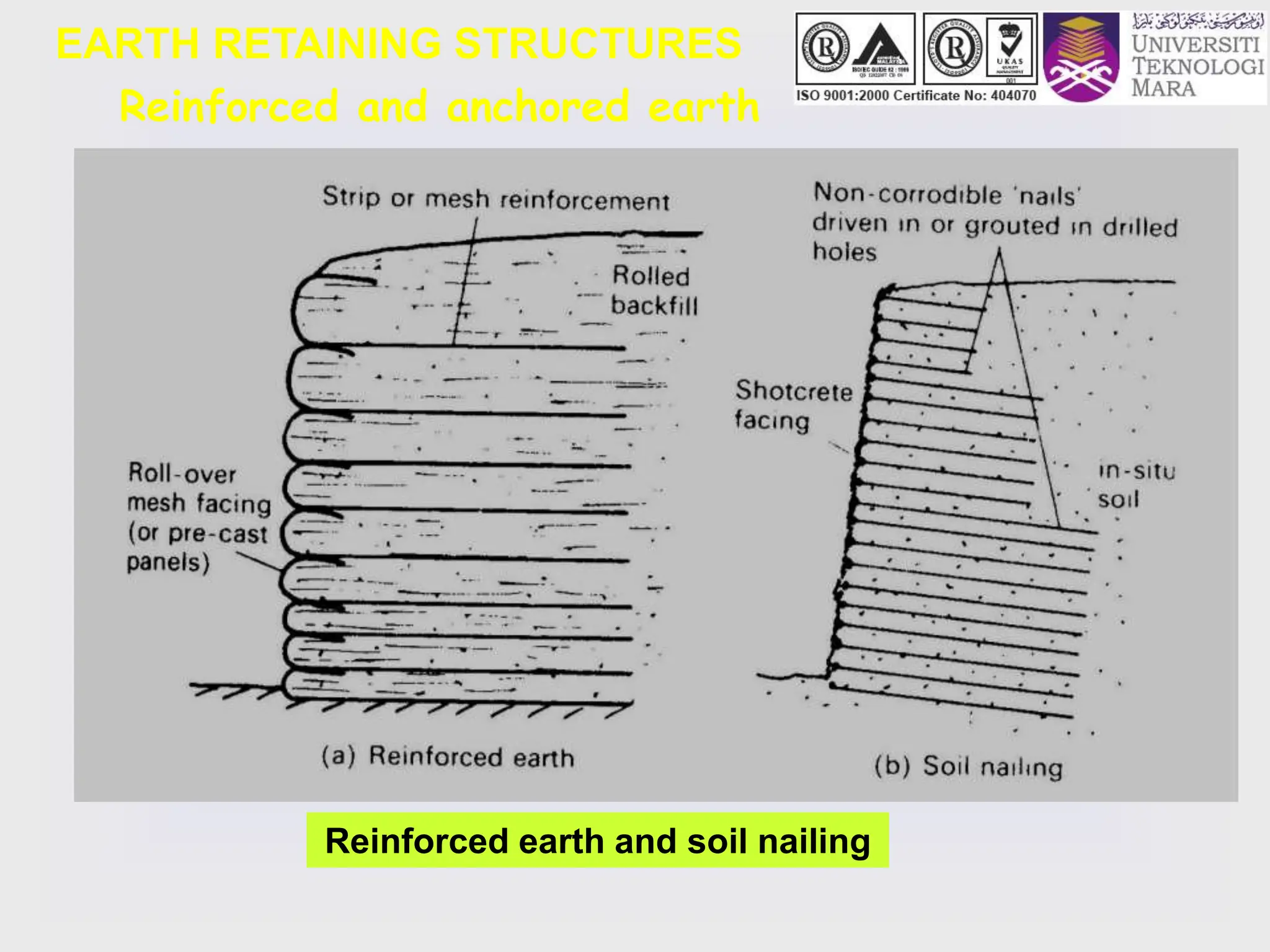
Reinforced and anchored earth
Reinforced earth and soil nailing
EARTH RETAINING STRUCTURES
Stability Criteria
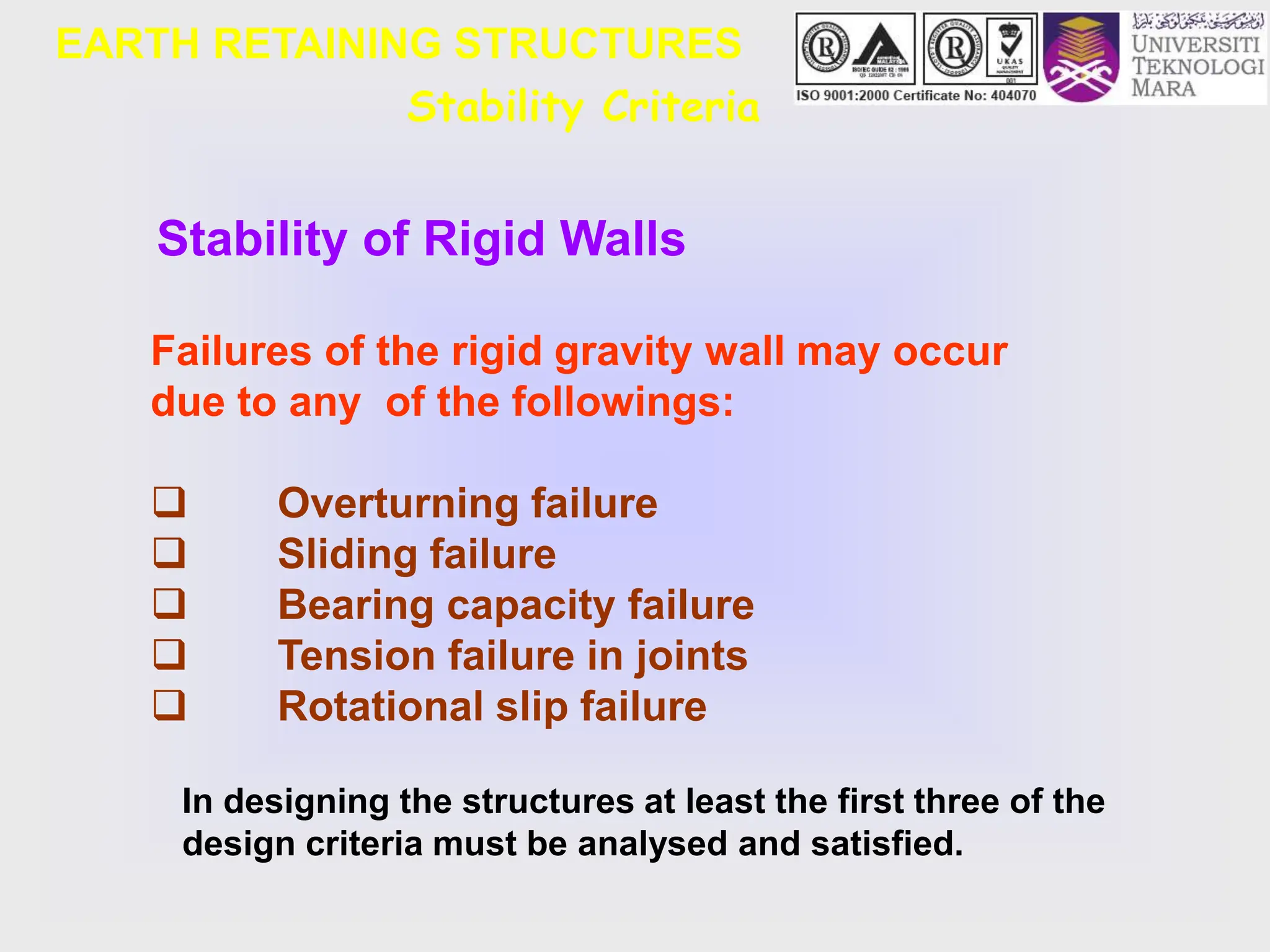
Stability of Rigid Walls
Failures of the rigid gravity wall may occur
due to any of the followings:
 Overturning failure
 Sliding failure
 Bearing capacity failure
 Tension failure in joints
 Rotational slip failure
In designing the structures at least the first three of the
design criteria must be analysed and satisfied.
EARTH RETAINING STRUCTURES
LATERAL EARTH PRESSURE
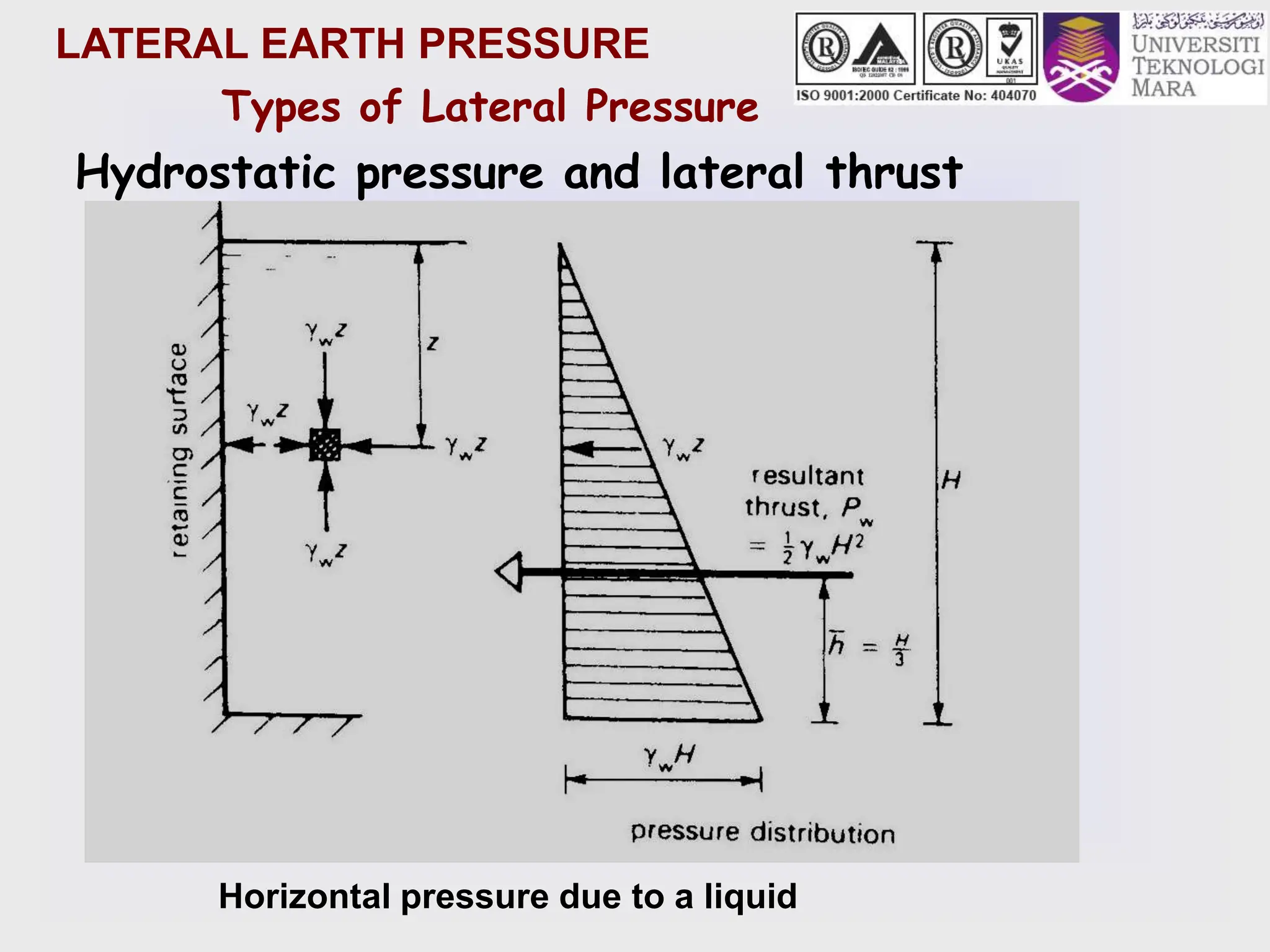
Types of Lateral Pressure
Hydrostatic Pressure and Lateral Thrust
Earth Pressure at Rest
Active Earth Pressure
Passive Earth pressure
States of Equilibrium
LATERAL EARTH PRESSURE
Types of Lateral Pressure
Hydrostatic pressure and lateral thrust
Horizontal pressure due to a liquid
LATERAL EARTH PRESSURE
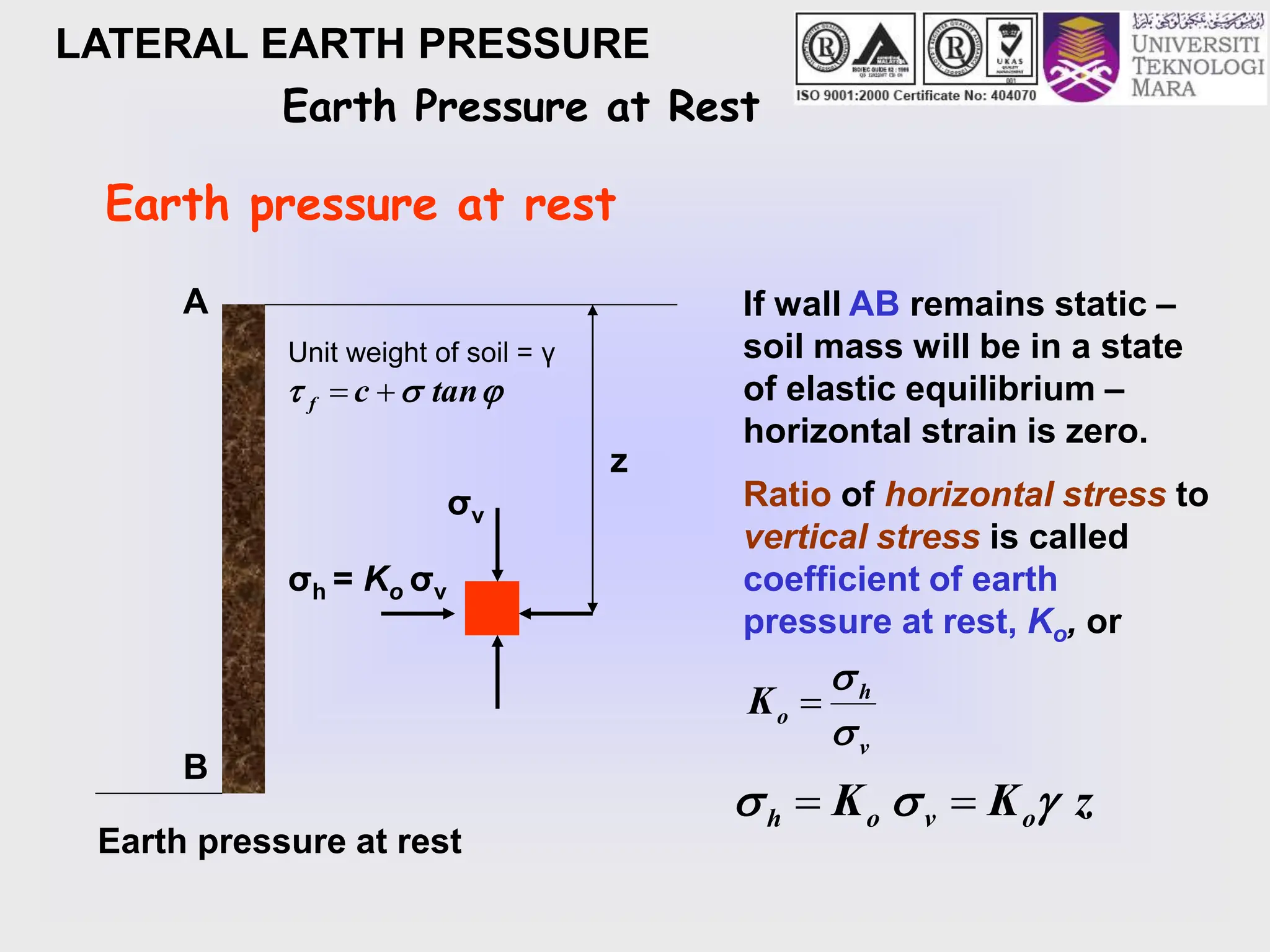
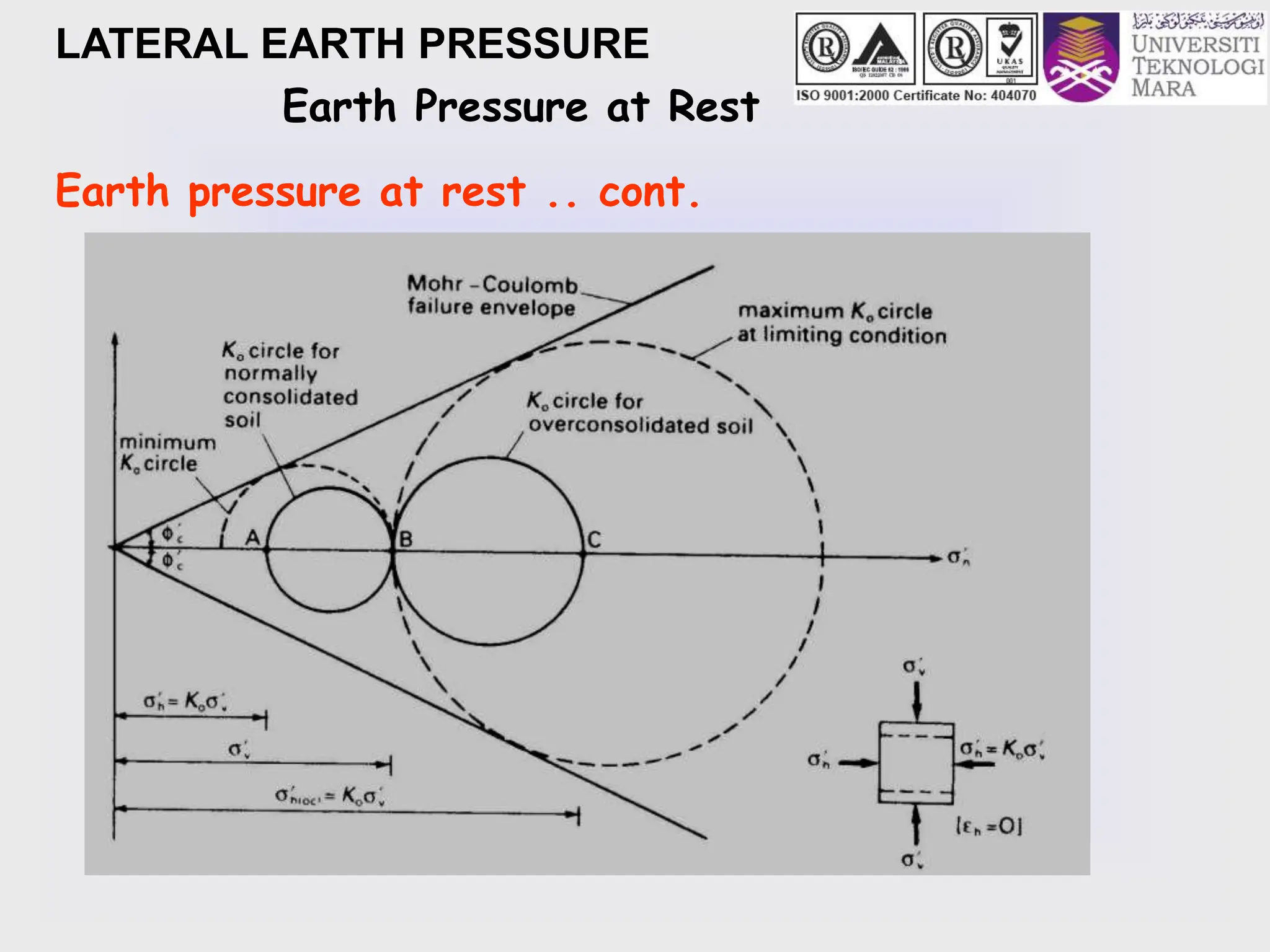
Earth Pressure at Rest
Earth pressure at rest
z
σv
σh = Ko σv
A
B
If wall AB remains static –
soil mass will be in a state
of elastic equilibrium –
horizontal strain is zero.
Ratio of horizontal stress to
vertical stress is called
coefficient of earth
pressure at rest, Ko, or
v
h
o
K



z
K
K o
v
o
h 

 

Unit weight of soil = γ


 tan
c
f 

LATERAL EARTH PRESSURE
Earth pressure at rest .. cont.
Earth Pressure at Rest
LATERAL EARTH PRESSURE
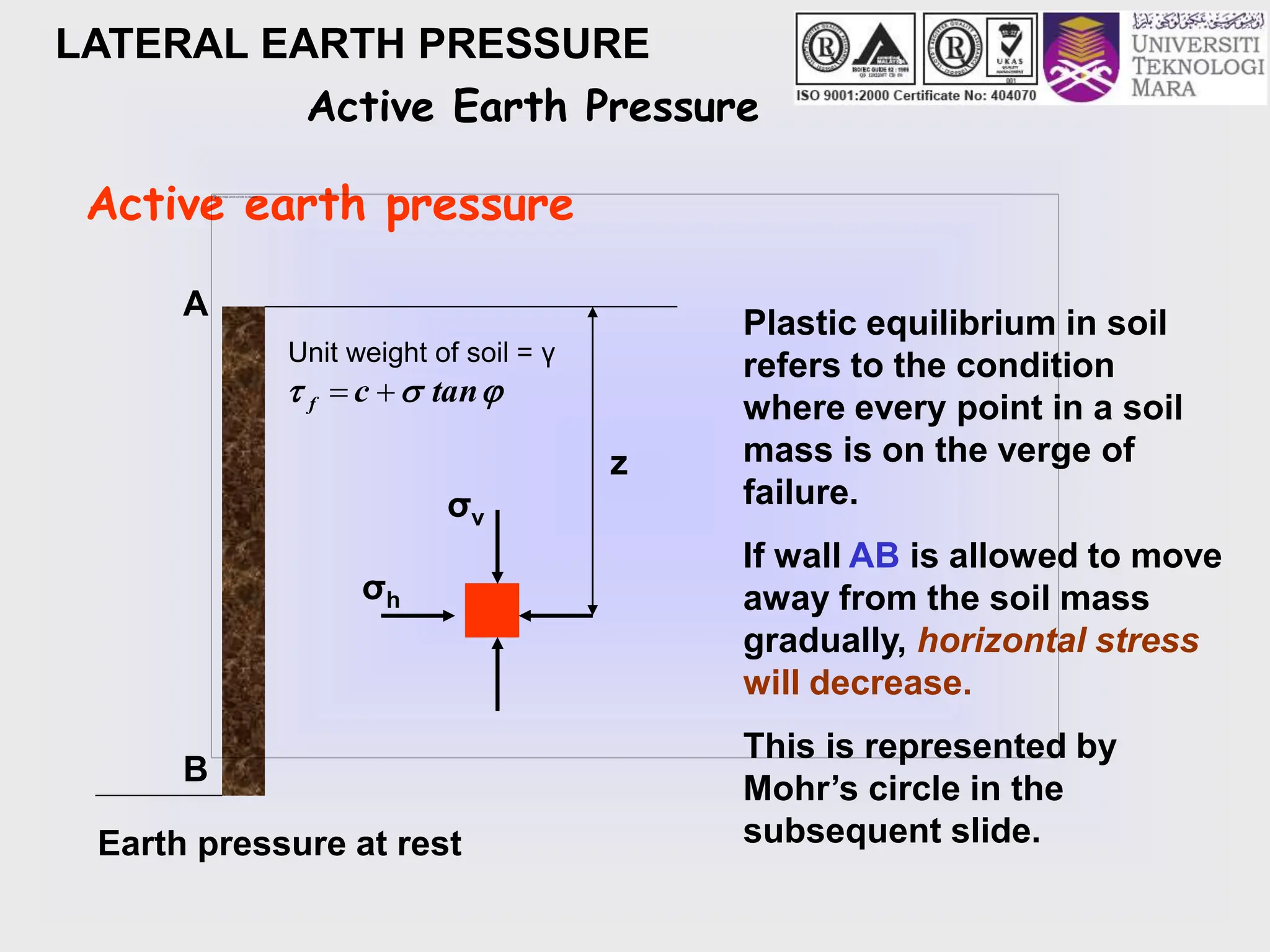
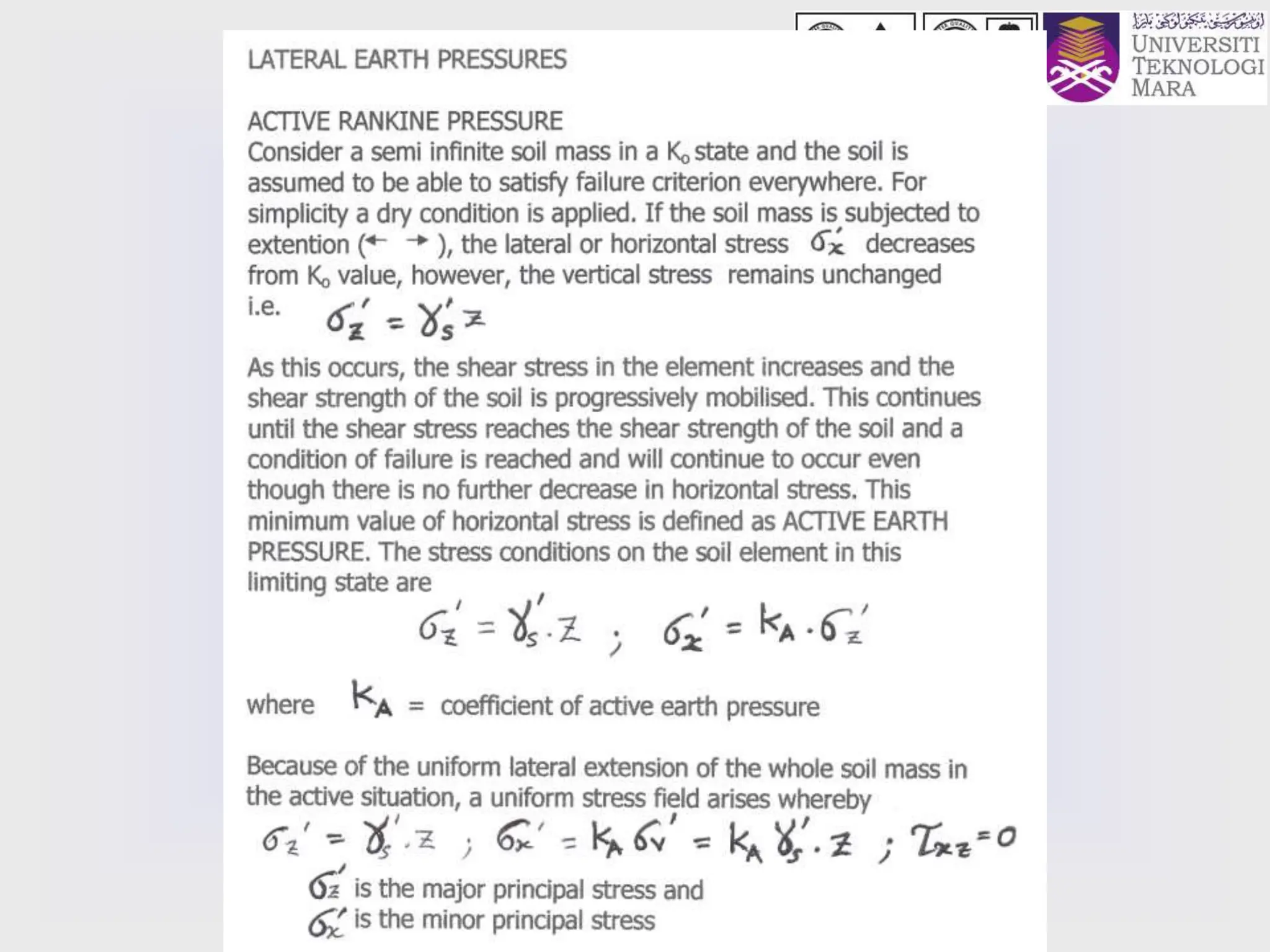
Active Earth Pressure
Active earth pressure
Earth pressure at rest
z
σv
σh
A
B
Plastic equilibrium in soil
refers to the condition
where every point in a soil
mass is on the verge of
failure.
If wall AB is allowed to move
away from the soil mass
gradually, horizontal stress
will decrease.
This is represented by
Mohr’s circle in the
subsequent slide.
Unit weight of soil = γ


 tan
c
f 

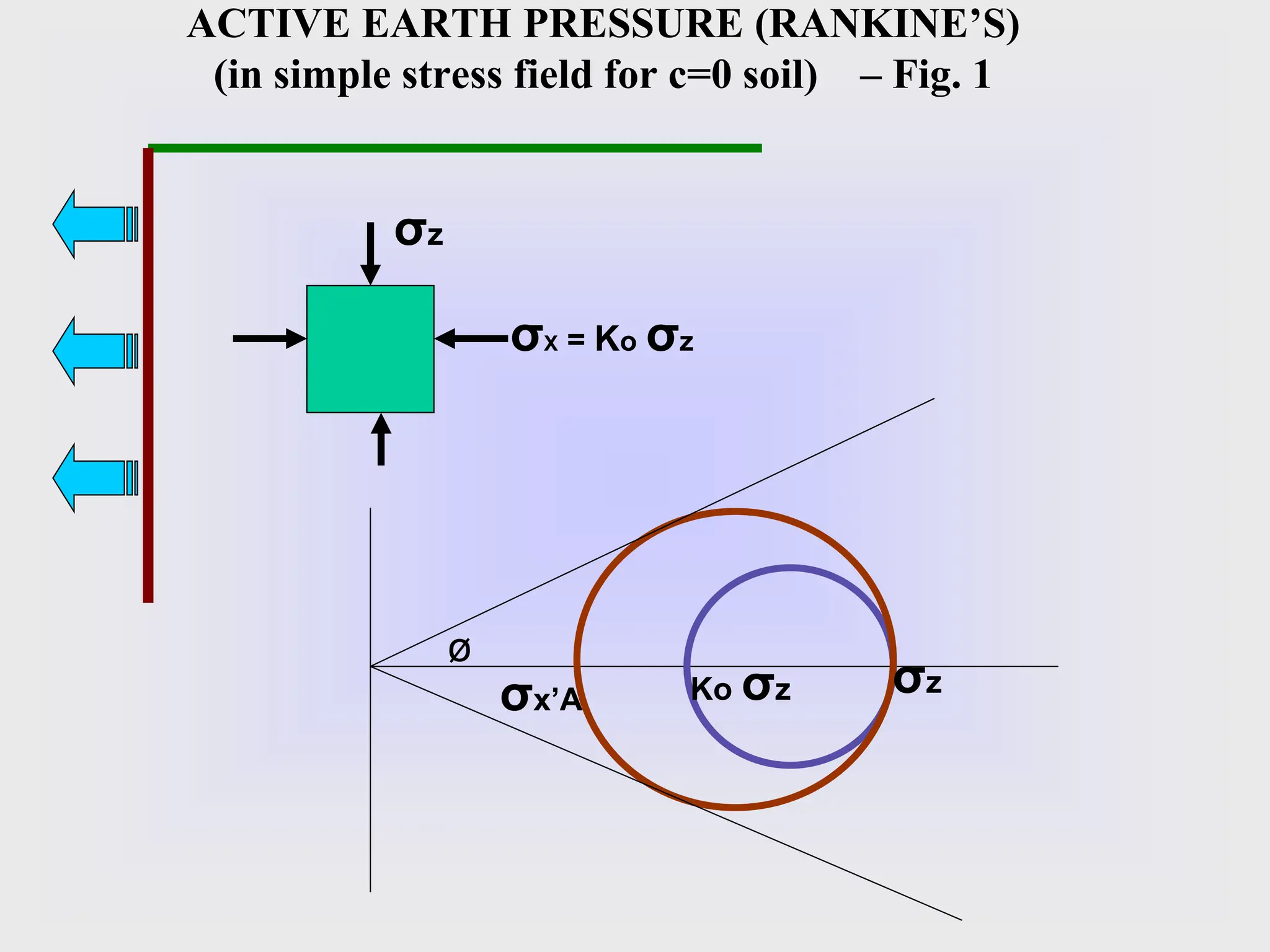
ACTIVE EARTH PRESSURE (RANKINE’S)
(in simple stress field for c=0 soil) – Fig. 1
σX = Ko σz
σz
σz
Ko σz
σx’A
ø
LATERAL EARTH PRESSURE
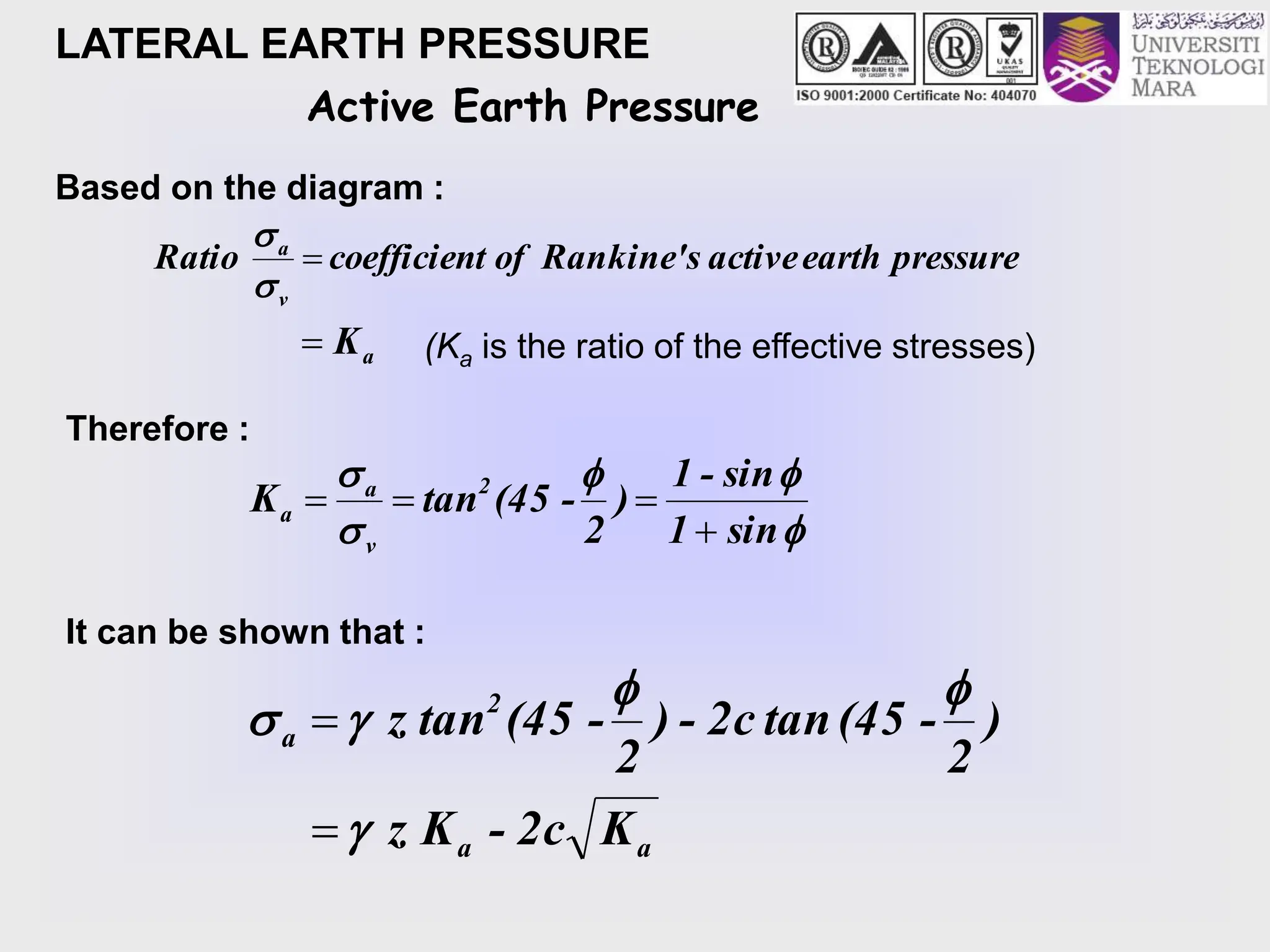
Based on the diagram :
pressure
earth
active
s
Rankine'
of
t
coefficien
Ratio
v
a



a
K
 (Ka is the ratio of the effective stresses)
Therefore :





sin
1
sin
-
1
)
2
(45 -
tan
K 2
v
a
a




It can be shown that :
a
a
2
a
K
2c
-
K
z
)
2
(45 -
tan
2c
-
)
2
(45 -
tan
z







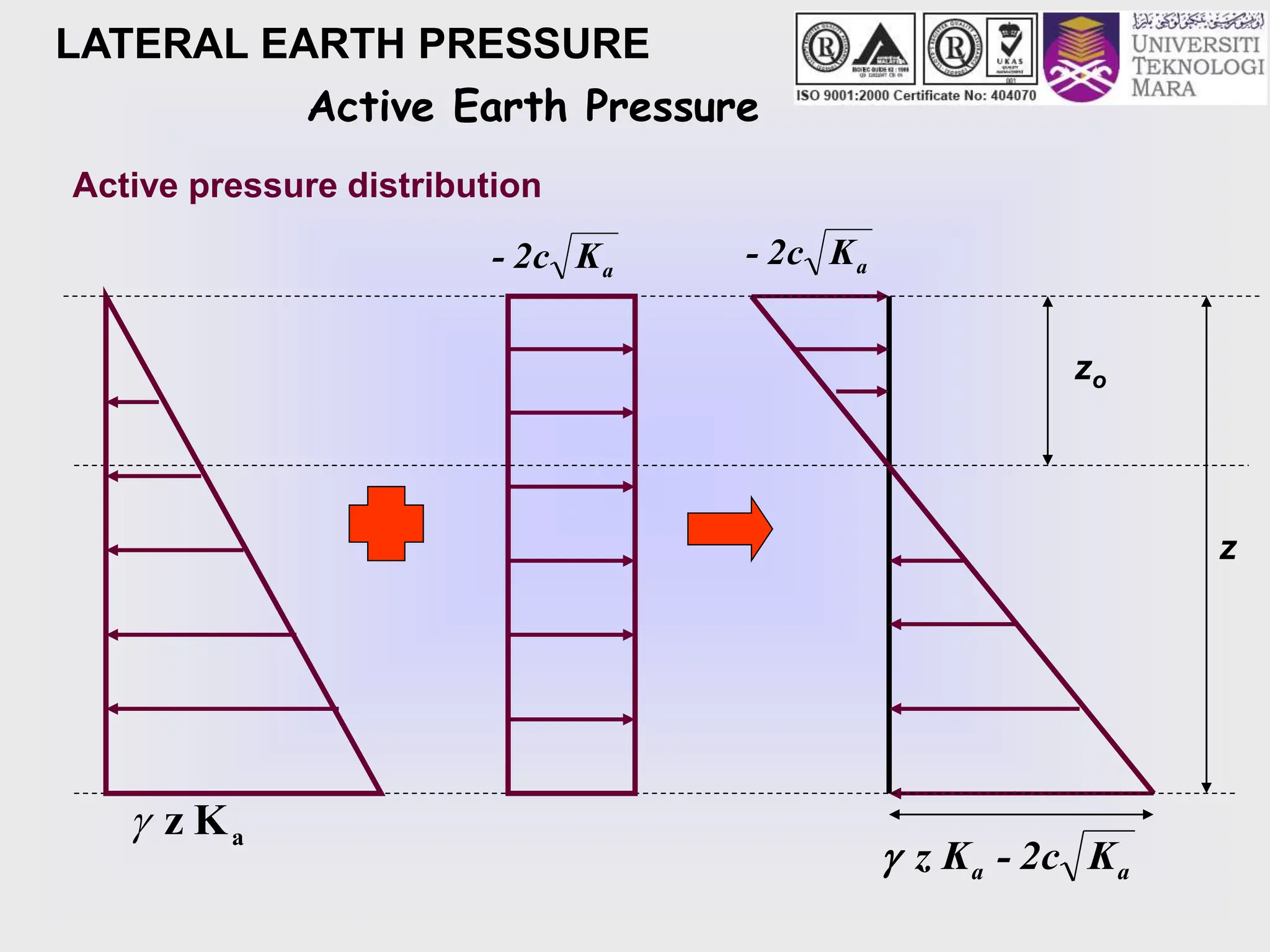
Active Earth Pressure
LATERAL EARTH PRESSURE
a
a K
2c
-
K
z

z
zo
a
K
2c
-
Active pressure distribution
Active Earth Pressure
a
K
2c
-
K
z a

LATERAL EARTH PRESSURE
Active pressure distribution
Active Earth Pressure
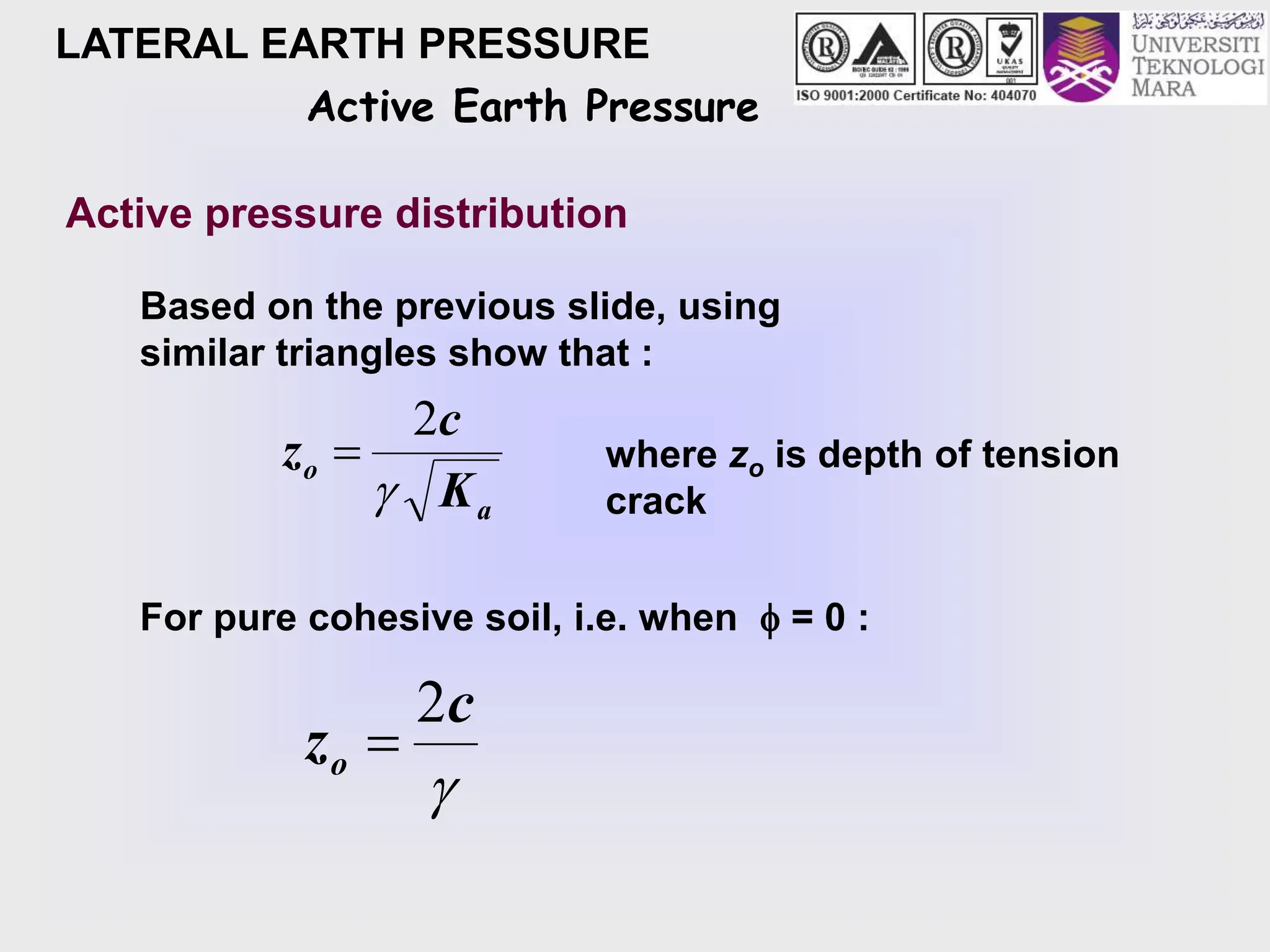
Based on the previous slide, using
similar triangles show that :
a
o
K
c
z

2
 where zo is depth of tension
crack
For pure cohesive soil, i.e. when  = 0 :

c
zo
2

LATERAL EARTH PRESSURE
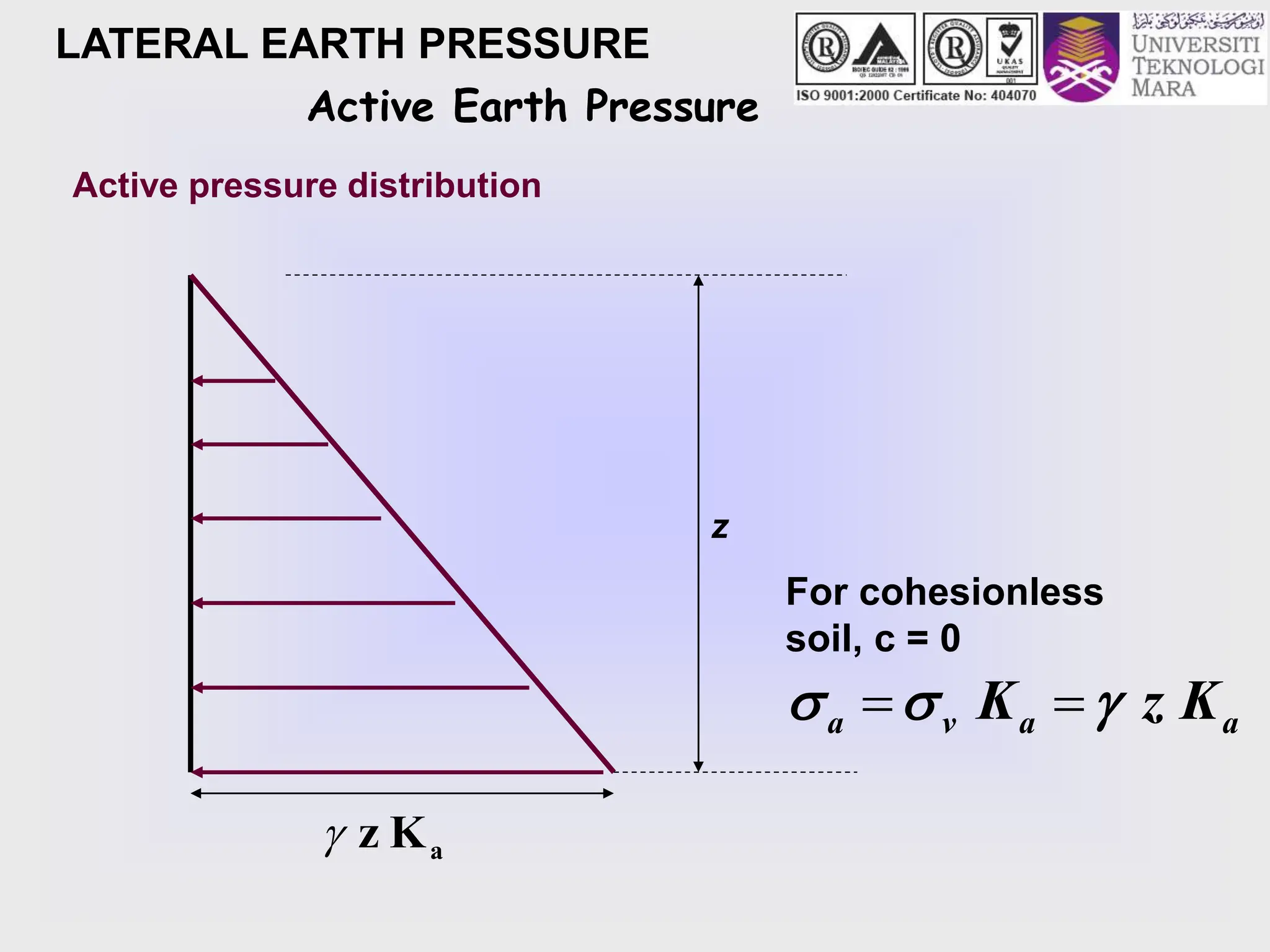
For cohesionless
soil, c = 0
a
a
v
a K
z
K 

 

z
Active pressure distribution
Active Earth Pressure
K
z a

LATERAL EARTH PRESSURE
Passive Earth Pressure
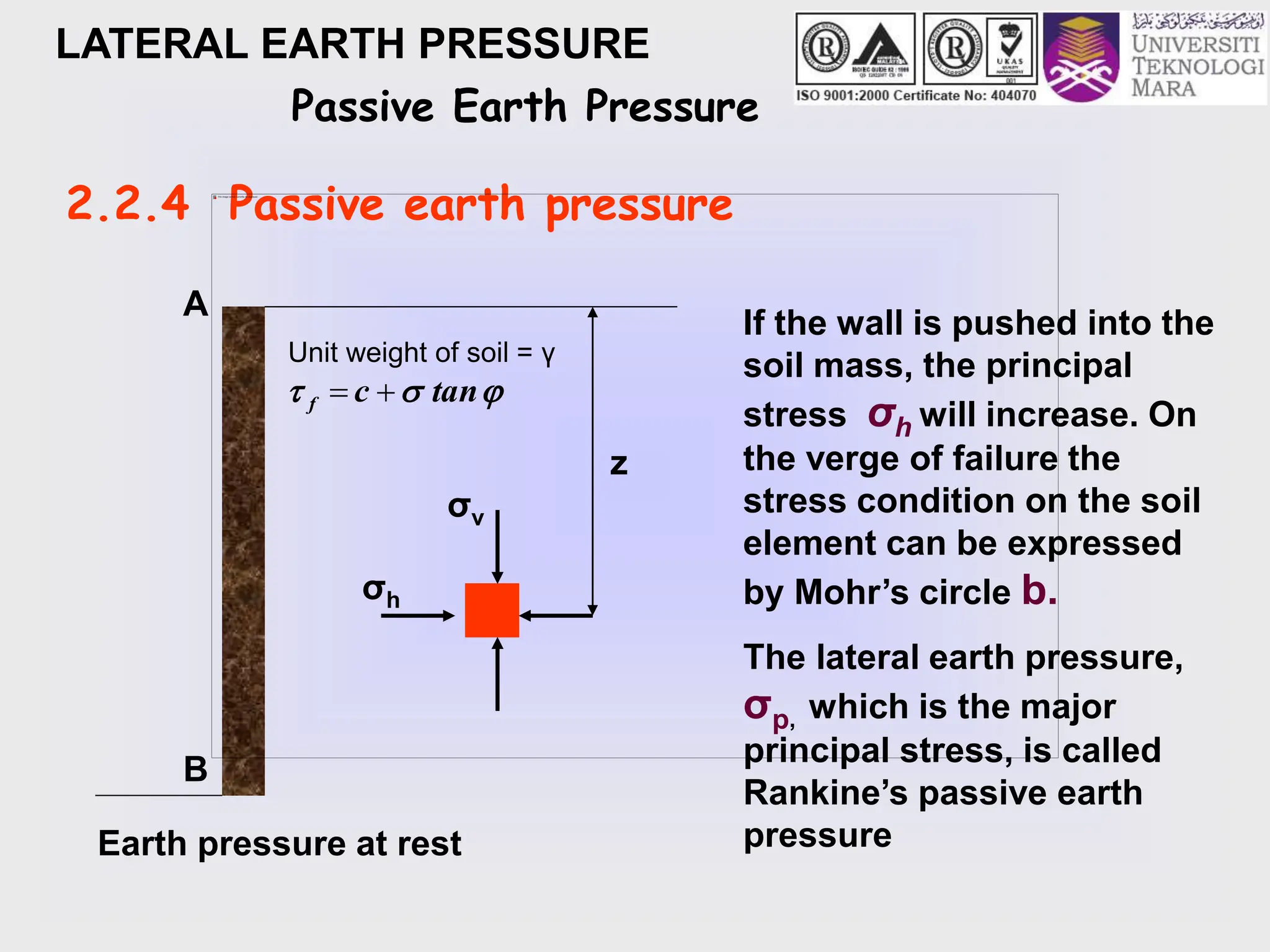
2.2.4 Passive earth pressure
Earth pressure at rest
z
σv
σh
A
B
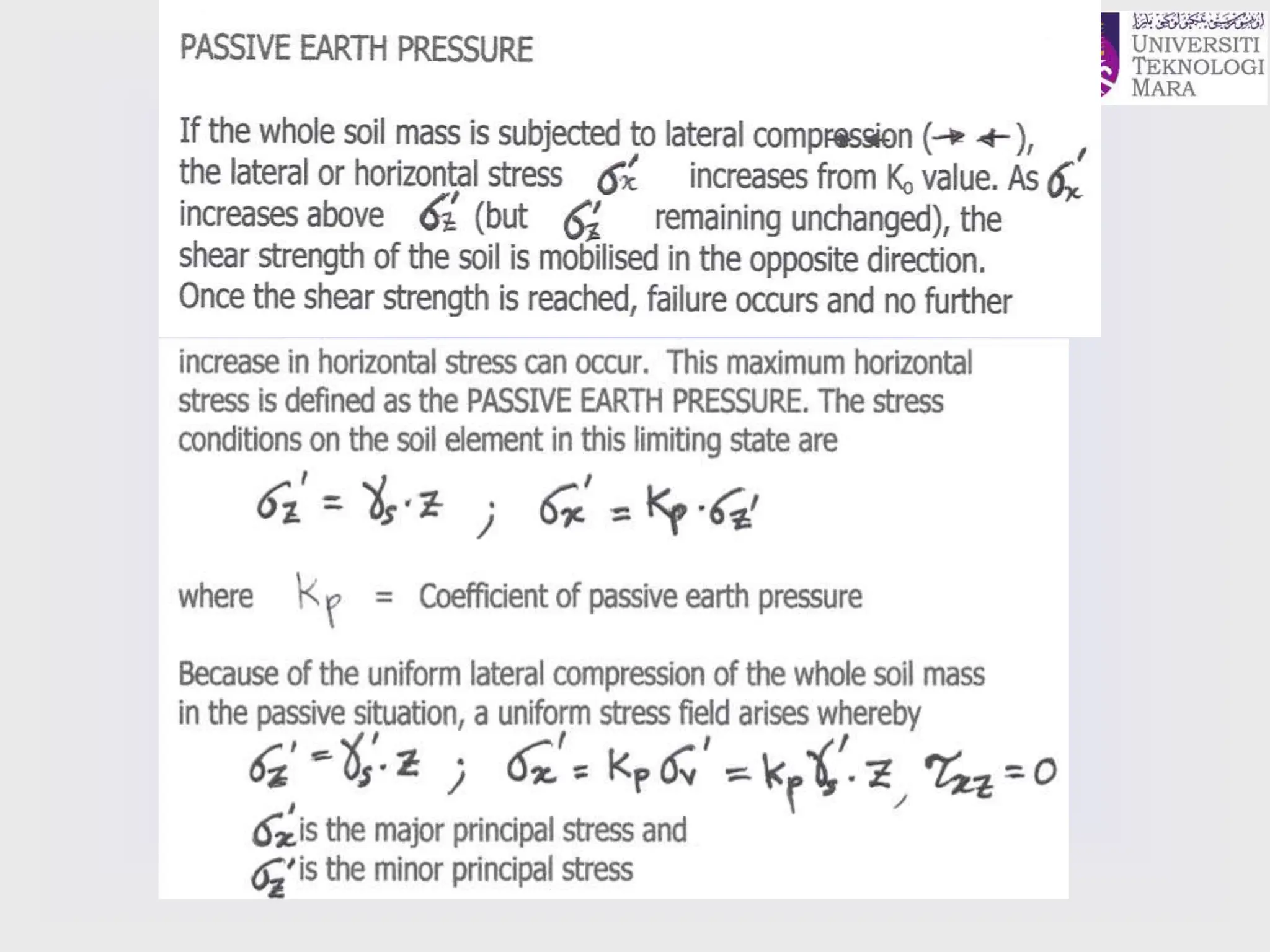
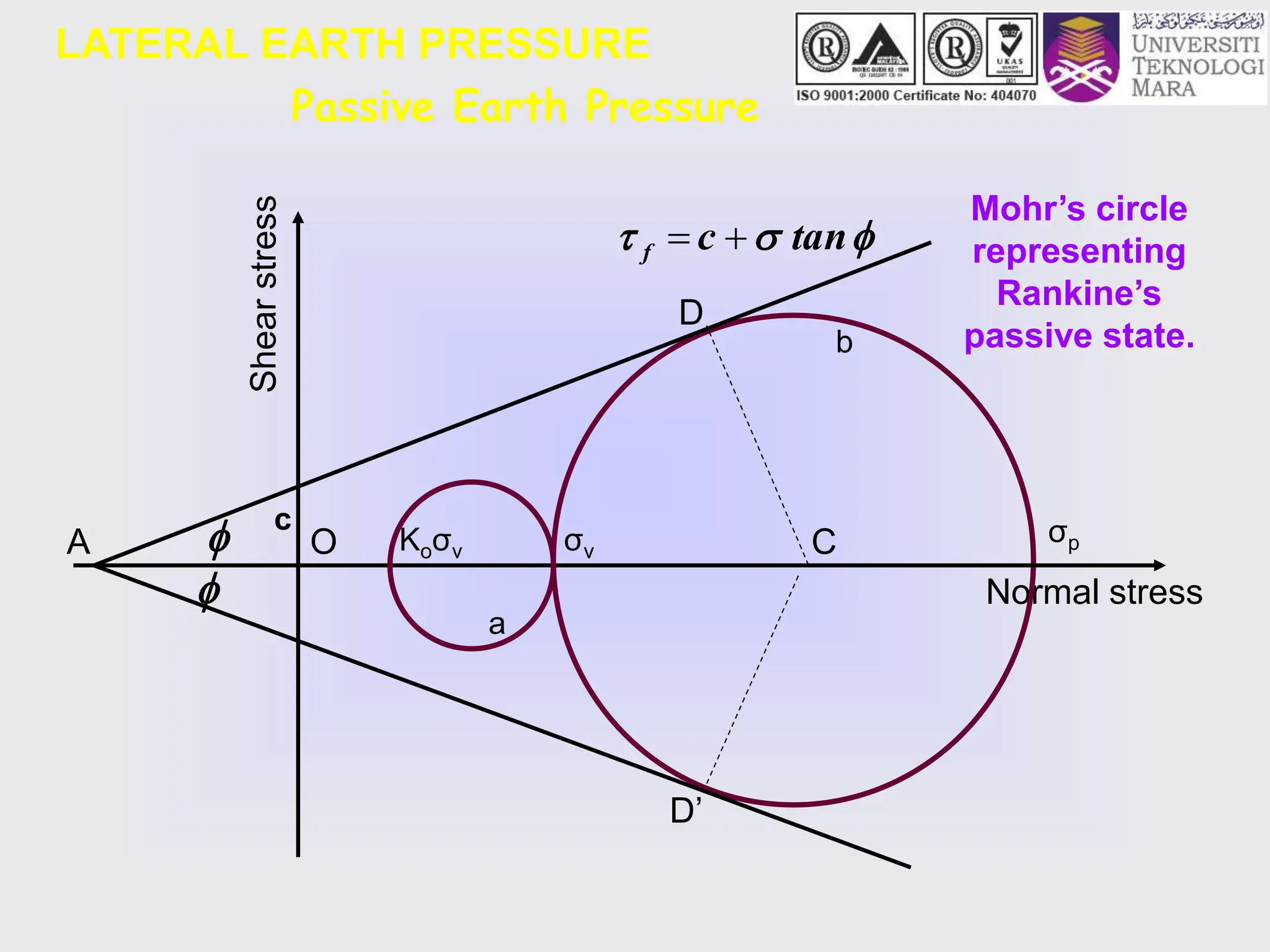
If the wall is pushed into the
soil mass, the principal
stress σh will increase. On
the verge of failure the
stress condition on the soil
element can be expressed
by Mohr’s circle b.
The lateral earth pressure,
σp, which is the major
principal stress, is called
Rankine’s passive earth
pressure
Unit weight of soil = γ


 tan
c
f 

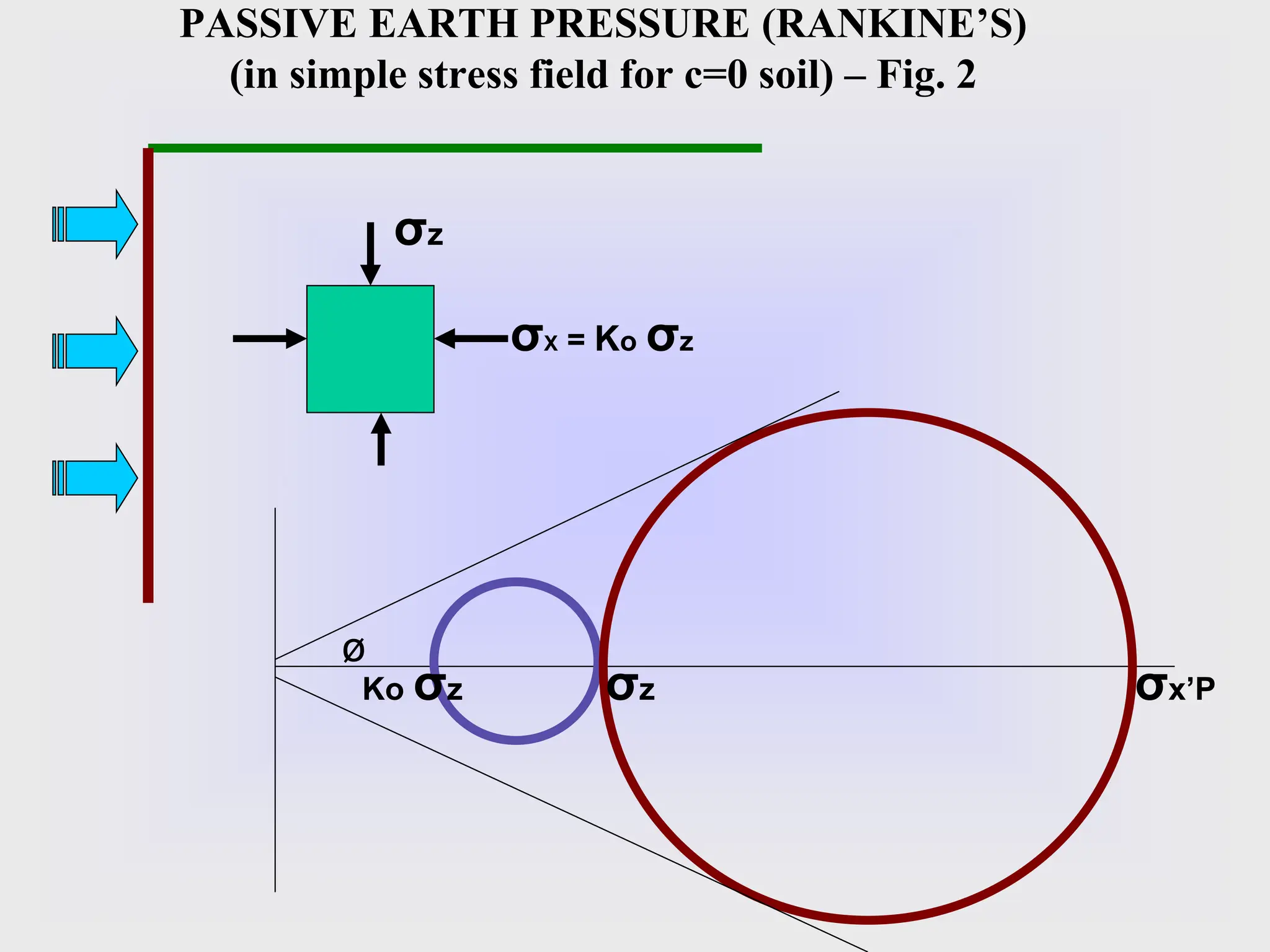
PASSIVE EARTH PRESSURE (RANKINE’S)
(in simple stress field for c=0 soil) – Fig. 2
σX = Ko σz
σz
σz
Ko σz σx’P
ø
LATERAL EARTH PRESSURE
Shear
stress
Normal stress


 tan
c
f 

C
D
D’
O
A σp
Koσv
b
a
σv


c
Mohr’s circle
representing
Rankine’s
passive state.
Passive Earth Pressure
LATERAL EARTH PRESSURE
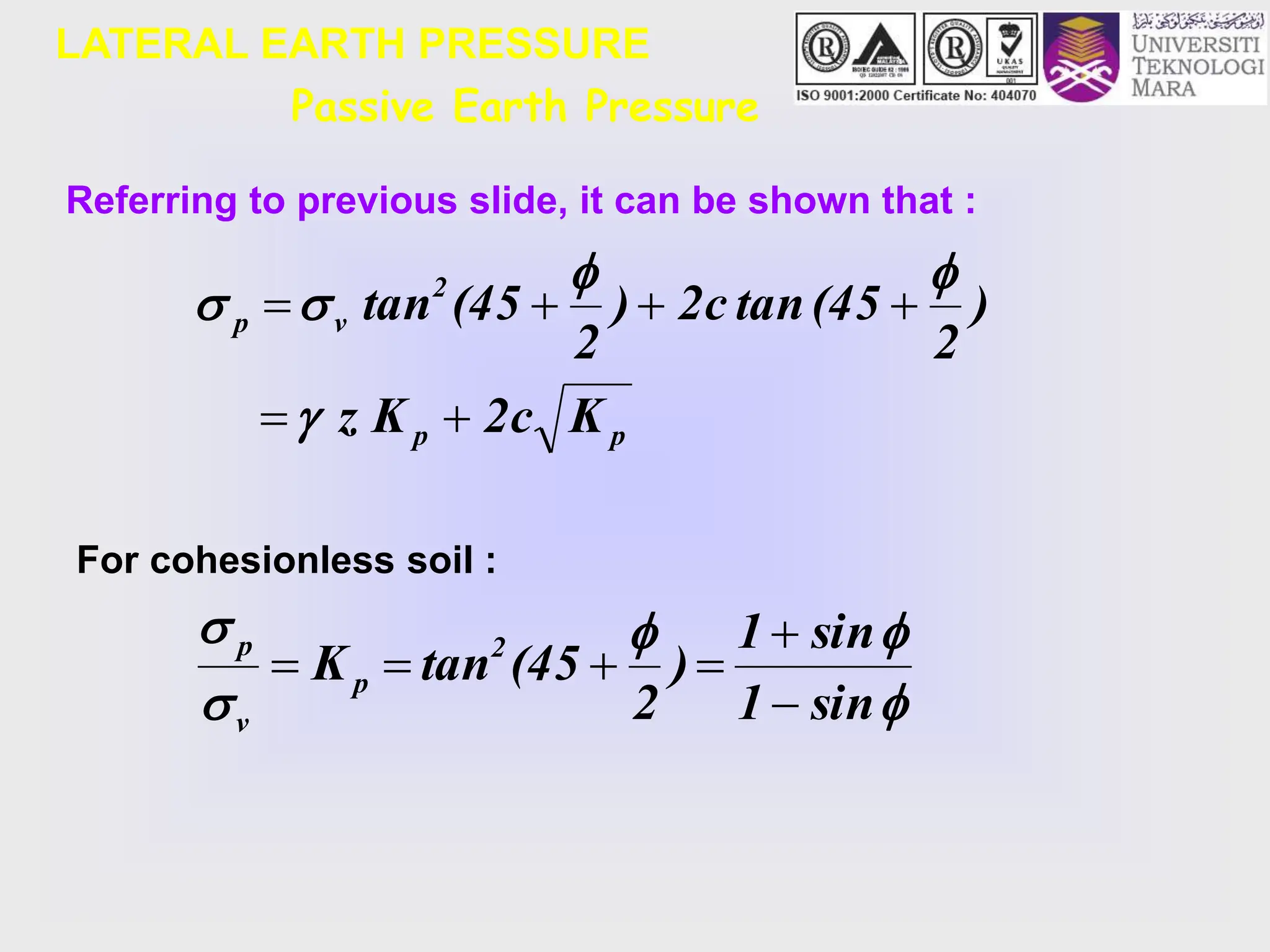
For cohesionless soil :
Referring to previous slide, it can be shown that :
Passive Earth Pressure
p
p
2
v
p
K
2c
K
z
)
2
(45
tan
2c
)
2
(45
tan
















sin
1
sin
1
)
2
(45
tan
K 2
p
v
p






LATERAL EARTH PRESSURE
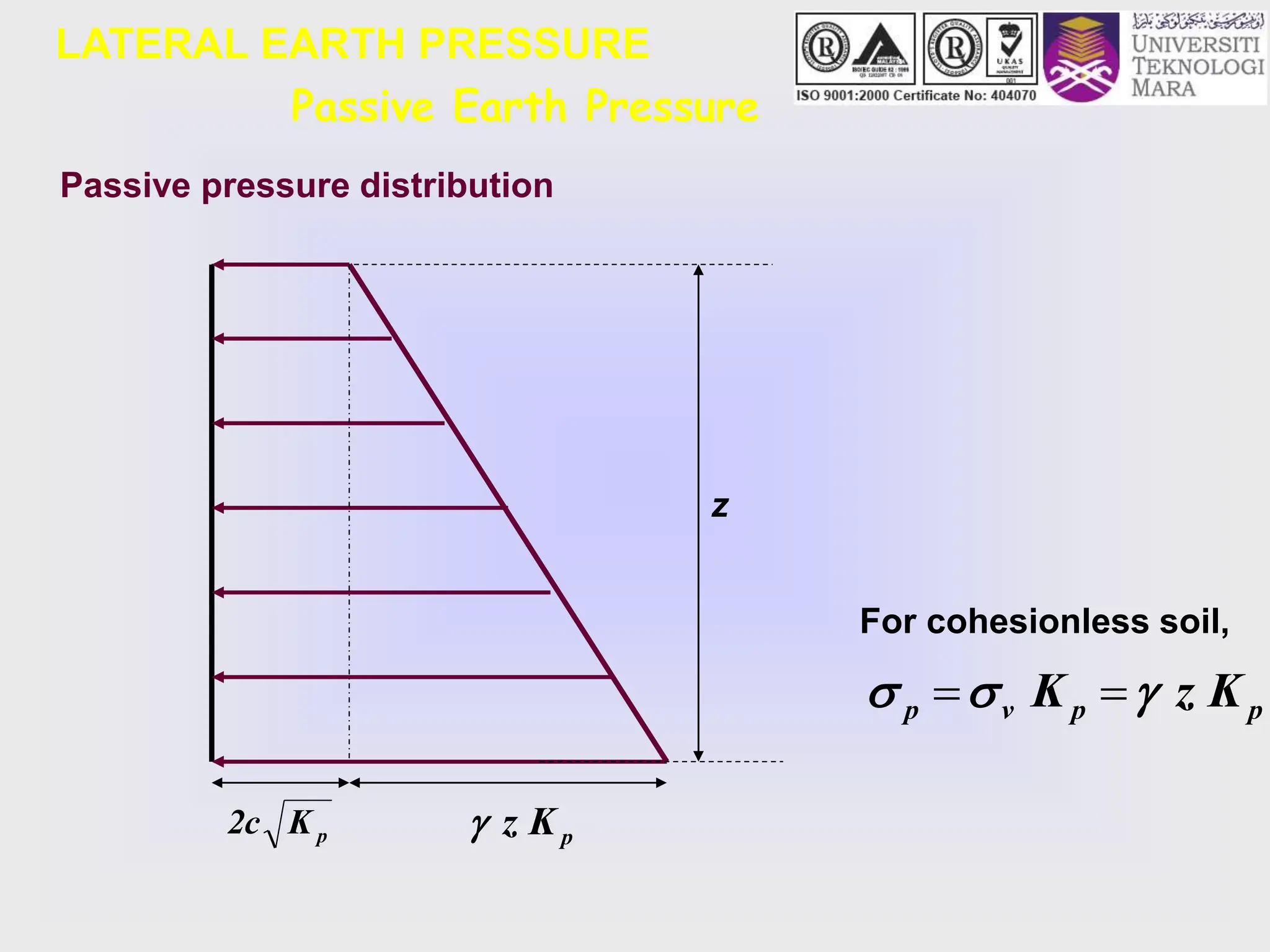
For cohesionless soil,
Passive pressure distribution
Passive Earth Pressure
z
K
z p

p
K
2c
p
p
v
p K
z
K 

 

LATERAL EARTH PRESSURE
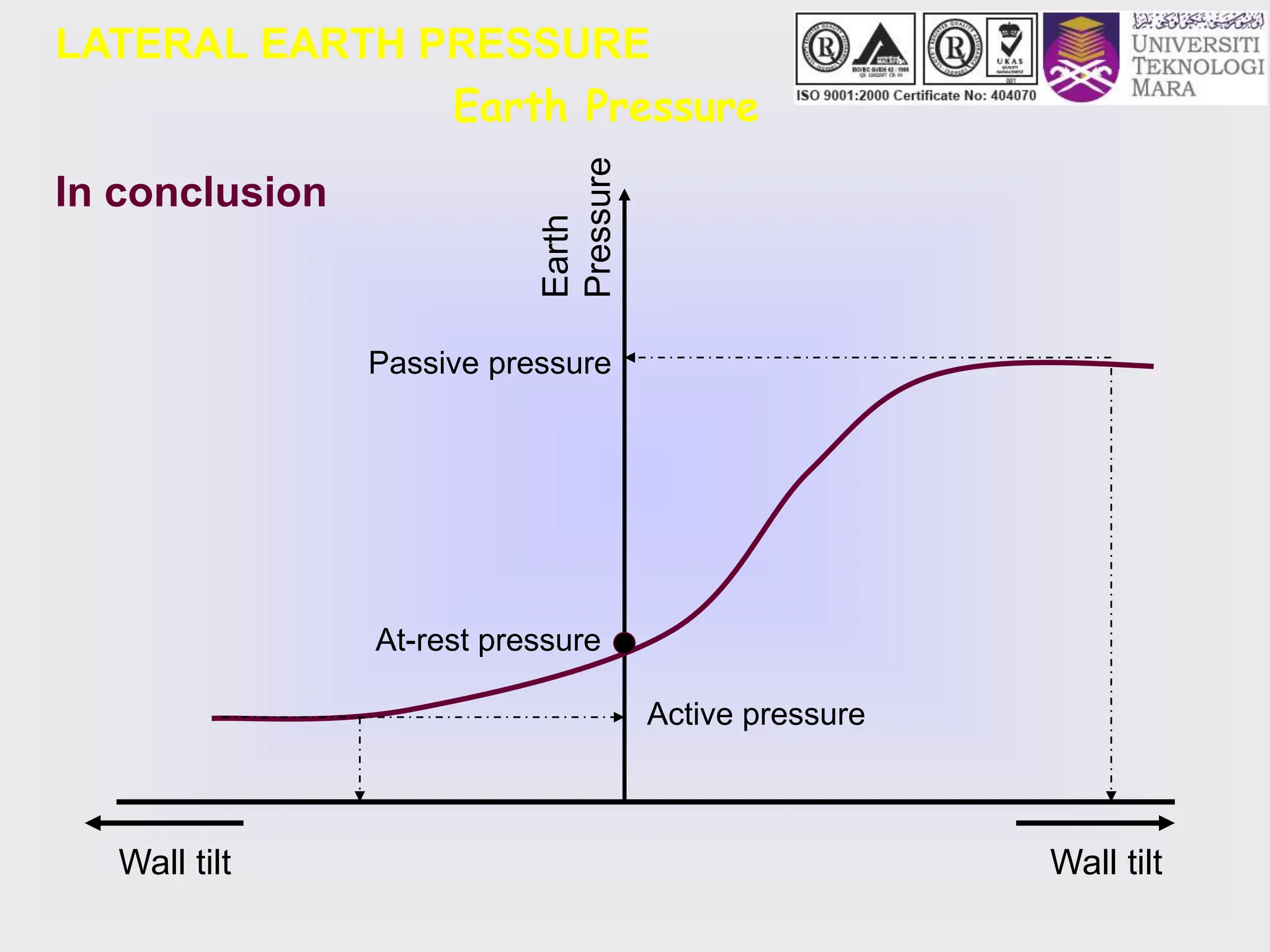
In conclusion
Earth Pressure
Wall tilt
Passive pressure
At-rest pressure
Active pressure
Earth
Pressure
Wall tilt
LATERAL EARTH PRESSURE
Types of Lateral Pressure
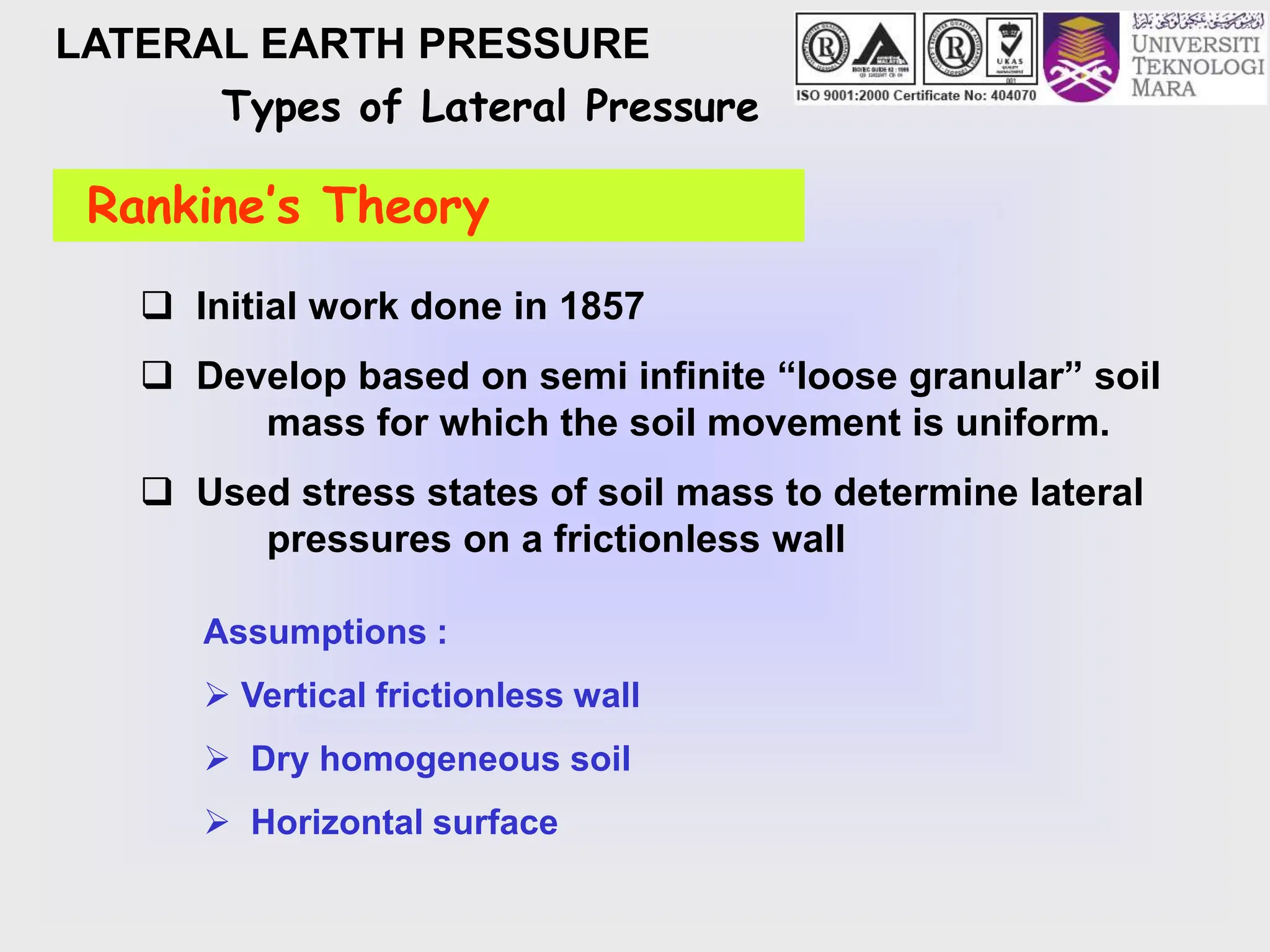
Rankine’s Theory
Assumptions :
 Vertical frictionless wall
 Dry homogeneous soil
 Horizontal surface
 Initial work done in 1857
 Develop based on semi infinite “loose granular” soil
mass for which the soil movement is uniform.
 Used stress states of soil mass to determine lateral
pressures on a frictionless wall
LATERAL EARTH PRESSURE
Types of Lateral Pressure
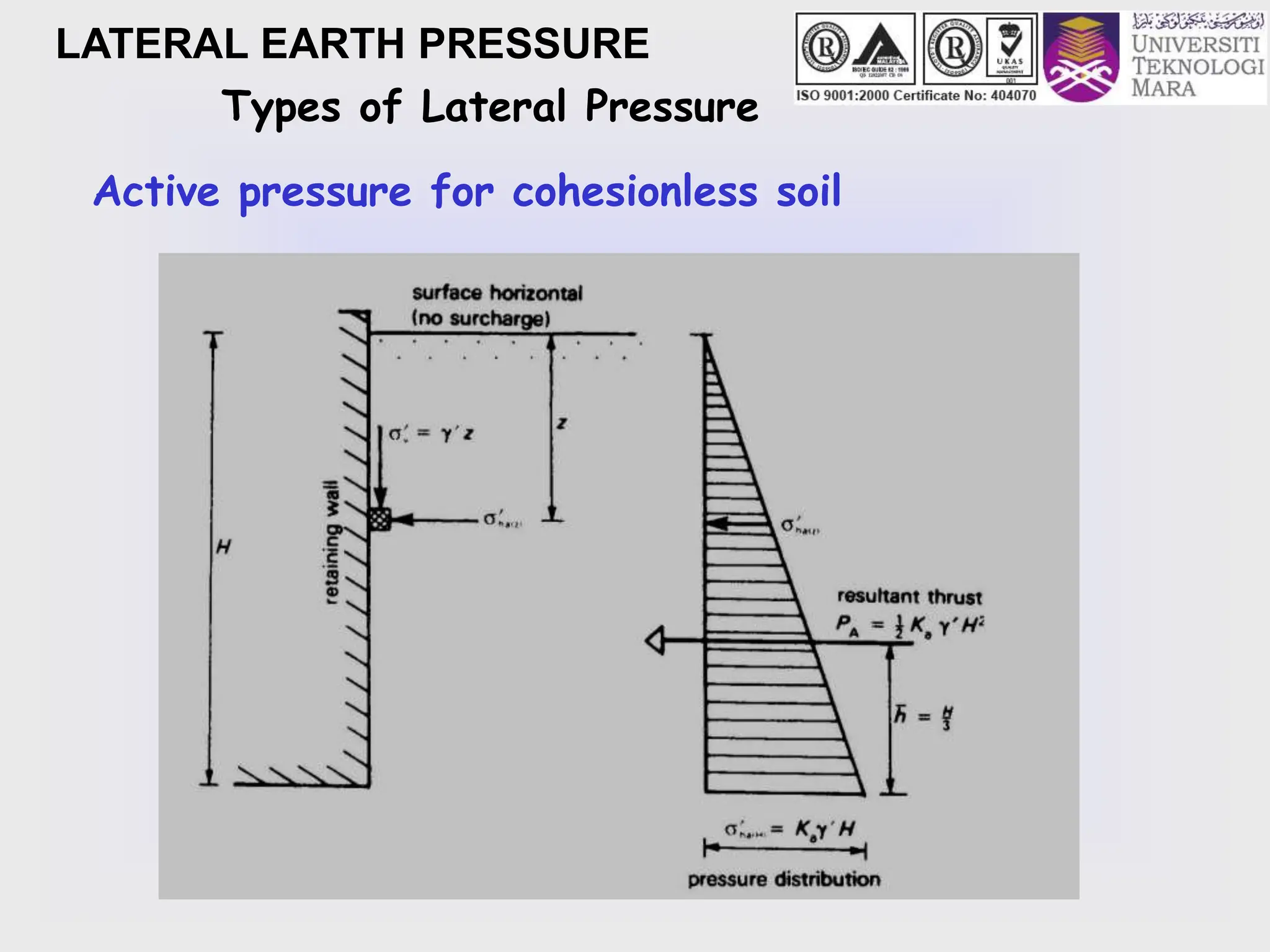
Active pressure for cohesionless soil
LATERAL EARTH PRESSURE
Types of Lateral Pressure
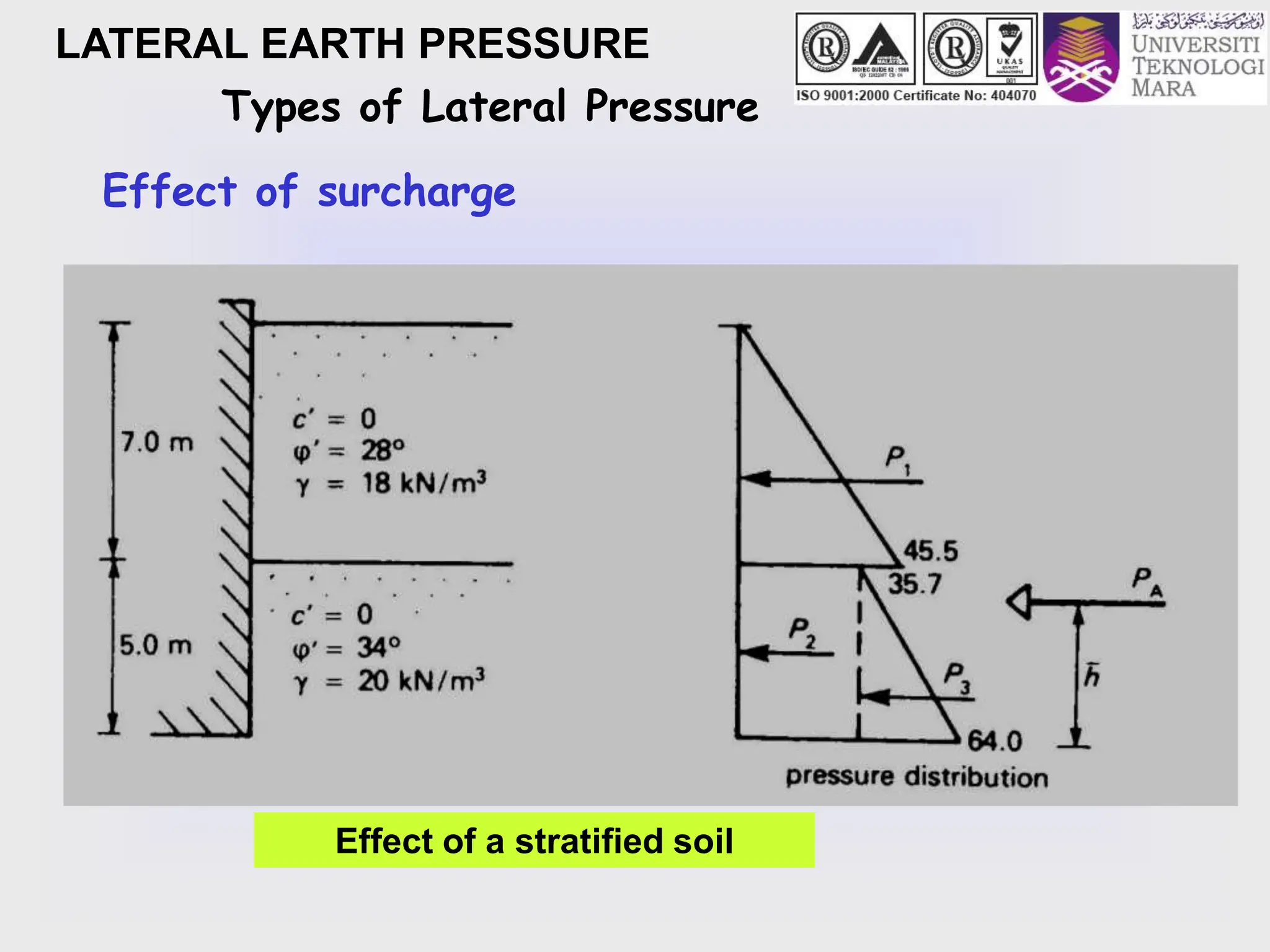
Effect of a stratified soil
Effect of surcharge
LATERAL EARTH PRESSURE
Types of Lateral Pressure
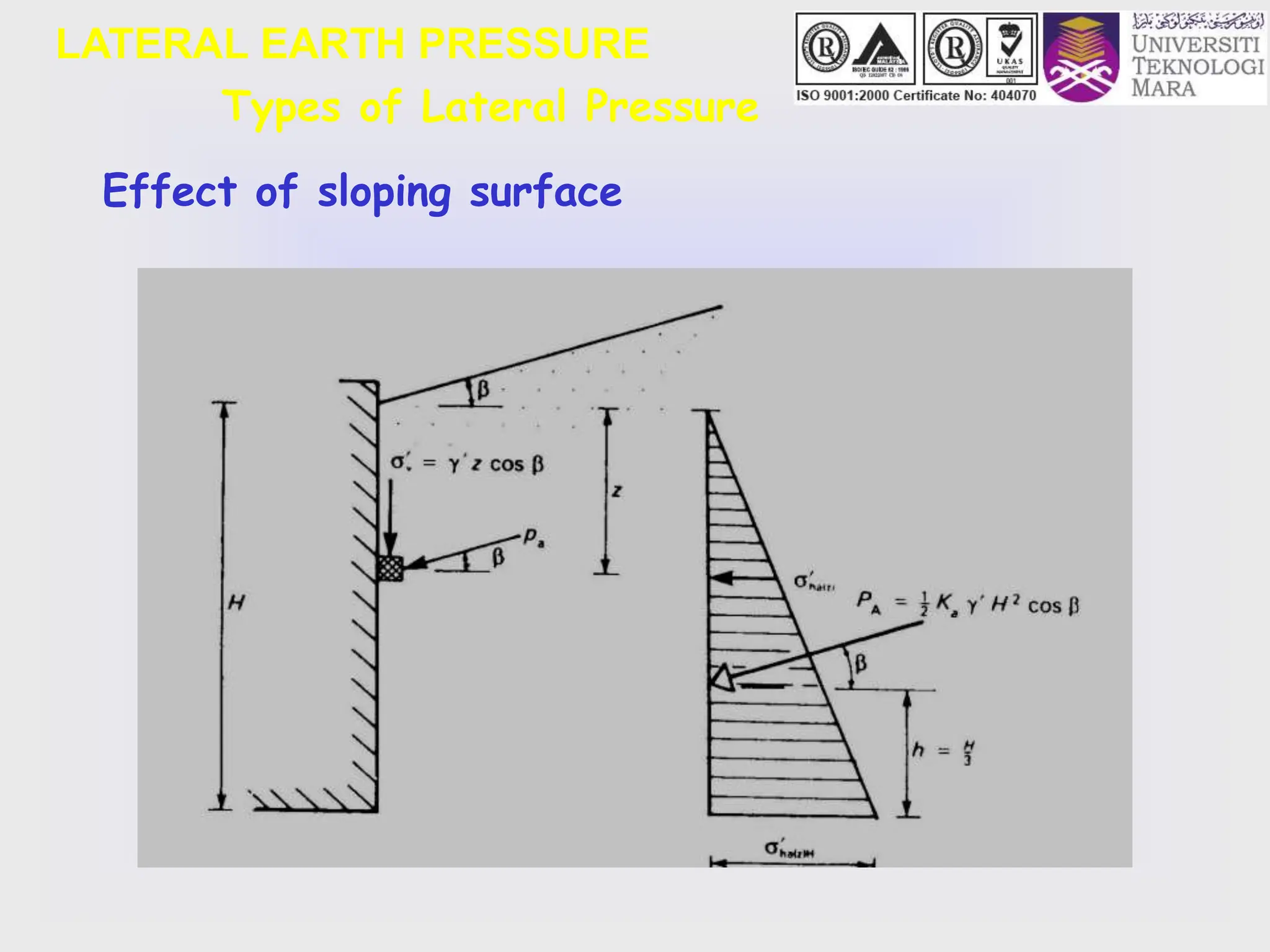
Effect of sloping surface
LATERAL EARTH PRESSURE
Types of Lateral Pressure
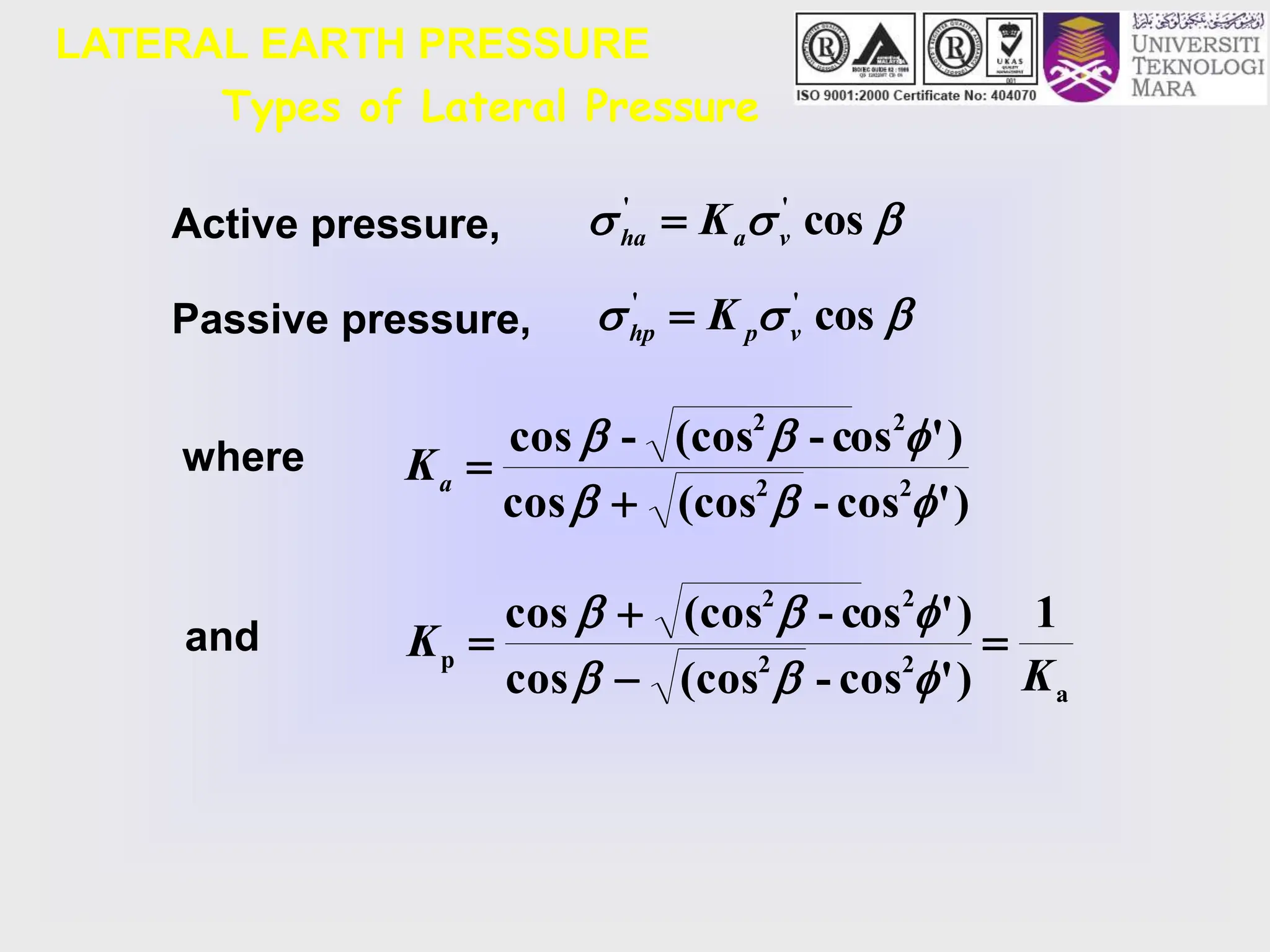
Active pressure,
Passive pressure,


 cos
'
'
v
a
ha K



 cos
'
'
v
p
hp K

where
)
'
cos
-
(cos
cos
)
'
os
c
-
(cos
-
cos
2
2
2
2








a
K
a
2
2
2
2
p
1
)
'
cos
-
(cos
cos
)
'
os
c
-
(cos
cos
K
K 









and
LATERAL EARTH PRESSURE
Types of Lateral Pressure
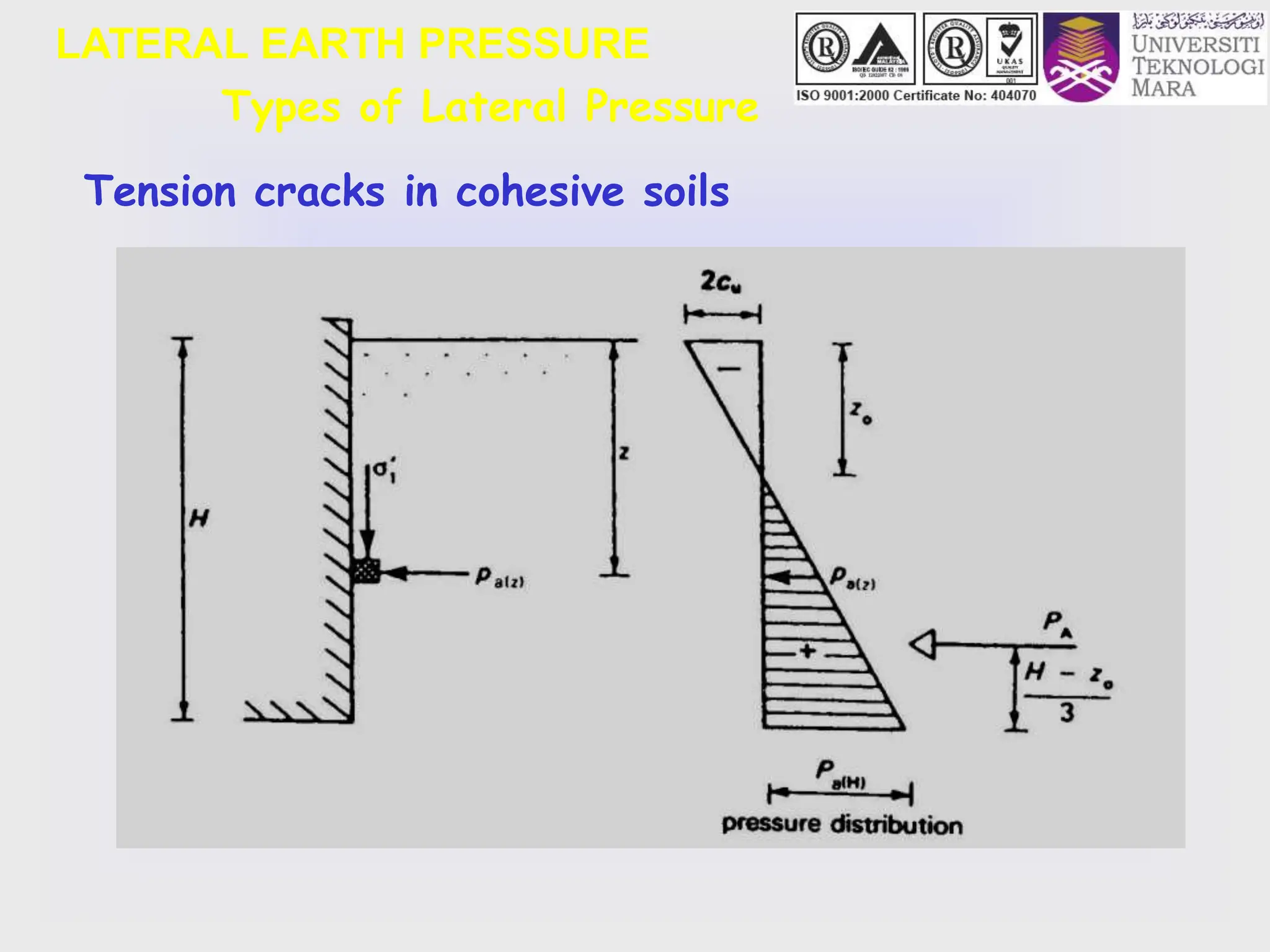
Tension cracks in cohesive soils
LATERAL EARTH PRESSURE
Types of Lateral Pressure
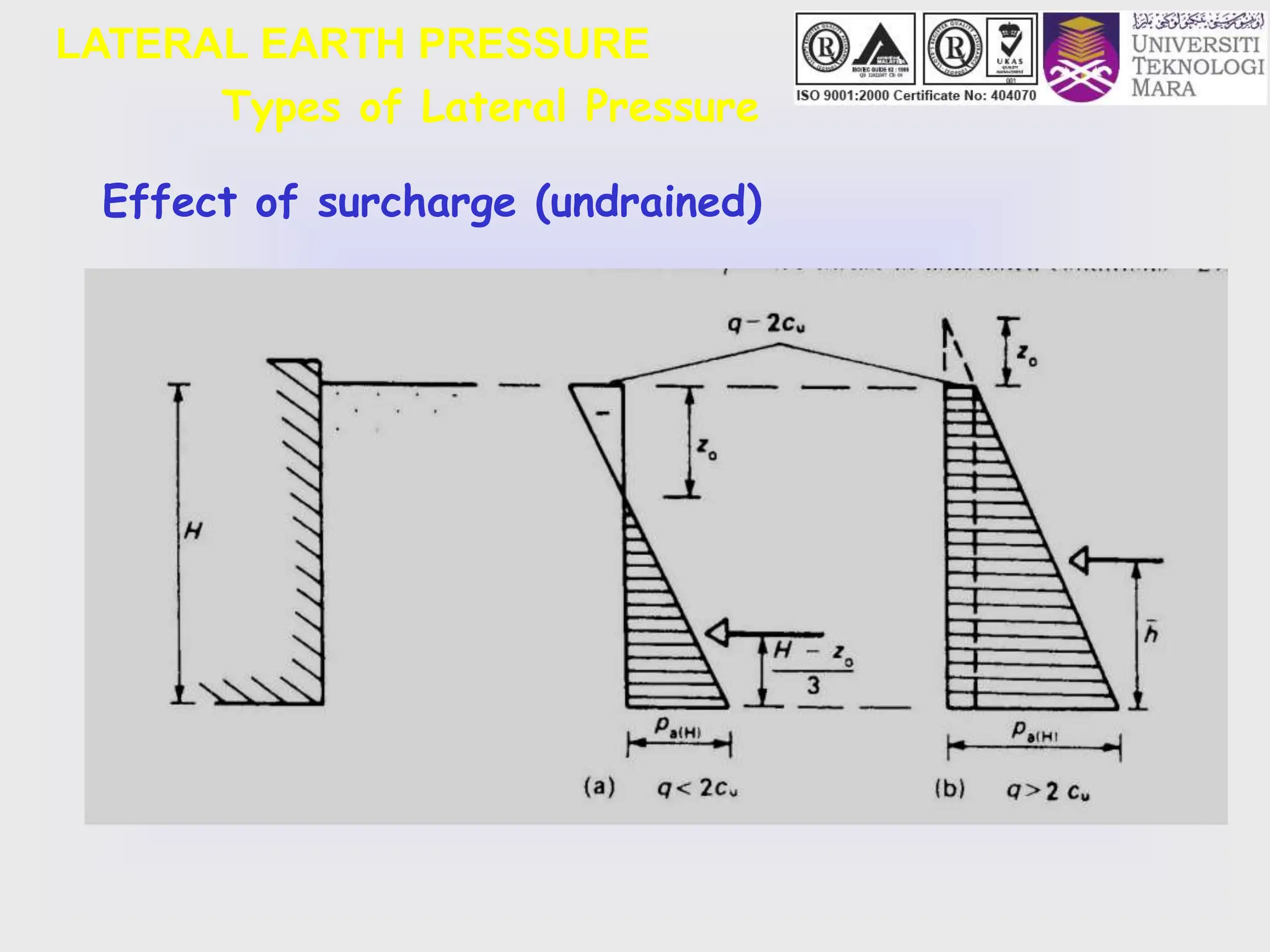
Effect of surcharge (undrained)
LATERAL EARTH PRESSURE
Types of Lateral Pressure
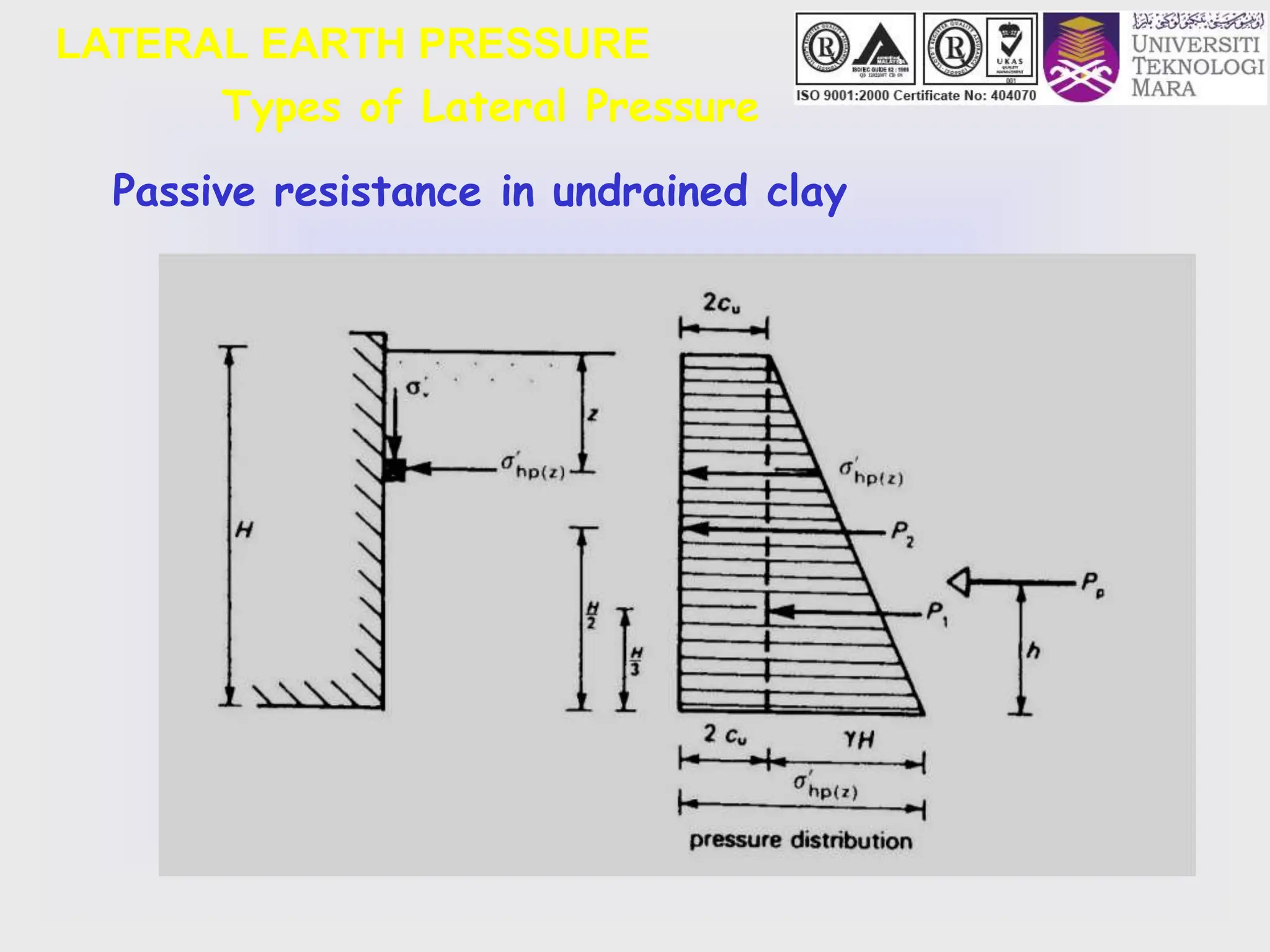
Passive resistance in undrained clay
LATERAL EARTH PRESSURE
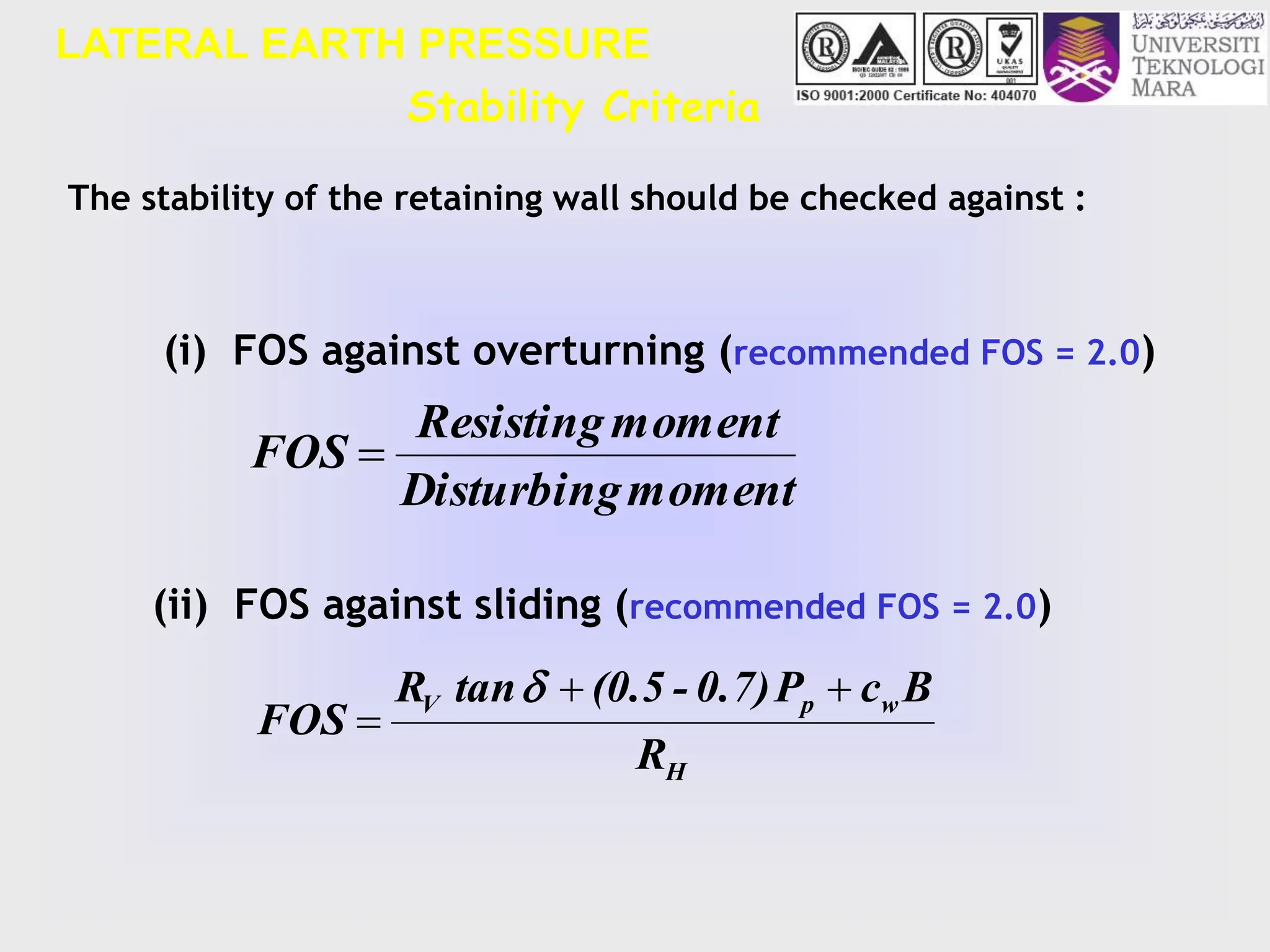
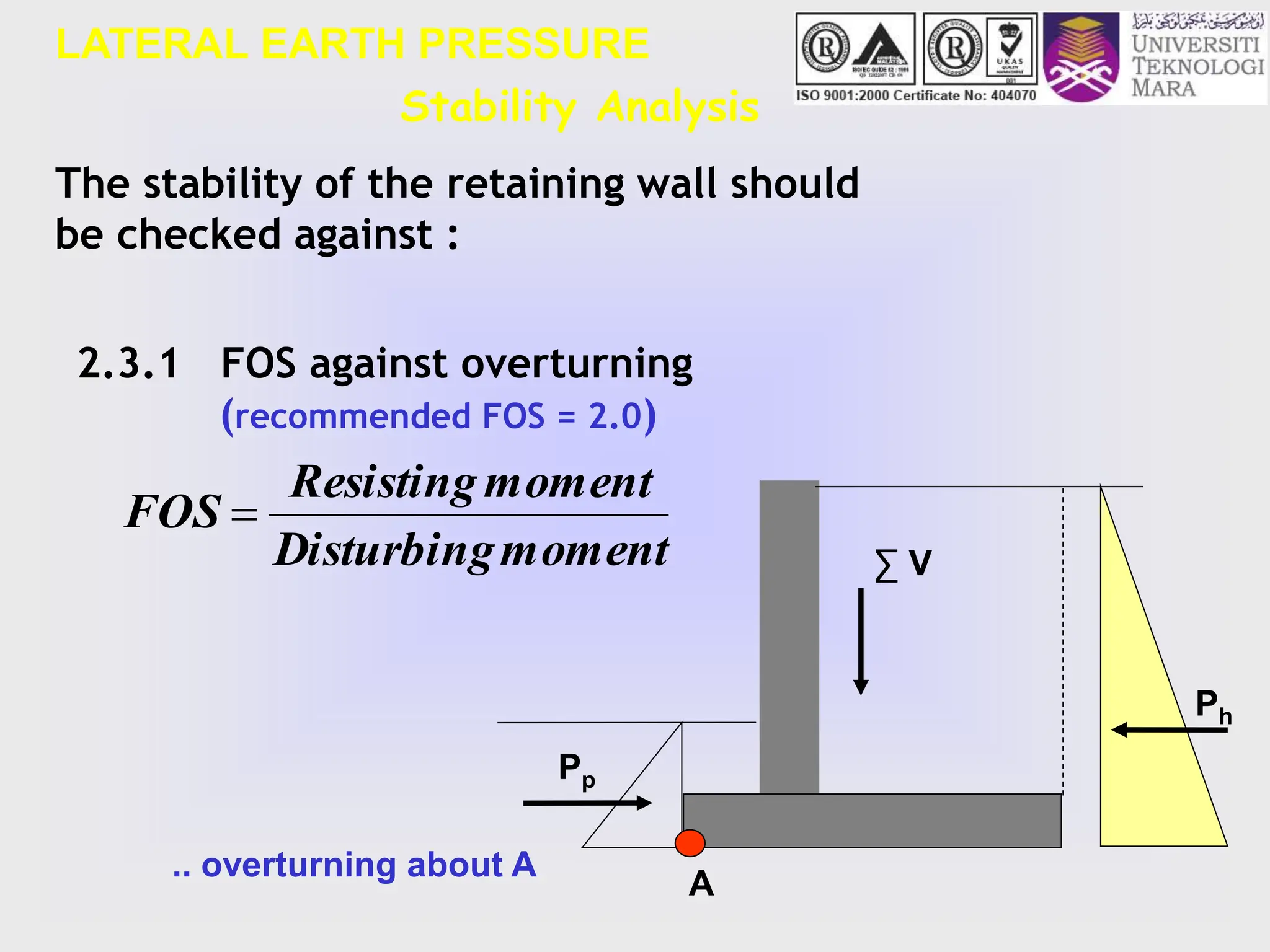
The stability of the retaining wall should be checked against :
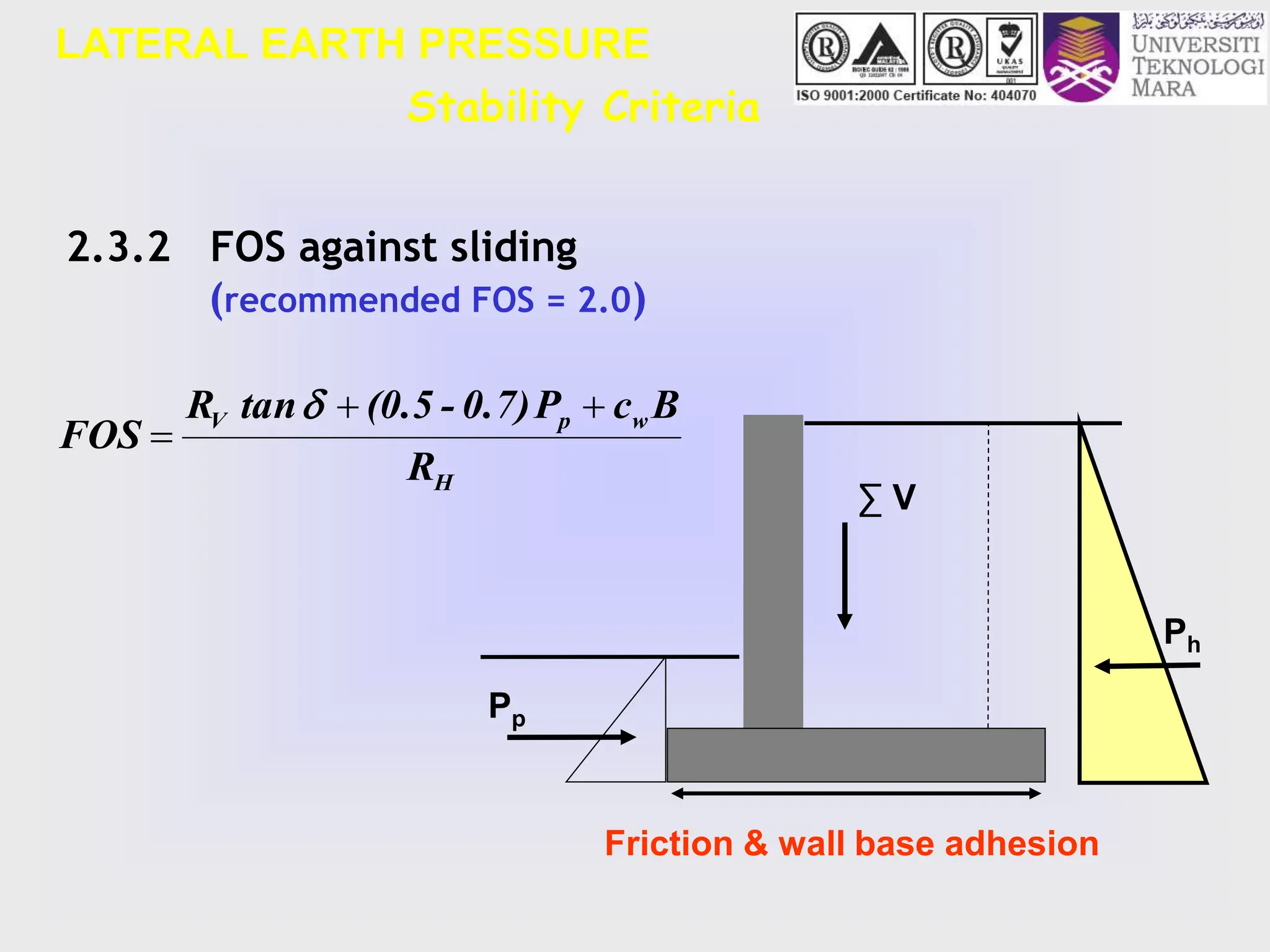
(ii) FOS against sliding (recommended FOS = 2.0)
(i) FOS against overturning (recommended FOS = 2.0)
Stability Criteria
moment
Disturbing
moment
Resisting
FOS 
H
w
p
V
R
B
c
P
0.7)
-
(0.5
tan
R
FOS




LATERAL EARTH PRESSURE
Stability Analysis
Pp
Ph
∑ V
A
The stability of the retaining wall should
be checked against :
2.3.1 FOS against overturning
(recommended FOS = 2.0)
moment
Disturbing
moment
Resisting
FOS 
.. overturning about A
LATERAL EARTH PRESSURE
2.3.2 FOS against sliding
(recommended FOS = 2.0)
Stability Criteria
H
w
p
V
R
B
c
P
0.7)
-
(0.5
tan
R
FOS




Ph
∑ V
Pp
Friction & wall base adhesion
LATERAL EARTH PRESSURE








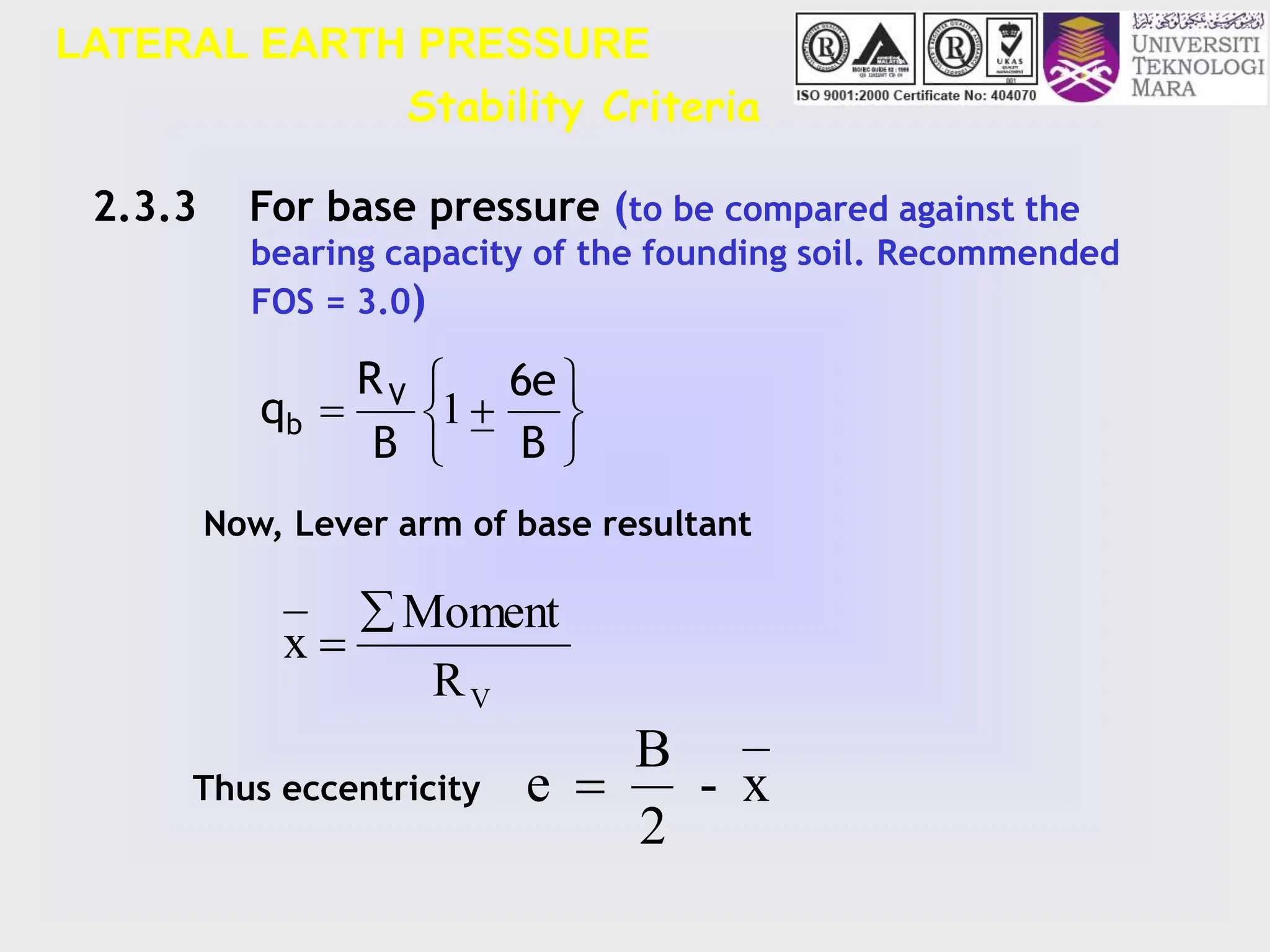
B
6e
B
R
q V
b 1
2.3.3 For base pressure (to be compared against the
bearing capacity of the founding soil. Recommended
FOS = 3.0)
Now, Lever arm of base resultant
Thus eccentricity
R
Moment
x
V


x
-
2
B
e 
Stability Criteria
LATERAL EARTH PRESSURE
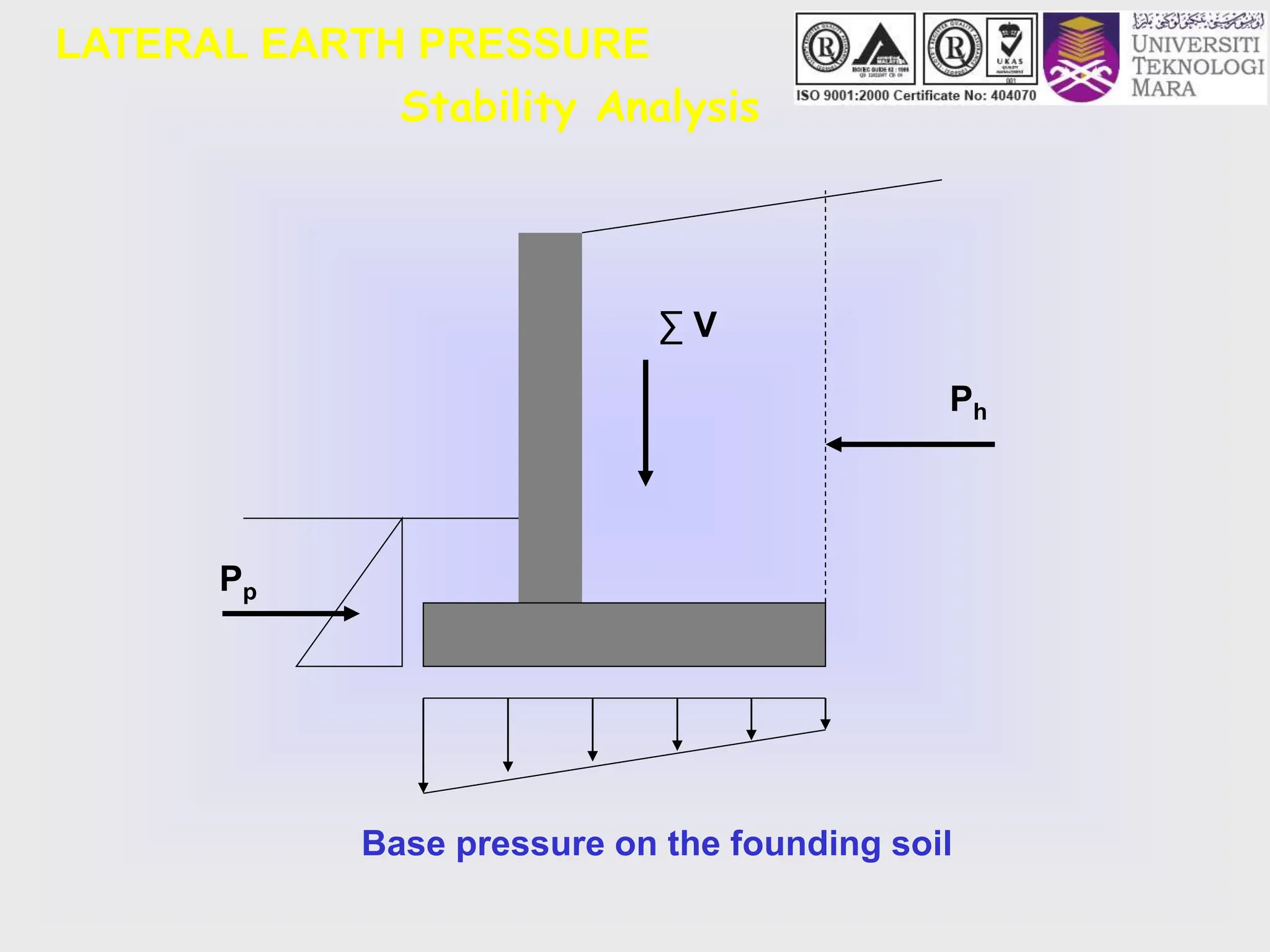
Stability Analysis
Pp
Ph
∑ V
Base pressure on the founding soil
Stability Analysis
LATERAL EARTH PRESSURE
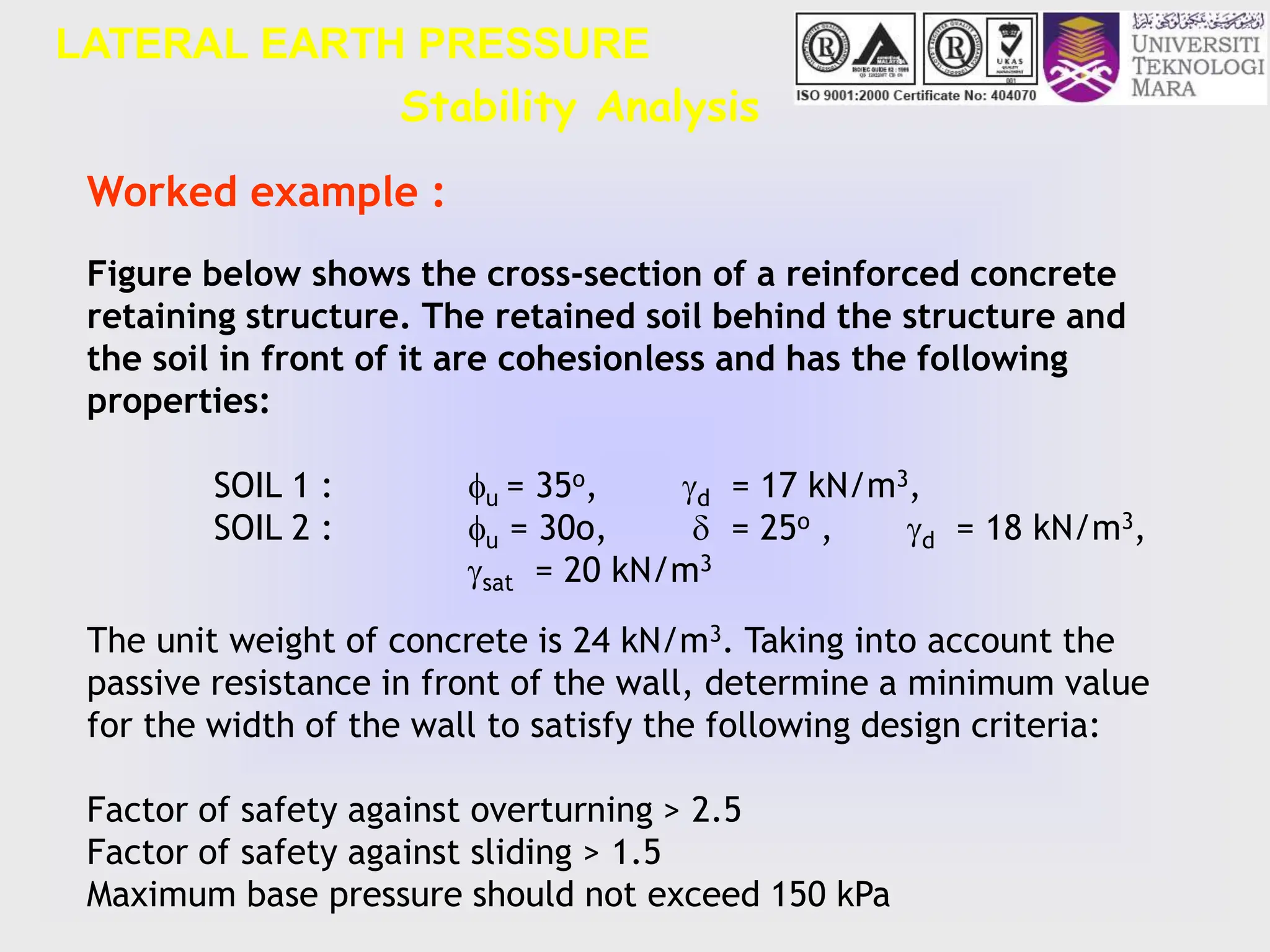
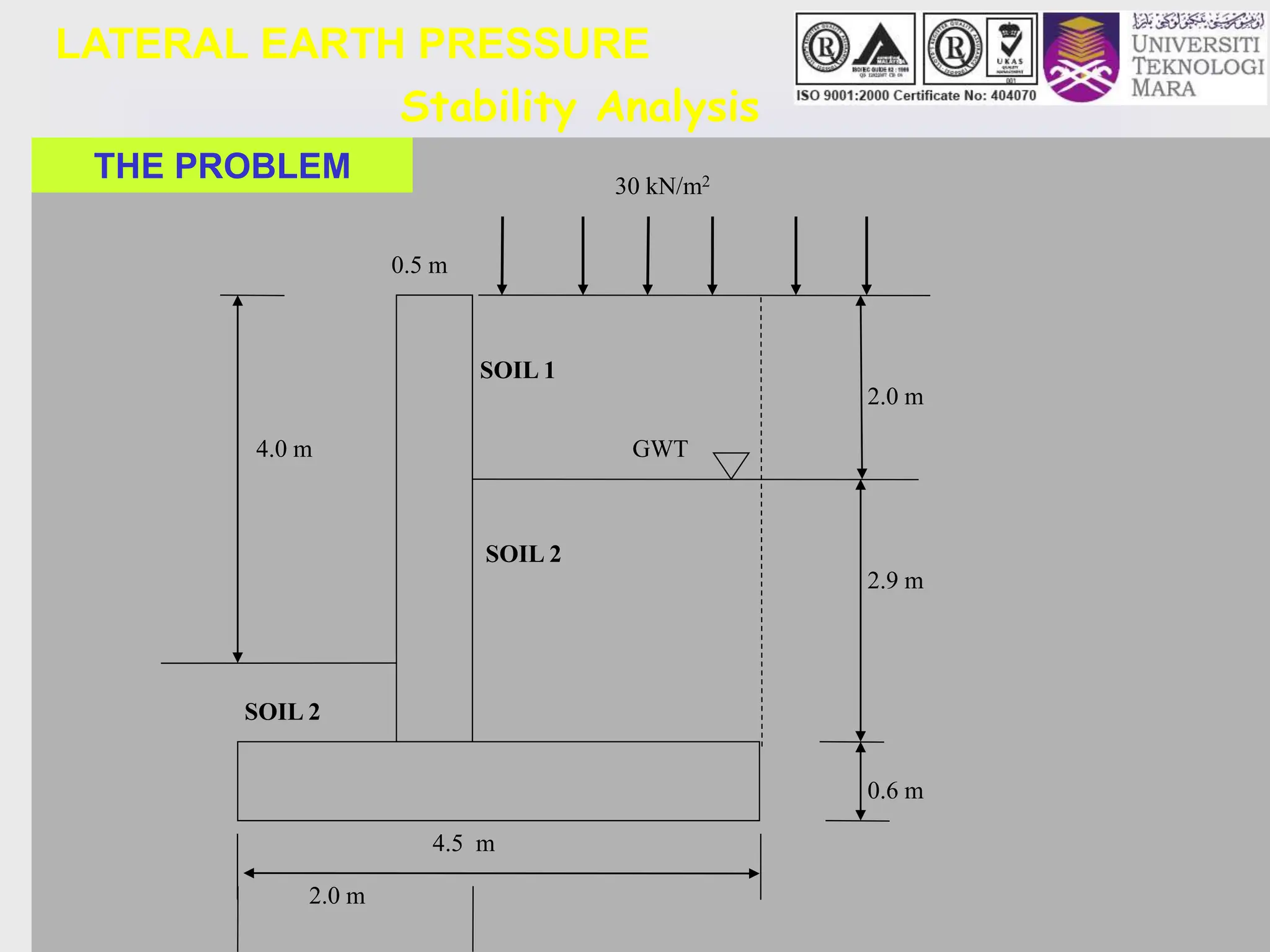
Figure below shows the cross-section of a reinforced concrete
retaining structure. The retained soil behind the structure and
the soil in front of it are cohesionless and has the following
properties:
SOIL 1 : u = 35o, d = 17 kN/m3,
SOIL 2 : u = 30o,  = 25o , d = 18 kN/m3,
sat = 20 kN/m3
The unit weight of concrete is 24 kN/m3. Taking into account the
passive resistance in front of the wall, determine a minimum value
for the width of the wall to satisfy the following design criteria:
Factor of safety against overturning > 2.5
Factor of safety against sliding > 1.5
Maximum base pressure should not exceed 150 kPa
Worked example :
Stability Analysis
LATERAL EARTH PRESSURE
SOIL 2
2.0 m
0.5 m
0.6 m
2.9 m
2.0 m
GWT
4.5 m
SOIL 1
SOIL 2
30 kN/m2
4.0 m
THE PROBLEM
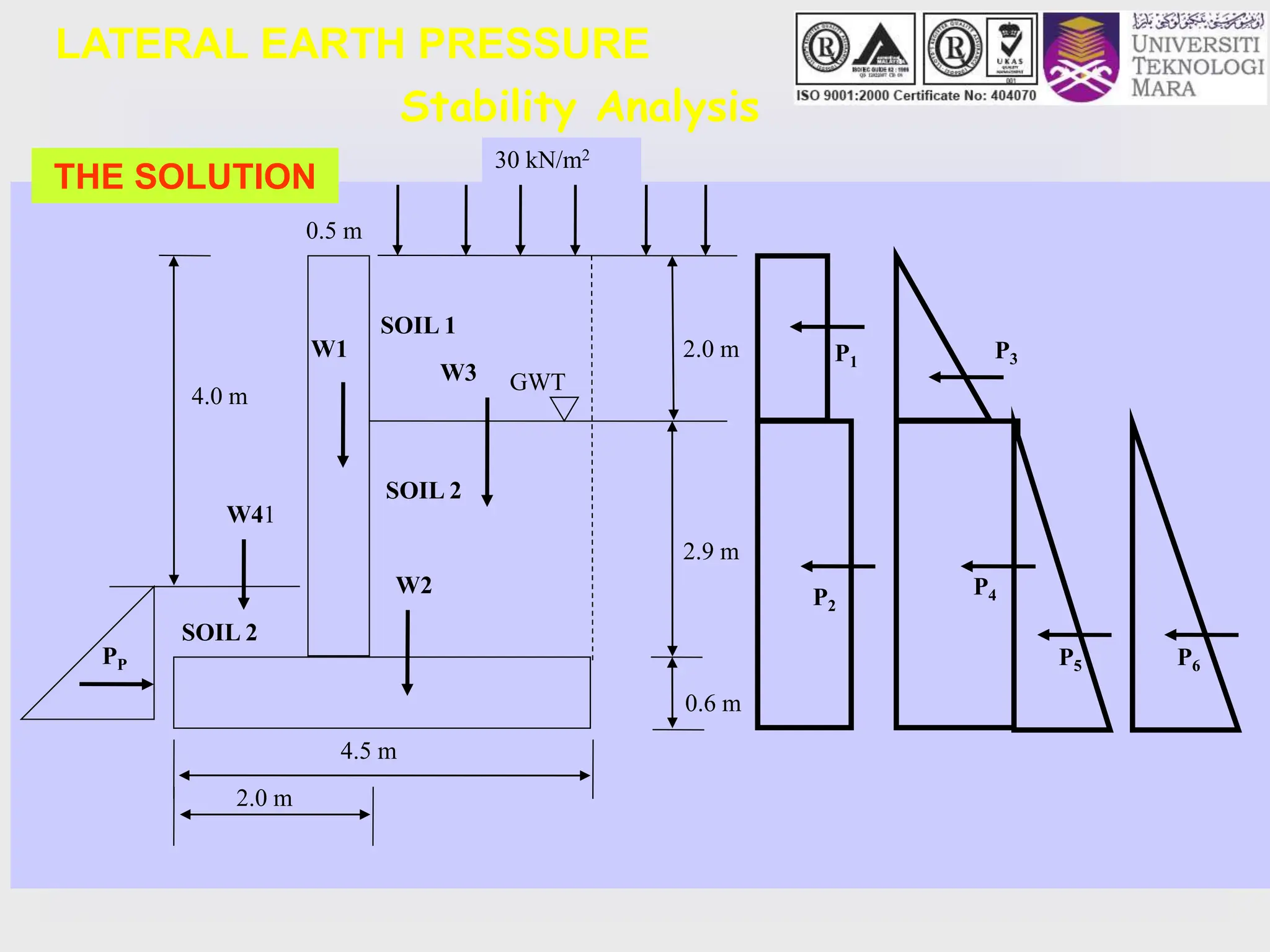
LATERAL EARTH PRESSURE
Stability Analysis
P1
P3
SOIL 2
2.0 m
0.5 m
0.6 m
2.9 m
2.0 m
GWT
4.5 m
SOIL 1
SOIL 2
30 kN/m2
4.0 m
P2
P4
PP
W41
W3
W2
W1
P5
THE SOLUTION
P6
LATERAL EARTH PRESSURE
Stability Analysis
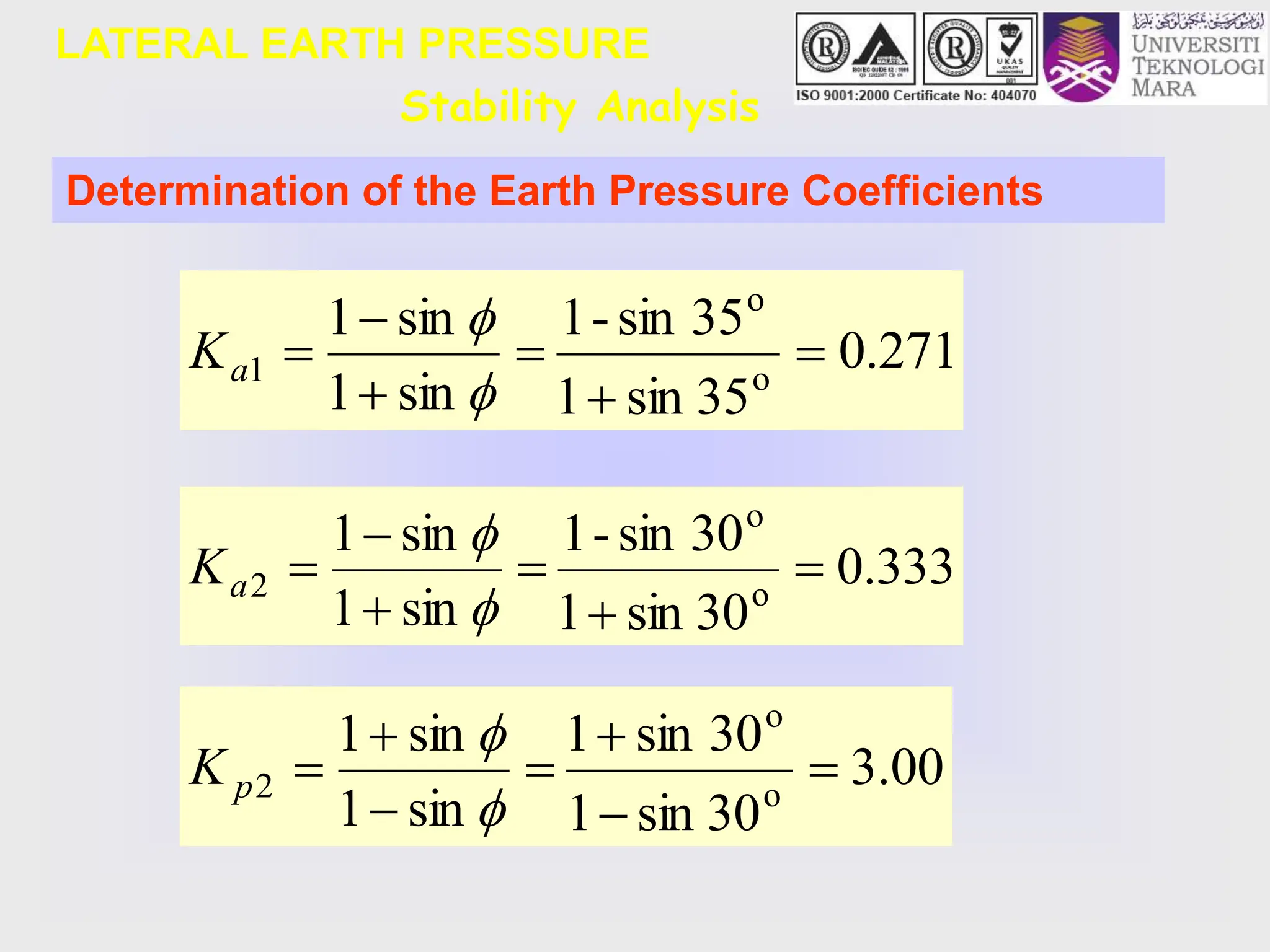
271
.
0
35
sin
1
35
sin
-
1
sin
1
sin
1
o
o
1 







a
K
333
.
0
30
sin
1
30
sin
-
1
sin
1
sin
1
o
o
2 







a
K
00
.
3
30
sin
1
30
sin
1
sin
1
sin
1
o
o
2 








p
K
Determination of the Earth Pressure Coefficients
LATERAL EARTH PRESSURE
Stability Analysis
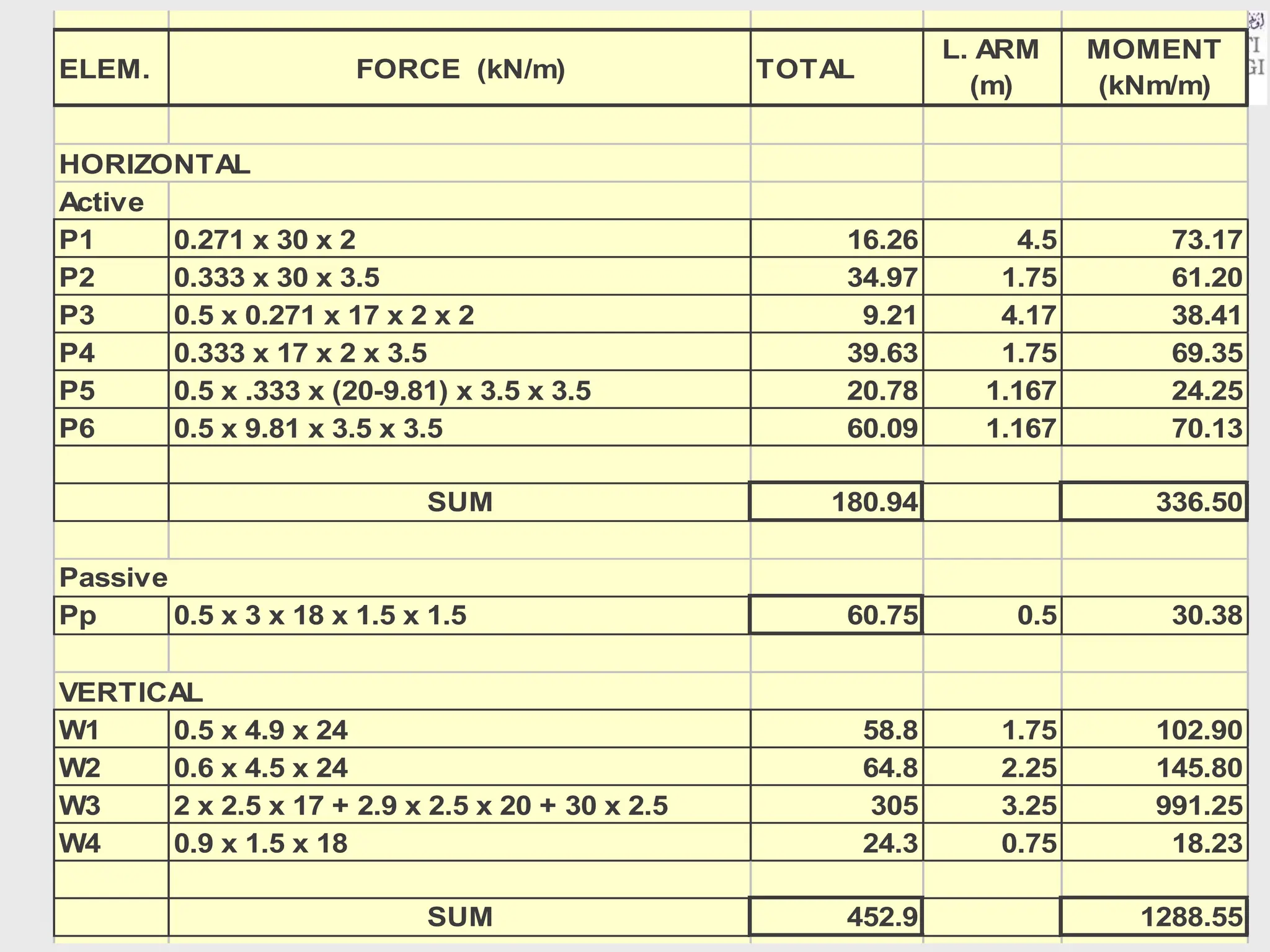
ELEM. FORCE (kN/m) TOTAL
L. ARM
(m)
MOMENT
(kNm/m)
HORIZONTAL
Active
P1 0.271 x 30 x 2 16.26 4.5 73.17
P2 0.333 x 30 x 3.5 34.97 1.75 61.20
P3 0.5 x 0.271 x 17 x 2 x 2 9.21 4.17 38.41
P4 0.333 x 17 x 2 x 3.5 39.63 1.75 69.35
P5 0.5 x .333 x (20-9.81) x 3.5 x 3.5 20.78 1.167 24.25
P6 0.5 x 9.81 x 3.5 x 3.5 60.09 1.167 70.13
SUM 180.94 336.50
Passive
Pp 0.5 x 3 x 18 x 1.5 x 1.5 60.75 0.5 30.38
VERTICAL
W1 0.5 x 4.9 x 24 58.8 1.75 102.90
W2 0.6 x 4.5 x 24 64.8 2.25 145.80
W3 2 x 2.5 x 17 + 2.9 x 2.5 x 20 + 30 x 2.5 305 3.25 991.25
W4 0.9 x 1.5 x 18 24.3 0.75 18.23
SUM 452.9 1288.55
LATERAL EARTH PRESSURE
Stability Analysis
OK
is
it
thus
2.5,
moment
Disturbing
moment
Resisting



 83
.
3
50
.
336
55
.
1288
FOS
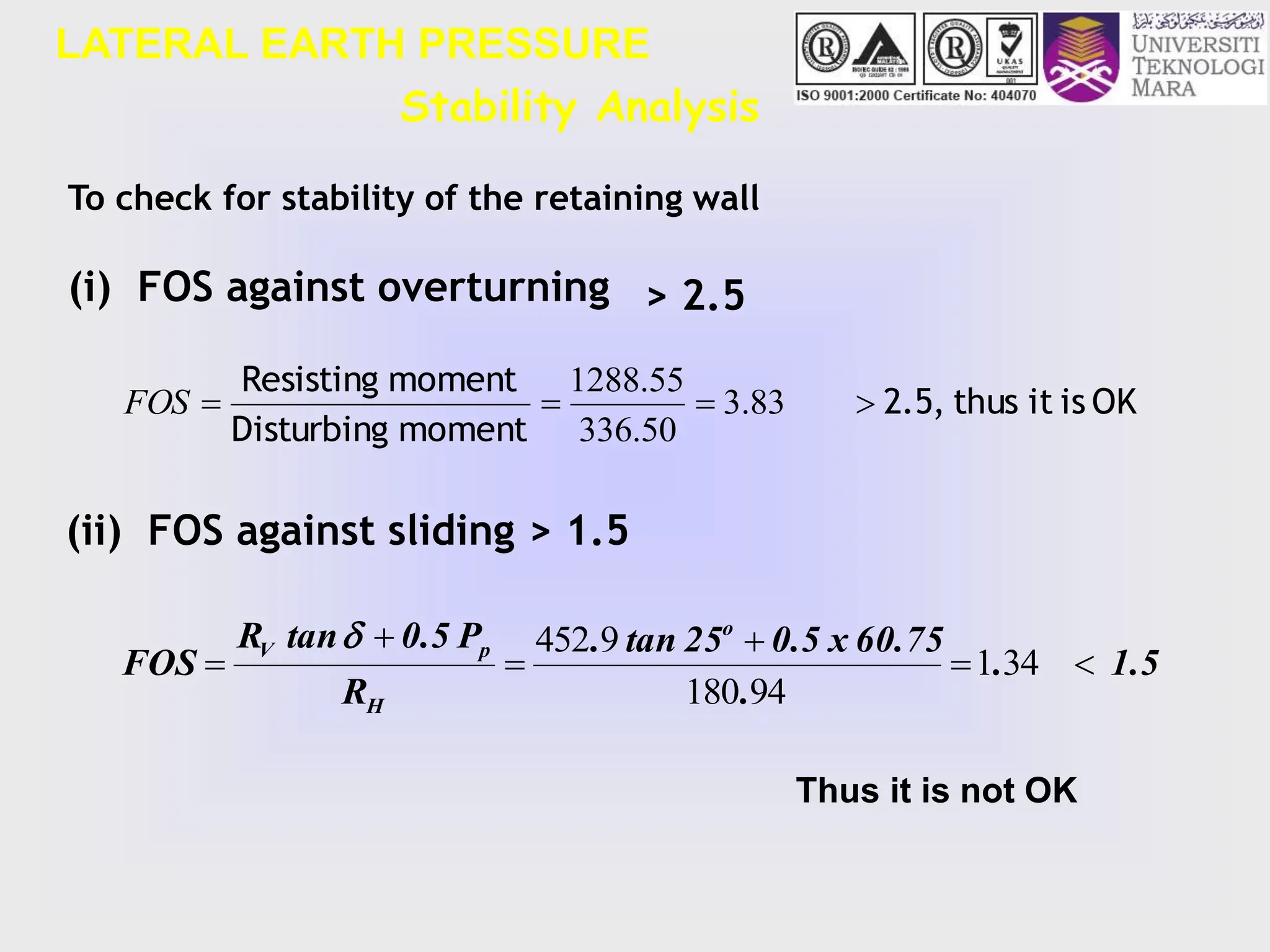
To check for stability of the retaining wall
(i) FOS against overturning > 2.5
(ii) FOS against sliding > 1.5
1.5
.
.
60.75
x
0.5
25
tan
.
R
P
0.5
tan
R
FOS
o
H
p
V





 34
1
94
180
9
452

Thus it is not OK
LATERAL EARTH PRESSURE
Stability Analysis








B
6e
B
R
q V
b 1
2.10
452.9
336.5
-
1288.55
R
Moment
x
V




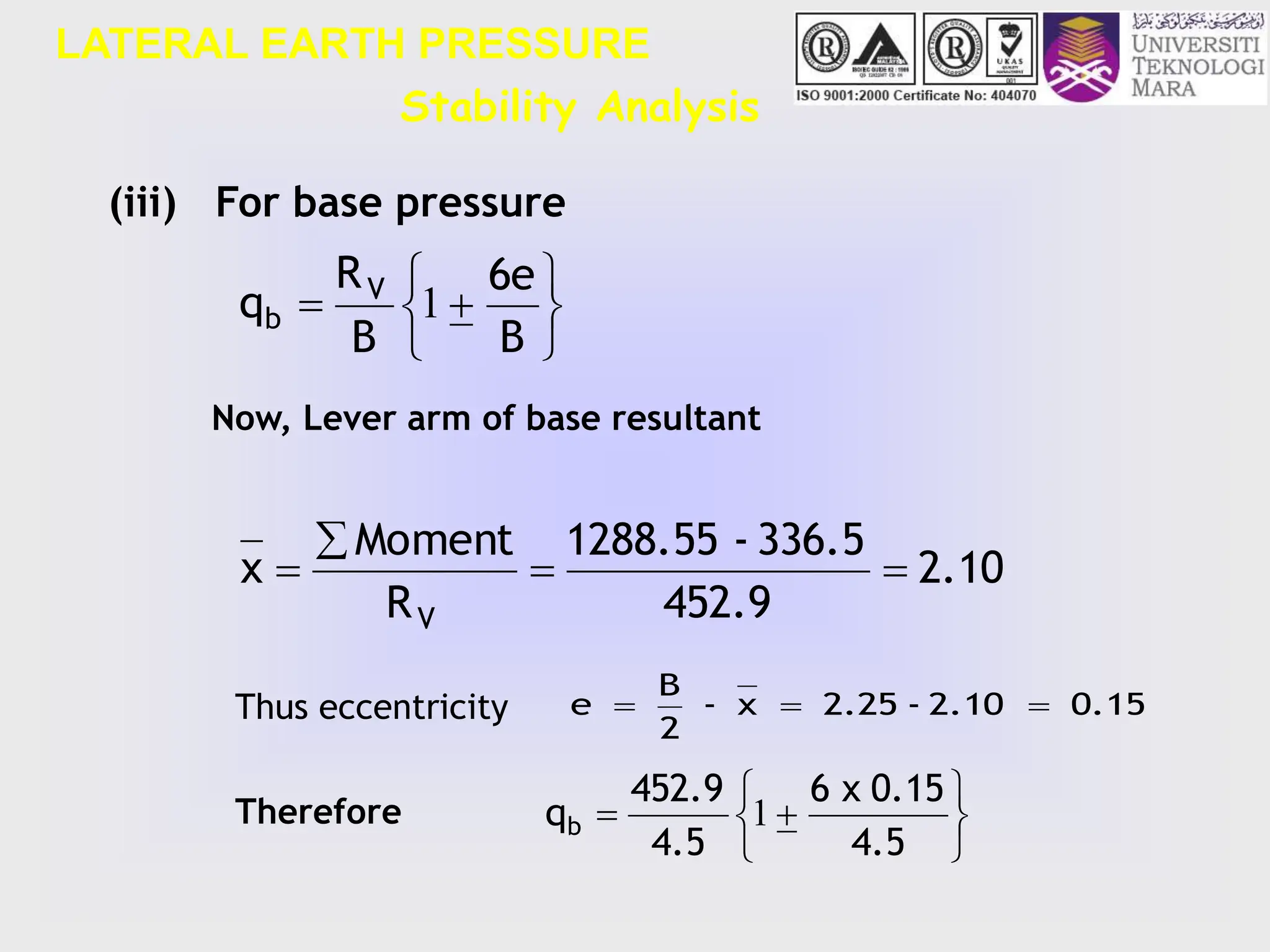
(iii) For base pressure
Now, Lever arm of base resultant
0.15
2.10
-
2.25
x
-
2
B
e 










4.5
0.15
x
6
4.5
452.9
qb 1
Thus eccentricity
Therefore
Stability Analysis
LATERAL EARTH PRESSURE
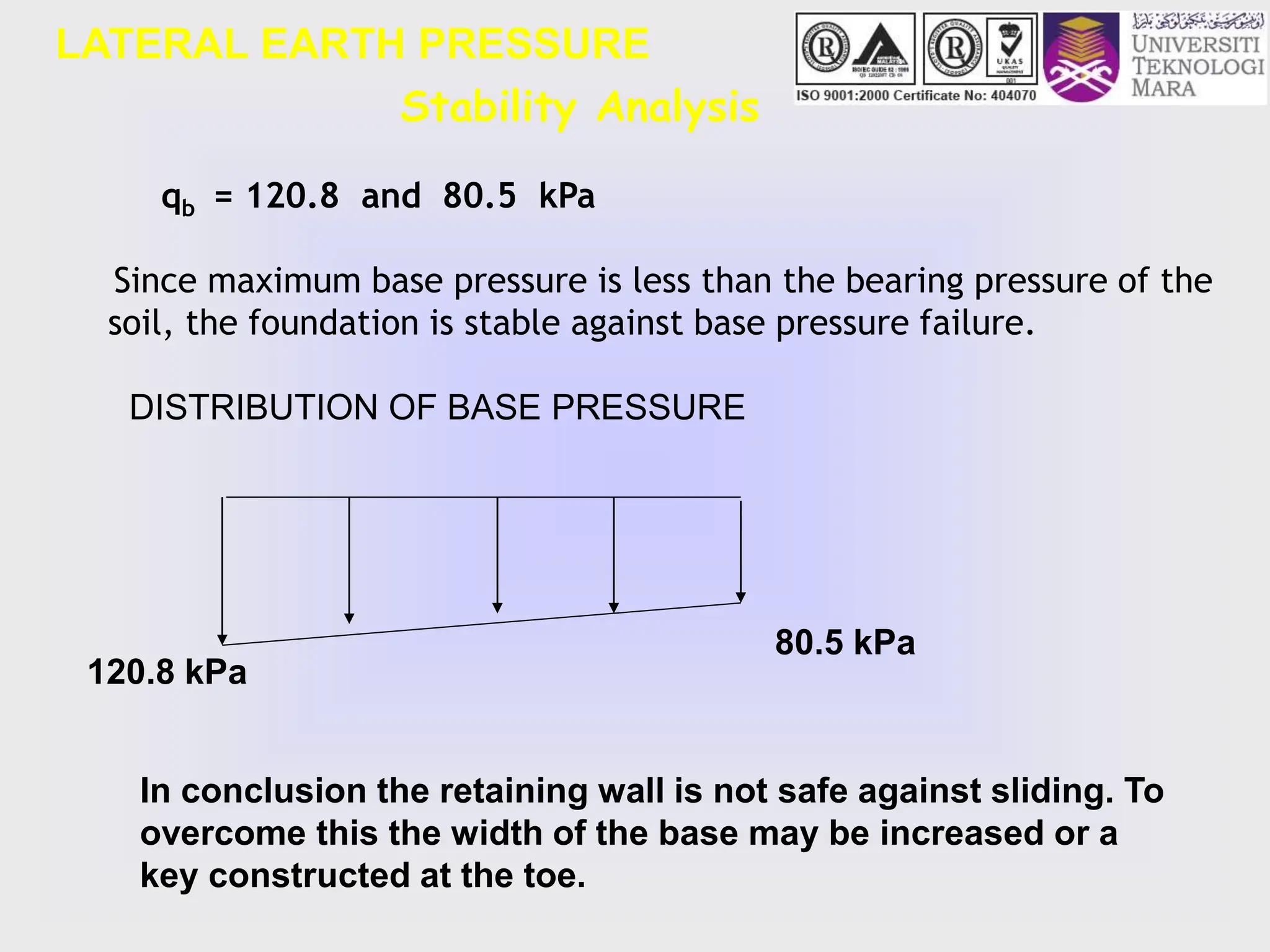
qb = 120.8 and 80.5 kPa
Since maximum base pressure is less than the bearing pressure of the
soil, the foundation is stable against base pressure failure.
DISTRIBUTION OF BASE PRESSURE
80.5 kPa
120.8 kPa
In conclusion the retaining wall is not safe against sliding. To
overcome this the width of the base may be increased or a
key constructed at the toe.
Group assignment NO. 1:
Form a group of 6 members in each group. Your task is to
write up a case study which involve a dam case failure in
Malaysia and a slope failure in Malaysia. Your report shall
consists of the history of each case, as examples;
amount of dam in Malaysia, their purpose, operation, etc.
Make sure your case study are not the same as others
groups. Penalties will be given accordingly for those who
ignore the warnings.
Date of submission :
Group assignment NO. 2:
Form a group of 6 members in each group. Your task is to
write up a case study which involve a ground
improvement technique. Your shall selected a real project
which will consists of real soil problems and technique to
overcome the problems.
Make sure your case study are not the same as others
groups. Penalties will be given accordingly for those who
ignore the warnings.
Date of submission :

ecg503-week-7-lecture-note-chp3.ppt

  • 1.
    GEOTECHNICAL ENGINEERING ECG 503 LECTURENOTE 07 TOPIC : 3.0 ANALYSIS AND DESIGN OF RETAINING STRUCTURES
  • 2.
    LEARNING OUTCOMES Learning outcomes: Atthe end of this lecture/week the students would be able to:  Understand natural slope and made engineered soil slope assessment which include rainfall induced failure and role of suction.
  • 3.
    TOPIC TO BECOVERED  Types of Retaining Structures  Sheet Pile Wall – Cantilever and Anchored Sheet Pile
  • 4.
    LATERAL EARTH PRESSURE Introduction& Overview 2.1 Introduction and overview Retaining structures such as retaining walls, basement walls, and bulkheads are commonly encountered in foundation engineering, and they may support slopes of earth mass. Proper design and construction of these structures require a thorough knowledge of the lateral forces that act between the retaining structures and the soil mass being retained.
  • 5.
    • Retaining wallsare used to prevent the retained material from assuming its natural slope. Wall structures are commonly use to support earth are piles. Retaining walls may be classified according to how they produce stability as reinforced earth, gravity wall, cantilever wall and anchored wall. At present, the reinforced earth structure is the most used particularly for roadwork
  • 6.
    3 basic componentsof retaining structure • Facing unit – not necessary but usually used to maintain appearance and avoid soil erosion between the reinforces. • Reinforcement – strips or rods of metal, strips or sheets of geotextiles, wire grids, or chain link fence or geogrids fastened to the facing unit and extending into the backfill some distance. • The earth fill – usually select granular material with than 15% passing the no. 200 sieve.
  • 7.
  • 8.
    Types of RetainingWall Retaining Wall Gravity Walls Embedded walls Reinforced and anchored earth The various types of earth-retaining structures fall into three broad groups. EARTH RETAINING STRUCTURES
  • 9.
    Gravity Walls Gravity Walls Masonrywalls Gabion walls Crib walls RC walls Counterfort walls Buttressed walls EARTH RETAINING STRUCTURES
  • 10.
    Gravity Walls Unreinforced masonrywall EARTH RETAINING STRUCTURES
  • 11.
    Gravity Walls Gabion wall EARTHRETAINING STRUCTURES
  • 12.
    Gravity Walls Crib wall EARTHRETAINING STRUCTURES
  • 13.
    Gravity Walls Types ofRC Gravity Walls EARTH RETAINING STRUCTURES
  • 14.
    Embedded Walls Embedded walls Drivensheet-pile walls Braced or propped walls Contiguous bored-pile walls Secant bored-pile walls Diaphram walls EARTH RETAINING STRUCTURES
  • 15.
    Embedded Walls Types ofembedded walls EARTH RETAINING STRUCTURES
  • 16.
    Reinforced and AnchoredEarth Reinforced and anchored earth Reinforced earth wall Soil nailing Ground anchors EARTH RETAINING STRUCTURES
  • 17.
    Reinforced and anchoredearth Reinforced earth and soil nailing EARTH RETAINING STRUCTURES
  • 20.
    Stability Criteria Stability ofRigid Walls Failures of the rigid gravity wall may occur due to any of the followings:  Overturning failure  Sliding failure  Bearing capacity failure  Tension failure in joints  Rotational slip failure In designing the structures at least the first three of the design criteria must be analysed and satisfied. EARTH RETAINING STRUCTURES
  • 21.
    LATERAL EARTH PRESSURE Typesof Lateral Pressure Hydrostatic Pressure and Lateral Thrust Earth Pressure at Rest Active Earth Pressure Passive Earth pressure States of Equilibrium
  • 22.
    LATERAL EARTH PRESSURE Typesof Lateral Pressure Hydrostatic pressure and lateral thrust Horizontal pressure due to a liquid
  • 23.
    LATERAL EARTH PRESSURE EarthPressure at Rest Earth pressure at rest Earth pressure at rest z σv σh = Ko σv A B If wall AB remains static – soil mass will be in a state of elastic equilibrium – horizontal strain is zero. Ratio of horizontal stress to vertical stress is called coefficient of earth pressure at rest, Ko, or v h o K    z K K o v o h      Unit weight of soil = γ    tan c f  
  • 24.
    LATERAL EARTH PRESSURE Earthpressure at rest .. cont. Earth Pressure at Rest
  • 25.
    LATERAL EARTH PRESSURE ActiveEarth Pressure Active earth pressure Earth pressure at rest z σv σh A B Plastic equilibrium in soil refers to the condition where every point in a soil mass is on the verge of failure. If wall AB is allowed to move away from the soil mass gradually, horizontal stress will decrease. This is represented by Mohr’s circle in the subsequent slide. Unit weight of soil = γ    tan c f  
  • 26.
    ACTIVE EARTH PRESSURE(RANKINE’S) (in simple stress field for c=0 soil) – Fig. 1 σX = Ko σz σz σz Ko σz σx’A ø
  • 28.
    LATERAL EARTH PRESSURE Basedon the diagram : pressure earth active s Rankine' of t coefficien Ratio v a    a K  (Ka is the ratio of the effective stresses) Therefore :      sin 1 sin - 1 ) 2 (45 - tan K 2 v a a     It can be shown that : a a 2 a K 2c - K z ) 2 (45 - tan 2c - ) 2 (45 - tan z        Active Earth Pressure
  • 29.
    LATERAL EARTH PRESSURE a aK 2c - K z  z zo a K 2c - Active pressure distribution Active Earth Pressure a K 2c - K z a 
  • 30.
    LATERAL EARTH PRESSURE Activepressure distribution Active Earth Pressure Based on the previous slide, using similar triangles show that : a o K c z  2  where zo is depth of tension crack For pure cohesive soil, i.e. when  = 0 :  c zo 2 
  • 31.
    LATERAL EARTH PRESSURE Forcohesionless soil, c = 0 a a v a K z K      z Active pressure distribution Active Earth Pressure K z a 
  • 32.
    LATERAL EARTH PRESSURE PassiveEarth Pressure 2.2.4 Passive earth pressure Earth pressure at rest z σv σh A B If the wall is pushed into the soil mass, the principal stress σh will increase. On the verge of failure the stress condition on the soil element can be expressed by Mohr’s circle b. The lateral earth pressure, σp, which is the major principal stress, is called Rankine’s passive earth pressure Unit weight of soil = γ    tan c f  
  • 33.
    PASSIVE EARTH PRESSURE(RANKINE’S) (in simple stress field for c=0 soil) – Fig. 2 σX = Ko σz σz σz Ko σz σx’P ø
  • 35.
    LATERAL EARTH PRESSURE Shear stress Normalstress    tan c f   C D D’ O A σp Koσv b a σv   c Mohr’s circle representing Rankine’s passive state. Passive Earth Pressure
  • 36.
    LATERAL EARTH PRESSURE Forcohesionless soil : Referring to previous slide, it can be shown that : Passive Earth Pressure p p 2 v p K 2c K z ) 2 (45 tan 2c ) 2 (45 tan                 sin 1 sin 1 ) 2 (45 tan K 2 p v p      
  • 37.
    LATERAL EARTH PRESSURE Forcohesionless soil, Passive pressure distribution Passive Earth Pressure z K z p  p K 2c p p v p K z K     
  • 38.
    LATERAL EARTH PRESSURE Inconclusion Earth Pressure Wall tilt Passive pressure At-rest pressure Active pressure Earth Pressure Wall tilt
  • 39.
    LATERAL EARTH PRESSURE Typesof Lateral Pressure Rankine’s Theory Assumptions :  Vertical frictionless wall  Dry homogeneous soil  Horizontal surface  Initial work done in 1857  Develop based on semi infinite “loose granular” soil mass for which the soil movement is uniform.  Used stress states of soil mass to determine lateral pressures on a frictionless wall
  • 40.
    LATERAL EARTH PRESSURE Typesof Lateral Pressure Active pressure for cohesionless soil
  • 41.
    LATERAL EARTH PRESSURE Typesof Lateral Pressure Effect of a stratified soil Effect of surcharge
  • 42.
    LATERAL EARTH PRESSURE Typesof Lateral Pressure Effect of sloping surface
  • 43.
    LATERAL EARTH PRESSURE Typesof Lateral Pressure Active pressure, Passive pressure,    cos ' ' v a ha K     cos ' ' v p hp K  where ) ' cos - (cos cos ) ' os c - (cos - cos 2 2 2 2         a K a 2 2 2 2 p 1 ) ' cos - (cos cos ) ' os c - (cos cos K K           and
  • 44.
    LATERAL EARTH PRESSURE Typesof Lateral Pressure Tension cracks in cohesive soils
  • 45.
    LATERAL EARTH PRESSURE Typesof Lateral Pressure Effect of surcharge (undrained)
  • 46.
    LATERAL EARTH PRESSURE Typesof Lateral Pressure Passive resistance in undrained clay
  • 47.
    LATERAL EARTH PRESSURE Thestability of the retaining wall should be checked against : (ii) FOS against sliding (recommended FOS = 2.0) (i) FOS against overturning (recommended FOS = 2.0) Stability Criteria moment Disturbing moment Resisting FOS  H w p V R B c P 0.7) - (0.5 tan R FOS    
  • 48.
    LATERAL EARTH PRESSURE StabilityAnalysis Pp Ph ∑ V A The stability of the retaining wall should be checked against : 2.3.1 FOS against overturning (recommended FOS = 2.0) moment Disturbing moment Resisting FOS  .. overturning about A
  • 49.
    LATERAL EARTH PRESSURE 2.3.2FOS against sliding (recommended FOS = 2.0) Stability Criteria H w p V R B c P 0.7) - (0.5 tan R FOS     Ph ∑ V Pp Friction & wall base adhesion
  • 50.
    LATERAL EARTH PRESSURE         B 6e B R qV b 1 2.3.3 For base pressure (to be compared against the bearing capacity of the founding soil. Recommended FOS = 3.0) Now, Lever arm of base resultant Thus eccentricity R Moment x V   x - 2 B e  Stability Criteria
  • 51.
    LATERAL EARTH PRESSURE StabilityAnalysis Pp Ph ∑ V Base pressure on the founding soil
  • 52.
    Stability Analysis LATERAL EARTHPRESSURE Figure below shows the cross-section of a reinforced concrete retaining structure. The retained soil behind the structure and the soil in front of it are cohesionless and has the following properties: SOIL 1 : u = 35o, d = 17 kN/m3, SOIL 2 : u = 30o,  = 25o , d = 18 kN/m3, sat = 20 kN/m3 The unit weight of concrete is 24 kN/m3. Taking into account the passive resistance in front of the wall, determine a minimum value for the width of the wall to satisfy the following design criteria: Factor of safety against overturning > 2.5 Factor of safety against sliding > 1.5 Maximum base pressure should not exceed 150 kPa Worked example :
  • 53.
    Stability Analysis LATERAL EARTHPRESSURE SOIL 2 2.0 m 0.5 m 0.6 m 2.9 m 2.0 m GWT 4.5 m SOIL 1 SOIL 2 30 kN/m2 4.0 m THE PROBLEM
  • 54.
    LATERAL EARTH PRESSURE StabilityAnalysis P1 P3 SOIL 2 2.0 m 0.5 m 0.6 m 2.9 m 2.0 m GWT 4.5 m SOIL 1 SOIL 2 30 kN/m2 4.0 m P2 P4 PP W41 W3 W2 W1 P5 THE SOLUTION P6
  • 55.
    LATERAL EARTH PRESSURE StabilityAnalysis 271 . 0 35 sin 1 35 sin - 1 sin 1 sin 1 o o 1         a K 333 . 0 30 sin 1 30 sin - 1 sin 1 sin 1 o o 2         a K 00 . 3 30 sin 1 30 sin 1 sin 1 sin 1 o o 2          p K Determination of the Earth Pressure Coefficients
  • 56.
    LATERAL EARTH PRESSURE StabilityAnalysis ELEM. FORCE (kN/m) TOTAL L. ARM (m) MOMENT (kNm/m) HORIZONTAL Active P1 0.271 x 30 x 2 16.26 4.5 73.17 P2 0.333 x 30 x 3.5 34.97 1.75 61.20 P3 0.5 x 0.271 x 17 x 2 x 2 9.21 4.17 38.41 P4 0.333 x 17 x 2 x 3.5 39.63 1.75 69.35 P5 0.5 x .333 x (20-9.81) x 3.5 x 3.5 20.78 1.167 24.25 P6 0.5 x 9.81 x 3.5 x 3.5 60.09 1.167 70.13 SUM 180.94 336.50 Passive Pp 0.5 x 3 x 18 x 1.5 x 1.5 60.75 0.5 30.38 VERTICAL W1 0.5 x 4.9 x 24 58.8 1.75 102.90 W2 0.6 x 4.5 x 24 64.8 2.25 145.80 W3 2 x 2.5 x 17 + 2.9 x 2.5 x 20 + 30 x 2.5 305 3.25 991.25 W4 0.9 x 1.5 x 18 24.3 0.75 18.23 SUM 452.9 1288.55
  • 57.
    LATERAL EARTH PRESSURE StabilityAnalysis OK is it thus 2.5, moment Disturbing moment Resisting     83 . 3 50 . 336 55 . 1288 FOS To check for stability of the retaining wall (i) FOS against overturning > 2.5 (ii) FOS against sliding > 1.5 1.5 . . 60.75 x 0.5 25 tan . R P 0.5 tan R FOS o H p V       34 1 94 180 9 452  Thus it is not OK
  • 58.
    LATERAL EARTH PRESSURE StabilityAnalysis         B 6e B R q V b 1 2.10 452.9 336.5 - 1288.55 R Moment x V     (iii) For base pressure Now, Lever arm of base resultant 0.15 2.10 - 2.25 x - 2 B e            4.5 0.15 x 6 4.5 452.9 qb 1 Thus eccentricity Therefore
  • 59.
    Stability Analysis LATERAL EARTHPRESSURE qb = 120.8 and 80.5 kPa Since maximum base pressure is less than the bearing pressure of the soil, the foundation is stable against base pressure failure. DISTRIBUTION OF BASE PRESSURE 80.5 kPa 120.8 kPa In conclusion the retaining wall is not safe against sliding. To overcome this the width of the base may be increased or a key constructed at the toe.
  • 60.
    Group assignment NO.1: Form a group of 6 members in each group. Your task is to write up a case study which involve a dam case failure in Malaysia and a slope failure in Malaysia. Your report shall consists of the history of each case, as examples; amount of dam in Malaysia, their purpose, operation, etc. Make sure your case study are not the same as others groups. Penalties will be given accordingly for those who ignore the warnings. Date of submission :
  • 61.
    Group assignment NO.2: Form a group of 6 members in each group. Your task is to write up a case study which involve a ground improvement technique. Your shall selected a real project which will consists of real soil problems and technique to overcome the problems. Make sure your case study are not the same as others groups. Penalties will be given accordingly for those who ignore the warnings. Date of submission :