http://www.iaeme.com/IJCIET/index.asp 873 editor@iaeme.com
International Journal of Civil Engineering and Technology (IJCIET)
Volume 8, Issue 1, January 2017, pp. 873–881 Article ID: IJCIET_08_01_103
Available online at http://www.iaeme.com/IJCIET/issues.asp?JType=IJCIET&VType=8&IType=1
ISSN Print: 0976-6308 and ISSN Online: 0976-6316
© IAEME Publication Scopus Indexed
OPTIMUM DESIGN OF SEMI-GRAVITY RETAINING
WALL SUBJECTED TO STATIC AND SEISMIC
LOADS
Abdul-Hassan K. Al-Shukur
PhD., Professor, Department of Civil Engineering, College of Engineering,
University of Babylon, Babylon, Iraq
Ayaat Majid Abbas Al-Rammahi
M.Sc. Postgraduate Student, Department of Civil Engineering, College of Engineering,
University of Babylon, Babylon, Iraq
ABSTRACT
A 2D (Plain strain) wall‒backfill‒foundation interaction is modeled using finite element
method by ANSYS to find the optimum design based on the principle of soil-structure
interactions analyses. A semi-gravity retaining wall subjected to static and seismic loads has
been considered in this research. Seismic records which are obtained from the records of Iraq
for the period 1900-1988. The optimization process is simulated by ANSYS /APDL language
programming depending on the available optimization commands. The objective function of
optimization process OBJ is to minimize the cross-sectional area of the retaining wall. The
results showed that the optimum design method via ANSYS is a successful strategy prompts to
optimum values of cross‒sectional area with both safety and stability factors as compared with
other optimum design methods. Also, the results showed that the area of optimum section by
ANSYS method is lesser than the section area of the GAs algorithm , PSO, and CSS methods by
percentages are equal to	15.04%, 23.92%, and 25.33%; respectively, when
3.Additionally, from studying the effect of some parameters such as Compressive Strength of
Concrete ( ´ ) and Yielding Strength of Steel ( 	 on cross-sectional area and reinforced
area, is provided that the ( ´ ) and have small effect or do not effect on the value of cross-
sectional area ( ) and this is due to the lack of weight ratio of steel reinforcement to concrete
weight. Moreover, the yielding strength of steel has larger effect than compressive strength of
concrete in the reinforcement area.
Key words: Semi-Gravity Retaining Wall, Optimal Design, ANSYS Parametric Design Language
(APDL), Soil-Structure-Interaction, seismic effect.
Cite this Article Abdul-Hassan K. Al-Shukur and Ayaat Majid Abbas Al-Rammahi, Optimum
Design of Semi-Gravity Retaining Wall Subjected to Static and Seismic Loads. International
Journal of Civil Engineering and Technology, 8(1), 2017, pp. 873–881.
http://www.iaeme.com/IJCIET/issues.asp?JType=IJCIET&VType=8&IType=1
Optimum Design of Semi-Gravity Retaining Wall Subjected to Static and Seismic Loads
http://www.iaeme.com/IJCIET/index.asp 874 editor@iaeme.com
1. INTRODUCTION
Retaining wall is a very important kind of structure in civil engineering. As a typical representative of
the retaining wall, the gravity wall have been used as low-height retaining walls for both roadway cut
and fill application.
Gravity wall are rigid type walls that rely entirely on their self-weight to resist overturning and
sliding, and are generally proportioned to avoid any tensile stresses within the structure. In many
cases, a small amount of steel may be used for the construction of gravity walls, thereby minimizing
the size of wall sections. Such walls are generally referred to as semi gravity walls [1].
Semi- gravity walls are commonly used for earth retaining structure and bridge abutments in fill
situation. They can also be used in cut situation, but for such application temporary support system is
typically required. In addition to its own weight, this type of wall uses bending action to resist vertical
and lateral forces on the wall [2].
Conventional design of concrete retaining walls is highly dependent on the experience of
engineers. The structure is defined on a trial–and–error basis. Tentative design must satisfy the limit
states prescribed by concrete codes. This process leads to safe designs, but the cost of the concrete
retaining walls is, consequently, highly dependent upon the experience of the designer. Therefore, in
order to economize the cost of the concrete retaining walls under design constraints, it is advantageous
for designer to cast the problem as an optimization problem [3].
There are several general approaches to optimization including analytical methods, graphical
methods, experimental methods, and numerical methods. Analytical methods are based on the
classical techniques of differential calculus and cannot be applied to highly nonlinear problems.
Graphical methods require a plot of the function to be maximized and minimized. However, the
number of independent variables does not exceed two. Experimental methods use a setup and change
variables while the performance criterion is measured directly in each case. Numerical methods can be
used to solve highly complex optimization problems of the type that cannot be solved analytically. The
discipline encompassing the theory and practice of these methods has come to be known as
mathematical programming techniques [4]. The branches of mathematical programing are linear
programing, quadratic programing, nonlinear programing, dynamic programing, Modern optimization
techniques, etc. The modern optimization methods, also sometimes called nontraditional optimization
methods. These methods include genetic algorithms, simulated annealing, particle swarm
optimization, ant colony optimization, neural network-based optimization, and fuzzy optimization [5].
The seismic response of retaining systems is still a matter of ongoing experimental, analytical and
numerical research. The dynamic interaction between a wall and a retained and foundation soils make
the response complicated. The dynamic analysis becomes much more complex, as usually material
and/or geometry non-linearities have to be taken into account [6, 7].
In this paper, the optimum design of semi-gravity retaining wall including soil-structure-
interaction due to seismic load will be investigated.
In order to achieve the aim above, the paper is organized as follows: Section II describes the
numerical modeling of problem by finite element software ANSYS which include simulate wall-
backfill-foundation problem and all caverning equations related with soil-structure interactions. The
formulation optimization problem is distributed in two sections, namely Sections III and VI, to
describe the formulation of optimization problem by ANSYS and applied of different loads,
respectively. The numerical applications and discussions are presented in Section V. Finally, Section
IV presents conclusions.
Abdul-Hassan K. Al-Shukur and Ayaat Majid Abbas Al-Rammahi
http://www.iaeme.com/IJCIET/index.asp 875 editor@iaeme.com
2. NUMERICAL MODELING OF PROBLEM BY FINITE ELEMENT ANSYS
PROGRAMING
In this section the numerical model used to simulate the dynamic response of a semi-gravity retaining
wall based on principle of soil‒structure interaction.
2.1. Soil-Structure interaction
The discretized structural dynamic equation including the structure and soil subject to ground motion
can be formulated using the finite‒element approach as [8]
! (1)
Where: , and are represent the system relative displacements, velocity and acceleration
vectors with respect to base, respectively; ,	 and are represent the system mass, damping and
stiffness matrix respectively, and term ! represent the horizontal component of ground acceleration.
A four‒nodes PLANE 42 element (structural 2D solids) plain strain, shown in Fig. 1 which
available in ANSYS is used for both wall body and the soil of foundation and backfill modeling.
Figure 1 PLANE42 Element Geometry [9]
Also, the interface of the soil‒structure interaction problem can be discretize by making
NUMMRGE command for all nodes and elements on the contact surfaces ( interaction planes ) or by
CONTA172 and TARGE 169 elements, shown in Fig. 2 and Fig.2 which making a SURF between
them[9].
Figure 2 CONTA172 Geometry [9]
Figure 3 TARGE 169 Geometry [9]
Optimum Design of Semi-Gravity Retaining Wall Subjected to Static and Seismic Loads
http://www.iaeme.com/IJCIET/index.asp 876 editor@iaeme.com
3. FORMULATION OF THE OPTIMIZATION PROBLEM
The scheme of the practical section of semi-gravity retaining wall with boundary condition of backfill
and foundation that will be optimized by ANSYS can be given in Fig. 4
Figure 4 Scheme of Optimized of Semi-Gravity Wall Model by ANSYS
In this section the optimization problem to be solved is explained in detail. The design variables,
the parameters, the constraints, the objective function and the optimum design process are presented.
3.1. Design Variables
The design variables of the problem are shown in Fig. 5. These are the width of the toe denoted
by ",the width of the front butters denoted by #,the top width of wall denoted by $, the width of the
back butters denoted by &, the width of the heel denoted by ', the thickness of the base denoted by
(, steel reinforcement required to resist moment at toe slab ) and steel reinforcement at heel *.
3.2. State Variables (Constraints)
The stability of the retaining wall include different modes of failure as [1], structural, overturning,
sliding, and deep-seated sheet failure.
The factors of safety that should be realized for stability and safety of optimization process could
be given as:
• Against overturning, +, =
-./0/1231 4,4.31
5-0603! 4,4.31
=
∑ 89
∑ 8:
≥ 2 (2)
• Against sliding, +/ =
-./0/1231 ;,- .
<=>?@=ABCD E>?FGA H=>IGJ
=
∑ K9
∑ K:
≥ 1.5 under static loads . (3)
≥ 1.125 under static and seismic loads
• Against bearing capacity of soil, +L =
MNOP
MQRS
≥ 3 under static loads (4)
≥ 1.5 under static and seismic loads
Where:TUV = W / 5 0X + TWM M/ M5 M0XM +
"
#
Y/#Z´W[ [/ [5 [0X[is Meyerhof's ultimate
bearing capacity, [15]; B′= (B-2e),and e is the eccentricity; T = Y/;. ;; /, M/, [/ are shape
factors; 5 , M5 , [5 are depth factors; 0 , M0 , [0 are inclination factors;W ,WM , W[ are baring
capacity factors;X ,XM, X[ are the seismic factors; T42] =
^
L
_1 +
(.
L
`.
Abdul-Hassan K. Al-Shukur and Ayaat Majid Abbas Al-Rammahi
http://www.iaeme.com/IJCIET/index.asp 877 editor@iaeme.com
• The tension crack should be avoided. The resultant force must passes through middle third of the dam
width i.e. X ≤
L
(
Against eccentricity; +. =
L
(.
≥ 1 (5)
• The heel and toe slabs of semi-gravity wall must be adequate to resist shear forces and flexure bending
moment.
Against shear failure of toe slab, +1/ =
^b
^UPcd
≥ 1 (6)
Against heel shear failure, +f/ =
^b
^UgddO
≥ 1 (7)
Against bending moment failure of toe slab, +14 =
8h
8UPcd
≥ 1 (8)
Against heel bending failure, +f4 =
8h
8UgddO
≥ 1 (9)
Where:i = 0.17kl ´ mn ois nominal shear strength, ´ is a compressive strength of
concrete, mn is a unit width, and o is effective depth [10]; - = pq/ _o −
2
#
`is a factored flexural
resistance, p is a flexural resistance factor equal to 0.9, q/is the area of flexural steel reinforcement,
is the yielding strength of steel reinforcement,o is the effective depth from extreme compression fiber
to the centroid of the tensile force in the tensile reinforcement,r =
st;u
v.*';´b
, m is a width of the
section, ´ is a concrete compressive strength [11].
3.3. Objective Function
An objective function is a mathematical expression that should be maximized or minimized in certain
conditions and chosen as the volume, cost, weight, etc. in structural engineering [12]. The aim of this
optimization problem is to minimize the cross-section of the wall so area of the wall is considered as
OBJ.
=
"
#
w# + 2w$ + w& × y − w( + Z ∗ w( (10)
Where:Z = w" + w# + w$ + w& + w'
3.4. Optimization Method
The ANSYS optimization procedure offers a few methods and tools that in different ways attempt to
address the mathematical problems. In this research, the zero-order optimization method is applied to
minimized the objective function.
In this method, it will be shown that the constrained problem will transform into an unconstrained
one that is eventually minimized [9]. The OBJ is written as:
Minimize f = f(X) (11)
Where: f(X) is the function of variables design.
4. LOADS OF OPTIMIZATION PROBLEM
In the design of concrete gravity retaining wall, it is essential to determine the loads required in the
stability and stress analyses which are weight of wall (dead load or stabilizing force), lateral earth
pressure (static and dynamic), surcharge load (live traffic load), earthquake forces (inertia forces) , and
seismic load (ground motion excitation) .The forces of wind waves, silt, and Ice are ignored in this
research.
Optimum Design of Semi-Gravity Retaining Wall Subjected to Static and Seismic Loads
http://www.iaeme.com/IJCIET/index.asp 878 editor@iaeme.com
The seismic load is concerned according to the records of earthquake of Iraq for the period 1900-1988
which are the 1031 events ranging magnitudes between 3.0-7.4 on Richter scale.
5. NUMERICAL APPLICATION AND VERIFICATION OF OPTIMIZATION
PROCESS
Several physical and mechanical properties of the walls and soils are assigned to the functions of the
optimization problem in order to obtain the optimum cross-section of these situations. The assigned
parameters corresponding to the optimization problem are given in table 1
Table 1 The Values of Design Parameters of Retaining Wall.
No. Input Parameters Sy. Unit Value
1 Height H m 5.7
2 Surcharge q KN/m2
0
3 Unit weight of back fill soil γ s1 KN/m3
16
4 Unit weight of foundation soil γ s2 kN/m3
18.5
5 Internal friction of back fill soil ∅" degree 30
6 Internal friction of foundation soil ∅# degree 38
7 Cohesion of foundation soil C Kpa 0
8 Inclination of back fill slope α degree 0
9 Wall soil angle friction δ degree 15
10 Unit weight of concrete γc kN/m3
24
11 Specified compressive strength of concrete ´ Mpa 20
12 Specified yield strength of reinforcement Mpa 400
13 Horizontal seismic coefficient kh - 0.35
14 Safety factor of sliding +/ - 1.2
15 Safety factor of overturning +, - 2
16 Safety factor of Bering capacity + - 1.5*
3**
17 Safety factor of eccentricity +. - 1
*safety factor for seismic bearing capacity
** safety factor for static bearing capacity
An example is optimized with the Zero-Order method by ANSYS. The final result is compared to
the solution of the Genetic Algorithm Method (GAs) in example [13], Charged System Search (CSS),
the particle swarm optimization (PSO) methods in example [14] to demonstrate the efficiency of the
present approach and the results of the seismic design optimization process for the Zero-order
(subproblem) method and other methods are summarized in Table 2.
Abdul-Hassan K. Al-Shukur and Ayaat Majid Abbas Al-Rammahi
http://www.iaeme.com/IJCIET/index.asp 879 editor@iaeme.com
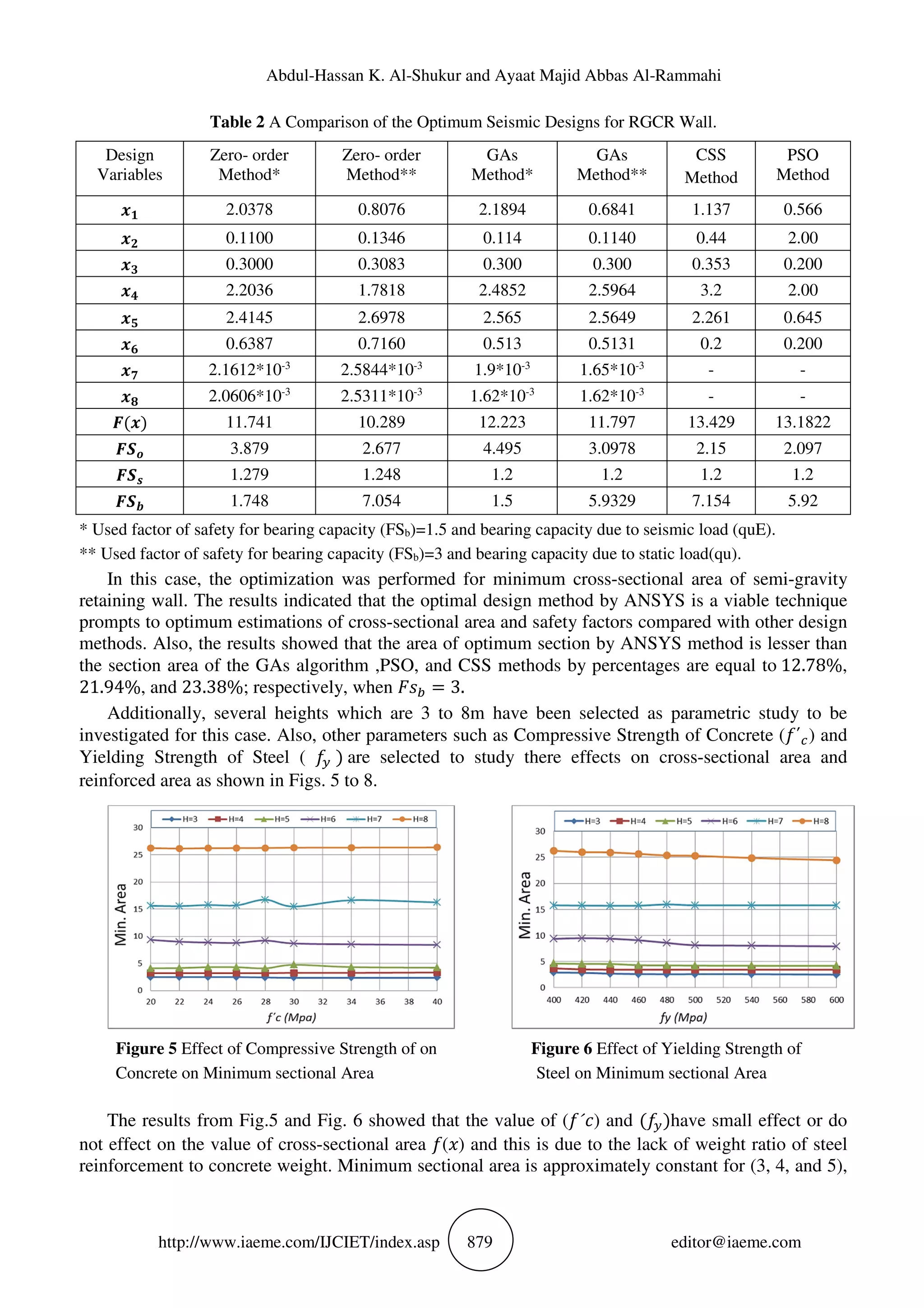
Table 2 A Comparison of the Optimum Seismic Designs for RGCR Wall.
Design
Variables
Zero- order
Method*
Zero- order
Method**
GAs
Method*
GAs
Method**
CSS
Method
PSO
Method
|} 2.0378 0.8076 2.1894 0.6841 1.137 0.566
|~ 0.1100 0.1346 0.114 0.1140 0.44 2.00
|• 0.3000 0.3083 0.300 0.300 0.353 0.200
|€ 2.2036 1.7818 2.4852 2.5964 3.2 2.00
|• 2.4145 2.6978 2.565 2.5649 2.261 0.645
|‚ 0.6387 0.7160 0.513 0.5131 0.2 0.200
|ƒ 2.1612*10-3
2.5844*10-3
1.9*10-3
1.65*10-3
- -
|„ 2.0606*10-3
2.5311*10-3
1.62*10-3
1.62*10-3
- -
… | 11.741 10.289 12.223 11.797 13.429 13.1822
…†‡ 3.879 2.677 4.495 3.0978 2.15 2.097
…†ˆ 1.279 1.248 1.2 1.2 1.2 1.2
…†‰ 1.748 7.054 1.5 5.9329 7.154 5.92
* Used factor of safety for bearing capacity (FSb)=1.5 and bearing capacity due to seismic load (quE).
** Used factor of safety for bearing capacity (FSb)=3 and bearing capacity due to static load(qu).
In this case, the optimization was performed for minimum cross-sectional area of semi-gravity
retaining wall. The results indicated that the optimal design method by ANSYS is a viable technique
prompts to optimum estimations of cross-sectional area and safety factors compared with other design
methods. Also, the results showed that the area of optimum section by ANSYS method is lesser than
the section area of the GAs algorithm ,PSO, and CSS methods by percentages are equal to	12.78%,
21.94%, and 23.38%; respectively, when 3.
Additionally, several heights which are 3 to 8m have been selected as parametric study to be
investigated for this case. Also, other parameters such as Compressive Strength of Concrete ( ´ ) and
Yielding Strength of Steel ( 	 	are selected to study there effects on cross-sectional area and
reinforced area as shown in Figs. 5 to 8.
Figure 5 Effect of Compressive Strength of on Figure 6 Effect of Yielding Strength of
Concrete on Minimum sectional Area Steel on Minimum sectional Area
The results from Fig.5 and Fig. 6 showed that the value of ( ´ ) and have small effect or do
not effect on the value of cross-sectional area ( ) and this is due to the lack of weight ratio of steel
reinforcement to concrete weight. Minimum sectional area is approximately constant for (3, 4, and 5),
Optimum Design of Semi-Gravity Retaining Wall Subjected to Static and Seismic Loads
http://www.iaeme.com/IJCIET/index.asp 880 editor@iaeme.com
while for y=6‹, the increment in ( ) value from 400 Mpa to 480 Mpa,which is equal to 20%,
decreases min. area to an amount of 8.14% .
Figure 7 Effect of Compressive Strength of Figure 8 Effect of the Yielding Strength of
Concrete on Reinforced Area Steel on Reinforced Area
From Fig. 7 and Fig. 8, It can be observed that the yielding strength of steel ( ) effects on the
quantity of reinforcement steel area of toe slab ( )) and heel slab ( *).The increment values of
yielding strength of steel ( ) lead to decrease the quantity of reinforcement. Also, the yielding
strength of steel ( Œ) has larger effect than compressive strength of concrete ( ´ ) in the reinforcement
area.
6. CONCLUTION
• The ANSYS / APDL are efficient tool to simulate wall-backfill-foundation interaction problem and
optimization process.
• Through the gathering of optimization module (/OPT) and APDL, the optimal reuse examination is
quick and the results are dependable and sensible.
• The optimum design method by ANSYS is a viable technique prompts to optimum values of
cross‒sectional area with both safety and stability factors as compared with other design methods.
• From design semi-gravity wall under static and seismic loads, it is preferred that the back buttress ( &)
be larger than front buttress ( #) 3 times or more for several reasons, it reduces the lateral earth pressure
and increases the weight of backfill soil on back buttress which leads to an increase in resistance forces
also.
• The yielding strength of steel ( Œ) has larger effect than compressive strength of concrete ( ´ ) in the
reinforcement area.
REFERENCES
[1] Das, B., M., 2011, “Principle of Foundation Engineering”, th7 Edition, Printed in the United States
of America.
[2] FHWA, Federal Highway Administration, 2004, “Seismic Retrofitting Manual for Highway
Structures: Part 2-Retaining Structures, Slopes, Tunnels, Culverts, and Roadways”, Report
No.FHWA-HRT-05-067, Federal Highway Administration, Washington, DC, August.
[3] R. Sheikholeslami, B. G. Khalili, A. Sadollah, and J. H. Kim, 2015 “Optimization Of Reinforced
Concrete Retaining Walls Via Hybrid Firefly Algorithm With Upper Bounded Strategy” KSCE
Journal of Civil Engineering.
Abdul-Hassan K. Al-Shukur and Ayaat Majid Abbas Al-Rammahi
http://www.iaeme.com/IJCIET/index.asp 881 editor@iaeme.com
[4] Erol Dsadoglu, 2014 “Optimization For Symmetrical Gravity Retaining Walls” Karadeniz
Technical University, Faculty of Engineering Trabzon, Turkey.
[5] Rao, S., 2009 "Engineering Optimization Theory and Practice", th4 Edition, John Wiley & Sons.
[6] S. Kramer,1996 “Geotechnical Earthquake Engineering”, Prentice Hall.
[7] G. Wu, W.D.L. Finn, 1999 “Seismic lateral pressures for design of rigid walls”. Canadian
Geotechnical Journal, 36(3), 509-522.
[8] M. Kutanis and M. Elmas, 2001 “Non Linear Seismic Soil Structure Interaction Analysis Based On
The Substructure Method In The Time Domaine“. Turk Journal Engineering Environ Sci25 pp 617-
626.
[9] ANSYS. ANSYS User’s Manual,2007 “ANSYS Theory Manual”. Version 11.0.
[10] American Concrete Institute, 2011, “Building Code Requirements for Structural Concrete (ACI
318M-11)”.
[11] American Association of State Highway and Transportation Official, 2012, “AASHTO LRFD
Bridge Design Specifications”, Washington, D.C.R. Sheikholeslami et al.
[12] Truman, K.Z., Hoback, A.S., 1992 “Optimization of steel piles under rigid slab foundations using
optimality criteria”. Structural and Multidisciplinary Optimization, 5, 1, 30-36.
[13] M. K. O. Muhammad, 2014, “Optimal Design of types of Retaining Structures under Static and
Seismic Loads”, University of Babylon, College of Engineering, Department of Civil Engineering,
A dissertation for the Master degree.
[14] A. Kaveh, S. Talatahari and R. Sheikholeslami, 2011, “Optimum Seismic Design of Gravity
Retaining Walls using the Heuristic Big Bang-Big Crunch Algorithm” in Proceedings of the 2nd
International Conference on Soft Computing Technology in Civil, Structural and Environmental
Engineering, B. H. V. Topping and Y. Tsompanakis, Eds., Paper 4, Civil-Comp Press.
[15] K Venkatesh and T. Venkatdas, Study on Seismic Effect of High Rise Building Shear Wall/Wall
Without Shear Wall International Journal of Civil Engineering and Technology 8(1), 2017, pp.
852–862
[16] Mohsin, A.Z., Dr. Omran, H.A. and Dr. Al - Shukur, A. - H.K. Dynamic Response of Concrete
Gravity Dam on Random Soil. International Journal of Civil Engineering and Technology
(IJCIET), 6 (11), 2015, pp. 21-31.

OPTIMUM DESIGN OF SEMI-GRAVITY RETAINING WALL SUBJECTED TO STATIC AND SEISMIC LOADS

  • 1.
    http://www.iaeme.com/IJCIET/index.asp 873 editor@iaeme.com InternationalJournal of Civil Engineering and Technology (IJCIET) Volume 8, Issue 1, January 2017, pp. 873–881 Article ID: IJCIET_08_01_103 Available online at http://www.iaeme.com/IJCIET/issues.asp?JType=IJCIET&VType=8&IType=1 ISSN Print: 0976-6308 and ISSN Online: 0976-6316 © IAEME Publication Scopus Indexed OPTIMUM DESIGN OF SEMI-GRAVITY RETAINING WALL SUBJECTED TO STATIC AND SEISMIC LOADS Abdul-Hassan K. Al-Shukur PhD., Professor, Department of Civil Engineering, College of Engineering, University of Babylon, Babylon, Iraq Ayaat Majid Abbas Al-Rammahi M.Sc. Postgraduate Student, Department of Civil Engineering, College of Engineering, University of Babylon, Babylon, Iraq ABSTRACT A 2D (Plain strain) wall‒backfill‒foundation interaction is modeled using finite element method by ANSYS to find the optimum design based on the principle of soil-structure interactions analyses. A semi-gravity retaining wall subjected to static and seismic loads has been considered in this research. Seismic records which are obtained from the records of Iraq for the period 1900-1988. The optimization process is simulated by ANSYS /APDL language programming depending on the available optimization commands. The objective function of optimization process OBJ is to minimize the cross-sectional area of the retaining wall. The results showed that the optimum design method via ANSYS is a successful strategy prompts to optimum values of cross‒sectional area with both safety and stability factors as compared with other optimum design methods. Also, the results showed that the area of optimum section by ANSYS method is lesser than the section area of the GAs algorithm , PSO, and CSS methods by percentages are equal to 15.04%, 23.92%, and 25.33%; respectively, when 3.Additionally, from studying the effect of some parameters such as Compressive Strength of Concrete ( ´ ) and Yielding Strength of Steel ( on cross-sectional area and reinforced area, is provided that the ( ´ ) and have small effect or do not effect on the value of cross- sectional area ( ) and this is due to the lack of weight ratio of steel reinforcement to concrete weight. Moreover, the yielding strength of steel has larger effect than compressive strength of concrete in the reinforcement area. Key words: Semi-Gravity Retaining Wall, Optimal Design, ANSYS Parametric Design Language (APDL), Soil-Structure-Interaction, seismic effect. Cite this Article Abdul-Hassan K. Al-Shukur and Ayaat Majid Abbas Al-Rammahi, Optimum Design of Semi-Gravity Retaining Wall Subjected to Static and Seismic Loads. International Journal of Civil Engineering and Technology, 8(1), 2017, pp. 873–881. http://www.iaeme.com/IJCIET/issues.asp?JType=IJCIET&VType=8&IType=1
  • 2.
    Optimum Design ofSemi-Gravity Retaining Wall Subjected to Static and Seismic Loads http://www.iaeme.com/IJCIET/index.asp 874 editor@iaeme.com 1. INTRODUCTION Retaining wall is a very important kind of structure in civil engineering. As a typical representative of the retaining wall, the gravity wall have been used as low-height retaining walls for both roadway cut and fill application. Gravity wall are rigid type walls that rely entirely on their self-weight to resist overturning and sliding, and are generally proportioned to avoid any tensile stresses within the structure. In many cases, a small amount of steel may be used for the construction of gravity walls, thereby minimizing the size of wall sections. Such walls are generally referred to as semi gravity walls [1]. Semi- gravity walls are commonly used for earth retaining structure and bridge abutments in fill situation. They can also be used in cut situation, but for such application temporary support system is typically required. In addition to its own weight, this type of wall uses bending action to resist vertical and lateral forces on the wall [2]. Conventional design of concrete retaining walls is highly dependent on the experience of engineers. The structure is defined on a trial–and–error basis. Tentative design must satisfy the limit states prescribed by concrete codes. This process leads to safe designs, but the cost of the concrete retaining walls is, consequently, highly dependent upon the experience of the designer. Therefore, in order to economize the cost of the concrete retaining walls under design constraints, it is advantageous for designer to cast the problem as an optimization problem [3]. There are several general approaches to optimization including analytical methods, graphical methods, experimental methods, and numerical methods. Analytical methods are based on the classical techniques of differential calculus and cannot be applied to highly nonlinear problems. Graphical methods require a plot of the function to be maximized and minimized. However, the number of independent variables does not exceed two. Experimental methods use a setup and change variables while the performance criterion is measured directly in each case. Numerical methods can be used to solve highly complex optimization problems of the type that cannot be solved analytically. The discipline encompassing the theory and practice of these methods has come to be known as mathematical programming techniques [4]. The branches of mathematical programing are linear programing, quadratic programing, nonlinear programing, dynamic programing, Modern optimization techniques, etc. The modern optimization methods, also sometimes called nontraditional optimization methods. These methods include genetic algorithms, simulated annealing, particle swarm optimization, ant colony optimization, neural network-based optimization, and fuzzy optimization [5]. The seismic response of retaining systems is still a matter of ongoing experimental, analytical and numerical research. The dynamic interaction between a wall and a retained and foundation soils make the response complicated. The dynamic analysis becomes much more complex, as usually material and/or geometry non-linearities have to be taken into account [6, 7]. In this paper, the optimum design of semi-gravity retaining wall including soil-structure- interaction due to seismic load will be investigated. In order to achieve the aim above, the paper is organized as follows: Section II describes the numerical modeling of problem by finite element software ANSYS which include simulate wall- backfill-foundation problem and all caverning equations related with soil-structure interactions. The formulation optimization problem is distributed in two sections, namely Sections III and VI, to describe the formulation of optimization problem by ANSYS and applied of different loads, respectively. The numerical applications and discussions are presented in Section V. Finally, Section IV presents conclusions.
  • 3.
    Abdul-Hassan K. Al-Shukurand Ayaat Majid Abbas Al-Rammahi http://www.iaeme.com/IJCIET/index.asp 875 editor@iaeme.com 2. NUMERICAL MODELING OF PROBLEM BY FINITE ELEMENT ANSYS PROGRAMING In this section the numerical model used to simulate the dynamic response of a semi-gravity retaining wall based on principle of soil‒structure interaction. 2.1. Soil-Structure interaction The discretized structural dynamic equation including the structure and soil subject to ground motion can be formulated using the finite‒element approach as [8] ! (1) Where: , and are represent the system relative displacements, velocity and acceleration vectors with respect to base, respectively; , and are represent the system mass, damping and stiffness matrix respectively, and term ! represent the horizontal component of ground acceleration. A four‒nodes PLANE 42 element (structural 2D solids) plain strain, shown in Fig. 1 which available in ANSYS is used for both wall body and the soil of foundation and backfill modeling. Figure 1 PLANE42 Element Geometry [9] Also, the interface of the soil‒structure interaction problem can be discretize by making NUMMRGE command for all nodes and elements on the contact surfaces ( interaction planes ) or by CONTA172 and TARGE 169 elements, shown in Fig. 2 and Fig.2 which making a SURF between them[9]. Figure 2 CONTA172 Geometry [9] Figure 3 TARGE 169 Geometry [9]
  • 4.
    Optimum Design ofSemi-Gravity Retaining Wall Subjected to Static and Seismic Loads http://www.iaeme.com/IJCIET/index.asp 876 editor@iaeme.com 3. FORMULATION OF THE OPTIMIZATION PROBLEM The scheme of the practical section of semi-gravity retaining wall with boundary condition of backfill and foundation that will be optimized by ANSYS can be given in Fig. 4 Figure 4 Scheme of Optimized of Semi-Gravity Wall Model by ANSYS In this section the optimization problem to be solved is explained in detail. The design variables, the parameters, the constraints, the objective function and the optimum design process are presented. 3.1. Design Variables The design variables of the problem are shown in Fig. 5. These are the width of the toe denoted by ",the width of the front butters denoted by #,the top width of wall denoted by $, the width of the back butters denoted by &, the width of the heel denoted by ', the thickness of the base denoted by (, steel reinforcement required to resist moment at toe slab ) and steel reinforcement at heel *. 3.2. State Variables (Constraints) The stability of the retaining wall include different modes of failure as [1], structural, overturning, sliding, and deep-seated sheet failure. The factors of safety that should be realized for stability and safety of optimization process could be given as: • Against overturning, +, = -./0/1231 4,4.31 5-0603! 4,4.31 = ∑ 89 ∑ 8: ≥ 2 (2) • Against sliding, +/ = -./0/1231 ;,- . <=>?@=ABCD E>?FGA H=>IGJ = ∑ K9 ∑ K: ≥ 1.5 under static loads . (3) ≥ 1.125 under static and seismic loads • Against bearing capacity of soil, +L = MNOP MQRS ≥ 3 under static loads (4) ≥ 1.5 under static and seismic loads Where:TUV = W / 5 0X + TWM M/ M5 M0XM + " # Y/#Z´W[ [/ [5 [0X[is Meyerhof's ultimate bearing capacity, [15]; B′= (B-2e),and e is the eccentricity; T = Y/;. ;; /, M/, [/ are shape factors; 5 , M5 , [5 are depth factors; 0 , M0 , [0 are inclination factors;W ,WM , W[ are baring capacity factors;X ,XM, X[ are the seismic factors; T42] = ^ L _1 + (. L `.
  • 5.
    Abdul-Hassan K. Al-Shukurand Ayaat Majid Abbas Al-Rammahi http://www.iaeme.com/IJCIET/index.asp 877 editor@iaeme.com • The tension crack should be avoided. The resultant force must passes through middle third of the dam width i.e. X ≤ L ( Against eccentricity; +. = L (. ≥ 1 (5) • The heel and toe slabs of semi-gravity wall must be adequate to resist shear forces and flexure bending moment. Against shear failure of toe slab, +1/ = ^b ^UPcd ≥ 1 (6) Against heel shear failure, +f/ = ^b ^UgddO ≥ 1 (7) Against bending moment failure of toe slab, +14 = 8h 8UPcd ≥ 1 (8) Against heel bending failure, +f4 = 8h 8UgddO ≥ 1 (9) Where:i = 0.17kl ´ mn ois nominal shear strength, ´ is a compressive strength of concrete, mn is a unit width, and o is effective depth [10]; - = pq/ _o − 2 # `is a factored flexural resistance, p is a flexural resistance factor equal to 0.9, q/is the area of flexural steel reinforcement, is the yielding strength of steel reinforcement,o is the effective depth from extreme compression fiber to the centroid of the tensile force in the tensile reinforcement,r = st;u v.*';´b , m is a width of the section, ´ is a concrete compressive strength [11]. 3.3. Objective Function An objective function is a mathematical expression that should be maximized or minimized in certain conditions and chosen as the volume, cost, weight, etc. in structural engineering [12]. The aim of this optimization problem is to minimize the cross-section of the wall so area of the wall is considered as OBJ. = " # w# + 2w$ + w& × y − w( + Z ∗ w( (10) Where:Z = w" + w# + w$ + w& + w' 3.4. Optimization Method The ANSYS optimization procedure offers a few methods and tools that in different ways attempt to address the mathematical problems. In this research, the zero-order optimization method is applied to minimized the objective function. In this method, it will be shown that the constrained problem will transform into an unconstrained one that is eventually minimized [9]. The OBJ is written as: Minimize f = f(X) (11) Where: f(X) is the function of variables design. 4. LOADS OF OPTIMIZATION PROBLEM In the design of concrete gravity retaining wall, it is essential to determine the loads required in the stability and stress analyses which are weight of wall (dead load or stabilizing force), lateral earth pressure (static and dynamic), surcharge load (live traffic load), earthquake forces (inertia forces) , and seismic load (ground motion excitation) .The forces of wind waves, silt, and Ice are ignored in this research.
  • 6.
    Optimum Design ofSemi-Gravity Retaining Wall Subjected to Static and Seismic Loads http://www.iaeme.com/IJCIET/index.asp 878 editor@iaeme.com The seismic load is concerned according to the records of earthquake of Iraq for the period 1900-1988 which are the 1031 events ranging magnitudes between 3.0-7.4 on Richter scale. 5. NUMERICAL APPLICATION AND VERIFICATION OF OPTIMIZATION PROCESS Several physical and mechanical properties of the walls and soils are assigned to the functions of the optimization problem in order to obtain the optimum cross-section of these situations. The assigned parameters corresponding to the optimization problem are given in table 1 Table 1 The Values of Design Parameters of Retaining Wall. No. Input Parameters Sy. Unit Value 1 Height H m 5.7 2 Surcharge q KN/m2 0 3 Unit weight of back fill soil γ s1 KN/m3 16 4 Unit weight of foundation soil γ s2 kN/m3 18.5 5 Internal friction of back fill soil ∅" degree 30 6 Internal friction of foundation soil ∅# degree 38 7 Cohesion of foundation soil C Kpa 0 8 Inclination of back fill slope α degree 0 9 Wall soil angle friction δ degree 15 10 Unit weight of concrete γc kN/m3 24 11 Specified compressive strength of concrete ´ Mpa 20 12 Specified yield strength of reinforcement Mpa 400 13 Horizontal seismic coefficient kh - 0.35 14 Safety factor of sliding +/ - 1.2 15 Safety factor of overturning +, - 2 16 Safety factor of Bering capacity + - 1.5* 3** 17 Safety factor of eccentricity +. - 1 *safety factor for seismic bearing capacity ** safety factor for static bearing capacity An example is optimized with the Zero-Order method by ANSYS. The final result is compared to the solution of the Genetic Algorithm Method (GAs) in example [13], Charged System Search (CSS), the particle swarm optimization (PSO) methods in example [14] to demonstrate the efficiency of the present approach and the results of the seismic design optimization process for the Zero-order (subproblem) method and other methods are summarized in Table 2.
  • 7.
    Abdul-Hassan K. Al-Shukurand Ayaat Majid Abbas Al-Rammahi http://www.iaeme.com/IJCIET/index.asp 879 editor@iaeme.com Table 2 A Comparison of the Optimum Seismic Designs for RGCR Wall. Design Variables Zero- order Method* Zero- order Method** GAs Method* GAs Method** CSS Method PSO Method |} 2.0378 0.8076 2.1894 0.6841 1.137 0.566 |~ 0.1100 0.1346 0.114 0.1140 0.44 2.00 |• 0.3000 0.3083 0.300 0.300 0.353 0.200 |€ 2.2036 1.7818 2.4852 2.5964 3.2 2.00 |• 2.4145 2.6978 2.565 2.5649 2.261 0.645 |‚ 0.6387 0.7160 0.513 0.5131 0.2 0.200 |ƒ 2.1612*10-3 2.5844*10-3 1.9*10-3 1.65*10-3 - - |„ 2.0606*10-3 2.5311*10-3 1.62*10-3 1.62*10-3 - - … | 11.741 10.289 12.223 11.797 13.429 13.1822 …†‡ 3.879 2.677 4.495 3.0978 2.15 2.097 …†ˆ 1.279 1.248 1.2 1.2 1.2 1.2 …†‰ 1.748 7.054 1.5 5.9329 7.154 5.92 * Used factor of safety for bearing capacity (FSb)=1.5 and bearing capacity due to seismic load (quE). ** Used factor of safety for bearing capacity (FSb)=3 and bearing capacity due to static load(qu). In this case, the optimization was performed for minimum cross-sectional area of semi-gravity retaining wall. The results indicated that the optimal design method by ANSYS is a viable technique prompts to optimum estimations of cross-sectional area and safety factors compared with other design methods. Also, the results showed that the area of optimum section by ANSYS method is lesser than the section area of the GAs algorithm ,PSO, and CSS methods by percentages are equal to 12.78%, 21.94%, and 23.38%; respectively, when 3. Additionally, several heights which are 3 to 8m have been selected as parametric study to be investigated for this case. Also, other parameters such as Compressive Strength of Concrete ( ´ ) and Yielding Strength of Steel ( are selected to study there effects on cross-sectional area and reinforced area as shown in Figs. 5 to 8. Figure 5 Effect of Compressive Strength of on Figure 6 Effect of Yielding Strength of Concrete on Minimum sectional Area Steel on Minimum sectional Area The results from Fig.5 and Fig. 6 showed that the value of ( ´ ) and have small effect or do not effect on the value of cross-sectional area ( ) and this is due to the lack of weight ratio of steel reinforcement to concrete weight. Minimum sectional area is approximately constant for (3, 4, and 5),
  • 8.
    Optimum Design ofSemi-Gravity Retaining Wall Subjected to Static and Seismic Loads http://www.iaeme.com/IJCIET/index.asp 880 editor@iaeme.com while for y=6‹, the increment in ( ) value from 400 Mpa to 480 Mpa,which is equal to 20%, decreases min. area to an amount of 8.14% . Figure 7 Effect of Compressive Strength of Figure 8 Effect of the Yielding Strength of Concrete on Reinforced Area Steel on Reinforced Area From Fig. 7 and Fig. 8, It can be observed that the yielding strength of steel ( ) effects on the quantity of reinforcement steel area of toe slab ( )) and heel slab ( *).The increment values of yielding strength of steel ( ) lead to decrease the quantity of reinforcement. Also, the yielding strength of steel ( Œ) has larger effect than compressive strength of concrete ( ´ ) in the reinforcement area. 6. CONCLUTION • The ANSYS / APDL are efficient tool to simulate wall-backfill-foundation interaction problem and optimization process. • Through the gathering of optimization module (/OPT) and APDL, the optimal reuse examination is quick and the results are dependable and sensible. • The optimum design method by ANSYS is a viable technique prompts to optimum values of cross‒sectional area with both safety and stability factors as compared with other design methods. • From design semi-gravity wall under static and seismic loads, it is preferred that the back buttress ( &) be larger than front buttress ( #) 3 times or more for several reasons, it reduces the lateral earth pressure and increases the weight of backfill soil on back buttress which leads to an increase in resistance forces also. • The yielding strength of steel ( Œ) has larger effect than compressive strength of concrete ( ´ ) in the reinforcement area. REFERENCES [1] Das, B., M., 2011, “Principle of Foundation Engineering”, th7 Edition, Printed in the United States of America. [2] FHWA, Federal Highway Administration, 2004, “Seismic Retrofitting Manual for Highway Structures: Part 2-Retaining Structures, Slopes, Tunnels, Culverts, and Roadways”, Report No.FHWA-HRT-05-067, Federal Highway Administration, Washington, DC, August. [3] R. Sheikholeslami, B. G. Khalili, A. Sadollah, and J. H. Kim, 2015 “Optimization Of Reinforced Concrete Retaining Walls Via Hybrid Firefly Algorithm With Upper Bounded Strategy” KSCE Journal of Civil Engineering.
  • 9.
    Abdul-Hassan K. Al-Shukurand Ayaat Majid Abbas Al-Rammahi http://www.iaeme.com/IJCIET/index.asp 881 editor@iaeme.com [4] Erol Dsadoglu, 2014 “Optimization For Symmetrical Gravity Retaining Walls” Karadeniz Technical University, Faculty of Engineering Trabzon, Turkey. [5] Rao, S., 2009 "Engineering Optimization Theory and Practice", th4 Edition, John Wiley & Sons. [6] S. Kramer,1996 “Geotechnical Earthquake Engineering”, Prentice Hall. [7] G. Wu, W.D.L. Finn, 1999 “Seismic lateral pressures for design of rigid walls”. Canadian Geotechnical Journal, 36(3), 509-522. [8] M. Kutanis and M. Elmas, 2001 “Non Linear Seismic Soil Structure Interaction Analysis Based On The Substructure Method In The Time Domaine“. Turk Journal Engineering Environ Sci25 pp 617- 626. [9] ANSYS. ANSYS User’s Manual,2007 “ANSYS Theory Manual”. Version 11.0. [10] American Concrete Institute, 2011, “Building Code Requirements for Structural Concrete (ACI 318M-11)”. [11] American Association of State Highway and Transportation Official, 2012, “AASHTO LRFD Bridge Design Specifications”, Washington, D.C.R. Sheikholeslami et al. [12] Truman, K.Z., Hoback, A.S., 1992 “Optimization of steel piles under rigid slab foundations using optimality criteria”. Structural and Multidisciplinary Optimization, 5, 1, 30-36. [13] M. K. O. Muhammad, 2014, “Optimal Design of types of Retaining Structures under Static and Seismic Loads”, University of Babylon, College of Engineering, Department of Civil Engineering, A dissertation for the Master degree. [14] A. Kaveh, S. Talatahari and R. Sheikholeslami, 2011, “Optimum Seismic Design of Gravity Retaining Walls using the Heuristic Big Bang-Big Crunch Algorithm” in Proceedings of the 2nd International Conference on Soft Computing Technology in Civil, Structural and Environmental Engineering, B. H. V. Topping and Y. Tsompanakis, Eds., Paper 4, Civil-Comp Press. [15] K Venkatesh and T. Venkatdas, Study on Seismic Effect of High Rise Building Shear Wall/Wall Without Shear Wall International Journal of Civil Engineering and Technology 8(1), 2017, pp. 852–862 [16] Mohsin, A.Z., Dr. Omran, H.A. and Dr. Al - Shukur, A. - H.K. Dynamic Response of Concrete Gravity Dam on Random Soil. International Journal of Civil Engineering and Technology (IJCIET), 6 (11), 2015, pp. 21-31.